World

Health fears over Beluga whale spotted in France's Seine river

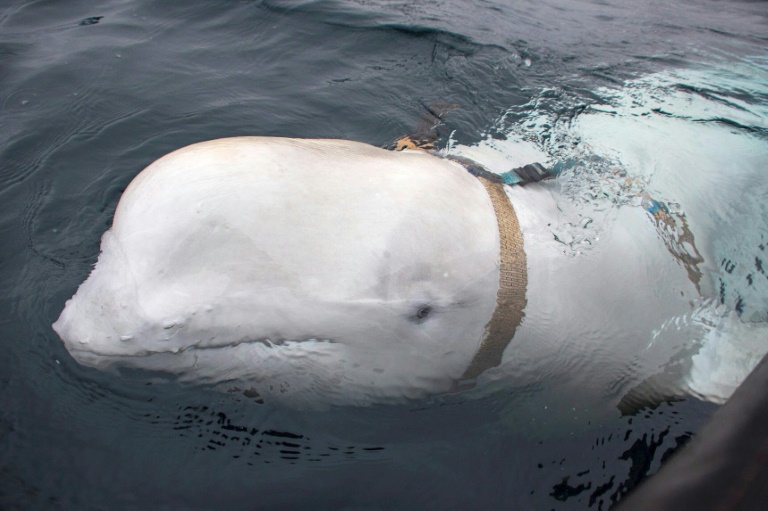
A beluga whale that swam up France’s Seine river appears to be underweight and officials are worried about its health, regional authorities said Thursday.

The protected species, usually found in cold Arctic waters, had made its way up the waterway and reached a lock some 70 kilometres (44 miles) from Paris.

The whale was first spotted Tuesday in the river that flows through the French capital to the English Channel, and follows the rare appearance of a killer whale in the Seine just over two months ago.

French rescue services as well as firefighters and biodiversity officials mobilised swiftly and kept a close eye on the whale throughout the day to evaluate the “worrying” health of the mammal, the local prefecture said.

It added the whale seemed to have “skin changes and to be underweight”.

It is “currently between the Poses dam and that of Saint-Pierre-la-Garenne”, around 70 kilometres (43 miles) northwest of Paris.

Gerard Mauger, deputy head of French Marine Mammal Research Group GEEC, said the mammal spent “very little time on the surface” and appeared to have “good” lung capacity.

But Mauger said rescuers were struggling to guide the whale to the mouth of the Seine.

Officials did not specify the size, but an adult beluga can reach up to four metres (13 feet) in length.

Authorities in Normandy’s Eure department urged people to keep their distance to avoid distressing the animal.

Lamya Essemlali, head of the non-profit marine conservation organisation Sea Shepherd, said some of her team would arrive with drones in the evening to locate the whale more easily.

“The environment is not very welcoming for the beluga, the Seine is very polluted and cetaceans are extremely sensitive to noise,” she said, adding that the Seine was “very noisy”.

In late May, the killer whale — also known as an orca, but technically part of the dolphin family — was found dead in the Seine between Le Havre and Rouen.

The animal had found itself stranded in the river and was unable to make its way back to the ocean despite attempts by officials to guide it.

“The urgency is to feed the whale to prevent it from suffering the same fate as the orca who died after starving to death,” Essemlali said.

The prefecture said it would assist and monitor Sea Shepherd’s efforts.

The Eure authorities said lone belugas do sometimes swim further south than usual, and are able to temporarily survive in fresh water.

While they migrate away from the Arctic in the autumn to feed as ice forms, they rarely venture so far south.


Griner sentence sparks show of solidarity, calls for US action

Phoenix Mercury and Connecticut Sun players linked arms in 42 seconds of silence before their game Thursday in solidarity with WNBA star Brittney Griner, who was sentenced earlier to nine years in prison in Russia.

The number honored Griner’s jersey number 42 and the gesture brought tears to the eyes of players from both teams and from fans at Mohegan Sun Arena in Uncasville, Connecticut, where the moment ended with chants of “Bring her home!”

Griner was convicted and sentenced in a Russian court earlier Thursday on charges of smuggling cannabis vape cartridges into the country.

The United States government has declared that Griner was wrongfully detained in Russia, and Sun player Brionna Jones said players from both teams wanted to show their support.

“We all have relationships with her, on the court, off the court,” Jones said. “So it was huge. It was an emotional moment for all of us out here. I think it was great that we came together and did that to show our unity — that everybody on this court, everybody in the league, is behind BG.”

Mercury head coach Vanessa Nygaard said before the game that watching their star center speak from a barred courtroom cell was devastating to the team — even though it was no surprise.

“We knew this was coming, we’ve been prepared for it,” Nygaard said, noting the low acquittal rates in Russian courts. “We weren’t hanging our hopes on the Russian justice system.

“I was really amazed by her courage and her strength as I was listening to it today,” Nygaard added. “She showed great strength and great humility.”

The verdict and sentence was widely condemned in the United States as “unjustified” and sparked urgent calls for the US government to bring Griner home.

“Today’s verdict and sentencing is unjustified and unfortunate, but not unexpected and Brittney Griner remains wrongfully detained,” said WNBA commissioner Cathy Engelbert and NBA commissioner Adam Silver in a joint statement.

“The WNBA and NBA’s commitment to her safe return has not wavered and it is our hope that we are near the end of this process of finally bringing BG home to the United States.”

The Mercury said in a statement that the verdict was “a sobering milestone in the 168-day nightmare being endured by our sister, BG.”

– ‘Every possible avenue’ –

While Griner stars for the Mercury, like many WNBA players, she competes in an overseas league as well.

The six-foot-nine (2.06-meter) center was returning to her Russian team, UMMC Ekaterinburg, from the United States when she was detained in February.

The Mercury said they were “heartbroken” for her, but had faith the administration of US President Joe Biden “will do what it takes to end her wrongful detention.”

In the wake of the verdict, Biden vowed to “pursue every possible avenue” to repatriate her.

US Secretary of State Antony Blinken said last week that Washington had made a “substantial proposal” to Moscow to free Griner and former US Marine Paul Whelan, who was imprisoned in Russia on espionage charges.

White House spokeswoman Karine Jean-Pierre said after the verdict the adminstration had again urged Russia to accept the offer.

Candy Desaulniers, a 60-year-old quality engineer who attended Thursday’s game, said she was disappointed but not surprised by the verdict but hoped that “this way they can start the process of a prisoner swap.

“I believe she will come home,” Desaulniers said.

Griner’s agent, Lindsay Colas, said on Twitter that the sentence “goes to prove what we have known all along, that Brittney is being used as a political pawn.”

She praised the efforts of Biden and Blinken “to get a deal done swiftly to bring Brittney, Paul and all Americans home.”

Nygaard also praised the “tremendous” efforts of Biden and his administration in seeking the release of Griner and other Americans deemed wrongfully detained in Russia.

“What I do know is our government has really put itself behind BG and all other Americans — we’re learning a lot more about international wrongly detained Americans than we ever have,” she said.

“I know there are so many other families experiencing this feeling, too.”

Most Asian markets up as oil drops, eyes on Taiwan and US jobs

Asian equities mostly rose Friday as a drop in oil prices to pre-Ukraine war levels stirred hopes of a slowdown in inflation and central bank interest rate hikes, while focus turns to key US jobs data later in the day.

However, while markets have enjoyed a broadly positive week, optimism remains at a premium as traders fret over issues including the conflict in Eastern Europe, China’s military drills around Taiwan and a possible global recession.

Crude edged up but expectations that economies will contract — dampening demand — have sent the commodity tumbling more than 10 percent this week, with US data indicating Americans were driving less now than in summer 2020 at the height of the pandemic.

And while analysts are beating the drum of recession, traders are taking heart from the possibility of a reprieve from central bank monetary tightening.

“The recent fall in oil prices, which are now trading below the levels immediately before Russia’s invasion of Ukraine, has contributed to the market’s perception that inflation is likely to peak soon, taking pressure off the Fed to raise rates as aggressively,” said National Australia Bank’s Rodrigo Catril. 

Traders will now be closely watching the release of a crucial US jobs report later Friday for a fresh snapshot of the world’s top economy.

The Federal Reserve has said its rate decision will be guided by data, with signs of economic weakness seen as likely to mean any increases will be light.

Officials have said the economy remains healthy despite four-decade high inflation and a sharp lift in borrowing costs, while several have suggested they are open to more big increases to get on top of prices.

And SPI Asset Management’s Stephen Innes said: “Though some high-frequency data suggest employment and inflation have softened in some parts of the economy, markets may wonder if they are soft enough to change the course for the Fed.”

In a sign of the long road ahead, the Bank of England hiked rates by the most since it was made independent in 1997, and warned inflation will likely go higher than 13 percent while Britain will suffer an extended recession.

Wall Street provided a soft lead after recent gains, but Asia was largely higher.

Tokyo, Shanghai, Sydney, Seoul, Jakarta, Wellington and Singapore rose, though Hong Kong and Manila dipped.

Taipei surged more than two percent on easing concerns over a conflict with Beijing, even as China conducts its largest-ever military exercises around Taiwan in response to US House Speaker Nancy Pelosi’s visit this week.

China launched a series of exercises in multiple zones Thursday, straddling some of the busiest shipping lanes in the world.

While Taipei did not say where the missiles landed or whether they flew over the island, Japan said that of the nine missiles it had detected, four were “believed to have flown over Taiwan’s main island”.

Geir Lode, of Federated Hermes, said: “For a world facing a whole raft of major challenges, there sure is a lot of optimism across equities right now.

“Inflation is challenging corporate earnings and weighing on consumer sentiment. Global recession appears probable as growth becomes ever more scarce. Geopolitical tensions and the growth in populism accelerate the trend towards localisation (and increase the risk of even darker futures). Climate change looms over us all.

“And yet equities this week have continued July’s strong rally.”

– Key figures at around 0300 GMT –

Tokyo – Nikkei 225: UP 0.7 percent at 28,131.87 (break)

Hong Kong – Hang Seng Index: DOWN 0.1 percent at 20,145.45

Shanghai – Composite: UP 0.1 percent at 3,191.55

Euro/dollar: DOWN at $1.0233 from $1.0248 Thursday

Pound/dollar: DOWN at $1.2139 from $1.2166

Euro/pound: UP at 84.31 pence from 84.21 pence

Dollar/yen: UP at 133.22 yen from 132.95 yen

West Texas Intermediate: UP 0.4 percent at $88.87 per barrel

Brent North Sea crude: UP 0.2 percent at $94.35 per barrel

New York – Dow: DOWN 0.3 percent at 32,726.82 (close)

London – FTSE 100: FLAT at 7,448.06 (close)

South Korea's first lunar orbiter launched by SpaceX

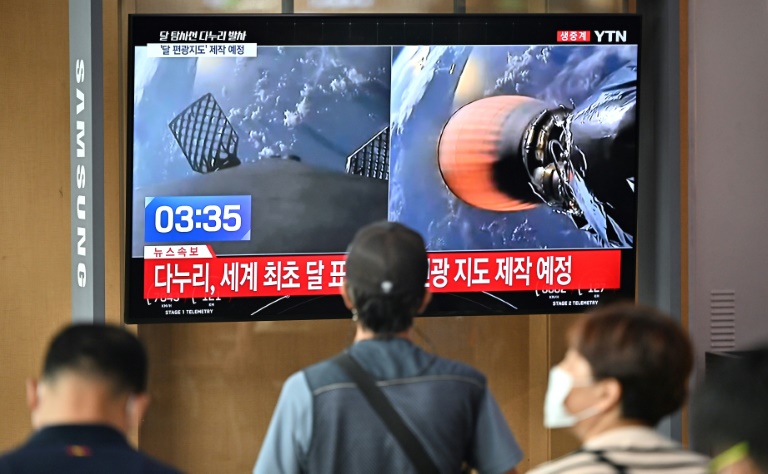
South Korea’s first lunar orbiter successfully launched on a year-long mission to observe the Moon, Seoul said Friday, with the payload including a new disruption-tolerant network for sending data from space.

Danuri — a portmanteau of the Korean words for “Moon” and “enjoy” — was on a Falcon 9 rocket launched from Cape Canaveral in Florida by Elon Musk’s aerospace company SpaceX. It aims to reach the Moon by mid-December.

“South Korea’s first lunar orbiter ‘Danuri’ left for space at 8:08 am on August 5, 2022,” Seoul’s science ministry said in a tweet, sharing a video of the rocket blasting off trailing a huge column of smoke and flames.

“Danuri will be the first step towards the Moon and the farther universe,” it said, apparently referring to the country’s ambitious space program, which includes plans for a Moon mission by 2030.

SpaceX tweeted that the launch had been a success.

“Deployment of KPLO confirmed,” it said, referring to Danuri using an acronym of its official name, the Korea Pathfinder Lunar Orbiter.

During its mission, Danuri will use six different instruments, including a highly sensitive camera provided by NASA, to conduct research, including investigating the lunar surface to identify potential landing sites.

One of the instruments will evaluate disruption-tolerant, network-based space communications, which, according to South Korea’s science ministry, is a world first.

– BTS in space –

Danuri will also try to develop a wireless Internet environment to link satellites or exploration spacecraft, they added.

The lunar orbiter will stream K-pop sensation BTS’ song “Dynamite” to test this wireless network.

Another instrument, ShadowCam, will record images of the permanently shaded regions around the poles of the Moon where no sunlight can reach.

Scientists also hope that Danuri will find hidden sources of water and ice in areas of the Moon, including the permanently dark and cold regions near the poles.

“This is a very significant milestone in the history of Korean space exploration,” said Lee Sang-ryool, head of the Korea Aerospace Research Institute, in a video shown before the launch.

“Danuri is just the beginning, and if we are more determined and committed to technology development for space travel, we will be able to reach Mars, asteroids, and so on in the near future.”

South Korean scientists say Danuri — which took seven years to build — will pave the way for the nation’s more ambitious goal of landing on the Moon by 2030. 

“South Korea will become the seventh country in the world to have launched an unmanned probe to the Moon,” an official at the Korea Aerospace Research Institute told AFP.

“We hope to continue contributing to the global understanding of the Moon with what Danuri is set to find out.”

– Lunar ambitions –

Danuri was launched by a private company — SpaceX — but South Korea recently became one of a handful of countries to successfully launch a one-tonne payload using their own rockets.

In June, the country’s homegrown three-stage rocket nicknamed Nuri — a decade in development at a cost of 2 trillion won ($1.5 billion) — launched successfully and put a satellite into orbit, on its second attempt after a failure last October.

That launch — coupled with Danuri’s launch Friday — helps bring South Korea ever closer to achieving its space ambitions.

In Asia, China, Japan and India all have advanced space programmes — and the South’s nuclear-armed neighbour North Korea has also demonstrated satellite launch capability.

Ballistic missiles and space rockets use similar technology and Pyongyang put a 300-kilogram (660-pound) satellite into orbit in 2012 in what Washington condemned as a disguised missile test.

South Korea's first lunar orbiter launched by SpaceX

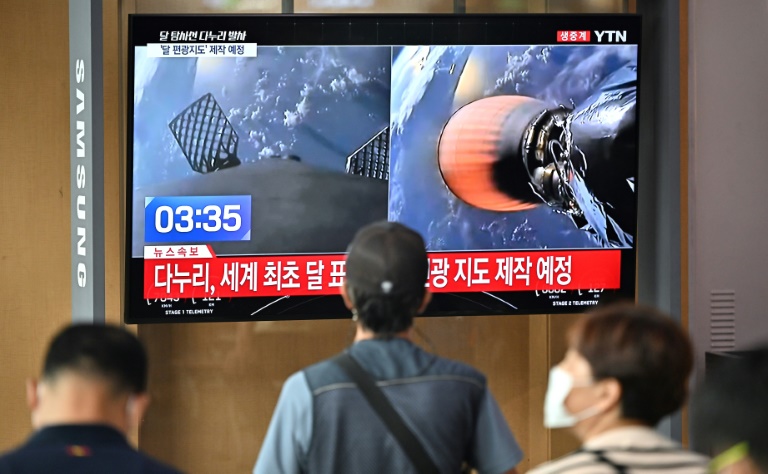
South Korea’s first lunar orbiter successfully launched on a year-long mission to observe the Moon, Seoul said Friday, with the payload including a new disruption-tolerant network for sending data from space.

Danuri — a portmanteau of the Korean words for “Moon” and “enjoy” — was on a Falcon 9 rocket launched from Cape Canaveral in Florida by Elon Musk’s aerospace company SpaceX. It aims to reach the Moon by mid-December.

“South Korea’s first lunar orbiter ‘Danuri’ left for space at 8:08 am on August 5, 2022,” Seoul’s science ministry said in a tweet, sharing a video of the rocket blasting off trailing a huge column of smoke and flames.

“Danuri will be the first step towards the Moon and the farther universe,” it said, apparently referring to the country’s ambitious space program, which includes plans for a Moon mission by 2030.

SpaceX tweeted that the launch had been a success.

“Deployment of KPLO confirmed,” it said, referring to Danuri using an acronym of its official name, the Korea Pathfinder Lunar Orbiter.

During its mission, Danuri will use six different instruments, including a highly sensitive camera provided by NASA, to conduct research, including investigating the lunar surface to identify potential landing sites.

One of the instruments will evaluate disruption-tolerant, network-based space communications, which, according to South Korea’s science ministry, is a world first.

– BTS in space –

Danuri will also try to develop a wireless Internet environment to link satellites or exploration spacecraft, they added.

The lunar orbiter will stream K-pop sensation BTS’ song “Dynamite” to test this wireless network.

Another instrument, ShadowCam, will record images of the permanently shaded regions around the poles of the Moon where no sunlight can reach.

Scientists also hope that Danuri will find hidden sources of water and ice in areas of the Moon, including the permanently dark and cold regions near the poles.

“This is a very significant milestone in the history of Korean space exploration,” said Lee Sang-ryool, head of the Korea Aerospace Research Institute, in a video shown before the launch.

“Danuri is just the beginning, and if we are more determined and committed to technology development for space travel, we will be able to reach Mars, asteroids, and so on in the near future.”

South Korean scientists say Danuri — which took seven years to build — will pave the way for the nation’s more ambitious goal of landing on the Moon by 2030. 

“South Korea will become the seventh country in the world to have launched an unmanned probe to the Moon,” an official at the Korea Aerospace Research Institute told AFP.

“We hope to continue contributing to the global understanding of the Moon with what Danuri is set to find out.”

– Lunar ambitions –

Danuri was launched by a private company — SpaceX — but South Korea recently became one of a handful of countries to successfully launch a one-tonne payload using their own rockets.

In June, the country’s homegrown three-stage rocket nicknamed Nuri — a decade in development at a cost of 2 trillion won ($1.5 billion) — launched successfully and put a satellite into orbit, on its second attempt after a failure last October.

That launch — coupled with Danuri’s launch Friday — helps bring South Korea ever closer to achieving its space ambitions.

In Asia, China, Japan and India all have advanced space programmes — and the South’s nuclear-armed neighbour North Korea has also demonstrated satellite launch capability.

Ballistic missiles and space rockets use similar technology and Pyongyang put a 300-kilogram (660-pound) satellite into orbit in 2012 in what Washington condemned as a disguised missile test.

South Korea's first lunar orbiter launched by SpaceX

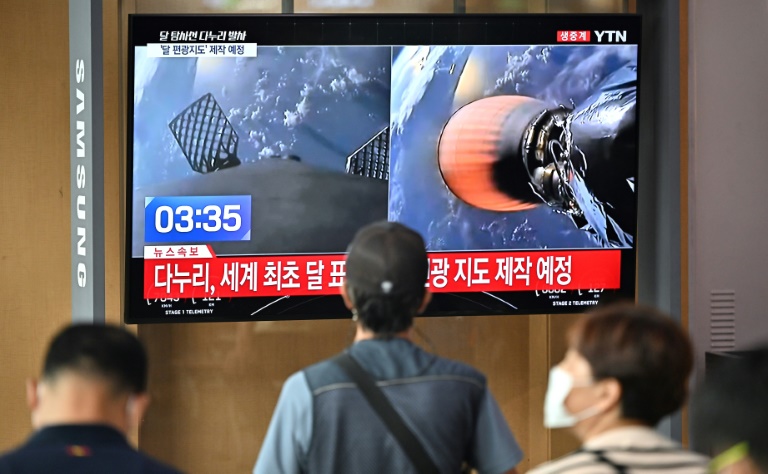
South Korea’s first lunar orbiter successfully launched on a year-long mission to observe the Moon, Seoul said Friday, with the payload including a new disruption-tolerant network for sending data from space.

Danuri — a portmanteau of the Korean words for “Moon” and “enjoy” — was on a Falcon 9 rocket launched from Cape Canaveral in Florida by Elon Musk’s aerospace company SpaceX. It aims to reach the Moon by mid-December.

“South Korea’s first lunar orbiter ‘Danuri’ left for space at 8:08 am on August 5, 2022,” Seoul’s science ministry said in a tweet, sharing a video of the rocket blasting off trailing a huge column of smoke and flames.

“Danuri will be the first step towards the Moon and the farther universe,” it said, apparently referring to the country’s ambitious space program, which includes plans for a Moon mission by 2030.

SpaceX tweeted that the launch had been a success.

“Deployment of KPLO confirmed,” it said, referring to Danuri using an acronym of its official name, the Korea Pathfinder Lunar Orbiter.

During its mission, Danuri will use six different instruments, including a highly sensitive camera provided by NASA, to conduct research, including investigating the lunar surface to identify potential landing sites.

One of the instruments will evaluate disruption-tolerant, network-based space communications, which, according to South Korea’s science ministry, is a world first.

– BTS in space –

Danuri will also try to develop a wireless Internet environment to link satellites or exploration spacecraft, they added.

The lunar orbiter will stream K-pop sensation BTS’ song “Dynamite” to test this wireless network.

Another instrument, ShadowCam, will record images of the permanently shaded regions around the poles of the Moon where no sunlight can reach.

Scientists also hope that Danuri will find hidden sources of water and ice in areas of the Moon, including the permanently dark and cold regions near the poles.

“This is a very significant milestone in the history of Korean space exploration,” said Lee Sang-ryool, head of the Korea Aerospace Research Institute, in a video shown before the launch.

“Danuri is just the beginning, and if we are more determined and committed to technology development for space travel, we will be able to reach Mars, asteroids, and so on in the near future.”

South Korean scientists say Danuri — which took seven years to build — will pave the way for the nation’s more ambitious goal of landing on the Moon by 2030. 

“South Korea will become the seventh country in the world to have launched an unmanned probe to the Moon,” an official at the Korea Aerospace Research Institute told AFP.

“We hope to continue contributing to the global understanding of the Moon with what Danuri is set to find out.”

– Lunar ambitions –

Danuri was launched by a private company — SpaceX — but South Korea recently became one of a handful of countries to successfully launch a one-tonne payload using their own rockets.

In June, the country’s homegrown three-stage rocket nicknamed Nuri — a decade in development at a cost of 2 trillion won ($1.5 billion) — launched successfully and put a satellite into orbit, on its second attempt after a failure last October.

That launch — coupled with Danuri’s launch Friday — helps bring South Korea ever closer to achieving its space ambitions.

In Asia, China, Japan and India all have advanced space programmes — and the South’s nuclear-armed neighbour North Korea has also demonstrated satellite launch capability.

Ballistic missiles and space rockets use similar technology and Pyongyang put a 300-kilogram (660-pound) satellite into orbit in 2012 in what Washington condemned as a disguised missile test.

China Evergrande to get $818 mn for scrapping stadium deal

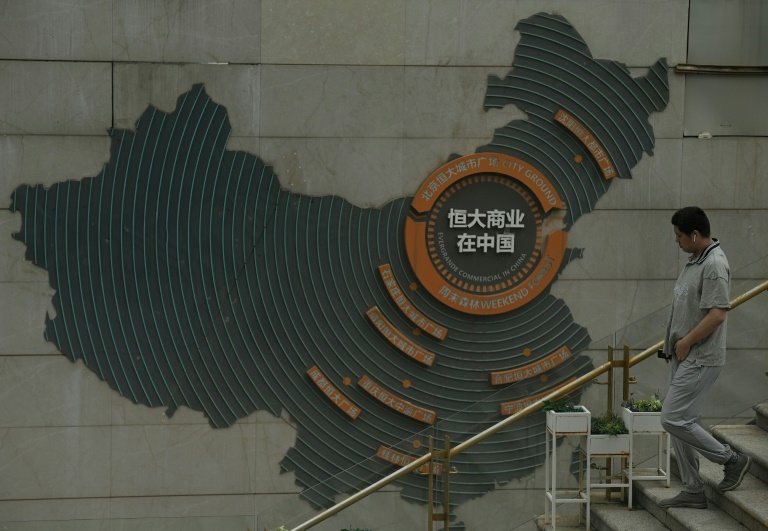
Embattled Chinese property giant Evergrande has cancelled a contract to build a football stadium in a southern city in return for 5.52 billion yuan ($818 million), it said in a filing.

The real estate behemoth has been involved in restructuring negotiations after racking up $300 billion in liabilities in the wake of  Beijing’s crackdown on excessive debt and rampant speculation in the property sector.

Last week, the company failed to meet a self-imposed deadline to publish a preliminary restructuring proposal, although it said it has made positive progress.

In a filing to the Hong Kong stock exchange late Thursday, Evergrande said “the group’s liquidity issue has adversely affected the development of and construction on the land” in Guangzhou.

Evergrande entered a contract with the city’s authorities in 2020 for use of the land, designated for sports and industrial purposes.

The contract allowed for commercial and sports uses of the land for 40 years, as well as other business uses for 50 years, the filing said.

Evergrande had started construction, including the building of the Guangzhou Evergrande Football Stadium, which was set to have at least 80,000 seats, it said.

The latest refund will enter a project escrow account designated by the government and will be used to settle debts relating to the deal, Evergrande said.

“It is expected that the group will record a loss of approximately 1.255 billion” yuan over the total book value of the land along with buildings, structures and other items at the site after deducting the refund, Evergrande said.

Evergrande, one of China’s biggest developers, has scrambled to offload assets in recent months, with chairman Hui Ka Yan paying off some of its debts using his personal wealth.

It has also found a potential buyer for its Hong Kong headquarters, according to earlier media reports.

Its troubles are emblematic of the problems rippling across China’s massive property sector, with smaller companies also defaulting on loans and others struggling to raise cash.

Cash-strapped developers have increasingly struggled to deliver projects on time, sparking mortgage boycotts from angry homebuyers in many cities.

China to hold fresh drills around Taiwan despite US condemnation

China was set to press ahead Friday with its largest-ever military exercises encircling Taiwan despite firm statements of condemnation by the United States, Japan and the European Union.

Beijing’s decision to fire ballistic missiles and deploy fighter jets around Taiwan saw Washington lambast what it said was a gross overreaction to a visit to the self-ruled, democratic island by US House Speaker Nancy Pelosi.

The US House speaker was the highest-profile US official to go to Taiwan in years and defied stark threats from Beijing, which views the self-ruled island as its territory.

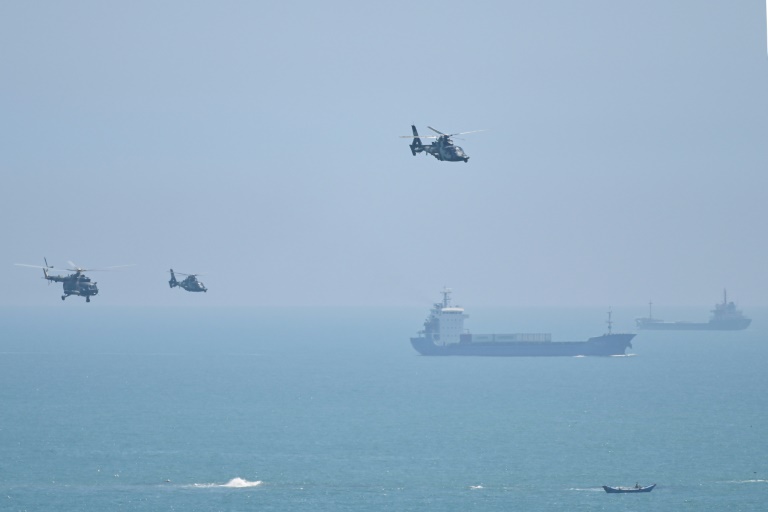
In retaliation, China on Thursday launched a series of exercises in multiple zones around Taiwan, straddling some of the busiest shipping lanes in the world and at some points coming just 20 kilometres (12 miles) from the island’s shores.

The drills involved a “conventional missile firepower assault” in waters to the east of Taiwan, the Chinese military said. Beijing has said they will continue until midday Sunday.

Beijing’s state-run Xinhua news agency reported the Chinese army “flew more than 100 warplanes including fighters and bombers” during the exercises, as well as “over 10 destroyers and frigates.”

State broadcaster CCTV reported that Chinese missiles had flown over Taiwan.

Taiwan said the Chinese military fired 11 Dongfeng-class ballistic missiles “in several batches”, while Japan claimed of the nine missiles it had detected, four were “believed to have flown over Taiwan’s main island”.

Taiwan has said it would not confirm missile flight paths, however.

“Considering the main goal of CCP’s (Chinese Communist Party’s) launch of missiles is to intimidate us and in order to protect the military’s intelligence, surveillance and reconnaissance capabilities, we will not release information such as its flight,” the defence ministry said in a statement.

– ‘Temperature’s pretty high’ –

China has defended the drills as just countermeasures in the face of provocations by the United States and its allies in Taiwan, which China views as its own territory and which it has vowed to retake.

But the drills have triggered outrage in the United States and other democracies.

“China has chosen to overreact and use the speaker’s visit as a pretext to increase provocative military activity in and around the Taiwan Strait,” John Kirby, a White House spokesman, told reporters.

“The temperature’s pretty high,” but tensions “can come down very easily by just having the Chinese stop these very aggressive military drills,” he added.

Japan has lodged a formal diplomatic complaint against Beijing for the drills, with five of the missiles believed to have landed in its exclusive economic zone.

And Prime Minister Fumio Kishida Friday slammed the drills as a “serious problem that impacts our national security and the safety of our citizens” and called for an “immediate cancellation of the military drills.”

While on the final leg of her tour of Asia, Pelosi said in Tokyo Friday that Washington will “not allow” China to isolate Taiwan.

“We have said from the start that our representation here is not about changing the status quo here in Asia, changing the status quo in Taiwan,” she added.

But Chinese Foreign Minister Wang Yi said in Phnom Penh, on the sidelines of a regional summit on Thursday, that the “flagrant provocation” by the United States had set an “egregious precedent.” 

“If it’s not corrected and countered, will the principle of non-interference in internal affairs still exist? Will the international law still be upheld?” he said, according to Xinhua.

– Trading places – 

The manoeuvers are taking place along some of the busiest shipping routes on the planet, used to supply vital semiconductors and electronic equipment produced in East Asian factory hubs to global markets.

Taiwan’s Maritime and Port Bureau has issued warnings to ships to avoid the areas being used for the Chinese drills.

The Taiwanese cabinet has also said the drills would disrupt 18 international routes passing through its flight information region (FIR).

Several international airlines have told AFP they will divert flights from airspace around Taiwan island. 

“China’s planned live-fire exercises are occurring in an incredibly busy waterway,” Nick Marro, the Economist Intelligence Unit’s lead analyst for global trade, wrote in a note.

“The shutting down of these transport routes — even temporarily — has consequences not only for Taiwan, but also trade flows tied to Japan and South Korea.”

But markets in Taipei appeared to shrug off the tensions, with the Taiwan Taiex Shipping and Transportation Index, which tracks major shipping and airline stocks, up 2.3 percent early Friday.

And analysts broadly agree that  despite all its aggressive posturing, Beijing does not want an active military conflict against the United States and its allies over Taiwan — just yet.

“The last thing Xi wants is an accidental war ignited,” Titus Chen, an associate professor of political science at the National Sun Yat-Sen University in Taiwan, told AFP.

'Balancing act': Erdogan to sound out Putin on Ukraine and Syria

Ending the war in Ukraine and starting a new one in Syria are expected to dominate talks on Friday between Russian President Vladimir Putin and Turkish counterpart Recep Tayyip Erdogan. 

Erdogan will be riding high from the diplomatic success of helping orchestrate the resumption of Ukrainian grain shipments across the Black Sea when he visits Sochi for his second talks with Putin in just over two weeks.

But there are tensions. The Turkish leader was told by Putin in Tehran last month that Russia remains opposed to any new offensive that Turkey might be planning against Kurdish militants in northern Syria.

Analysts believe these strains form part of the “competitive cooperation” that has defined the two leaders’ relation over the past 20 years.

“Russia’s war on Ukraine has restored Turkey’s self image as a key geopolitical player and given Erdogan more visibility than at any time in the last few years,” European Council of Foreign Relations fellow Asli Aydintasbas wrote in a report last week.

“Most Turks support their country’s balancing act and quasi-neutral position between the West and Russia.”

– Truce talks –

Attempts by NATO member Turkey to remain neutral in the face of Moscow’s historic standoff with the West over Ukraine are starting to pay off.

Months of Turkish efforts saw Moscow and Kyiv sign a UN-backed agreement in Istanbul last month to resume grain deliveries from Ukrainian ports.

The first ship from Ukraine crossed Istanbul on Wednesday. Three more are expected to to set sail Friday under a landmark deal designed to relieve a global food crisis caused by the war.

Turkey wants to translate this success into truce talks in Istanbul between Putin and Ukrainian President Volodymyr Zelensky.

“We discussed if the grain agreement could be an occasion for a sustainable ceasefire,” Turkish Foreign Minister Mevlut Cavusoglu said after talks with Russian counterpart Sergei Lavrov in Asia on Wednesday.

Complicating these efforts are repeated threats by Erdogan to launch a new military operation in Syria — a country where Russian and Turkish interests clash.

Russia’s army helped Syrian President Bashar al-Assad survive a decade-long rebellion by groups backed by Turkey.

But Erdogan is threatening to invade northern Syria to establish a buffer zone that pushes out Kurdish groups he links to “terrorists” waging an insurgency against the Turkish state.

Putin told Russian media in Tehran he still has “certain disagreements, obviously” with Erdogan about Syria.

“In most likelihood, (Friday’s) meeting has something do with a possible incursion into Syria, for which Turkey did not get a green light from Russia — or from Iran, for that matter,” said foreign affairs analyst Soli Ozel of Istanbul’s Has University.

“Russia would have to get something in return,” Ozel added.

– Waiting game –

Some Turkish media speculate that what Putin really wants is drones.

Turkey has been supplying Kyiv with lethal Bayraktar aerial vehicles that have proved effective in destroying Russian armoured columns across the Ukrainian war zone.

US officials say a Russian team has visited Iran to scope out the purchase of hundreds of drones for its own forces in Ukraine.

Erdogan has added to the intrigue by telling his cabinet that Putin asked him in Tehran to start selling the Bayraktars to Russia.

A senior Turkish official later said that Erdogan interpreted the suggestion as a joke. 

But Kremlin spokesman Dmitry Peskov appeared to lend credence to the idea.

“Military and technological cooperation are always on the two countries’ agenda,” Peskov told reporters.

One unlikely source of tension is how the two leaders — renowned for being chronically late — will actually meet.

Erdogan made Putin stand in place for nearly 50 seconds before walking out to greet him in Tehran.

A Turkish state news agency camera zeroed in on Putin’s fidgeting face the entire time.

Many interpreted this as payback for the time Putin made Erdogan wait for nearly two minutes at a meeting in 2020.

Families of trapped Mexican miners pray for miracle

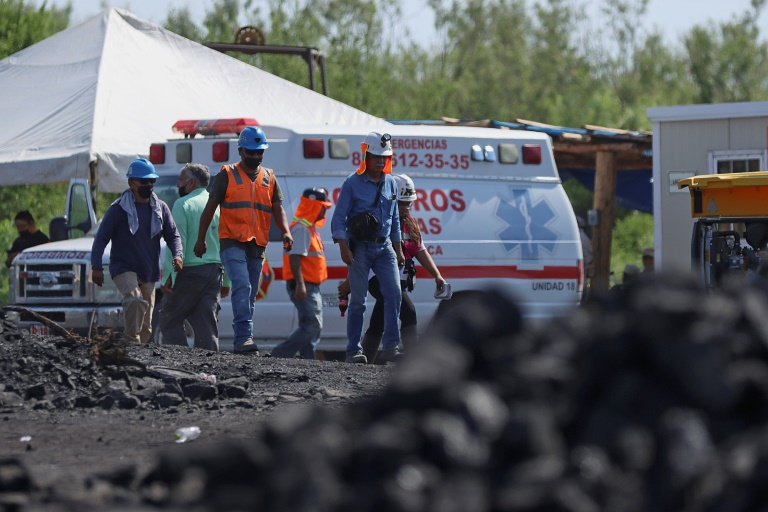
Dozens of rescuers battled Thursday to free 10 workers trapped in a flooded coal mine in northern Mexico, where desperate relatives waited for news more than 24 hours after a cave-in.

As night fell again in Coahuila state, family members cried and comforted each other while hopes of finding survivors dimmed with each passing hour.

“What we want is for them to retrieve the bodies,” Angelica Montelongo said with a sad and tired look, before summoning up new hope that her brother Jaime would be rescued.

“But hey, God willing, right? You have to have faith that they’re alive,” she said.

Soldiers, emergency workers and rescue dogs were deployed to the mine in Agujita in the municipality of Sabinas after the latest disaster to strike Mexico’s main coal-producing region.

“What I want with all my soul is that we rescue the miners,” President Andres Manuel Lopez Obrador told reporters in Mexico City.

“We must not lose faith. We must not lose hope,” he added.

Five miners managed to escape alive after the cave-in Wednesday and were taken to hospital, civil defense national coordinator Laura Velazquez said, adding that two had been discharged.

“Time is crucial here,” she said.

Authorities said the mine’s three shafts descended 60 meters (200 feet) and the floodwater inside was 34 meters deep.

“It’s complicated,” Velazquez said.

But the authorities were making progress and pumping out water “to rescue the miners as soon as possible,” she added.

– ‘Not much hope’ –

Around 230 army and other government personnel were sent to the site, about 1,130 kilometers (700 miles) north of Mexico City, the defense ministry said.

Several pumps were being used to tackle the flooding, but Lopez Obrador urged the national water agency to send more equipment.

“Unfortunately, there’s not much hope,” Jose Luis Amaya, whose cousin was among those trapped, told Milenio TV.

Experts and relatives painted a picture of a precarious profession fraught with risks extracting coal from the mines with lax safety standards.

“There’s always job insecurity… and danger,” said Blasa Maribel Navarro, whose cousin Sergio Cruz has mined coal for several years to support his two daughters.

Navarro said she was still hopeful of seeing him alive “because we trust in God.”

Crudely constructed mines like the one that collapsed lack concrete reinforcements to protect workers from a cave-in, engineering expert Guillermo Iglesias said.

The miners “dig a shaft two meters in circumference and keep digging until they reach a small layer of coal,” he told local radio.

The only thing supporting the surrounding earth is usually a large plastic tube through which the workers enter, he added.

Coahuila’s state government said the miners had been carrying out excavation work when they hit an adjoining area full of water, causing the shaft to collapse and flood.

Coahuila has seen a series of fatal mining accidents over the years.

Last year, seven miners died when they were trapped in the region.

The worst accident was an explosion that claimed 65 lives at the Pasta de Conchos mine in 2006.

Only two bodies were rescued after that tragedy and the families have repeatedly urged the Mexican authorities to recover them.

Close Bitnami banner
Bitnami