World

Taiwan defiant as China readies military drills over Pelosi visit

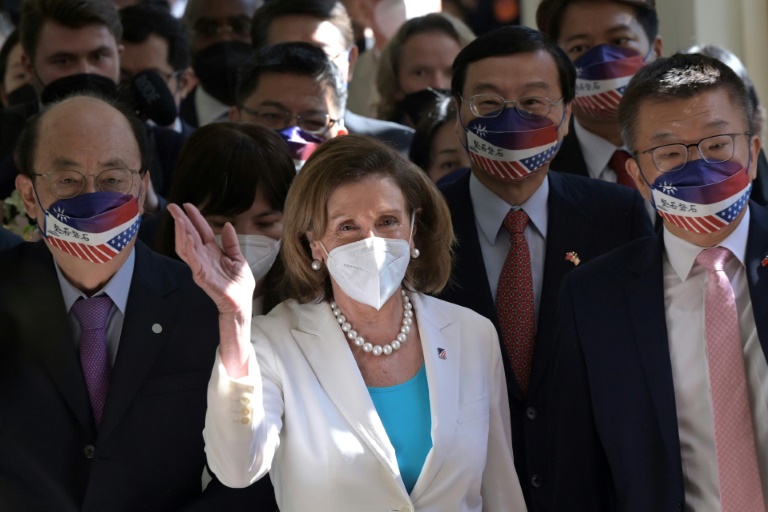
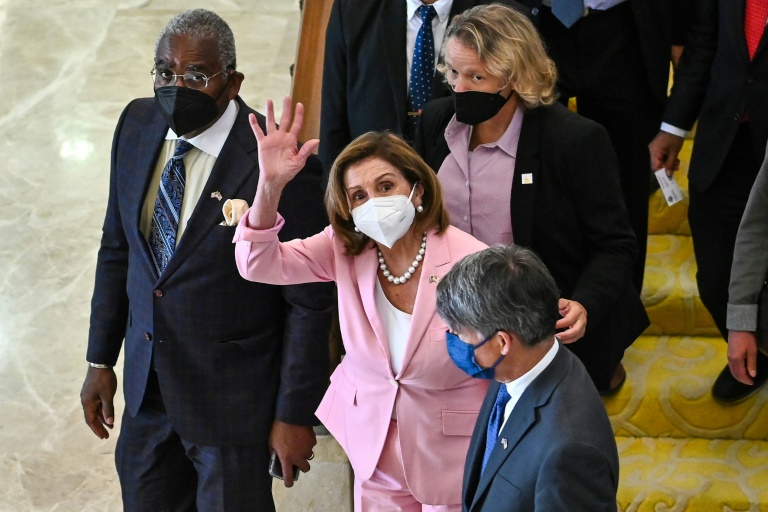
Taiwan struck a defiant tone Wednesday as it hosted US House Speaker Nancy Pelosi, with a furious China gearing up for military exercises dangerously close to the island’s shores in retaliation for the visit.

Pelosi landed in Taiwan late Tuesday despite a series of increasingly stark threats from Beijing, which views the island as its territory and warned it would consider the visit a major provocation.

China responded swiftly, announcing what it said were “necessary and just” military drills in the seas just off Taiwan’s coast — some of the world’s busiest waterways.

“In the current struggle surrounding Pelosi’s Taiwan visit, the United States are the provocateurs, China is the victim,” Beijing’s foreign ministry said.

But Taiwanese President Tsai Ing-wen said the island of 23 million would not be cowed. 

“Facing deliberately heightened military threats, Taiwan will not back down. We will… continue to hold the line of defence for democracy,” Tsai said at an event with Pelosi in Taipei.

She also thanked the 82-year-old US lawmaker for “taking concrete actions to show your staunch support for Taiwan at this critical moment”.

China tries to keep Taiwan isolated on the world stage and opposes countries having official exchanges with Taipei.

Pelosi, second in line to the presidency, is the highest-profile elected US official to visit Taiwan in 25 years.

“Today, our delegation… came to Taiwan to make unequivocally clear we will not abandon our commitment to Taiwan,” she said at the event with Tsai.

She added her group had come “in peace to the region”.

Before leaving Taiwan, Pelosi also met with several dissidents who have previously been in the crosshairs of China’s wrath — including Tiananmen protest student leader Wu’er Kaixi. 

“We are in high agreement that Taiwan is in the frontline (of democracy),” Wu’er said. 

“Both the United States and Taiwan governments need to… conduct more in defending human rights.”

Pelosi’s delegation left Taiwan on Wednesday evening en route to South Korea, her next stop in an Asia tour that has included stops in Singapore and Malaysia. She will wrap up her trip in Japan.

– Crossing the median line –

After her departure, Taiwan’s defence ministry announced late Wednesday that 27 Chinese warplanes had entered the island’s air defence identification zone (ADIZ).

Over the last two years, Beijing has ramped up military incursions into Taiwan’s ADIZ — which is not the same as the island’s territorial airspace, but includes a far greater area. 

The ministry published a map that showed 16 Su-30s and 6 J-11s had crossed the so-called “median line” of the Taiwan Strait — an unofficial boundary in the narrow waterway, which separates the island from the mainland and straddles vital shipping lanes.

Chinese jets also crossed over the so-called “median line” during two high-level visits by US officials in 2020 during Donald Trump’s presidency.

Nevertheless, that is still a relatively rare occurrence. 

– ‘High alert’ –

President Joe Biden’s administration said in the run-up to Pelosi’s visit that US policy towards Taiwan remained unchanged.

This means support for its government while diplomatically recognising Beijing over Taipei, and opposing a formal independence declaration by Taiwan or a forceful takeover by China.

Beijing summoned US Ambassador Nicholas Burns over Pelosi’s visit, while the Chinese military declared it was on “high alert” and would “launch a series of targeted military actions in response” to the visit.

The drills will include “long-range live ammunition shooting” in the Taiwan Strait.

The zone of Chinese exercises will be within 20 kilometres (12 miles) of Taiwan’s shoreline at some points, according to coordinates released by the Chinese military.

Taiwan’s defence ministry spokesman Sun Li-fang said Wednesday that some of the areas of China’s drills “breach into… (Taiwan’s) territorial waters”. 

“This is an irrational move to challenge the international order.”

But a source with the Chinese military told AFP that the exercises would be staged “in preparation for actual combat”. 

“If the Taiwanese forces come into contact with the PLA on purpose and accidentally fires a gun, the PLA will take stern countermeasures, and all the consequences will be borne by the Taiwanese side,” the source warned. 

Taiwan’s Mainland Affairs Council, which sets the government’s China policies, accused Beijing of “vicious intimidation” and called for democratic countries to “unite and take a solemn stand to punish and deter” Beijing.

– ‘We shouldn’t be too worried’ –

Beijing has long used diplomatic, military and economic pressure on Taiwan.

China has announced curbs on the import of fruit and fish from Taiwan — citing the detection of pesticide residue and the coronavirus. It also halted shipments of sand to the island.

Outside the Taiwanese parliament, 31-year-old computer programmer Frank Chen shrugged off the Chinese warnings over Pelosi’s visit.

“I think China will take more threatening actions and ban more Taiwanese products, but we shouldn’t be too worried,” he told AFP.

There was a small group of pro-China demonstrators outside parliament as well.

“The United States uses Taiwan as a pawn in its confrontation with China, to try to drag China down,” Lee Kai-dee, a 71-year-old retired researcher, told AFP.

“If the United States continues to act this way, Taiwan will end up like Ukraine.”

China has vowed to annex self-ruled, democratic Taiwan one day, by force if necessary.

Russia’s invasion of Ukraine in February heightened fears in Taiwan that China may similarly follow through on its threats to annex the island.
War in Ukraine: latest developments

Here are the latest developments in the war in Ukraine:

– Grain ship clears Istanbul checks –

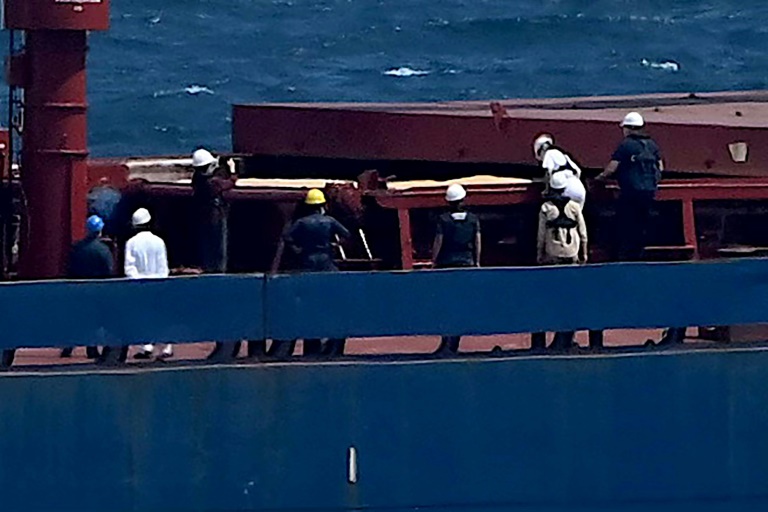
A cargo ship carrying the first delivery of grain from Ukraine since Russia’s February 24 invasion sets sail from Istanbul after getting clearance from a Russian and Ukrainian team of inspectors to sail on to its final destination in Lebanon. 

The Sierra Leone-flagged Razoni left the port of Odessa on Monday following a deal brokered by Turkey and the United Nations on lifting a Russian naval blockade of Ukraine’s Black Sea cities.

Wednesday’s inspection was being watched closely for signs of how well the agreement holds up.

Ukraine is one of the world’s main grain suppliers and the blockade had sent food prices soaring.

– Ukraine makes new gains in Kherson –

Ukraine says its forces have retaken seven more villages in the southern Kherson region in a major counteroffensive.

Moscow seized almost all the territory of the economically and strategically important region bordering the annexed Crimea peninsula during the first days of its invasion.

But in recent weeks, the Ukrainian army, bolstered by deliveries of Western-supplied long-range artillery, have regained ground.

– Germany accuses Russia over gas –

German Chancellor Olaf Scholz accuses Russia of blocking the delivery of a turbine needed to keep gas flowing to Europe through the Nord Stream pipeline.

Standing next to the turbine, currently stuck with maker Siemens Energy in Germany, Scholz said the unit was “available and working”.

Russian energy giant Gazprom has blamed the delayed return of the unit from Canada, where it was being serviced, for the initial reduction in deliveries of gas via the pipeline in June.

Germany, which is heavily dependent on Russian gas, has branded the decision to limit supplies as a “political” response over the West’s support for Ukraine.

– Lviv hit –

Russia says it has destroyed an arms depot near the city of Lviv, in a rare strike on western Ukraine, using “air-launched high-precision long-range missiles”.

The defence ministry says it also destroyed four warehouses containing rockets, artillery pieces and ammunition in the southern region of Mykolaiv and the eastern region of Donetsk.

– US bans alleged Putin girlfriend –

The United States blacklists Russian President Vladimir Putin’s purported girlfriend, Alina Kabaeva, a former Olympic gymnast, and the tycoon owner of the second-largest estate in London, Andrey Grigoryevich Guryev, in its latest round of sanctions.

It also slaps business bans on several other oligarchs believed to be close to Putin, four officials Russia has named to administer occupied territories in Ukraine, and around two dozen high technology institutes and companies, including key state-backed electronics entities.

– ‘Volatile’ situation at nuclear plant –

The situation is “volatile” at Europe’s largest nuclear power plant, which fell under Russian control in March, the head of the international nuclear agency IAEA, Rafael Grossi, says.

The IAEA has been trying to send a mission to the Zaporizhzhia plant which, although under Russian control, is still being operated by Ukrainian staff.

Ukraine has rejected the efforts, which it says would legitimise Russia’s occupation of the site in the eyes of the international community.

“Every principle of safety has been violated one way or the other,” Grossi tells a news conference at UN headquarters in New York.

burs-jmy/gw

Stock markets rise after Pelosi's Taiwan trip

Global stocks mostly rose on Wednesday as investor concerns over US-China tensions eased following House Speaker Nancy Pelosi’s trip to Taiwan.

Oil prices also marginally rose after the OPEC+ oil cartel, led by Saudi Arabia and Russia, agreed a small increase in production.

The decision to raise production by 100,000 barrels per day for September is likely to disappoint US President Joe Biden, who had lobbied for a big hike to tame soaring energy prices, analysts said.

Analyst Edward Gardner, of Capital Economics, warned however that “as has become increasingly glaring recently, though, an increase in quotas is not the same as an increase in production.”

Output is supposed to have returned to pre-Covid levels, but only on paper, as some members of the 23-nation group have struggled to meet their quotas.

The main contracts were only slightly higher, with Brent — the international benchmark — rising just over $100.

– ‘Rollercoaster ride’- 

Traders also nervously watched for reactions — so far — to Pelosi’s visit to Taiwan, which China considers a part of its territory.

“What China didn’t do has seemingly been the focal point,” said Patrick O’Hare, at Briefing.com.

“China didn’t take any action that would necessitate a military response from the US. That understanding has sparked a measure of relief for investors as Speaker Pelosi heads to South Korea,” he said.

The highest profile trip to Taiwan in 25 years by a US politician was met with condemnation from Beijing, which vowed “punishment”.

“This week was already shaping up to be another rollercoaster ride and Pelosi’s trip just added another layer of event risk for the markets,” Craig Erlam, an analyst at OANDA, said.

News of the visit had sent shivers on Tuesday through trading floors that were already on edge over the Ukraine war, surging inflation, rising interest rates and slowing economic growth.

However, most equity markets edged upwards on Wednesday.

London nudged higher on the eve of a widely-expected half-point interest rate hike by the Bank of England.

“There has been a lot of fear but no material effect,” AvaTrade analyst Naeem Aslam told AFP, when questioned about the markets impact of Pelosi’s visit.

“Hence, we see equities holding on to their gains and moving higher.” 

– Rate hikes –

Analysts are also keen to find out what the White House’s response will be, particularly ahead of mid-term elections in November, with anti-China rhetoric playing well with voters but Biden keen not to further harm economic ties.

SPI Asset Management’s Stephen Innes added that the US administration was probably not likely to cut Trump-era tariffs before then.

Wednesday’s broadly positive performance followed a drop on Wall Street, where the Taiwan news was compounded by a series of hawkish comments from Federal Reserve officials indicating more big interest rate hikes could still be in the pipeline.

– Key figures at around 1350 GMT –

London – FTSE 100: UP 0.3 percent at 7,434.31  points

Frankfurt – DAX: UP 0.4 percent at 13,496.38 

Paris – CAC 40: UP 0.7 percent at 6,453.31 

EURO STOXX 50: UP 0.8 percent at 3,713.60

New York – Dow: UP 0.7 percent at 32,631.29

Tokyo – Nikkei 225: UP 0.5 percent at 27,741.90 (close)

Hong Kong – Hang Seng Index: UP 0.4 percent at 19,767.09 (close)

Shanghai – Composite: DOWN 0.7 percent at 3,163.67 (close)

Taipei – TAIEX: DOWN 0.2 percent at 14,777.02 (close)

Dollar/yen: UP at 133.61 yen from 133.10 yen Tuesday

Euro/dollar: UP at $1.0175 from $1.0166

Pound/dollar: DOWN at $1.2160 from $1.2170

Euro/pound: UP at 83.65 pence from 83.57 pence

Brent North Sea crude: UP 0.2 percent at $100.75 per barrel

West Texas Intermediate: UP 0.1 percent at $94.52 per barrel

burs/rfj-kjm/lth

Dutch declare shortage in 'land of water'

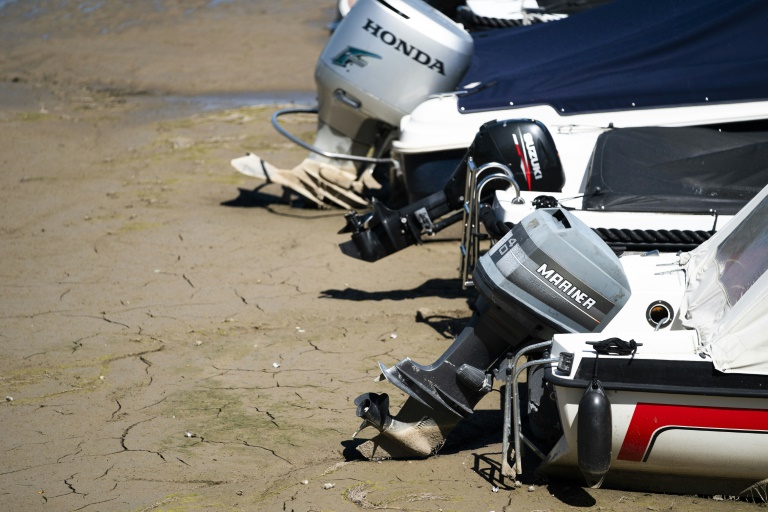
The Netherlands declared an official water shortage on Wednesday as the low-lying “land of water” was hit by Europe’s sweltering summer.

The Dutch government said it was eyeing further measures to conserve water amid a drought, and authorities have already imposed limits on farming and shipping.

The country is protected from the sea by a famed system of dams, dykes and canals but remains particularly vulnerable to climate change.

“The Netherlands is a land of water, but here too our water is precious,” Infrastructure and Water Management Minister Mark Harbers said in a statement.

Parts of the Netherlands have already banned farmers from spraying their crops with surface water, in a blow for the world’s second largest agricultural exporter after the United States.

Some canal locks for shipping have also been suspended, with salt water from the sea creeping back into some rivers as their water levels are so low, Harbers added.

Priority would now be given to ensuring that vital dykes remain safe, and then to drinking water and energy supplies, he said.

The drought was “becoming increasingly visible in nature” and it was “conceivable that the drought will affect more social interests”, Harbers added.

“That is why I ask all Dutch people to think carefully about whether they should wash their car or fill their inflatable swimming pool completely.”

With around a third of its surface area lying below sea level, the Netherlands has historically battled against the weather. 

Climate change has now accentuated its struggle.

In July the Netherlands recorded its third-highest temperature since records began — 39.4C. A month earlier it suffered its first fatal tornado for 30 years.

Driest July in memory imperils Europe's crops

As much of Europe bakes in a third heatwave since June, fears are growing that extreme drought driven by climate change in the continent’s breadbasket nations will dent stable crop yields and deepen the cost-of-living crisis. 

The European Commission on Wednesday urged EU member states to re-use treated urban waste water as irrigation on the continent’s parched farms, after France and parts of England saw their driest July on record.

In France, where an intense drought has hammered farmers and prompted widespread limits on freshwater use, there was just 9.7 millimetres (0.38 inches) of rain last month, Meteo France said.

That was 84 percent down on the average levels seen for July between 1991 and 2022, making it the driest month since March 1961, the agency added.

Farmers nationwide are reporting difficulties in feeding livestock because of parched grasslands, while irrigation has been banned in large areas of the northwest and southeast due to freshwater shortages.

Environment Minister Christophe Bechu said July’s rainfall represented “just 12 percent of what’s needed”. 

France is the forth-largest exporter of wheat and among the top five exporters of maize globally. Poor harvests due to drought may heap further pressure on grain supplies after Russia’s invasion of Ukraine caused global shockwaves. 

“Our food system has been under stress for a while, and with the supply issues from Ukraine, that has only gotten worse,” said Shouro Dasgupta, environmental economist at the Euro-Mediterranean Center on Climate Change.

“These heatwaves are on top of droughts and will see crops wither faster.”

Dasgupta said that extreme heat driven by climate change is also contributing to food price inflation for consumers and harsher conditions for producers. 

“Droughts and heatwaves impact people’s livelihoods. People will be less able to afford food,” he told AFP. 

“And during heatwaves outdoor workers are only able to work fewer hours, which brings cascading impacts for supply.”

– ‘Food systems not working’ –

Britain’s Met Office this week said much of southern and eastern England had their driest July on record. 

Some water providers have already announced restrictions affecting millions of people, and fruit and vegetable producers have announced several crop losses such as beans and berries.

Britain’s inflation surged to a 40-year high in June on rising fuel and food prices.

Elizabeth Robinson, director of the London School of Economics’ Grantham Research Institute on Climate Change and the Environment, said that spiralling food costs — worsened by heat-induced losses in Europe and Britain — were a sign that “food systems aren’t working for people.”

“There are some long-term, difficult conversations that need to be had, particularly about food waste and the diversion of grains away from food for people to feed animals,” she told AFP.

In Spain, already parched under a prolonged hot spell, temperatures will breach 40C in several areas this week. 

The heat is worsening water shortages that have dogged Spanish agriculture since last winter, with local restrictions on water usage in the most affected regions. 

The government said this week that Spain’s reservoirs are at just 40.4 percent capacity.

Juan Carlos Hervas, from the COAG farmers’ union, told AFP that Spains olive harvest from unirrigated land will come in at less than 20 percent of the average of the last five years. 

Spain supplies nearly half the world’s olive oil.  

– ‘Worst drought this century’ –

Portugal, where temperatures yet again breached the 40C mark this week, is experiencing “the worst drought this century”, environment minister Jose Duarte Cordeiro warned last month.

Portugal along with Poland has asked its citizens to cut down on water use to ease the pressure.

“Water authorities across Europe are unprepared for what scientists have been saying for three decades,” said Dasgupta. “A high incidence of heatwaves will hit water supply “.

The European Commission in an updated assessment last month found that nearly half — 44 percent — of the EU and Britain was currently experiencing “warning” levels of drought. 

It warned that exceptional low soil moisture levels meant several countries, including France, Romania, Spain, Portugal and Italy will experience reduced crop yield in 2022. 

“The unfavourable  forecasts  for the coming months may compromise the water supply and will likely keep the competition for this resource high,” it said. 

A separate EU bulletin, also last month, said that EU yields of soybean, sunflowers and maize were already 9 percent below average. 

On Wednesday Virginijus Sinkevicius, EU commissioner for the environment, fisheries and the oceans. urged EU nations to re-use more of its waste water.

“We need to stop wasting water and use this resource more efficiently to adapt to the changing climate and ensure the security and sustainability of our agricultural supply.” he said.

ASEAN warns Myanmar against more executions

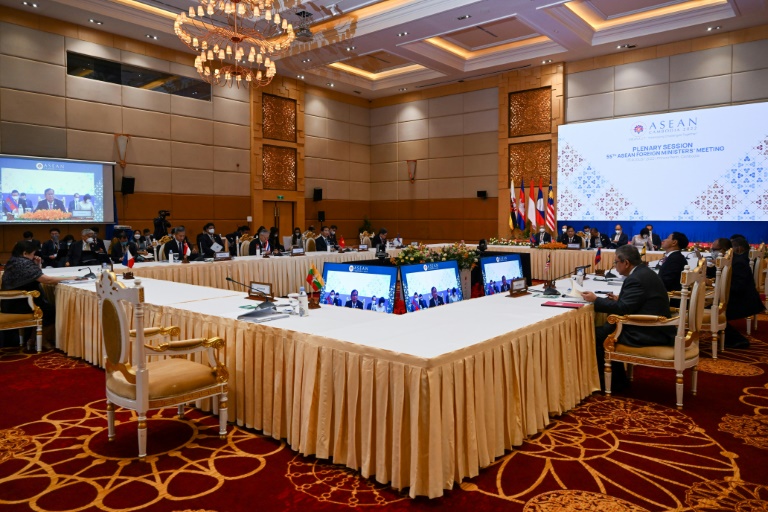
Current ASEAN chair Cambodia warned Myanmar on Wednesday not to execute any more prisoners after the hanging of four people — two of them prominent pro-democracy figures — caused international outrage.

Foreign ministers from the Association of Southeast Asian Nations (ASEAN) are discussing how to address the growing crisis in Myanmar at talks in Phnom Penh.

The 10-nation regional bloc has spearheaded so far fruitless efforts to restore peace to the country after a military coup last year, and anger is growing at the junta’s stonewalling tactics.

Myanmar executed four prisoners last month in a move roundly condemned by ASEAN members, who are voicing increased frustration at the lack of progress on the bloc’s “five-point consensus” plan on Myanmar’s conflict.

Agreed in April last year, the plan calls for an immediate end to violence and dialogue between the army and coup opponents.

“If more prisoners are to be executed, we will be forced to rethink our role vis a vis ASEAN’s five-point consensus,” Cambodian Prime Minister Hun Sen said as he opened the foreign ministers’ gathering.

Hun Sen said the bloc was “disappointed and disturbed by the execution of these opposition activists despite the appeals from me and others for the death sentences to be reconsidered for the sake of political dialogue, peace and reconciliation”.

– Suspension threat –

Malaysia, which has led efforts to get tough on Myanmar’s junta, told reporters there must be progress before the ASEAN leaders summit in November.

“If there is no progress, then the leaders will have to ask the hard questions when they meet in November,” said Malaysian Foreign Minister Saifuddin Abdullah, adding that suspending Myanmar from the regional bloc was not off the table.

He also described the Myanmar executions — which came despite personal appeals from Hun Sen — akin to “a slap”.

“They are making a mockery of the five-point consensus, there is no respect to the ASEAN leaders, there is no respect to the ASEAN chair,” he told reporters.

His comments were echoed by Indonesia’s Retno Marsudi, who said there was “no significant progress”. 

“There’s no goodwill and no commitment from the junta to implement the five-point plan,” the foreign minister told reporters.

She added certain countries were frustrated by “broken promises” by the junta, and Hun Sen told foreign ministers that “ASEAN shouldn’t be held hostage to Myanmar”.

But with no representatives from Myanmar present for the summit — highlighted by the country’s prominently placed empty chair — Cambodia’s ASEAN spokesman admitted Tuesday that progress over the conflict might be tricky.

The February coup has left Myanmar in disarray, with the death toll from a brutal military crackdown on dissent passing 2,100, according to a local monitoring group.

ASEAN ministers urge restraint after Pelosi Taiwan visit

Southeast Asian nations Wednesday urged restraint over Taiwan after US House Speaker Nancy Pelosi’s visit to the island prompted an enraged China to vow “punishment”.

Pelosi’s dramatic trip to Taipei, defying stark threats by China, overshadowed a meeting of Association of Southeast Asian Nations (ASEAN) foreign ministers in Phnom Penh, which had been expected to focus on the bloody crisis engulfing Myanmar.

ASEAN spokesman Kung Phoak, Cambodia’s deputy foreign minister, said ministers at the closed-door talks — meeting face to face for the first time since the pandemic — had expressed concern over “growing tension in the Taiwan Strait.”

“We hope that all sides will try their best to deescalate the tension there, avoid actions that may contribute to the escalation of tension and engage in dialogue,” Kung Phoak told reporters.

Malaysia and Thailand echoed the calls for calm, with Malaysian Foreign Minister Saifuddin Abdullah urging all sides to tread “very carefully”.

Thai foreign ministry spokesman Tanee Sangrat said the kingdom called for “utmost restraint” and warned against “any actions that would aggravate tensions”.

Attention will now turn to Chinese Foreign Minister Wang Yi and his American counterpart Antony Blinken who will join ASEAN and other ministers for regional security talks on Thursday and Friday.

On Wednesday Wang slammed the trip by Pelosi — the highest-profile elected US official to visit Taiwan in 25 years — as a violation of Chinese sovereignty.

“Those who play with fire will not come to a good end, and those who offend China will be punished,” he warned in an interview in Phnom Penh with Chinese state media.

China considers self-governing Taiwan a part of its territory to one day be reclaimed, by force if necessary.

The 10-member ASEAN bloc is split between countries with close ties to China, such as Myanmar, Cambodia and Laos, and others that are warier of Beijing and its growing international assertiveness. 

But no ASEAN country formally recognises Taiwan and none have shown an appetite for backing Taipei against the communist giant.

– Myanmar execution warning –

Cambodian Prime Minister Hun Sen, opening the meeting as chair of ASEAN, condemned Myanmar for executing four prisoners last month in defiance of widespread international pleas for clemency.

Myanmar was plunged into violent turmoil when the military seized power last year, ousting Aun San Suu Kyi’s civilian government. The death toll from the subsequent junta crackdown has passed 2,100, according to local monitors.

ASEAN, long derided as a toothless talking shop that gives political cover to repressive regimes, has spearheaded thus far fruitless efforts to restore peace and voiced anger at the hangings.

Hun Sen said the bloc was “disappointed and disturbed” by the executions and warned that further use of capital punishment would mean a “rethink” of the five-point peace plan agreed to last year with Myanmar.

The plan calls for an immediate end to violence and dialogue between the junta and coup opponents.

Malaysia, which has been leading a push to get tough on Myanmar, is demanding concrete progress on the framework ahead of an ASEAN summit later this year.

Foreign Minister Saifuddin said last month’s executions were “like a slap”. 

“They are making a mockery of the five-point consensus, there is no respect to the ASEAN leaders, there is no respect to the ASEAN chair,” he told reporters.

Myanmar itself was not represented at the meeting after the other members said they would not accept a junta minister and the generals refused to send another official instead.

In a highly visible snub to the regime, a place was set for the Myanmar delegation at the negotiating table, complete with flag, and the chair left empty.

– South China Sea –

In addition to Taiwan, the ongoing South China Sea tensions will be another hot-button issue on the agenda.

Beijing claims most of the sea — with competing territorial assertions from Brunei, Malaysia, the Philippines, Taiwan and Vietnam.

Cambodia — a key Beijing ally — last hosted ASEAN in 2012 and was accused of siding with China over the disputed and resource-rich waters, resulting in no communique being issued.

Turkish inflation stabilises at under 80% in boost to Erdogan

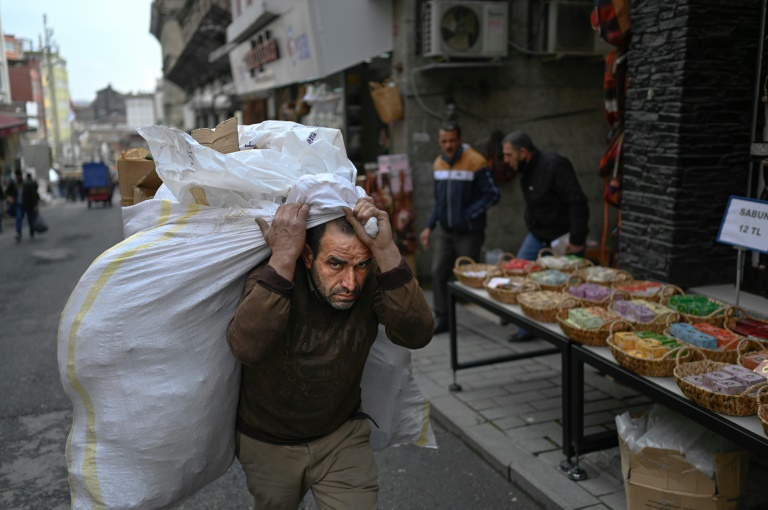
Turkey’s annual inflation rate stabilised in July at just under 80 percent, official data showed on Wednesday, helping support President Recep Tayyip Erdogan’s pledges that runaway price increases would soon stop.

The official annual rate of consumer price increases reached 79.6 percent in July compared to 78.6 percent in June.

Turkey plunged into a fresh economic crisis when Erdogan set off on an unusual economic experiment nearly a year ago that attempted to bring down chronically high inflation by slashing interest rates.

Conventional economic theory, accepted by world governments, states that lower interest rates drive growth and push up prices by building up demand.

Turkey now has a real interest rate that factors in inflation of negative 64.4 percent — the lowest in the world by a substantial margin.

This means that Turks have a strong incentive to spend as much as they can before their liras lose even more value.

But Erdogan has repeatedly urged “patience” and vowed that prices would start falling again at the start of next year.

“A price stabilisation trend has already started,” Erdogan said two days before the latest inflation report was released.

“We hope that inflation will enter a significant downward trend in the first months of the new year.”

The central bank now forecasts the inflation rate to ease back down to roughly 40 percent by the time Erdogan is due to face a difficult re-election next July.

– Doubt in data –

Opposition leaders and many Turks no longer trust official government data.

The annual inflation rate reported this week in Istanbul — headed by a popular opposition party figure — was roughly 100 percent.

“Turkey’s official inflation and Istanbul’s inflation have historically moved in tandem,” the Turkish central bank’s former chief economist Hakan Kara tweeted.

“The difference, which has reached 19.5 percentage points in the last four months, is remarkable.”

But a respected monthly study released by independent economists from Turkey’s ENAG research institute also showed prices stabilising — although at a much higher rate than the one reported by the state statistics agency.

ENAG said the official annual rate of consumer price increases reached 176 percent in July compared to 174 percent in June.

The government’s July report showed price increases being led by a 119-percent jump in the cost of transportation.

This helps back government arguments that inflation is being driven by external factors such as soaring energy prices caused by Russia’s standoff with the West over its invasion in Ukraine.

Food and non-alcoholic prices rose by 95 percent because of the sharp depreciation of the lira that makes imports more expensive.

The Turkish currency has lost more than half its value against the dollar in the past 12 months.

It now trades at nearly 18 to the dollar compared to the 3.5 mark at which it stood in 2018.

Erdogan’s popularity has suffered badly in the second decade of his rule as a result.

A poll of polls released this week showed him losing in a runoff against any of the top five potential challengers to his rule.

Scholz opens door to extend nuclear as Russia squeezes gas supply

German Chancellor Olaf Scholz on Wednesday raised the possibility of keeping nuclear plants going as he accused Russia of blocking the delivery of a key turbine to throttle gas supplies to Europe.

The continent’s biggest economy has been scrambling for energy sources to fill a gap left by a reduction in gas supplies from Moscow. 

Standing next to the turbine, Scholz said that extending the lifetime of Germany’s three remaining nuclear power plants “can make sense”.

The power stations, which are set to be taken off the grid at the end of the year, were “relevant exclusively for electricity production, and only for a small part of it,” Scholz said.

In total, the nuclear fleet accounts for six percent of Germany’s electricity output.

The government has said it will await the outcome of a new “stress test” of the national electric grid before determining whether to stick with the long-planned phaseout.

– Nuclear switch –

Former Chancellor Angela Merkel spectacularly decided to ditch atomic energy in 2011 following the Fukushima nuclear disaster in Japan.

Extending the lifetime of the plants has set off a heated debate in Germany, where nuclear power has been a source of controversy stretching back before Merkel’s move.

The question has split the governing coalition, with Scholz’s Social Democrats and the Greens hitherto sceptical, and the FDP favouring an extension.

Germany has already moved to restart mothballed coal power plants to guard against an energy shortfall.

The first of these was already “supplying electricity to the network”, Scholz said Wednesday, adding that Germany had to prepare for a “difficult time”. 

The squeeze comes as Russia dwindles supplies of gas, which Germany has long relied on to power industry and heat homes.

Russian energy giant Gazprom has chalked up limited supplies to technical issues.

The delayed return of a turbine from Canada, where the unit was being serviced, was behind the initial reduction in deliveries via the Nord Stream 1 gas pipeline in June, according to Gazprom.

Supplies via the energy link were further reduced to around 20 percent of capacity in late July, after Gazprom halted the operation of one of the last two operating turbines due to the “technical condition of the engine”.

– Turbine trouble –

Berlin has dismissed Gazprom’s justifications for the reduction to supply, seeing instead a “political” move in response to the West’s support for Ukraine.

The turbine which was transferred from Canada to Germany was “available and working”, Scholz said Wednesday.

“There is no reason why this delivery cannot happen,” he said, adding that it had received “all the approvals” needed for export from Germany to Russia.

Pipeline operators only had to say “they want to have the turbine and provide the necessary customs information for transport to Russia”, Scholz said.

But Kremlin spokesperson Dmitry Peskov insisted that Gazprom was still waiting for documents confirming the unit was “not affected by sanctions”.

It was however “technologically possible” in the opinion of Russian President Vladimir Putin to continue deliveries via the Nord Stream 2 pipeline, Peskov said.

The second pipeline, which runs parallel to Nord Stream 1, stands completed but was blocked by the German government in the run up to the invasion of Ukraine.

Former Chancellor Gerhard Schroeder, who signed off on the pipeline while in office, told German magazine Stern it was “the easiest solution” to use Nord Stream 2 instead.

But Scholz has rejected the call, saying Nord Stream 1 provided sufficient capacity for gas flows. 

Moscow’s move to limit supplies sent a “difficult message” to the world by creating doubt over Russia’s commitment to its agreements, he added.

Taiwan defiant as China readies military drills over Pelosi visit

Taiwan struck a defiant tone Wednesday as it hosted US House Speaker Nancy Pelosi, with a furious China gearing up for military exercises dangerously close to the island’s shores in retaliation for the visit.

Pelosi landed in Taiwan on Tuesday despite a series of increasingly stark threats from Beijing, which views the island as its territory and had said it would consider the visit a major provocation.

China responded swiftly, announcing what it said were “necessary and just” military drills in the seas just off Taiwan’s coast — some of the world’s busiest waterways.

“In the current struggle surrounding Pelosi’s Taiwan visit, the United States are the provocateurs, China is the victim,” Beijing’s foreign ministry said. 

But Taiwanese President Tsai Ing-wen said the island of 23 million would not be cowed. 

“Facing deliberately heightened military threats, Taiwan will not back down. We will… continue to hold the line of defence for democracy,” Tsai said at an event with Pelosi in Taipei.

She also thanked the 82-year-old US lawmaker for “taking concrete actions to show your staunch support for Taiwan at this critical moment”.

China tries to keep Taiwan isolated on the world stage and opposes countries having official exchanges with Taipei.

Pelosi, second in line to the presidency, is the highest-profile elected US official to visit Taiwan in 25 years.

“Today, our delegation… came to Taiwan to make unequivocally clear we will not abandon our commitment to Taiwan,” she said at the event with Tsai.

She added her group had come “in friendship to Taiwan” and “in peace to the region”.

Before leaving Taiwan, Pelosi also met with several dissidents who have previously been in the crosshairs of China’s wrath — including Tiananmen protest student leader Wu’er Kaixi. 

“We are in high agreement that Taiwan is in the frontline (of democracy),” Wu’er said. 

“Both the United States and Taiwan governments need to… conduct more in defending human rights.”

Pelosi’s delegation left Taiwan on Wednesday evening headed to South Korea, her next stop in an Asia tour. She will head to Japan after. 

– ‘High alert’ –

The administration of President Joe Biden said in the run-up to the visit that US policy towards Taiwan remained unchanged.

This means support for its government while diplomatically recognising Beijing over Taipei, and opposing a formal independence declaration by Taiwan or a forceful takeover by China.

While the White House is understood to be opposed to Pelosi’s Taiwan stop, its National Security Council spokesman John Kirby said she was entitled to go where she pleased. 

Beijing summoned US Ambassador Nicholas Burns over Pelosi’s visit, while the Chinese military declared it was on “high alert” and would “launch a series of targeted military actions in response” to the visit.

The drills will include “long-range live ammunition shooting” in the Taiwan Strait, which separates the island from mainland China and straddles vital shipping lanes.

The zone of Chinese exercises will be within 20 kilometres (12 miles) of Taiwan’s shoreline at some points, according to coordinates released by the Chinese military.

“Some of the areas of China’s drills breach into… (Taiwan’s) territorial waters,” defence ministry spokesman Sun Li-fang said at a press conference Wednesday.

“This is an irrational move to challenge the international order.”

Taiwan’s Mainland Affairs Council, which sets the government’s China policies, accused Beijing of “vicious intimidation” that would “seriously impact the peace and prosperity of the entire East Asia”.

It added that democratic countries should “unite and take a solemn stand to punish and deter” Beijing.

Japan, a key US ally in the region, said Wednesday it had expressed concern to China over the exercises, while South Korea called for dialogue to maintain regional peace.

– ‘We shouldn’t be too worried –

Beijing has long used diplomatic, military and economic pressure on Taiwan.

On Wednesday China announced curbs on the import of fruit and fish from Taiwan — citing the detection of pesticide residue and the coronavirus. It also halted shipments of sand to the island.

“Those who offend China will be punished,” Chinese Foreign Minister Wang Yi told reporters Thursday while on a trip to Cambodia. 

Outside the Taiwanese parliament, 31-year-old computer programmer Frank Chen shrugged off the Chinese warnings against Pelosi’s visit.

“I’m not too worried about China’s intimidation,” he told AFP.

“I think China will take more threatening actions and ban more Taiwanese products, but we shouldn’t be too worried.”

There was a small group of pro-China demonstrators outside parliament as well.

“The United States uses Taiwan as a pawn in its confrontation with China, to try to drag China down so (it) can dominate the world,” Lee Kai-dee, a 71-year-old retired researcher, told AFP.

“If the United States continues to act this way, Taiwan will end up like Ukraine.”

China has vowed to annex self-ruled, democratic Taiwan one day, by force if necessary.

Russia’s invasion of Ukraine in February heightened fears in Taiwan that China may similarly follow through on its threats to annex the island.
Close Bitnami banner
Bitnami