World

Yemen's warring parties renew truce for two months: UN

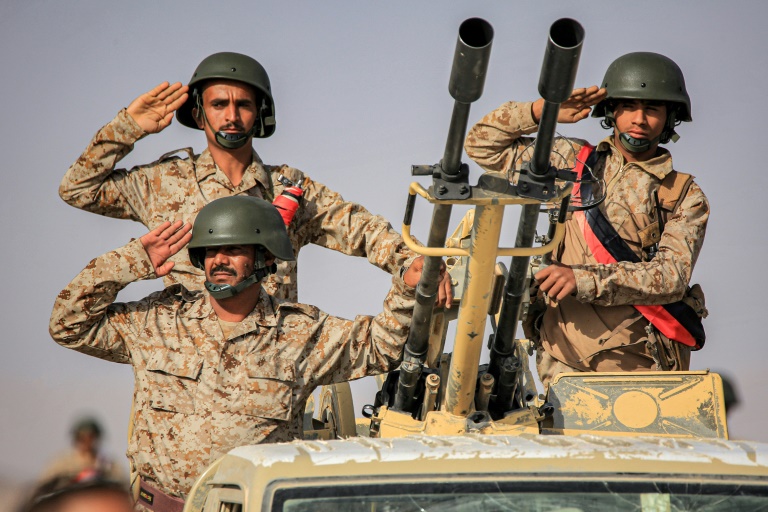
Yemen’s warring parties agreed to extend a four-month long truce for a further two months just hours before it was due to expire, the United Nations announced Tuesday.

Yemen has been gripped by conflict since the Iran-backed Huthi rebels took control of the capital Sanaa in 2014, triggering a Saudi-led military intervention in support of the beleaguered government the following year.

But a truce came into effect on April 2 and was renewed from June 4, providing a rare respite from violence for much of the country and alleviating some of the suffering. 

The latest extension, running from August 2 to October 2, “includes a commitment from the parties to intensify negotiations to reach an expanded truce agreement as soon as possible,” the UN special envoy on Yemen, Hans Grundberg, said in a statement.

Hundreds of thousands have died, directly from fighting as well as indirectly, and millions have been displaced in what the UN calls the world’s worst humanitarian crisis.

“The main objective of the current truce continues to be to provide tangible relief to civilians and to create a conducive environment for reaching a peaceful settlement to the conflict through a comprehensive political process,” Grundberg added.

– ‘Progress slowed’ –

More than two thirds of Yemen’s 30 million people need humanitarian aid, a UN official said last month, and the country has been pushed to the brink of famine.

Under the truce, commercial flights have resumed from the rebel-held capital Sanaa to Jordan and Egypt, while oil tankers have been able to dock in the lifeline port of Hodeida, also in Huthi hands.

The extension of the truce was welcomed Tuesday by aid agencies working to support those impacted by the conflict.

“Millions of Yemenis are suffering due to rocketing food prices, a lack of health and other essential services and dwindling economic opportunities,” said Abdulwasea Mohammed, from the aid agency Oxfam.

“Now is the time for all parties — and the international community — to work towards a lasting and inclusive peace that guarantees the lives, dignity and freedom of the Yemeni people.”

On Monday, 30 aid agencies working in Yemen had said that since the truce first came into force in April 2, “reports of civilian casualties have dropped significantly.”

The aid groups, including Yemeni and international organisations, urged “all parties to the conflict to adhere to and extend the agreement to protect civilians” across the country.

But Erin Hutchinson, Yemen country director for the Norwegian Refugee Council, sounded a note of caution. 

“After seeing swift and decisive action towards the success of the truce in the first months, progress towards meeting all of its elements has slowed,” Hutchinson said.

“We hope this two-month extension will allow for the reopening of roads linking cities and regions, enable more displaced people to return to their homes safely, and ensure humanitarian aid can reach people who have been out of reach for far too long.”

First Ukrainian grain shipment since invasion reaches Turkey

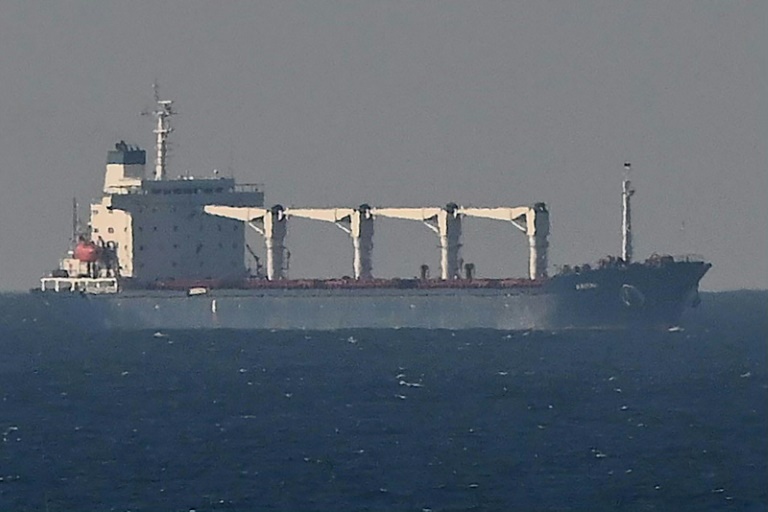
The first shipment of Ukrainian grain to leave Odessa since Russia’s invasion reached Turkey on Wednesday under a landmark deal to lift Moscow’s naval blockade in the Black Sea.

The Sierra Leone-flagged Razoni arrived at the edge of the Bosphorus Strait shortly after Kyiv announced the start of mandatory evacuations from the war-scarred Donetsk region now bearing the brunt of Russia’s five-month assault.

In Moscow, Russia’s supreme court labelled Ukraine’s Azov regiment a “terrorist” organisation — a decision that could pave the way for fighters captured by the Kremlin to face lengthy jail terms.

The Razoni set sail under a deal brokered by Turkey and the United Nations aimed at getting millions of tonnes of trapped produce to world markets and curb a global food crisis.

It is due to be inspected Wednesday near Istanbul by a team that includes Russian and Ukrainian officials before delivering its cargo of 26,000 tonnes of maize to Tripoli, Lebanon.

The halt of deliveries from Ukraine — one of the world’s biggest grain exporters — has contributed to soaring food prices, hitting the world’s poorest nations especially hard.

Kyiv says at least 16 more grain ships are waiting to depart.

But it also accuses Russia of stealing Ukrainian grain in territories seized by Kremlin forces and then shipping it to allied countries in Africa and the Middle East, such as Syria.

Russia attacked the Odessa port from which the Razonia set off on Monday less than 24 hours after the grain deal was signed in Istanbul, putting the safety of future deliveries in doubt.

“Let’s wait and see how the agreement works and whether security will be really guaranteed,” Ukrainian President Volodymyr Zelensky said in a video address late Monday. 

– Donetsk evacuations –

Yet Russia has continued to pound cities and towns across Ukraine’s sprawling front line.

Kyiv said it had started mandatory evacuations from the eastern region of Donetsk bearing the brunt of the Russian offensive after Zelensky urged the estimated 200,000 remaining residents to leave. 

Ukrainian Deputy Prime Minister Iryna Vereshchuk said a train carrying “women, children, elderly people, many people with reduced mobility” arrived in the central city of Kropyvnytskyi on Tuesday morning.

More than 130 people were evacuated from the Donetsk region, governor Pavlo Kyrylenko said.

Officials have said they want to get residents out of the battered region before the start of winter as gas pipes for heating have been severed.

In the south of the country, the head of Ukraine’s Kryviy Rig military administration said Russian shelling had killed two civilians in a minibus trying to leave the Moscow-controlled Kherson region.

Oleksander Vilkul said two other passengers were in serious condition in hospital with burns. 

The mayor of the city of Mykolaiv, the closest to where Ukrainian forces are looking to launch a counter-offensive in Kherson, said Russian strikes had damaged a university dormitory. 

– More Western arms –

He said in a briefing that 403 people had been killed in his region since the invasion but added that a looming Ukraine counter-offensive for the neighbouring Kherson region “will result in a decrease of shelling”.

Ukraine was bolstered by more supplies of Western arms — particularly long-range artillery — as it looks to launch a major push in the south to retake Kherson.

The United States announced a new tranche of weapons worth $550 million for Ukraine’s forces, including ammunition for increasingly important rocket launchers and artillery pieces.

“Our artillerymen are ready to turn night into day to expel the Russian invaders,” Ukraine’s Defence Minister Oleksiy Reznikov said.

In Moscow meanwhile, Russia paved the way for handing tough prison sentences to captured members of Ukraine’s Azov regiment. 

Fighters from Azov were among 2,500 Ukrainian soldiers who surrendered in May after weeks of fierce resistance at the Azovstal steel plant in devastated Mariupol. 

The regiment — which was incorporated into Ukraine’s national guard in 2014 — is demonised by Moscow for alleged far-right links. 

Its members were among 50 Ukrainian servicemen killed last week in an attack on a jail holding prisoners of war in Russian-occupied territory. 

Ukraine has accused Moscow of deliberately executing the detainees, while Russia says Ukrainian forces hit the facility with missiles. 

Azov, in response to the Russian court ruling, called on the US and other countries to recognise Russia as a “terrorist state”. 

Al-Qaeda faces succession quandary after Zawahiri killing

The killing of Al-Qaeda chief Ayman al-Zawahiri in a US drone strike will not affect the operations of the terror group’s affiliates across the world, but opens the way for a potentially troubled succession process.

The Egyptian jihadist, who the United States says has been killed in a hideout in the Afghan capital Kabul, never even attempted to replicate the charisma and influence of his predecessor Osama bin Laden, the mastermind of the September 11, 2001 attacks against the United States.

But after US special forces killed bin Laden in Pakistan in 2011, he played a key role in encouraging a decentralisation of the group, which resulted in Al-Qaeda franchises emerging all over the planet.

These include the Al-Shabaab who still control a large chunk of rural Somalia, the JNIM active in West Africa — in particular Mali, and the Al-Qaeda in the Indian Subcontinent (AQIS) branch.

“He accepted major new players in the Al-Qaeda network,” said Hans-Jakob Schindler, director of the NGO Counter-Extremism Project and a former UN advisor.

“So it is a blow to Al-Qaeda,” he said. But “it’s not going to stop anything” planned by Al-Qaeda affiliates.

– ‘Bit of a challenge’ –

The most likely successors pointed to by analysts contacted by AFP include two other Egyptians.

One contender is Saif al-Adel, a former Egyptian special forces lieutenant-colonel and figure in the old guard of Al-Qaeda, whose presence has been reported in Iran.

The Islamic republic’s Shiite rulers officially oppose the Sunni Al-Qaeda but opponents have repeatedly accused Iran of cooperating with network and giving sanctuary to its leaders.  

Also in the running is Abu Abd al-Karim al-Masri who is part of the leadership of Syrian jihadist group Hurras al-Din and believed to be in Syria.

“Zawahiri was not involved in the day-to-day decision-making of the affiliates… but you need a figurehead with a certain prominence and seniority because all the heads of all the affiliates need to swear personal loyalty to him,” said Schindler.

“So replacing him is going to be a bit of a challenge.”

Rita Katz, the director and co-founder of the SITE Intelligence Group, said the Al-Qaeda succession was the “big question” in the wake of the killing of Zawahiri.

“Unlike the situation after Osama bin Laden’s killing, so much of its leadership has moved to Syria, where many were killed,” she said.

She said that little is known about the whereabouts of Adel but emphasised it was far from certain he was still in the Islamic republic, where observers believe he spent some two decades.

“Rumours are that he was released from prison in Iran and moved to Syria. However not much is known,” she said.

– ‘Dwindling bench’ –

Adel joined the Egyptian Islamic Jihad group in the 1980s. He was arrested but later freed, and travelled to Afghanistan to join Al-Qaeda under Zawahiri. 

Scrutiny over Tehran’s alleged relationship with Al-Qaeda intensified in August 2020 following the killing in Tehran, reportedly by Israeli agents, of Abdullah Ahmed Abdullah, the group’s former number two under Zawahiri and known by his nom-de-guerre of Abu Mohammed al-Masri.

This prompted then US secretary of state Mike Pompeo to claim — just a week before his boss president Donald Trump left office — that Iran was the “new Afghanistan” for Al-Qaeda militants, a statement that was met with some scepticism by analysts.

The Soufan Center, a US-based security research organisation, said the killing of a number of Al-Qaeda old guard figures in recent years had left the network with a “dwindling bench of potential successors”.

It said Adel’s “long presence” in overwhelmingly Shiite Iran “might taint his candidature in certain circles”.

Younger Al-Qaeda cadres may prefer a figure like Masri who in Syria “worked assiduously to cultivate ties with potential recruits more focused on local targets and motivated by parochial grievances in regions engulfed by civil war and insurgency”.

“The selection of Al-Qaeda’s next leader will tell a great deal about the future plans of the organisation,” it said. 

US loan delinquencies creep up amid high debt loads: report

US households have continued to take on more debt, in part to deal with soaring prices, a report showed Tuesday, while cases of borrowers unable to pay loans are creeping up in a troubling sign of things to come.

Facing the biggest surge in inflation in more than four decades, which is squeezing families trying to make ends meet, the New York Federal Reserve Bank’s latest report shows credit card balances in the April-June quarter surged by the most in 20 years.

Total household debt posted a two percent increase in the latest three months, and is now $2 trillion more than the pre-pandemic level, the report showed.

While family finances remain in good shape for now — helped by government aid and the ban on foreclosures — researchers caution that the era of historically low delinquencies is coming to an end, especially among those with lower credit scores known as “subprime borrowers.”

“The second quarter of 2022 showed robust increases in mortgage, auto loan, and credit card balances, driven in part by rising prices,” said Joelle Scally, of the New York Fed’s Center for Microeconomic Data.

“While household balance sheets overall appear to be in a strong position, we are seeing rising delinquencies among subprime and low-income borrowers with rates approaching pre-pandemic levels.”

Delinquency rates remain low and an increase is to be expected as the moratoria on foreclosures end, but the report warns that data point to potential trouble ahead for communities that “are experiencing the economy differently.” 

“We are seeing a hint of the return of the delinquency and hardship patterns we saw prior to the pandemic,” New York Fed researchers said in a blog post.

Total household debt rose $312 billion in the quarter to $16.15 trillion, and the biggest component — mortgages — jumped $207 billion to just under $11.4 trillion, the report said. However, the amount of new home loans fell, amid rising lending rates.

Credit card balances (up $46 billion) and auto loans (up $33 billion to $1.5 trillion) were impacted by rising prices, the report said.

Meanwhile, student loans, which still benefit from pandemic forbearance programs, were essentially flat at $1.6 trillion.

Webb telescope captures colourful Cartwheel Galaxy

The James Webb Space Telescope has peered through time and huge amounts of dust to capture a new image of the Cartwheel Galaxy, revealing the spinning ring of colour in unprecedented clarity, NASA and the European Space Agency said Tuesday.

Located around 500 million light-years from Earth in the constellation Sculptor, the Cartwheel gained its shape during a spectacular head-on collision between two galaxies.

The impact sent two rings expanding from the galaxy’s centre, “like ripples in a pond after a stone is tossed into it”, NASA and the ESA said in a joint statement.

A smaller white ring remains closer to the galaxy’s centre, while the outer ring, with its spokes of colour, has been expanding into the universe for around 440 million years, the statement added.

As the outer ring expands it runs into gas, sparking the formation of new stars.

The Hubble telescope had previously captured images of the rare ring galaxy, which is believed to have been a spiral galaxy like our own Milky Way before it was hit by a smaller intruder galaxy.

But the Webb telescope, which launched in December 2021 and revealed its first images to global fanfare last month, has a far greater reach.

Webb’s ability to detect infrared light allowed it to see through the “tremendous amount of hot dust” obscuring the view of the Cartwheel Galaxy, NASA and the ESA said.

This revealed new details about star formation in the galaxy, as well as the behaviour of the supermassive black hole at its heart, they said.

It was also able to detect regions rich in hydrocarbons and other chemicals, as well as dust that is similar to dust on Earth.

Behind the Cartwheel, two smaller galaxies shine brightly, while even more galaxies can be seen behind them.

The observations show that the Cartwheel Galaxy is still in “very transitory stage”, the space agencies said.

“While Webb gives us a snapshot of the current state of the Cartwheel, it also provides insight into what happened to this galaxy in the past and how it will evolve in the future.”

Webb telescope captures colourful Cartwheel Galaxy

The James Webb Space Telescope has peered through time and huge amounts of dust to capture a new image of the Cartwheel Galaxy, revealing the spinning ring of colour in unprecedented clarity, NASA and the European Space Agency said Tuesday.

Located around 500 million light-years from Earth in the constellation Sculptor, the Cartwheel gained its shape during a spectacular head-on collision between two galaxies.

The impact sent two rings expanding from the galaxy’s centre, “like ripples in a pond after a stone is tossed into it”, NASA and the ESA said in a joint statement.

A smaller white ring remains closer to the galaxy’s centre, while the outer ring, with its spokes of colour, has been expanding into the universe for around 440 million years, the statement added.

As the outer ring expands it runs into gas, sparking the formation of new stars.

The Hubble telescope had previously captured images of the rare ring galaxy, which is believed to have been a spiral galaxy like our own Milky Way before it was hit by a smaller intruder galaxy.

But the Webb telescope, which launched in December 2021 and revealed its first images to global fanfare last month, has a far greater reach.

Webb’s ability to detect infrared light allowed it to see through the “tremendous amount of hot dust” obscuring the view of the Cartwheel Galaxy, NASA and the ESA said.

This revealed new details about star formation in the galaxy, as well as the behaviour of the supermassive black hole at its heart, they said.

It was also able to detect regions rich in hydrocarbons and other chemicals, as well as dust that is similar to dust on Earth.

Behind the Cartwheel, two smaller galaxies shine brightly, while even more galaxies can be seen behind them.

The observations show that the Cartwheel Galaxy is still in “very transitory stage”, the space agencies said.

“While Webb gives us a snapshot of the current state of the Cartwheel, it also provides insight into what happened to this galaxy in the past and how it will evolve in the future.”

F1 star Hamilton takes ownership stake in NFL Broncos

Seven-time Formula One world champion Lewis Hamilton has joined the ownership group of the NFL’s Denver Broncos, the team announced Tuesday.

The Broncos entered into a sale agreement with the Walton-Penner family in June pending ownership approval of the deal, which is expected to come next Tuesday.

“Excited to join an incredible group of owners and become a part of the @Broncos story!!” Hamilton tweeted. “Honoured to work with a world class team and serve as an example of the value of more diverse leadership across all sports.”

The 37-year-old Englishman posted a photo of his dog wearing a Broncos’ scarf and shirt and added, “Roscoe already thinks he made the team”.

Wal-Mart store heir Rob Walton, his daughter Carrie Penner and son-in-law Greg Penner paid $4.65 billion, the largest sale price for any North American sports team, to purchase the Broncos.

Former US Secretary of State Condoleezza Rice was added to the ownership group last month and Hamilton, a record 103-time F1 race winner, is the latest high-profile investor.

“We’re delighted to welcome seven-time Formula One world champion Sir Lewis Hamilton to our ownership group,” Walton said in a statement.

“He’s a champion competitor who knows what it takes to lead a winning team and a fierce advocate for global equality, including in his own sport.

“With over 100 race wins, Lewis is considered the most successful F1 driver of all time. His resilient spirit and standard of excellence will be an asset to the ownership group and the Broncos organization.”

The sale must be approved by at least 24 of the NFL’s 32 club owners to complete the purchase from the Pat Bowlen Trust. Bowlen purchased the Broncos in 1984 and died in 2019.

The vote is likely only a formality and it is scheduled for an owners’ meeting next week.

The Broncos won their third Super Bowl crown in 2016 but have not made the playoffs since. They went 7-10 last year for a fifth consecutive losing season.

Markets drop over China-US tensions

Stock markets fell Tuesday as investors dumped risky equities on spiking China-US tensions over a visit by House Speaker Nancy Pelosi to Taiwan.

Traders were already skittish after a string of data showed economies beginning to take a hit from surging inflation and central bank interest rate hikes aimed at taming prices.

Any meeting between Pelosi and Taiwanese President Tsai Ing-wen is sure to anger Beijing, which views the island as its territory and has said the White House was playing “with fire”.

Observers do not think the move will spark a conflict but moments before her arrival in Taiwan on Tuesday, Chinese state media announced advanced Su-35 fighter jets were crossing the Taiwan Strait.

China’s defence ministry spokesman also vowed “targeted military actions”.

Heightened tensions between the world’s two superpowers have sent shivers through trading floors, compounding worries that Russia’s invasion of Ukraine could escalate into a wider war.

– Investors ‘very nervous’ –

“We’re seeing more risk aversion as Nancy Pelosi’s trip to Taiwan generates numerous unsettling headlines at a time of strained ties between the US and China,” said OANDA analyst Craig Erlam.

The trip was “making investors very nervous”, he said.

Pelosi’s visit hit US stocks, with all three main indexes dropping Tuesday in early morning trading before the tech-rich Nasdaq Composite Index and broad-based S&P 500 were up in the afternoon.

Asian stocks also fell earlier, though some markets recovered as the day wore on.

Hong Kong and Shanghai led losses, shedding more than two percent, while Taipei was off more than one percent along with Tokyo.

In Europe, Frankfurt and Paris were down at the close of trading, while only London ended the day flat after oil giant BP announced soaring profits.

“Objectively, given the potential seriousness of some kind of confrontation with China, the market is not reacting with abject fear about the outcome,” said market analyst Patrick O’Hare at Briefing.com.

The safe-haven yen jumped to a two-month high against the dollar.

The Taiwan dollar meanwhile sank to its lowest since April 2020 before bouncing back.

– Rising rates –

The flare-up in tensions comes less than a week after US President Joe Biden and Xi Jinping held telephone talks during which the Chinese leader warned the United States not to “play with fire”.

The market selloff comes as investors try to assess the outlook for the global economy as leaders try to bring down sky-high inflation by lifting rates while at the same time maintaining growth.

Australia’s central bank raised its central interest rate for a fourth time by another 50 basis points Tuesday.

The Bank of England is also under pressure to make a more aggressive rate hike of 50 basis points this Thursday.

Oil prices recouped some of Monday’s steep losses that were fuelled by falling demand expectations.

– Key figures at around 1545 GMT –

New York – Dow: DOWN 0.4 percent at 32,660.97 points

EURO STOXX 50: DOWN 0.5 percent at 3,684.63

London – FTSE 100: FLAT at 7,409.11 (close)

Frankfurt – DAX: DOWN 0.2 percent at 13,449.20 (close)

Paris – CAC 40: DOWN 0.4 percent at 6,409.80 (close)

Tokyo – Nikkei 225: DOWN 1.4 percent at 27,594.73 (close)

Hong Kong – Hang Seng Index: DOWN 2.4 percent at 19,689.21 (close)

Shanghai – Composite: DOWN 2.3 percent at 3,186.27 (close)

Taipei – TAIEX: DOWN 1.6 percent at 14,747.23 (close)

Dollar/yen: DOWN at 131.99 yen from 131.61 yen Monday

Euro/dollar: DOWN at $1.0206 from $1.0262

Pound/dollar: DOWN at $1.2222 from $1.2255

Euro/pound: DOWN at 83.48 pence from 83.70 pence

Brent North Sea crude: UP 0.6 percent at $100.69 per barrel

West Texas Intermediate: UP 0.6 percent at $94.52 per barrel

burs-raz/jm

Pelosi defies China threats and lands in Taiwan

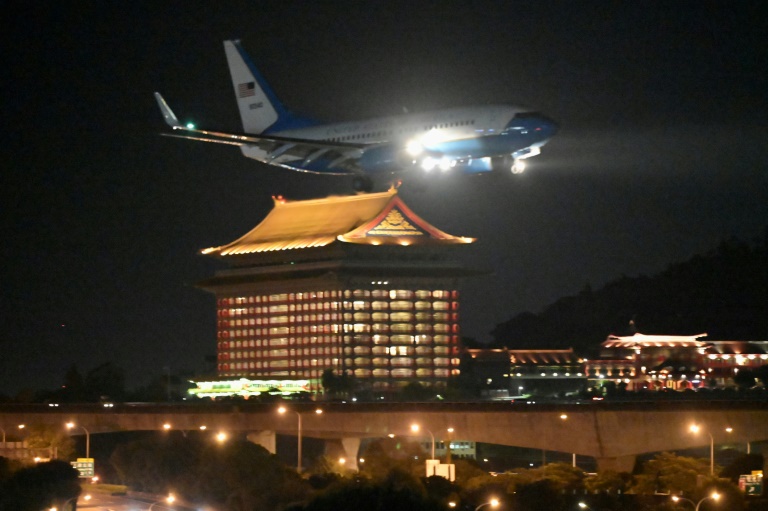
United States House Speaker Nancy Pelosi landed in Taiwan on Tuesday evening, defying a string of increasingly stark warnings and threats from China that have sent tensions between the world’s two superpowers soaring.

Pelosi, second in line to the presidency, is the highest-profile elected US official to visit Taiwan in 25 years and Beijing has made clear that it regards her presence as a major provocation, setting the region on edge.

Live broadcasts showed the 82-year-old lawmaker, who flew on a US military aircraft, being greeted at Taipei’s Songshan Airport by foreign minister Joseph Wu.

“Our delegation’s visit to Taiwan honors America’s unwavering commitment to supporting Taiwan’s vibrant Democracy,” Pelosi’s official Twitter account tweeted moments after she arrived.

She added her visit “in no way contradicts” US policy towards Taiwan and Beijing. 

Pelosi is currently on a tour of Asia and while neither she nor her office confirmed the Taipei visit, multiple US and Taiwanese media outlets reported it was on the cards — triggering days of building anger from Beijing. 

The People’s Liberation Army said it was on “high alert” and would “launch a series of targeted military actions in response” to the visit.

“Those who play with fire will perish by it,” Beijing’s foreign ministry added. 

– No need for ‘crisis’ –

China considers self-ruled, democratic Taiwan as its territory and has vowed to one day seize the island, by force if necessary. 

It tries to keep Taiwan isolated on the world stage and opposes countries having official exchanges with Taipei.

In a call with US President Joe Biden last week, Chinese President Xi Jinping warned Washington against “playing with fire” on Taiwan.

While the Biden administration is understood to be opposed to a Taiwan stop, White House National Security Council spokesman John Kirby said Pelosi was entitled to go where she pleased. 

“There is no reason for Beijing to turn a potential visit consistent with longstanding US policies into some sort of crisis,” he told reporters.

The last House Speaker to visit Taiwan was Newt Gingrich in 1997.

Kirby reiterated that US policy was unchanged toward Taiwan.

This means support for its self-ruling government, while diplomatically recognising Beijing over Taipei and opposing a formal independence declaration by Taiwan or a forceful takeover by China.

Moscow said it was “absolutely in solidarity with China”, calling the prospect of a Pelosi visit “pure provocation”. 

China has refused to condemn Russia’s invasion of Ukraine and has been accused of providing diplomatic cover for the Kremlin by blasting Western sanctions and arms sales to Kyiv.

As Pelosi’s plane neared Taipei Chinese state media said advanced Su-35 fighter jets were crossing the Taiwan Strait. The brief report had no details on timing or precise location of the crossing.

Taiwan’s military later released a statement denying that any Su-35s had crossed the Taiwan Strait. 

– All eyes on Taiwan –

Pelosi left Kuala Lumpur Tuesday after meeting Malaysian Prime Minister Ismail Sabri and Foreign Minister Saifuddin Abdullah.

So many people were tracking the US military plane ferrying her on FlightRadar that the website said some users experienced outages.

The plane took a circuitous route that studiously avoided the South China Sea — which Beijing claims — before heading up the east coast of the Philippines. 

Press access around Pelosi has been tightly restricted and limited to a handful or short statements confirming meetings with officials.

Her itinerary includes stops in South Korea and Japan — but the prospect of a Taiwan trip had dominated attention.

Before her arrival, Taipei’s government had stayed silent on whether she would visit even as local media published reports showing her presence was all but guaranteed. 

The capital’s famous Taipei 101 skyscraper was illuminated with the words “Speaker Pelosi… Thank You” on Tuesday night before her plane arrived. 

– ‘Seek to punish Taiwan’ –

Taiwan’s 23 million people have long lived with the possibility of an invasion, but that threat has intensified under Xi, China’s most assertive ruler in a generation.

“Beijing shouldn’t get to decide who can visit Taiwan or how the US should interact with Taiwan,” Wang Ting-yu, a lawmaker from the ruling Democratic Progressive Party, told AFP ahead of the visit. 

“I think China’s open intimidation is counter-effective.”

Bonnie Glaser, director of the Asia programme at the US-based German Marshall Fund think tank, said the probability of Beijing choosing war was “low”. 

“But the probability that… (China) will take a series of military, economic, and diplomatic actions to show strength & resolve is not insignificant,” she wrote on Twitter.

Taipei’s Council of Agriculture on Tuesday said China had suspended the import of some Taiwanese goods, including some fishery products, tea, and honey. The council said China cited regulatory breaches.

Pelosi’s potential visit has been proceeded by a flurry of military activity across the region that highlights how combustible the issue of Taiwan is.

Last week both Taiwan and China held live fire drills.

Firefighters race to protect California town threatened by wildfire

Rain and cooler conditions brought some relief on Tuesday to hundreds of firefighters battling a wildfire in northern California that has killed two people and threatens the 8,000-strong town of Yreka.

State fire department, CalFire, said that while the weather had “mitigated fire spread,” vegetation in the area “remains extremely dry” and in danger of being ignited by lightning strikes. 

“The continued threat of thunderstorms and the associated strong, erratic winds could result in increased fire behavior,” CalFire said.

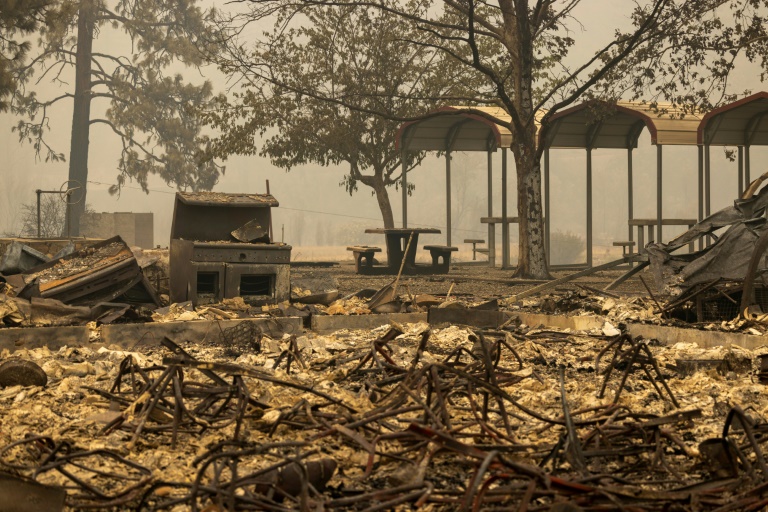
The McKinney fire burning in the Klamath National Forest near the border with Oregon is California’s largest wildfire so far this year — though it remains much smaller than last year’s Dixie Fire, which burned nearly one million acres.

More than 55,000 acres (22,000 hectares) of the sparsely populated forest have been ravaged and the blaze is zero percent contained, according to CalFire.

Firefighters are constructing containment lines to prevent the fire from spreading, including using bulldozers to build a firebreak to protect Yreka, the county seat of Siskiyou County.

The McKinney Fire has killed two people, according to the Siskiyou County Sheriff’s Office.

Firefighters found two people dead on Sunday inside a burned-out car in the driveway of a home in the town of Klamath River.

Sheriff Jeremiah LaRue said the pair were likely caught in the swift-moving blaze as they tried to flee.

Sherri Marchetti-Perrault, who lived off of Highway 96, told the Los Angeles Times that her home had burned to the ground.

“When we left, everything was on fire,” Marchetti-Perrault told the newspaper. “It happened so fast. We left with the clothes on our back. We couldn’t breathe and we couldn’t see.”

– ‘Holding out’ – 

California, along with much of the western United States, is in the grip of its worst drought in more than 1,000 years.

The drought, exacerbated by man-made climate change, has left the countryside parched and vulnerable to the wildfires that naturally break out, making the blazes hotter, faster and more destructive.

California Governor Gavin Newsom has declared a state of emergency in Siskiyou County, and more than 2,000 residents of the rural area are under evacuation orders.

According to the Siskiyou County Sheriff’s Office, the fire has destroyed more than 100 structures — including homes, a grocery store and a community center — in the area around Yreka.

“Surrounding areas should be ready to leave if needed. Please don’t hesitate to evacuate,” the county sheriff tweeted.

“I’m holding out trying not to leave too soon because I’m helping out my mom,” said Rafael Franco, who lives in the mandatory evacuation area.

“She’s not in the best physical health to get around,” Franco told AFP.

“At the last minute if I see the fire cross the ridge where we are, we are going to head out and grab what we can and get going and hope for the best.”

Marjie Lawrence, who fled Klamath River on Friday night, said she went back to retrieve some belongings in case the fire spread to her home. 

“We are taking stuff in case the house goes, we are taking things we want, but not too many,” Lawrence said.

The McKinney Fire comes just days after the Oak Fire near Yosemite National Park destroyed dozens of buildings and forced thousands to evacuate.

California still has months of fire season ahead of it.

Other parts of the world have also faced intense wildfires this year, as scientists say climate change is making heatwaves more frequent and more intense, increasing the risk of fires.

Close Bitnami banner
Bitnami