World

Firefighters race to protect California town threatened by wildfire

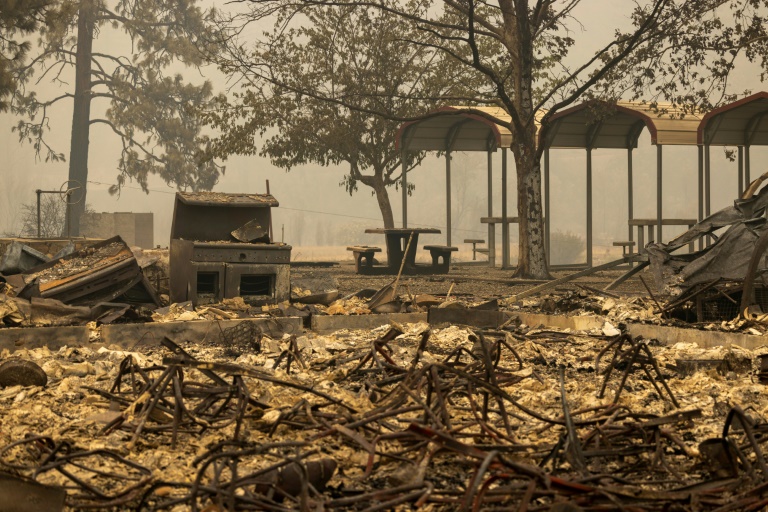
Rain and cooler conditions brought some relief on Tuesday to hundreds of firefighters battling a wildfire in northern California that has killed two people and threatens the 8,000-strong town of Yreka.

State fire department, CalFire, said that while the weather had “mitigated fire spread,” vegetation in the area “remains extremely dry” and in danger of being ignited by lightning strikes. 

“The continued threat of thunderstorms and the associated strong, erratic winds could result in increased fire behavior,” CalFire said.

The McKinney fire burning in the Klamath National Forest near the border with Oregon is California’s largest wildfire so far this year — though it remains much smaller than last year’s Dixie Fire, which burned nearly one million acres.

More than 55,000 acres (22,000 hectares) of the sparsely populated forest have been ravaged and the blaze is zero percent contained, according to CalFire.

Firefighters are constructing containment lines to prevent the fire from spreading, including using bulldozers to build a firebreak to protect Yreka, the county seat of Siskiyou County.

The McKinney Fire has killed two people, according to the Siskiyou County Sheriff’s Office.

Firefighters found two people dead on Sunday inside a burned-out car in the driveway of a home in the town of Klamath River.

Sheriff Jeremiah LaRue said the pair were likely caught in the swift-moving blaze as they tried to flee.

Sherri Marchetti-Perrault, who lived off of Highway 96, told the Los Angeles Times that her home had burned to the ground.

“When we left, everything was on fire,” Marchetti-Perrault told the newspaper. “It happened so fast. We left with the clothes on our back. We couldn’t breathe and we couldn’t see.”

– ‘Holding out’ – 

California, along with much of the western United States, is in the grip of its worst drought in more than 1,000 years.

The drought, exacerbated by man-made climate change, has left the countryside parched and vulnerable to the wildfires that naturally break out, making the blazes hotter, faster and more destructive.

California Governor Gavin Newsom has declared a state of emergency in Siskiyou County, and more than 2,000 residents of the rural area are under evacuation orders.

According to the Siskiyou County Sheriff’s Office, the fire has destroyed more than 100 structures — including homes, a grocery store and a community center — in the area around Yreka.

“Surrounding areas should be ready to leave if needed. Please don’t hesitate to evacuate,” the county sheriff tweeted.

“I’m holding out trying not to leave too soon because I’m helping out my mom,” said Rafael Franco, who lives in the mandatory evacuation area.

“She’s not in the best physical health to get around,” Franco told AFP.

“At the last minute if I see the fire cross the ridge where we are, we are going to head out and grab what we can and get going and hope for the best.”

Marjie Lawrence, who fled Klamath River on Friday night, said she went back to retrieve some belongings in case the fire spread to her home. 

“We are taking stuff in case the house goes, we are taking things we want, but not too many,” Lawrence said.

The McKinney Fire comes just days after the Oak Fire near Yosemite National Park destroyed dozens of buildings and forced thousands to evacuate.

California still has months of fire season ahead of it.

Other parts of the world have also faced intense wildfires this year, as scientists say climate change is making heatwaves more frequent and more intense, increasing the risk of fires.


US kills Al-Qaeda chief in Afghan drone strike

A United States drone strike killed Al-Qaeda chief Ayman al-Zawahiri at a hideout in Kabul, President Joe Biden said Monday, declaring “justice had been delivered” to the families of the 9/11 attacks.

Zawahiri’s assassination is the biggest blow to Al-Qaeda since US special forces killed Osama bin Laden in 2011, and calls into question the Taliban’s promise not to harbour militant groups.

It was the first known over-the-horizon strike by the US on a target in Afghanistan since Washington withdrew its forces from the country on August 31 last year, days after the Taliban swept back to power.

The Taliban condemned the drone strike Tuesday, but made no mention of casualties nor did they name Zawahiri.

“Justice has been delivered and this terrorist leader is no more,” Biden said in a sombre televised address, adding he hoped Zawahiri’s death would bring “closure” to families of the 3,000 people killed in the US on September 11, 2001.

Zawahiri was believed to be the mastermind who steered Al-Qaeda’s operations — including the 9/11 attacks — as well as bin Laden’s personal doctor.

A senior administration official said the 71-year-old Egyptian was on the balcony of a three-storey house in the Afghan capital when targeted with two Hellfire missiles after dawn Sunday.

“We identified Zawahiri on multiple occasions for sustained periods of time on the balcony where he was ultimately struck,” the official said. 

The house is in Sherpur, one of Kabul’s most affluent neighbourhoods, with several villas occupied by high-ranking Taliban officials and commanders.

The Taliban’s interior ministry previously denied reports circulating on social media of a drone strike, telling AFP a rocket struck “an empty house” in Kabul, causing no casualties.

Early Tuesday, however, Taliban spokesman Zabihullah Mujahid tweeted that an “aerial attack” was carried out.

“The nature of the incident was not revealed at first,” he said.

“The security and intelligence agencies of the Islamic Emirate investigated the incident and found in their preliminary investigations that the attack was carried out by American drones.”

– ‘Grossly violated’ –

Although Biden did not mention the Taliban in his televised address, Secretary of State Antony Blinken said “by hosting and sheltering” Zawahiri, the Islamist group had “grossly violated the Doha Agreement” which paved the way for America’s withdrawal.

Zabihullah, in turn, accused Washington of breaking the 2020 deal.

“Such actions are a repetition of the failed experiences of the past 20 years and are against the interests of the United States of America, Afghanistan, and the region,” he said.

Zawahiri, who grew up in a comfortable Cairo household before turning to violent radicalism, had been on the run since the 9/11 attacks.

He took over Al-Qaeda after bin Laden was killed, and had a $25 million US bounty on his head.

News of his death comes a month before the first anniversary of the final withdrawal of US troops from Afghanistan, leaving the country in the hands of the Taliban insurgency that fought Western forces for two decades.

Under the Doha deal, the Taliban promised not to allow Afghanistan to be used again as a launchpad for international jihadism, but experts believe the group never broke ties with Al-Qaeda.

“What we know is that the senior Haqqani Taliban were aware of his presence in Kabul,” the senior US official said. 

Afghan Interior Minister Sirajuddin Haqqani also heads the feared Haqqani Network, a brutal subset of the Taliban blamed for some of the worst violence of the past 20 years and which has been described by US officials as a “veritable arm” of Pakistani intelligence.

In Sherpur, locals told AFP they long thought the targeted house  — surrounded by high walls and barbed wire, and now with green tarpaulin covering the balcony where Zawahiri was believed to have been killed — was empty.

“We have not seen anybody living there for almost a year,” said an employee of a nearby office.

“It has always been in dark, with not a single bulb lit.”

Some residents found it hard to believe that Zawahiri had been hiding in their midst.

“It’s just propaganda,” Fahim Shah, 66, told AFP.

“They should show to the people and to the world that ‘we had hit this man and here is the evidence,'” added Abdul Kabir.

– Doctor turned jihadist –

Zawahiri lacked the potent charisma that helped bin Laden rally jihadists around the world but willingly channelled his analytical skills into the Al-Qaeda cause.

Still, the group is believed to have been degraded since the US invasion of Afghanistan, and the White House official said Zawahiri was “one of the last remaining figures who carried this kind of significance”.

The organisation is “at a crossroads”, said Soufan Center researcher Colin Clarke. 

“Despite Zawahiri’s leadership, which minimised AQ’s losses while rebuilding, the group still faces serious challenges going forward. For one, there’s the question of who will lead Al-Qaeda after Zawahiri’s gone.”

Zawahiri’s father was a renowned physician and his grandfather a prayer leader at Cairo’s Al-Azhar institute, the highest authority for Sunni Muslims.

He became involved with Egypt’s radical Islamist community at a young age and published several books which came for many to symbolise the movement.

He left Egypt in the mid-1980s, heading for Pakistan’s northwestern city of Peshawar where the resistance to the Soviet occupation of Afghanistan was based.

Thousands of Islamist fighters were flooding into Afghanistan at the time, setting the stage for Zawahiri’s first meeting with bin Laden. 

In 1998 he became one of five signatories to bin Laden’s “fatwa” calling for attacks against Americans.

Jihadist monitor SITE said some militants were questioning the veracity of the report he had been killed, while others believed Zawahiri had achieved his desire of “martyrdom.”

Israeli Prime Minister Yair Lapid welcomed the news of his killing.

“Terrorist groups and their sponsors must know: You’re living on borrowed time. The forces of freedom will bring you to justice,” he tweeted.

sms-pmh-st-fox/ecl/jd

New Liga sponsors EA Sports to 'revolutionise' Spanish football

US video games giant Electronic Arts will replace Spanish bank Santander as the title sponsor of La Liga from summer 2023, the league announced on Tuesday. 

The sponsorship will be in the name of the company’s EA Sports division.

La Liga said in a statement that the deal would yield more than just increased revenue.

“Starting with the 23/24 season, the new agreement lays the foundations to revolutionise the football experience, seeks the integration of the physical and virtual worlds, involves improvements in broadcasting and the commitment of both companies to grassroots football,” said La Liga on its web site.

Spanish media reported that the agreement is for five years and will bring La Liga between 30 million and 40 million euros (30.6m-40.8m dollars) annually.

The deal with Santander, which began in 2016, will end after this season. It is worth 17 million euros a year. 

For the last six years, the official name of the Spanish first division has been  “LaLiga Santander”, and the second division has been “LaLiga Smartbank”, after a subsidiary of the  bank. 

“EA SPORTS represents the cutting edge of interactive football experiences, while La Liga spearheads football competitions around the world with unrivalled fan experiences on the pitch, in broadcast and digitally,” said Liga president Javier Tebas. 

La Liga’s sponsorship revenue has grown from 50m euros in 2016-17 to 155m euros last season.

Over the same period, revenue from TV rights has almost doubled from 825m euros in 2016-2017 to 1,625m euros in 2021-2022.

California-based Electronic Arts and its EA Sports franchise are the publishers of the popular video game FIFA, although the company will end its long association with the governing body of world football in 2023 and rebrand the game EA Sports FC.

Liga giants Barcelona have also recently announced two deals with tech companies saying they would add to the football experience.

On Monday, Barcelona announced the sale of 24.5 per cent of its media arm Barca Studios to internet company Socios.com “to accelerate the club’s audiovisual, blockchain, NFT and Web.3 strategy.” 

In July, Barcelona welcomed Swedish music streaming company Spotify as shirt sponsor by tweeting: “We’re partnering with Spotify to bring football and music together like you’ve never seen before.”

Caterpillar profits rise but says supply chain still messy

Strong industrial demand in most leading markets lifted Caterpillar’s results in the latest quarter, but the US heavy equipment maker said Tuesday it faced persistent supply chain problems.

With the exception of China, where Covid-19 restrictions constrained activity, Caterpillar saw “healthy demand across most of our end markets,” Chief Executive Jim Umpleby said in a statement.

Price hikes “more than offset” elevated manufacturing costs,” Umpleby told analysts on a conference call, as the company reported higher sales across all three operating divisions: construction industries, resources and energy, and transportation. 

Profits rose 18 percent to $1.7 billion on an 11 percent increase in revenues to $14.2 billion.

Umpleby said the company still had seen no appreciable improvement in the supply chain, and the state of key materials and components remains unpredictable.

“It’s still hand-to-hand combat,” Umpleby told analysts.

“It changes from component to component. One day, it’s one issue. One day, it’s another issue. But at the macro level, we have not seen an improvement.”

And he said Caterpillar had yet to see any benefit from the pullback in metals and energy prices, which have retreated somewhat from their peaks earlier in the spring shortly after the Russian invasion of Ukraine.

“We’re still dealing with an inflationary environment and we have not seen a decrease from our suppliers as a result of commodity price reductions,” Umpleby said. “It takes a while for those kind of changes to work their way through the supply chain.”

Caterpillar’s results translated into better-than-expected earnings-per-share, but lower revenues than analysts projected.

The company’s shares fell 3.6 percent in mid-morning trading to $187.82.

Uber reports loss, but beats income expectations

Uber reported better-than-expected revenue on Tuesday, fueled by strong demand for the San Francisco-based company’s ride-hailing and food delivery services that sent its shares upward.

Revenue more than doubled to $8.1 billion in the three months through June, a 105 percent increase, at a time when many tech companies are struggling to navigate global economic turbulence.

Still, the firm posted a net loss of $2.6 billion, but investors shrugged it off and shares were up about 13 percent in early trading on Wall Street.

Uber primarily attributed the loss to the falling value of its investments in financially-strapped companies such as Singapore’s VTC Grab, US self-driving vehicle start-up Aurora and Indian food delivery service Zomato.

The ride hailing giant posted $1.8 billion in revenue from its freight operations, and said income figures got a boost from a change in how it accounts for its rides business in Britain. 

Uber also notched gains in monthly active platform consumers, gross bookings and trips compared with a year ago, reflecting higher demand but also a higher number of drivers for its signature ride service and food delivery operations.

– Inflation attracts new drivers –

“We continue to benefit from an… increase in the on-demand transportation of people and things,” Uber CEO Dara Khosrowshahi said. “We intend to continue capitalizing on these growth tailwinds.”

Analysts noted that the relatively robust earnings were well above expectations, a relief during an earnings season buffeted by inflation, economic uncertainty and the ongoing impact of the coronavirus pandemic.

“Consumers are still moving to the Uber platform especially as travel, shifting to the office, and other post-pandemic trends take hold globally,” wrote analyst Dan Ives.

Uber reported it now has nearly five million drivers and couriers on its platform, a 31 percent increase from last year. 

“We saw an acceleration in both active and new driver growth in the quarter,” Khosrowshahi. “Against the backdrop of elevated gas prices globally, this is a resounding endorsement.”

Uber noted that some 70 percent of drivers coming to the platform said inflation played a part in their decision, as people look for additional income to offset price increases.

The latest earnings season has been marked both by investors being relieved when results weren’t as bad as feared, but also backing away from companies with less clear futures.

Facebook owner Meta and messaging app Snapchat’s parent company both saw shares fall after results showed their ad-driven models were vulnerable to the current economic uncertainty.

But giants like Apple and Amazon reassured markets last week with better than expected results on strong demand and sales.

Ferrari lifts annual target after record orders

Luxury Italian carmaker Ferrari raised its financial targets for the year on Tuesday after reporting record orders in the second quarter.

The iconic firm delivered a total of 3,455 cars worldwide in the second three months of 2022, up 28.7 percent on the previous year, according to a statement.

“The quality of the first six months and the robustness of our business allows us to revise upward the 2022 guidance on all metrics,” said chief executive Benedetto Vigna.

“Also the net order intake reached a new record level in the quarter.”

Turnover jumped 24.9 percent to 1.29 billion euros ($1.3 billion), while net profit rose 22 percent to 251 million euros.

For 2022, the group is targeting revenues of 4.9 billion euros, compared to 4.8 billion previously.

Europe, the Middle East and Africa remained Ferrari’s biggest market in the second quarter, although deliveries spiked 116 percent in the region of China, Hong Kong and Taiwan.

UK PM hopeful Truss on back foot as poll lead shrinks

British Conservative Liz Truss’s leadership campaign faced its first serious peril Tuesday as she was forced into a policy U-turn and came under fierce fire in Scotland, against the backdrop of a shrinking poll lead.

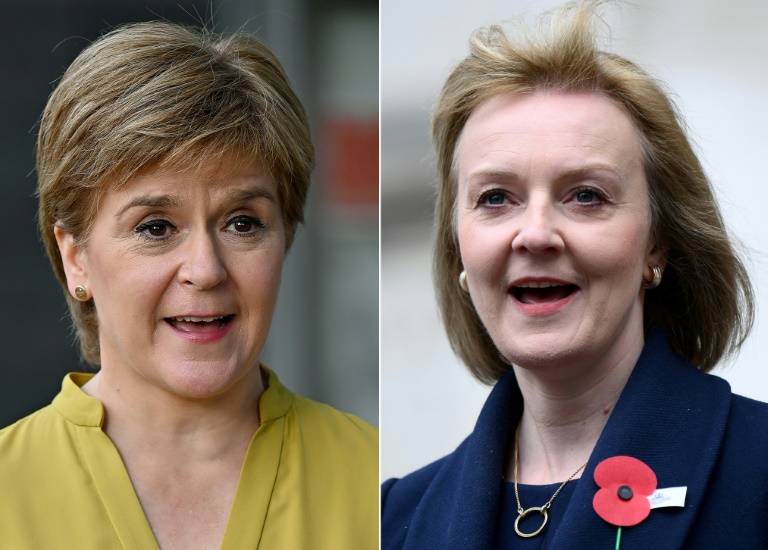
The foreign secretary was accused of insulting the government in Edinburgh after she alleged First Minister Nicola Sturgeon was an “attention seeker” for agitating for Scottish independence, and recommended to “ignore her”.

The provocative remarks, delivered at a Tory member hustings in southwest England late Monday, were denounced by the Scottish National Party (SNP), which is pressing for a second referendum on independence.

John Swinney, Sturgeon’s deputy as first minister of Scotland, called the remarks “obnoxious” and contrasted the roughly 200,000 Tory members with the 2.4 million votes the SNP won in elections last year.

“Nicola Sturgeon has far more democratic legitimacy than Liz Truss is going to have if she becomes the prime minister,” he told BBC television.

“And I think Liz Truss has absolutely no right or foundation to make these remarks,” Swinney said, arguing her “silly, intemperate intervention” had made the case itself for Scotland to go its own way.

Former finance minister Rishi Sunak, Truss’s rival in the race to succeed Prime Minister Boris Johnson, has also ruled out another referendum, after Scots voted narrowly in 2014 to stay in the UK.

Last week, Sunak called it “the wrong priority at the worst possible moment”. 

But the SNP argues that Brexit has transformed the constitutional debate, and wants to hold a second plebiscite in October 2023.

The Supreme Court in London plans to hold hearings on October 11-12 this year on whether that would be legal without approval from the UK government, which by then will be led by Truss or Sunak.

“Keeping the UK together means confronting nationalism and beating them at the ballot box. Only I have a plan to do this,” Sunak said, after winning the endorsement of 10 Scottish Conservative colleagues.

– ‘Wilful misrepresentation’ –

Truss, however, already has the backing of big hitters in Johnson’s outgoing cabinet after initially building a strong poll lead on her promises of immediate tax cuts to address a cost-of-living crisis in Britain.

But as Tory members begin voting by post and online this week, a new survey reported by The Times said her lead had narrowed from more than 20 points to just five: 48 percent to 43 percent. 

The result of the election is due on September 5.

Both candidates have been issuing daily pledges of policy changes in a bid to turn a page on the Johnson government and address Britons’ economic fears.

They have also been trying to curry favour with right-wingers in the Tory rank and file. 

Truss outlined the creation of “regional pay boards” outside London for public-sector pay, rather than a uniform rate set nationally, as part of a plan to wage “war on Whitehall waste”.

The plan could save £8.8 billion ($10.75 billion) a year if it covered “all public-sector workers in the long term”, her campaign said late Monday.

That drew a storm of criticism from Tories in more deprived regions of England, noting that all state workers would include nurses, teachers and police officers already suffering from the spiral in inflation.

Despite its clear language, a Truss campaign spokesperson alleged Tuesday the plan had been subject to “wilful misrepresentation”, insisting in an apparent U-turn that there was no plot to slash the pay of any public-sector workers.

Truss’s remarks about the leader of the UK’s second-biggest nation meanwhile revived criticism that she lacks judgment, as when encouraging Britons to fight in Ukraine at the start of Russia’s invasion.

And many pointed to Truss’s own high profile on social media and repeated invocation of Margaret Thatcher, the Conservative premier throughout the 1980s, in photo opportunities such as when she posed atop a tank.

Best-selling author Philip Pullman tweeted: “Has any politician ever, anywhere, shown less self-awareness than Liz Truss calling Nicola Sturgeon ‘attention-seeking’?”

Markets drop over China-US tensions

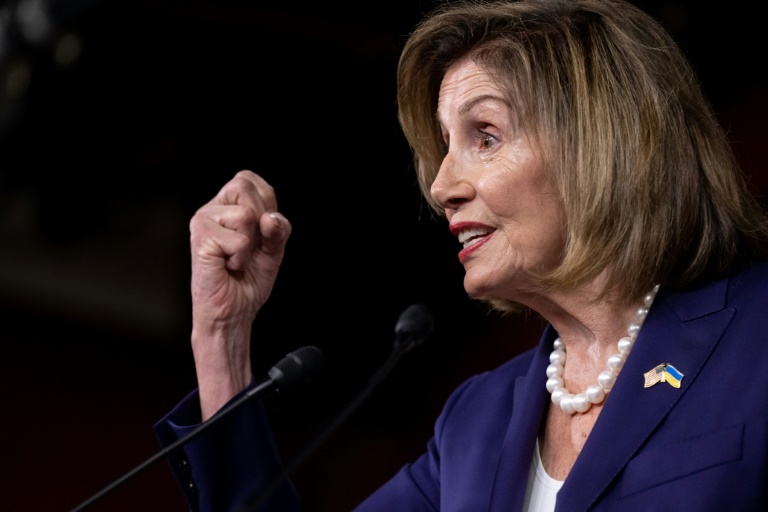
Stock markets fell Tuesday as investors dumped risky equities on spiking US-China tensions over a possible visit by House Speaker Nancy Pelosi to Taiwan.

Traders were already skittish after a string of data showed economies beginning to take a hit from surging inflation and central bank interest rate hikes aimed at taming prices.

A possible meeting between Pelosi and Taiwanese President Tsai Ing-wen is sure to anger Beijing, which views the island as its territory and has said the White House was playing “with fire”.

While observers do not think the move will spark a conflict, US officials said China was preparing possible military provocations that could include firing missiles in the Taiwan Strait or “large-scale” incursions into Taiwan’s airspace.

Heightened tensions between the world’s two superpowers have sent shivers through trading floors, compounding worries that Russia’s invasion of Ukraine could escalate into a wider war.

– Investors ‘very nervous’ –

“We’re seeing more risk aversion as Nancy Pelosi’s trip to Taiwan generates numerous unsettling headlines at a time of strained ties between the US and China,” said OANDA analyst Craig Erlam.

“Pelosi’s proposed visit has been met with numerous threats from Beijing including an unspecified military response,” he said, adding that the reported trip was “making investors very nervous”.

Reports of the visit hit US stocks, with all three main indexes dropping at the start of trading Tuesday.

Asian stocks also fell earlier, though some markets recovered as the day wore on.

Hong Kong and Shanghai led losses, shedding more than two percent, while Taipei was off more than one percent along with Tokyo.

In Europe, Frankfurt was down 0.2 percent and Paris by 0.2 percent, while only London was up 0.1 percent after oil giant BP announced soaring profits.

“Objectively, given the potential seriousness of some kind of confrontation with China, the market is not reacting with abject fear about the outcome,” said market analyst Patrick O’Hare at Briefing.com.

The safe-haven yen jumped to a two-month high against the dollar.

The Taiwan dollar meanwhile sank to its lowest since April 2020 before bouncing back.

– Rising rates –

The flare-up in tensions comes less than a week after US President Joe Biden and Xi Jinping held phone talks during which the Chinese leader warned the United States not to “play with fire”.

The market selloff comes as investors try to assess the outlook for the global economy as leaders try to bring down sky-high inflation by lifting rates while at the same time maintaining growth.

Australia’s central bank raised its central interest rate for a fourth time by another 50 basis points Tuesday.

The Bank of England is also under pressure to make a more aggressive rate hike of 50 basis points this Thursday.

Oil prices extended Monday’s steep losses that were fuelled by falling demand expectations.

– Key figures at around 1330 GMT –

London – FTSE 100: UP 0.1 percent at 7,427.40 points

Frankfurt – DAX: DOWN 0.2 percent at 13,448.47

Paris – CAC 40: DOWN 0.2 at 6,418.47

EURO STOXX 50: DOWN 0.5 percent at 3,687.71

New York – Dow: DOWN 0.5 percent at 32,625.40

Tokyo – Nikkei 225: DOWN 1.4 percent at 27,594.73 (close)

Hong Kong – Hang Seng Index: DOWN 2.4 percent at 19,689.21 (close)

Shanghai – Composite: DOWN 2.3 percent at 3,186.27 (close)

Taipei – TAIEX: DOWN 1.6 percent at 14,747.23 (close)

Dollar/yen: DOWN at 131.05 yen from 131.61 yen Monday

Euro/dollar: DOWN at $1.0234 from $1.0262

Pound/dollar: DOWN at $1.2236 from $1.2255

Euro/pound: UP at 83.62 pence from 83.70 pence

Brent North Sea crude: DOWN 0.1 percent at $99.84 per barrel

West Texas Intermediate: DOWN 0.1 percent at $93.74.28 per barrel

burs-raz/lth

First Ukrainian grain shipment since invasion heads to Istanbul

The first shipment of Ukrainian grain to leave Odessa since Russia’s invasion is expected in Istanbul “after midnight”, Ankara said Tuesday, under a landmark deal to lift Moscow’s naval blockade in the Black Sea.

As the cargo vessel carrying the long-awaited consignment hugged the Bulgarian coastline, Kyiv announced it had begun mandatory evacuations from the war-torn Donetsk region at the heart of the Kremlin’s gruelling assault. 

In Moscow, Russia’s supreme court labelled Ukraine’s Azov regiment a “terrorist” organisation in a move that could pave the way for fighters captured by the Kremlin to face lengthy jail terms.

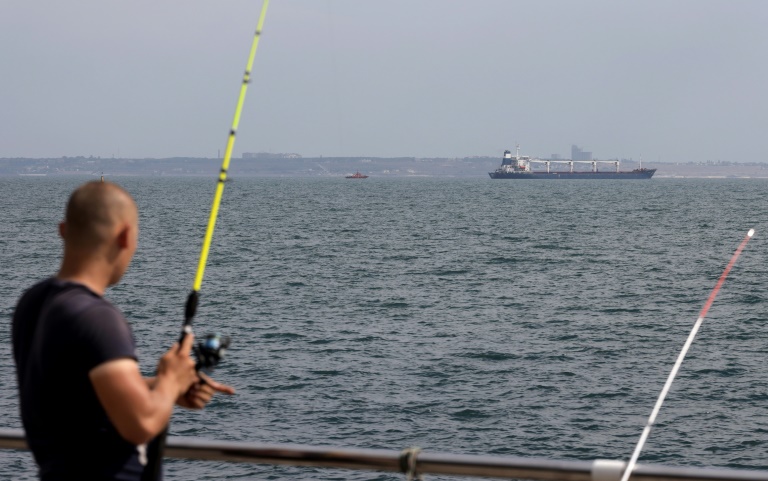
The Sierra Leone-registered ship, Razoni, set sail from Odessa for Lebanon Monday under an accord brokered by Turkey and the United Nations aimed at getting millions of tonnes of trapped produce to world markets and curb a global food crisis.

Turkish officials said it would arrive in Istanbul “after midnight”. 

The ship had cautiously made its way through a specially cleared corridor in the mine-infested waters of the Black Sea. 

The Marine Traffic website showed the vessel — which is carrying 26,000 tonnes of maize — off the coast of Bulgaria by 1200 GMT. 

It will be inspected by a special coordination centre involving representatives of Ukraine, Russia, Turkey and the UN at sea in the mouth of the Bosphorus before being allowed to progress.

The five-month halt of deliveries from Ukraine — one of the world’s biggest grain exporters — has contributed to soaring food prices, hitting the world’s poorest nations especially hard.

Kyiv says at least 16 more grain ships are waiting to depart.

“Let’s wait and see how the agreement works and whether security will be really guaranteed,” Zelensky said in a video address late Monday. 

The breakthrough pact signed in July was the first significant accord involving Ukraine and Russia since Moscow invaded its neighbour on February 24.

– Donetsk evacuations –

Yet Russia has continued to pound cities and towns across Ukraine’s sprawling front line.

Kyiv said it had started mandatory evacuations from the eastern region of Donetsk bearing the brunt of the Russian offensive after Zelensky urged the estimated 200,000 remaining residents to leave. 

Ukrainian Deputy Prime Minister Iryna Vereshchuk said a train carrying “women, children, elderly people, many people with reduced mobility” arrived in the central city of Kropyvnytskyi on Tuesday morning.

More than 130 people were evacuated from the Donetsk region, governor Pavel Kyrylenko said.

Officials have said they want to get residents out of the battered region before the start of winter as gas pipes for heating have been severed.

In the south of the country, the head of Ukraine’s Kryviy Rig military administration said Russian shelling had killed two civilians in a minibus trying to leave the Moscow-controlled Kherson region.

Oleksander Vilkul said two other passengers were in serious condition in hospital with burns. 

The mayor of the city of Mykolaiv, the closest to where Ukrainian forces are looking to launch a counter-offensive in Kherson, said Russian strikes had damaged a university dormitory. 

– More Western arms –

He said in a briefing that 403 people had been killed in his region since the invasion but added that a looming Ukraine counter-offensive for the neighbouring Kherson region “will result in a decrease of shelling”.

Ukraine was bolstered by more supplies of Western arms — particularly long-range artillery — as it looks launch a major push in the south to retake Kherson.

The United States announced a new tranche of weapons worth $550 million for Ukraine’s forces, including ammunition for increasingly important rocket launchers and artillery guns.

“Our artillerymen are ready to turn night into day to expel the Russian invaders,” Ukraine’s Defence Minister Oleksiy Reznikov said.

In Moscow meanwhile, Russia paved the way for handing tough prison sentences to captured members of Ukraine’s Azov regiment. 

Fighters from Azov were among 2,500 Ukrainian soldiers who surrendered in May after weeks of fierce resistance at the Azovstal steel plant in devastated Mariupol. 

The regiment — which was incorporated into Ukraine’s national guard in 2014 — is demonised by Moscow for alleged far-right links. 

It members were among 50 Ukrainian servicemen killed last week in an attack on a jail holding prisoners of war in Russian-occupied territory. 

Ukraine has accused Moscow of deliberately executing the detainees, while Russia says Ukrainian forces hit the facility with missiles. 

Azov, in response to the Russian court ruling, called on the US and other countries to recognise Russia as a “terrorist state”. 

China warns US will 'pay the price' if Pelosi visits Taiwan

The United States will “pay the price” if House Speaker Nancy Pelosi visits Taiwan during her Asia trip, China warned Tuesday, as tensions between the two superpowers continued to soar.

The prospect of Pelosi going to Taipei, which would be the highest-profile visit by an elected US official in 25 years, has triggered increasingly bellicose warnings from Beijing that have set the region on edge.

Pelosi, 82, has yet to officially confirm whether Taiwan is part of an ongoing Asia tour but US and Taiwanese media have reported it will happen.

“The US side will bear the responsibility and pay the price for undermining China’s sovereign security interests,” foreign ministry spokeswoman Hua Chunying said at a regular press briefing in Beijing.

Chinese Foreign Minister Wang Yi said “the US breach of faith on the Taiwan issue is despicable” in comments published on his ministry’s website Tuesday that did not specifically mention Pelosi.

Beijing considers self-ruled, democratic Taiwan its territory and has vowed to one day seize the island, by force if necessary. 

It tries to keep Taiwan isolated on the world stage and opposes countries having official exchanges with it. 

In a call with US President Joe Biden last week, Chinese President Xi Jinping warned the United States against “playing with fire” on Taiwan.

While the Biden administration is understood to be opposed to a Taiwan stop, White House National Security Council spokesman John Kirby said Pelosi was entitled to go where she pleased. 

“There is no reason for Beijing to turn a potential visit consistent with longstanding US policies into some sort of crisis,” he told reporters.

The last House Speaker to visit Taiwan was Newt Gingrich in 1997.

Kirby cited intelligence that China was preparing possible military provocations.

He said Pelosi was travelling on a military aircraft and that while Washington did not fear a direct attack, it “raises the stakes of a miscalculation”.

Kirby reiterated, however, that US policy was unchanged toward Taiwan.

This means support for its self-ruling government, while diplomatically recognising Beijing over Taipei and opposing a formal independence declaration by Taiwan or a forceful takeover by China.

Meanwhile, Moscow said it was “absolutely in solidarity with China”, calling the prospect of a Pelosi visit “pure provocation”. 

China has refused to condemn Russia’s invasion of Ukraine and has been accused of providing diplomatic cover for the Kremlin by blasting Western sanctions and arms sales to Kyiv.

– All eyes on Taiwan –

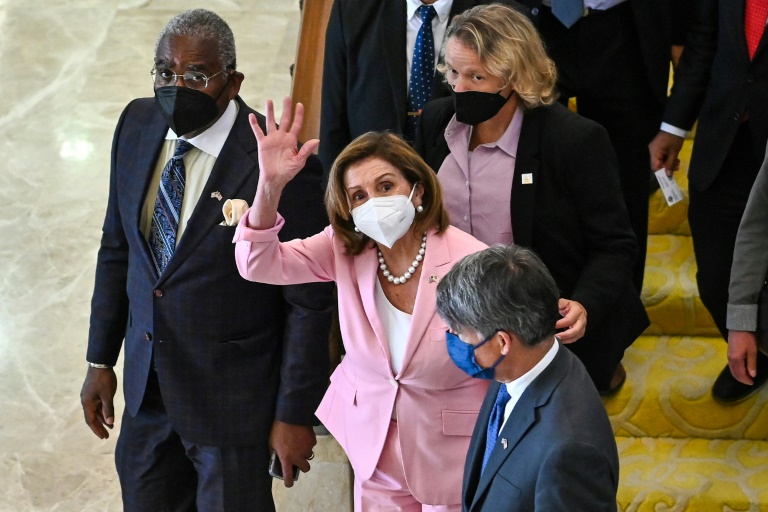
Pelosi arrived in Kuala Lumpur on Tuesday where she met Malaysian Prime Minister Ismail Sabri and Foreign Minister Saifuddin Abdullah.

Press access around Pelosi has been tightly restricted and limited to a handful of short statements confirming meetings with Malaysian and Singaporean officials.

The remainder of her itinerary includes stops in South Korea and Japan — but the prospect of a Taiwan trip has dominated attention.

Taipei has kept silent on whether they expect to roll out the red carpet.

Multiple Taiwanese media outlets carried comments from deputy parliament speaker Tsai Chi-chang saying Pelosi was “very likely” to visit in the coming days.

And Taiwan’s Liberty Times newspaper cited unnamed sources as saying she would land Tuesday night, then meet President Tsai Ing-wen the next day before departing in the afternoon.

On Tuesday evening, Taiwan’s presidential office said its website was briefly offline for 20 minutes because of a DDoS attack that was halted. It was not clear why, but the office said it would up its monitoring in the face of “hybrid information warfare by external forces”.

– ‘Seek to punish Taiwan’ –

The island nation’s 23 million people have long lived with the possibility of an invasion, but that threat has intensified under Xi, China’s most assertive leader in a generation.

The island’s military on Tuesday said it was “determined” to defend it against increased threats by China over the potential Pelosi visit.

“The probability of war or a serious incident is low,” tweeted Bonnie Glaser, director of the Asia programme at the US-based German Marshall Fund think tank.

“But the probability that… (China) will take a series of military, economic, and diplomatic actions to show strength & resolve is not insignificant,” she added.

“Likely it will seek to punish Taiwan in myriad ways.”

Taipei’s Council of Agriculture said on Tuesday that China had suspended the import of some Taiwanese goods, including some fishery products, tea and honey. The council said China cited regulatory breaches.

Pelosi’s potential visit has been preceded by a flurry of military activity across the region that highlights how combustible the issue of Taiwan is.

Last week, both Taiwan and China held live-fire drills.

The US has maintained a navy presence in the region, including the usually Japan-based aircraft carrier USS Ronald Reagan which sailed through the South China Sea last week. 

The Seventh Fleet’s official Twitter reported Tuesday that the aircraft carrier was now in the Philippine Sea.

Close Bitnami banner
Bitnami