World

Tunisia library races to preserve rich polyglot press archive

In the basement of the National Library of Tunis, conservator Hasna Gabsi combs through shelves of newspapers dating back to the mid-19th century to select the latest to digitise.

She picks out a yellowed copy of an Arabic-language newspaper printed in the 1880s, then walks to the sections containing French, Italian, Maltese and Spanish-language newspapers published in Tunisia.

“The archive is a witness to an important, historical culture,” Gabsi said under the flickering neon lights.

The library’s collection includes some 16,000 titles printed in Tunisia — numbering hundreds of thousands of editions of newspapers and periodicals.

As part of a campaign to preserve the country’s archives, the library staff have been working to digitise the documents.

Most of the newspapers are in Arabic, with the oldest from the mid-19th century when Tunisia was an Ottoman province.

After France occupied Tunisia in 1881, European settlers published periodicals in several languages, including French, Italian, Spanish and Maltese.

Some publications are even in Judeo-Arabic, a local Arabic dialect written in the Hebrew alphabet.

Gabsi selects a copy of Voix d’Israel, a Hebrew-language newspaper printed by Tunisia’s Jewish community, which numbered around 100,000 when the country gained independence from France in 1956.

Further along the shelves, she picks out L’Unione, published in 1886 by an Italian community that would number some 130,000 by the middle of the following century.

Nearby, technicians use huge scanners to digitise the newspapers and other documents, which have been made available to the public online since May.

The library’s director Raja Ben Slama has brought together a team of around 20 employees to accelerate the process.

She said the importance of preserving the newspapers was clear to her when she arrived in 2015.

“We are in a race against time with the elements against the deterioration of the periodicals,” she said.

Some of them “can’t be found anywhere else”, she added.

Many of the publications have disappeared, particularly those published in Italian, Hebrew and Maltese.

Economic woes and tensions sparked by the Arab-Israeli conflict led to the departure of most of the country’s Jewish community, while most Italians left in the years after independence.

For historian Abdessattar Amamou, the archives are rare in the region, reflecting the “mosaic” of different communities that were present in the North African country.

“At the dawn of independence, we were three million people — but with that came a huge richness on the level of the press,” Amamou added.


Syria's last traditional boat-makers keep ancient craft afloat

Khaled Bahlawan hammers nails into a traditional wooden boat he built by hand, toiling under the scorching sun on Syria’s Mediterranean coast to preserve a disappearing ancient skill.

“We are the last family that makes wooden ships and boats in Syria,” said the 39-year-old on the shores of Arwad island, near the city of Tartus.

“This is the legacy of our ancestors… We are fighting to preserve it every day”.

Located about three kilometres (less than two miles) off the coast, Arwad is Syria’s only inhabited island and a haven of peace in a country torn by 11 years of war.

Hundreds of workers, residents and visitors commute to and from there every day in wooden boats, mostly built by the Bahlawan family.

But demand for a craft that dates back to ancient Phoenician times has dropped to all but a trickle.

The eight members of the Bahlawan family now share the work, making boats for fishermen, resorts and passenger transport.

The tradition of building and repairing wooden boats has been in their family for hundreds of years.

Long power cuts due to years of conflict mean that Bahlawan cannot use his electrical equipment.

Instead he works with his grandfather’s manual tools, smoothing the wood by hand rather than with an electric plane.

“It’s a hard task,” he said, standing inside the hull of a boat and tapping each nail carefully.

He heads to his narrow, open-air workshop near the beach every day, despite the low demand and modest means.

“We are doing our best to overcome difficulties,” said Bahlawan, his face covered in sweat and sporadic wood shavings.

– ‘Historic responsibility’ –

Boat-building has been a village tradition since Phoenician times, said Noureddine Suleiman, who heads the Arwad municipality.

In the past, the majority of Arwad’s residents were boat-makers, he said.

“Today, only the Bahlawan family remains,” he said.

Thousands of years ago the Phoenicians, renowned for their ship and boat-making, laid the foundations of marine navigation.

The skilled sailors and traders roamed the seas, bringing their knowledge, craftsmanship and their alphabet to other parts of the Mediterranean.

But traditional boat-making now risks disappearing altogether, Suleiman warned, as young people emigrate or search for easier, more profitable work.

Farouk Bahlawan, Khaled’s uncle, said his family had preserved the original shape and structure of ancient Phoenician boats, with a few modifications. 

“We mainly make ships from eucalyptus and mulberry wood from the Tartus forests,” said the 54-year-old, a skilled carpenter.

Young children played hide-and-seek in the boats’ hulls at the workshop, while an elderly man smoked in the shade of a large ship.

Close by, more than 40 wooden boats were moored at the Arwad port.

“We used to manufacture four big ships and several boats every year that we would export to Cyprus, Turkey and Lebanon,” Farouk Bahlawan said.

 “This year, we only worked on one ship, and it still needs a lot of work before it is done.”

He gazed at the beach, where the children ran in the sand.

“We must continue this journey,” he said, his voice welling up with emotion. “We bear a historic responsibility on our shoulders.”

Alibaba shares extend losses on US delisting fear

Chinese e-commerce giant Alibaba led technology stocks lower in Hong Kong on Monday after US authorities put it on a watchlist that could see it delisted in New York if it does not comply with disclosure orders.

The market heavyweight sank more than five percent in early trade, pushing it to its lowest level since May and dragging the Hang Seng Tech Index with it. 

The US securities watchdog on Friday said it added the Chinese firm to a list of more than 250 others that could be booted from Wall Street — where it listed in 2014 — if strict auditing requirements were not met for three consecutive years.

The announcement comes as tensions between Washington and Beijing are dragged lower by a range of issues including technology, human rights and Taiwan.

It also follows a report last week that founder Jack Ma plans to give up control of Ant Group as part of a strategy to appease Chinese regulators and revive the digital payments unit’s initial public offering.

The firm has come under intense pressure from a crackdown on the tech sector by Chinese authorities for more than a year, sending its share price plunging about 70 percent from its record high in late 2020.

It was hit with a record $2.75 billion fine in April 2021 for anti-competitive practices.

Earlier this year, Alibaba removed all executives linked to Ant from Alibaba Partnership, a group that can nominate the majority of Alibaba’s board.

Reports about Ma’s decision wiped out Alibaba’s gains from earlier in the week, when the firm announced it would seek a primary listing in Hong Kong to better access China’s vast pool of investors.

The selling — it sank more than 10 percent in New York — was made worse by concerns about Alibaba’s upcoming earnings report, which many fear will show its first ever drop in quarterly revenue.

Myanmar junta extends state of emergency

Myanmar’s military government has extended a state of emergency by six months, state media said Monday, with the junta chief saying elections could only take place when the conflict-wracked country was “stable and peaceful”.

Min Aung Hlaing, who led last year’s coup, requested the military government to “allow him to serve for an additional 6 months”, according to a report in the Global New Light of Myanmar.

Members of the junta’s National Defence and Security Council “unanimously supported the proposal”, it said.

The junta declared a state of emergency after ousting Aung San Suu Kyi’s government in February last year and plunged the country into turmoil.

It has previously said elections would be held and the state of emergency lifted by August 2023 — extending the initial one-year timeline it announced days after the coup.

The army has justified its power grab by alleging massive fraud during the 2020 elections in which Suu Kyi’s National League for Democracy (NLD) trounced a military-backed party.

Last year, it cancelled the results of the polls, saying it had uncovered more than 11 million instances of voter fraud.

International observers said the voting was largely free and fair.

Suu Kyi has been detained since the coup and faces an eclectic raft of charges that could see her jailed for more than 150 years. 

In a speech broadcast on Monday, Min Aung Hlaing did not mention a date for fresh polls but said they could only be held when the country was “peaceful and stable”.

He also said “reform” to the country’s electoral system was needed, including combining the first-past-the-post system — under which Suu Kyi’s NLD has won sweeping majorities — with proportional representation.

The influence of “powerful parties” had previously stifled other political voices in the country, he said.

The junta chief also invited the leaders of a number of the country’s established ethnic rebel groups for a second round of face-to-face meetings.

Myanmar has about 20 ethnic rebel armies — many of which control swathes of remote border territory, and have fought each other and the military for decades.

Some have condemned the coup and offered shelter and weapons training to the “People’s Defence Forces” (PDFs) that have sprung up since the putsch, and which analysts say have surprised the military with their effectiveness.

Several ethnic rebel groups attended a first round of “peace talks” with the junta in May, although groups fighting alongside anti-junta rebels stayed away.

Year's largest fire burns through dry terrain to destroy California homes

The largest fire in California this year is forcing thousands of people to evacuate as it destroys homes and rips through the state’s dry terrain, whipped up on Sunday by strong winds and lightning storms.

The McKinney Fire was zero percent contained as it burned in Klamath National Forest in northern California, CalFire said, spreading more than 51,000 acres near the city of Yreka.

It is the largest wildfire in California so far this year, with the state already battling several blazes this summer. 

California Governor Gavin Newsom declared a state of emergency Saturday, saying the fire had “destroyed homes” and “threatened critical infrastructure” after breaking out on Friday.

The fire was “intensified and spread by dry fuels, extreme drought conditions, high temperatures, winds and lightning storms,” Newsom said in a statement. 

More than 2,000 residents were under evacuation orders and some 200 under evacuation warnings, according to the California Office of Emergency Services (OES), mostly in Siskiyou County. 

“Surrounding areas should be ready to leave if needed. Please don’t hesitate to evacuate,” the Siskiyou County Sheriff tweeted. 

Highway 96 and McKinney Creed Road southwest of the Klamath River were closed to the public, CalFire said. 

Yreka resident Larry Castle told the Sacramento Bee newspaper that he and his wife had packed up a few possessions and their three dogs to leave the area for the night, as other fires in recent years had taught them the situation could turn “very, very serious.”

Nearly 650 people working to douse the blaze as of Sunday, the National Wildfire Coordinating Group said. 

Fire fighting forces were sent from nearby Oregon to assist in containment efforts, the Oregon State Fire Marshall said, as the Klamath National Forest also deals with the Kelsey Creek Fire. 

The record-breaking blaze sparked just days after the year’s previous largest fire raged in central California. 

The Oak Fire near Yosemite National Park broke out in mid-July and spread rapidly, destroying 41 buildings and forcing thousands to evacuate.

California, which is facing a punishing drought, still has months of fire season ahead of it.

In recent years, California and other parts of the western United States have been ravaged by huge and fast-moving wildfires, driven by a warming climate.

Unit of Chinese property giant Evergrande ordered to pay $1.1 billion

A unit of embattled Chinese developer Evergrande has failed to repay its loans and must pay a guarantor $1.1 billion, the company said in a Hong Kong stock exchange filing.

Evergrande has been involved in restructuring negotiations after racking up $300 billion in liabilities in the wake of Beijing’s crackdown on excessive debt and rampant speculation in the real estate sector.

The announcement comes after the company failed to publish a “preliminary restructuring proposal” by the end of July, despite assuring creditors it was on track to meet the deadline.

Evergrande said Friday it had made “positive progress” in its restructuring process, floating the potential use of equity in its offshore subsidiaries to repay bondholders but falling short of providing concrete details.

And on Sunday, the company said subsidiary Evergrande Group (Nanchang) had failed to fulfil its debt obligations to an unnamed third party. 

Evergrande Nanchang had provided counter-guarantees in the form of a pledge of 1.3 billion shares in Shengjing Bank that it held, according to the filing.

“As the borrowers failed to repay the loans, the applicant carried out its obligations under the guarantee and claimed against the subsidiary,” it said.

It noted that the guarantor has priority to receive compensation from the sale of the shares, and that the scope covers the amount paid by the applicant (7.3 billion yuan).

Evergrande, a major name in China’s property sector, has in recent months scrambled to offload assets, with chairman Hui Ka Yan paying some of its debts using his personal wealth.

It has since found a potential buyer for its Hong Kong headquarters, according to media reports.

Its woes are emblematic of the problems rippling across China’s massive property sector, with smaller companies also defaulting on loans and others struggling to raise cash.

With developers strapped for finances and projects stalling, furious homebuyers in dozens of cities have also begun refusing to pay their mortgages.

“The central government needs to take strong and credible measures to ensure stalled projects are finished and delivered” to restore confidence, said Andrew Batson of Gavekal Dragonomics in a recent report.

“The problem is mostly a political one: the leadership has committed significant political capital to strict property policies over the past few years,” he added.

“Can the government accept the embarrassment of such an obvious reversal… probably yes, but the risk is that it takes a while to get there.”

Kentucky flood death toll hits 28 with more bodies expected

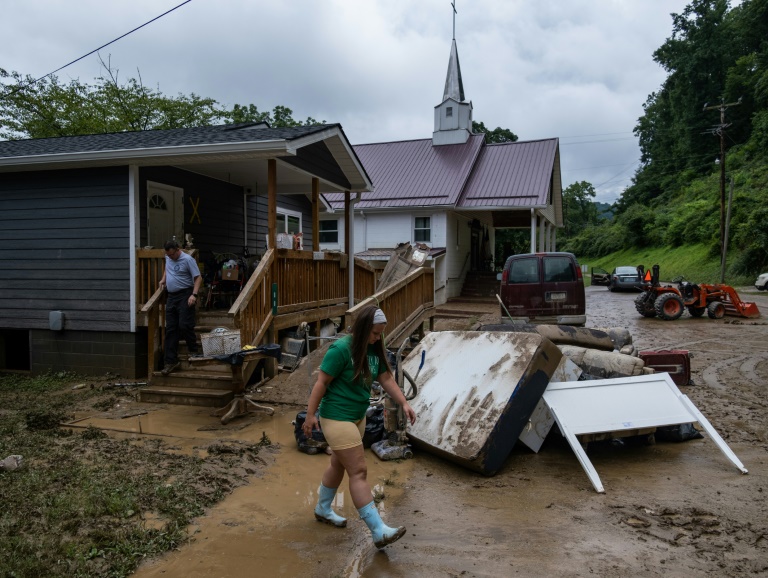
Kentucky’s governor predicted bodies will continue to be found “for weeks” as the death toll from devastating flooding rose Sunday to 28 and rescuers embarked on a long and grueling effort to locate victims.

Some areas in the mountainous region are still inaccessible following the flooding in the state’s east that turned roads into rivers, washed out bridges and swept away houses. Off-and-on rain plus poor cell phone service are also complicating rescue efforts.

“This is one of the most devastating, deadly floods that we have seen in our history… And at a time that we’re trying to dig out, it’s raining,” Governor Andy Beshear told NBC’s “Meet the Press.”

“We’re going to work to go door to door, work to find, again, as many people as we can. We’re even going to work through the rain. But the weather is complicating it.”

The number of dead in the flooding, caused by torrential rain that began on Wednesday, is expected to rise even further.

“We’re going to be finding bodies for weeks, many of them swept hundreds of yards, maybe a quarter mile-plus from where they were lost,” Beshear said on “Meet the Press.”

The governor toured flooded areas and made stops in three counties on Sunday. Across the rain-soaked portions of the state, more than 350 people are living temporarily in shelters, he said. 

In the town of Jackson, the seat of hard-hit Breathitt County, state, local and federal rescue teams and aid workers fanned out. 

Some were distributing water bottles to those in need. A boat marked “FEMA Rescue 4” sat on a trailer, indicating the presence of federal emergency crews.

Receding floodwaters had left a thick coating of dust on the streets as dark clouds presaged more rain ahead.

Some 35 miles (55 kilometers) south in the tiny community of Buckhorn, volunteers at a distribution center told AFP that 700 to 800 people had come through on Sunday alone to collect donated supplies ranging from food to paper towels and toiletries.

The floods hit a region of Kentucky that was already suffering from grinding poverty — driven by the decline of the coal industry that was the heart of its economy — taking everything from people who could least afford it.

“It wiped out areas where people didn’t have that much to begin with,” Beshear said.

– Threat of more flooding –

Some areas in eastern Kentucky reported receiving more than eight inches (20 centimeters) of rain in a 24-hour period.

The water level of the North Fork of the Kentucky River at Whitesburg rose to a staggering 20 feet within hours, well above its previous record of 14.7 feet.

The National Weather Service’s Weather Prediction Center warned of the potential for flooding in a swath of the United States, including central and eastern Kentucky, into Monday.

“The threat of flash flooding will continue through the afternoon and early evening hours from showers and thunderstorms with very heavy rainfall rates,” it said in a forecast.

President Joe Biden has issued a disaster declaration for the Kentucky flooding, allowing federal aid to supplement state and local recovery efforts.

The eastern Kentucky flooding is the latest in a series of extreme weather events that scientists say are an unmistakable sign of climate change.

Nearly 60 people were killed in western Kentucky by a tornado in December 2021 — a disaster that Beshear said offered lessons for current efforts on the other end of the state.

“We learned a lot of lessons in western Kentucky on those devastating tornados about seven months ago, so we are providing as much support as we can and we are moving fast from all over the state to help out,” he told CNN on Saturday.

South Ukraine city pounded as Russia says Crimea navy HQ hit by drone

Ukraine said the “brutal” shelling by Moscow so far of the southern city Mykolaiv killed a grain tycoon Sunday, as Russia claimed an attack from a drone wounded six personnel at the headquarters of its Black Sea fleet. 

AFP journalists witnessed intense Russian bombardment of the eastern town of Bakhmut after Ukrainian President Volodymyr Zelensky called for civilians to leave the front line Donetsk region bearing the brunt of the Kremlin’s offensive.

Authorities in Ukraine’s southern city of Mykolaiv said Sunday that widespread Russian bombardments overnight killed at least two civilians.

“Today, one of the most brutal shellings of Mykolaiv and the region over the entire period of the full-scale war took place. Dozens of missiles and rockets,” Ukrainian President Volodymyr Zelensky said in an address.

“I want to thank every resident of Mykolaiv for their indomitability.”

Ukrainian agricultural magnate Oleksiy Vadatursky, 74, and his wife Raisa were killed when a missile struck their house, authorities said.

Vadatursky owned major grain exporter Nibulon and was previously decorated with the prestigious “Hero of Ukraine” award.

Zelensky offered condolences and paid tribute to Vadatursky in his Sunday address.

Mykolaiv — which has been attacked frequently — is the closest Ukrainian city to the southern front where Kyiv’s forces are looking to launch a major counter-offensive to recapture territory lost after Russia’s February invasion. 

– Drone attack –

Russian authorities in the Crimean Black Sea peninsula — seized by Moscow from Ukraine in 2014 — said a small explosive device from a commercial drone, likely launched nearby, hit the navy command in Sevastopol.

The local mayor blamed “Ukrainian nationalists” for the attack that forced the cancellation of festivities marking Russia’s annual holiday celebrating the navy.

But Ukraine’s navy accused Russia of staging the attacks as a pretext to cancel the festivities.

The claim and counterclaim came as the dispute over which side struck a jail holding Ukrainian prisoners of war in Kremlin-controlled Olenivka, rumbled on, with Kyiv and Moscow trading blame. 

Russia’s defence ministry said Sunday it had invited the International Committee of the Red Cross (ICRC) and the United Nations to visit the site “in the interests of an objective investigation”. 

But the ICRC said Sunday it had yet to receive approval to enter the site.

Russia’s military said 50 Ukrainian servicemen died, including troops who had surrendered after weeks of resisting the bombardment of the Azovstal steelworks in the port city of Mariupol.

Ukraine says Russia was behind the attack, with Zelensky accusing Moscow of the “deliberate mass murder of Ukrainian prisoners of war”.

– Intense bombardments –

AFP journalists on Sunday saw one wounded man collected by an ambulance after a ferocious bombardment of the town of Bakhmut in the Donetsk region where Russia is focusing its firepower.

Zelensky warned on the weekend that thousands of people, including children, were still in Donetsk’s battleground areas.

He urged people to leave the besieged region, echoing calls from the authorities in recent weeks to evacuate.

“Leave, we will help,” Zelensky said. “At this stage of the war, terror is the main weapon of Russia.”

Official Ukrainian estimates put the number of civilians still living in the unoccupied area of Donetsk at between 200,000 and 220,000.

A mandatory evacuation notice posted Saturday evening said the coming winter made it a matter of urgency, particularly for the more than 50,000 children.

Kateryna Novakivska, a deputy commander of a Ukrainian unit, said she was fighting so her comrades could be reunited with their families.

“The morale of our servicemen is at a high level now, but everyone wants to visit their homes, see their relatives and loved ones,” she said.

The intense bombardments around Ukraine come as the authorities push to restart grain exports under a plan brokered by the UN and Turkey to lift a Russian naval blockade. 

A spokesman for the Turkish presidency said there was a “high probability” that a first ship carrying Ukrainian grain could leave Ukraine on Monday.

South Ukraine city pounded as Russia says Crimea navy HQ hit by drone

Ukraine said the “brutal” shelling by Moscow so far of the southern city Mykolaiv killed a grain tycoon Sunday, as Russia claimed an attack from a drone wounded six personnel at the headquarters of its Black Sea fleet. 

AFP journalists witnessed intense Russian bombardment of the eastern town of Bakhmut after Ukrainian President Volodymyr Zelensky called for civilians to leave the front line Donetsk region bearing the brunt of the Kremlin’s offensive.

Authorities in Ukraine’s southern city of Mykolaiv said Sunday that widespread Russian bombardments overnight killed at least two civilians.

“Today, one of the most brutal shellings of Mykolaiv and the region over the entire period of the full-scale war took place. Dozens of missiles and rockets,” Ukrainian President Volodymyr Zelensky said in an address.

“I want to thank every resident of Mykolaiv for their indomitability.”

Ukrainian agricultural magnate Oleksiy Vadatursky, 74, and his wife Raisa were killed when a missile struck their house, authorities said.

Vadatursky owned major grain exporter Nibulon and was previously decorated with the prestigious “Hero of Ukraine” award.

Zelensky offered condolences and paid tribute to Vadatursky in his Sunday address.

Mykolaiv — which has been attacked frequently — is the closest Ukrainian city to the southern front where Kyiv’s forces are looking to launch a major counter-offensive to recapture territory lost after Russia’s February invasion. 

– Drone attack –

Russian authorities in the Crimean Black Sea peninsula — seized by Moscow from Ukraine in 2014 — said a small explosive device from a commercial drone, likely launched nearby, hit the navy command in Sevastopol.

The local mayor blamed “Ukrainian nationalists” for the attack that forced the cancellation of festivities marking Russia’s annual holiday celebrating the navy.

But Ukraine’s navy accused Russia of staging the attacks as a pretext to cancel the festivities.

The claim and counterclaim came as the dispute over which side struck a jail holding Ukrainian prisoners of war in Kremlin-controlled Olenivka, rumbled on, with Kyiv and Moscow trading blame. 

Russia’s defence ministry said Sunday it had invited the International Committee of the Red Cross (ICRC) and the United Nations to visit the site “in the interests of an objective investigation”. 

But the ICRC said Sunday it had yet to receive approval to enter the site.

Russia’s military said 50 Ukrainian servicemen died, including troops who had surrendered after weeks of resisting the bombardment of the Azovstal steelworks in the port city of Mariupol.

Ukraine says Russia was behind the attack, with Zelensky accusing Moscow of the “deliberate mass murder of Ukrainian prisoners of war”.

– Intense bombardments –

AFP journalists on Sunday saw one wounded man collected by an ambulance after a ferocious bombardment of the town of Bakhmut in the Donetsk region where Russia is focusing its firepower.

Zelensky warned on the weekend that thousands of people, including children, were still in Donetsk’s battleground areas.

He urged people to leave the besieged region, echoing calls from the authorities in recent weeks to evacuate.

“Leave, we will help,” Zelensky said. “At this stage of the war, terror is the main weapon of Russia.”

Official Ukrainian estimates put the number of civilians still living in the unoccupied area of Donetsk at between 200,000 and 220,000.

A mandatory evacuation notice posted Saturday evening said the coming winter made it a matter of urgency, particularly for the more than 50,000 children.

Kateryna Novakivska, a deputy commander of a Ukrainian unit, said she was fighting so her comrades could be reunited with their families.

“The morale of our servicemen is at a high level now, but everyone wants to visit their homes, see their relatives and loved ones,” she said.

The intense bombardments around Ukraine come as the authorities push to restart grain exports under a plan brokered by the UN and Turkey to lift a Russian naval blockade. 

A spokesman for the Turkish presidency said there was a “high probability” that a first ship carrying Ukrainian grain could leave Ukraine on Monday.

Asian markets mixed as traders weigh rates outlook, China data

Asian markets were mixed Monday and oil fell as investors assessed data showing further weakness in China’s economy and comments from Federal Reserve officials showing it was wedded to its campaign of interest rate hikes to fight inflation.

A strong set of earnings from Wall Street titans Amazon and Apple helped US markets end last week with healthy gains and eased concerns about the impact on consumers of surging inflation and rising borrowing costs.

That came after investors took Fed chief Jerome Powell’s post-policy-meeting comments Wednesday as indicating the bank could start to slow down its pace of monetary tightening, providing a much-needed boost to stocks.

However, analysts warned that inflation would take time to come down from its four-decade highs and there were undoubtedly more rate hikes to come.

And officials backed that up at the weekend, with Minneapolis Fed chief Neel Kashkari telling the New York Times that he was “surprised by markets’ interpretation” of the latest Fed meeting statement.

“The committee is united in our determination to get inflation back down to two percent, and I think we’re going to continue to do what we need to do until we are convinced that inflation is well on its way back down to two percent — and we are a long way away from that.”

That came as Atlanta Fed president Raphael Bostic said he did not think the economy was in recession owing to ongoing jobs growth but that inflation remained too high and he was “convinced” more must be done.

Still, Treasuries continued to fall, with the 10-year yield at 2.67 percent, well down from June’s peak near 3.50 percent, suggesting expectations for future rates are easing. 

Figures showing a second successive economic contraction in April-June put the United States in a technical recession but it is not officially considered so until identified as such by the National Bureau of Economic Research.

In early Asian trade, investors struggled to extend Wall Street’s lead, with Hong Kong and Shanghai suffering most after another disappointing reading on the Chinese economy.

The closely watched Purchasing Managers’ Index of manufacturing activity shrank in July on the back of weak demand and the strict zero-Covid measures imposed in parts of the country.

While sweeping Covid curbs have eased in major cities such as Shanghai and Beijing, sporadic lockdowns in various cities and towns have kept businesses and consumers worried.

And there are few signs of an easing of the policy, with officials appearing to emphasise zero-Covid over growth in a Politburo meeting last week.

Adding to weakness in Hong Kong was news that US authorities had put market heavyweight Alibaba on a list of firms threatened with New York delisting if they did not comply with disclosure rules.

There were also losses in Taipei and Manila.

However, Tokyo, Sydney, Seoul, Singapore, Jakarta and Wellington edged up.

The data out of China revived demand concerns on oil markets, sending both main contracts down Monday, following a bounce last week.

Brent and WTI both lost more than one percent, and investors are now eyeing a meeting of OPEC and other major producers this week, where they will discuss their deal to raise output slowly.

Joe Biden called on Saudi Arabia to open the taps further when he visited last month as he tries to address a crucial driver of inflation around the world.

But the kingdom does not appear to have made any such moves so far with the commodity having lost almost all the gains made since Russia’s Ukraine invasion.

“The US has expressed optimism about the potential for an OPEC+ supply response, said SPI Asset Management’s Stephen Innes.

“However, it seems highly unlikely there will be much appetite for a significant increase in production, with Brent still (around) 15 percent down from year-to-date highs and (down) 12 percent in the last month,” he added.

“OPEC+ seems more likely to signal a willingness to continue cooperating long-term, but it would be a surprise if the upcoming meeting resulted in a significant policy shift.”

– Key figures at around 0230 GMT –

Tokyo – Nikkei 225: UP 0.5 percent at 27,933.27 (break)

Hong Kong – Hang Seng Index: DOWN 1.0 percent at 19,948.11

Shanghai – Composite: DOWN 0.3 percent at 3,243.32

Euro/dollar: UP at $1.0238 from $1.0228 Friday

Pound/dollar: UP at $1.2191 from $1.2189 

Euro/pound: UP at 83.98 pence from 83.89 pence

Dollar/yen: DOWN at 132.47 yen from 133.25 yen

West Texas Intermediate: DOWN 1.3 percent at $97.34 per barrel

Brent North Sea crude: DOWN 1.1 percent at $102.85 per barrel

New York – Dow: UP 1.0 percent at 32,845.13 (close)

London – FTSE 100: UP 1.1 percent at 7,423.43 (close)

Close Bitnami banner
Bitnami