World

Fed attacks US inflation with another interest rate hike

The US Federal Reserve on Wednesday again raised the benchmark interest rate by three-quarters of a percentage point in its ongoing battle to tamp down raging price pressures that are squeezing American families.

It was the second straight 75 basis point increase, and the fourth rate hike this year, as US central bankers move aggressively to cool the strongest surge in inflation in more than four decades, without derailing the world’s largest economy.

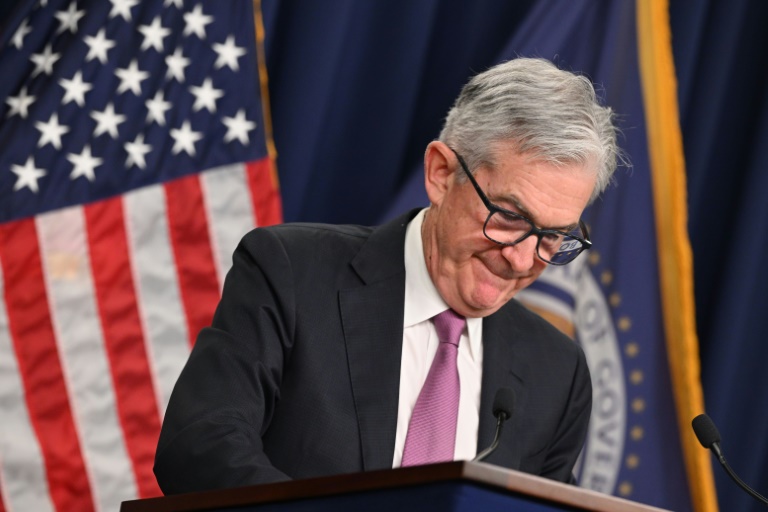
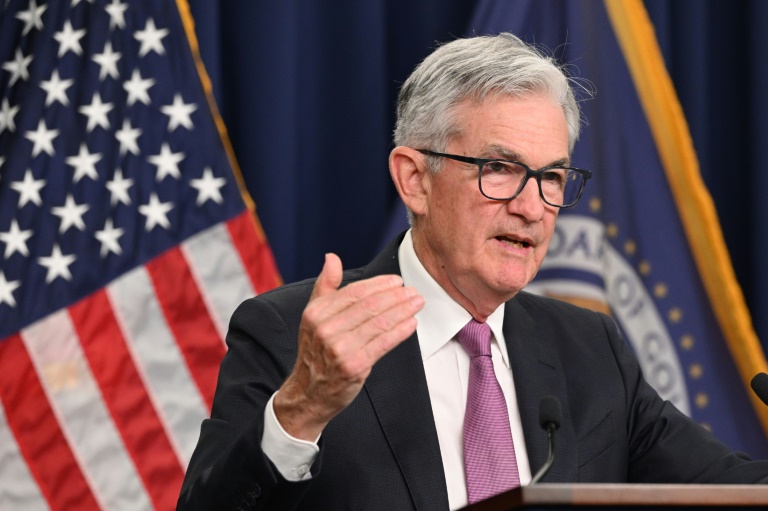
While the Fed noted signs that the US economy is slowing, it signaled plans to continue to increase borrowing costs — and Fed Chair Jerome Powell made it clear an even bigger rate hike is possible.

“Inflation is much too high,” Powell told reporters, saying the Fed will keep raising rates until there is solid evidence that inflation is moving back towards the two percent goal.

Another “unusually large increase could be appropriate” at the next meeting in September, Powell said, stressing that US central bankers “wouldn’t hesitate to make a larger move than we did today” if justified.

President Joe Biden is facing political backlash for surging prices, which he has mainly blamed on the Russian invasion of Ukraine that sent global food and energy prices soaring. 

In a vote that was unanimous — unlike the decision made in June — the Fed’s policy-setting Federal Open Market Committee (FOMC) raised its benchmark lending rate to a range of 2.25 to 2.5 percent, after starting the year near zero.

Economists say this has been the most aggressive Fed tightening cycle since the 1980s, when stagflation — a wage-price spiral and stagnant growth — crippled the US economy. But the Fed chief acknowledged that at some point, policymakers will be able to slow the pace of rate hikes.

Wall Street seemed cheered by Powell’s comments, with solid gains in all three major stock indices, including the blue-chip Dow, which ended with an increase of more than 430 points.

The challenge for policymakers is to quell inflation before it becomes dangerously entrenched — and without sending the world’s largest economy into a recession that would reverberate around the globe.

Powell has made it clear they are willing to risk a downturn.

But on Wednesday, he expressed confidence that the United States can avoid that fate, and the Fed can engineer a “soft landing,” taming inflation without causing a recession.

“We’re trying to do just the right amount. We’re not trying to have a recession and we don’t think we have to,” Powell said.

– Recession risk –

The Fed chair nevertheless acknowledged that the path to thread that needle “has narrowed.”

With government data on second quarter GDP due out Thursday, there is intense focus on whether another negative reading will mean the economy is in recession.

The economy contracted 1.6 percent in the January-March period, and though the consensus forecast calls for modest growth in the latest three months, many economists expect a downturn. 

Two consecutive quarters of negative growth are generally considered a sign the economy is in recession, although that is not the official criteria.

But Powell said he does not think the country is currently in a recession because “there are too many areas of the economy that are performing too well.”

While “it’s necessary to have growth slow down… We think that there’s a path for us to be able to bring inflation down while sustaining a strong labor market.”

US prices have continued to rise, and he lamented the hardships faced by families whose paychecks don’t stretch as far at the grocery store.

But the pace seems to be slowing and gasoline prices at the pump have fallen more than 70 cents from the record of just over $5 a gallon in mid-June.

Meanwhile, rising mortgage rates have slowed housing sales for five straight months, and the FOMC statement noted that “recent indicators of spending and production have softened.”

Policymakers seemed to acknowledge that some factors are beyond their control.

“Russia’s war against Ukraine is causing tremendous human and economic hardship. The war and related events are creating additional upward pressure on inflation and are weighing on global economic activity,” the FOMC statement said.

Nancy Vanden Houten of Oxford Economics still expects another three-quarter-point rate hike at the next policy meeting, but after that, she says, “we look for the Fed to downshift to a slower pace of 25bp rate hikes.”

Other economists are now calling for a smaller, half-point increase.

The Fed will see two more key monthly data releases by then, on employment and consumer prices.

Global fight against HIV 'In Danger' amid resource crunch, says UN

The global fight against HIV has stalled from shrinking resources due to Covid-19 and other crises, according to a new report presented at the International AIDS Conference in Montreal, Canada.

Across the world, new HIV infections fell just 3.6 percent between 2020 and 2021, the smallest annual drop since 2016, said the UNAIDS report, titled “In Danger.”

Some 1.5 million new infections occurred last year –- more than a million over global targets of fighting the virus.

“The response to the AIDS pandemic has been derailed by global crises from the colliding pandemics of HIV and Covid, to the war in Ukraine and the resulting global economic crisis,” UNAIDS executive director Winnie Byanyima told reporters.

New infections climbed in Eastern Europe, Central Asia, the Middle East, North Africa and Latin America, in line with trends over several years.

Asia and the Pacific saw a slight rise, bucking previous declines.

Bright spots included western and central Africa — the latter driven largely by Nigeria — and the Caribbean.

“Covid-19 and other instabilities have disrupted health services in much of the world, and millions of students have been out of school, increasing their HIV vulnerability,” the report said.

Globally, 38.4 million people were living with HIV in 2021, with 650,000 deaths from AIDS-related illnesses.

Young women and adolescent girls were disproportionately impacted, with a new infection occurring in this population every two minutes.

Sub-Saharan Africa still accounts for the majority of new infections — 59 percent in 2021 — but that proportion is decreasing as the decline in new cases slows in the rest of the world.

– Fatigue and Ukraine war – 

The report comes as high-income countries are cutting back aid. 

In 2021, international resources available for HIV were six percent lower than in 2010, with bilateral assistance from the United States down 57 percent over the past decade.

The UN says the HIV response in low- and middle-income countries is $8 billion short of the amount needed by 2025.

Anthony Fauci, the United States’ top infectious disease official, said he was worried that fatigue over HIV was holding back resource allocation.

“When you have the disease that we have been addressing as a community, now over 40 years, even that alone is a tough sell to keep the enthusiasm up,” he said.

With Covid and monkeypox added to the mix, “people are exhausted with epidemics and pandemics, so I think our challenge is we have to fight twice as hard to get HIV back on the radar screen,” he added.

Andriy Klepikov, executive director of the Alliance for Public Health, an AIDS advocacy group in Ukraine, called for special attention to his country in light of the invasion by Russia.

“Over 100,000 people living with HIV are actually living in areas directly affected by the war,” he said, stressing the need for more funds from the United States’ PEPFAR program for HIV as well as from UNAIDS.

– Racial disparities – 

Seventy percent of cases globally were reported in key populations: sex workers and their clients, men who have sex with men, people who inject drugs, and transgender people.

The report also called attention to racial inequality as an exacerbator of HIV risks. 

In the United Kingdom and United States of America, Black people lag white people in declines in new infections. In Australia, Canada and the United States, HIV acquisition rates are higher in Indigenous communities.

The report also showed that access to life-saving treatments is faltering, growing by its slowest rate in over a decade.

Three-quarters of all people living with HIV had access to antiretroviral treatments, but 10 million people do not.

The rate of global new infections has declined since peaking in the mid-1990s, but there is far to go in order to achieve the global goal of ending AIDS by 2030.

“We can end AIDS by 2030, but the curve will not bend by itself,” said Byanyima, urging countries to heed the call to action.

Global fight against HIV 'In Danger' amid resource crunch, says UN

The global fight against HIV has stalled from shrinking resources due to Covid-19 and other crises, according to a new report presented at the International AIDS Conference in Montreal, Canada.

Across the world, new HIV infections fell just 3.6 percent between 2020 and 2021, the smallest annual drop since 2016, said the UNAIDS report, titled “In Danger.”

Some 1.5 million new infections occurred last year –- more than a million over global targets of fighting the virus.

“The response to the AIDS pandemic has been derailed by global crises from the colliding pandemics of HIV and Covid, to the war in Ukraine and the resulting global economic crisis,” UNAIDS executive director Winnie Byanyima told reporters.

New infections climbed in Eastern Europe, Central Asia, the Middle East, North Africa and Latin America, in line with trends over several years.

Asia and the Pacific saw a slight rise, bucking previous declines.

Bright spots included western and central Africa — the latter driven largely by Nigeria — and the Caribbean.

“Covid-19 and other instabilities have disrupted health services in much of the world, and millions of students have been out of school, increasing their HIV vulnerability,” the report said.

Globally, 38.4 million people were living with HIV in 2021, with 650,000 deaths from AIDS-related illnesses.

Young women and adolescent girls were disproportionately impacted, with a new infection occurring in this population every two minutes.

Sub-Saharan Africa still accounts for the majority of new infections — 59 percent in 2021 — but that proportion is decreasing as the decline in new cases slows in the rest of the world.

– Fatigue and Ukraine war – 

The report comes as high-income countries are cutting back aid. 

In 2021, international resources available for HIV were six percent lower than in 2010, with bilateral assistance from the United States down 57 percent over the past decade.

The UN says the HIV response in low- and middle-income countries is $8 billion short of the amount needed by 2025.

Anthony Fauci, the United States’ top infectious disease official, said he was worried that fatigue over HIV was holding back resource allocation.

“When you have the disease that we have been addressing as a community, now over 40 years, even that alone is a tough sell to keep the enthusiasm up,” he said.

With Covid and monkeypox added to the mix, “people are exhausted with epidemics and pandemics, so I think our challenge is we have to fight twice as hard to get HIV back on the radar screen,” he added.

Andriy Klepikov, executive director of the Alliance for Public Health, an AIDS advocacy group in Ukraine, called for special attention to his country in light of the invasion by Russia.

“Over 100,000 people living with HIV are actually living in areas directly affected by the war,” he said, stressing the need for more funds from the United States’ PEPFAR program for HIV as well as from UNAIDS.

– Racial disparities – 

Seventy percent of cases globally were reported in key populations: sex workers and their clients, men who have sex with men, people who inject drugs, and transgender people.

The report also called attention to racial inequality as an exacerbator of HIV risks. 

In the United Kingdom and United States of America, Black people lag white people in declines in new infections. In Australia, Canada and the United States, HIV acquisition rates are higher in Indigenous communities.

The report also showed that access to life-saving treatments is faltering, growing by its slowest rate in over a decade.

Three-quarters of all people living with HIV had access to antiretroviral treatments, but 10 million people do not.

The rate of global new infections has declined since peaking in the mid-1990s, but there is far to go in order to achieve the global goal of ending AIDS by 2030.

“We can end AIDS by 2030, but the curve will not bend by itself,” said Byanyima, urging countries to heed the call to action.

Spirit terminates Frontier deal, says in talks with JetBlue

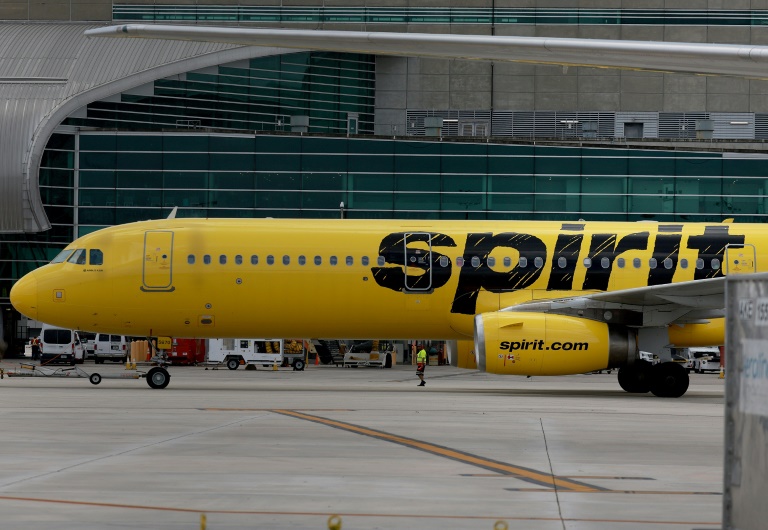
After months of back-and-forth, Spirit Airlines announced Wednesday that it was breaking off a merger with Frontier Group, opening the door to a possible takeover by JetBlue.

The Spirit-Frontier deal, announced in February, was thrown into doubt in early April when JetBlue Airways unveiled its own takeover bid and subsequently launched a hostile takeover bid as smaller carriers try to gain scale to take on the biggest US airlines.

Spirit officials continued to back the Frontier deal, in part due to concerns that the JetBlue offer might face difficulty with antitrust authorities.

But company leaders ran into trouble with Spirit shareholders and repeatedly were forced to postpone an investor vote on the Frontier agreement.

“While we are disappointed that we had to terminate our proposed merger with Frontier, we are proud of the dedicated work of our team members on the transaction over the past many months,” said Ted Christie, chief executive of Spirit in a statement.

“Moving forward, the Spirit Board of Directors will continue our ongoing discussions with JetBlue as we pursue the best path forward for Spirit and our stockholders.”

The most recent bid from JetBlue values Spirit at $3.7 billion, almost a billion more than the value of Frontier.

JetBlue’s bid includes a potential $400 million payment to Spirit if regulators block the takeover.

All three companies have been looking to grow to better compete with the biggest US carriers, American, United, Delta and Southwest.

Boeing sees progress on 787 but warns on supply chain

Boeing said Wednesday it is close to receiving regulatory approval to resume 787 jet deliveries, a move that could help reverse lackluster profits, but warned that its production ramp-up for the 737 MAX would be slowed by supply chain problems.

The US aviation giant’s two most popular commercial planes figured prominently in its mixed quarterly earnings report, with the lack of revenue from the 787 Dreamliner again a big drag.

Shares gyrated before finishing the session slightly higher.

A resumption of 787 deliveries will restore a key source of revenue, but a more protracted 737 MAX ramp-up suggests Boeing won’t deliver as many of those planes as quickly as had been expected.

“A lot of things good happened over the quarter,” said Chief Executive Dave Calhoun, who described the company as “on the verge” of garnering approval from US air safety officials on the 787, though he declined to give a precise target date.

Calhoun reported no sign of overall slowdown in the sector, telling analysts that “this general recession thing so far hasn’t impacted our aviation industry.” 

“Will it at some moment? Maybe,” he said, while noting that air travel appears to have been “prioritized fundamentally to a higher slot” by consumers tired of pandemic restrictions.

– Engine trouble –

Calhoun however warned that the company had no timetable for lifting production of the MAX to 38 per month from the current level of 31, calling “limited” engine capacity a “constraint” on the company’s outlook.

“Some investment has to get made and capacity has to expand for the engine suppliers to keep up with what I believe will be continued robust demand,” Calhoun said.

Boeing Chief Financial Officer Brian West told analysts to expect MAX deliveries in the “low 400s” in 2022 after previously estimating around 500.

For the quarter ending June 30, Boeing reported a 67 percent plunge in quarterly profits to $193 million, as revenues declined 1.9 percent to $16.7 billion.

The company missed analyst estimates for revenues and earnings-per-share, but stock prices initially rose after the report, as Boeing confirmed it still expects to have positive cash flow in 2022.

On the 787, the company has been working with the Federal Aviation Administration to address a series of manufacturing issues uncovered in 2020 and since.

Boeing took a $3.5 billion charge for additional rework costs on the 787 in the fourth quarter of 2021. It said in April it also expects another $2 billion in “abnormal costs” for the 787.

At the end of June, Boeing had 120 Dreamliner planes in inventory and was producing the jet “at very low rates,” the company said in a filing.

On Wednesday, the company said it was working with US air safety officials on “final actions” to resume 787 deliveries. 

– China haze –

The enhanced regulatory scrutiny of the 787 and other Boeing planes comes on the heels of a pair of crashes in 2018 and 2019 on the 737 MAX, which led to a lengthy global grounding of the plane.

But the MAX has since returned to service, enabling Boeing to resume deliveries and announce significant new orders, including at the Farnborough Airshow earlier this month.

But Boeing still has 290 MAX planes in inventory. A key wild card remains when deliveries will resume in China, where the MAX has still not returned to service. 

“While we expect 737 MAX deliveries to our customers in China to resume in 2022, subject to final regulatory approvals, risk remains around the timing and rate of those deliveries,” Boeing said in a securities filing Wednesday.

Despite the latest Farnborough orders, Boeing’s backlog of orders in the pipeline lags that of archrival Airbus, but Calhoun told CNBC Wednesday he is not worried about the difference.

“We don’t need to close that gap,” Calhoun said, adding that the aviation industry is “supply constrained for as far as I can see.”

Boeing’s job is “to deliver against our backlog,” he said. “My job is to make sure I’ve got a big enough backlog to continue to increase my rate, stay stable in production and satisfy our customers every step of the way.”

Shares fell during the conference call, but recovered later and finished at $156.09, up 0.1 percent.

Resuming talks with Russia, Blinken offers 'substantial' deal on prisoners

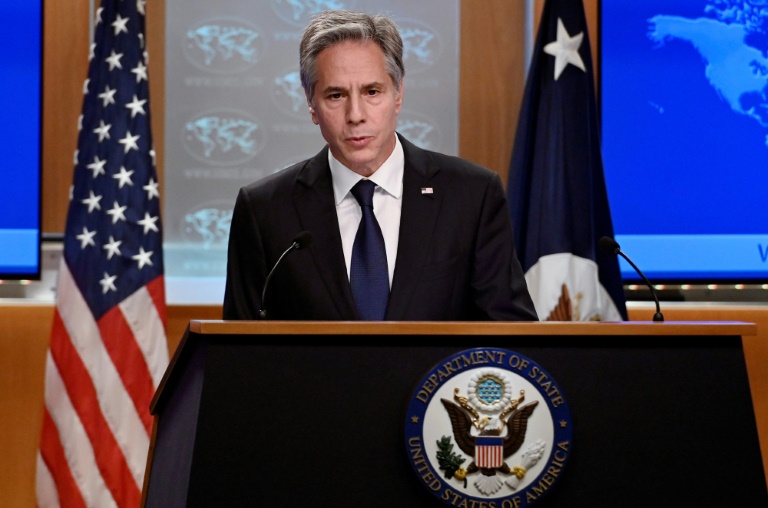
The United States has made a “substantial proposal” to Russia to free Americans including basketball star Brittney Griner, Secretary of State Antony Blinken said Wednesday, as he announced he will speak to his Moscow counterpart for the first time since the Ukraine war.

Blinken said he expected a telephone call “in the coming days” with Foreign Minister Sergei Lavrov on the offer to free former Marine Paul Whelan as well as Griner — who told a court earlier Wednesday that she had brought in banned drugs unintentionally.

The pair “have been wrongfully detained and must be allowed to come home,” Blinken told reporters.

“We put a substantial proposal on the table weeks ago to facilitate their release. Our governments have communicated repeatedly and directly on that proposal and I’ll use the conversation to follow up personally,” he said.

Citing the sensitivity, Blinken declined to go into detail or confirm reports that the United States was offering to trade them for Viktor Bout, a convicted Russian arms smuggler.

The United States and Russia already engaged in one prisoner swap in the heat of the Ukraine war: In April Washington exchanged former US Marine Trevor Reed for convicted drug smuggler Konstantin Yaroshenko.

President Joe Biden has faced growing pressure to free Griner, who faces up to 10 years in prison and whose wife earlier accused the administration of doing too little.

Whelan, a security official at an auto parts company, was arrested in Moscow in December 2018 and in 2020 sentenced to 16 years in prison for espionage, which he denies.

Whelan’s family in a statement voiced appreciation for the Biden administration’s efforts and hoped that Russia “accepts this or some other concession” for his freedom.

– No negotiation on Ukraine –

The telephone conversation will be the first between Blinken and Lavrov since February 15 when the top US diplomat warned Russia against invading Ukraine.

President Vladimir Putin went ahead and attacked nine days later, leading the United States and its allies to impose sweeping sanctions and to seek to isolate Russia on the world stage.

The conversation “will not be a negotiation about Ukraine,” Blinken told reporters.

“Any negotiation regarding Ukraine is for its people and people to determine,” he said.

Blinken said the United States — which has been pouring billions in military aid into Ukraine — was “under no illusion” that Russia was ready to engage “meaningfully and constructively” to end the war.

“In the meantime, we’ll continue to do all that we can to strengthen Ukraine’s position on the battlefield,” he said. 

Blinken said he would urge Russia to fulfill a breakthrough agreement reached last week in Turkey to allow the release of Ukrainian grain after a blockade has sent global food prices soaring.

“Hundreds of millions of people are waiting for these ships to set forth from Ukraine’s ports,” Blinken said.

He also said he would warn of further consequences if Russia annexes more Ukrainian territory. Moscow in 2014 seized Crimea and declared the peninsula to be part of Russia, a decision not recognized by most of the world.

The White House recently said that Russia was laying the groundwork for “sham referenda” in areas it seized, possibly as early as September.

Blinken pointedly declined to meet Lavrov when they both attended Group of 20 talks earlier this month in Bali, with the United States rallying its allies in criticizing Russia in the closed-door sessions.

– Griner says no intention to break law –

Griner, a two-time Olympic basketball gold medalist and Women’s NBA champion who had played in Russia, was detained just days before Moscow launched its offensive.

She has pleaded guilty to drug charges over possessing vape cartridges with cannabis oil.

Speaking at her trial in Khimki, just outside Moscow, Griner said she still did not know how the cartridges ended up in her bag and had no intention to use them. 

“I did not think of or plan to bring banned substances into Russia,” said Griner, wearing a Phoenix Mercury T-shirt and black basketball trousers.

“I did not intend to break Russian law,” she added, saying that she was in a rush packing and tired after a recovery from Covid.

“I wouldn’t do anything that would hurt my team.”

burs-sct/bfm

In US, even the definition of 'recession' is controversial

In Washington circles, saying the “R” word comes with a bit of risk.

As the specter of recession looms over the US economy, defining exactly what one is and when it begins has sparked furious debate — based as much around politics as economics.

Last week, the White House appeared to be trying to get the jump on the possible declaration of a recession in the world’s largest economy — second quarter GDP data is due on Thursday — with a pointed blog post.

The title? “How Do Economists Determine Whether the Economy is in a Recession?”

In the post, President Joe Biden’s team rejects the widely accepted definition of a recession as two consecutive quarters of negative growth — a situation the United States could find itself in as of Thursday.

“While some maintain that two consecutive quarters of falling real GDP constitute a recession, that is neither the official definition nor the way economists evaluate the state of the business cycle,” the White House said.

Of course, opposition Republicans quickly picked up on the spin.

“Newsflash for Joe Biden: You can’t change reality by arguing over definitions,” the Republican National Committee said in a statement on Monday.

– ‘One official arbiter’ –

So beyond the political spin machine, what really is a recession?

“There’s been negative growth in the first quarter of this year. We’ll see what the numbers are… If (the second quarter) were negative, that would technically potentially be a recession,” IMF chief economist Pierre-Olivier Gourinchas said.

In a note on its website, the International Monetary Fund nevertheless insists there is “no official definition of recession.”

“Most commentators and analysts use, as a practical definition of recession, two consecutive quarters of decline in a country’s real (inflation-adjusted) gross domestic product (GDP),” the Washington-based global lender says.

For Gourinchas, “the general assessment as to whether the economy is in a recession overall is a little bit more complex.”

Federal Reserve Chair Jerome Powell said Wednesday the Fed “doesn’t make a judgment on that,” but added: “What a recession really is — it’s a broad-based decline across many industries that is sustained for more than a couple months.”

“The labor market is just sending such a strong signal of economic strength that it makes you really question the GDP data,” Powell said.

David Wilcox, a senior economist at the Peterson Institute for International Economics and at Bloomberg Economics, says that considering an economy as entering recession after two consecutive quarters of negative GDP growth is simply “wrong.”

He says while it’s a “handy rule of thumb,” it’s not gospel. 

“I kind of cringe and resist every time I see” that definition, Wilcox told AFP.

“There’s one official arbiter of recession dating in the United States. And that’s the National Bureau of Economic Research.”

– Late to the party? –

The NBER, a private, independent and nonpartisan entity, was founded in 1920 to refine research on the US economy. Its “Business Cycle Dating Committee” uses several data points to determine when the economy is in expansion or recession.

“A recession is the period between a peak of economic activity and its subsequent trough, or lowest point,” the NBER says on its website.

“The NBER’s definition emphasizes that a recession involves a significant decline in economic activity that is spread across the economy and lasts more than a few months.”

But because the bureau prefers to base its assessment on solid data and publish its opinion several months after the figures are released, it can seem a little late to the party.

Ellen Hughes-Cromwick, an economist at the Third Way, a center-left think tank, says that the NBER’s traditional delay is “not a problem” but rather a “methodology” that allows the bureau to avoid repeated revisions.

“What is common knowledge among economists is that in that preliminary estimate, they have less than 50 percent of actual statistics to measure second quarter GDP,” she explains.

“In other words, 50 percent of that GDP preliminary estimate… are estimates,” adds Hughes-Cromwick, who worked as an economist under presidents Ronald Reagan and Barack Obama.

Translation: the NBER is perhaps totally justified in taking its time.

US regulators move to block Meta virtual reality app deal

US market regulators on Wednesday went to court in an effort to stop Facebook-owner Meta from buying virtual reality fitness app maker Within, a potential blow to the tech giant’s metaverse ambitions.

In a complaint filed in federal court, the Federal Trade Commission argued Meta is trying to illegally expand its virtual reality empire with the purchase of Within Unlimited, maker of fitness app “Supernatural.”

Meta has made it a focus to build its metaverse vision for the internet’s future, betting heavily on the interactive virtual world that the company believes will ensure its powerful position.

“This acquisition poses a reasonable probability of eliminating both present and future competition,” the FTC complaint said. “And Meta would be one step closer to its ultimate goal of owning the entire ‘Metaverse.'”

The social media giant said the FTC’s move defied reality, and expressed confidence that its buy of Within would be good for VR users as well as developers who make apps in that market.

“The FTC’s case is based on ideology and speculation, not evidence,” Meta said in response to an AFP inquiry.

“The idea that this acquisition would lead to anticompetitive outcomes in a dynamic space with as much entry and growth as online and connected fitness is simply not credible.”

Yet the FTC called the acquisition “illegal” and competition bureau deputy director John Newman added: “Instead of competing on the merits, Meta is trying to buy its way to the top.”  

– Moving to block Meta –

Meta is already a leading player in the virtual reality market, and its chief Mark Zuckerberg has stressed that the metaverse is key to the company’s future.

The Silicon Valley titan years back bought virtual reality gear maker Oculus and studios devoted to apps for use in digital realms.

Meta purchases have included a popular “Beat Saber” game in which players slash at oncoming virtual blocks in time to music.

The FTC said that the suit seeks specifically to block Meta and Zuckerberg from getting their hands on Within Unlimited.

The Supernatural app made buy independent studio Within lets users work out in routines set to music by popular artists such as Lady Gaga, Katy Perry, and Coldplay in realistic, virtual locales such as the Galapagos Islands, the FTC said.

The complaint quoted Within’s as calling fitness apps “the killer use case for VR.”

Oculus vice president of play Jason Rubin announced the deal to buy Within in October, not disclosing financial details.

Supernatural is to operate independently as part of Meta’s Reality Labs if the deal is consummated, Rubin said in a blog post at the time.

Supernatural workouts feature routines synched to music hits, real coaches, and “stunning” virtual destinations from Machu Picchu to the surface of Mars, Rubin said.

Some tech world watchers questioned whether the FTC move had also sent a “chilling message” to developers who hope of cashing in when their creations are snapped upt.

“How does the FTC expect startup founders and employees to get any liquidity from their hard work if traditional exit method are going to be blocked?” read a tweet to the regulator from the @pachos account of Samsung Ventures America managing director Michael Pachos.

US Senate passes bill to boost domestic semiconductor manufacturing

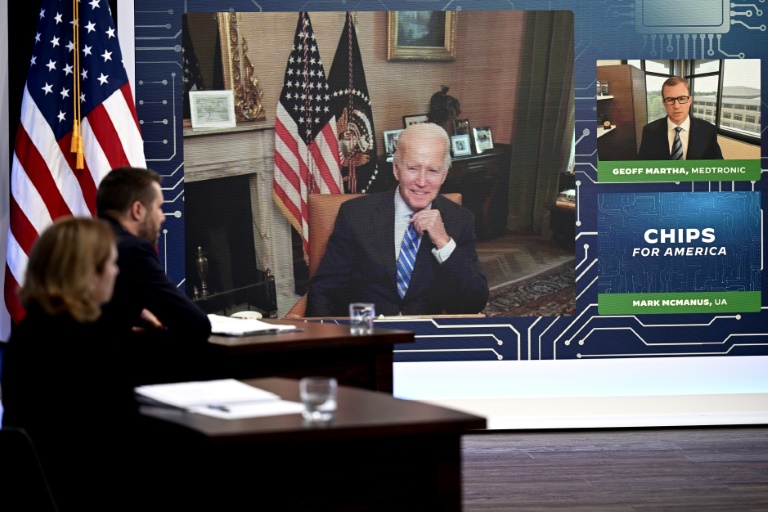
The US Senate passed a bill on Wednesday to boost domestic production of semiconductors amid shortages of the microchips that power everything from smartphones to cars to weapons.

The legislation, which now goes back to the House of Representatives for final passage, provides $52 billion to increase domestic semiconductor production and more than $100 billion over five years for research and development.

The CHIPS Act was passed in the Senate by a rare bipartisan vote of 64 to 33 with 17 Republicans joining hands with Democrats.

President Joe Biden welcomed Senate passage of the legislation that he said will “accelerate the manufacturing of semiconductors in America, lowering prices on everything from cars to dishwashers.”

“It also will create jobs -– good-paying jobs right here in the United States,” Biden said in a statement.

“It will mean more resilient American supply chains, so we are never so reliant on foreign countries for the critical technologies that we need for American consumers and national security,” he said.

Global semiconductor supplies were severely disrupted by fallout from Covid-19 pandemic shutdowns, sparking shortages of the chips — many of which are made in Asia.

The shortages notably slowed production of new automobiles last year, causing prices to increase.

The version of the CHIPS Act passed Wednesday provides $39 billion to finance semiconductor manufacturing plants in the United States and another $13 billion for research.

Senate passage of the bill came a day after the South Korean group SK announced a huge investment in US semiconductor and other cutting edge industries.

The conglomerate said in a statement it plans to “increase its new investment in the United States by $22 billion in areas including semiconductors, green energy, and bioscience, creating tens of thousands of new high-tech, high-paying American jobs.”

US regulators move to block Meta virtual reality app deal

US market regulators on Wednesday went to court to stop Meta from buying virtual reality fitness app maker Within, a potential blow to the tech giant’s metaverse ambitions.

In a complaint filed in federal court, the Federal Trade Commission argued that Facebook-parent Meta is trying to illegally expand its virtual reality empire with the buy of Within Unlimited, maker of fitness app “Supernatural.”

Meta has made it a focus to build its metaverse vision for the internet’s future, betting heavily on the interactive virtual world that the company believes will keep it relevant.

“Instead of competing on the merits, Meta is trying to buy its way to the top,” FTC competition bureau deputy director John Newman said in a release.

“This is an illegal acquisition, and we will pursue all appropriate relief.”

Meta did not immediately respond to a request for comment.

Meta is already a leading player in the virtual reality market, and its chief Mark Zuckerberg has stressed that the metaverse is key to the company’s future.

The Silicon Valley titan years back bought virtual reality gear maker Oculus and studios devoted to apps for use in digital realms.

Meta purchases have included a popular “Beat Saber” game in which players slash at oncoming virtual blocks in time to music.

The FTC said that the suit seeks specifically to block Meta and Zuckerberg from getting their hands on Within Unlimited.

The Supernatural app made buy independent studio Within lets users work out in routines set to music by popular artists such as Lady Gaga, Katy Perry, and Coldplay in realistic, virtual locales such as the Galapagos Islands, the FTC said.

The complaint quoted Within’s as calling fitness apps “the killer use case for VR.”

“Meta is a potential entrant in the virtual reality dedicated fitness app market with the required resources and a reasonable probability of building its own virtual reality app to compete in the space,” the FTC said in the complaint.

“But instead of entering, it chose to try buying Supernatural.”

Close Bitnami banner
Bitnami