World

Eye-popping: Saudi prince unveils mirrored skyscraper eco-city

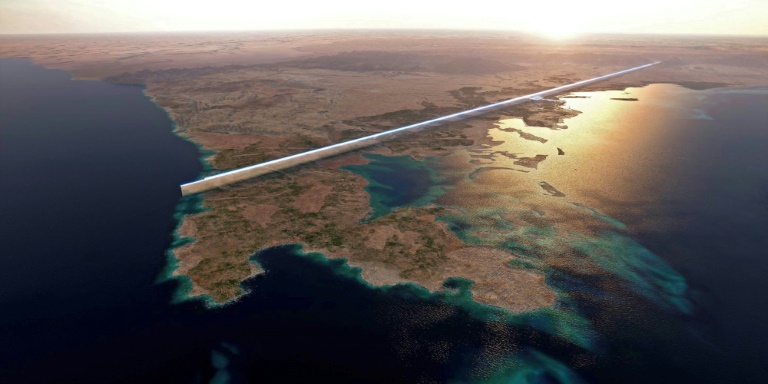
A futuristic Saudi megacity is to feature two skyscrapers extending across a swathe of desert and mountain terrain, according to the latest disclosures on the project by the kingdom’s de facto ruler.

The parallel structures of mirror-encased skyscrapers extending over 170 kilometres (more than 100 miles), known collectively as The Line, form the heart of the Red Sea megacity NEOM, a plank of Crown Prince Mohammed bin Salman’s bid to diversify the Gulf state’s oil-dependent economy.

First announced in 2017, NEOM has consistently raised eyebrows for proposed flourishes like flying taxis and robot maids, even as architects and economists have questioned its feasibility.

In a presentation Monday night, Prince Mohammed sketched out an even more ambitious vision, describing a car-free utopia that would become the planet’s most liveable city “by far”.

Analysts noted, though, that plans for NEOM have changed course over the years, fuelling doubts about whether The Line will ever become reality.

NEOM was once touted as a regional “Silicon Valley”, a biotech and digital hub spread over 26,500 square kilometres (10,000 square miles).

Now it’s a vehicle for reimagining urban life on a footprint of just 34 square kilometres, and addressing what Prince Mohammed describes as “liveability and environmental crises”.

“The concept has morphed so much from its early conception that it’s sometimes hard to determine its direction: scaling down, scaling up, or making an aggressive turn sideways,” said Robert Mogielnicki of the Arab Gulf States Institute in Washington.

– Population boom –

Officials had earlier said NEOM’s population would top one million, but Prince Mohammed said the number would actually hit 1.2 million by 2030 before climbing to nine million by 2045.

The eye-popping total is part of a hoped-for nationwide population boom that Prince Mohammed said would be necessary to make Saudi Arabia, the world’s biggest crude exporter, an economic powerhouse.

The goal for 2030 is to have 50 million people — half Saudis and half foreigners — living in the kingdom, up from roughly 34 million today.

By 2040 the target is 100 million people, he said.

“That’s the main purpose of building NEOM, to raise the capacity of Saudi Arabia, get more citizens and more people in Saudi Arabia. And since we are doing it from nothing, why should we copy normal cities?”

The site will be powered by 100 percent renewable energy and feature “a year-round temperate micro-climate with natural ventilation”, a promotional video released Monday said.

Past environmental pledges by the kingdom, such as a vow to achieve net zero carbon emissions by 2060, have sparked scepticism from environmentalists.

NEOM is well-positioned to harness solar and wind energy, and plans are also afoot for the city to host the world’s largest green hydrogen plant, said Torbjorn Soltvedt of risk intelligence company Verisk Maplecroft.

“But the feasibility of NEOM as a whole is still unclear given the unprecedented scale and cost of the project,” he said.

– Finding funds –

At just 200 metres (yards) wide, The Line is intended to be Saudi Arabia’s answer to unchecked and wasteful urban sprawl, layering homes, schools and parks on top of each other in what planners term “Zero Gravity Urbanism”.

Residents will have “all daily needs” reachable within a five-minute walk, while also having access to other perks like outdoor skiing facilities and “a high-speed rail with an end-to-end transit of 20 minutes”, according to a statement.

Though NEOM will operate under its own founding law, which is still being prepared, Saudi officials say they have no plans to waive the kingdom’s alcohol ban.

An airport is already operational at NEOM, and authorities announced in May it would begin receiving regular flights from Dubai, but it is unclear whether major construction of the megacity itself has commenced.

NEOM said Tuesday it would create 380,000 jobs by the end of the decade “whilst providing the ultimate work-life balance”.

The “first phase” of the project, lasting until 2030, will cost 1.2 trillion Saudi riyals (roughly $319 billion), Prince Mohammed said.

Besides government subsidies, potential sources of funding include the private sector and an initial public offering for NEOM expected in 2024, he said.

Securing the necessary financing remains a potential challenge, though the current climate is more favourable than during the coronavirus pandemic that lowered oil prices.

“But funding is only part of the equation… demand is harder to buy, especially when you’re asking people to be part of an experiment on living and working in the future,” Mogielnicki said.
Eye-popping: Saudi prince unveils mirrored skyscraper eco-city

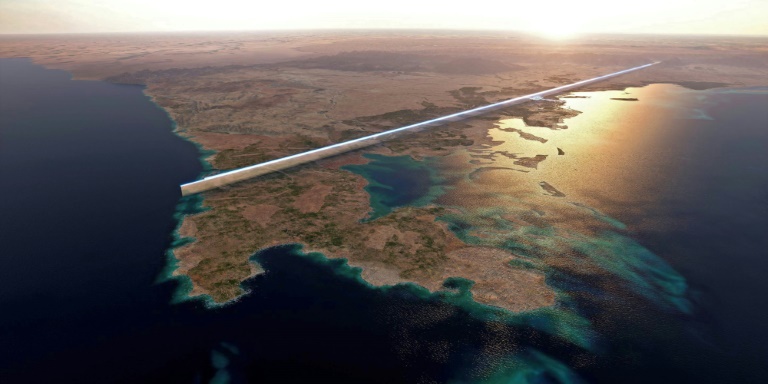
A futuristic Saudi megacity is to feature two skyscrapers extending across a swathe of desert and mountain terrain, according to the latest disclosures on the project by the kingdom’s de facto ruler.

The parallel structures of mirror-encased skyscrapers extending over 170 kilometres (more than 100 miles), known collectively as The Line, form the heart of the Red Sea megacity NEOM, a plank of Crown Prince Mohammed bin Salman’s bid to diversify the Gulf state’s oil-dependent economy.

First announced in 2017, NEOM has consistently raised eyebrows for proposed flourishes like flying taxis and robot maids, even as architects and economists have questioned its feasibility.

In a presentation Monday night, Prince Mohammed sketched out an even more ambitious vision, describing a car-free utopia that would become the planet’s most liveable city “by far”.

Analysts noted, though, that plans for NEOM have changed course over the years, fuelling doubts about whether The Line will ever become reality.

NEOM was once touted as a regional “Silicon Valley”, a biotech and digital hub spread over 26,500 square kilometres (10,000 square miles).

Now it’s a vehicle for reimagining urban life on a footprint of just 34 square kilometres, and addressing what Prince Mohammed describes as “liveability and environmental crises”.

“The concept has morphed so much from its early conception that it’s sometimes hard to determine its direction: scaling down, scaling up, or making an aggressive turn sideways,” said Robert Mogielnicki of the Arab Gulf States Institute in Washington.

– Population boom –

Officials had earlier said NEOM’s population would top one million, but Prince Mohammed said the number would actually hit 1.2 million by 2030 before climbing to nine million by 2045.

The eye-popping total is part of a hoped-for nationwide population boom that Prince Mohammed said would be necessary to make Saudi Arabia, the world’s biggest crude exporter, an economic powerhouse.

The goal for 2030 is to have 50 million people — half Saudis and half foreigners — living in the kingdom, up from roughly 34 million today.

By 2040 the target is 100 million people, he said.

“That’s the main purpose of building NEOM, to raise the capacity of Saudi Arabia, get more citizens and more people in Saudi Arabia. And since we are doing it from nothing, why should we copy normal cities?”

The site will be powered by 100 percent renewable energy and feature “a year-round temperate micro-climate with natural ventilation”, a promotional video released Monday said.

Past environmental pledges by the kingdom, such as a vow to achieve net zero carbon emissions by 2060, have sparked scepticism from environmentalists.

NEOM is well-positioned to harness solar and wind energy, and plans are also afoot for the city to host the world’s largest green hydrogen plant, said Torbjorn Soltvedt of risk intelligence company Verisk Maplecroft.

“But the feasibility of NEOM as a whole is still unclear given the unprecedented scale and cost of the project,” he said.

– Finding funds –

At just 200 metres (yards) wide, The Line is intended to be Saudi Arabia’s answer to unchecked and wasteful urban sprawl, layering homes, schools and parks on top of each other in what planners term “Zero Gravity Urbanism”.

Residents will have “all daily needs” reachable within a five-minute walk, while also having access to other perks like outdoor skiing facilities and “a high-speed rail with an end-to-end transit of 20 minutes”, according to a statement.

Though NEOM will operate under its own founding law, which is still being prepared, Saudi officials say they have no plans to waive the kingdom’s alcohol ban.

An airport is already operational at NEOM, and authorities announced in May it would begin receiving regular flights from Dubai, but it is unclear whether major construction of the megacity itself has commenced.

NEOM said Tuesday it would create 380,000 jobs by the end of the decade “whilst providing the ultimate work-life balance”.

The “first phase” of the project, lasting until 2030, will cost 1.2 trillion Saudi riyals (roughly $319 billion), Prince Mohammed said.

Besides government subsidies, potential sources of funding include the private sector and an initial public offering for NEOM expected in 2024, he said.

Securing the necessary financing remains a potential challenge, though the current climate is more favourable than during the coronavirus pandemic that lowered oil prices.

“But funding is only part of the equation… demand is harder to buy, especially when you’re asking people to be part of an experiment on living and working in the future,” Mogielnicki said.
Drought threatens Spain's 'green gold' harvest

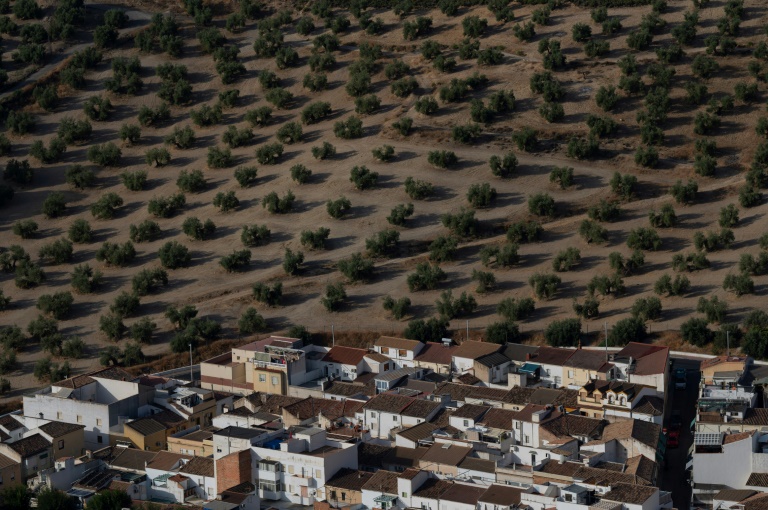
In the scorching heat, Felipe Elvira inspects the branches of his olive trees, planted as far as the eye can see on a dusty hillside in southern Spain.

“There are no olives on these. Everything is dry,” the 68-year-old said.

He and his son own a 100-hectare (250-acre) olive farm in the southern province of Jaen in sun-drenched Andalusia, a region which produces the bulk of the country’s olive oil.

But a severe drought gripping much of Spain threatens to shrivel their harvest this year.

“We are used to a lack of water, but not to this point,” said Elvira.

The region used to get 800 litres (210 gallons) of rainfall per square metre, but is set to get around half that amount this year, he said. 

“Every year it’s worse,” Elvira said.

Global warming is hitting Spain harder than most European nations. 

The country has suffered three intense heatwaves since May, damaging crops already grappling with an unusually dry winter.

“Olive trees are very resistant to water scarcity,” said Juan Carlos Hervas, an expert with the COAG farmers’ union.

But when droughts become extreme, the trees “activate mechanisms to protect themselves. They don’t die but no longer produce anything,” he added.

– ‘Absolutely dramatic’ –

Hervas predicts the olive harvest from unirrigated land will come in at less than 20 percent of the average of the last five years.

The harvest from irrigated land will be just 50 to 60 percent of this average, he said.

But water reserves are dwindling.

The Guadalquivir river, which provides Andalusia with a large part of its water, is in “an absolutely dramatic situation” due to the lack of rain, said Rosario Jimenez, a hydrology professor at the University of Jaen.

Reservoirs fed by the river are at just 30 percent of their capacity, according to Spain’s ecological transition ministry.

“Some are even at 10 percent capacity — that is practically dried up,” said Jimenez.

Farmers have also noticed changes in recent years.

“Not only does it rain less, but when it falls, it does so torrentially. The water flows without penetrating the earth,” said Hervas.

Parts of Portugal and Spain are the driest they have been in a thousand years due to an atmospheric high-pressure system driven by climate change, according to a study published this month in the journal Nature Geoscience.

The phenomenon is set to increase, jeopardising crops like olives and grapes.

At stake is a key export: Spain supplies nearly half of the world’s olive oil. Its exports of this “green gold” are worth some 3.6 billion euros ($3.7 billion) per year.

– Olive dependence –

Olive oil has been an essential part of the Mediterranean diet for thousands of years and olive trees cover many hillsides in southern Spain, which are often unsuitable for other crops.

“Many villages here depend entirely on olive trees. Without olives, there is no more revenue,” said Hervas.

Seven out of 10 hectares of olive farmland in Spain are not irrigated, according to the COAG farmers’ union.

With the rise in temperatures, 80 percent of Andalusia’s unirrigated olive tree plantations may no longer be suitable to grow olives, or at least some varieties of the crop, it added.

The quality could also decline because farmers will have to pick the fruit early, before it is fully mature, the union said in a recent report.

Some farmers may be tempted to start irrigating their plots, but this would deplete stretched reservoirs even further.

Agriculture already consumes up to four-fifths of Spain’s water resources, said Jimenez.

“Not all land can be irrigated,” she said.

Back at his farm, Elvira is all too aware of the problem.

“We can’t exhaust resources, everyone needs water. Honestly, I don’t know how we are going to manage,” he said.

Drought threatens Spain's 'green gold' harvest

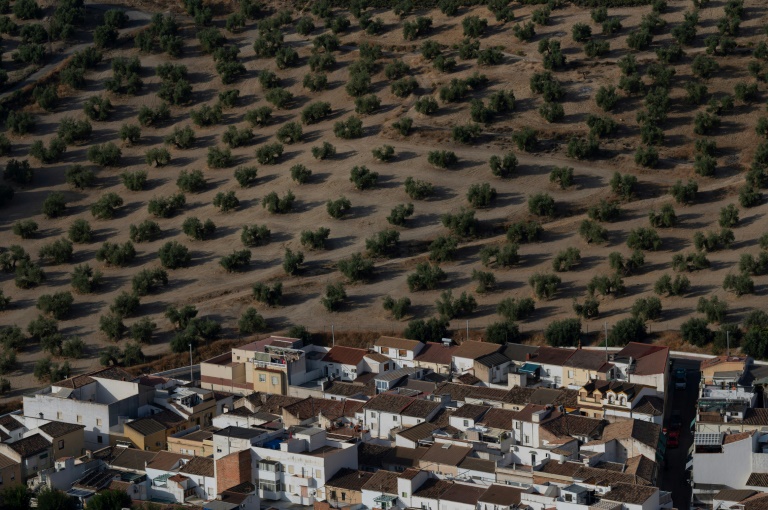
In the scorching heat, Felipe Elvira inspects the branches of his olive trees, planted as far as the eye can see on a dusty hillside in southern Spain.

“There are no olives on these. Everything is dry,” the 68-year-old said.

He and his son own a 100-hectare (250-acre) olive farm in the southern province of Jaen in sun-drenched Andalusia, a region which produces the bulk of the country’s olive oil.

But a severe drought gripping much of Spain threatens to shrivel their harvest this year.

“We are used to a lack of water, but not to this point,” said Elvira.

The region used to get 800 litres (210 gallons) of rainfall per square metre, but is set to get around half that amount this year, he said. 

“Every year it’s worse,” Elvira said.

Global warming is hitting Spain harder than most European nations. 

The country has suffered three intense heatwaves since May, damaging crops already grappling with an unusually dry winter.

“Olive trees are very resistant to water scarcity,” said Juan Carlos Hervas, an expert with the COAG farmers’ union.

But when droughts become extreme, the trees “activate mechanisms to protect themselves. They don’t die but no longer produce anything,” he added.

– ‘Absolutely dramatic’ –

Hervas predicts the olive harvest from unirrigated land will come in at less than 20 percent of the average of the last five years.

The harvest from irrigated land will be just 50 to 60 percent of this average, he said.

But water reserves are dwindling.

The Guadalquivir river, which provides Andalusia with a large part of its water, is in “an absolutely dramatic situation” due to the lack of rain, said Rosario Jimenez, a hydrology professor at the University of Jaen.

Reservoirs fed by the river are at just 30 percent of their capacity, according to Spain’s ecological transition ministry.

“Some are even at 10 percent capacity — that is practically dried up,” said Jimenez.

Farmers have also noticed changes in recent years.

“Not only does it rain less, but when it falls, it does so torrentially. The water flows without penetrating the earth,” said Hervas.

Parts of Portugal and Spain are the driest they have been in a thousand years due to an atmospheric high-pressure system driven by climate change, according to a study published this month in the journal Nature Geoscience.

The phenomenon is set to increase, jeopardising crops like olives and grapes.

At stake is a key export: Spain supplies nearly half of the world’s olive oil. Its exports of this “green gold” are worth some 3.6 billion euros ($3.7 billion) per year.

– Olive dependence –

Olive oil has been an essential part of the Mediterranean diet for thousands of years and olive trees cover many hillsides in southern Spain, which are often unsuitable for other crops.

“Many villages here depend entirely on olive trees. Without olives, there is no more revenue,” said Hervas.

Seven out of 10 hectares of olive farmland in Spain are not irrigated, according to the COAG farmers’ union.

With the rise in temperatures, 80 percent of Andalusia’s unirrigated olive tree plantations may no longer be suitable to grow olives, or at least some varieties of the crop, it added.

The quality could also decline because farmers will have to pick the fruit early, before it is fully mature, the union said in a recent report.

Some farmers may be tempted to start irrigating their plots, but this would deplete stretched reservoirs even further.

Agriculture already consumes up to four-fifths of Spain’s water resources, said Jimenez.

“Not all land can be irrigated,” she said.

Back at his farm, Elvira is all too aware of the problem.

“We can’t exhaust resources, everyone needs water. Honestly, I don’t know how we are going to manage,” he said.

Marauding monkey caught, killed after dozens injured in Japan

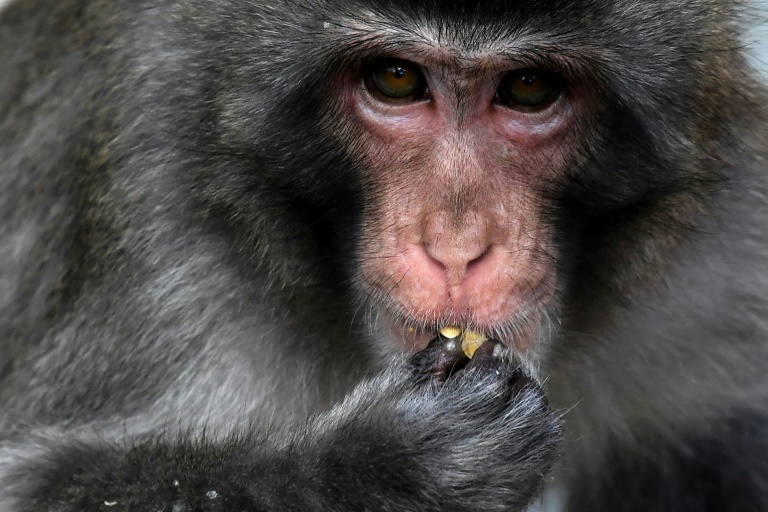
Local authorities hunting for a gang of monkeys who attacked and wounded nearly 50 people in western Japan have caught and killed one of the marauding primates, an official said Wednesday.

The male simian was seized while roaming the grounds of a high school in Yamaguchi city — but it may not be the end of the furry, twisting tale, with other monkeys feared to be at large.

City officials have been trying for weeks to track down the vicious gang who have made national headlines by assaulting residents with mostly mild scratches and bites.

On Tuesday evening, specially commissioned hunters shot the monkey with a tranquiliser gun and eventually caught it near a lake on the school premises, an official at the local agricultural department told AFP.

After identifying it as the same animal responsible for one of the attacks, the monkey was put down, he said. It had an estimated age of four and was around half a metre tall.

Patrols have been underway in Yamaguchi since the attacks on adults and children began around three weeks ago.

But with 49 people injured as of Tuesday midday and fresh attack reports coming in, the search is still on.

“Eyewitnesses describe monkeys of different sizes, and even after the capture, we’ve been getting reports of new attacks,” said the city official, who declined to be named.

Japanese macaques are seen commonly across large parts of the country, and are a pest in some areas, eating crops and even entering homes.

But the spate of attacks in Yamaguchi is unusual, with some residents telling local media that they are now carrying umbrellas and tree-cutting scissors to defend themselves.

Japan eSports players with disabilities shoot down stereotypes

Street Fighter player Shunya Hatakeyama has muscular dystrophy, so he uses his chin to launch devastating combos. He is not the only Japanese gamer proving that disability is no barrier in eSports.

Naoya Kitamura, who is blind and relies on sound to play beat ’em up game Tekken 7, also hopes that his skills in a billion-dollar industry will help make society more open-minded.

“I’ll block a move and the sound it makes will tell me what kind of move it was,” Kitamura said.

“Then I’ll react and make my move,” he told AFP, demonstrating a dizzying attack with Tekken character Lucky Chloe.

Competitive gaming is booming worldwide, with global eSports revenues estimated at more than $1 billion, and many think it could one day be at the Olympics.

The sector is not as big in Japan as in eSports-crazy China and South Korea, but it is gradually starting to take root.

Keen to offer Japanese gamers with disabilities a chance to be part of the action, social welfare worker Daiki Kato founded a company called ePara in 2016.

Kato’s firm employs players such as Hatakeyama and Kitamura, who are both 28, and gives them time to practise around their other duties, which include working on the company’s website and helping organise gaming events.

Hatakeyama mostly enters Street Fighter V tournaments that are open to anyone — disabled or non-disabled — and says the beauty of fighting games is that “you can overcome handicaps and compete against different people”.

“When I play in a tournament I don’t want my disability to be an issue,” he said.

“I want to move people with the way I play.”

– Custom controller –

Hatakeyama was born with degenerative muscular dystrophy and has used a wheelchair since he was about six years old.

He has always loved fighting games, but over the years his muscles weakened so much that he could not hold a controller.

Depressed, he quit playing for six years until he and a friend decided last year to design and make a custom controller that he could operate with his chin.

Using his fingers to press buttons on his computer keyboard, Hatakeyama says he quickly got back into the groove.

Now he also coaches other players with disabilities, talking them through complicated combos and offering tips on different characters.

“If I had never played fighting games, I don’t think I would try to find solutions whenever I encountered something difficult,” he said.

Many of ePara’s gamers are new to eSports and do not have much experience of competing in tournaments.

Company chief Kato believes there is a growing market for gamers with disabilities and he thinks manufacturers will start to sit up and take notice.

“If you have more people with hearing impairments or visual impairments playing games, game manufacturers will react by making more games that they can play,” he said.

– ‘Same rules, same competitions’ –

Kato wants to use eSports to showcase the talents of people with disabilities, saying many people in Japan “don’t have much chance to interact” with them.

Kitamura, who has microphthalmos and has been blind since birth, says eSports can help change the perception that people with disabilities “just need assistance”.

“I’m really good with computers and I can do a lot more than some people who can see can do,” he said.

“It’s not just about being helped — depending on the circumstances, we can help people out too. It’s about cooperation.”

Kitamura thinks the term eSports itself also helps, projecting the image of serious competition rather than “just people playing games”.

The Southeast Asian Games have featured eSports medal events and they will also appear at next year’s pandemic-delayed Asian Games.

Many believe that the Olympics and Paralympics will follow suit but Kato says there is “no need to distinguish between people with or without disabilities in eSports”.

“That’s one interesting thing about it,” he said.

“Whether you’re in a wheelchair or not, it’s the same rules and the same competitions.”

Bitter harvest: Malaysian palm oil farmers face labour crunch

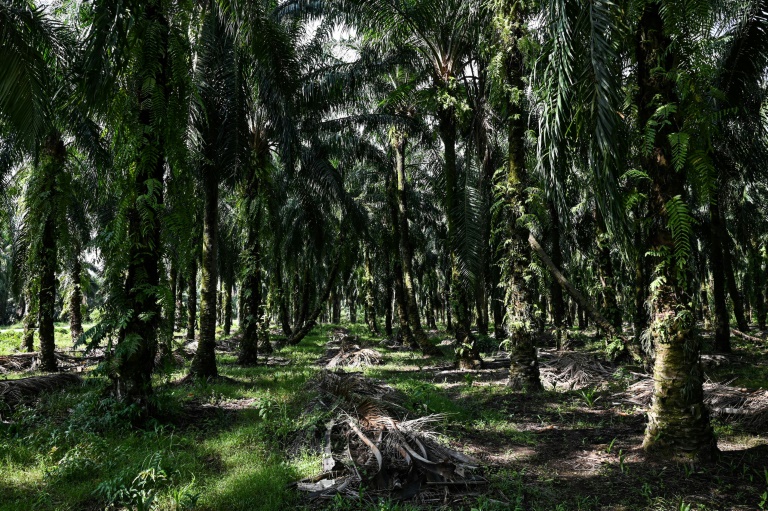
Overripe palm oil fruits hang untouched in trees while others lie rotting scattered around a plantation, as Malaysian farmers reap the bitter harvest of a severe labour shortage.

The tropical country is the world’s second-biggest producer of the edible vegetable oil, which is found in many everyday goods from chocolate to cosmetics. 

The sector has long been reliant on migrants from neighbouring Indonesia for back-breaking plantation work, which is shunned by most in more affluent Malaysia. 

Lengthy Covid border closures had already reduced the foreign labour force, but now bureaucratic hurdles and a ban by Indonesia on sending new workers have dramatically worsened the problems.

“A lot of bunches of fruit are rotting on the trees,” Suzaidee Rajan, 47, who owns a 300-acre (120-hectare) plantation in Ijok, central Selangor state, told AFP. 

“We usually harvest twice a month. But now due to the labour shortage, we can (do so) just once a month. Our income has plunged and locals are angry.”

With just four foreign workers — two fewer than the number he needs — Suzaidee now has to drive into his plantation and load the fruit onto a lorry himself.

Palm oil is a controversial commodity, blamed by environmentalists for fuelling the destruction of rainforest in Malaysia and Indonesia, which together produce 85 percent of global output. 

Green groups say rapid expansion of plantations has destroyed rare animals’ habitats, while there have been allegations of foreign workers being abused and mistreated on some estates. 

The sector nevertheless remains a major contributor to Malaysia’s economy, and has continued to attract foreign workers who can earn higher wages than back home. 

Agricultural firms run large estates, while there are also numerous small-scale farmers like Suzaidee.

– ‘Darkness on horizon’ –

Other Malaysian industries, including construction and manufacturing, also rely on migrant workers from across Asia, and suffered as a result of lengthy pandemic border closures.

While authorities ended a freeze on hiring foreigners in February, labourers have been slow to return because of red tape and difficult negotiations with countries of origin. 

Problems in the plantation sector have been particularly acute, however, and look set to get worse after Indonesia banned sending new workers to Malaysia earlier this month.

Hermono — Indonesia’s ambassador in Kuala Lumpur, who goes by one name — said Jakarta took the decision as Malaysia was not abiding by an agreement aimed at protecting his compatriots.  

The Malaysian estate owners’ association says there is currently a shortage of about 120,000 workers. 

And this month Minister Zuraida Kamaruddin, who oversees the plantation sector, said the industry lost 10.46 billion ringgit ($2.35 billion) in the first five months of 2022 as palm oil fruit was left unharvested. 

“I can see only darkness on the horizon unless migrant workers are brought into the country immediately,” farmer Sahman Duriat, who has a plantation in Ijok, told AFP. 

“My earnings are falling while inflation and production costs are rising.”

After the Indonesian ban was announced, Malaysia’s human resources ministry vowed to address Jakarta’s concerns quickly to ensure it is reversed. 

For Indonesian plantation workers still in Malaysia, there is now much more to do.

“Usually we work in a group of five… but now there are just two of us,” said Zan, who goes by one name, as he cut fruit from a tree while a second man loaded it into a wheelbarrow.

“We harvest 200 tonnes a month with five people but now only 80 tonnes with just two of us.”

Bitter harvest: Malaysian palm oil farmers face labour crunch

Overripe palm oil fruits hang untouched in trees while others lie rotting scattered around a plantation, as Malaysian farmers reap the bitter harvest of a severe labour shortage.

The tropical country is the world’s second-biggest producer of the edible vegetable oil, which is found in many everyday goods from chocolate to cosmetics. 

The sector has long been reliant on migrants from neighbouring Indonesia for back-breaking plantation work, which is shunned by most in more affluent Malaysia. 

Lengthy Covid border closures had already reduced the foreign labour force, but now bureaucratic hurdles and a ban by Indonesia on sending new workers have dramatically worsened the problems.

“A lot of bunches of fruit are rotting on the trees,” Suzaidee Rajan, 47, who owns a 300-acre (120-hectare) plantation in Ijok, central Selangor state, told AFP. 

“We usually harvest twice a month. But now due to the labour shortage, we can (do so) just once a month. Our income has plunged and locals are angry.”

With just four foreign workers — two fewer than the number he needs — Suzaidee now has to drive into his plantation and load the fruit onto a lorry himself.

Palm oil is a controversial commodity, blamed by environmentalists for fuelling the destruction of rainforest in Malaysia and Indonesia, which together produce 85 percent of global output. 

Green groups say rapid expansion of plantations has destroyed rare animals’ habitats, while there have been allegations of foreign workers being abused and mistreated on some estates. 

The sector nevertheless remains a major contributor to Malaysia’s economy, and has continued to attract foreign workers who can earn higher wages than back home. 

Agricultural firms run large estates, while there are also numerous small-scale farmers like Suzaidee.

– ‘Darkness on horizon’ –

Other Malaysian industries, including construction and manufacturing, also rely on migrant workers from across Asia, and suffered as a result of lengthy pandemic border closures.

While authorities ended a freeze on hiring foreigners in February, labourers have been slow to return because of red tape and difficult negotiations with countries of origin. 

Problems in the plantation sector have been particularly acute, however, and look set to get worse after Indonesia banned sending new workers to Malaysia earlier this month.

Hermono — Indonesia’s ambassador in Kuala Lumpur, who goes by one name — said Jakarta took the decision as Malaysia was not abiding by an agreement aimed at protecting his compatriots.  

The Malaysian estate owners’ association says there is currently a shortage of about 120,000 workers. 

And this month Minister Zuraida Kamaruddin, who oversees the plantation sector, said the industry lost 10.46 billion ringgit ($2.35 billion) in the first five months of 2022 as palm oil fruit was left unharvested. 

“I can see only darkness on the horizon unless migrant workers are brought into the country immediately,” farmer Sahman Duriat, who has a plantation in Ijok, told AFP. 

“My earnings are falling while inflation and production costs are rising.”

After the Indonesian ban was announced, Malaysia’s human resources ministry vowed to address Jakarta’s concerns quickly to ensure it is reversed. 

For Indonesian plantation workers still in Malaysia, there is now much more to do.

“Usually we work in a group of five… but now there are just two of us,” said Zan, who goes by one name, as he cut fruit from a tree while a second man loaded it into a wheelbarrow.

“We harvest 200 tonnes a month with five people but now only 80 tonnes with just two of us.”

Powerful earthquake hits northern Philippines

A 7.1-magnitude earthquake hit the northern Philippines Wednesday, the US Geological Survey said, shattering windows of buildings at the epicentre and shaking high-rise towers more than 300 kilometres (185 miles) away in the capital Manila. 

The shallow but powerful quake struck the mountainous and lightly populated province of Abra on the main island of Luzon at 8:43 am (0043 GMT), the USGS said.

Shallow earthquakes tend to cause more damage than deeper ones.

In the municipality of Dolores, which felt the full force of the quake, terrified people ran outside their homes and shops, and the local market’s windows were shattered, Police Major Edwin Sergio told AFP.

“The quake was very strong,” Sergio said, adding there were small cracks in the police station building.

“Vegetables and fruits sold in the market were also disarranged after tables were toppled.”

A video posted on Facebook and verified by AFP showed cracks in the asphalt road and ground in the nearby town of Bangued, though there was no visible damage to houses or stores.

But a number of injured people in Bangued were taken to hospital, police chief Major Nazareno Emia told AFP. 

“Some of the buildings here show cracks. Power was cut off and internet as well,” he added.

Congressman Ching Bernos, who represents the Lone District of Abra, said the quake “caused damages to many households and establishments”, but did not elaborate.

University student Mira Zapata was in her house in the town of San Juan when she felt “really strong shaking”.

“We started shouting and rushed outside,” she said, as aftershocks continued.

“Our house is ok but houses down the hill were damaged.” 

– Ring of Fire –

The Philippines is regularly rocked by quakes due to its location on the Pacific “Ring of Fire”, an arc of intense seismic activity that stretches from Japan through Southeast Asia and across the Pacific basin.

Wednesday’s quake was the strongest recorded in the Philippines in years.

In Vigan City, in the nearby province of Ilocos Sur, centuries-old structures built during the Spanish colonial period were damaged.

Verified video posted on Facebook showed the Bantay Bell Tower in the popular tourist destination partially crumbling. 

“We can’t rule out the possibility of another strong earthquake,” said Renato Solidum, director of the Philippine Institute of Volcanology and Seismology.

In October 2013, a magnitude 7.1 earthquake struck Bohol Island in the central Philippines, killing over 200 people and triggering landslides.

Old churches in the birthplace of Catholicism in the Philippines were badly damaged. Nearly 400,000 were displaced and tens of thousands of houses were damaged. 

The powerful quake altered the island’s landscape and a “ground rupture” pushed up a stretch of ground by up to three meters, creating a wall of rock above the epicentre. 

In 1990, a magnitude 7.8 earthquake in the northern Philippines created a ground rupture stretching over a hundred kilometres. 

Fatalities were estimated to reach over 1,200 and caused major damage to buildings in Manila.

The nation’s volcanology and seismology institute regularly holds quake drills, simulating scenarios in the nation’s active fault lines. 

During major earthquakes, the agency said people would find it difficult to stand on upper floors, trees could shake strongly, heavy objects and furniture may topple and large church bells may ring. 

Powerful earthquake hits northern Philippines

A 7.1-magnitude earthquake hit the northern Philippines Wednesday, the US Geological Survey said, shattering windows of buildings at the epicentre and shaking high-rise towers more than 300 kilometres (185 miles) away in the capital Manila. 

The shallow but powerful quake struck the mountainous and lightly populated province of Abra on the main island of Luzon at 8:43 am (0043 GMT), the USGS said.

Shallow earthquakes tend to cause more damage than deeper ones.

In the municipality of Dolores, which felt the full force of the quake, terrified people ran outside their homes and shops, and the local market’s windows were shattered, Police Major Edwin Sergio told AFP.

“The quake was very strong,” Sergio said, adding there were small cracks in the police station building.

“Vegetables and fruits sold in the market were also disarranged after tables were toppled.”

A video posted on Facebook and verified by AFP showed cracks in the asphalt road and ground in the nearby town of Bangued, though there was no visible damage to houses or stores.

But a number of injured people in Bangued were taken to hospital, police chief Major Nazareno Emia told AFP. 

“Some of the buildings here show cracks. Power was cut off and internet as well,” he added.

Congressman Ching Bernos, who represents the Lone District of Abra, said the quake “caused damages to many households and establishments”, but did not elaborate.

University student Mira Zapata was in her house in the town of San Juan when she felt “really strong shaking”.

“We started shouting and rushed outside,” she said, as aftershocks continued.

“Our house is ok but houses down the hill were damaged.” 

– Ring of Fire –

The Philippines is regularly rocked by quakes due to its location on the Pacific “Ring of Fire”, an arc of intense seismic activity that stretches from Japan through Southeast Asia and across the Pacific basin.

Wednesday’s quake was the strongest recorded in the Philippines in years.

In Vigan City, in the nearby province of Ilocos Sur, centuries-old structures built during the Spanish colonial period were damaged.

Verified video posted on Facebook showed the Bantay Bell Tower in the popular tourist destination partially crumbling. 

“We can’t rule out the possibility of another strong earthquake,” said Renato Solidum, director of the Philippine Institute of Volcanology and Seismology.

In October 2013, a magnitude 7.1 earthquake struck Bohol Island in the central Philippines, killing over 200 people and triggering landslides.

Old churches in the birthplace of Catholicism in the Philippines were badly damaged. Nearly 400,000 were displaced and tens of thousands of houses were damaged. 

The powerful quake altered the island’s landscape and a “ground rupture” pushed up a stretch of ground by up to three meters, creating a wall of rock above the epicentre. 

In 1990, a magnitude 7.8 earthquake in the northern Philippines created a ground rupture stretching over a hundred kilometres. 

Fatalities were estimated to reach over 1,200 and caused major damage to buildings in Manila.

The nation’s volcanology and seismology institute regularly holds quake drills, simulating scenarios in the nation’s active fault lines. 

During major earthquakes, the agency said people would find it difficult to stand on upper floors, trees could shake strongly, heavy objects and furniture may topple and large church bells may ring. 

Close Bitnami banner
Bitnami