World

Eye-popping: Saudi prince unveils mirrored skyscraper eco-city

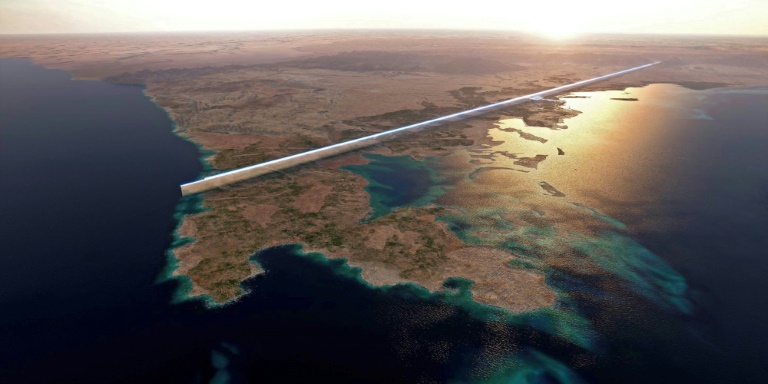
A futuristic Saudi megacity is to feature two skyscrapers extending across a swathe of desert and mountain terrain, according to the latest disclosures on the project by the kingdom’s de facto ruler.

The parallel structures of mirror-encased skyscrapers extending over 170 kilometres (more than 100 miles), known collectively as The Line, form the heart of the Red Sea megacity NEOM, a plank of Crown Prince Mohammed bin Salman’s bid to diversify the Gulf state’s oil-dependent economy.

First announced in 2017, NEOM has consistently raised eyebrows for proposed flourishes like flying taxis and robot maids, even as architects and economists have questioned its feasibility.

In a presentation Monday night, Prince Mohammed sketched out an even more ambitious vision, describing a car-free utopia that would become the planet’s most liveable city “by far”.

Analysts noted, though, that plans for NEOM have changed course over the years, fuelling doubts about whether The Line will ever become reality.

NEOM, a biotech and digital hub spread over 26,500 square kilometres (10,000 square miles), was once touted as a regional “Silicon Valley”.

Now it’s a vehicle for reimagining urban life on a footprint of just 34 square kilometres, and addressing what Prince Mohammed describes as “liveability and environmental crises”.

“The concept has morphed so much from its early conception that it’s sometimes hard to determine its direction: scaling down, scaling up, or making an aggressive turn sideways,” said Robert Mogielnicki of the Arab Gulf States Institute in Washington.

– Population boom –

Officials had earlier said NEOM’s population would top one million, but Prince Mohammed said the number would actually hit 1.2 million by 2030 before climbing to nine million by 2045.

The eye-popping total is part of a hoped-for nationwide population boom that Prince Mohammed said would be necessary to make Saudi Arabia, the world’s biggest crude exporter, an economic powerhouse.

The goal for 2030 is to have 50 million people — half Saudis and half foreigners — living in the kingdom, up from roughly 34 million today.

By 2040 the target is 100 million people, he said.

“That’s the main purpose of building NEOM, to raise the capacity of Saudi Arabia, get more citizens and more people in Saudi Arabia. And since we are doing it from nothing, why should we copy normal cities?”

The site will be powered by 100 percent renewable energy and feature “a year-round temperate micro-climate with natural ventilation”, a promotional video released Monday said.

Past environmental pledges by the kingdom, such as a vow to achieve net zero carbon emissions by 2060, have sparked scepticism from environmentalists.

NEOM is well-positioned to harness solar and wind energy, and plans are also afoot for the city to host the world’s largest green hydrogen plant, said Torbjorn Soltvedt of risk intelligence company Verisk Maplecroft.

“But the feasibility of NEOM as a whole is still unclear given the unprecedented scale and cost of the project,” he said.

– Finding funds –

At just 200 metres (yards) wide, The Line is intended to be Saudi Arabia’s answer to unchecked and wasteful urban sprawl, layering homes, schools and parks on top of each other in what planners term “Zero Gravity Urbanism”.

Residents will have “all daily needs” reachable within a five-minute walk, while also having access to other perks like outdoor skiing facilities and “a high-speed rail with an end-to-end transit of 20 minutes”, according to a statement.

Though NEOM will operate under its own founding law, which is still being prepared, Saudi officials say they have no plans to waive the kingdom’s alcohol ban.

An airport is already operational at NEOM, and authorities announced in May it would begin receiving regular flights from Dubai, but it is unclear whether major construction of the megacity itself has commenced.

The “first phase” of the project, lasting until 2030, will cost 1.2 trillion Saudi riyals (roughly $319 billion), Prince Mohammed said.

Besides government subsidies, potential sources of funding include the private sector and an initial public offering for NEOM expected in 2024, he said.

Securing the necessary financing remains a potential challenge, though the current climate is more favourable than during the coronavirus pandemic that lowered oil prices.

“But funding is only part of the equation… demand is harder to buy, especially when you’re asking people to be part of an experiment on living and working in the future,” Mogielnicki said.
Eye-popping: Saudi prince unveils mirrored skyscraper eco-city

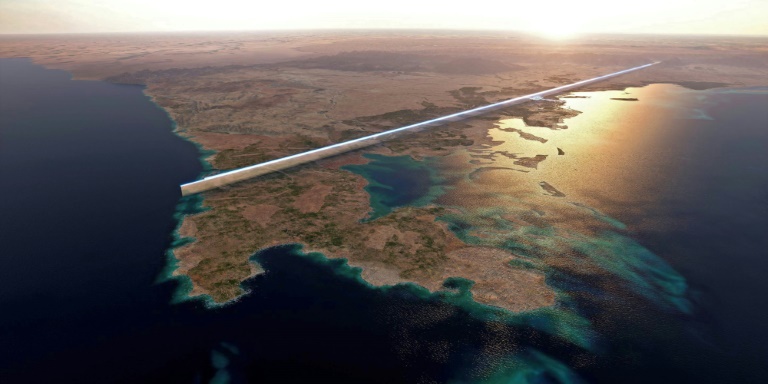
A futuristic Saudi megacity is to feature two skyscrapers extending across a swathe of desert and mountain terrain, according to the latest disclosures on the project by the kingdom’s de facto ruler.

The parallel structures of mirror-encased skyscrapers extending over 170 kilometres (more than 100 miles), known collectively as The Line, form the heart of the Red Sea megacity NEOM, a plank of Crown Prince Mohammed bin Salman’s bid to diversify the Gulf state’s oil-dependent economy.

First announced in 2017, NEOM has consistently raised eyebrows for proposed flourishes like flying taxis and robot maids, even as architects and economists have questioned its feasibility.

In a presentation Monday night, Prince Mohammed sketched out an even more ambitious vision, describing a car-free utopia that would become the planet’s most liveable city “by far”.

Analysts noted, though, that plans for NEOM have changed course over the years, fuelling doubts about whether The Line will ever become reality.

NEOM, a biotech and digital hub spread over 26,500 square kilometres (10,000 square miles), was once touted as a regional “Silicon Valley”.

Now it’s a vehicle for reimagining urban life on a footprint of just 34 square kilometres, and addressing what Prince Mohammed describes as “liveability and environmental crises”.

“The concept has morphed so much from its early conception that it’s sometimes hard to determine its direction: scaling down, scaling up, or making an aggressive turn sideways,” said Robert Mogielnicki of the Arab Gulf States Institute in Washington.

– Population boom –

Officials had earlier said NEOM’s population would top one million, but Prince Mohammed said the number would actually hit 1.2 million by 2030 before climbing to nine million by 2045.

The eye-popping total is part of a hoped-for nationwide population boom that Prince Mohammed said would be necessary to make Saudi Arabia, the world’s biggest crude exporter, an economic powerhouse.

The goal for 2030 is to have 50 million people — half Saudis and half foreigners — living in the kingdom, up from roughly 34 million today.

By 2040 the target is 100 million people, he said.

“That’s the main purpose of building NEOM, to raise the capacity of Saudi Arabia, get more citizens and more people in Saudi Arabia. And since we are doing it from nothing, why should we copy normal cities?”

The site will be powered by 100 percent renewable energy and feature “a year-round temperate micro-climate with natural ventilation”, a promotional video released Monday said.

Past environmental pledges by the kingdom, such as a vow to achieve net zero carbon emissions by 2060, have sparked scepticism from environmentalists.

NEOM is well-positioned to harness solar and wind energy, and plans are also afoot for the city to host the world’s largest green hydrogen plant, said Torbjorn Soltvedt of risk intelligence company Verisk Maplecroft.

“But the feasibility of NEOM as a whole is still unclear given the unprecedented scale and cost of the project,” he said.

– Finding funds –

At just 200 metres (yards) wide, The Line is intended to be Saudi Arabia’s answer to unchecked and wasteful urban sprawl, layering homes, schools and parks on top of each other in what planners term “Zero Gravity Urbanism”.

Residents will have “all daily needs” reachable within a five-minute walk, while also having access to other perks like outdoor skiing facilities and “a high-speed rail with an end-to-end transit of 20 minutes”, according to a statement.

Though NEOM will operate under its own founding law, which is still being prepared, Saudi officials say they have no plans to waive the kingdom’s alcohol ban.

An airport is already operational at NEOM, and authorities announced in May it would begin receiving regular flights from Dubai, but it is unclear whether major construction of the megacity itself has commenced.

The “first phase” of the project, lasting until 2030, will cost 1.2 trillion Saudi riyals (roughly $319 billion), Prince Mohammed said.

Besides government subsidies, potential sources of funding include the private sector and an initial public offering for NEOM expected in 2024, he said.

Securing the necessary financing remains a potential challenge, though the current climate is more favourable than during the coronavirus pandemic that lowered oil prices.

“But funding is only part of the equation… demand is harder to buy, especially when you’re asking people to be part of an experiment on living and working in the future,” Mogielnicki said.
Most Asian markets down as Fed prepares latest hike

Stocks fell Wednesday as recession fears returned to the forefront of traders’ minds ahead of an expected Federal Reserve interest rate hike later in the day.

The selling followed a steep drop on Wall Street fuelled by concerns that four-decade high inflation and rising borrowing costs were keeping Americans from spending, and pushing the economy towards a recession.

That was backed up by a profit warning by retail titan Walman and a closely watched consumer confidence gauge sinking for the third month in a row.

And the International Monetary Fund slashed its global growth forecasts, warning the US economy would likely shrink.

There had been hope that a recent rally across markets indicated the long-running sell-off may have come to an end, and that signs of an economic slowdown could allow the Fed to ease off its tightening by next year and start cutting rates in 2023.

But observers warned there was still a lot of volatility to come as the bank was still hiking, prices were soaring, Russia’s war in Ukraine showed no sign of ending and China was still battling Covid with lockdowns.

“The Fed hasn’t even gotten to neutral yet,” Jason England, of Janus Henderson Investors, told Bloomberg Television.

“For them to start easing already or for them to start seeing eases priced in is, I think, a little premature.”

All eyes are now on the Fed meeting, which concludes Wednesday and is followed Thursday by second-quarter economic growth figures.

While officials are widely tipped to announce a second successive three-quarter point increase, the main focus will be their outlook for the economy and clues about future moves as it begins to falter.

“Markets are pricing at a slower pace of tightening before the Fed pivots to an easing stance in 2023,” said SPI Asset Management’s Stephen Innes.

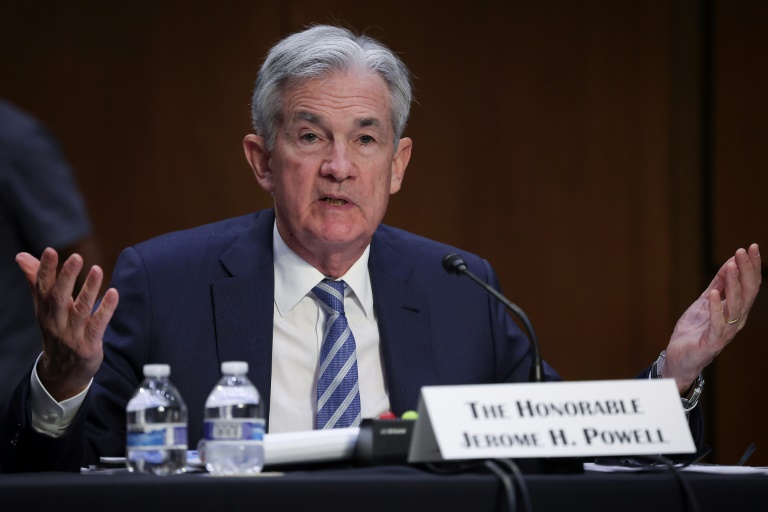
“However, Fed Chair Jerome Powell has been pushing back against a recession outcome while highlighting an outsized focus on combating inflation.”

After a drop on Wall Street, most of Asia gave back a large chunk of Tuesday’s rally.

Hong Kong, Shanghai, Sydney, Seoul, Singapore, Taipei, Manila and Jakarta were all in the red, though Tokyo, Jakarta and Wellington eked out gains.

But US futures rallied after healthy earnings releases from tech titans, including Microsoft and Alphabet, soothed some worries about the consumer.

Oil prices fluctuated as recession worries were offset by data showing a big drop in US stockpiles, which pointed to strong demand at a time when supplies remain weak.

– Key figures at around 0230 GMT –

Tokyo – Nikkei 225: UP 0.1 percent at 27,692.89 (break)

Hong Kong – Hang Seng Index: DOWN 1.2 percent at 20,659.18

Shanghai – Composite: DOWN 0.3 percent at 3,268.76

Euro/dollar: UP at $1.0146 from $1.0126 Tuesday

Pound/dollar: UP at $1.2051 from $1.2030 

Euro/pound: UP at 84.19 pence from 84.09 pence

Dollar/yen: UP at 137.02 yen from 136.95 yen

West Texas Intermediate: FLAT percent at $94.96 per barrel

Brent North Sea crude: DOWN 0.2 percent at $104.22 per barrel

New York – Dow: DOWN 0.7 percent at 31,761.54 (close)

London – FTSE 100: FLAT at 7,306.28 (close)

Japan eSports players with disabilities shoot down stereotypes

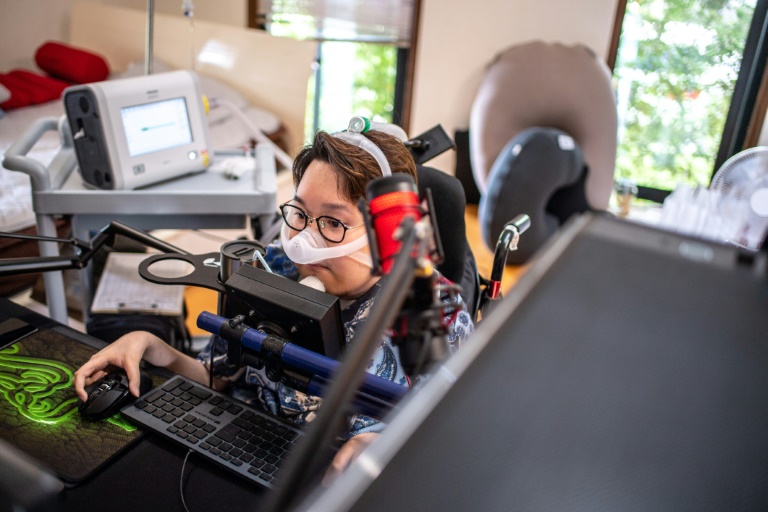
Street Fighter player Shunya Hatakeyama has muscular dystrophy, so he uses his chin to launch devastating combos. He is not the only Japanese gamer proving that disability is no barrier in eSports.

Naoya Kitamura, who is blind and relies on sound to play beat ’em up game Tekken 7, also hopes that his skills in a billion-dollar industry will help make society more open-minded.

“I’ll block a move and the sound it makes will tell me what kind of move it was,” Kitamura said.

“Then I’ll react and make my move,” he told AFP, demonstrating a dizzying attack with Tekken character Lucky Chloe.

Competitive gaming is booming worldwide, with global eSports revenues estimated at more than $1 billion, and many think it could one day be at the Olympics.

The sector is not as big in Japan as in eSports-crazy China and South Korea, but it is gradually starting to take root.

Keen to offer Japanese gamers with disabilities a chance to be part of the action, social welfare worker Daiki Kato founded a company called ePara in 2016.

Kato’s firm employs players such as Hatakeyama and Kitamura, who are both 28, and gives them time to practise around their other duties, which include working on the company’s website and helping organise gaming events.

Hatakeyama mostly enters Street Fighter V tournaments that are open to anyone — disabled or non-disabled — and says the beauty of fighting games is that “you can overcome handicaps and compete against different people”.

“When I play in a tournament I don’t want my disability to be an issue,” he said.

“I want to move people with the way I play.”

– Custom controller –

Hatakeyama was born with degenerative muscular dystrophy and has used a wheelchair since he was about six years old.

He has always loved fighting games, but over the years his muscles weakened so much that he could not hold a controller.

Depressed, he quit playing for six years until he and a friend decided last year to design and make a custom controller that he could operate with his chin.

Using his fingers to press buttons on his computer keyboard, Hatakeyama says he quickly got back into the groove.

Now he also coaches other players with disabilities, talking them through complicated combos and offering tips on different characters.

“If I had never played fighting games, I don’t think I would try to find solutions whenever I encountered something difficult,” he said.

Many of ePara’s gamers are new to eSports and do not have much experience of competing in tournaments.

Company chief Kato believes there is a growing market for gamers with disabilities and he thinks manufacturers will start to sit up and take notice.

“If you have more people with hearing impairments or visual impairments playing games, game manufacturers will react by making more games that they can play,” he said.

– ‘Same rules, same competitions’ –

Kato wants to use eSports to showcase the talents of people with disabilities, saying many people in Japan “don’t have much chance to interact” with them.

Kitamura, who has microphthalmos and has been blind since birth, says eSports can help change the perception that people with disabilities “just need assistance”.

“I’m really good with computers and I can do a lot more than some people who can see can do,” he said.

“It’s not just about being helped — depending on the circumstances, we can help people out too. It’s about cooperation.”

Kitamura thinks the term eSports itself also helps, projecting the image of serious competition rather than “just people playing games”.

The Southeast Asian Games have featured eSports medal events and they will also appear at next year’s pandemic-delayed Asian Games.

Many believe that the Olympics and Paralympics will follow suit but Kato says there is “no need to distinguish between people with or without disabilities in eSports”.

“That’s one interesting thing about it,” he said.

“Whether you’re in a wheelchair or not, it’s the same rules and the same competitions.”

Israel's Teva reaches potential $4.25 bn US opioid settlement

Israeli generic drug maker Teva has reached an agreement in principle to pay $4.25 billion over 13 years to settle a series of court cases over its role in the US opioid epidemic.

If the deal is finalized, Teva would become the latest major company to reach a settlement over the crisis which caused hundreds of thousands of deaths and ravaged communities across the country.

Teva reached the potential agreement on the terms of a “nationwide opioids settlement” with a working group of state attorneys general and lawyers for Native American tribes and other plaintiffs, the company said in its second-quarter financial results.

“Teva will pay up to $4.25 billion (including the already settled cases) plus approximately $100 million for the tribes, spread over 13 years,” it said.

The overall figure includes up to $1.2 billion in the generic version of Narcan, which can reverse opioid overdoses.

The deal will include “no admission of wrongdoing,” but “it remains in our best interest to put these cases behind us,” the company added.

Teva has already gone through several opioid-related lawsuits and reached agreements with some states.

The opioid crisis, which has caused more than 500,000 deaths over 20 years in the United States, has triggered a flurry of lawsuits from victims as well as cities, counties and states impacted by the fallout.

Drugmaker Johnson & Johnson and three major distributors, McKesson, AmerisourceBergen and Cardinal Health, have agreed to pay out $24.5 billion over several years to end more than 3,000 lawsuits.

Purdue Pharma, considered by many to be a major driver of the crisis because of its aggressive promotion of its pain killer OxyContin, filed for bankruptcy in September 2019 as it faced a flood of legal action.

Fighter jets and warships: Russians get a taste of Crimea summer vacation

Russian tourist Alexandra Rumyantseva is tanning on a beach in Moscow-annexed Crimea, not far away from the front lines of Ukraine’s eastern and southern territories.

Sitting on a rock in a white bikini by clear Black Sea waters on the outskirts of Sevastopol, Rumyantseva looks up as a Russian fighter jet whizzes through the perfectly blue sky.

“Of course, I cannot say that we are in a fully relaxed state,” she told AFP.

The front is around 300 kilometres (190 miles) north of Sevastopol — Crimea’s largest city and home to the Russian Black Sea fleet.

Despite the fighting nearby, the Saint Petersburg charity worker chose to have her beach break with her husband and two sons on the peninsula.

Moscow’s intervention in Ukraine, the onset of Western sanctions, severed air links with Europe and mounting economic troubles at home have made a lot of popular tourist destinations in Europe and elsewhere off limits to Russian tourists.

But even getting to Crimea, annexed by Russia from Ukraine in 2014 and a popular beach destination, is difficult.

Russia’s balmy Black Sea coast and Crimea have become hard to reach due to the closure of airspace in the south over the fighting in Ukraine.

Rumyantseva’s family drove 2,500 kilometres. They used a land bridge Moscow built to connect the peninsula to mainland Russia. 

Rumyantseva said there were rumours the bridge could be blown up and that “many were worried”, but the family decided to risk it anyway.

On their way, they saw a military convoy, seemingly on its way to the front. 

– ‘People are scared’ –

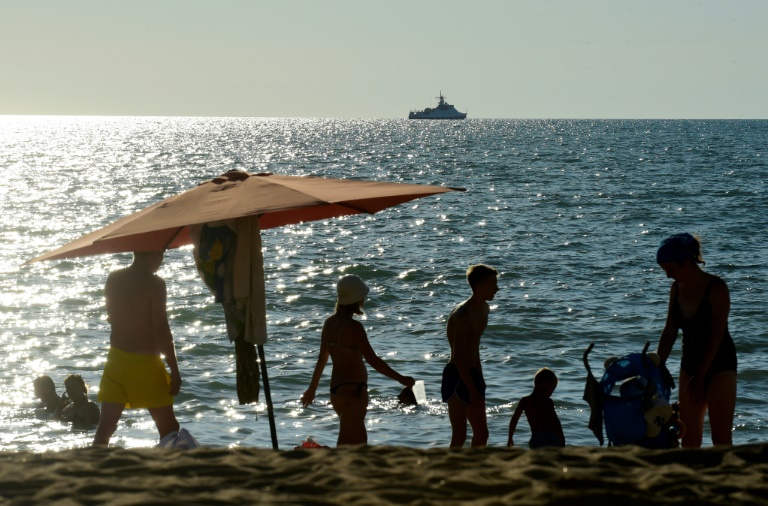
When AFP visited Sevastopol on a hot July day, Russian warships were visible in the distance as beachgoers cooled off in the sea. 

Aside from the ships and occasional jet sounds, few signs pointed to the full-scale military campaign next door.

Teenagers jumped off rocks and bare-chested men drank beer and made shashliki (grilled meat), a Russian summer favourite. 

In the city centre, Russian patriotic music rang out and souvenirs featuring the letter Z — a symbol of Moscow’s forces fighting in Ukraine — were offered to visitors.

Fewer tourists than usual have showed up in Crimea this summer.

“It seems like it is mainly locals here,” said 28-year-old Anna Zaluzhnaya, who works in the food industry, as she lounged in the sun.

Local businesspeople, who rely on tourism as the peninsula is largely cut off from the world due to sanctions, are feeling the effects. 

Albert Agagulyan, 69, runs a small kebab joint on a beach outside Sevastopol.

The retired fighter pilot said he could not afford to send his child to summer camp this year.

“People are not coming here because they are scared,” he added.

– ‘Worried by these events’ –

Crimea borders the southern Ukrainian region of Kherson — now controlled by Moscow — and the southeastern region of Zaporizhzhia — partially occupied by the Russian army — is also nearby.

Kyiv has pledged to retake lost southern territories captured by Russian troops, and some believe that the possibility of Ukrainian strikes on Crimea cannot be ruled out.

While some prefer not to discuss politics, locals like Viktor Borodulin say they have been closely following Moscow’s military campaign in Ukraine.

“I am very worried by these events,” said the 77-year-old engineer. He said he was particularly saddened by the sinking of the Russian cruiser Moskva in April. 

Borodulin waxed nostalgic for the Soviet past and lit up when he spoke of the possibility of buying fruit and vegetables from Moscow-occupied southern Ukraine. 

“Today I even bought some products from Kherson,” he said. 

“For me, it is a great joy.”

bur/kjm 

Microsoft earnings fall short as computer sales sag

Microsoft on Tuesday said that its earnings in the recently ended quarter fell shy of expectations as personal computer sales suffered from production holdups in China and sagging demand.

The US technology giant reported profit of $16.7 billion on revenue of $51.9 billion, topping the same quarter a year earlier but missing market forecasts.

The earnings stumble was due mostly to foreign exchange rates and shutdowns of personal computer factories in China, Wedbush analyst Dan Ives said in a note to investors.

Microsoft said that the strong US dollar made its offerings more costly in foreign markets, hurting sales.

“The most important core business; cloud and commercial bookings was relatively rock solid despite fears,” Ives said.

“The core DNA of the Microsoft growth story is cloud and core Azure growth which was healthy this quarter and appears to have momentum into 2023 despite economic headwinds.”

Microsoft shares were up some 4 percent in after-market trades that followed release of the earnings figures.

“In a dynamic environment we saw strong demand, took share, and increased customer commitment to our cloud platform,” said Microsoft chief financial officer Amy Hood.

Shutdowns at computer production facilities in China in May, and a deteriorating market for personal computers, cost Microsoft some $300 million in revenue it would have made from Windows operating systems bought to power the machines, the earnings report indicated.

The personal computer market had been in steady decline prior to the pandemic, as people turned to smartphones or tablets.

A massive shift to shopping, working, socializing and playing from home reignited demand for desktop computing power, but it remains to be seen whether that appetite will remain post-pandemic.

Ad revenue at Microsoft’s online news, search, and career social network LinkedIn suffered due to companies cutting marketing budgets due to broad economic woes, the company said.

The tech veteran based in the US state of Washington also logged $126 million in operating expenses related to scaling back its operations in Russia because of that country’s invasion of Ukraine.

Microsoft saw consumers spend less on Xbox videogame content in the quarter compared to the same period a year earlier, in a possible sign that many are out playing in the real world more as pandemic restrictions ease.

However, Microsoft’s cloud, business and productivity offerings continued to thrive.

“We see real opportunity to help every customer in every industry use digital technology to overcome today’s challenges and emerge stronger,” said Microsoft chief executive Satya Nadella.

Fed poised to attack inflation with another interest rate hike

The Federal Reserve is set to announce another big interest rate increase on Wednesday, the fourth this year, in its ongoing battle to tamp down price pressures that have been squeezing American families.

US central bankers are hoping that their aggressive stance will start to cool red-hot inflation that topped nine percent in June, the highest in more than 40 years, without derailing the world’s largest economy.

President Joe Biden is paying the political cost for surging prices, which he blames mostly on Russia’s war in Ukraine, which has sent global food and energy prices soaring. 

Biden insists the American economy will avoid a recession, but even as his approval ratings have cratered, he has supported the Fed in its battle to quell inflation.

Fed Chair Jerome Powell and others have made it clear they are willing to risk a downturn and will keep raising interest rates until they see clear evidence inflation is moving back towards the two percent goal.

The policy-setting Federal Open Market Committee is widely expected to announce another three-quarter-point increase in the benchmark borrowing rate at the conclusion of its two-day policy meeting at 1800 GMT.

From zero at the start of the year, the Fed has raised the policy lending rate to a range of 1.5 to 1.75 percent, which has pushed mortgage rates higher and slowed housing sales for five straight months.

Economists say this has been the most aggressive Fed tightening cycle since the 1980s, when stagflation — a wage-price spiral and stagnant growth — crippled the US economy.

The challenge for policymakers is to quell inflation before it becomes dangerously entrenched, but without sending the world’s largest economy into a recession that would reverberate around the globe.

While prices have continued to rise, with home prices hitting a new record, there are signs the pace of the increases has begun to slow, which may allow the central bank to ease up on its rate increases.

Global oil prices are trending down, with the US benchmark WTI falling to below $95 a barrel from its peak of more than $123 in March, and gasoline prices at the pump have fallen 69 cents from the record of just over $5 a gallon in mid-June.

– Recession risk –

Meanwhile, the job market has remained strong, consumer demand has not fallen dramatically, and surveys show inflation expectations in the months ahead have started to trend lower.

Policymakers want to engineer a “soft landing,” taming inflation without causing a downturn, but economists warn they face an increasingly narrow path to success and it would be easy to overshoot by being too aggressive.

“The Fed is now stuck between a rock and a hard place, with no easy way out without the economy feeling pain,” KPMG chief economist Diane Swonk said in an analysis, noting that “Powell has started to underscore that reality by admitting a recession could occur.”

In fact, it is rare that the central bank moves so decidedly without causing a downturn, and there are signs of concern among Fed policymakers.

Kansas City Fed President Esther George dissented at the June meeting, saying she preferred a smaller half-point rate hike and warning that going too fast could be “unsettling” and raise recession fears.

GDP in the first quarter contracted 1.6 percent, and the first reading on the April-June period is due out Thursday. Though the consensus forecast calls for modest growth, many economists expect a downturn. 

Two quarters of negative growth are generally considered a recession, although that is not the official criteria.

But Fed Governor Christopher Waller said he was prepared to move even faster, with an unheard-of full point increase if inflation continued to accelerate.

Swonk said the Fed “is in uncharted waters,” so “uncertainty and disagreement about the course of rate hikes is a natural consequence.”

Tunisia approves new constitution in vote with low turnout

Tunisia has approved a new constitution granting unchecked powers to the office of President Kais Saied, the electoral board said, after a poorly attended referendum in which voters overwhelmingly backed the document.

Saied’s rivals accused the electoral board controlled by Saied of “fraud” and said his referendum, held Monday, had failed.

On Tuesday evening, electoral commission head Farouk Bouasker told journalists the body “announces the acceptance of the new draft constitution for the Republic of Tunisia”, based on preliminary results, with 94.6 percent of valid ballots voting “yes”, on 30.5 percent turnout.

Monday’s vote came a year to the day after the president sacked the government and suspended parliament in a dramatic blow to the only democracy to have emerged from the 2011 Arab Spring uprisings.

For some Tunisians, his moves sparked fears of a return to autocracy, but they were welcomed by others, fed up with high inflation and unemployment, political corruption and a system they felt had brought few improvements.

There had been little doubt the “yes” campaign would prevail, a forecast reflected in an exit poll by independent polling group Sigma Conseil.

Most of Saied’s rivals called for a boycott, and while turnout was low, it was higher than the single figures many had expected.

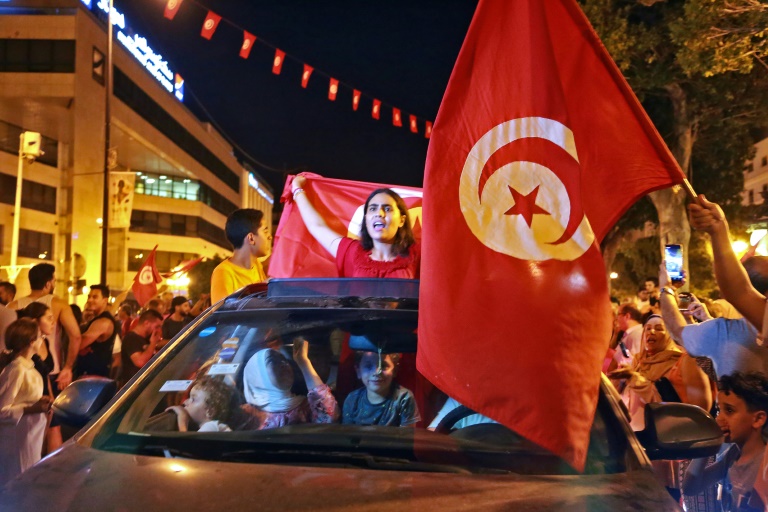
“Tunisia has entered a new phase,” Saied told celebrating supporters after polling closed.

“What the Tunisian people did… is a lesson to the world, and a lesson to history on a scale that the lessons of history are measured on,” he said.

But the US State Department said on Tuesday it noted “concerns that the new constitution includes weakened checks and balances that could compromise the protection of human rights and fundamental freedoms”.

And Tunisia’s National Salvation Front opposition alliance accused the electoral board of falsifying turnout figures.

– ‘Opaque and illegal’ –

NSF head Ahmed Nejib Chebbi said the figures were “inflated and don’t fit with what observers saw on the ground”.

The electoral board “isn’t honest and impartial, and its figures are fraudulent”, he said.

Saied, a 64-year-old law professor, dissolved parliament and seized control of the judiciary and the electoral commission on July 25 last year.

His opponents say the moves aimed to install an autocracy more than a decade after the fall of dictator Zine El Abidine Ben Ali, but his supporters say they were necessary after years of corruption and political turmoil.

“After 10 years of disappointment and total failure in the management of state and the economy, the Tunisian people wanted to get rid of the old and take a new step — whatever the results are,” said Noureddine al-Rezgui, a bailiff.

A poll of “yes” voters by state television suggested “reforming the country and improving the situation” along with “support for Kais Saied/his project” were their main motivations.

Thirteen percent cited being “convinced by the new constitution”.

Rights groups have warned the draft gives vast, unchecked powers to the presidency, allows Saied to appoint a government without parliamentary approval and makes him virtually impossible to remove from office.

Said Benarbia, regional director of the International Commission of Jurists, told AFP the new constitution would “give the president almost all powers and dismantle any check on his rule”.

“The process was opaque and illegal, the outcome is illegitimate,” he added.

– ‘Whatever he wants’ –

Saied has repeatedly threatened his enemies in recent months, issuing video diatribes against unnamed foes he describes as “germs”, “snakes” and “traitors”.

On Monday, he promised to hold to account “all those who have committed crimes against the country”.

Analyst Abdellatif Hannachi said the results meant Saied “can now do whatever he wants without taking anyone else into account”.

“The question now is: what is the future of opposition parties and organisations?”

As well as remaking the political system, Monday’s vote was seen as a gauge of Saied’s personal popularity, almost three years since the political outsider won by a landslide in Tunisia’s first democratic direct presidential election.

The country is now set to hold elections to the neutered parliament in December.

Until then, “Kais Saied will have more powers than a pharaoh, a Middle Ages Caliph or the (Ottoman-era) Bey of Tunis,” said political scientist Hamadi Redissi.

Participation in elections has gradually declined since the 2011 revolution, from just over half in a parliamentary poll months after Ben Ali’s ouster to 32 percent in 2019.

After the apology, the 'healing': Pope visits sacred lake in Canada

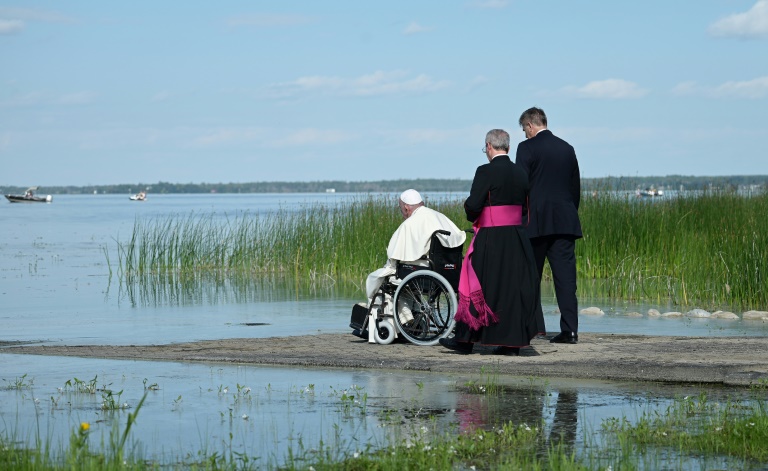
Pope Francis called for “healing” Tuesday as he joined a pilgrimage to a sacred lake in Canada, one day after making a landmark apology for the abuse of Indigenous children at Catholic-run schools.

The 85-year-old pontiff prayed for the Church to choose “truth” over “defending the institution” as he visited Lac Ste Anne, some 80 kilometers (50 miles) west of Edmonton, where some of Canada’s Indigenous people began their relationship with Catholicism generations ago.

The lake is one of the most important pilgrimage sites in North America. Every year since the end of the 19th century, thousands of pilgrims mainly from Canada and the United States have come to bathe and pray in the healing waters, according to Indigenous rites. 

Hundreds of faithful, many of them Indigenous, fell silent as the pope, who has been suffering with knee pain, was wheeled carefully to the water’s edge and prayed in silence there for several minutes.

He was then wheeled to a shrine, sprinkling some of those assembled with water he had blessed from the lake on the way, as Indigenous people drummed and chanted. 

Lamenting the “terrible effects of colonization, the indelible pain of so many families, grandparents and children,” Francis told those gathered for a liturgical celebration that their presence was “testimony of resilience and a fresh start.”

“All of us, as (a) Church, now need healing: healing from the temptation of closing in on ourselves, of defending the institution rather than seeking the truth,” the pope continued. 

Tuesday marked the second day of what Francis has called a “penitential” journey, a major tour of Canada which he began Monday with the long-awaited apology to a gathering of Indigenous people in the community of Maskwacis, south of Edmonton.

From the late 1800s to the 1990s, Canada’s government sent about 150,000 children into 139 residential schools run by the Church, where they were cut off from their families, language and culture.

Many were physically and sexually abused, and thousands are believed to have died of disease, malnutrition or neglect.

– ‘Part of a process’ –

For some, the healing had already begun.

Cindy Dearhead, a First Nations woman who was a student in one of the infamous schools, said she felt the pope’s apology was “important.”

“It was a long time coming, but finally a pope himself is finally acknowledging yes, I’m sorry,” she told AFP at Lac Ste Anne.

“For those of us that suffered into generations of trauma, maybe we can have healing and can understand what our parents came through and maybe feel better.”

But for many others that healing may well depend on what comes next. 

“I think the apology has always been one thing, part of a process of reconciliation. To me, the actions that need to come behind it are very important,” said Chief Peter Powder of the Mikisew Cree First Nations.

At Lac Ste Anne, the leader of the world’s 1.3 billion Catholics appeared tired and weakened by knee pain that has seen him use a wheelchair often in recent months.

His pilgrimage came hours after he delivered a mass to tens of thousands of people thronging a stadium in Edmonton, the capital of Alberta, one of the largest open-air events of his visit. 

There he prayed for a “future in which the history of violence and marginalization suffered by our Indigenous brothers and sisters is never repeated.”

At both events traditional music filled the air, while Indigenous people in the crowd were recognizable by their orange shirts — intended to symbolize what they endured in the country’s infamous residential schools.

Francis greeted the crowds both times — in his wheelchair at the lake, and in the popemobile at the stadium — kissing babies and blessing children.

– Generational trauma –

Since May 2021, more than 1,300 unmarked graves have been discovered at the sites of the former schools, sending shockwaves through Canada — which has slowly begun to acknowledge this long, dark chapter in its history.

More than 4,000 children have been identified as dying in the schools, but the true toll is estimated to be at least 6,000.

The abuse created trauma for generations.

On Wednesday the pope will fly to Quebec City, before ending his trip on Friday in Iqaluit, capital of the northern territory of Nunavut and home to the largest Inuit population in Canada.

There he will meet again with former residential school students, before returning to Italy. 

Close Bitnami banner
Bitnami