World

Three peacekeepers killed as anti-UN protests spread in DR Congo

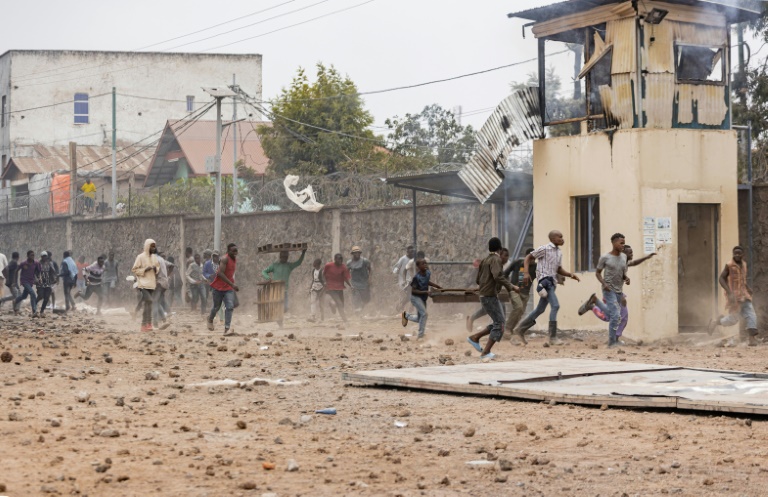
Three United Nations peacekeepers and at least 12 demonstrators have been killed in escalating anti-UN protests in eastern DR Congo, officials said on Tuesday.

Anger has been fuelled by perceptions that MONUSCO, the UN mission in the Democratic Republic of Congo (DRC), is failing to do enough to stop attacks by armed groups.

Crowds on Monday stormed a MONUSCO headquarters and supply base in Goma, the chief city in North Kivu province, and the protests spread on Tuesday to Beni and Butembo to the north.

Butembo police chief Colonel Paul Ngoma said three peacekeepers there — two Indians and a Moroccan — had been killed and another injured, while seven demonstrators had died and several others were wounded.

MONUSCO stated on Tuesday that one soldier and two military police officers serving with the UN had been killed in an attack on its base in Butembo. Another peacekeeper was gravely wounded.

“Assailants violently snatched weapons from elements of the Congolese National Police and fired at point-blank range at our peacekeepers,” MONUSCO said, adding that it “strongly condemns” the attack.

Morocco’s army also released a statement confirming that one Moroccan peacekeeper had been shot dead, with 20 of the North African country’s MONUSCO contingent also wounded during recent unrest.

Farhan Haq, a UN spokesman, warned reporters in New York that the situation on the ground is “very volatile”. “Reinforcements are being mobilised,” he said.

At a news conference in the DRC’s capital Kinshasa, government spokesman Patrick Muyaya said that about 15 people, including three peacekeepers, had been killed in the recent unrest and 61 people wounded. 

“In no case is violence justified,” he said. 

– Anger –

MONUSCO is one of the world’s biggest peacekeeping operations.

But it has regularly come under criticism in the troubled east, where many accuse it of failing to do enough to end decades-long bloodshed.

More than 120 armed groups roam the volatile region, where civilian massacres are common and conflict has displaced millions of people. 

In Monday’s unrest, hundreds of people in Goma blocked roads and chanted hostile slogans before storming MONUSCO’s headquarters and a supply base there.

Protesters smashed windows and looted valuables, while helicopters airlifted UN staff from the premises and security forces fired teargas in a bid to push them back. 

The unrest in Goma continued on Tuesday, with the fatal shooting of a man near the supplies base, an AFP correspondent saw.

Congolese security forces held back a crowd outside the facility, some of whom carried placards with slogans such as “Bye-bye, MONUSCO”.

At Goma’s CBCA Ndosho Hospital, the head of administration, Serge Kilumbiro, told AFP that 28 people had been admitted with gunshot wounds on Monday and eight more on Tuesday.

In Beni, about 350 kilometres (215 miles) to the north, soldiers deployed on the road leading to the MONUSCO base there on Tuesday, while protesters burned tyres. Shops, markets and petrol stations were closed.

In the town of Butembo, security forces dispersed protesters who had gathered in front of a MONUSCO base, witnesses said.

Ngoma, the local police chief, said some youths were “armed”.

– Rebels –

The latest protests come after the president of the senate, Modeste Bahati, told supporters in Goma on July 15 that MONUSCO should “pack its bags”.

They coincide with the resurgence of the M23 — a militia that lay mostly dormant for years before resuming fighting last November. 

The rebels have since made significant advances in eastern Congo, including capturing the North Kivu town of Bunagana on the Ugandan border. 

The UN first deployed an observer mission to eastern Congo in 1999. 

In 2010, it became the peacekeeping mission MONUSCO — the United Nations Organization Stabilization Mission in the Democratic Republic of the Congo — with a mandate to conduct offensive operations.

It has a current strength of about 16,300 uniformed personnel, according to the UN. 

MONUSCO on Monday said it “vigorously condemned the attack” on its premises in Goma, “carried out by a group of looters on the sidelines of a demonstration which, in addition, was banned by the mayor of Goma”.

In a statement on Monday, Khassim Diagne, the deputy special representative of the UN secretary general to MONUSCO, said the peacekeepers were there to protect civilians.  

“The incidents in Goma are not only unacceptable but totally counterproductive,” he said. 

Twitter shareholders to vote on Musk buy in September

Twitter on Tuesday urged shareholders to endorse the $44 billion deal Elon Musk made to buy the online podium, setting a vote on the merger for September 13.

The firm is locked in a legal battle with the mercurial Tesla boss over his effort to walk away from the agreement, and a judge has called for a trial to begin in October.

“Twitter believes that Mr. Musk’s purported termination is invalid and wrongful, and the merger agreement remains in effect,” chief executive Parag Agrawal and board chairman Bret Taylor said in a copy of a letter to investors filed with the US Securities and Exchange Commission.

“Your vote at the special meeting is critical to our ability to complete the merger.”

Twitter shareholders were assured that they will be able to attend the meeting online, and vote remotely.

Twitter’s board unanimously recommended that shareholders vote in favor of Musk buying the company for $54.20 per share under the terms of a deal inked in April.

“We are committed to closing the merger on the price and terms agreed upon with Mr. Musk,” Tuesday’s letter said.

Twitter shares ended the formal trading day Tuesday at $39.34.

The company last week blamed disappointing quarterly earnings results on “headwinds,” including uncertainty imposed on the company by Musk’s chaotic buyout bid. 

The social giant reported that the number of “monetizable” daily active users — those who can be shown advertising — increased by 8.8 million to 237.8 million. 

Twitter’s results covered the period ending in June, and so don’t include Musk’s move in July to try to “terminate” the deal on the argument that the platform was not forthcoming about its tally of fake accounts.

The social media network has countered by saying Musk already agreed to the deal and can’t back out now.

A court in the eastern US state of Delaware agreed to a fast-track trial on whether to force the billionaire to complete the buyout.

Billions of dollars are at stake, but so is the future of Twitter, which Musk has said should allow any legal speech — an absolutist position that has sparked fears the network could be used to incite violence.

Russia doing better than expected despite sanctions: IMF

Despite damaging Western sanctions imposed on Moscow in the wake of the invasion of Ukraine, Russia’s economy appears to be weathering the storm better than expected as it benefits from high energy prices, the IMF said Tuesday.

The sanctions were meant to sever Russia from the global financial system and choke off funds available to Moscow to finance the war.

But the International Monetary Fund’s latest World Economic Outlook upgraded Russia’s GDP estimate for this year by a remarkable 2.5 percentage points, although its economy is still expected to contract by six percent.

“That’s still a fairly sizable recession in Russia in 2022,” IMF chief economist Pierre-Olivier Gourinchas told AFP in an interview.

A key reason that the downturn was not as bad as expected was that “the Russian central bank and the Russian policymakers have been able to stave off a banking panic or financial meltdown when the sanctions were first imposed,” he said.

Meanwhile, rising energy prices are “providing an enormous amount of revenues to the Russian economy.”

After starting the year below $80 a barrel, oil prices spiked to nearly $129 in March before easing back to under $105 on Tuesday for Brent, the key European benchmark, while natural gas prices are rising again and approaching their recent peak.

While major economies including the United States and China are slowing, the report said, “Russia’s economy is estimated to have contracted during the second quarter by less than previously projected, with crude oil and non-energy exports holding up better than expected.” 

Meanwhile, despite the sanctions, Russia’s “domestic demand is also showing some resilience” due to government support.

But Gourinchas said “there is no rebound” ahead for Russia. “In fact,” the IMF is “revising down the Russian growth in 2023,” 1.2 points lower than the April forecast for a contraction of 3.5 percent.

The penalties already in place, as well as new ones announced by Europe, mean “the cumulative effect of the sanctions is also growing over time,” he said.

The report indicates Europe is facing the brunt of the fallout from sanctions given its reliance on Russia for energy. The situation could worsen dramatically if Moscow cuts off gas exports, and once the European Union imposes a ban on Russian oil delivered by sea starting next year.

Russia doing better than expected despite sanctions: IMF

Despite damaging Western sanctions imposed on Moscow in the wake of the invasion of Ukraine, Russia’s economy appears to be weathering the storm better than expected as it benefits from high energy prices, the IMF said Tuesday.

The sanctions were meant to sever Russia from the global financial system and choke off funds available to Moscow to finance the war.

But the International Monetary Fund’s latest World Economic Outlook upgraded Russia’s GDP estimate for this year by a remarkable 2.5 percentage points, although its economy is still expected to contract by six percent.

“That’s still a fairly sizable recession in Russia in 2022,” IMF chief economist Pierre-Olivier Gourinchas told AFP in an interview.

A key reason that the downturn was not as bad as expected was that “the Russian central bank and the Russian policymakers have been able to stave off a banking panic or financial meltdown when the sanctions were first imposed,” he said.

Meanwhile, rising energy prices are “providing an enormous amount of revenues to the Russian economy.”

After starting the year below $80 a barrel, oil prices spiked to nearly $129 in March before easing back to under $105 on Tuesday for Brent, the key European benchmark, while natural gas prices are rising again and approaching their recent peak.

While major economies including the United States and China are slowing, the report said, “Russia’s economy is estimated to have contracted during the second quarter by less than previously projected, with crude oil and non-energy exports holding up better than expected.” 

Meanwhile, despite the sanctions, Russia’s “domestic demand is also showing some resilience” due to government support.

But Gourinchas said “there is no rebound” ahead for Russia. “In fact,” the IMF is “revising down the Russian growth in 2023,” 1.2 points lower than the April forecast for a contraction of 3.5 percent.

The penalties already in place, as well as new ones announced by Europe, mean “the cumulative effect of the sanctions is also growing over time,” he said.

The report indicates Europe is facing the brunt of the fallout from sanctions given its reliance on Russia for energy. The situation could worsen dramatically if Moscow cuts off gas exports, and once the European Union imposes a ban on Russian oil delivered by sea starting next year.

Saudi prince to sign deal for 'cheaper energy' in Greece

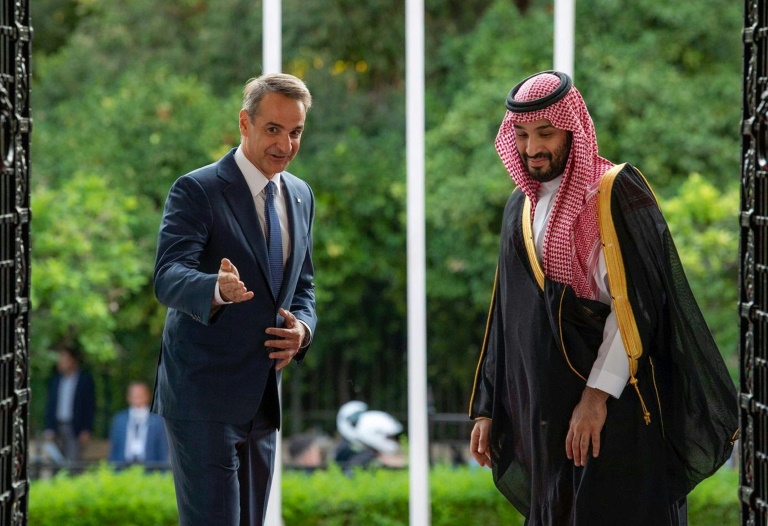
Saudi Crown Prince Mohammed bin Salman announced upcoming bilateral projects on a visit to Greece Tuesday, including for a power cable between both countries to provide Europe with “cheaper renewable energy”.

Prince Mohammed landed in Greece on Tuesday on his first Europe trip since the killing of Saudi journalist Jamal Khashoggi, and is set to head to France later in the week.

“I believe we have… historical opportunities, that we are going to finalise a lot of it today,” Prince Mohammed said at a press conference with Prime Minister Kyriakos Mitsotakis in the capital Athens.

This would include linking electricity grids to “provide Greece and southwest Europe through Greece with… much cheaper renewable energy,” he added.

The Greek foreign ministry said agreements on maritime transport, energy and defence technology among other things were due to be signed on Wednesday.

Khashoggi’s killing and dismemberment by Saudi agents in the kingdom’s Istanbul consulate in October 2018 brought the powerful crown prince international condemnation.

Prince Mohammed’s trip to Europe comes less than two weeks after US President Joe Biden visited the Saudi city of Jeddah for a summit of Arab leaders and met one-on-one with the prince, greeting him with a fist bump.

That move sealed Biden’s retreat from a presidential election campaign pledge to turn the kingdom into a “pariah” over the Khashoggi affair and wider human rights controversies.

– ‘Isolation’ over –

US intelligence agencies determined that Prince Mohammed, Saudi Arabia’s de facto ruler, had “approved” the operation that led to Khashoggi’s death, though Riyadh denies this, blaming rogue operatives.

Prince Mohammed’s stay in Europe represents a “highly symbolic move past his post-Khashoggi isolation”, said Kristian Ulrichsen, a research fellow at the Baker Institute at Rice University.

“While there has not been any formal coordination of policy in the ‘West’ against Mohammed bin Salman since 2018, the fact is that he has not visited any European or North American country since Khashoggi’s killing,” Ulrichsen said.

Prince Mohammed has also received a recent boost from Turkish President Recep Tayyip Erdogan, who visited Saudi Arabia in April, then welcomed Prince Mohammed in Ankara in June.

Erdogan had enraged the Saudis by vigorously pursuing the Khashoggi case, opening an investigation and briefing international media about the lurid details of the killing.

But with ties on the mend, an Istanbul court halted the trial in absentia of 26 Saudi suspects linked to Khashoggi’s death, transferring the case to Riyadh in April.

– Oil focus –

After Russia’s invasion of Ukraine triggered a spike in energy prices earlier this year, Saudi Arabia came under pressure from the United States and European powers to pump more oil.

Elevated oil prices have been a key factor in inflation in the US soaring to 40-year highs, putting pressure on the Biden administration ahead of mid-term elections later this year.

But the world’s biggest crude exporter has resisted pressure to open the supply taps, citing its commitment to production schedules determined by the OPEC+ exporting bloc it co-leads with Russia.

In May, Saudi Foreign Minister Prince Faisal bin Farhan stated that the kingdom had done what it could for the oil market.

Last week French President Emmanuel Macron received the new president of the energy-rich United Arab Emirates, Sheikh Mohamed bin Zayed Al-Nahyan, in Paris.

During that trip officials announced a deal between French energy giant Total Energies and UAE state oil company ADNOC “for cooperation in the area of energy supplies”.

Energy will probably be on the agenda again when Prince Mohammed goes to France, though it is unlikely the kingdom will change its position on oil production, said Huda al-Halisi, vice chair of the foreign affairs committee of the Saudi Shura Council, an advisory body.

“We’re on a set path and we need to see it through,” Halisi told AFP, while stressing there are many opportunities for deals on sustainable energy and other efforts to combat climate change.

Security concerns are also likely to get a lengthy hearing, Halisi said. 

Those include regional rival Iran’s nuclear programme and Tehran’s role in Yemen, where a truce is currently set to expire in early August between Iran-backed Huthi rebels and a Saudi-led military coalition supporting the internationally recognised government.

Pair of new studies point to natural Covid origin

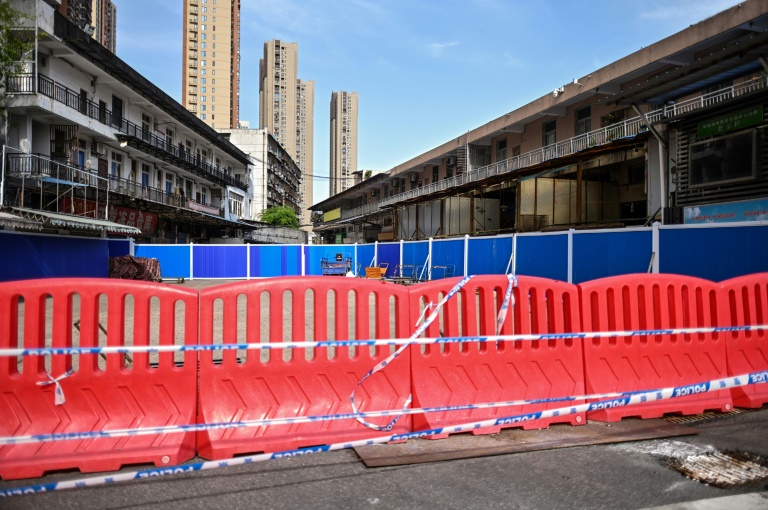
An animal market in China’s Wuhan really was the epicenter of the Covid pandemic, according to a pair of new studies in the journal Science published Tuesday that claimed to have tipped the balance in the debate about the virus’ origins.

Answering the question of whether the disease spilled over naturally from animals to humans, or was the result of a lab accident, is viewed as vital to averting the next pandemic and saving millions of lives.

The first paper analyzed the geographic pattern of Covid cases in the outbreak’s first month, December 2019, showing the first cases were tightly clustered around the Huanan Market. 

The second examined genomic data from the earliest cases to study the virus’ early evolution, concluding it was unlikely the coronavirus circulated widely in humans prior to November 2019.

Both were previously posted as “preprints” but have now been vetted by scientific peer review and appear in a prestigious journal.

Michael Worobey of the University of Arizona, who co-authored both papers, had previously called on the scientific community in a letter to be more open to the idea that the virus was the result of a lab leak.

But the findings moved him “to the point where now I also think it’s just not plausible that this virus was introduced any other way than through the wildlife trade at the Wuhan market,” he told reporters on a call about the findings.

Though previous investigation had centered on the live animal market, researchers wanted more evidence to determine it was really the progenitor of the outbreak, as opposed to an amplifier.

This required neighborhood-level study within Wuhan to be more certain the virus was “zoonotic” — that it jumped from animals to people.

The first study’s team used mapping tools to determine the location of most of the first 174 cases identified by the World Health Organization, finding 155 of them were in Wuhan.

Further, these cases clustered tightly around the market — and some early patients with no recent history of visiting the market lived very close to it.

Mammals now known to be infectable with the virus — including red foxes, hog badgers and raccoon dogs, were all sold live in the market, the team showed.

– Two introductions to humans –

The study authors also tied positive samples from patients in early 2020 to the western portion of the market, which sold live or freshly butchered animals in late 2019.

The tightly confined early cases contrasted with how it radiated throughout the rest of the city by January and February, which the researchers confirmed by drilling into social media check-in data from the Weibo app.

“This tells us the virus was not circulating cryptically,” Worobey said in a statement. “It really originated at that market and spread out from there.”

The second study focused on resolving an apparent discrepancy in the virus’ early evolution.

Two lineages, A and B, marked the early pandemic. 

But while A was closer to the virus found in bats, suggesting the coronavirus in humans came from this source and that A gave rise to B, it was B that was found to be far more present around the market.

The researchers used a technique called “molecular clock analysis,” which relies on the rate at which genetic mutations occur over time to reconstruct a timeline of evolution — and found it unlikely that A gave rise to B.

“Otherwise, lineage A would have had to have been evolving in slow motion compared to the lineage B virus, which just doesn’t make biological sense,” said Worobey.

Instead, the probable scenario was that both jumped from animals at the market to humans on separate occasions, in November and December 2019. The researchers concluded it was unlikely that there was human circulation prior to November 2019.

Under this scenario, there were probably other animal-to-human transmissions at the market that failed to manifest as Covid cases.

“Have we disproven the lab leak theory? No, we have not. Will we ever be able to know? No,” said co-author Kristian Anderson of The Scripps Research Institute.

“But I think what’s really important here is that there are possible scenarios and they’re plausible scenarios and it’s really important to understand that possible does not mean equally likely.”

Buzz Aldrin's Apollo 11 jacket sold for $2.7 mn

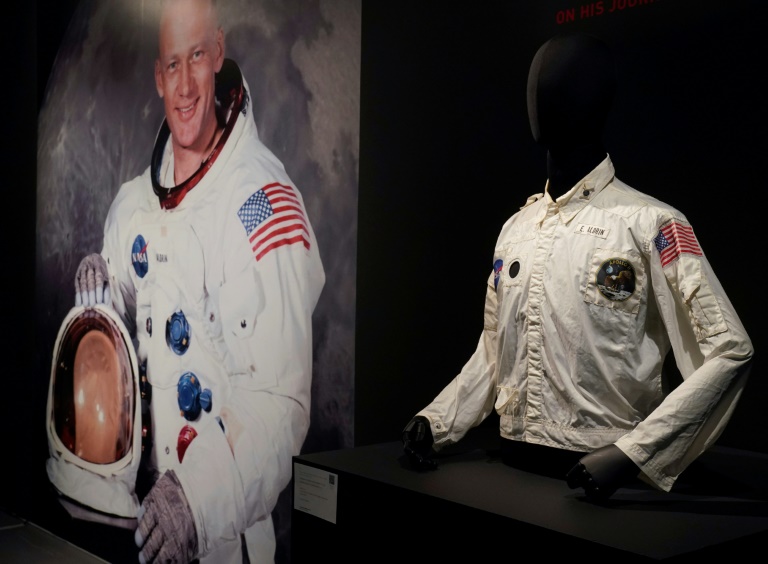
The jacket worn by US astronaut Buzz Aldrin during his 1969 flight to the Moon aboard Apollo 11 was sold at auction for $2.7 million in New York Tuesday, Sotheby’s announced.

The white jacket, adorned with an American flag, NASA’s initials, a patch for the Apollo 11 mission and the name “E. ALDRIN,” is part of a personal collection of items the 92-year-old astronaut decided to put up for sale. 

“The exceptionally rare garment was chased by multiple bidders for almost ten minutes before selling to a bidder on the phone,” Sotheby’s said in a statement. 

“After deep consideration, the time felt right to share these items with the world, which for many are symbols of a historical moment, but for me have always remained personal mementos of a life dedicated to science and exploration,” Aldrin, the last living member of Apollo 11’s three-member flight crew, said in a statement last week. 

He explained the jacket was separate from the spacesuit he wore while walking on the moon with fellow astronaut Neil Armstrong, but that he wore it while flying to and from the Moon. 

“I wore this Inflight Coverall Jacket… in the Command Module Columbia, on our historic journey to the Moon and back home again during the Apollo 11 mission,” Aldrin said.

The suits worn on the Moon by Aldrin and Armstrong are part of the National Air and Space Museum’s collections in Washington. 

In total, the New York auction garnered $8.2 million for 68 items sold out of the 69 offered, including $819,000 for a flight plan. 

Third body found in drought-hit lake outside Las Vegas

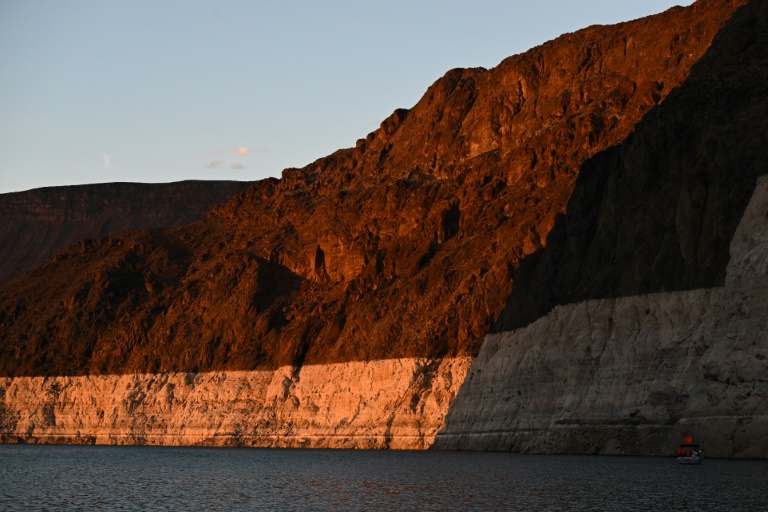
More human remains have been found at a lake near Las Vegas, officials said, months after the rapidly receding waters of drought-hit Lake Mead revealed the corpse of a long-submerged mob victim.

Park rangers responded Monday afternoon to a witness report of a body at Swim Beach and have begun efforts to recover the remains, the National Park Service said.

No details were immediately provided about the age or identity of the most recent discovery, with the local county coroner set to conduct an autopsy.

The giant man-made reservoir drew global attention in May when the decades-old skeleton of a man shot in the head were found stuffed in a barrel that had been dumped in the lake.

Police believe that murder occurred in the late 1970s or early 1980s, when the Las Vegas criminal underworld was particularly active in the desert gambling capital.

Another body was found days later, with no evidence of foul play, and authorities had predicted more bodies would be found as water levels drop in the country’s biggest reservoir.

A historic drought that is gripping much of the western United States is putting a strain on water sources, with reservoirs and lakes falling to unprecedently low levels.

Lake Mead once sat 1,200 feet above sea level. But after more than two decades of drought, it was at only 1,040 feet above sea level Tuesday — its lowest level since filling in the 1930s.

It is currently falling about 12 inches every week.

Russia to quit International Space Station 'after 2024'

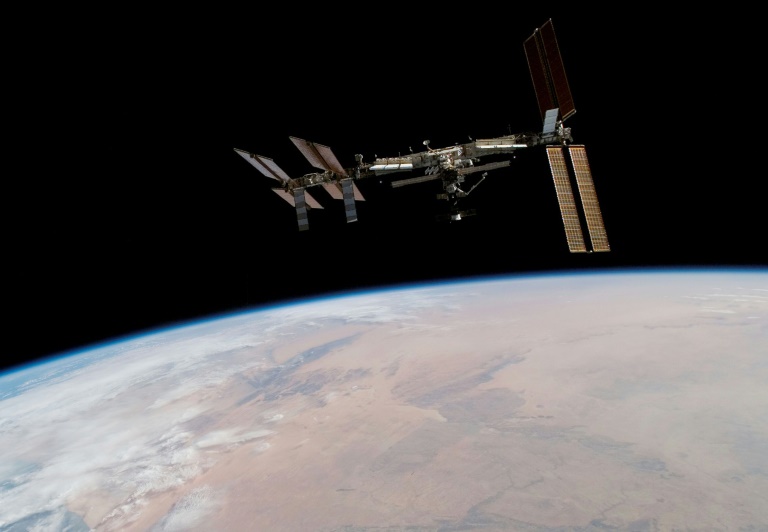
Moscow said Tuesday it was leaving the International Space Station “after 2024” amid tensions with the West, in a move analysts warned could lead to a halt of Russian-crewed flights.

The confirmation of the long-mooted move comes as ties unravel between the Kremlin and the West over Moscow’s military intervention in Ukraine and several rounds of devastating sanctions against Russia, including its space sector.

Space experts said Russia’s departure from the International Space Station would seriously affect the country’s space sector and deal a significant blow to its programme of crewed flights, a major source of Russian pride.

“Of course, we will fulfil all our obligations to our partners, but the decision to leave this station after 2024 has been made,” Yury Borisov, the new head of Russian space agency Roscosmos, told President Vladimir Putin, according to a Kremlin account of their meeting.

“I think that by this time we will start putting together a Russian orbital station,” Borisov added, calling it the domestic space programme’s main “priority”.

“Good,” Putin replied.

The ISS is due to be retired after 2024, although US space agency NASA says it can remain operational until at least 2030.

The ISS was launched in 1998 at a time of hope for US-Russia cooperation following their Space Race competition during the Cold War.

The United States said it was taken by surprise by the announcement.

“It’s an unfortunate development given the critical scientific work performed at the ISS, the valuable professional collaboration our space agencies have had over the years,” State Department spokesman Ned Price said. 

In a statement to AFP, NASA administrator Bill Nelson said the agency “has not been made aware of decisions from any of the partners, though we are continuing to build future capabilities to assure our major presence in low-Earth orbit”.

Until now, space exploration has been one of the few areas where cooperation between Russia and the United States and its allies had not been wrecked by tensions over Ukraine and elsewhere.

– ‘Like an old woman’s flat’-

Russia is heavily reliant on imports of everything from manufacturing equipment to consumer goods, and the effects of Western sanctions are expected to wreak havoc on the country’s economy in the long term.

Space expert Vadim Lukashevich said space science cannot flourish in a heavily sanctioned country.

“If the ISS ceases to exist in 2024, we will have nowhere to fly,” Lukashevich told AFP. “At stake is the very preservation of manned flights in Russia, the birthplace of cosmonautics.”

Pointing to Russia’s growing scientific and technological isolation, Lukashevich said the authorities could not plan more than several months in advance and added that even if Russia builds an orbiting station, it would be a throwback to the 1980s.

“It will be archaic, like an old woman’s flat, with a push-button telephone and a record player,” he said.

Space analyst Vitaly Yegorov struck a similar note, saying it was next to impossible to build a new orbiting station from scratch in a few years.

“Neither in 2024, nor in 2025, nor in 2026 will there be a Russian orbital station,” Yegorov told AFP.

He added that creating a fully-fledged space station would take at least a decade of “the most generous funding”.

Yegorov said Russia’s departure from the ISS meant Moscow might have to put on ice its programme of manned flights “for several years” or even “indefinitely”.

The move could also see Russia abandon its chief spaceport, Baikonur, which it is renting from Kazakhstan, Yegorov said.

Russian Soyuz rockets were the only way to reach the International Space Station until SpaceX, run by billionaire Elon Musk, debuted a capsule in 2020.

– ‘Difficult to restore’ –

The Soviet space programme can boast of a number of key accomplishments, including sending the first man into space in 1961 and launching the first satellite four years earlier. These feats remain a major source of national pride in Russia.

But experts say Roscosmos is now a shadow of its former self and has in recent years suffered a series of setbacks, including corruption scandals and the loss of a number of satellites and other spacecraft.

Borisov, appointed in mid-July, replaced Dmitry Rogozin, a firebrand politician known for his bombastic statements.

Rogozin had previously warned that without cooperation from Moscow, the ISS could de-orbit and fall on US or European territory.

In a possible sign of disagreement with Borisov, Vladimir Solovyov, chief designer at spacecraft manufacturer Energia, said Russia should not rush to quit the ISS.

“If we halt manned flights for several years, then it will be very difficult to restore what has been achieved,” he was quoted as telling the Russky Cosmos magazine.

Russia to quit International Space Station 'after 2024'

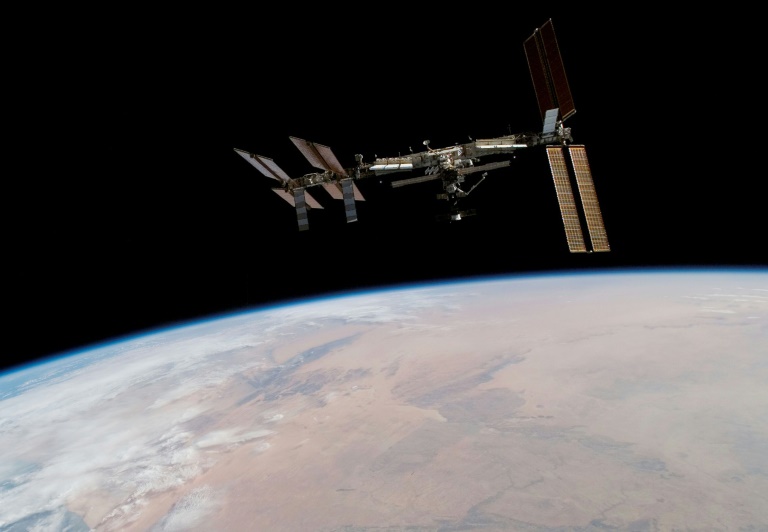
Moscow said Tuesday it was leaving the International Space Station “after 2024” amid tensions with the West, in a move analysts warned could lead to a halt of Russian-crewed flights.

The confirmation of the long-mooted move comes as ties unravel between the Kremlin and the West over Moscow’s military intervention in Ukraine and several rounds of devastating sanctions against Russia, including its space sector.

Space experts said Russia’s departure from the International Space Station would seriously affect the country’s space sector and deal a significant blow to its programme of crewed flights, a major source of Russian pride.

“Of course, we will fulfil all our obligations to our partners, but the decision to leave this station after 2024 has been made,” Yury Borisov, the new head of Russian space agency Roscosmos, told President Vladimir Putin, according to a Kremlin account of their meeting.

“I think that by this time we will start putting together a Russian orbital station,” Borisov added, calling it the domestic space programme’s main “priority”.

“Good,” Putin replied.

The ISS is due to be retired after 2024, although US space agency NASA says it can remain operational until at least 2030.

The ISS was launched in 1998 at a time of hope for US-Russia cooperation following their Space Race competition during the Cold War.

The United States said it was taken by surprise by the announcement.

“It’s an unfortunate development given the critical scientific work performed at the ISS, the valuable professional collaboration our space agencies have had over the years,” State Department spokesman Ned Price said. 

In a statement to AFP, NASA administrator Bill Nelson said the agency “has not been made aware of decisions from any of the partners, though we are continuing to build future capabilities to assure our major presence in low-Earth orbit”.

Until now, space exploration has been one of the few areas where cooperation between Russia and the United States and its allies had not been wrecked by tensions over Ukraine and elsewhere.

– ‘Like an old woman’s flat’-

Russia is heavily reliant on imports of everything from manufacturing equipment to consumer goods, and the effects of Western sanctions are expected to wreak havoc on the country’s economy in the long term.

Space expert Vadim Lukashevich said space science cannot flourish in a heavily sanctioned country.

“If the ISS ceases to exist in 2024, we will have nowhere to fly,” Lukashevich told AFP. “At stake is the very preservation of manned flights in Russia, the birthplace of cosmonautics.”

Pointing to Russia’s growing scientific and technological isolation, Lukashevich said the authorities could not plan more than several months in advance and added that even if Russia builds an orbiting station, it would be a throwback to the 1980s.

“It will be archaic, like an old woman’s flat, with a push-button telephone and a record player,” he said.

Space analyst Vitaly Yegorov struck a similar note, saying it was next to impossible to build a new orbiting station from scratch in a few years.

“Neither in 2024, nor in 2025, nor in 2026 will there be a Russian orbital station,” Yegorov told AFP.

He added that creating a fully-fledged space station would take at least a decade of “the most generous funding”.

Yegorov said Russia’s departure from the ISS meant Moscow might have to put on ice its programme of manned flights “for several years” or even “indefinitely”.

The move could also see Russia abandon its chief spaceport, Baikonur, which it is renting from Kazakhstan, Yegorov said.

Russian Soyuz rockets were the only way to reach the International Space Station until SpaceX, run by billionaire Elon Musk, debuted a capsule in 2020.

– ‘Difficult to restore’ –

The Soviet space programme can boast of a number of key accomplishments, including sending the first man into space in 1961 and launching the first satellite four years earlier. These feats remain a major source of national pride in Russia.

But experts say Roscosmos is now a shadow of its former self and has in recent years suffered a series of setbacks, including corruption scandals and the loss of a number of satellites and other spacecraft.

Borisov, appointed in mid-July, replaced Dmitry Rogozin, a firebrand politician known for his bombastic statements.

Rogozin had previously warned that without cooperation from Moscow, the ISS could de-orbit and fall on US or European territory.

In a possible sign of disagreement with Borisov, Vladimir Solovyov, chief designer at spacecraft manufacturer Energia, said Russia should not rush to quit the ISS.

“If we halt manned flights for several years, then it will be very difficult to restore what has been achieved,” he was quoted as telling the Russky Cosmos magazine.

Close Bitnami banner
Bitnami