World

October trial set in Musk, Twitter buyout battle

Twitter notched an early win Tuesday in its fight with Elon Musk, after a judge agreed to a fast-track trial on whether to force the Tesla chief to complete his $44 billion buyout of the social network.

Musk’s lawyers had pushed for a February 2023 date, but the court in the eastern US state of Delaware hewed closely to the uncertainty-wracked platform’s desire for speed and set an October start.

Billions of dollars are at stake, but so is the future of Twitter, which Musk has said should allow any legal speech — an absolutist position that has sparked fears the network could be used to incite violence.

Judge Kathaleen McCormick, who set a five-day trial and left the sides to work with the court to fix the exact date, noted that the “risk of irreparable harm” generally grows the longer a merger remains in limbo.

Musk’s team argued fiercely against an relatively quick date, saying the core issues are simply too complex.

“Billions of actions on their platform have to be analyzed in order for us to get to the bottom of the real issue,” said Musk lawyer Andrew Rossman.

“The real issue here is what’s the percentage of real users on the Twitter platform versus spam or false accounts,” he added.

After pausing the deal in May, Musk moved in early July to “terminate” his unsolicited buyout bid after he accused the platform of misleading him on the number of its so-called “bot” accounts, and not being forthcoming with details.

Twitter has argued his claims are simply an effort by him to back out of the deal, and its lawyer William Savitt said “the continued uncertainty caused by Musk’s purported termination inflicts harm on Twitter every day, every hour of every day.”

Experts watching the trial saw the relatively rapid timeline as a triumph for the social network, which is limping along while the buyout endgame remains unclear.

“I think it was pretty favorable for Twitter. She didn’t give them exactly what they wanted, but she gave them a pretty speedy trial,” said Adam Badawi, a University of California at Berkeley law professor.

The social network’s lawyers had asked for a September date, just months after Musk launched a bid that the company’s board initially resisted but then supported.

The world’s richest person has backed away from the deal in recent months as tech stocks have tumbled, and Twitter’s value has fallen well below the $54.20 per share he offered.

– Musk willingness to fight –

Rather than Silicon Valley, where Twitter is based, the company has lodged its lawsuit against Musk in Delaware.

The firm is incorporated in the tiny state like scores of other companies, and the case will be heard in the Delaware Chancery Court, which has deep experience in business disputes.

“The Chancery Court, which handles most of these matters, is very expert in corporate law, and more particularly, mergers and acquisitions. So this is the place to go,” said Carl Tobias, a University of Richmond law professor.

McCormick, who ran the hearing remotely after she tested positive for Covid-19, comes with a no-nonsense reputation.

She also reportedly has the distinction of previously ordering a reluctant buyer into completing a corporate merger.

A forced closing of the Twitter deal is a scenario that some analysts consider possible.

“(Wall) Street and legal experts across the board view Twitter as having a ‘strong iron fist upper hand,’ heading into the Delaware court battle after months of this fiasco and nightmare,” analyst Dan Ives wrote last week.

He also noted that less likely options include Musk paying a $1 billion break-up fee and being able to walk away, or winning outright on his fake account argument.

Tuesday’s hearing was just the first step in what could be a lengthy legal fight that could end in a trial, but also a settlement.

“Musk has shown his willingness to take things all the way to the end in Delaware court,” said Badawi, the Berkeley law professor.

“I think settling is not necessarily his instinct.”
US adds Vietnam, Cambodia, Macau to trafficking blacklist

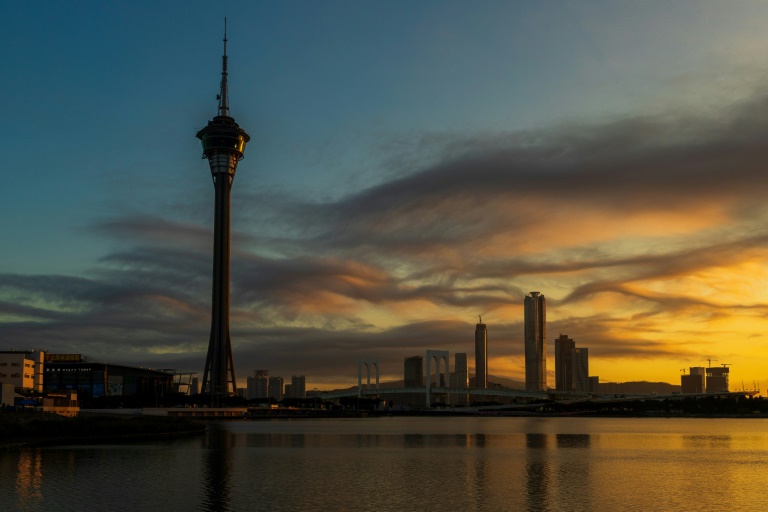
The United States on Tuesday added Vietnam, Cambodia, Brunei and Macau to a human trafficking blacklist that already counts Malaysia, alleging weak efforts to stop forced sex work or assist migrant laborers.

In an annual report, the United States also added authoritarian-ruled Belarus to the blacklist and, in a rare criticism of a Western ally, put Bulgaria on a watchlist over concerns it is not taking trafficking seriously.

“If you look at the report, you’re going to see a mixed picture of progress,” Secretary of State Antony Blinken said as he presented it.

Blinken said that corruption was a “top tool” of traffickers who count on a blind eye from governments.

“As we tackle issues like climate and corruption throughout our diplomacy, we also have to address how they intersect with trafficking in persons,” he said.

The State Department’s annual trafficking report has historically not spared close allies, often causing friction, although US officials say the unflattering headlines have led governments to act. 

Nations that are put on the blacklist — “Tier 3” — are subject to US sanctions, although the administration routinely waives punishment for friendly nations that promise improvements.

Kari Johnstone, a senior State Department official in charge of combatting human trafficking, said that several Asian governments were downgraded because they had previously been on the watchlist and had not shown progress.

“Unfortunately, there were a number of countries this year within that region that did not make the increasing efforts,” she told reporters.

– Weak enforcement –

Vietnam, which has a warming relationship with Washington due to shared concerns over a rising China, was downgraded to Tier 3, with the State Department saying that prosecutions dropped off in 2021. 

The report especially found fault with Hanoi taking no action against a Vietnamese diplomat and embassy staff member posted in Saudi Arabia who were accused of complicity in trafficking several of their citizens.

In Cambodia, the State Department said that “endemic corruption” has impeded efforts to help thousands including children trafficked to entertainment establishments, brick kilns and online scam operations.

“Authorities often overlooked, denied or downplayed labor abuses — including forced child labor — in factories and at brick kilns and colluded with brick manufacturers to arrest, jail and return indentured laborers who had attempted to escape,” the report said.

In the semi-autonomous Chinese city of Macau, a former Portuguese territory known for its bustling casinos and sex industry, the report said that authorities did not provide services to a single trafficking victim for a third consecutive year. 

On Bulgaria, which along with Serbia was threatened with a downgrade to the blacklist without improvements, the State Department said that authorities investigated “significantly fewer” traffickers and at times punished victims for the crimes against them. 

Also newly added to the Tier 3 blacklist was the tiny Dutch Caribbean territory of Sint Maarten.

Along with Malaysia, nations that remained on the list from the previous year were Afghanistan, Cuba, Eritrea, Guinea-Bissau, Iran, Myanmar, North Korea, Nicaragua, Russia, South Sudan, Syria, Turkmenistan and Venezuela.

Algeria and the Indian Ocean archipelago the Comoros both were upgraded off the blacklist this year following improvements.

Azerbaijan starts return of people to recaptured areas

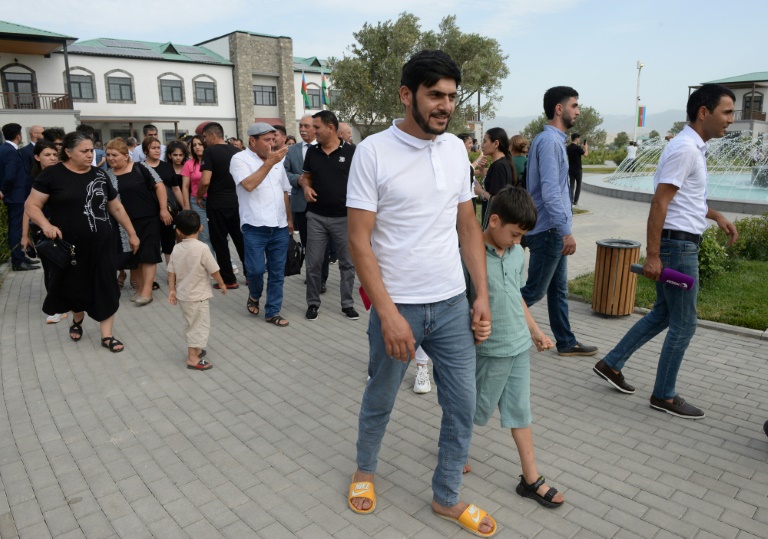
Azerbaijan on Tuesday began the process of returning its people to land recaptured from Armenian separatists in what Baku calls “The Great Return” following a 2020 war over disputed Nagorno-Karabakh.

The oil-rich country has vowed to repopulate lands recaptured in the six-week war with arch-foe Caucasus neighbour Armenia that killed more than 6,500 people two years ago.

President Ilham Aliyev had for years promised to retake lands lost in the 1990s and the first returns marked a symbolic moment for Azerbaijan.

An official said almost 60 people moved back to a village they had had to flee in 1993, when ethnic Armenian separatists broke away from Baku, triggering a conflict that claimed around 30,000 lives.

Hundreds of thousands of Azerbaijanis quit the area during the fighting.

“Fifty-eight people returned to the district of Zangilan” recaptured by Baku in October 2020, special presidential representative in the region Vahid Hajiyev, told reporters. 

More than 30,000 ethnic Azerbaijanis fled Zangilan, near the Iranian border, in 1993. 

“At this stage, a total of 41 families will return” over the next five days to the newly rebuilt village of Agally in Zangilan, Hajiyev said.

– ‘Native land’ –

The government has pledged to provide jobs for the returnees, he said. It has already built in Agally dozens of houses equipped with solar batteries, a brand new school, and a kindergarten, he added.

“Over the next months the village will be fully repopulated.”

Emotions ran high as repatriates stepped down from buses in Agally’s windswept central square, where a new fountain sparkled under a sweltering sun.

“We are so happy to be back,” one of the returnees, 64-year-old Mina Mirzoyeva told AFP. “This is our homeland, our native land.”

Rahilya Ismayilova, 72, said that back in 1993 she had been forced to ford a river into Iran with her small children, fleeing for life from the Armenian separatist forces.

“May all the refugees return to their homes, just as we did today,” she said.

“I fled my village with my four children and today I am back with my big family, with my nine grandchildren.”

Baku has vowed to spend billions of petrodollars on the reconstruction of Nagorno-Karabakh and nearby recaptured areas. 

It allocated $1.3 billion in last year’s budget for infrastructure projects such as new roads, bridges and airports in the region. 

But a large-scale return of refugees remains a distant prospect given the scale of the devastation and the danger from landmines.

– Peace talks –

In the autumn of 2020, Azerbaijan and Armenia went to war for a second time for control of Karabakh. 

The fighting ended with a Russian-brokered ceasefire agreement.

Under the deal, Armenia ceded swathes of territory it had controlled for decades, and Russia deployed some 2,000 peacekeepers to oversee the fragile truce.

The chair of Armenia’s security council, Armen Grigoryan, said Tuesday that Yerevan’s forces would complete their withdrawal from areas that had been under separatist control by September.

This weekend, the foreign ministers of Armenia and Azerbaijan met in the Georgian capital Tbilisi for their first one-on-one talks since the war.

They were expected to build on an agreement which Aliyev and Armenian Prime Minister Nikol Pashinyan reached under EU mediation in May to “advance discussions” on a future peace treaty.

The two leaders met in Brussels in April and May and European Council President Charles Michel has said their next meeting is scheduled for July or August.

Following its invasion of Ukraine on February 24, an increasingly isolated Moscow lost its status as the primary mediator in the conflict.

The European Union has since led the Armenia-Azerbaijan normalisation process, which involves peace talks, border delimitation and the reopening of transport links.

Biden highlights decline in US gasoline prices

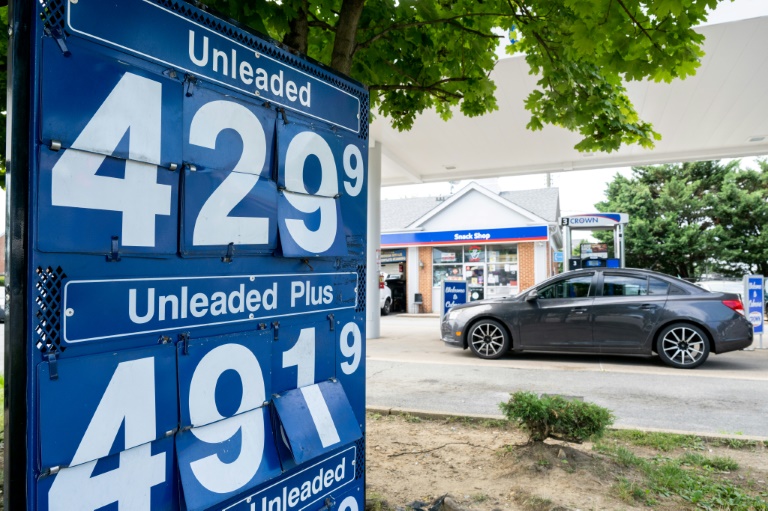
US gasoline prices have fallen from historic highs earlier in the summer, a retreat highlighted by a politically beset White House as a sign of moderating inflation.

President Joe Biden, who has seen his approval rating tumble amid the worst pricing pressures in decades, took to Twitter to point out that prices at the pump have fallen for more than a month, saving the average driver about $25 a month.

“I know those extra dollars and cents mean something. It’s breathing room,” Biden tweeted Monday night. “And we’re not done working to get prices even lower.”

Since hitting an all-time high of $5.016 a gallon on June 14, prices have fallen the last 35 days amid rising worries over economic growth and an easing in the physical crude oil market.

Gasoline prices are now at a national average of $4.495 per gallon, down 10 percent from a month ago but up 42 percent from the year-ago level, according to the American Automobile Association.

“The price went down a little bit,” said Rigobert Fokoua, 50, an independent contractor. “I’m feeling okay because before I was putting (in) like $80 a day, but today I can put in $60, it’s a little bit better.”

Fokoua was filling up at a Rockville, Maryland gas station, where a gallon of regular went for $4.39 Tuesday, down from more than $5 a few weeks ago.

“I noticed that in the last couple of weeks, it (the gas price) actually went down,” said Brendan Anderson, 24, who works in training and development in the entertainment industry.

“I figured the demand has decreased slightly just because less consumers are purchasing gas going out.” 

– Supply and demand –

The biggest factor in the pullback has been the drop in crude oil prices due to worries that a slowing economy or recession will dent energy demand. 

Crude prices rose to around $130 a barrel soon after the Russian invasion of Ukraine prompted fears of the loss of a major supply source at a time of rising demands.

Analysts say those fears were generally not realized and that most Russian crude oil has continued to flow to buyers in markets such as India and China.

Compared with March, US crude oil production has also risen about 400,000 barrels a day, according to US data.

The added US production, coupled with more Saudi oil added in the recent period, means the tightness of the crude market “has eased,” said Again Capital’s John Kilduff, who also cited as a factor unusually tepid gasoline consumption shown in the most recent weekly US energy report. 

Some of the drop in gasoline use likely is a response to price. But it also reflects shifting labor practices after the pandemic.

“Up until the pandemic, work from home was kind of considered an outlier,” said Bill O’Grady, chief market strategist of Confluence Investment Management.

Under today’s more flexible arrangements, “when the gasoline price goes up, instead of coming in five days a week, you may only come in three or two,” O’Grady said.

– Further to fall? –

A White House memo predicted gasoline prices would continue to fall through the “near term,” highlighting Biden’s actions such as a historically large release of oil from the Strategic Petroleum Reserve — which analysts think had its primary impact as soon as it was announced in late March.  

The White House memo also noted that the decline in gasoline prices has gotten a fraction of the media coverage that the run-up in prices earlier in the spring received.

“Despite the data, you wouldn’t know gas prices are coming down from watching the evening news or reading the paper,” the memo said.

Kilduff also expects gasoline prices to fall further, noting a long-running seasonal trend that typically sees gasoline prices retreat after July 4.

“My forecast is for prices to continue to slide lower into the fall,” Kilduff said, adding that prices will remain high by historical standards.

While O’Grady thinks prices will continue to fall, he added that there is always a risk in late summer that Gulf of Mexico hurricanes could impair key refineries.

“That can send gasoline prices up significantly,” he said.

Fire and destruction at Europe's biggest sand dune

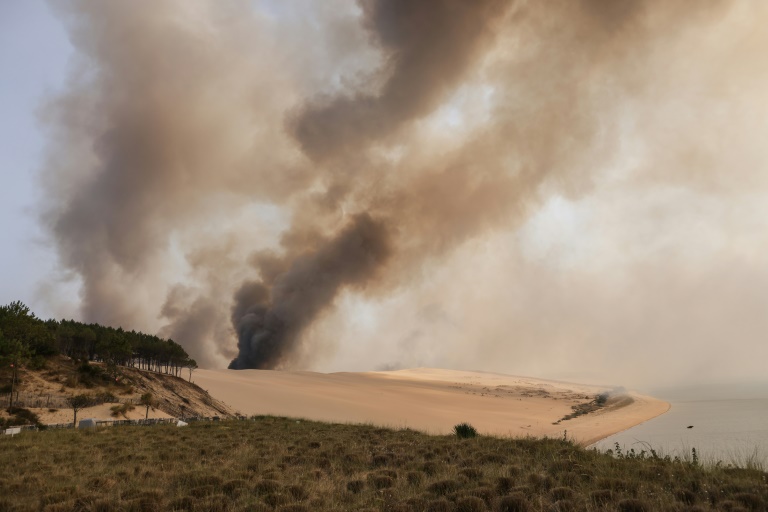
In a usual July on Europe’s biggest sand dune, holidaymakers clamber to its peak to admire the panoramic views of the Atlantic Ocean beyond. This year, its heights are deserted, shrouded in smoke, with fire service planes buzzing overhead.

The Dune du Pilat is a famous attraction on France’s west coast, with its sands rising abruptly out of thick pine forests that shade bustling camp sites and caravan parks in the summer months.  

This year, the forests are ablaze, sending up thick clouds of smoke that blot out the sun as they drift over the ocean or towards the city of Bordeaux, 60 kilometres (36 miles) to the north east.

Around 6,500 hectares (16,000 acres) of forest have burned near the dune — an area 12 km long and 7.0 km wide — with another 12,800 hectares lost to a separate and bigger fire further inland in the Gironde region.

“For people from here, it’s heart-breaking,” fire service spokesman Matthieu Jomain told AFP. 

“For visitors used to coming to this part of the Gironde it’s completely disorienting, and obviously we share this feeling as firefighters,” he added.

Around 2,000 of them are battling around the clock to bring the twin infernos under control, backed by helicopters and Canadair fire planes which swoop down into the ocean to fill their tanks.

“We were faced with a wall of fire that was 40-50 metres high. It was a tinderbox,” Jomain explained from a burned out area on Tuesday. 

Around 20,000 people have been evacuated near the dune, including residents in the tourist town of La Teste-de-Buch, where the temperature hovered around 40 Celsius (104 degrees Fahrenheit) on Tuesday.

“The firemen rang the doorbell to tell us we had to evacuate right away and then the police arrived five minutes later and told us the same thing,” a pensioner told AFP as he left with his partner and pets in a car.

– ‘Amazing’ firefighters – 

At least five campsites have been destroyed by the flames, including one that featured in a hit recent series of French comedy films called “Camping”.

“I had a message from a fireman saying ‘we’re sorry’,” the director of the gutted “Camping de la Dune” site, Franck Couderc, told BFM television.

“They shouldn’t be sorry. It’s amazing what they did,” he said.

The local zoo has begun evacuating its animals, with 363 out of 850 already sent in a special convoy to a facility near Bordeaux.

Around a dozen creatures succumbed to the stress and heat, however, the national environment ministry said.

– Tourism hit –

The whole area around the Dune du Pilat lives off tourists in the summer months, particularly British, German and Dutch visitors.

They are drawn to the nearby Bay of Arcachon and its famous oyster beds, surfing beaches to the south, or the upmarket Cap Ferret area with its five-star hotels.

“It’s heartbreaking,” said Patrick Davet, the mayor of La Teste-de-Buch.

“Economically, it’s going to be very difficult for them and very difficult for the town because we are a tourist town, and we need the season,” he added.

The top government official for the Gironde region, Fabienne Buccio, warned that the fires were “not over” despite forecasts of violent storms overnight.

“Unfortunately, the weather forecast is still predicting hot temperatures, not really rain. We would need rain over several days,” she explained. 

The cause of the fire near the Dune du Pilat is thought to be a van that caught fire last week, while the second fire in Gironde near Landiras is being treated as suspected arson.

One man is in police custody. 

Fires were also reported in the south of France, as well as the usually clement northwestern Brittany, which registered record temperatures of more than 40 C on Tuesday.

burs-adp/cdw

Fire and destruction at Europe's biggest sand dune

In a usual July on Europe’s biggest sand dune, holidaymakers clamber to its peak to admire the panoramic views of the Atlantic Ocean beyond. This year, its heights are deserted, shrouded in smoke, with fire service planes buzzing overhead.

The Dune du Pilat is a famous attraction on France’s west coast, with its sands rising abruptly out of thick pine forests that shade bustling camp sites and caravan parks in the summer months.  

This year, the forests are ablaze, sending up thick clouds of smoke that blot out the sun as they drift over the ocean or towards the city of Bordeaux, 60 kilometres (36 miles) to the north east.

Around 6,500 hectares (16,000 acres) of forest have burned near the dune — an area 12 km long and 7.0 km wide — with another 12,800 hectares lost to a separate and bigger fire further inland in the Gironde region.

“For people from here, it’s heart-breaking,” fire service spokesman Matthieu Jomain told AFP. 

“For visitors used to coming to this part of the Gironde it’s completely disorienting, and obviously we share this feeling as firefighters,” he added.

Around 2,000 of them are battling around the clock to bring the twin infernos under control, backed by helicopters and Canadair fire planes which swoop down into the ocean to fill their tanks.

“We were faced with a wall of fire that was 40-50 metres high. It was a tinderbox,” Jomain explained from a burned out area on Tuesday. 

Around 20,000 people have been evacuated near the dune, including residents in the tourist town of La Teste-de-Buch, where the temperature hovered around 40 Celsius (104 degrees Fahrenheit) on Tuesday.

“The firemen rang the doorbell to tell us we had to evacuate right away and then the police arrived five minutes later and told us the same thing,” a pensioner told AFP as he left with his partner and pets in a car.

– ‘Amazing’ firefighters – 

At least five campsites have been destroyed by the flames, including one that featured in a hit recent series of French comedy films called “Camping”.

“I had a message from a fireman saying ‘we’re sorry’,” the director of the gutted “Camping de la Dune” site, Franck Couderc, told BFM television.

“They shouldn’t be sorry. It’s amazing what they did,” he said.

The local zoo has begun evacuating its animals, with 363 out of 850 already sent in a special convoy to a facility near Bordeaux.

Around a dozen creatures succumbed to the stress and heat, however, the national environment ministry said.

– Tourism hit –

The whole area around the Dune du Pilat lives off tourists in the summer months, particularly British, German and Dutch visitors.

They are drawn to the nearby Bay of Arcachon and its famous oyster beds, surfing beaches to the south, or the upmarket Cap Ferret area with its five-star hotels.

“It’s heartbreaking,” said Patrick Davet, the mayor of La Teste-de-Buch.

“Economically, it’s going to be very difficult for them and very difficult for the town because we are a tourist town, and we need the season,” he added.

The top government official for the Gironde region, Fabienne Buccio, warned that the fires were “not over” despite forecasts of violent storms overnight.

“Unfortunately, the weather forecast is still predicting hot temperatures, not really rain. We would need rain over several days,” she explained. 

The cause of the fire near the Dune du Pilat is thought to be a van that caught fire last week, while the second fire in Gironde near Landiras is being treated as suspected arson.

One man is in police custody. 

Fires were also reported in the south of France, as well as the usually clement northwestern Brittany, which registered record temperatures of more than 40 C on Tuesday.

burs-adp/cdw

Climate deniers sow weather-map heatwave misinfo

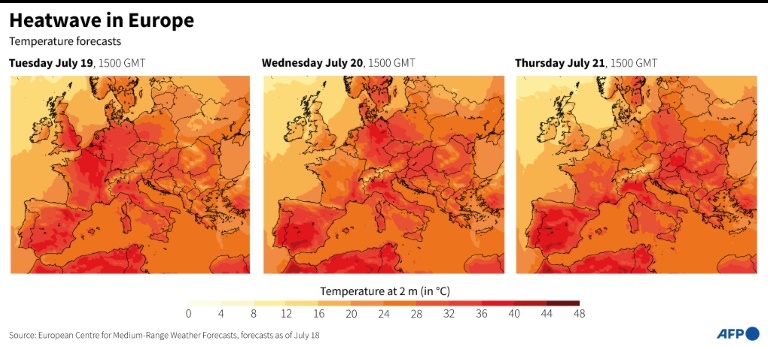
Climate-change deniers on social media have a viral way of spreading scepticism during a heatwave: by publishing weather maps out of context to imply forecasters are exaggerating climate change.

During the two recent heatwaves in Europe, users in various countries and languages misleadingly juxtaposed weather maps, sometimes taken from different media organisations at non-comparable dates.

Such posts typically include messages suggesting that the colour of the maps has been changed to red by media or authorities seeking to create panic. 

AFP Fact Check has debunked several versions of the claim, which have surfaced in languages including English, German, Spanish, French, Hungarian and Polish. 

“Back when there was no need to make people afraid of global warming, they put suns” on weather maps, said one post shared in Spanish and Catalan during this week’s heatwave. “Now they have to colour the map as if we were in hell itself.” 

The two side-by-side maps under the post showed hot weather over Spain. One was white with sun symbols, the other dark red. A digital investigation by AFP revealed they were two different types of map from different sources – not, as the post claimed, from a single forecaster that had manipulated its colour scheme. 

– Coloured red? – 

In English and German, numerous similar claims circulated during last month’s heatwave. 

“In 1986 it was called a normal summer. Today they colour the map red and call it extreme heat,” said a Facebook post published on May 25, 2022. 

The two side-by-side maps showed similar temperatures over Sweden. One was green and dated 1986, the other orange and dated 2022. 

A digital investigation revealed that the years on the maps were incorrect and they were from different news organisations that use different colour codes. 

Thousands of social media users shared the same image in French, claiming it was evidence of a “global warming scam.” The claim was also widely shared on Twitter. 

Posts in Germany in June showed two maps from the news show Tagesschau, claiming it had changed their colour from green in 2009 to red in 2019 to hype the climate threat. AFP published a detailed debunk of the claim. 

Tagesschau explained that the red map was a temperature forecast, and even in 2009 such maps had used red. The green one was a general weather forecast with different colour scheme and variables. 

A similar montage went viral in French. As an AFP investigation showed, it misleadingly juxtaposed maps from different media organisations at different times of year. 

Previously in Spain, users shared a photo of a newspaper from 1957 that reported a temperature record of 50 degrees Celsius. The article was authentic but Spanish meteorologists said that temperature measurement was not certified or recorded in official data. 

– Climate change is real – 

Climate scientists overwhelmingly agree that carbon emissions from humans burning fossil fuels are heating the planet, raising the risk and severity of heatwaves and other extreme weather events. 

With temperatures topping 40 C, the heatwave in Britain this week prompted comparisons with the summer of 1976, when the temperature peaked at 35.9 C. 

Experts said the comparison was unhelpful.

“Of course there have been heatwaves in the past, but the big difference with 1976 is what the rest of the world looked like,” said said Friederike Otto, senior lecturer at Imperial College London’s Grantham Institute for Climate Change.

“In ’76 there was a heatwave in (Britain), in 2022 there are heatwaves everywhere in the world and so there have been in 2021, ’20, ’19,” she told reporters on Monday.

Nostalgia for 1976 – sometimes accompanied by misleading map-sharing – irritated some users on social media. 

“Folk keep sharing the fake f**king image showing ‘WEATHER in my day’ bla bla bla,” wrote one user, identified as Talent Stockport, on July 17. 

“Its misleading” (sic), the post continued. “Your spreading miss information which could actually put peoples lives in danger, and its the same type of people too. The people who are unable to process basic facts.” 

The AFP fact check articles cited in this story can be found with full explanations of the methods used, in different languages at factcheck.afp.com. 

Climate deniers sow weather-map heatwave misinfo

Climate-change deniers on social media have a viral way of spreading scepticism during a heatwave: by publishing weather maps out of context to imply forecasters are exaggerating climate change.

During the two recent heatwaves in Europe, users in various countries and languages misleadingly juxtaposed weather maps, sometimes taken from different media organisations at non-comparable dates.

Such posts typically include messages suggesting that the colour of the maps has been changed to red by media or authorities seeking to create panic. 

AFP Fact Check has debunked several versions of the claim, which have surfaced in languages including English, German, Spanish, French, Hungarian and Polish. 

“Back when there was no need to make people afraid of global warming, they put suns” on weather maps, said one post shared in Spanish and Catalan during this week’s heatwave. “Now they have to colour the map as if we were in hell itself.” 

The two side-by-side maps under the post showed hot weather over Spain. One was white with sun symbols, the other dark red. A digital investigation by AFP revealed they were two different types of map from different sources – not, as the post claimed, from a single forecaster that had manipulated its colour scheme. 

– Coloured red? – 

In English and German, numerous similar claims circulated during last month’s heatwave. 

“In 1986 it was called a normal summer. Today they colour the map red and call it extreme heat,” said a Facebook post published on May 25, 2022. 

The two side-by-side maps showed similar temperatures over Sweden. One was green and dated 1986, the other orange and dated 2022. 

A digital investigation revealed that the years on the maps were incorrect and they were from different news organisations that use different colour codes. 

Thousands of social media users shared the same image in French, claiming it was evidence of a “global warming scam.” The claim was also widely shared on Twitter. 

Posts in Germany in June showed two maps from the news show Tagesschau, claiming it had changed their colour from green in 2009 to red in 2019 to hype the climate threat. AFP published a detailed debunk of the claim. 

Tagesschau explained that the red map was a temperature forecast, and even in 2009 such maps had used red. The green one was a general weather forecast with different colour scheme and variables. 

A similar montage went viral in French. As an AFP investigation showed, it misleadingly juxtaposed maps from different media organisations at different times of year. 

Previously in Spain, users shared a photo of a newspaper from 1957 that reported a temperature record of 50 degrees Celsius. The article was authentic but Spanish meteorologists said that temperature measurement was not certified or recorded in official data. 

– Climate change is real – 

Climate scientists overwhelmingly agree that carbon emissions from humans burning fossil fuels are heating the planet, raising the risk and severity of heatwaves and other extreme weather events. 

With temperatures topping 40 C, the heatwave in Britain this week prompted comparisons with the summer of 1976, when the temperature peaked at 35.9 C. 

Experts said the comparison was unhelpful.

“Of course there have been heatwaves in the past, but the big difference with 1976 is what the rest of the world looked like,” said said Friederike Otto, senior lecturer at Imperial College London’s Grantham Institute for Climate Change.

“In ’76 there was a heatwave in (Britain), in 2022 there are heatwaves everywhere in the world and so there have been in 2021, ’20, ’19,” she told reporters on Monday.

Nostalgia for 1976 – sometimes accompanied by misleading map-sharing – irritated some users on social media. 

“Folk keep sharing the fake f**king image showing ‘WEATHER in my day’ bla bla bla,” wrote one user, identified as Talent Stockport, on July 17. 

“Its misleading” (sic), the post continued. “Your spreading miss information which could actually put peoples lives in danger, and its the same type of people too. The people who are unable to process basic facts.” 

The AFP fact check articles cited in this story can be found with full explanations of the methods used, in different languages at factcheck.afp.com. 

Ukraine calls for ramp-up of US precision rocket systems

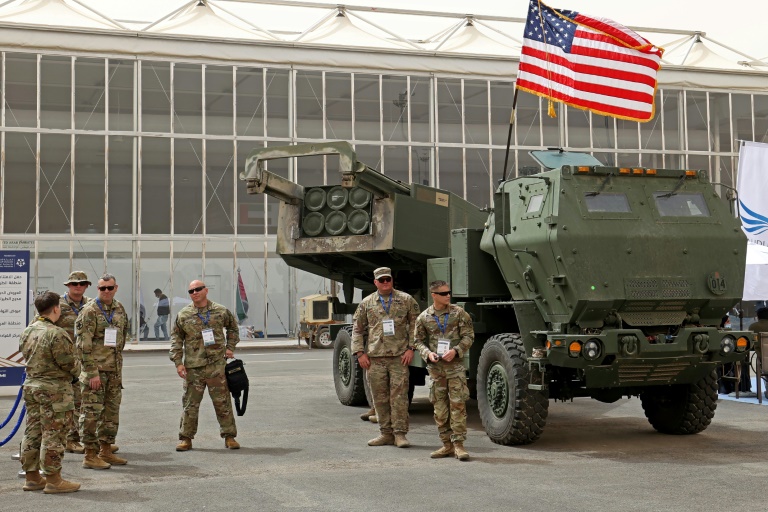
Ukraine’s defense minister asked Tuesday for the West to scale up drastically its supply of precision rocket systems, calling them a “game-changer” that could allow a counteroffensive against Russian invaders. 

The United States since mid-June has delivered eight units of the M142 High Mobility Artillery Rocket System, or Himars, which can precisely strike targets within 80 kilometers (50 miles) using the ammunition that has been provided, with plans for four more.

“These systems allowed us to destroy approximately 30 command stations and ammunition storages,” Ukrainian Defense Minister Oleksiy Reznikov told the Atlantic Council.

“This has significantly slowed down the Russian advance and dramatically decreased the intensity of their artillery shelling. So it’s working. We are grateful to our partners,” he said in a virtual appearance at the Washington think tank.

But he said that far more systems were needed, likening Ukraine’s border with Russia to the distance from Barcelona to Warsaw.

“The shield of Europe in Ukraine has the same distance — 2,500 kilometers of aggressive frontline with the enemy. For an effective counter-offensive, we would need at least 100, I think,” he said of the Himars systems.

“That could be a game-changer on the battlefield in that case.”

He renewed a call for longer-range rockets — 100 to 150 kilometers (60-90 miles) — to cut off Russian units from their support.

“We don’t need the strategy of the meat-grinder,” he said.

President Joe Biden’s administration has refused to send longer-range ammunition, fearing that Ukraine would strike targets inside Russian territory and potentially expand the war to a direct clash with the West.

October trial set in Musk, Twitter buyout battle

Twitter and Elon Musk were ordered Tuesday to trial in October over whether the Tesla chief can be forced to complete his $44 billion deal to buy the social network, an early win for the uncertainty-wracked platform.

A judge in the eastern US state of Delaware ruled against Musk’s push for a February date, while hewing closely to Twitter’s desire for an expedited schedule.

Billions of dollars are at stake, but so is the future of the platform that Musk has said should allow any legal speech, an absolutist position that has sparked fears the network could be used to incite violence.

“We urge the court to enter a prompt schedule and give multiple grounds for that,” Twitter lawyer William Savitt argued, noting “the continued uncertainty caused by Musk’s purported termination inflicts harm on Twitter every day, every hour of every day.”

Musk’s team had argued fiercely against an expedited trial date, saying Twitter’s preferred date in September was simple too fast for such a complex matter.

The judge did not set an exact date, leaving it to the parties to converge on the timing.

Twitter lawyers noted the deal is supposed to close toward the end of October, just six months after Musk launched an unsolicited bid that the company’s board first resisted but then supported.

The world’s richest person has backed away from the deal in recent months as tech stocks have tumbled, and Twitter’s value has fallen well below the $54.20 per share he offered.

– Musk willingness to fight –

Rather than Silicon Valley, where Twitter is based, the company has lodged its lawsuit against Musk in Delaware.

The firm is incorporated in the tiny state like scores of other companies, and the case will be heard in the Delaware Chancery Court, which has deep experience in business disputes.

“The Chancery Court, which handles most of these matters, is very expert in corporate law, and more particularly, mergers and acquisitions. So this is the place to go,” said Carl Tobias, a University of Richmond law professor.

Kathaleen McCormick, the judge overseeing the case, comes with a no-nonsense reputation.

She also reportedly has the distinction of previously ordering a reluctant buyer into completing a corporate merger.

A forced closing of the Twitter deal is a scenario that some analysts consider possible.

“(Wall) Street and legal experts across the board view Twitter as having a ‘strong iron fist upper hand,’ heading into the Delaware court battle after months of this fiasco and nightmare,” analyst Dan Ives wrote last week.

He also noted that less likely options include Musk paying a $1 billion breakup fee and being able to walk away, or winning outright on his fake-account argument.

After pausing the deal in May, Musk’s lawyers announced in July he was “terminating” the agreement because of skepticism over Twitter’s false or spam accounts tally and allegations the firm was not forthcoming with details.

Tuesday’s hearing will be just the first step in what could be a lengthy legal fight that could end in a trial, but also a settlement.

“Musk has shown his willingness to take things all the way to the end in Delaware court,” said Adam Badawi, a University of California at Berkeley law professor.

“I think settling is not necessarily his instinct.”
Close Bitnami banner
Bitnami