World

Mexico court temporarily blocks drug lord's extradition

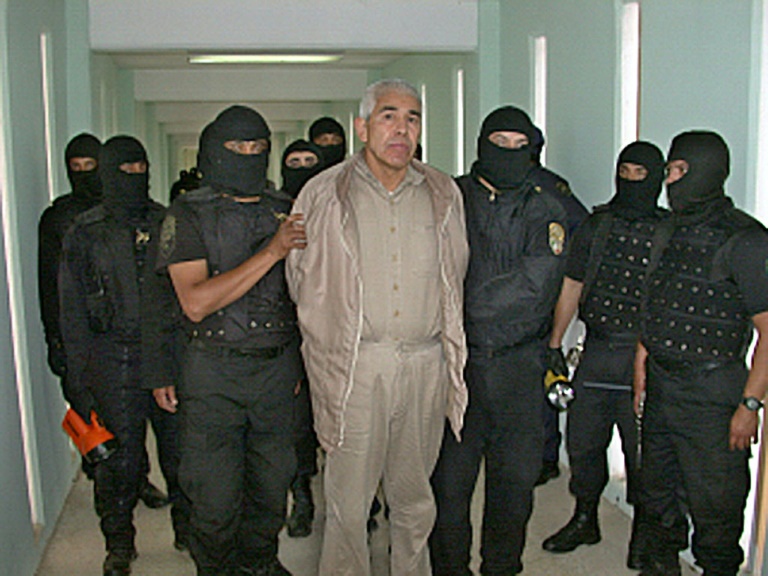
A Mexican court on Monday temporarily blocked the extradition of a drug lord wanted for the murder of a US undercover agent, dimming Washington’s hopes of a quick handover.

Rafael Caro Quintero, 69, is on the FBI’s list of 10 most-wanted fugitives for the kidnap, torture and murder of Drug Enforcement Administration (DEA) special agent Enrique “Kiki” Camarena in 1985.

A federal judge in the western state of Jalisco ruled that Caro Quintero cannot be handed over to the United States without a proper extradition process.

It is unknown how long the procedure will take, but any delays are likely to disappoint US officials.

US Attorney General Merrick Garland had said on Friday that Washington would seek the drug kingpin’s “immediate extradition.”

Caro Quintero’s arrest Friday came nine years after he was freed by a court on a technicality, having served 28 years of a 40-year sentence in Mexico for Camarena’s murder.

By the time Mexico’s Supreme Court overturned the decision, Caro Quintero had already gone into hiding.

His defense team is trying to secure his release again, alleging procedural errors in his capture, President Andres Manuel Lopez Obrador told reporters.

“We’re going to take care that there’s no corruption or any act contrary to the law,” he said.

Asked about the US request for Caro Quintero’s extradition, Lopez Obrador said only that it would be “decided by the competent authority.”

Caro Quintero was detained by Mexican marines in the town of Choix in the northwestern state of Sinaloa, and is being held in the high-security Altiplano prison in central Mexico.

Lopez Obrador insisted that no DEA personnel had participated in the drug kingpin’s capture and denied that it was the result of pressure from Washington, saying: “We’re an independent government.”

Caro Quintero, alias “Rafa,” has a $20-million bounty on his head.

He is accused of co-founding the now-defunct Guadalajara drug cartel and currently runs an arm of the infamous Sinaloa cartel, according to US authorities.

Fourteen Mexican marines who took part in the operation died in a helicopter crash after Caro Quintero’s arrest.

Sunak widens lead in race to become UK PM after party vote

Former finance minister Rishi Sunak widened his lead in the latest round of voting Monday by Conservative MPs to decide Britain’s next prime minister, but the race to get in the final two tightened.

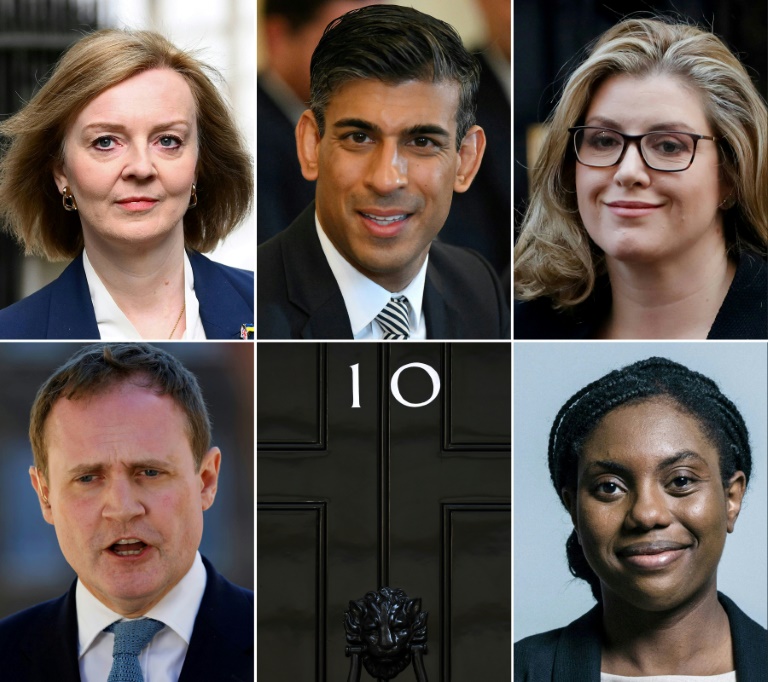
Sunak won the support of 115 Tory lawmakers, followed by Penny Mordaunt on 82 votes, Liz Truss on 71, Kemi Badenoch on 58 and Tom Tugendhat on 31, who drops out as the last-placed candidate, the party announced.

MPs will keep voting until only two candidates remain, the winner then being decided by the party members.

Mordaunt had been bookmakers’ favourite before the weekend, but lost votes from the previous round. 

Foreign Secretary Truss closed the gap to 11 and can probably expect more support switching to her from Badenoch’s backers, should the insurgent candidate be eliminated in the next round, promising a tense race to make the final cut Wednesday.

Television bosses earlier Monday scrapped a planned debate between the remaining contenders for Tuesday night after Sunak and Truss pulled out, said Sky News, which was due to host it.

“Conservative MPs are said to be concerned about the damage the debates are doing to the image of the Conservative party, exposing disagreements and splits within the party,” it added in a statement.

Prime Minister Boris Johnson announced on July 7 he was quitting as Conservative leader after a government rebellion in protest at his scandal-hit administration.

He is staying on as prime minister until his successor is announced on September 5.

– ‘Hunger Games’ –

In the two previous televised debates — on Channel 4 Friday and the ITV network Sunday — the contenders clashed notably on whether to cut taxes to help ease a soaring cost of living crisis.

But Sunday’s clash turned more acrimonious — and personal — with candidates encouraged to directly criticise one another and their proposals.

Sunak called out Truss for voting against Brexit, her previous membership of the Liberal Democrats, and her position on tax.

In turn, Truss questioned Sunak’s stewardship of the economy.

Badenoch attacked Mordaunt for her stance on transgender rights — a rallying call in the “culture wars” exercising the Tory right.

Paul Goodman, from the ConservativeHome website, likened the debates to a “political version of ‘The Hunger Games'” questioning their decision to agree to them.

“Tory MPs and activists will have watched in horror as several of the candidates flung buckets of manure over each other,” he wrote.

He asked why they would agree to publicly criticise the record of the government that all but one of them served in, or the policies they supported as ministers.

– ‘Out of ideas’ –

The main opposition Labour party has called for Johnson to leave office immediately.

Its leader, Keir Starmer, called the candidates’ withdrawal a sign of a party “out of ideas (and) out of purpose”.

“Pulling out of a TV debate when you want to be prime minister doesn’t show very much confidence,” he added.

The government blocked attempts by Starmer to call a confidence vote in parliament to get rid of Johnson immediately, instead bringing forward its own confidence vote on the government as a whole.

During the debate, Johnson defended his government’s record, citing the vaccine rollout and support of Ukraine.

“I believe this is one the most dynamic governments of modern times, not just overcoming adversity on a scale we haven’t seen for centuries but delivering throughout adversity.”

The government won the vote on Monday night by 349 votes to 238.

Former Labour leader Jeremy Corbyn joked that his one-time sparring partner Johnson was taking MPs on a “fantasy tour of this country”.

Starmer called the outgoing leader a “vengeful squatter” in Downing Street.

Amanda Lee named first female pilot in US navy aviation team

The US Navy’s famed aerial display team, the Blue Angels, named Lieutenant Amanda Lee on Monday as its first female pilot to fly fighter aircraft.

Lee, of Mounds View, Minnesota, was one of six new officers selected for the 2023 air show season, the navy said in a statement.

After a five-month training program, she will fly F/A-18 “Super Hornet” for the navy’s elite demonstration team founded in 1946.

Lee was commissioned as an officer in 2013 after being trained as an aviation electronics technician, the navy said.

She became a naval aviator in 2016.

Lee, whose call sign is “Stalin,” will be the first woman to fly fighter aircraft for the Blue Angels.

Another woman, Marine Major Katie Cook, joined the Blue Angels in 2015 and flew C-130 support aircraft known as “Fat Albert.”

Mixed day for global stocks as oil prices rise again

Wall Street stocks fell Monday after an early rally petered out, while the dollar weakened and oil prices continued to recover after recent declines.

Following upbeat sessions on European and Asian equity markets, New York appeared poised to extend Friday’s positive momentum following commentary from banks expressing confidence in US economic resiliency.

But the trend reversed after Bloomberg News reported that Apple was pulling back on some investments in preparation for a potential economic slowdown. Apple shares fell more than two percent.

“Investors are becoming cautious again,” said Peter Cardillo of Spartan Capital Securities. “I guess investors are looking for more convincing data that the earnings season is not going to be all that bad.”

The broad-based S&P 500 fell gradually throughout the day, ending with a loss of 0.8 percent.

The session opened a heavy calendar of earnings reports, with results from Netflix, Johnson & Johnson and Tesla in the coming days.

– ECB to act –

The European Central Bank is set on Thursday to raise its interest rates for the first time in more than a decade.

To try and counteract a steep rise in prices, the central bank has said it intends to raise borrowing costs by a quarter point, the first such move since 2011. 

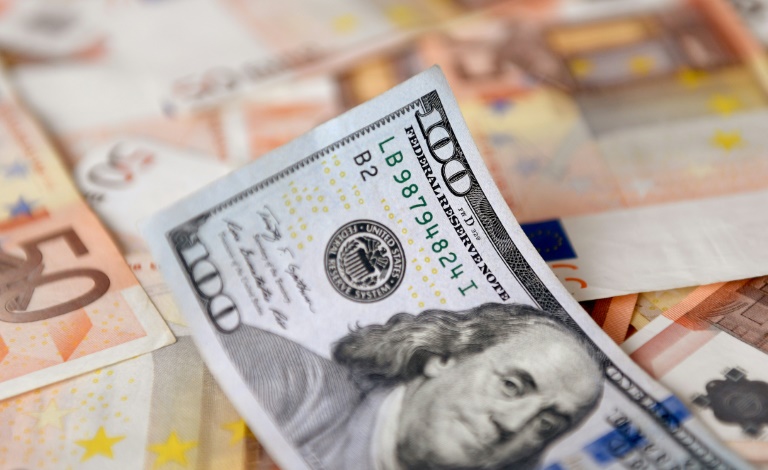
The ECB’s delay in acting compared with other central banks that have announced multiple increases — coupled with fears of a eurozone recession — saw the euro fall to parity with the dollar last week.

But on Monday, the European single currency was up around 0.6 percent against the dollar, while the British pound climbed 0.7 percent.

Meanwhile, crude prices jumped more than five percent, lifting West Texas Intermediate back above $100 a barrel and pushing Brent futures further above that key level.

“Oil prices are soaring again today, buoyed by an apparent easing in economic fears, stronger risk appetite and a failure by the White House to get any concrete commitment to increase oil output during the Middle East visit,” said market analyst Craig Erlam at trading platform OANDA.

“When the biggest talking point from President (Joe) Biden’s meeting with Saudi Crown Prince Mohammed bin Salman is a fist bump photo, you know it probably hasn’t gone to plan,” he added.

– Key figures at around 2040 GMT –

New York – Dow: DOWN 0.7 percent at 31,072.61 (close)

New York – S&P 500: DOWN 0.8 percent at 3,830.85 (close)

New York – Nasdaq: DOWN 0.8 percent at 11,360.05 (close)

London – FTSE 100: UP 0.9 percent at 7,223.24 (close)

Frankfurt – DAX: UP 0.7 percent at 12,959.81 (close)

Paris – CAC 40: UP 0.9 percent at 6,091.91 (close)

EURO STOXX 50: UP 1.0 percent at 3,511.86 (close)

Hong Kong – Hang Seng Index: UP 2.7 percent at 20,846.18 (close)

Shanghai – Composite: UP 1.6 percent at 3,278.10 (close)

Tokyo – Nikkei 225: Closed for a holiday

Euro/dollar: UP at $1.0146 from $1.0080 on Friday

Pound/dollar: UP at $1.1950 from $1.1855 

Euro/pound: DOWN at 84.88 pence from 85.03 pence

Dollar/yen: DOWN at 138.13 yen from 138.68 yen

Brent North Sea crude: UP 5.1 percent at $106.27 per barrel

West Texas Intermediate: UP 5.1 percent at $102.60 per barrel

burs-jmb/hs

Russian shelling kills 6 in Donbas, EU defends sanctions on Moscow

Russian shelling of a town in eastern Ukraine on Monday killed six people, Kyiv said, as EU ministers meeting in Brussels insisted the pressure of Western sanctions on Moscow was working.

Ukraine’s President Volodymyr Zelensky meanwhile appointed an acting security chief, having announced the suspension of senior law enforcement officials late on Sunday.

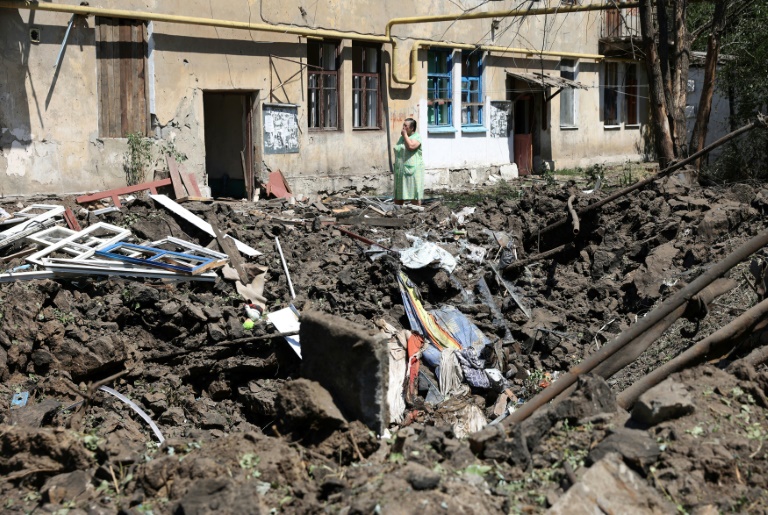
Rescue workers were digging through debris and clearing rubble from a collapsed two-storey building in Toretsk in the industrial east that was struck by Russian artillery early Monday.

“I had my windows open. There was a huge explosion around 5:00 am — stones and dust,” local resident Nadia told AFP journalists, still shaking.

Emergency services said five people had been pulled dead from the rubble, while a sixth, seriously wounded, had died in hospital.

Toretsk, a town of around 30,000 residents, lies 50 kilometres (30 miles) south of Kramatorsk, a key target for Russian forces, who invaded Ukraine in late February.

Russia’s troops have made gains in the eastern region of Donbas recently, capturing the sister cities of Lysychansk and Severodonetsk.

On Monday, pro-Moscow rebels claimed their next target in Donbas — the town of Siversk — was under their control, an announcement that could not be independently verified.

– Grain supply talks –

In Kyiv, Zelensky appointed 39-year-old Vasyl Malyuk — first deputy head of the SBU security services since March — as acting chief after pulling Ivan Bakanov from the post.

Zelensky officially asked parliament to dismiss Bakanov later Monday, and the issue will be discussed at the next session for which a date has not yet been set.

Andriy Smirnov, a deputy head of the presidential administration told Ukrainian television that prosecutor general Iryna Venediktova and Bakanov had been suspended to prevent them “potentially influencing criminal proceedings against employees of the Security Service of Ukraine”.

The night before, Zelensky said security officials were investigating more than 650 cases of suspected treason and aiding and abetting Russia, including 60 cases of officials in Russian-occupied territories working against Ukraine.

In Brussels, the EU’s foreign policy chief warned Russia’s blockade of Ukrainian ports was threatening grain supplies to tens of thousands of people vulnerable to starvation and said it must end.

“It’s an issue of life and death for many human beings. And the question is that Russia has to de-block and allow Ukrainian grain to be exported,” Josep Borrell told reporters. 

Zelensky tweeted he had had talks with Brazil’s President Jair Bolsonaro. “Discussed the importance of resuming Ukrainian grain exports to prevent a global food crisis provoked by Russia,” he wrote.

Russian and Ukrainian negotiators are due to meet UN and Turkish diplomats in Istanbul Wednesday to try to agree an end to the months-long blockade of Ukraine’s ports.

Kremlin advisor Yury Ushakov meanwhile said the impasse would feature in talks between Russian President Vladimir Putin and Turkish counterpart Recep Tayyip Erdogan on Tuesday in Tehran. 

– Stay with sanctions: Borrell –

Borrell urged the EU not to falter on sanctions against Russia, insisting they were working, days after Hungarian leader Viktor Orban said the penalties were harming Europe more than Russia.

“It is what we had to do, and we will continue doing,” Borrell said.

Ukraine Foreign Minister Dmytro Kuleba warned against “backing down and bowing to” Putin’s demands “will not work, it has never worked.”

Putin, meanwhile, vowed to overcome the high-tech problems caused by the sanctions.

“This is a huge challenge for our country,” he told a meeting. “Realising the colossal amount of difficulties we are facing, we will look for new solutions in an energetic and competent manner.”

European Commission President Ursula von der Leyen was visiting gas-rich Azerbaijan to secure alternatives to Russian energy for Europe.

“We will double the supply of gas from Azerbaijan to the EU,” within several years she said after meeting with President Ilham Aliyev, a leader routinely criticised by rights groups.

– Russia to target long-range weapons –

A Ukrainian counter-offensive in the direction of  encircled Black Sea ports has been gaining momentum.

With the delivery of long-range precision artillery to Ukraine by its Western allies, the battlefield dynamics in the south — and in the east — have shifted, say Kyiv and observers of the conflict.

Those weapons are a key concern for Russia, and Defence Minister Sergei Shoigu during a recent troop inspection said Moscow’s forces had to set about neutralising systems such as US-supplied Himars.

“Shoigu gave orders to prioritise the destruction — with high-precision weapons — of enemy artillery and long-range missiles,” the Russian defence ministry said.

In a BBC television interview broadcast Sunday, the head of Britain’s armed forces, Admiral Tony Radakin, estimated  50,000 Russian soldiers had been killed or wounded in the invasion, with nearly 1,700 Russian tanks and some 4,000 armoured fighting vehicles destroyed.

But more than 20 weeks since the invasion began, Moscow said over the weekend it would step up its military operations.

burs-jbr/raz/cw

Sunak widens lead in race to become UK PM after party vote

Former finance minister Rishi Sunak widened his lead in the latest round of voting Monday by Conservative MPs to decide Britain’s next prime minister, but the race to get in the final two tightened.

Sunak won the support of 115 Tory lawmakers, followed by Penny Mordaunt on 82 votes, Liz Truss on 71, Kemi Badenoch on 58 and Tom Tugendhat on 31, who drops out as the last-placed candidate, the party announced.

MPs will keep voting until only two candidates remain, the winner then being decided by the party members.

Mordaunt had been bookmakers’ favourite before the weekend, but lost votes from the previous round. 

Foreign Secretary Truss closed the gap to 11 and can probably expect more support switching to her from Badenoch’s backers, should the insurgent candidate be eliminated in the next round, promising a tense race to make the final cut Wednesday.

Television bosses earlier Monday scrapped a planned debate between the remaining contenders for Tuesday night after Sunak and Truss pulled out, said Sky News, which was due to host it.

“Conservative MPs are said to be concerned about the damage the debates are doing to the image of the Conservative party, exposing disagreements and splits within the party,” it added in a statement.

Prime Minister Boris Johnson announced on July 7 he was quitting as Conservative leader after a government rebellion in protest at his scandal-hit administration.

He is staying on as prime minister until his successor is announced on September 5.

– ‘Hunger Games’ –

In the two previous televised debates — on Channel 4 Friday and the ITV network Sunday — the contenders clashed notably on whether to cut taxes to help ease a soaring cost of living crisis.

But Sunday’s clash turned more acrimonious — and personal — with candidates encouraged to directly criticise one another and their proposals.

Sunak called out Truss for voting against Brexit, her previous membership of the Liberal Democrats, and her position on tax.

In turn, Truss questioned Sunak’s stewardship of the economy.

Badenoch attacked Mordaunt for her stance on transgender rights — a rallying call in the “culture wars” exercising the Tory right.

Paul Goodman, from the ConservativeHome website, likened the debates to a “political version of ‘The Hunger Games'” and questioned why they had agreed to it.

“Tory MPs and activists will have watched in horror as several of the candidates flung buckets of manure over each other,” he wrote.

He questioned why they would publicly accept to criticise the record of the government that all but one of them served in, or the policies they supported as ministers.

– ‘Out of ideas’ –

The main opposition Labour party has called for Johnson to leave immediately.

Its leader, Keir Starmer, called the candidates’ withdrawal a sign of a party “out of ideas (and) out of purpose”.

“Pulling out of a TV debate when you want to be prime minister doesn’t show very much confidence,” he added.

The government blocked attempts by Starmer to call a confidence vote in parliament to get rid of Johnson immediately, instead bringing forward its own confidence vote on the government as a whole.

During the debate, Johnson defended his government’s record, citing the vaccine rollout and support of Ukraine.

“I believe this is one the most dynamic governments of modern times, not just overcoming adversity on a scale we haven’t seen for centuries but delivering throughout adversity.”

Former Labour leader Jeremy Corbyn joked that his one-time sparring partner was taking MPs on a “fantasy tour of this country”.

Starmer called the outgoing leader a “vengeful squatter” in Downing Street.

phz/jwp/raz

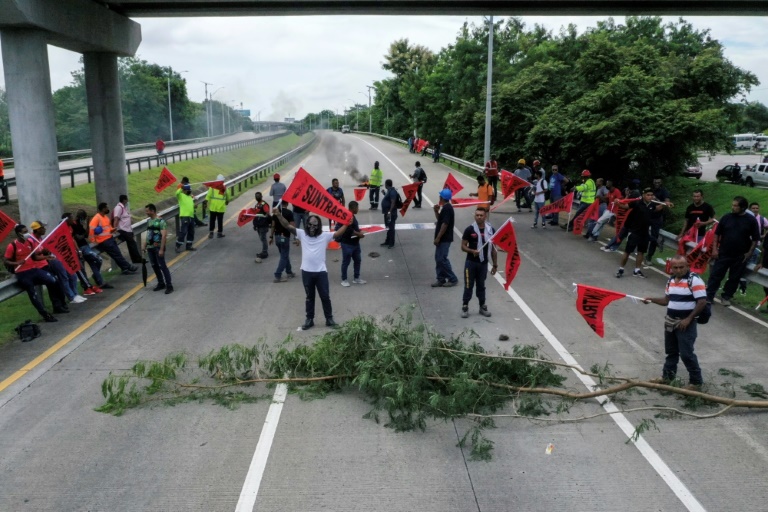
Fresh roadblocks as Panama protesters reject deal

There were fresh demonstrations and roadblocks in Panama on Monday as pressure groups turned their backs on a deal signed with the government to end their protest in exchange for a fuel price cut. 

After union leaders consulted grassroots supporters on the deal announced Sunday, it was decided to continue the protest, said Luis Sanchez, a leader of the Anadepo civic grouping.

“We had warned the executive that we still have to consult the rank and file,” he told the TVN-2 channel.

The agreement, he added, “was signed under pressure” and members have opted to continue the mobilization that had seen trucks and banner-waving demonstrators paralyze the strategic Pan-American Highway.

“In the meantime, there is no agreement,” said Sanchez as he tore up a sheet of paper.

On Sunday, the government and some protest leaders announced a deal to end more than two weeks of demonstrations over high fuel prices and rising living costs in the country of 4.4 million people.

The outpouring has cost the economy millions of dollars in losses and has led to shortages of fuel and food in some parts of the country, according to the private sector.

“We are in a bad way; no food, no buses. I wanted to buy rice and… what little can be found is very expensive. The vegetables are damaged,” said Angelica Ruiz, a resident of Pacora east of Panama City who also had trouble getting to her place of work.

– ‘We will not weaken’ –

The government agreed Sunday to cut the price of petrol to $3.25 per gallon and pursue talks on lowering food and medicine costs that were key among protesters’ concerns.

Last week, it had already reduced the petrol price to $3.95 from $5.20 per gallon in June, but this was not enough to appease the demonstrators.

After Sunday’s announcement, several unions said the so-called agreement was inadequate and had left out many groups.

“We will stay on in the street,” said protester Juan Morales, a farmer from Capira, west of Panama City.

“We will not weaken. We need strong and positive answers,” he told AFP.

The biggest protest Monday was in the capital, with members of the Suntracs construction union closing access roads with burning tire barricades, causing massive traffic backups.

There were also new blockades of the Pan-American Highway that connects Panama with the rest of Central America and is the main transport route for goods through the country.

The protests come amid difficult economic times for a country with inflation of 4.2 percent recorded in May, along with an unemployment rate of about 10 percent and fuel price hikes of nearly 50 percent since January. 

Despite its dollarized economy and high growth figures, the country has a high rate of social inequality. 

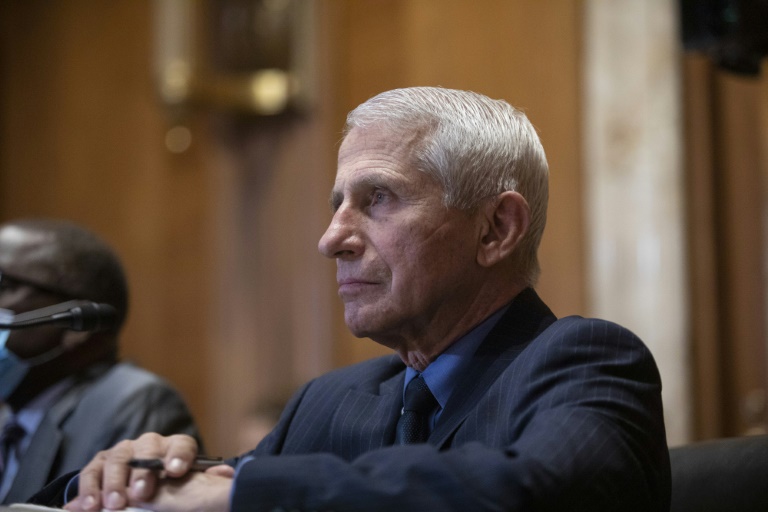
America's Fauci to retire by end of Biden's current term

Anthony Fauci, who has helmed the United States’ response to infectious disease outbreaks since the 1980s, will retire by the end of President Joe Biden’s current term, he said in interviews Monday.

The 81-year-old told Politico and CNN he would step down from his position as director of the National Institute of Allergy and Infectious Diseases (NIAID) to pursue other avenues sometime before January 2025.

“Obviously, you can’t go on forever. I do want to do other things in my career, even though I’m at a rather advanced age,” Fauci, who is also Biden’s chief medical advisor, said to CNN.

He told Politico he did not plan to stay in office long enough to see out Covid-19 because the disease was not going away soon. 

“I think we’re going to be living with this,” said Fauci, who was appointed director of the National Institutes of Health’s NIAID in 1984 and has served under seven presidents.

When Covid first spread globally from China, he became a trusted source of reliable information, reassuring the public with his calm and professorial demeanor during frequent media appearances. 

But his honest takes on America’s failures to get to grips with the virus brought Fauci into conflict with former president Donald Trump, and turned the physician-scientist into a hated figure for some on the right.

Fauci now lives with security protection after his family received death threats and harassment.

But he was conciliatory toward his former nemesis Trump in his Politico interview.

“We developed an interesting relationship,” said the Italian-American.

“Two guys from New York, different in their opinions and their ideology, but still, two guys who grew up in the same environments of this city. I think that we are related to each other in that regard.”

During the 1980s, Fauci became a lightning rod for criticism that the government was not doing enough to stem the rise of HIV-AIDS — but later forged a close collaboration with activists.

His accomplishments include implementing a fast-track system that widened access to antiretroviral medicines, and working with former president George H.W. Bush to plough in more resources.

Under president George W. Bush, Fauci was the architect of the President’s Emergency Plan For AIDS Relief (PEPFAR), credited with saving millions of lives in sub-Saharan Africa.

As a scientist, he is credited with developing effective treatments for formerly fatal inflammatory diseases, as well as for contributions into understanding how HIV destroys the body’s defenses. 

Despite his many duties, he continues to treat patients at the NIH’s Clinical Center in Bethesda, Maryland.

Russian shelling kills 6 in Donbas, EU defends sanctions on Moscow

Russian shelling of a town in eastern Ukraine on Monday killed six people, Kyiv said, as EU ministers meeting in Brussels insisted the pressure of Western sanctions on Moscow was working.

Ukraine’s President Volodymyr Zelensky meanwhile appointed an acting security chief, having announced the suspension of senior law enforcement officials late on Sunday.

Rescue workers were digging through debris and clearing rubble from a collapsed two-storey building in Toretsk in the industrial east that was struck by Russian artillery early Monday.

“I had my windows open. There was a huge explosion around 5:00 am — stones and dust,” local resident Nadia told AFP journalists, still shaking.

Emergency services said five people had been pulled dead from the rubble, while a sixth, seriously wounded, had died in hospital.

Toretsk, a town of around 30,000 residents, lies 50 kilometres (30 miles) south of Kramatorsk, a key target for Russian forces, who invaded Ukraine in late February.

Russia’s troops have made gains in the eastern region of Donbas recently, capturing the sister cities of Lysychansk and Severodonetsk.

On Monday, pro-Moscow rebels claimed their next target in Donbas — the town of Siversk — was under their control, an announcement that could not be independently verified.

– Grain supply talks –

In Kyiv, Zelensky appointed 39-year-old Vasyl Malyuk — first deputy head of the SBU security services since March — as acting chief after pulling Ivan Bakanov from the post.

Zelensky officially asked parliament to dismiss Bakanov later Monday, and the issue will be discussed at the next session for which a date has not yet been set.

Andriy Smirnov, a deputy head of the presidential administration told Ukrainian television that prosecutor general Iryna Venediktova and Bakanov had been suspended to prevent them “potentially influencing criminal proceedings against employees of the Security Service of Ukraine”.

The night before, Zelensky said security officials were investigating more than 650 cases of suspected treason and aiding and abetting Russia, including 60 cases of officials in Russian-occupied territories working against Ukraine.

In Brussels, the EU’s foreign policy chief warned Russia’s blockade of Ukrainian ports was threatening grain supplies to tens of thousands of people vulnerable to starvation and said it must end.

“It’s an issue of life and death for many human beings. And the question is that Russia has to de-block and allow Ukrainian grain to be exported,” Josep Borrell told reporters. 

Zelensky tweeted he had had talks with Brazil’s President Jair Bolsonaro. “Discussed the importance of resuming Ukrainian grain exports to prevent a global food crisis provoked by Russia,” he wrote.

Russian and Ukrainian negotiators are due to meet UN and Turkish diplomats in Istanbul Wednesday to try to agree an end to the months-long blockade of Ukraine’s ports.

Kremlin advisor Yury Ushakov meanwhile said the impasse would feature in talks between Russian President Vladimir Putin and Turkish counterpart Recep Tayyip Erdogan on Tuesday in Tehran. 

– Stay with sanctions: Borrell –

Borrell urged the EU not to falter on sanctions against Russia, insisting they were working, days after Hungarian leader Viktor Orban said the penalties were harming Europe more than Russia.

“It is what we had to do, and we will continue doing,” Borrell said.

Ukraine Foreign Minister Dmytro Kuleba warned against “backing down and bowing to” Putin’s demands “will not work, it has never worked.”

Putin, meanwhile, vowed to overcome the high-tech problems caused by the sanctions.

“This is a huge challenge for our country,” he told a meeting. “Realising the colossal amount of difficulties we are facing, we will look for new solutions in an energetic and competent manner.”

European Commission President Ursula von der Leyen was visiting gas-rich Azerbaijan to secure alternatives to Russian energy for Europe.

“We will double the supply of gas from Azerbaijan to the EU,” within several years she said after meeting with President Ilham Aliyev, a leader routinely criticised by rights groups.

– Russia to target long-range weapons –

A Ukrainian counter-offensive in the direction of  encircled Black Sea ports has been gaining momentum.

With the delivery of long-range precision artillery to Ukraine by its Western allies, the battlefield dynamics in the south — and in the east — have shifted, say Kyiv and observers of the conflict.

Those weapons are a key concern for Russia, and Defence Minister Sergei Shoigu during a recent troop inspection said Moscow’s forces had to set about neutralising systems such as US-supplied Himars.

“Shoigu gave orders to prioritise the destruction — with high-precision weapons — of enemy artillery and long-range missiles,” the Russian defence ministry said.

In a BBC television interview broadcast Sunday, the head of Britain’s armed forces, Admiral Tony Radakin, estimated  50,000 Russian soldiers had been killed or wounded in the invasion, with nearly 1,700 Russian tanks and some 4,000 armoured fighting vehicles destroyed.

But more than 20 weeks since the invasion began, Moscow said over the weekend it would step up its military operations.

burs-jbr/raz/cw

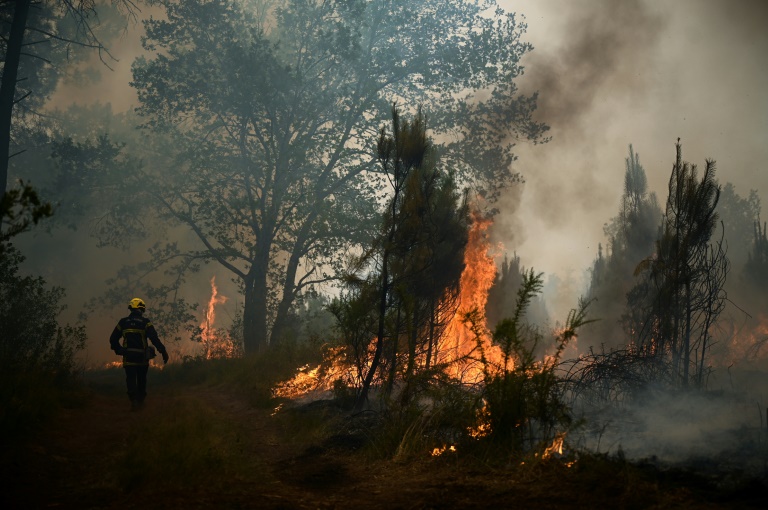
Europe burns as heatwave breaks temperature records

A fierce heatwave in western Europe on Monday left much of the continent wilting under a scorching sun, smashing temperature records and feeding ferocious forest wildfires.

In Britain, the 38.1 Celsius (100.9 Fahrenheit) in Suffolk, eastern England, made it the hottest day of the year and the third-hottest day on record.

Expectations are now high that the current British record of 38.7C could be broken and 40C breached for the first time, with experts blaming climate change and predicting more frequent extreme weather to come.

Across the Channel in France, a host of towns and cities recorded their highest-ever temperatures on Monday, the national weather office said.

The mercury hit 39.3C in Brest on the Atlantic coast in the far northwest of the country, smashing a previous record of 35.1C from 2002.

Saint-Brieuc, on the Channel coast, hit 39.5C beating a previous record of 38.1C, and the western city of Nantes recorded 42C, beating a decades-old high of 40.3C, set in 1949.

Firefighters in France’s southwest were still struggling to contain two massive fires that have caused widespread destruction.

For six days, armies of firefighters and a fleet of waterbombing aircraft have battled against blazes that have mobilised much of France’s firefighting capacity.

– France on ‘red alert’ –

Forecasters put 15 French departments on the highest state of alert for extreme temperatures Monday, including in the northwest Brittany region, where the Atlantic port of Brest hit 39.3C Monday — another record.

Ireland saw temperatures of 33C in Dublin — the highest since 1887 — while in the Netherlands, temperatures reached 35.4C in the southern city of Westdorpe. While that was not a record, higher temperature are expected there on Tuesday.

Neighbouring Belgium also expected temperatures of 40C and over.

The European heatwave, spreading north, is the second to engulf parts of the southwest of the continent in recent weeks.

European Commission researchers meanwhile said nearly half (46 percent) of EU territory was exposed to warning-level drought.

Eleven percent was at an alert level and crops were already suffering from lack of water.

– Holiday markers evacuated –

Blazes in France, Greece, Portugal and Spain have destroyed thousands of hectares of land and forced thousands of residents and holidaymakers to flee.

An area of nine kilometres (5.5 miles) long and eight kilometres wide was still ablaze near France’s Dune de Pilat, Europe’s highest sand dune, turning picturesque landscapes, popular campsites and pristine beaches into a scorching mess.

A total of 8,000 people were being evacuated from near the dune Monday as changing winds blew thick smoke into residential areas, officials said.

“The smoke is toxic,” firefighter spokesman Arnaud Mendousse told AFP. “Protecting the population is a matter of public health.”

A nearby zoo in Archachon evacuated its more than 1,000 animals, sending them to other facilities to escape the smoke.

The evacuations added to the 16,000 tourists or residents already forced to decamp in France, many to emergency shelters.

In Spain, fire burning in the northwestern province of Zamora claimed the life of a 69-year-old shepherd, regional authorities said.

The previous day a fireman died in the same area.

Later Monday it was reported that an office worker in his fifties had died from heatstroke in Madrid.

Authorities have reported around 20 wildfires still raging from the south to Galicia in the far northwest, where blazes have destroyed around 4,500 hectares (more than 11,000 acres) of land. 

– ‘Enjoy the sunshine’ –

In Portugal, almost the entire country remained on high alert for wildfires despite a slight drop in temperatures, which last Thursday hit 47C — a record for July.

Fires have killed two, injured around 60 and destroyed between 12,000 and 15,000 hectares of land in Portugal.

In Britain, the government, already on the ropes after a series of scandals that forced Prime Minister Boris Johnson to quit, was accused of not taking the situation seriously enough.

Johnson was criticised for having failed to attend an emergency meeting on the crisis on Sunday, instead hosting a farewell party at his state-funded country retreat.

Deputy prime minister Dominic Raab also drew flak from frontline medics by appearing to minimise the threat from the extreme heat after he told Britons to “enjoy the sunshine”.

The Sun tabloid headlined its coverage of the heat “British Bake Off”, observing that the “scorcher” was making the UK hotter than Ibiza where temperatures were a comparatively low 30C.

“It is a bit frightening,” Karina Lawford, 56, told AFP as she took a stroll by the sea in Tankerton on the north Kent coast, saying the heat reminded her of Australia where she lives.

The extreme temperatures saw flights suspended at Luton Airport near London and Royal Air Force base Brize Norton due to “defects” on the runway, with no let-up expected for Tuesday.

Trains were cancelled and schools closed in affected areas.

But some like 64-year-old plumber Dave Williams urged people to “just get on with it”.

“It’s nothing to get excited about, is it really? If it isn’t Brexit or the weather we don’t know what else to talk about, do we?” he said.

In Brighton, on England’s south coast, bank worker Abu Bakr put the heatwave in perspective.

“I come from Sudan,” he said. “Forty, forty-five degrees is just the norm. This is as good as it can be.”

burs-jh-phz/jwp/jj

Close Bitnami banner
Bitnami