World

Israel hits Gaza 'military site' after rocket fire: army

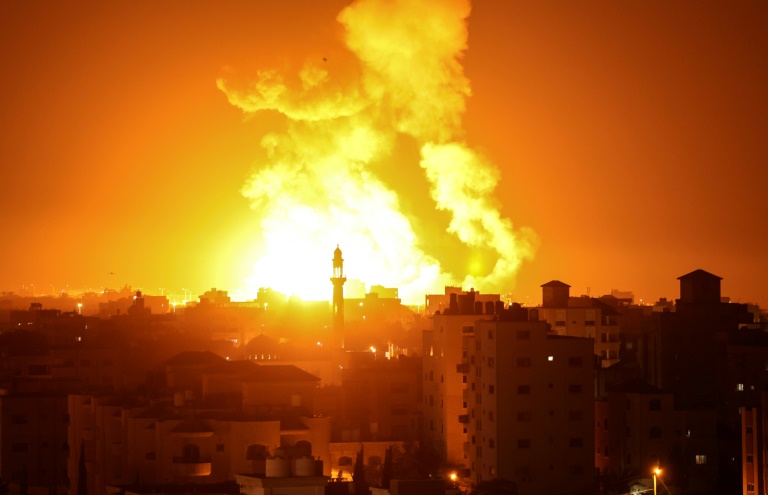
Israeli warplanes struck a weapons manufacturing facility in the Gaza Strip early Saturday, the military said, after rocket fire against Israeli territory.

The exchange of fire came hours after US President Joe Biden visited Israel and the occupied West Bank.

“A short while ago, IDF fighter jets struck a military site in the central Gaza Strip belonging to the Hamas terrorist organisation,” a statement from the Israel Defense Forces said.

“The military site consists of an underground complex containing raw materials used for the manufacturing of rockets,” it said, describing the facility as “one of the most significant” of its kind in the territory.

“The strike on this site will significantly impede and undermine Hamas’ force-building capabilities,” it said, adding that Israel was responding to “attacks from the Gaza Strip on Israeli territory”.

During the night there had been two separate launches, each of two rockets, towards Israeli territory, the military said.

Warning sirens alerting residents to the rocket fire had sounded during the night in the city of Ashkelon and elsewhere in Israel’s south.

Israel’s military said one of the rockets had been intercepted while the other three fell on empty land.

Impoverished Gaza, home to 2.3 million Palestinians, has been under Israeli blockade since 2007 when the Islamist movement Hamas seized power.

– Biden visit –

Before flying to Saudi Arabia on Friday, Biden visited the Israeli-occupied West Bank where he reiterated his administration’s commitment to a two-state solution to end the Israeli-Palestinian conflict.

There “must be a political horizon that the Palestinian people can actually see”, Biden said.

“I know that the goal of the two states seems so far away,” he said in Bethlehem, alongside Palestinian president Mahmud Abbas.

Abbas said “recognising the state of Palestine” is the key to peace.

With Israeli-Palestinian peace negotiations moribund since 2014, the US delegation has been focusing on economic measures.

Biden announced an additional $200 million for the United Nations agency serving Palestinian refugees, which saw funding cut by the previous US president Donald Trump.

During a visit earlier Friday to a hospital in Israeli-annexed east Jerusalem, Biden pledged a $100 million aid package for medical institutions in the area.

He also announced plans to roll out infrastructure for 4G internet across the Gaza Strip and the West Bank by the end of next year, fulfilling a longstanding aspiration among Palestinians.

Biden earlier held talks in Jerusalem with Israeli Prime Minister Yair Lapid, during which a focal point was Iran’s nuclear programme and that country’s support for Hamas and other Islamist groups.
G20 finance talks to end without joint communique: officials

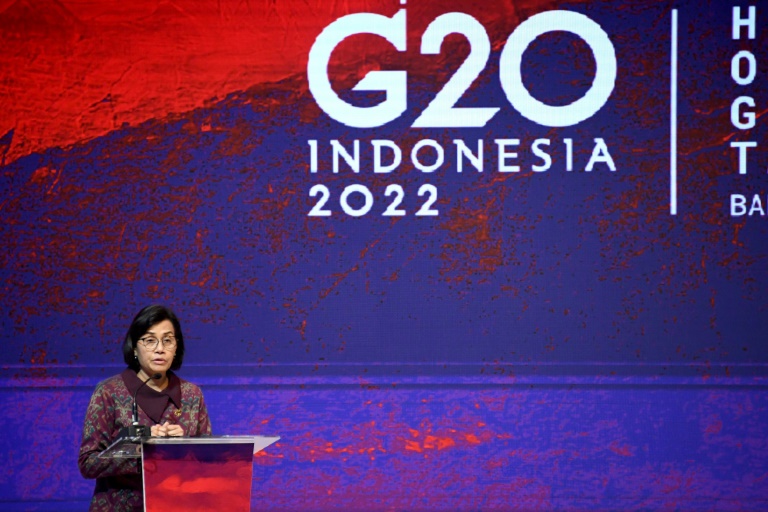
A two-day meeting of G20 finance ministers in Indonesia is expected to end Saturday without a joint communique, two officials said, after Russia’s war in Ukraine overshadowed proceedings.

During talks on the Indonesian resort island of Bali, finance chiefs from Western nations accused Russian technocrats of complicity in the invasion.

US Treasury Secretary Janet Yellen and Australian Treasurer Jim Chalmers on Friday blamed the invasion for sending a shockwave through the global economy.

In place of a formal communique will be a statement by Indonesia, which holds the G20 presidency, said one official who spoke on condition of anonymity.

Another source at the meeting said the host would summarise the talks in a declaration that would not fall under the G20 banner.

Indonesian officials did not respond to a request for comment.

At the beginning of the second day of talks, Indonesian central bank governor Perry Warjiyo called on ministers and global finance leaders to concentrate on recovery in a world economy still reeling from the Covid-19 pandemic.

“It is important that we remain focused on what we have planned to achieve this year, as this will also send a positive message to the global community on the G20’s role and efforts to support global recovery,” Warjiyo said.

But the talks have been under the shadow of the Ukraine war — which Russia calls a “special military operation” — after it roiled global markets, caused rising food prices and added to breakneck inflation.

It has left the forum unable to agree on a text with Russia disagreeing with Western nations over its invasion of Ukraine being the cause of the global economic headwinds.

The Kremlin instead blames subsequent Western sanctions for blocked food shipments and rising energy prices.

“Russia tried to say that the world economic situation had nothing to do with the war,” a French delegation source told AFP on Friday.

Russian Finance Minister Anton Siluanov and Ukrainian Finance Minister Serhiy Marchenko participated virtually in the meeting.

Russian Deputy Finance Minister Timur Maksimov attended the talks in person.

He was in the room as Western officials expressed their condemnation, according to a source present at the talks.

Marchenko said the Russian invasion “clearly marks the end of the existing world order”, and called for “more severe targeted sanctions” against Moscow.

Members will also discuss sustainable finance, cryptocurrencies and international taxation on Saturday.

G20 finance talks to end without joint communique: officials

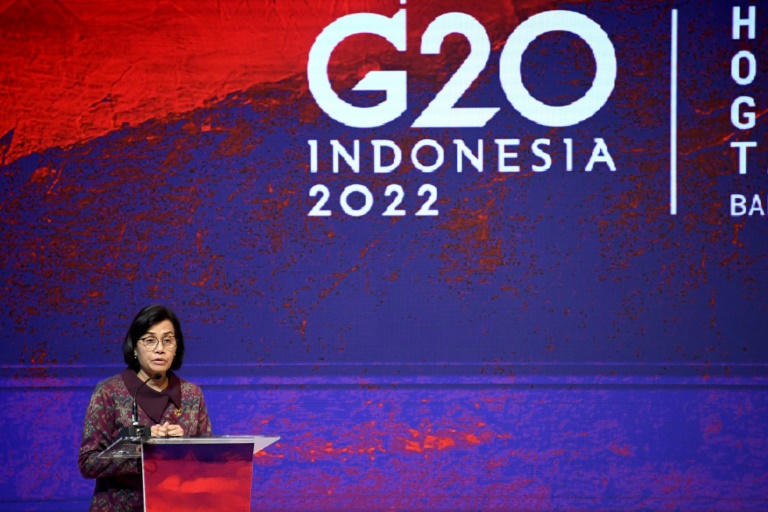
A two-day meeting of G20 finance ministers in Indonesia is expected to end Saturday without a joint communique, two officials said, after Russia’s war in Ukraine overshadowed proceedings.

During talks on the Indonesian resort island of Bali, finance chiefs from Western nations accused Russian technocrats of complicity in the invasion.

US Treasury Secretary Janet Yellen and Australian Treasurer Jim Chalmers on Friday blamed the invasion for sending a shockwave through the global economy.

In place of a formal communique will be a statement by Indonesia, which holds the G20 presidency, said one official who spoke on condition of anonymity.

Another source at the meeting said the host would summarise the talks in a declaration that would not fall under the G20 banner.

Indonesian officials did not respond to a request for comment.

At the beginning of the second day of talks, Indonesian central bank governor Perry Warjiyo called on ministers and global finance leaders to concentrate on recovery in a world economy still reeling from the Covid-19 pandemic.

“It is important that we remain focused on what we have planned to achieve this year, as this will also send a positive message to the global community on the G20’s role and efforts to support global recovery,” Warjiyo said.

But the talks have been under the shadow of the Ukraine war — which Russia calls a “special military operation” — after it roiled global markets, caused rising food prices and added to breakneck inflation.

It has left the forum unable to agree on a text with Russia disagreeing with Western nations over its invasion of Ukraine being the cause of the global economic headwinds.

The Kremlin instead blames subsequent Western sanctions for blocked food shipments and rising energy prices.

“Russia tried to say that the world economic situation had nothing to do with the war,” a French delegation source told AFP on Friday.

Russian Finance Minister Anton Siluanov and Ukrainian Finance Minister Serhiy Marchenko participated virtually in the meeting.

Russian Deputy Finance Minister Timur Maksimov attended the talks in person.

He was in the room as Western officials expressed their condemnation, according to a source present at the talks.

Marchenko said the Russian invasion “clearly marks the end of the existing world order”, and called for “more severe targeted sanctions” against Moscow.

Members will also discuss sustainable finance, cryptocurrencies and international taxation on Saturday.

Jan 6 Capitol riot committee subpoenas Secret Service over missng texts

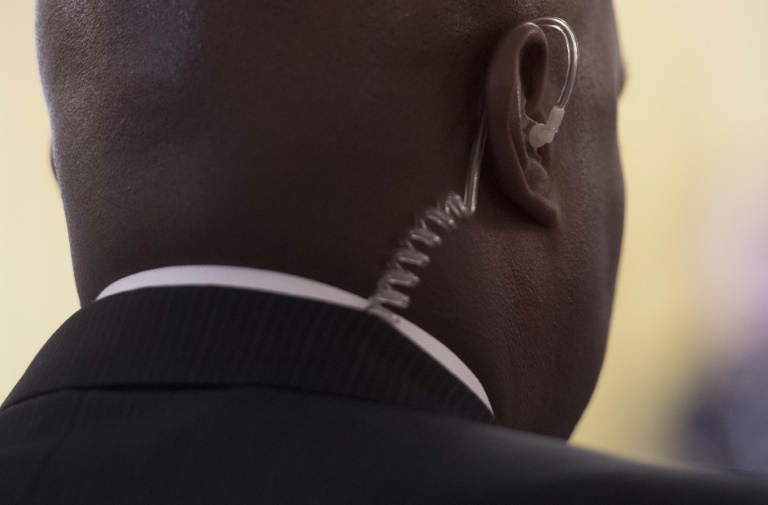
The US House committee investigating the January 6 assault on the Capitol said late Friday night it had subpoenaed the Secret Service over questions surrounding missing text messages from the days surrounding the riot last year.

The inspector general of the Department of Homeland Security (DHS), Joseph Cuffari, told Congress earlier this week that his office has had difficulties obtaining records of text messages from the Secret Service, the law enforcement agency that protects the president, from January 5 and 6, 2021. 

Representative Bennie Thompson, chairman of the January 6 committee, informed the agency’s director James Murray in a letter Friday of the subpoena compelling the Secret Service to hand over the missing texts by Tuesday. 

“The Select Committee seeks the relevant text messages, as well as any after action reports that have been issued in any and all divisions of the USSS pertaining or relating in any way to the events of January 6, 2021,” the letter, posted to the committee’s website, said.

The messages could be important in the House of Representatives and Justice Department investigations into whether Donald Trump and his close advisors encouraged the deadly insurrection by the former president’s supporters, which aimed to prevent the certification of his Democratic rival Joe Biden as the winner of the November 2020 election.

Secret Service agents were with Trump during the day of the uprising, and were also with vice president Mike Pence, who went into hiding at the Capitol after pro-Trump rioters called for him to be hanged.

On June 29 a former White House staffer told the House January 6 investigation that Trump had attempted to force the Secret Service to take him to the Capitol to join his supporters on that day. 

According to Secret Service spokesman Anthony Guglielmi, agents’ phones were wiped as part of a planned replacement program that began before the DHS Office of the Inspector General (OIG) first asked for the data, six weeks after the insurrection.

“The Secret Service notified DHS OIG of the loss of certain phones’ data, but confirmed to OIG that none of the texts it was seeking had been lost in the migration,” he said in a statement.

The Secret Service has been criticized for not adequately anticipating the threat of the violent action by armed Trump supporters on January 6.

Trump had made a senior Secret Service official at the time, Tony Ornato, his personal deputy chief of staff.

Ornato has denied the account given to the January 6 committee by former Trump aide Cassidy Hutchinson that Trump tried to force the Secret Service to drive him to the Capitol as his supporters massed at the building, the seat of the US legislature.

But other then White House officials have backed Hutchinson’s story.

GSK spin-off to create consumer healthcare giant

British drugs giant GlaxoSmithKline on Monday demerges its newly-named consumer healthcare unit Haleon, resulting in what is set to be London’s largest new stock market listing in more than a decade.

The new company — owning brands including Sensodyne toothpaste, pain relief drug Panadol and cold treatment Theraflu — is set for a valuation of about £40 billion ($47.4 billion) when it begins trading on the London stock market, according to Bloomberg. 

The major strategy shift by GSK chief executive Emma Walmsley comes after she has faced intense activist shareholder pressure over the company’s delays in producing Covid jabs and treatments.

– ‘Landmark London listing –

“This will be the largest London stock market listing in a decade, with the new company becoming a big beast with a new skin in the consumer goods world,” said Susannah Streeter, senior investment and markets analyst at Hargreaves Lansdown.

It is set to be the capital’s biggest listing since Swiss mining giant Glencore was valued at £38 billion on entry in 2011.

GSK, which owns 68 percent of Haleon, plans to retain six percent of the group following the spin-off.

US pharmaceutical titan Pfizer has said it plans to sell its 32-percent minority stake.

Walmsley, who had led the consumer unit prior to her promotion as head of GSK in 2017, has described the demerger as the group’s most significant corporate change in 20 years.

The split sees GSK “parcelling off a considerable quantity of its sizeable debt pile into Haleon, expected to be around £10 billion”, Streeter said.

Haleon could join London’s top-tier FTSE 100 depending on its market valuation.

Walmsley, part of a group of less than 10 women chief executives running companies on the benchmark index, sees more long-term value in the demerger than a sale.

GSK at the start of the year rejected a £50 billion bid for the unit from consumer goods titan Unilever.

– Vaccine push –

Alongside the demerger, GSK is expanding further into the field of vaccines, having in May snapped up US biopharmaceutical firm Affinivax for up to $3.3 billion.

Also this year, the British company spent $1.9 billion on US group Sierra Oncology, a specialist in medicines for rare forms of cancer.

Keith Bowman, analyst at Interactive Investor, said the demerger was aimed at giving GSK “increased management focus to each respective business”.

This was the case “particularly for its pharma business which has underperformed rivals such as (Covid vaccine-maker) AstraZeneca over recent years”, he told AFP.

GSK is set to receive £7 billion in dividends at separation.

The consumer healthcare division, whose portfolio of products includes also Centrum multivitamins and anti-inflammatory Voltaren, generates annual sales of about £10 billion.

Haleon will be headquartered in Weybridge, southwest of London.

“The idea is that a more focused consumer business will help boost sales,” said Streeter.

“There will be no change at the top… which is a vote of confidence in Brian McNamara, a former Procter & Gamble executive who has led the division for eight years.”

Biden to talk oil at Arab summit concluding Middle East tour

US President Joe Biden is set to discuss volatile oil prices during a summit with Arab leaders on Saturday in Saudi Arabia, the final stop of his Middle East tour. 

The meeting in Jeddah, Saudi Arabia’s second city on the Red Sea coast, will bring together leaders of the six-member Gulf Cooperation Council as well as Egypt, Jordan and Iraq. 

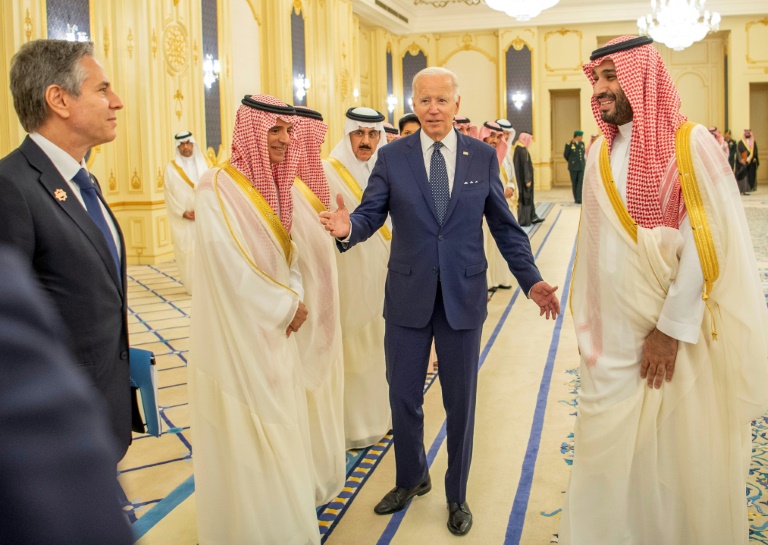
Biden landed Friday in Saudi Arabia, a longtime US ally he once vowed to make a “pariah” over its human rights record, and met with King Salman, de facto ruler Crown Prince Mohammed bin Salman and other top Saudi officials. 

Tensions had been high between Biden and Prince Mohammed, especially after Biden’s administration released US intelligence findings that Prince Mohammed “approved” an operation targeting journalist Jamal Khashoggi, whose gruesome killing in Saudi Arabia’s Istanbul consulate in 2018 spurred global outrage.

Biden now appears ready to re-engage with a country that has been a key strategic ally of the United States for decades, a major supplier of oil and an avid buyer of weapons.

Washington wants the world’s largest exporter of crude to open the floodgates to bring down soaring gasoline prices, which threaten Democratic chances in November mid-term elections. 

– Human rights –

But Jake Sullivan, Biden’s national security adviser, tamped down expectations of immediate progress while speaking with reporters on the flight to Jeddah. 

“I don’t think you should expect a particular announcement here bilaterally,” he said.

“We believe any further action taken to ensure that there is sufficient energy to protect the health of the global economy will be done in the context of OPEC+,” Sullivan said, referring to the wider bloc of oil producers. 

The summit will enable Biden to “lay out clearly and substantively his vision and his strategy” for US engagement in the Middle East, he added.

Biden said his trip “is about once again positioning America in this region for the future.

“We are not going to leave a vacuum in the Middle East for Russia or China to fill,” he insisted.

Biden was under pressure to discuss the cases of Khashoggi as well as Saudis detained under what critics of Prince Mohammed described as a far-reaching crackdown on dissent. 

Late Friday, Biden said he raised Khashoggi’s killing “at the top of the meeting” with Prince Mohammed and “made it clear if anything occurs like that again they will get that response and much more”.

While in Israel he told reporters his motives for visiting Saudi Arabia were “broader” than human rights. 

“My views on Khashoggi have been absolutely, positively clear, and I have never been quiet about talking about human rights.”

– Israeli ties –

Such comments disappointed relatives of detained Saudis, including some with US citizenship. 

“I don’t feel very optimistic about the visit only because past incidents prove that the powers that be in Saudi can do whatever they want and there are no consequences,” said Sarah al-Haider.

Her brother, US citizen Salah al-Haider, was held for nearly two years on suspicion of terrorism-related crimes and remains under a travel ban despite being released last year.

Also Friday, dozens of British and US lawmakers urged Biden to discuss Egypt’s “extensive architecture of repression” in talks with his Egyptian counterpart Abdel Fattah al-Sisi.

White House officials have used the trip as a bid to promote integration between Israel and Arab nations.

The issue of the strategic Red Sea islands of Tiran and neighbouring Sanafir is also expected to be on Saturday’s agenda.

Egypt ceded the islands in 2016 to Saudi Arabia, but the deal requires Israel’s green light — a move that could spur contacts between the Jewish state and Riyadh.

Biden said Friday that a decades-old multinational peacekeeping force, including US troops, would leave Tiran, with the White House adding they would depart by the end of the year.

Saudi Arabia has refused to join the US-brokered Abraham Accords which in 2020 created ties between Israel and two of the kingdom’s neighbours, the United Arab Emirates and Bahrain. 

Riyadh has repeatedly said it would stick to the decades-old Arab League position of not establishing official ties with Israel until the conflict with the Palestinians is resolved. 

But it is showing signs of greater openness towards Israel, and on Friday announced it was lifting overflight restrictions on aircraft travelling to and from Israel, a move Biden hailed as “historic”.

Israeli caretaker Prime Minister Yair Lapid went further saying: “This is the first official step in normalisation with Saudi Arabia.”

Mexico captures drug lord wanted for murder of US agent

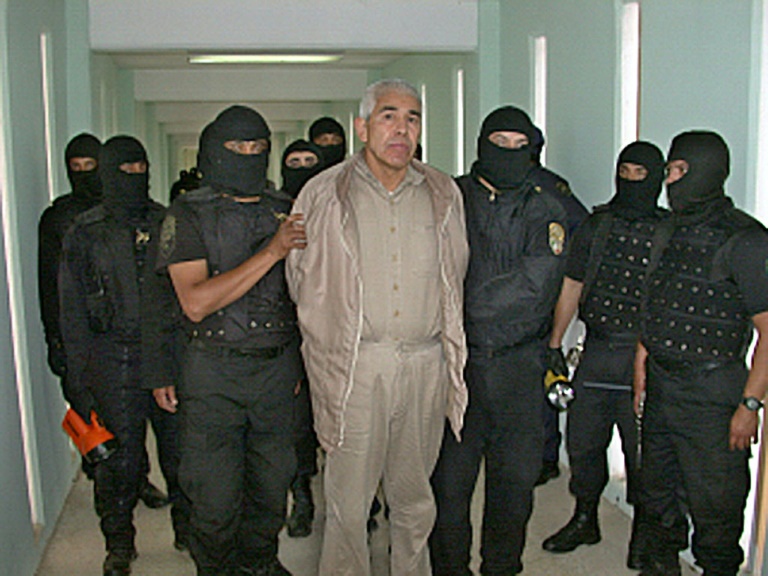
Mexico on Friday captured a notorious drug kingpin on the FBI’s list of 10 most-wanted fugitives for the murder of a US undercover agent that strained the countries’ diplomatic relations.

Rafael Caro Quintero, 69, is accused by the United States of ordering the kidnap, torture and murder of Drug Enforcement Administration (DEA) special agent Enrique “Kiki” Camarena in 1985.

He was detained by Mexican marines in the town of Choix in the northwestern state of Sinaloa, for “the purpose of extradition,” the navy said in a statement.

Caro Quintero had already been arrested in 1985, tried in Mexico and sentenced to 40 years in prison for Camarena’s murder.

But in 2013, a Mexican court ordered his release on a legal technicality after he served 28 years, a move that angered US authorities.

By the time Mexico’s Supreme Court overturned the decision, Caro Quintero had already gone into hiding.

The case plunged US-Mexican relations into a crisis, and it took decades for anti-drug agencies on both sides of the border to rebuild trust.

Caro Quintero, alias “Rafa,” has a $20 million bounty on his head and is described by the FBI as “extremely dangerous.”

He is accused of co-founding the now-defunct Guadalajara drug cartel and currently runs an arm of the infamous Sinaloa cartel, according to US authorities.

The US Department of Justice expressed gratitude Friday to Mexican authorities over Caro Quintero’s arrest, confirming the US plans to seek his extradition.

“There is no hiding place for anyone who kidnaps, tortures, and murders American law enforcement,” Attorney General Merrick Garland said in a statement. 

– Denial of guilt –

In 2016, in an interview published by news magazine Proceso, Caro Quintero denied killing Camarena, whose story was depicted in the Netflix show “Narcos: Mexico.”

“I did not kidnap, did not torture and did not kill him,” Caro Quintero said, adding that he wanted to “live in peace” and work as a cattle rancher.

“I apologize to the society of Mexico for the mistakes I made, to the Camarena family, the DEA, the US government. I apologize,” he added.

Camarena’s murder was considered a vendetta for investigations by the DEA agent that led to the seizure of a massive marijuana field in Chihuahua.

Last year a Mexican court ruled that Caro Quintero could be extradited to the United States if caught, rejecting an appeal from his lawyers who argued that he had already been tried in his home country.

The Guadalajara drug cartel, powerful in the 1980s, is considered the forefather of modern Mexican drug cartels.

It was one of the first to establish contacts with Colombian drug lords to transport cocaine from the South American country to the United States.

The cartel’s other founders, Miguel Angel Felix Gallardo and Ernesto Fonseca Carillo, were also handed long prison sentences in Mexico for Camarena’s murder.

The organization’s disappearance led to the rise of the powerful Sinaloa drug cartel led by Joaquin “El Chapo” Guzman.

In 2017, Mexico extradited Guzman to the United States where he is serving a life sentence.

A wave of cartel-related violence has left more than 340,000 people dead in Mexico since the government deployed the military in the war on drugs in 2006.

UN Security Council calls on members to stop arming gangs in Haiti

The United Nations Security Council agreed Friday to ask member states to ban the transfer of small arms to Haiti, rocked by deadly gang violence, but stopped short of a full embargo requested by China.

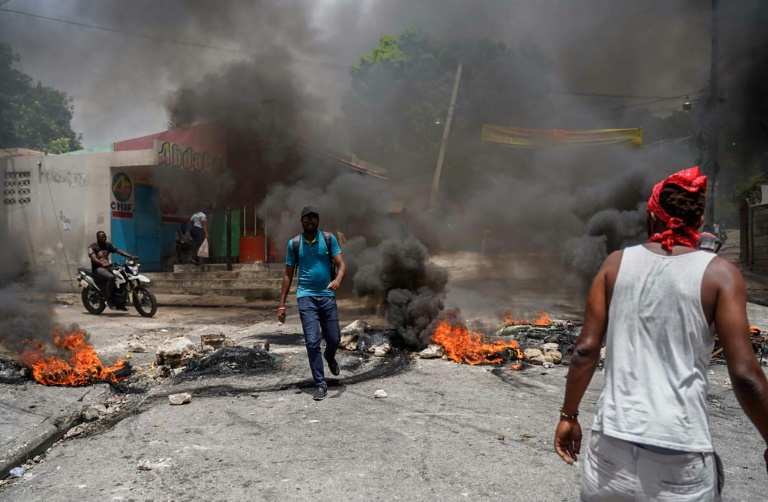
Bloodshed in the Caribbean nation has been soaring — alongside fuel shortages and rising food prices — with at least 89 people killed in the Port-au-Prince capital region alone this week. Aid agencies have said many areas are dangerous to access.

The Security Council resolution, put forward by the United States and Mexico, was adopted unanimously. The text calls on UN members to prohibit the transfer of small arms, light weapons and ammunition to non-state actors in Haiti. 

It also provides for the Council to impose individual sanctions against gang leaders within 90 days of the resolution’s adoption. 

China’s ambassador to the UN, Zhang Jun, called the resolution a “warning” to gangs in Haiti and a “step in the right direction.”

The Security Council resolution did not mention another Chinese request, that the UN examine the possibility of sending a regional police force to support beleaguered Haitian security forces. 

Instead it asks the UN Secretary-General Antonio Guterres to join with regional countries to study options to strengthen security in Haiti, with a report to be submitted on October 15. 

It also extended the mandate of the UN’s special political mission in Haiti, Binuh, until 2023. 

The resolution came after Haiti announced Thursday night a rare seizure of weapons in cargo containers: 18 military grade weapons, four 9mm handguns, 14,646 rounds of ammunition and $50,000 in counterfeit money.

Haitian prosecutors said arrest warrants have been issued against several people suspected of being linked to the cache.

Beijing has taken an increasingly prominent role in issues relating to Haiti at the UN in recent years — primarily over Haiti’s recognition of self-ruled Taiwan, which China views as its own territory. 

Beijing denies any link between its stance at the United Nations and the Taiwan issue, however.  

Crushing poverty and widespread violence is causing many Haitians to flee to the Dominican Republic, with which Haiti shares a border, or to the United States.

Haitians who spoke to AFP on Friday appeared pessimistic that the UN could do anything to change the situation. 

“Gangs are multiplying, insecurity is increasing and so is arms trafficking. Binuh has failed in its mission,” Fleurant Duceppe, a law student in Port-au-Prince, told AFP.

“It is not useful to us in any way,” he added. “It is up to us, the people, to take our destiny in hand.”

From catwalk to perp walk: Colombian designer awaits fate on smuggling charges

Colombian celebrity designer Nancy Gonzalez’s fall from grace was sudden and spectacular: taken in handcuffs from her luxury home in Cali last week to a Bogota jail cell, accused of smuggling protected animal skin purses into the United States.

The 77-year-old is now awaiting a ruling by a Colombian judge on whether she should be extradited to the United States, where she risks a 25-year jail sentence.

Gonzalez’s purses, clutches and wallets sell for thousands of US dollars apiece, have appeared on catwalks and TV shows and grace the shelves of high-end shops around the globe.

But according to an indictment from prosecutors in the Southern District of Florida, dated April 26, more than 200 of the caiman- and python-skin products sold in the United States were imported illegally. 

Gonzalez and two employees of her Gzuniga company, the charge sheet states, conspired to smuggle bags made of protected animal skins between February 2016 and April 2019 without the permit required under the Convention on International Trade in Endangered Species (CITES).

The goods were brought to the Gzuniga showroom in New York City by the accused for the purpose of “enriching themselves upon the sale of the contraband products in the United States,” said the indictment.

Individuals were allegedly paid to bring the bags from Colombia to New York on commercial flights, and coached to lie about the provenance of the goods if asked.

Gonzalez and her co-accused face one charge of conspiracy and two counts of smuggling.

– Not ‘black market’ –

According to her website, Gonzalez’s bags are handcrafted in her native Cali by a team of artisans.

The site says her bags are sold at over 300 luxury retailers, including Bergdorf Goodman, Neiman Marcus, Saks Fifth Avenue, Harrod’s and Tsum.

Her designs were also featured in an exhibition by the Metropolitan Museum of Art in New York.

Among Gonzalez’s famous clients are Salma Hayek, Britney Spears and Victoria Beckham, according to specialized portals.

According to the Florida indictment, the animals that provided the skins were not on the CITES endangered list but fell under a category of species “that had to be controlled in order to avoid utilization incompatible with survival.”

This means that trade in products obtained from such an animal required a permit, which Gonzalez allegedly failed to obtain.

Elmer Montana, a lawyer for one of Gonzalez’s employees, told AFP that the skins used to make the bags were “obtained by Nancy Gonzalez… from certified farms which are supervised by the Ministry of the Environment.

“These are not skins that she buys on the black market” in one of the world’s most biodiverse countries, where reptile trafficking is rife. 

Footage released by the Colombian prosecutor’s office showed the glamorous businesswoman led away in handcuffs after a raid on her luxury home in Cali last week.

A court must now decide on her extradition to the United States, a process that can take weeks or even months, according to defense lawyers.

A judge had denied Gonzalez’s request for bail pending a ruling.

From catwalk to perp walk: Colombian designer awaits fate on smuggling charges

Colombian celebrity designer Nancy Gonzalez’s fall from grace was sudden and spectacular: taken in handcuffs from her luxury home in Cali last week to a Bogota jail cell, accused of smuggling protected animal skin purses into the United States.

The 77-year-old is now awaiting a ruling by a Colombian judge on whether she should be extradited to the United States, where she risks a 25-year jail sentence.

Gonzalez’s purses, clutches and wallets sell for thousands of US dollars apiece, have appeared on catwalks and TV shows and grace the shelves of high-end shops around the globe.

But according to an indictment from prosecutors in the Southern District of Florida, dated April 26, more than 200 of the caiman- and python-skin products sold in the United States were imported illegally. 

Gonzalez and two employees of her Gzuniga company, the charge sheet states, conspired to smuggle bags made of protected animal skins between February 2016 and April 2019 without the permit required under the Convention on International Trade in Endangered Species (CITES).

The goods were brought to the Gzuniga showroom in New York City by the accused for the purpose of “enriching themselves upon the sale of the contraband products in the United States,” said the indictment.

Individuals were allegedly paid to bring the bags from Colombia to New York on commercial flights, and coached to lie about the provenance of the goods if asked.

Gonzalez and her co-accused face one charge of conspiracy and two counts of smuggling.

– Not ‘black market’ –

According to her website, Gonzalez’s bags are handcrafted in her native Cali by a team of artisans.

The site says her bags are sold at over 300 luxury retailers, including Bergdorf Goodman, Neiman Marcus, Saks Fifth Avenue, Harrod’s and Tsum.

Her designs were also featured in an exhibition by the Metropolitan Museum of Art in New York.

Among Gonzalez’s famous clients are Salma Hayek, Britney Spears and Victoria Beckham, according to specialized portals.

According to the Florida indictment, the animals that provided the skins were not on the CITES endangered list but fell under a category of species “that had to be controlled in order to avoid utilization incompatible with survival.”

This means that trade in products obtained from such an animal required a permit, which Gonzalez allegedly failed to obtain.

Elmer Montana, a lawyer for one of Gonzalez’s employees, told AFP that the skins used to make the bags were “obtained by Nancy Gonzalez… from certified farms which are supervised by the Ministry of the Environment.

“These are not skins that she buys on the black market” in one of the world’s most biodiverse countries, where reptile trafficking is rife. 

Footage released by the Colombian prosecutor’s office showed the glamorous businesswoman led away in handcuffs after a raid on her luxury home in Cali last week.

A court must now decide on her extradition to the United States, a process that can take weeks or even months, according to defense lawyers.

A judge had denied Gonzalez’s request for bail pending a ruling.

Close Bitnami banner
Bitnami