World

Forest fires rage in scorching southwest Europe

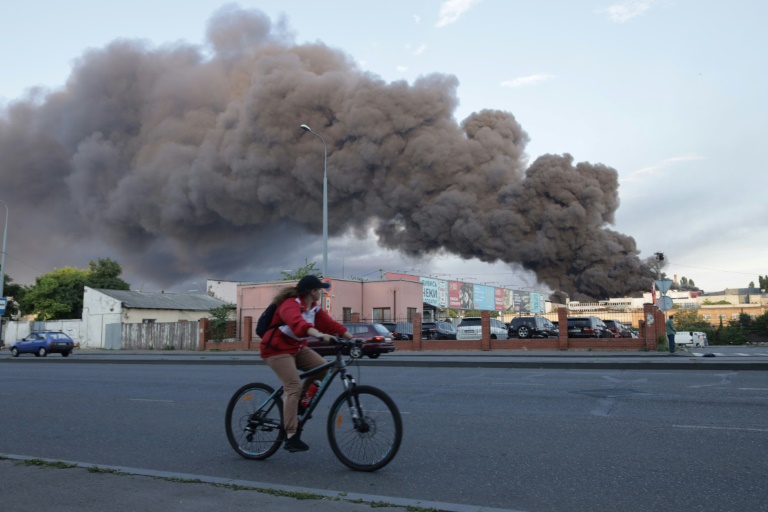
Southwest Europe entered a sixth day of a summer heatwave on Saturday that has triggered devastating forest fires as parts of the continent braced for new temperature records early next week.

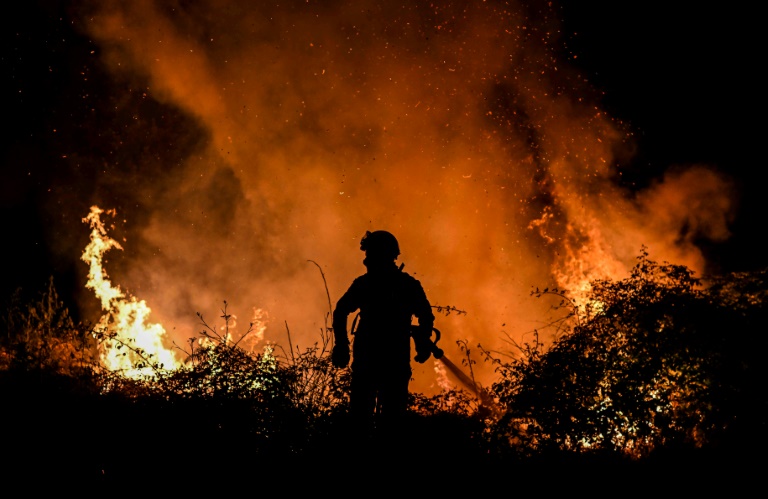
Firefighters in France, Portugal and Spain, as well as Greece, battled forest blazes that have ravaged thousands of hectares of land and killed several firefighters since the start of the week.

“The fire is still not under control,” said Ronan Leaustic, an official in Arcachon in southwest France’s Gironde region where firefighters battled to put out two forest blazes that have devoured 9,000 hectares (22,200 acres) since Tuesday.

Meteo France said temperatures will range between 35 degrees Celsius (95 degrees Fahrenheit) and 40C in the south of France on Saturday, with new heat records expected on Monday.

Authorities in the French Alps have urged climbers seeking to ascend Mont Blanc, Europe’s highest mountain, to postpone their trip due to repeated rock falls caused by “exceptional climatic conditions” and “drought”.

The call comes after a section of Italy’s biggest Alpine glacier gave way at the start of the month, sending ice and rock hurtling down the mountain and killing 11 people, in a disaster officials blamed on climate change.

In Portugal, the meteorological institute forecast temperatures of up to 42C and thermometer readings were not expected to drop below 40C until next week.

– ‘Extreme vigilance’ –

The civil defence, however, took advantage of a slight drop in temperatures after a July record of 47C on Thursday to try to stamp out one last major fire in the north of the country.

“The risk of fires remains very high,” civil defence chief Andre Fernandes warned during a midday briefing.

“This is a weekend of extreme vigilance.”

He spoke after an air tanker that had been fighting fires in northern Portugal crashed on Friday, killing its pilot.

A day earlier, two people were killed when a firefighting helicopter plummeted into the sea off Greece.

In Spain, the national meteorological agency maintained various levels of alert across the nation, warning of up to 44C in some regions.

Dozens of forest fires continued to rage in different parts of the country.

– UK crisis meeting –

One blaze in the south caused the authorities to cordon off a section of a key highway connecting Madrid to the Portuguese capital Lisbon.

The fires have scorched thousands of hectares in the Spanish region of Extremadura.

In Greece, the civil defence rushed to douse flames raging on the Mediterranean island of Crete.

Further north, people were also bracing for more unusually warm weather.

In the United Kingdom, a crisis committee of government ministers was meeting later Saturday after the state meteorological agency issued a first-ever “red” warning for extreme heat, cautioning there is a “risk to life”.

The Met Office said that in southern England, temperatures could exceed 40C for the first time on Monday or Tuesday.

Mayor Sadiq Khan advised Londoners only to use public transport on those days if “absolutely necessary”. National train operators also warned passengers to avoid travel.

Some schools in southern England told parents they would stay closed during the heatwave early next week.

burs-tsc/ah/jm
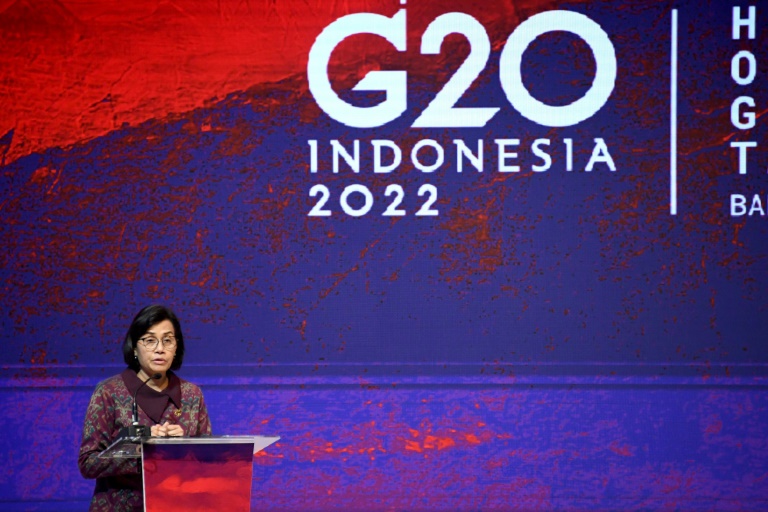
G20 finance talks overshadowed by Ukraine end without joint communique

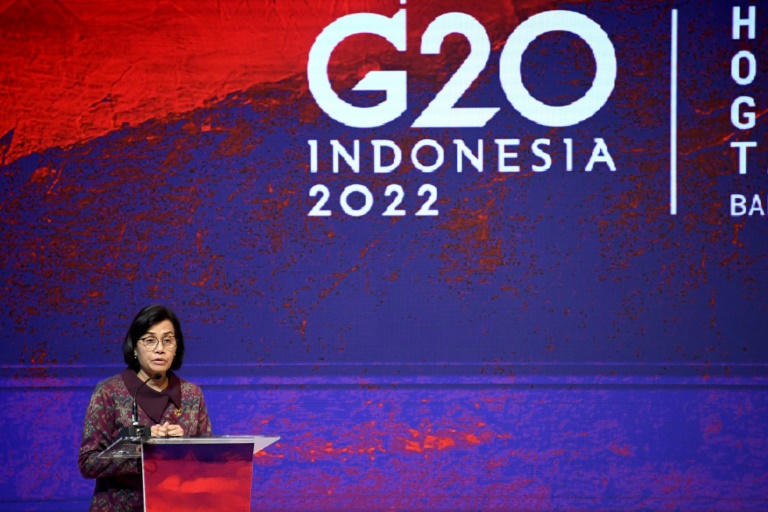
A two-day meeting of finance ministers from the Group of 20 major economies ended Saturday in Indonesia without a joint communique after Russia’s war in Ukraine divided the global forum.

During talks on the Indonesian resort island Bali, the finance chiefs looked for solutions to food and energy crises, while accusing Russian technocrats of exacerbating the problems.

US Treasury Secretary Janet Yellen, Australian Treasurer Jim Chalmers and Canadian Finance Minister Chrystia Freeland on Friday blamed the invasion of Ukraine for sending a shockwave through the global economy.

In place of a formal communique would be a 14-paragraph statement issued by Indonesia, the G20 chair’s Finance Minister Sri Mulyani Indrawati said in closing remarks.

She said there was consensus on most of the document but two paragraphs would focus on members’ differences regarding the war’s impacts and how to respond.

“I think this is the best result,” she said.

– No place at talks –

At the beginning of the second day of talks, Indonesian central bank governor Perry Warjiyo called on ministers and global finance leaders to concentrate on recovery in a world economy reeling from the Covid-19 pandemic.

The meeting took place after the International Monetary Fund slashed its global growth forecast, with another downgrade expected this month as US inflation stokes fears of a recession.

But the talks have been overshadowed by the Ukraine war after it roiled global markets, caused rising food prices and added to breakneck inflation.

The Kremlin calls the war a “special military operation” and blames retaliatory Western sanctions for blocking food shipments and rising energy prices.

Russian Finance Minister Anton Siluanov and Ukrainian Finance Minister Serhiy Marchenko participated virtually in the meeting.

Russian Deputy Finance Minister Timur Maksimov attended the talks in person a week after Foreign Minister Sergei Lavrov walked out of a G20 meeting over Western criticism of the invasion.

Maksimov was in the room as Western officials expressed their condemnation, according to a source present. Marchenko called for “more severe targeted sanctions” against Moscow.

– ‘Uncharted waters’ –

Indonesia has refrained from uninviting Russia from G20 meetings, including a leaders’ summit in November, even as Western nations repeated their calls for Moscow to be frozen out of the group.

Both Yellen and Freeland, who has Ukrainian heritage, said representatives of Russian President Vladimir Putin’s government had no place at talks.

Observers said the failure to agree on a joint communique would hinder coordinated efforts to solve rising inflation and food shortages.

“The lack of a G20 finance ministers’ communique means it will be more difficult for the G20 to forge a consensus on vital issues in the fall,” said Eric LeCompte, executive director of Jubilee USA Network, an NGO that lobbies for developing nation debt relief.

“Internal divisions hinder the G20’s ability to act decisively and leaves the world in uncharted waters.”

Yellen held bilateral meetings with counterparts from Indonesia, Saudi Arabia, South Africa, Australia, Singapore and Turkey, the Treasury said, lobbying their support for a price cap on Russian oil to cut off Putin’s war chest.

In response to the food crisis, the IMF, World Bank, World Food Programme, Food and Agriculture Organization and the World Trade Organization also called for action in four areas.

“Support the vulnerable, facilitate trade, boost food production & invest in climate-resilient agriculture,” IMF chief Kristalina Georgieva tweeted late Friday, summarising the call to action.

Members also discussed sustainable finance, cryptocurrencies and international taxation on Saturday.

Mulyani said “progress” was made on international tax rule changes that will set a global minimum corporate tax rate of 15 percent by 2024.

G20 finance talks overshadowed by Ukraine end without joint communique

A two-day meeting of finance ministers from the Group of 20 major economies ended Saturday in Indonesia without a joint communique after Russia’s war in Ukraine divided the global forum.

During talks on the Indonesian resort island Bali, the finance chiefs looked for solutions to food and energy crises, while accusing Russian technocrats of exacerbating the problems.

US Treasury Secretary Janet Yellen, Australian Treasurer Jim Chalmers and Canadian Finance Minister Chrystia Freeland on Friday blamed the invasion of Ukraine for sending a shockwave through the global economy.

In place of a formal communique would be a 14-paragraph statement issued by Indonesia, the G20 chair’s Finance Minister Sri Mulyani Indrawati said in closing remarks.

She said there was consensus on most of the document but two paragraphs would focus on members’ differences regarding the war’s impacts and how to respond.

“I think this is the best result,” she said.

– No place at talks –

At the beginning of the second day of talks, Indonesian central bank governor Perry Warjiyo called on ministers and global finance leaders to concentrate on recovery in a world economy reeling from the Covid-19 pandemic.

The meeting took place after the International Monetary Fund slashed its global growth forecast, with another downgrade expected this month as US inflation stokes fears of a recession.

But the talks have been overshadowed by the Ukraine war after it roiled global markets, caused rising food prices and added to breakneck inflation.

The Kremlin calls the war a “special military operation” and blames retaliatory Western sanctions for blocking food shipments and rising energy prices.

Russian Finance Minister Anton Siluanov and Ukrainian Finance Minister Serhiy Marchenko participated virtually in the meeting.

Russian Deputy Finance Minister Timur Maksimov attended the talks in person a week after Foreign Minister Sergei Lavrov walked out of a G20 meeting over Western criticism of the invasion.

Maksimov was in the room as Western officials expressed their condemnation, according to a source present. Marchenko called for “more severe targeted sanctions” against Moscow.

– ‘Uncharted waters’ –

Indonesia has refrained from uninviting Russia from G20 meetings, including a leaders’ summit in November, even as Western nations repeated their calls for Moscow to be frozen out of the group.

Both Yellen and Freeland, who has Ukrainian heritage, said representatives of Russian President Vladimir Putin’s government had no place at talks.

Observers said the failure to agree on a joint communique would hinder coordinated efforts to solve rising inflation and food shortages.

“The lack of a G20 finance ministers’ communique means it will be more difficult for the G20 to forge a consensus on vital issues in the fall,” said Eric LeCompte, executive director of Jubilee USA Network, an NGO that lobbies for developing nation debt relief.

“Internal divisions hinder the G20’s ability to act decisively and leaves the world in uncharted waters.”

Yellen held bilateral meetings with counterparts from Indonesia, Saudi Arabia, South Africa, Australia, Singapore and Turkey, the Treasury said, lobbying their support for a price cap on Russian oil to cut off Putin’s war chest.

In response to the food crisis, the IMF, World Bank, World Food Programme, Food and Agriculture Organization and the World Trade Organization also called for action in four areas.

“Support the vulnerable, facilitate trade, boost food production & invest in climate-resilient agriculture,” IMF chief Kristalina Georgieva tweeted late Friday, summarising the call to action.

Members also discussed sustainable finance, cryptocurrencies and international taxation on Saturday.

Mulyani said “progress” was made on international tax rule changes that will set a global minimum corporate tax rate of 15 percent by 2024.

Russia has been to Iran twice in last month to assess drones: US

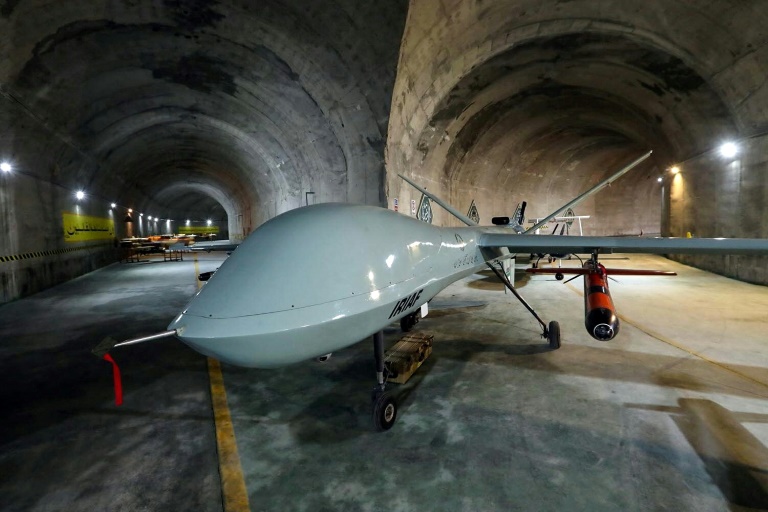
Russian officials have recently visited Iran twice to assess combat drones, US National Security Advisor Jake Sullivan said Saturday, as Moscow looks to bolster its arsenal for the war in Ukraine.

Iran’s military hosted two showcases for Russian delegations at the Kashan airfield, on June 8 and again on July 5, Sullivan said in a statement.

Satellite imagery released by the White House shows Shahed-191 and Shahed-129 drones at or flying near the site.

The White House said earlier this week that it believes Moscow is looking to acquire hundreds of the drones, or unmanned aerial vehicles (UAVs) — and that Tehran is set to train Russian forces to use them as soon as this month.

“We assess an official Russian delegation recently received a showcase of Iranian attack-capable UAVs,” Sullivan said Saturday.

“We are releasing these images captured in June showing Iranian UAVs that the Russian government delegation saw that day. This suggests ongoing Russian interest in acquiring Iranian attack-capable UAVs.

“To our knowledge, this is the first time a Russian delegation has visited this airfield for such a showcase,” Sullivan added.

John Kirby, a spokesman for the national security council, told CNN this week that the drones can be used both for reconnaissance and to deliver munitions.

“It was important to make it clear to the world that we know that Russia needs these additional capabilities,” Kirby said Tuesday. “They are expanding their resources at an accelerated rate.”

The United States and allies have recently provided longer-range precision weapons to Ukrainian forces, like the Himars precision-guided missiles, boosting their capability to strike Russian targets and repel Moscow’s intensifying attacks in the east.

Iran said Tuesday that “no special development” had taken place in technological cooperation with Russia following the invasion of Ukraine in February.

Drones have played a crucial role on both sides of the war in Ukraine, for everything from firing missiles from a distance, to dropping small bombs on targets, to conducting reconnaissance.

Ukraine’s forces have had particular success in using Turkish-made Bayraktar armed combat UAVs, and the United States and other allies have supplied Kyiv with many types of smaller drones.

Ukraine accuses Russia of shelling from captured nuclear plant

Ukraine’s atomic energy agency accused Russia of using Europe’s largest nuclear power plant to store weapons and shell the surrounding regions of Nikopol and Dnipro that were hit on Saturday.

Petro Kotin, president of Ukrainian nuclear agency Energoatom, called the situation at the Zaporizhzhia nuclear plant “extremely tense” with up to 500 Russian soldiers controlling the plant.

The plant in southeast Ukraine has been under Russian control since the early weeks of Moscow’s invasion, though it is still operated by Ukrainian staff.

“The occupiers bring their machinery there, including missile systems, from which they already shell the other side of the river Dnipro and the territory of Nikopol,” he said in a Ukrainian television interview broadcast on Friday.

On Saturday, Russian missiles struck residential buildings in the city of Nikopol, killing two people, Dnipro regional governor Valentin Reznichenko said.

In the northeast region around Ukraine’s second city of Kharkiv, governor Oleg Synegubov said an overnight Russian missile attack killed three people in the town of Chuguiv.

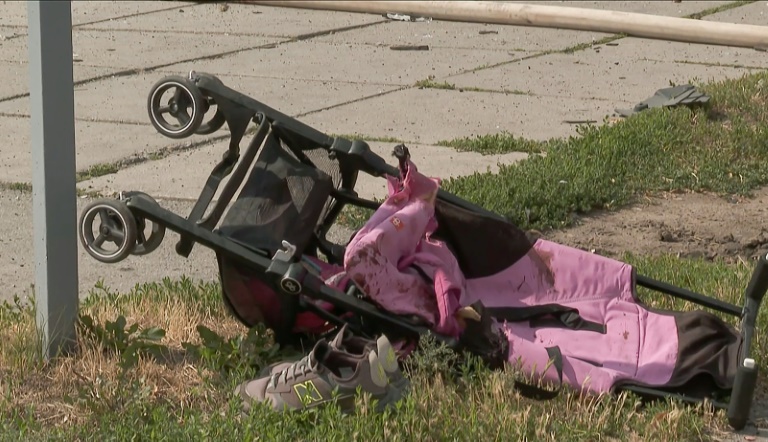
In the central Ukrainian city of Vinnytsia, officials said the death toll rose to 24 from Russian strikes after a woman died of her injuries in hospital on Saturday. Ukraine says three children are among the dead.

“Sixty-eight people continue treatment, including four children. Four people are still missing,” said Vinnytsia district chief Sergiy Borzov. 

– Outpouring for four-year-old –

President Volodymyr Zelensky accused the Russians of aiming to “cause maximum damage to Ukrainian cities”. 

“I’m urging you, once again: please don’t ignore the air raid signals now,” he said in his daily address on Friday.

Russia claimed the strikes in Vinnytsia — hundreds of kilometres away from frontline fighting — had killed Ukrainian military officials and foreign arms suppliers.

But Ukraine said the dead included four-year-old Liza Dmitrieva, who had Down’s syndrome and whose death spurred an outpouring after footage of her final moments alive went viral on social media.

Officials initially believed Liza’s mother was also killed, but have since confirmed she is in a “critical” condition after surgery.

The missile strikes on Vinnytsia were the latest attacks to carry a heavy civilian toll and came less than a week after strikes on Chasiv Yar in the Donetsk region left nearly 50 dead.

“I have no words to describe the horror I experienced today,” said Anastasiya, after rockets fell near her home in Kramatorsk, a major city and an administrative centre of the Donbas, on Friday.

“It’s good that it fell outside and did not fly into the house. That was lucky.”

– ‘Clearing’ Donbas town –

Moscow invaded Ukraine on February 24 and the conflict has killed thousands of people, destroyed cities and forced millions to flee their homes.

The heaviest fighting has recently focused on the industrial Donbas region in the east, where grinding trench battles and artillery duels are morphing into a war of attrition.

Britain said Friday that the Kremlin “must bear the full responsibility” for the death of a British captive in east Ukraine.

“I am shocked to hear reports of the death of British aid worker Paul Urey while in the custody of a Russian proxy in Ukraine,” Foreign Secretary Liz Truss said. 

Moscow-backed separatists said Friday they were closing in on their next target, Siversk, after wresting control of sister cities Lysychansk and Severodonetsk about 30 kilometres (18 miles) to its east.

And Donetsk separatist official Daniil Versonov said rebel fighters were “clearing” eastern districts of Siversk in small groups.

Ukraine has repeatedly urged allies to supply it with advanced, long-range precision artillery systems that would allow it to target Russian forces deeper inside Ukrainian-held territory.

Defence Minister Oleksiy Reznikov said Friday that Ukraine had taken delivery of its first batch of sophisticated M270 rocket systems, adding to a growing arsenal of Western-supplied artillery Kyiv says is changing dynamics on the battlefield.

burs-imm/jm

Saudis bristle after Biden highlights Khashoggi killing

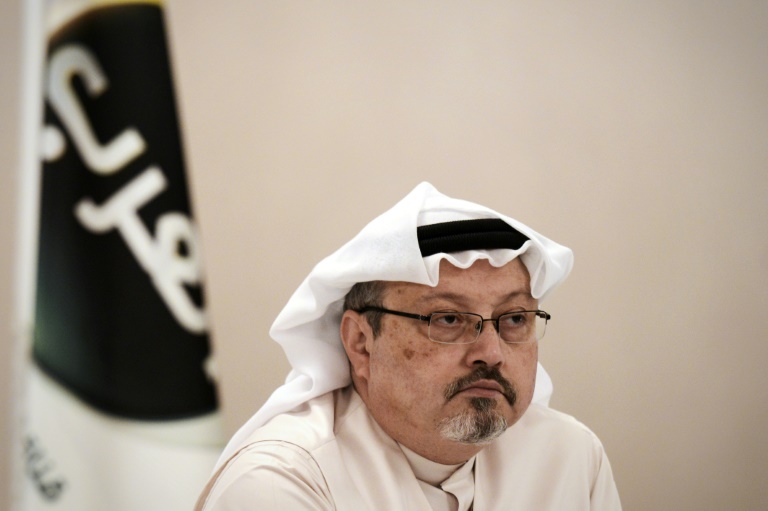
Saudi officials indicated Saturday they were keen to move on from the killing of journalist Jamal Khashoggi, one day after US President Joe Biden raised it in his talks with Crown Prince Mohammed bin Salman.

Tensions between the two men had been high ahead of their first meeting, especially after Biden’s administration last year released an assessment by the intelligence community that Prince Mohammed “approved” the operation that led to Khashoggi’s killing and dismemberment in the kingdom’s Istanbul consulate. 

In remarks Friday night, Biden called Khashoggi’s death “outrageous” and said he had warned Prince Mohammed against further attacks on dissidents, without specifying what actions he might take. 

The Al-Arabiya channel quoted a Saudi official saying the pair “addressed the issue of Jamal Khashoggi quickly” and that Prince Mohammed “confirmed that what happened is regrettable and we have taken all legal measures to prevent” a recurrence. 

Prince Mohammed also pointed out that “such an incident occurs anywhere in the world”, highlighting “a number of mistakes” made by Washington such as torturing detainees at Abu Ghraib prison in Iraq, Al-Arabiya reported. 

In an interview with CNN, Adel al-Jubeir, minister of state for foreign affairs, cast doubt on the intelligence community’s determination that Prince Mohammed ordered the 2018 operation, something Prince Mohammed has denied. 

“We know what the intelligence community’s assessment was with regard to Saddam Hussein having weapons of mass destruction,” Jubeir shot back in an exchange with Wolf Blitzer shared widely on Saudi social media.

Accusations that the Iraqi dictator had such weapons trigged the 2003 Iraq War. None were found. 

– ‘Double standards’ –

Jubeir also made clear the kingdom believed the Khashoggi affair had been sufficiently dealt with, even though Khashoggi’s remains have never been found. 

A Saudi court in 2020 jailed eight people for between seven and 20 years over the killing. Their names were never released, and Khashoggi’s fiancee branded the ruling a “farce”.

“The Kingdom of Saudi Arabia investigated this crime. The Kingdom of Saudi Arabia held those responsible for it accountable, and they are paying the price of the crime they committed as we speak,” Jubeir said. 

“We investigated, we punished and we put in place procedures to ensure this doesn’t happen again. This is what countries do in situations like this.” 

Despite lingering discord over the Khashoggi affair, the meeting between Prince Mohammed and Biden “went well with a frank exchange of opinions,” Ali Shihabi, a Saudi analyst, told AFP. 

Prince Mohammed “responded to Biden, pointing out US double standards of making a huge noise about Khashoggi (a Saudi) while trying their best to downplay the assassination of Shireen Abu Akleh even though she is a US citizen,” Shihabi said, referring to the Palestinian-American journalist shot dead in May while covering an Israeli army raid in the West Bank. 

“But beyond that frank exchange the meeting was very cordial and important to put the bad blood created by Biden’s statement behind them,” he said.

War in Ukraine: Latest developments

Here are the latest developments in the war in Ukraine:

– Russian strike death toll rises to 24 –

The death toll of a Russian missile strike on the central Ukrainian city of Vinnytsia on Thursday rises to 24, after a woman dies in hospital of her burn wounds, a Ukrainian official says. 

Russia claims the strikes — hundreds of kilometres from the front lines — had targeted a meeting of Ukrainian military officials and foreign arms suppliers. Kyiv has denied these claims and says the attack killed three children.

UN Secretary-General Antonio Guterres has said he was “appalled” by the attack, while the EU has slammed it as an “atrocity”.

– Nuclear plant turned ammo depot? –

Russia is using Europe’s largest nuclear power plant as a base to store weapons including “missile systems” and shell the surrounding areas of Ukraine, the head of Ukrainian nuclear agency Energoatom says.

The Zaporizhzhia nuclear plant has been under Russian control since the early weeks of Moscow’s invasion, though it is still being operated by Ukrainian staff.

– Briton reported dead in detention –

Paul Urey, a British man captured by pro-Russian forces in Ukraine, died in detention on July 10, Moscow-backed separatists say, claiming he died of diabetes. 

Non-governmental organisations describe Urey as a humanitarian who worked as an aid volunteer in Ukraine, while the separatists say he was a “professional” soldier fighting for Ukraine.

British Foreign Secretary Liz Truss says Russia bears “full responsibility” over the reported death.

– Russia under fire at G20 –

Western finance ministers on the island of Bali for two-day G20 talks condemn Moscow’s invasion of Ukraine, accusing Russian officials of complicity in atrocities committed during the war.

“Russia is solely responsible for negative spillovers to the global economy,” US Treasury Secretary Janet Yellen tells the Russian delegation in the opening session.

She is joined by Canadian Finance Minister Chrystia Freeland, who tells Russia’s delegation they are responsible for “war crimes” in Ukraine because of their support for the invasion.

– Next target: Siversk –

Moscow-backed troops in the Donbas region in eastern Ukraine say they are closing in on their next target, after wresting control of sister cities Lysychansk and Severodonetsk.

“Siversk is under our operational control, which means that the enemy can be hit by our aimed fire all over the area,” a pro-Moscow rebel official is cited as saying by Russian state-run news agency TASS.

– Russia sees grain deal ‘soon’ –

Russia’s defence ministry says that a “final document” designed to unblock grain exports from Ukrainian ports will be ready “soon”, following negotiations with Kyiv in Istanbul this week.    

Russia’s invasion has disrupted the export of grain from Ukraine, which is one of the world’s largest wheat producers, worsening a food crisis around the world. 

– Germany to ramp up ‘Berlin train lift’ –

German national rail operator Deutsche Bahn pledges to accelerate efforts to transport grain out of Ukraine by land, with sea exports still stalled by the country’s war with Russia.

“We believe we will be able to considerably ramp up the system in the next few weeks” to bring out as much grain as possible, the head of its freight transport division says.

– EU targets Russian gold –

The European Union executive proposes to target Russian gold exports in an update to its sanctions packages that will also tighten the screws on previous measures against Moscow. 

The move on gold, fulfilling a decision by the Group of Seven most industrialised nations in late June, will be discussed at a meeting of EU foreign ministers on Monday.

– US to resume flights to ISS –  

The United States says it will resume flights to the International Space Station with Russia, despite its attempts to isolate Moscow over the invasion of Ukraine.

“To ensure continued safe operations of the International Space Station, protect the lives of astronauts and ensure continuous US presence in space, NASA will resume integrated crews on US crew spacecraft and the Russian Soyuz,” US space agency NASA says in a statement.

burs-eab-jmy/ah/imm

Biden to talk oil at Arab summit concluding Middle East tour

US President Joe Biden is set to discuss volatile oil prices during a summit with Arab leaders on Saturday in Saudi Arabia, the final stop of his Middle East tour.

On his first trip to the region as president, Biden is also looking to outline his vision for Washington’s role in the region in order to not cede influence to Russia and China.

He plans to announce Saturday that the US is committing $1 billion in food aid to the Middle East and North Africa amid rising food insecurity induced by the war in Ukraine, a senior official told reporters.

Saturday’s meeting in Jeddah will bring together leaders of the six-member Gulf Cooperation Council as well as Egypt, Jordan and Iraq.

Biden landed Friday in Saudi Arabia, a longtime US ally he once vowed to make a “pariah” over its human rights record, and met with King Salman and de facto ruler Crown Prince Mohammed bin Salman.

Tensions had been high between Biden and Prince Mohammed, especially after Biden’s administration released US intelligence findings that Prince Mohammed “approved” an operation targeting journalist Jamal Khashoggi, whose killing and dismemberment in Saudi Arabia’s Istanbul consulate in 2018 spurred global outrage.

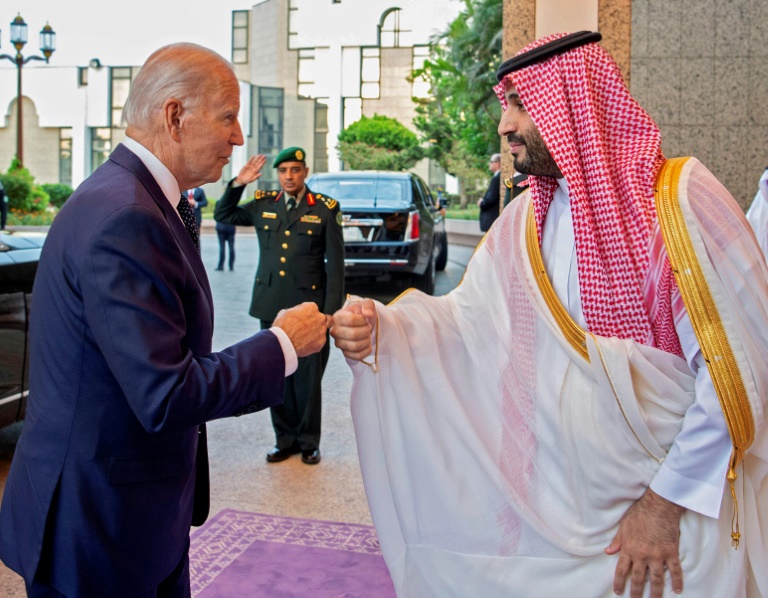
After a fist-bump greeting with Prince Mohammed, Biden said he raised Khashoggi’s case “at the top” of their discussions, adding that he “made it clear if anything occurs like that again they will get that response and much more”, without clarifying.

The Al-Arabiya channel quoted a Saudi official saying the pair “addressed the issue of Jamal Khashoggi quickly” and that Prince Mohammed “confirmed that what happened is regrettable and we have taken all legal measures to prevent” a recurrence.

Prince Mohammed also pointed out that “such an incident occurs anywhere in the world”, highlighting “a number of mistakes” made by Washington such as torturing detainees at Abu Ghraib prison in Iraq.

Biden faces pressure to raise human rights issues again Saturday, after dozens of British and US lawmakers urged him to discuss Egypt’s “extensive architecture of repression” in talks with his Egyptian counterpart Abdel Fattah al-Sisi.

– New agreements –

Biden appears keen to re-engage with US ally Saudi Arabia, the world’s largest oil exporter and an avid buyer of weapons.

Washington wants Saudi Arabia to open the floodgates to bring down soaring gasoline prices, which threaten Democratic chances in November mid-term elections.

But Biden on Friday tried to tamp down expectations that his trip would yield immediate gains.

“I’m doing all I can to increase the supply for the United States of America,” he said, adding concrete results would not be seen “for another couple weeks”.

Riyadh and Washington on Friday signed 18 agreements on areas including energy, space, health and investment, including developing 5G and 6G technology, said a Saudi statement.

Another statement said the two sides noted “the importance of their strategic economic and investment cooperation, especially in light of the current crisis in Ukraine and its repercussions, reiterating their commitment to the stability of global energy markets.”

Saudi Arabia agreed to link the electricity networks of the Gulf Cooperation Council to Iraq, which relies heavily on energy from Iran, “in order to provide Iraq and its people with new and diversified electricity sources,” the White House said.

A senior administration official said the Gulf bloc would commit $3 billion to a global infrastructure programme intended to counter China’s Belt and Road Initiative.

“Russia is effectively making a bet on Iran. We are making a bet on a more integrated, more stable, more peaceful and prosperous Middle East region,” the official said, in an apparent dig at Russian President Vladimir Putin’s plan to visit Iran next week.

Beyond oil Biden said his focus on the trip was “positioning America in this region for the future”.

“We are not going to leave a vacuum in the Middle East for Russia or China to fill, and we’re getting results,” he said.

– Israeli ties –

White House officials have used the trip as a bid to promote integration between Israel and Arab nations.

The issue of the strategic Red Sea islands of Tiran and neighbouring Sanafir is also expected to be on Saturday’s agenda.

Egypt ceded the islands in 2016 to Saudi Arabia, but the deal requires Israel’s green light — a move that could spur contacts between the Jewish state and Riyadh.

Biden said Friday that a decades-old multinational peacekeeping force, including US troops, would leave Tiran, with the White House adding they would depart by the end of the year.

Saudi Arabia has refused to join the US-brokered Abraham Accords which in 2020 created ties between Israel and two of the kingdom’s neighbours, the United Arab Emirates and Bahrain.

But it is showing signs of greater openness towards Israel, and on Friday announced it was lifting overflight restrictions on aircraft travelling to and from Israel, a move Biden hailed as “historic”.

Israeli caretaker Prime Minister Yair Lapid went further, saying: “This is the first official step in normalisation with Saudi Arabia.”

Biden to talk oil at Arab summit concluding Middle East tour

US President Joe Biden is set to discuss volatile oil prices during a summit with Arab leaders on Saturday in Saudi Arabia, the final stop of his Middle East tour.

On his first trip to the region as president, Biden is also looking to outline his vision for Washington’s role in the region in order to not cede influence to Russia and China.

He plans to announce Saturday that the US is committing $1 billion in food aid to the Middle East and North Africa amid rising food insecurity induced by the war in Ukraine, a senior official told reporters.

Saturday’s meeting in Jeddah will bring together leaders of the six-member Gulf Cooperation Council as well as Egypt, Jordan and Iraq.

Biden landed Friday in Saudi Arabia, a longtime US ally he once vowed to make a “pariah” over its human rights record, and met with King Salman and de facto ruler Crown Prince Mohammed bin Salman.

Tensions had been high between Biden and Prince Mohammed, especially after Biden’s administration released US intelligence findings that Prince Mohammed “approved” an operation targeting journalist Jamal Khashoggi, whose killing and dismemberment in Saudi Arabia’s Istanbul consulate in 2018 spurred global outrage.

After a fist-bump greeting with Prince Mohammed, Biden said he raised Khashoggi’s case “at the top” of their discussions and “made it clear if anything occurs like that again they will get that response and much more”.

The Al-Arabiya channel quoted a Saudi official saying the pair “addressed the issue of Jamal Khashoggi quickly” and that Prince Mohammed “confirmed that what happened is regrettable and we have taken all legal measures to prevent” a recurrence.

Prince Mohammed also pointed out that “such an incident occurs anywhere in the world”, highlighting “a number of mistakes” made by Washington such as torturing detainees at Abu Ghraib prison in Iraq.

Biden faces pressure to raise human rights issues again Saturday, after dozens of British and US lawmakers urged him to discuss Egypt’s “extensive architecture of repression” in talks with his Egyptian counterpart Abdel Fattah al-Sisi.

– New agreements –

Biden appears keen to re-engage with US ally Saudi Arabia, the world’s largest oil exporter and an avid buyer of weapons.

Washington wants Saudi Arabia to open the floodgates to bring down soaring gasoline prices, which threaten Democratic chances in November mid-term elections.

But Biden on Friday tried to tamp down expectations that his trip would yield immediate gains.

“I’m doing all I can to increase the supply for the United States of America,” he said, adding concrete results would not be seen “for another couple weeks”.

Riyadh and Washington on Friday signed 18 agreements on areas including energy, space, health and investment, including developing 5G and 6G technology, said a Saudi statement.

Another statement said the two sides noted “the importance of their strategic economic and investment cooperation, especially in light of the current crisis in Ukraine and its repercussions, reiterating their commitment to the stability of global energy markets.”

Saudi Arabia agreed to link the electricity networks of the Gulf Cooperation Council to Iraq, which relies heavily on energy from Iran, “in order to provide Iraq and its people with new and diversified electricity sources,” the White House said.

A senior administration said the Gulf bloc would commit $3 billion to a global infrastructure programme intended to counter China’s Belt and Road Initiative.

“Russia is effectively making a bet on Iran. We are making a bet on a more integrated, more stable, more peaceful and prosperous Middle East region,” the official said, in an apparent dig at Russian President Vladimir Putin’s plan to visit Iran next week.

Beyond oil Biden said his focus on the trip was “positioning America in this region for the future”.

“We are not going to leave a vacuum in the Middle East for Russia or China to fill, and we’re getting results,” he said.

– Israeli ties –

White House officials have used the trip as a bid to promote integration between Israel and Arab nations.

The issue of the strategic Red Sea islands of Tiran and neighbouring Sanafir is also expected to be on Saturday’s agenda.

Egypt ceded the islands in 2016 to Saudi Arabia, but the deal requires Israel’s green light — a move that could spur contacts between the Jewish state and Riyadh.

Biden said Friday that a decades-old multinational peacekeeping force, including US troops, would leave Tiran, with the White House adding they would depart by the end of the year.

Saudi Arabia has refused to join the US-brokered Abraham Accords which in 2020 created ties between Israel and two of the kingdom’s neighbours, the United Arab Emirates and Bahrain.

But it is showing signs of greater openness towards Israel, and on Friday announced it was lifting overflight restrictions on aircraft travelling to and from Israel, a move Biden hailed as “historic”.

Israeli caretaker Prime Minister Yair Lapid went further, saying: “This is the first official step in normalisation with Saudi Arabia.”

Sri Lanka's political crisis: What happens next?

Sri Lankan prime minister Ranil Wickremesinghe has been sworn in as acting president after his predecessor Gotabaya Rajapaksa fled to Singapore and resigned following months of protests over the country’s financial meltdown.

AFP looks at how cash-strapped Sri Lanka ended up in its worst-ever economic crisis, and what comes next in its complicated, corrupt and sometimes violent political system.

– Why did Rajapaksa flee? –

Sri Lanka’s financial woes were triggered by the coronavirus pandemic but exacerbated by mismanagement under Rajapaksa’s government. 

The country has been unable to finance even the most essential imports since late last year, and has since defaulted on its debt.

Discontent had been mounting for months over severe food and fuel shortages, record inflation and lengthy power cuts. 

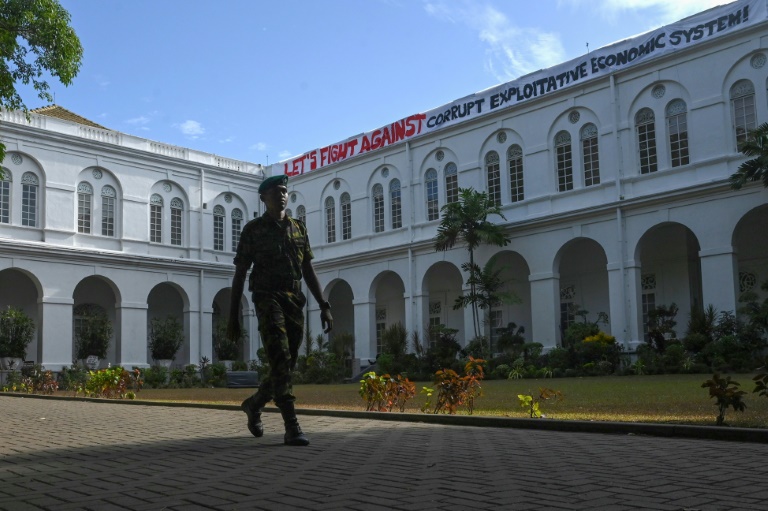
Even Rajapaksa’s closest allies began abandoning him, and when protesters overran his official residence in Colombo last weekend, he was forced to flee to a navy base in fear for his life. He escaped first to the Maldives, then travelled on to Singapore.

– Wasn’t Rajapaksa a popular leader?-

Rajapaksa was dubbed “The Terminator” for ruthlessly crushing Tamil rebels as head of the defence ministry during his elder brother Mahinda’s presidency between 2005 and 2015.

He was loved by his Sinhala Buddhist majority, but loathed by Tamils and Muslims who saw him as a war criminal, a racist and an oppressor of minorities.

When inflation crossed 50 percent, and with four out of five people forced to skip meals because of acute shortages, the ethnically divided nation united in its opposition to Rajapaksa.

– Why an acting president? –

Rajapaksa formally quit on July 14, just 32 months into his five-year term, with prime minister Wickremesinghe automatically elevated as the acting leader under the country’s constitution.

Wickremesinghe is serving as a stop-gap until the 225-seat parliament elects one of its members to lead the country for the balance of Rajapaksa’s term. The legislature’s Speaker Mahinda Yapa Abeywardana has scheduled the vote for Wednesday.

– How does the election work? –

The 225 MPs will rank the candidates in order of preference in a secret ballot.

Candidates need more than half the vote to be elected. If no-one crosses the threshold on first preferences, the candidate with the lowest support will be eliminated and their votes distributed according to second preferences, and so on until someone reaches the mark.

– Who are the likely candidates? –

Acting President Wickremesinghe, the pro-Western six-time prime minister, is the front runner after he secured the support of the Rajapaksas’ SLPP, which is still the largest single bloc in parliament.

The SLPP has more than 100 seats and if party discipline holds, Wickremesinghe is almost certain to be elected. 

But the party is fractured so that unity is not guaranteed, and SLPP dissident Dullas Alahapperuma, 63, a former media minister, is a serious challenger.

Sajith Premadasa, 55, the main opposition leader, announced Friday that he would also enter the fray.

A possible fourth contender is former army chief Sarath Fonseka, 71, a nemesis of the Rajapaksa family.

The secret ballot gives MPs a freer hand than an open poll, and previous elections have seen allegations of bribes offered and accepted in exchange for votes.

During a constitutional crisis in October 2018, some MPs said they had been offered $3.5 million in cash and apartments abroad for their support.

– What does this mean for IMF talks?-

Despite their differences, Sri Lanka’s political parties are united in their support for ongoing talks with the International Monetary Fund, with Wickremesinghe saying a bailout is urgently needed.

Sri Lanka declared itself bankrupt in mid-April when the government defaulted on its $51 billion foreign debt.

But the political crisis has interrupted the negotiations, and the IMF said Thursday that it hoped the unrest would be resolved soon so they could resume.

No political party in the current parliament has a clear majority, and even if the country could afford to hold a fresh election, Tamil legislator Dharmalingam Sithadthan pointed out that a strong mandate was not always a guarantee of stability or success.

“We had Gotabaya with a record 6.9 million votes and what did he do?” Sithadthan told AFP. “He was a total failure.”

Close Bitnami banner
Bitnami