World

Sunak leads race for UK PM as rivals round on bookies' favourite Mordaunt

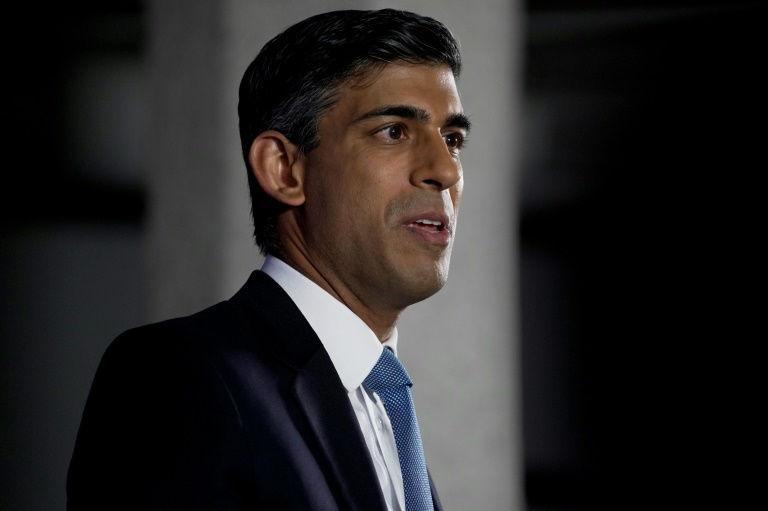
Former finance minister Rishi Sunak topped the latest vote Thursday by Conservative MPs to decide Britain’s next prime minister followed by bookmaker favourite Penny Mordaunt, as attacks on her escalated within the ruling party.

In the second ballot of Tory lawmakers since the contest began in earnest Tuesday, Foreign Secretary Liz Truss came third, hours after formally launching her campaign by vowing tax cuts and a smaller state.

The race, which now numbers five candidates following the elimination of another long-shot contender, will intensify with two televised debates — on Friday and Sunday — before the next round of voting Monday.

The final pair of contenders to replace Prime Minister Boris Johnson, to be put to Conservative party members over the summer, will be decided by the middle of next week.  

The little-known Mordaunt, a long-standing Brexiteer who was briefly Britain’s first woman defence secretary before Johnson demoted her to less senior roles, has emerged as the darling of the Tory grassroots.

Recent polls of members point to her beating Sunak, Truss and the other remaining candidates, which include former equalities minister Kemi Badenoch and prominent backbencher Tom Tugendhat.

But in a sign of her new status as a frontrunner, Mordaunt faced a barrage of attacks Thursday from colleagues, on everything from her Brexit record to alleged misplaced support for transgender rights.

In the latest salvo as she exited the race, Attorney General Suella Braverman accused her of failing to “stand up for women” when Mordaunt shepherded maternity leave legislation through parliament last year. 

She also questioned if she is an “authentic Brexiteer”, while party elder and Truss-backer Iain Duncan Smith said he did not know what she had been doing for Brexit over the past three years.

– ‘Character’ –

The leadership race was sparked by Prime Minister Boris Johnson’s announcement last week that he would resign once a successor was chosen, following months of near-constant scandal.

The eventual winner is set to be announced on September 5.

The latest ballot saw 356 Tory MPs cast votes, with Sunak leading the field on 101, followed by Mordaunt on 83 and Truss — the favoured candidate of Johnson loyalists — on 64. 

Braverman was eliminated after garnering just 27 votes while Tugendhat scraped through with 32. Braverman said she would now back Truss.

Thanking his supporters for their “continued support”, Sunak said he is “prepared to give everything I have in service to our nation”. 

“Together we can restore trust, rebuild our economy and reunite the country,” added the 42-year-old, whose cabinet resignation last week helped spark a ministerial revolt against Johnson that prompted his downfall.

Former foreign secretary Jeremy Hunt, after his elimination Wednesday, backed Sunak, calling him “one of the most decent, straight people with the highest standards of integrity”. 

But the wealthy frontrunner faces questions about his family’s tax affairs and his prior decision to retain US residency, and polls now show high “unfavourable” views of him. 

Meanwhile, he is opposed to immediate tax cuts to confront a post-pandemic cost-of-living crisis, stressing the need instead for fiscal responsibility.

“I don’t judge people by their bank accounts, I judge them by their character,” Sunak told BBC radio.

– ‘Part-time Penny’ –

Ahead of Thursday’s vote, Truss formally kicked off her campaign by promising “an aspiration nation”.

The 46-year-old insisted she would be ready “from day one” — in an apparent dig at Mordaunt, who has been criticised for lacking broad experience as Britain faces multiple crises.

Mordaunt, a Royal Navy reservist and junior trade minister who is relatively untainted by the scandals of Johnson’s premiership, has been targeted as she increasingly occupies the spotlight.

Political enemies have brander her “Part-time Penny”, alleging she has not taken her government roles seriously. 

Former Brexit minister David Frost, who worked with her in dealing with the European Union, backed up the claims, calling her unfit for office. 

“She wouldn’t always deliver tough messages to the European Union when that was necessary… she wasn’t always visible. Sometimes I didn’t even know where she was,” he said.

Mordaunt supporters rejected the portrayal, while Downing Street refused to comment.

She also lacks national name recognition. One recent poll found only 11 percent of people could identify her from a photograph — two respondents even thought she was the singer Adele.

Meanwhile the Daily Mail took aim at her stance on transgender people, one of Britain’s “culture war” debates that has energised the party’s right-wing, accusing her of “telling lies” on the issue.
California wildfire threat to Yosemite giant sequoias 'almost gone'

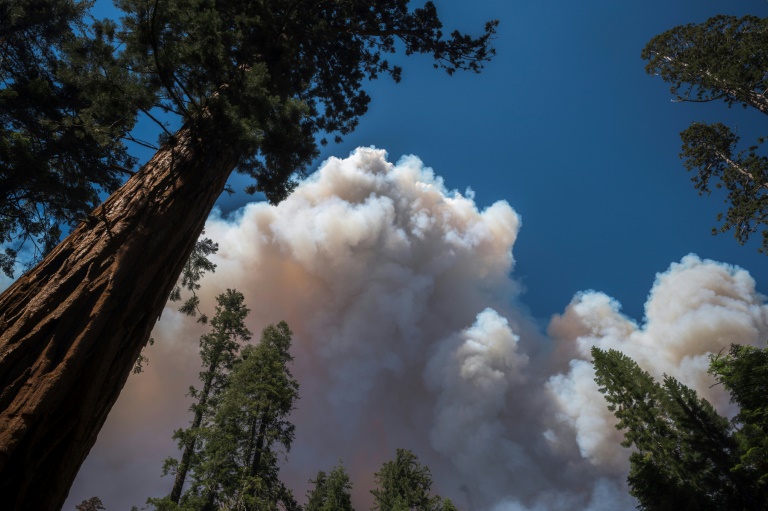
The wildfire threat to the world’s largest trees in California has almost passed, with the blaze now spreading away from giant sequoia trees in Yosemite National Park, a forestry official said Thursday.

More than 1,000 firefighters have scrambled to contain the Washburn fire, which started a week ago, and which for days threatened the world-renowned Mariposa Grove of giant sequoias.

“The threat is essentially almost gone,” Stanley Bercovitz, a US Forest Service spokesperson, told AFP.

“Currently none [of the giant sequoias] have been killed. You never know, down the road. In two years, if maybe some of the younger ones, their needles start to turn yellow… it might be because of the fire,” he added.

“But otherwise… almost every tree was very fortunate to have a low-grade fire burn around it.”

The Mariposa Grove is the largest group of sequoias in Yosemite, with over 500 mature trees.

Giant sequoias are the world’s largest trees by volume. Their relatives, the California redwoods, can grow taller — well over 100 meters (330 feet) — but are not as wide.

Crews worked to remove quick-burning leaves, sticks and branches. Sprinklers supplied with water tanks have been running 24 hours a day, increasing overall humidity in the area.

The fire has spread over 4,375 acres (1,770 hectares) and is 23 percent contained, according to the latest official data.

It is currently moving north and east, into the neighboring Sierra National Forest.

Weather conditions have helped efforts to control the blaze.

“It’s not being driven by the wind. It’s just being driven by the fuels,” said Bercovitz.

He added: “The threat is not completely gone. Until the fire is 100 percent controlled, there’s still always some threat.

“But it is currently greatly reduced, and burning away [from the giant sequoias].”

Giant sequoias, which can live for thousands of years, typically endure many fires, the heat from which helps their cones to open, allowing the seeds to disperse.

But longer, hotter and more aggressive fires can damage them, sometimes irreparably, and California has recently seen multiple severe fire seasons in a row.

In 2020, up to 10,000 of the giants — up to 14 percent of the world’s total — perished in one fire, and another 3,600 died last year.

Scientists say global warming, which is being driven chiefly by humanity’s unchecked burning of fossil fuels, is making extreme weather events more likely.

Wildfires spread across heatwave-hit Europe

A heatwave sweeping across southwestern Europe peaked on Thursday in Spain, with scorching temperatures fuelling stubborn wildfires that ravaged several countries.

Temperatures soared in Greece, Spain and Portugal, while the heatwave was expected to continue in Britain and France into next week.

It is the second heatwave to hit the region in a matter of weeks, as scientists say they are becoming more frequent and intense due to climate change. 

The mass of hot air pushed temperatures into the mid-40 degrees Celsius in parts of Spain again for the second day in a row.

The mercury hit 45 degrees Celsius (113 degrees Fahrenheit) at 5 pm (1500 GMT) near the central city of Avila as the suffocating temperatures continued.

On Wednesday, the city of Almonte in the southern region of Andalusia recorded Spain’s highest temperature that day — 45.6C.

Spain’s state meteorological agency AEMET said it expects temperatures to ease slightly on Friday in some parts of the country, although it predicts the heatwave will continue “at least” until Monday.

The health ministry told people to drink plenty of fluids, wear light clothes and stay in the shade or air-conditioning.

It also recommended people avoid caffeine and alcohol and reduce “intense” physical activity outdoors during the hottest hours.

– ‘Major’ fires –

A fire in Spain which started in the eastern region of Extremadura on Monday has so far ravaged at least 4,000 hectares of land, local officials said.

Between January 1 and July 3, more than 70,300 hectares of forest have gone up in smoke in Spain, the government has said — almost double the average of the past 10 years.

Italy, Croatia, France and Portugal all reported forest fires linked to the heat this week. 

In Greece, a helicopter helping to fight a forest fire on the island of Samos on Wednesday crashed into the Aegean Sea, killing two of its four crew members, the coastguard said Thursday.

The fire continued to burn on Thursday, fanned by strong winds.

In Portugal, over 2,000 firefighters were battling dozens of wildfires across Portugal, including four deemed “major”.

One person died in a forest blaze, authorities said Wednesday, after a body was found in a burned area in the northern region of Aveiro.

Around 60 others have been injured, some 860 people evacuated and roughly 60 homes destroyed or damaged.

Portuguese Prime Minister Antonio Costa earlier warned that Thursday would be the “most serious” day of the heat wave because temperatures were expected to rise and winds were stronger.

“Today is the day where we have to be the most careful,” he said.

In June, 96 percent of Portugal was classified as being in either “extreme” or “severe” drought.

– French evacuations – 

Meteorological services in France also warned the situation would “become intense between Sunday and Tuesday” — possibly exceeding 40C before dipping by Wednesday. 

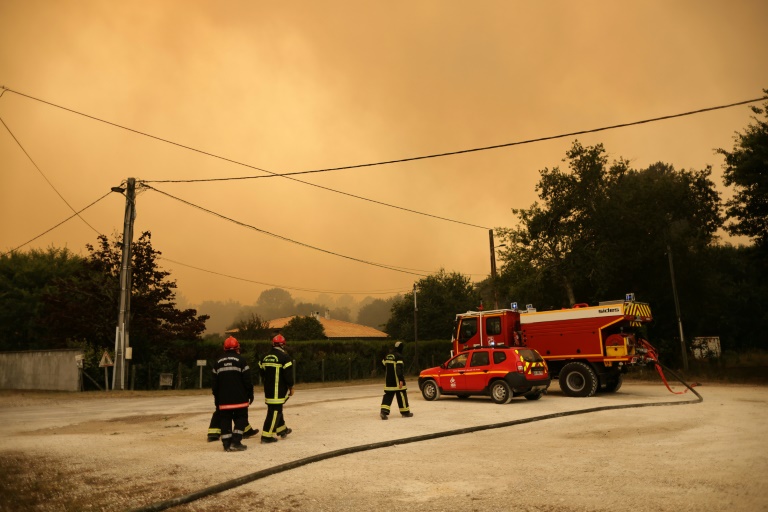
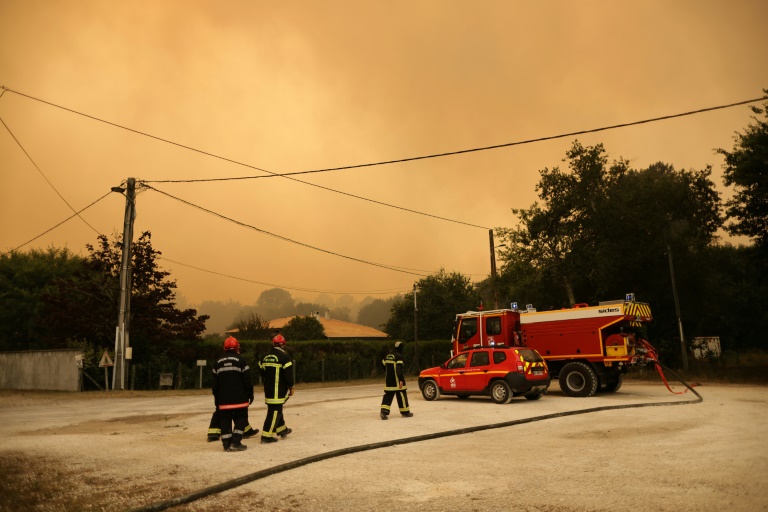
Although temperatures eased by a few degrees Celsius across France, two large wildfires continued in the Gironde region near the southwestern city of Bordeaux, destroying 4,200 hectares of forest in three days, with firefighters still unable Thursday to stop the blazes.

Some 4,000 people, including residents of a military base, were evacuated on Thursday as a precaution because of the risk from the smoke from the fire, local officials said.

Tourist magnet the Dune de Pilat, Europe’s highest sand dune, was closed to visitors after several thousands were evacuated from campsites this week.

“The situation is stable, but not yet under control,” the region’s authorities said Thursday as temperatures were forecast to hit 38C.

However, no additional evacuation of residents was planned, after hundreds were moved from their homes in recent days as a precaution in the region.

Further south, the Landes region and the city of Nimes cancelled all fireworks for Bastille Day, France’s national holiday.

Temperatures were expected to reach 36C in southern France, 25C in the north of the country, and 32C in Paris on Thursday.

London meanwhile has issued an “amber” alert — the second highest of three levels — while one UK climate official said there was a chance Britain’s highest temperature — 38.7C recorded on July 25, 2019 in Cambridge — could be surpassed.

London mayor Sadiq Khan announced an emergency plan to help homeless people deal with the extreme heat that includes distributing water and suntan lotion.

Wildfires spread across heatwave-hit Europe

A heatwave sweeping across southwestern Europe peaked on Thursday in Spain, with scorching temperatures fuelling stubborn wildfires that ravaged several countries.

Temperatures soared in Greece, Spain and Portugal, while the heatwave was expected to continue in Britain and France into next week.

It is the second heatwave to hit the region in a matter of weeks, as scientists say they are becoming more frequent and intense due to climate change. 

The mass of hot air pushed temperatures into the mid-40 degrees Celsius in parts of Spain again for the second day in a row.

The mercury hit 45 degrees Celsius (113 degrees Fahrenheit) at 5 pm (1500 GMT) near the central city of Avila as the suffocating temperatures continued.

On Wednesday, the city of Almonte in the southern region of Andalusia recorded Spain’s highest temperature that day — 45.6C.

Spain’s state meteorological agency AEMET said it expects temperatures to ease slightly on Friday in some parts of the country, although it predicts the heatwave will continue “at least” until Monday.

The health ministry told people to drink plenty of fluids, wear light clothes and stay in the shade or air-conditioning.

It also recommended people avoid caffeine and alcohol and reduce “intense” physical activity outdoors during the hottest hours.

– ‘Major’ fires –

A fire in Spain which started in the eastern region of Extremadura on Monday has so far ravaged at least 4,000 hectares of land, local officials said.

Between January 1 and July 3, more than 70,300 hectares of forest have gone up in smoke in Spain, the government has said — almost double the average of the past 10 years.

Italy, Croatia, France and Portugal all reported forest fires linked to the heat this week. 

In Greece, a helicopter helping to fight a forest fire on the island of Samos on Wednesday crashed into the Aegean Sea, killing two of its four crew members, the coastguard said Thursday.

The fire continued to burn on Thursday, fanned by strong winds.

In Portugal, over 2,000 firefighters were battling dozens of wildfires across Portugal, including four deemed “major”.

One person died in a forest blaze, authorities said Wednesday, after a body was found in a burned area in the northern region of Aveiro.

Around 60 others have been injured, some 860 people evacuated and roughly 60 homes destroyed or damaged.

Portuguese Prime Minister Antonio Costa earlier warned that Thursday would be the “most serious” day of the heat wave because temperatures were expected to rise and winds were stronger.

“Today is the day where we have to be the most careful,” he said.

In June, 96 percent of Portugal was classified as being in either “extreme” or “severe” drought.

– French evacuations – 

Meteorological services in France also warned the situation would “become intense between Sunday and Tuesday” — possibly exceeding 40C before dipping by Wednesday. 

Although temperatures eased by a few degrees Celsius across France, two large wildfires continued in the Gironde region near the southwestern city of Bordeaux, destroying 4,200 hectares of forest in three days, with firefighters still unable Thursday to stop the blazes.

Some 4,000 people, including residents of a military base, were evacuated on Thursday as a precaution because of the risk from the smoke from the fire, local officials said.

Tourist magnet the Dune de Pilat, Europe’s highest sand dune, was closed to visitors after several thousands were evacuated from campsites this week.

“The situation is stable, but not yet under control,” the region’s authorities said Thursday as temperatures were forecast to hit 38C.

However, no additional evacuation of residents was planned, after hundreds were moved from their homes in recent days as a precaution in the region.

Further south, the Landes region and the city of Nimes cancelled all fireworks for Bastille Day, France’s national holiday.

Temperatures were expected to reach 36C in southern France, 25C in the north of the country, and 32C in Paris on Thursday.

London meanwhile has issued an “amber” alert — the second highest of three levels — while one UK climate official said there was a chance Britain’s highest temperature — 38.7C recorded on July 25, 2019 in Cambridge — could be surpassed.

London mayor Sadiq Khan announced an emergency plan to help homeless people deal with the extreme heat that includes distributing water and suntan lotion.

Germans demand change a year on from deadly floods

Germany on Thursday paid tribute to more than 180 people killed in severe floods a year ago, as those left behind charged that help with the reconstruction effort has been too slow to arrive.

President Frank-Walter Steinmeier embarked on a tour of the Ahr valley, while Chancellor Olaf Scholz joined a human chain in the hard-hit town of Bad Neuenahr-Ahrweiler and took part in a minute’s silence to remember the victims.

In Bad Neuenahr-Ahrweiler, Cornelia Weigand, who was the mayor of nearby Altenahr at the time of the floods, told a sombre crowd that “the scale of the damage to body and soul” was “inconceivable”.

“Our mourning cannot be described with words,” she said, her voice wavering.

In Altenahr, Steinmeier said he wanted to “show that we haven’t forgotten the people of the Ahr valley” and “how many are still struggling to rebuild their homes”.

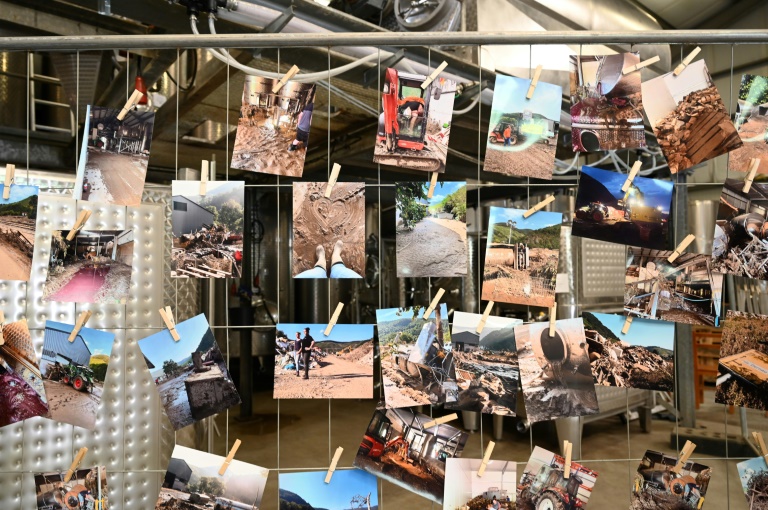
However, a year on from the disaster, frustration is building at the sluggish pace of help promised by the government.

Alfred Sebastian, the mayor of Dernau, said the town was “still at the very beginning” of the reconstruction process.

“We need to be financially supported by the state… We need it now. If not now, when? We have to move forward,” he said. 

– Trail of destruction –

“Many of us are simply tired, exhausted and also disappointed about the fact that parts of the reconstruction… are only progressing slowly,” said Guido Orthen, the mayor of Bad Neuenahr-Ahrweiler.

Orthen also called on the government to “improve disaster prevention so that people no longer lose their lives in this way”.

Severe floods pummelled western Germany over two days in July last year, ripping through entire towns and villages and destroying bridges, roads, railways and swathes of housing.

Between 100 and 150 millimetres (four and six inches) of rain fell between July 14 and 15, according to the German weather service — an amount that would normally be seen over two months. 

Forecasters had issued warnings, yet many residents were simply unaware of the risks of such violent flooding, with dozens found dead in their cellars.

With former chancellor Angela Merkel still in charge at the time of the floods, the government pledged a total of 30 billion euros ($30 billion) in federal and state aid to help with the reconstruction effort. 

But in the state of Rhineland-Palatinate, only 500 million euros in aid has been handed out of the total 15 billion euros set aside.  

In neighbouring North Rhine-Westphalia, 1.6 billion euros of government support has been approved for use, out of a total of 12.3 billion euros.

– Climate concerns –

Rhineland-Palatinate state premier Malu Dreyer on Thursday told residents of Bad Neuenahr-Ahrweiler that their suffering had not been forgotten.

“I can assure you that we are working hard every day to ensure that the reconstruction succeeds for all and we take your concerns very seriously,” she said.

The disaster prompted criticism of Germany’s flood warning system and a criminal inquiry was opened into local officials for “negligent homicide”.

The government has since pledged to introduce phone alerts in the form of “cell broadcasting” and to reinstall sirens, many of which have been taken down in recent years.

It also raised concerns about climate change, with one international study showing that man-made global warming had made the floods up to nine times more likely.

A year on, Germany is set for more extreme weather with temperatures of up to 40 degrees Celsius (104 degrees Fahrenheit) expected this week as a heatwave sweeps across Europe.  

In neighbouring Belgium, where 39 people were also killed in the deluge, King Philippe and Queen Mathilde attended a ceremony in Liege.

Belgian Prime Minister Alexander De Croo paid tribute to the “heroes” who came to the aid of the victims, including a 14-year-old boy who threw himself into a river in an unsuccessful attempt to save a fellow scout camp member.

UN urges Africa to swap commodities for tech

The UN’s trade body on Thursday said African economies were vulnerable to a triple shock as it urged governments to pave the way for tech startups that would  ease dependence on commodities.

“A recent analysis by the UN Global Crisis Response Group on Food, Energy and Finance, which analyses the global economic cost by the war in Ukraine, indicates that Africa and especially sub-Saharan Africa is now one of the world’s most exposed regions to the current crisis,” Rebeca Grynspan, secretary-general of the United Nations Conference on Trade and Development (UNCTAD), said at the launch of the body’s latest Africa report. 

“One out of two Africans — that means over 600 million people — are severely vulnerable to food, energy and finance shocks, all at once,” she added.

The report recommended diversifying away from both commodities exports, on which many African economies continue to depend, and traditional service sectors — such as travel and transport — towards more knowledge-intensive services. 

“We have been talking about diversification as long as I can remember, and how Africa can diversify its economy, and the fact is  that we’ve been looking at it through the lens of diversifying within the commodity sector,” said Paul Akiwumi, a director with UNCTAD.

“Now it’s also very timely because of technology,” he added.

He pointed to budding fintech, healthtech, agritech, e-mobility and other tech-focused sectors in African countries.  

“Africa has a growing educated middle class who need these jobs, and these types of small and medium size enterprises provide high skilled jobs — operational officers, finance officers, government liaison relations officers, software engineers, HR managers, administrative accountants,” he said. 

Akiwumi said governments must provide entrepreneurs the necessary regulatory frameworks, as well as training and capacity building. 

He also said they must implement the African Continental Free Trade Area (AfCFTA) agreement, a trade pact that came into force last year, to scale up developments across the continent.

Nigeria's Twitter ban unlawful: W.African court

A seven-month ban on Twitter use in Nigeria was unlawful, according to a court ruling by West Africa’s regional bloc ECOWAS seen by AFP on Thursday.

The Abuja government suspended Twitter in June last year after the social media giant deleted a tweet by President Muhammadu Buhari. It lifted the ban in January.

The Economic Community of West African States (ECOWAS) court issued its ruling following a suit brought by a Nigerian NGO called the Socio-Economic Rights and Accountability Project (SERAP) and rights campaigners.

In a summing-up statement sent to AFP the court said the ban, which drew international approbrium, was unlawful, infringed freedom of expression and access to media, and ran counter to provisions both of the African Charter and the International Covenant on Civil and Political Rights.

In declaring the ban unlawful the court also ordered the Nigerian authorities never to repeat it.

Abuja lifted the suspension after talks with Twitter representatives but laid down conditions, including Twitter registering its operations in Nigeria, Africa’s largest economy.

With three-quarters of Nigeria’s population of 200 million aged under 24 the country is hyper-connected to social media. 

The ban shocked many in Nigeria, given Twitter’s major role in political discourse, as evidenced by the #BringBackOurGirls hashtag deployed after Boko Haram extremists kidnapped nearly 300 schoolgirls in 2014.

Young activists also turned to Twitter to organise the #EndSARS protests against police brutality that eventually grew into the largest demonstrations in Nigeria’s modern history before they were repressed.

Around 40 million Nigerians, or around 20 percent of the population, have a Twitter account.

Abuja initially announced an unlimited ban, accusing the platform of allowing activities it said threatened the country’s existence citing posts by separatist agitators from the country’s southeast, where a civil war five decades ago killed one million people.

Nigeria’s National Information Technology Development Agency (NITDA) director general Kashifu Inuwa Abdullahi at the time said there were “unscrupulous elements” using Twitter “for subversive purposes and criminal activities, propagating fake news, and polarising Nigerians.”

The ban came two days after Twitter took down a tweet from President Buhari warning he would take action and treat those users “in the language they understand.”

Swedish court jails ex-Iran official for life over 1988 executions

A Swedish court on Thursday handed a life sentence to former Iranian prison official Hamid Noury for crimes committed during a 1988 purge of dissidents, in the first trial related to the mass executions.

Noury, 61, was convicted of a “serious crime against international law” and “murder”, the Stockholm district court said in a statement. 

According to the court, Noury was an assistant prosecutor in a prison near Tehran at the time of the events.

“The investigation has shown that the accused, jointly and in collusion with others, participated in the commission of the criminal acts,” the court said. 

It said he “retrieved prisoners, brought them to the committee and escorted them to the execution site”. 

The proceedings, which have been running since August 2021, have strained relations between Sweden and Iran, and Tehran on Thursday dismissed the verdict as “political”.

A statement from Iran’s foreign ministry condemned the case saying it consisted of “unfounded and fabricated accusations against Iran and its judicial system”.

The case related to the killing of at least 5,000 prisoners across Iran, allegedly ordered by supreme leader Ayatollah Khomeini, to avenge attacks carried out by exiled opposition group the People’s Mujahedin of Iran (MEK) at the end of the Iran-Iraq war of 1980-88.

Noury was sentenced both for his role in the killings targeting the MEK and for participating in a second wave directed at “left-wing sympathisers who were deemed to have renounced their Islamic faith”, the court said. 

The charge of “a serious crime against international law” related to the first wave and the “murder” charge related to the second.

“It feels very, very important that we have a conviction today,” public prosecutor Martina Winslow told AFP, noting that the crimes dated back decades. 

“There is no one that has been convicted anywhere in the world for participating in these mass executions.”

– ‘We won this time’ –

Throughout the trial Noury argued that he was on leave during the period in question, and said he worked in another prison, denouncing the accusations as a plot by the MEK to discredit the Islamic Republic.

Noury’s lawyer Thomas Soderqvist told AFP they were “disappointed” and said they would appeal the verdict. 

Noury was arrested at a Stockholm airport in November 2019 after Iranian dissidents in Sweden filed police complaints against him.

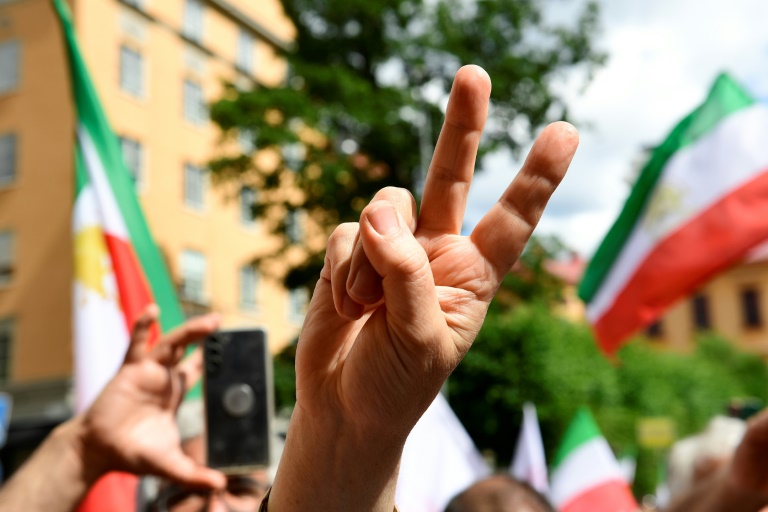
During the trial, MEK supporters protested loudly outside the Stockholm courthouse, and a few hundred had gathered ahead of the verdict.

“We won this time,” protesters chanted as they cheered and waved flags after the verdict.

“This is a historic day, both for Sweden and Iranians that have fought for democracy,” Mehri Emrani, a 61-year-old MEK supporter who served time in prison herself and whose husband was a plaintiff, told AFP.

“This is not only against Hamid Noury, this decision is against the whole regime in Iran,” Kenneth Lewis, a lawyer for the plaintiffs, told reporters.

– Reprisals –

The trial has rendered Stockholm’s already chilly relations with Tehran even frostier.

This is partly because rights activists accuse senior Iranian officials now in power — including current President Ebrahim Raisi — of having been members of the committees that handed down the death sentences.

The so-called “death committees” are thought to have sent at least 5,000 to be executed. The MEK puts the figure as high as 30,000 victims.

Raisi himself has denied ever having been part of these committees.

Tehran has repeatedly called on the Swedish government for Noury’s release.

Concerns have been raised about reprisals against Western prisoners held by the Islamic regime, as two Swedish-Iranian citizens are on death row, with the main concern being academic Ahmadreza Djalali.

Following a recent spate of arrests of Europeans in the country “for no apparent reason”, Sweden has advised citizens against travel to Iran since late June. 

Sri Lanka president submits resignation from Singapore: official

Sri Lanka’s president submitted his resignation shortly after reaching Singapore on Thursday, the parliamentary speaker’s office said, days after the head of state fled protests triggered by his country’s worst-ever economic crisis.

Gotabaya Rajapaksa’s emailed resignation would be examined before a formal announcement – expected on Friday – is made, the speaker’s spokesman Indunil Yapa said. 

Rajapaksa fled Sri Lanka on Wednesday, after protesters overran his palace on the weekend, heading first to the Maldives and then Singapore.

“The authenticity and the legality of the e-mail will have to be checked out” before being formally accepted, Yapa told AFP. 

Rajapaksa would be the first president to resign since Sri Lanka adopted a presidential system of government in 1978.

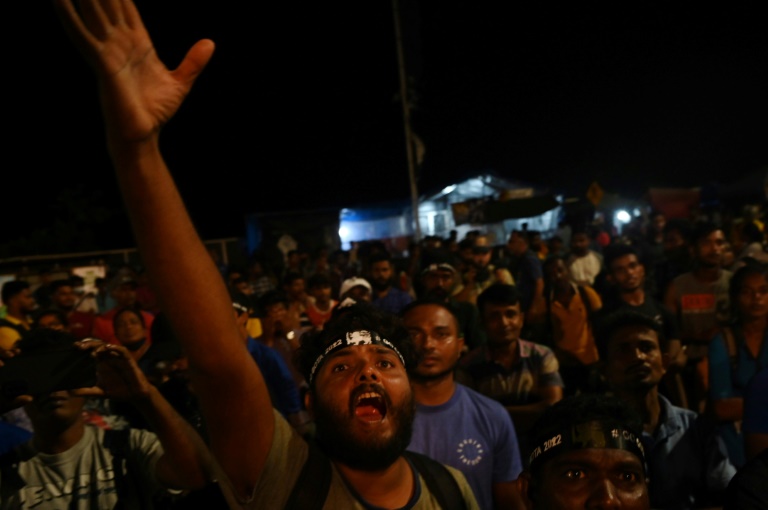
A small but jubilant crowd, some waving the national flag, danced and chanted in celebration outside the presidential secretariat as news of the resignation broke.

“This is a monumental victory,” said protester Harinda Fonseka. “But it is only a first step.”

Under Sri Lanka’s constitution, Prime Minister Ranil Wickremesinghe — whose resignation is also being demanded by protesters — would automatically become acting president until parliament can appoint a successor.

Rajapaksa, his wife Ioma and their two bodyguards arrived in Singapore from Male on board a Saudia airline flight.

As president, Rajapaksa enjoyed immunity from arrest, and he is understood to have wanted to go abroad before stepping down to avoid the possibility of being detained. 

The former Maldivian president Mohamed Nasheed is believed to have played a behind-the-scenes role in getting him out of the country, and said Rajapaksa feared he would be killed if he remained.

“I believe the President would not have resigned if he were still in Sri Lanka, and fearful of losing his life,” Nasheed tweeted. 

Singapore’s foreign ministry confirmed Rajapaksa had been allowed to enter the city-state for a “private visit”, adding: “He has not asked for asylum and neither has he been granted any asylum.”

He is expected to look to stay in Singapore for some time, according to Sri Lankan security sources, before potentially moving to the United Arab Emirates.

– Protesters exit –

Rajapaksa is accused of mismanaging the island nation’s economy to a point where it has run out of foreign exchange to finance even the most essential imports, leading to severe hardships for its 22 million people, with four out of five Sri Lankans skipping meals.

Sri Lanka defaulted on its $51-billion foreign debt in April and is in talks with the IMF for a possible bailout.

The island has nearly exhausted its already scarce supplies of petrol with the government ordering the closure of non-essential offices and schools to reduce commuting and save fuel.

In Colombo, demonstrators earlier left several of the emblematic state buildings they had taken over in recent days, after Wickremesinghe instructed security forces to restore order and declared a state of emergency.

“We are peacefully withdrawing from the Presidential Palace, the Presidential Secretariat and the Prime Minister’s Office with immediate effect, but will continue our struggle,” said a spokeswoman for the protesters.

Witnesses saw dozens of activists leave Wickremesinghe’s office as armed police and security forces moved in. 

The capital was put under curfew and armoured personnel carriers patrolled some areas.

Hundreds of thousands of people had visited the PM’s compound since it was opened to the public, after he fled and his security guards backed down. 

By Thursday afternoon, the gates were closed with armed guards posted both inside and outside.

Earlier in the day, business owner Gihan Martyn, 49, accused the president of “playing for time”.

“He’s a coward,” he said outside the president’s palace. “He ruined our country… So we don’t trust him at all. We need a new government.”

Police said a soldier and a constable were injured in overnight clashes with protesters outside the national parliament as security forces beat back an attempt to storm the legislature.

Protesters also left the studios of the main state television station after breaking in on Wednesday.

The main hospital in Colombo said about 85 people were admitted with injuries on Wednesday, with one man suffocating to death after being tear-gassed at the premier’s office.

The military and the police were issued with fresh orders Thursday to firmly put down any violence, and warned troublemakers they were “legitimately empowered to exercise their force”.

But student Chirath Chathuranga Jayalath, 26, said: “You cannot stop this protest by killing people. They’ll shoot our heads but we do this from our hearts.”

Webb begins hunt for the first stars and habitable worlds

The first stunning images from the James Webb Space Telescope were revealed this week, but its journey of cosmic discovery has only just begun. 

Here is a look at two early projects that will take advantage of the orbiting observatory’s powerful instruments.

– The first stars and galaxies – 

One of the great promises of the telescope is its ability to study the earliest phase of cosmic history, shortly after the Big Bang 13.8 billion years ago. 

The more distant objects are from us, the longer it takes for their light to reach us, and so to gaze back into the distant universe is to look back in the deep past.

“We’re going to look back into that earliest time to see the first galaxies that formed in the history of the universe,” explained Space Telescope Science Institute astronomer Dan Coe, who specializes in the early universe.

Astronomers have so far gone back 97 percent of the way back to the Big Bang, but “we just see these tiny red specks when we look at these galaxies that are so far away.”

“With Webb, we’ll finally be able to see inside these galaxies and see what they’re made of.”

While today’s galaxies are shaped like spirals or ellipticals, the earliest building blocks were “clumpy and irregular,” and Webb should reveal older redder stars in them, more like our Sun, that were invisible to the Hubble Space Telescope.

Coe has two Webb projects coming up — observing one of the most distant galaxies known, MACS0647-JD, which he found in 2013, and Earendel, the most distant star ever detected, which was found in March of this year.

While the public has been enticed by Webb’s stunning pictures, which are shot in infrared because light from the far cosmos has stretched into these wavelengths as the universe expanded, scientists are equally keen on spectroscopy.

Analyzing the light spectrum of an object reveals its properties, including temperature, mass, and chemical composition — effectively, forensic science for astronomy.

Science doesn’t yet know what the earliest stars, which probably started forming 100 million years after the Big Bang, will look like. 

“We might see things that are very different,” said Coe — so-called “Population III” stars that are theorized to have been much more massive than our own Sun, and “pristine,” meaning they were made up solely of hydrogen and helium. 

These eventually exploded in supernovae, contributing to the cosmic chemical enrichment that created the stars and planets we see today. 

Some are doubtful these pristine Population III stars will ever be found — but that won’t stop the astronomical community from trying.

– Anyone out there? – 

Astronomers won time on Webb based on a competitive selection process, open to all regardless of how advanced they are in their careers.

Olivia Lim, a doctoral student at the University of Montreal, is only 25 years old. “I was not even born when people started talking about this telescope,” she told AFP.

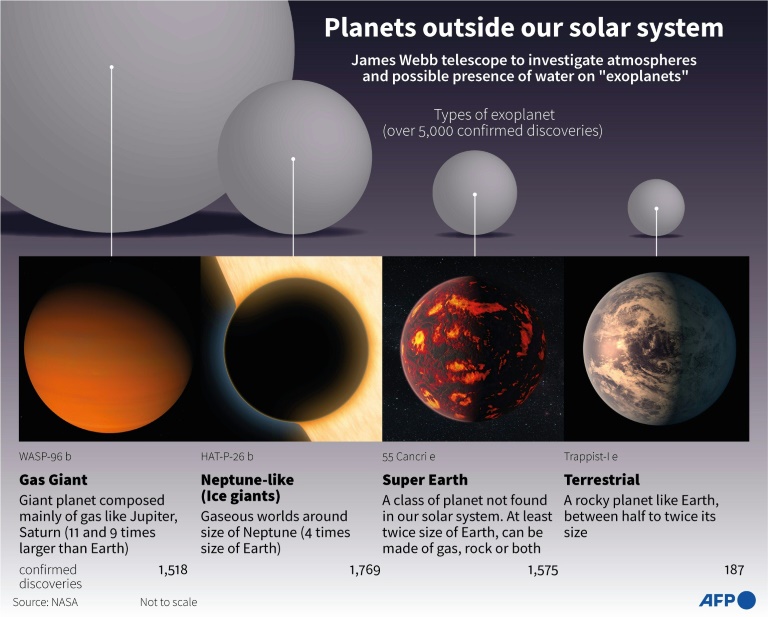
Her goal: to observe the roughly Earth-sized rocky planets revolving around a star named Trappist-1. They are so close to each other that from the surface of one, you could see the others appearing clearly in the sky.

“The Trappist-1 system is unique,” explains Lim. “Almost all of the conditions there are favorable for the search for life outside our solar system.”

In addition, three of Trappist-1’s seven planets are in the Goldilocks “habitable zone,” neither too close nor too far from their star, permitting the right temperatures for liquid water to exist on their surface.

The system is “only” 39 light year away — and we can see the planets transit in front of their star.

This makes it possible to observe the drop in luminosity that crossing the star produces, and use spectroscopy to infer planetary properties. 

It’s not yet known if these planets have an atmosphere, but that’s what Lim is looking to find out. If so, the light passing through these atmospheres will be “filtered” through the molecules it contains, leaving signatures for Webb.

The jackpot for her would be to detect the presence of water vapor, carbon dioxide and ozone. 

Trappist-1 is such a prime target that several other science teams have also been granted time to observe them.

Finding traces of life there, if they exist, will still take time, according to Lim. But “everything we’re doing this year are really important steps to get to that ultimate goal.”

Close Bitnami banner
Bitnami