World

France nods to Ukraine in Bastille Day military parade

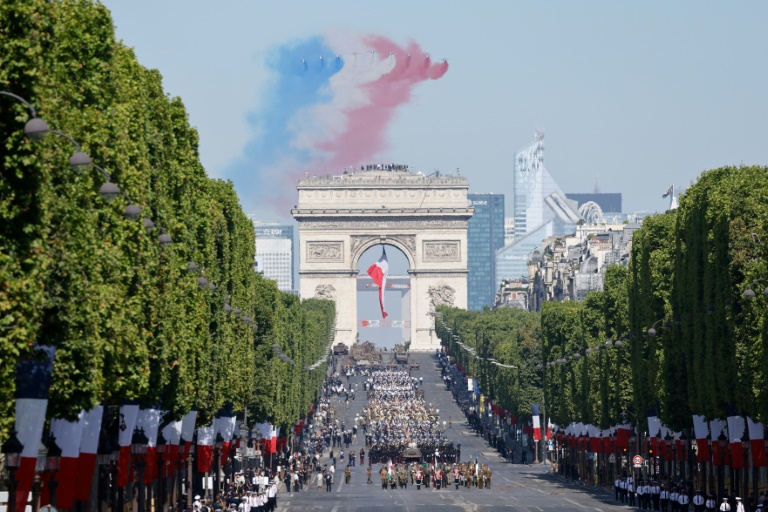
The war in Ukraine made its mark on Paris’s traditional Bastille Day military parade on Thursday as France honoured its eastern European NATO allies.

French troops deployed close to Ukraine since the Russian assault in February had a special place at the event, attended by President Emmanuel Macron, his government and French and foreign dignitaries.

“The parade is marked by, and takes account of, the strategic context,” an official in Macron’s office said. 

“The idea is to highlight the strategic solidarity with our allies.”

Almost five months after Russia invaded Ukraine, the parade on the Champs-Elysees opened with the presentation of the national flags of nine allied guest countries, most of them neighbours of Ukraine or Russia: Estonia, Latvia, Lithuania, Poland, the Czech Republic, Slovakia, Hungary, Romania and Bulgaria.

Troops representing France’s contingent on NATO’s eastern flank were next. Paris expedited the deployment of 500 troops to Romania days after the Russian attack on Ukraine, and has signalled its readiness to boost numbers if needed.

France also participates in ground and air operations in Estonia, and has sent Rafale fighter jets to bolster Poland’s air defences.

Macron’s increased military commitment to eastern Europe coincides with a reduction in French troops in Africa’s Sahel region. Paris will have no more than 2,300 troops stationed there by the end of the summer, down from more than 5,000 a year ago.

— ‘Meet the challenge’ —

In the light of the Ukraine conflict and inflationary pressures, Macron has announced an increased defence budget for the coming years “to match the means to the threats”.

On Wednesday, Macron asked the defence ministry to come up with a revision of the next procurement plan running to 2030.

“At a time when conflicts are intensifying, we must raise our targets,” he said at a defence ministry event.

“Our operational target for 2030 must be revised to improve our capacity to meet the challenge of any return of a high-intensity conflict,” he said.

The ongoing war in Ukraine has revealed gaps in the military capabilities of France which, like several other western countries, has been sending aid and hardware to Ukraine which, however, says it needs far more.

The current shift to artillery warfare in Ukraine especially has highlighted France’s lacking capacity to produce large amounts of ammunition quickly.

The July 14 parade marks the anniversary of the 1789 assault by rebels on the Bastille, then a prison, an event that is credited with kicking off the French Revolution.

It is an annual opportunity to showcase France’s latest military hardware, in a spectacular setting attended by many thousands of spectators lining the Champs-Elysees, and viewed by millions more on TV.

Some 6,300 took part in Thursday’s parade, 5,000 of whom were on foot.

There was a respite from a severe heatwave engulfing France in recent days, with temperatures dropping to a manageable 25 Celsius in central Paris, much to the relief of the marchers in full uniform.

The show involved 64 planes, 25 helicopters, 200 horses and 181 motorised vehicles.

The air force demonstration, the parade’s most spectacular part, included aircraft from European allies and the Patrouille de France fighter jet squadron — already seen flying over the Cannes Film Festival this year for the world premiere of “Top Gun: Maverick” starring Tom Cruise.

Their roar could be heard even from far away as they released smoke, drawing the French flag’s blue-white-red colours across the sky.

The Reaper drone, used in the Sahel in the hunt for jihadists, made its first Bastille Day appearance.

Like countless other cities across France, Paris has scheduled gigantic fireworks after nightfall.

But some, like Nimes in southwestern France, have cancelled the event because of a high fire risk brought on by unseasonal heat.

burs-jh/spm
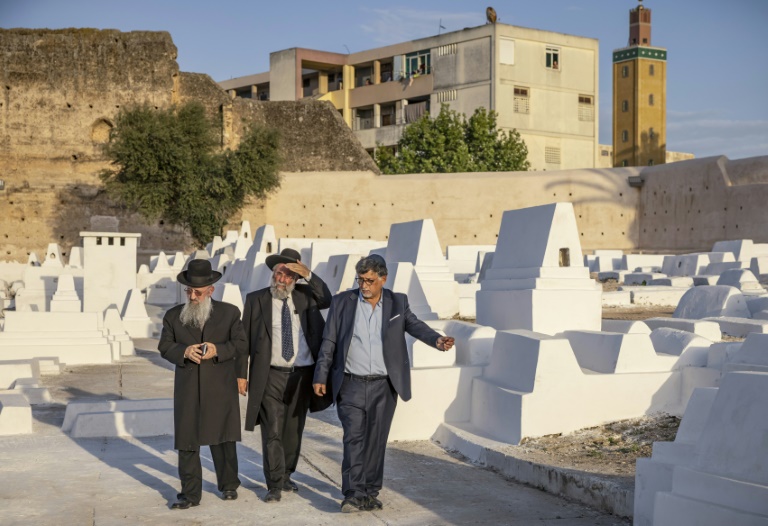
Morocco's king endorses new Jewish organisations

Morocco’s King Mohammed VI has authorised a reorganisation of the country’s Jewish community, a “component” of national culture in the North African country, according to the royal palace.

The measures were presented to a council of ministers meeting attended on Wednesday by the country’s monarch and crown prince, at Rabat’s royal palace.

Acting on “royal instruction”, Interior Minister Abdelouafi Laftit proposed the establishment of new representative bodies, acknowledging the Jewish tradition as “a component of the rich Moroccan culture”, according to the official news agency MAP.

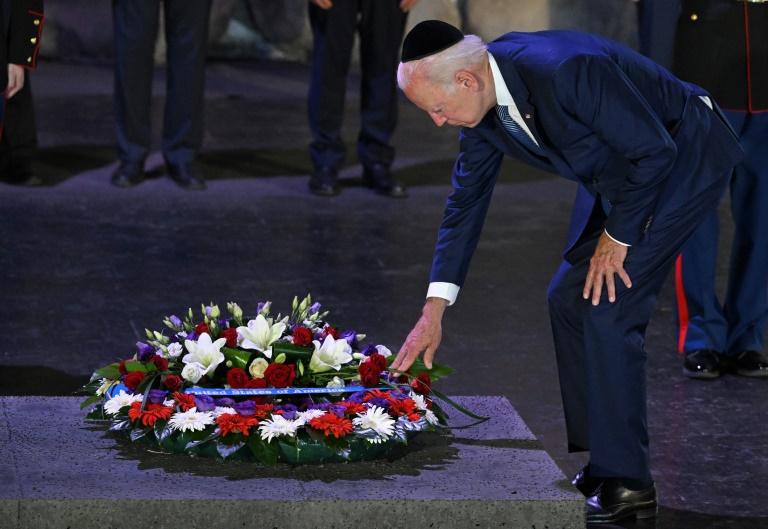
The measures came the same day US President Joe Biden touched down in Israel on his first presidential visit to the Middle East.

In a speech at Ben Gurion Airport, near Tel Aviv, he  promised to “advance Israel’s integration into the region.”

Morocco established diplomatic ties with the Jewish state in 2020.

The kingdom’s Jewish community is estimated to number 3,000 people, the largest in North Africa.

Following consultations with Jewish leaders King Mohammed’s initiative will establish a National Council of the Moroccan Jewish Community, a Foundation of Moroccan Judaism tasked with protecting the community’s heritage, and a Commission of Moroccan Jews Abroad.

The kingdom’s Jewish community dates to antiquity and grew in the 15th century with the expulsion of Spain’s Jews. 

By the 1940s its number had grown to 250,000, representing 10 percent of the country’s population, but mass emigration followed Israel’s founding in 1948.

Approximately 700,000 Israelis claim Moroccan descent and maintain strong ties with their country of origin.

This new organisation of Moroccan Judaism comes alongside growth across a range of spheres in the ties between Morocco and Israel. 

Israel and Morocco established diplomatic relations in December 2020 as part of the US-backed Abraham Accords, which saw several Arab countries normalise ties with the Jewish state. 

King Mohammed’s presence at the meeting was his second public appearance in three days, accompanied by Crown Prince Moulay El Hassan, amid public interest in the monarch’s health following two heart operations since 2018 and a June Covid-19 diagnosis.

On Sunday, the king led prayers at a royal residence in Sale, near Rabat, during the Muslim festival of Eid al-Adha.

Sri Lanka protesters to end occupation of official buildings

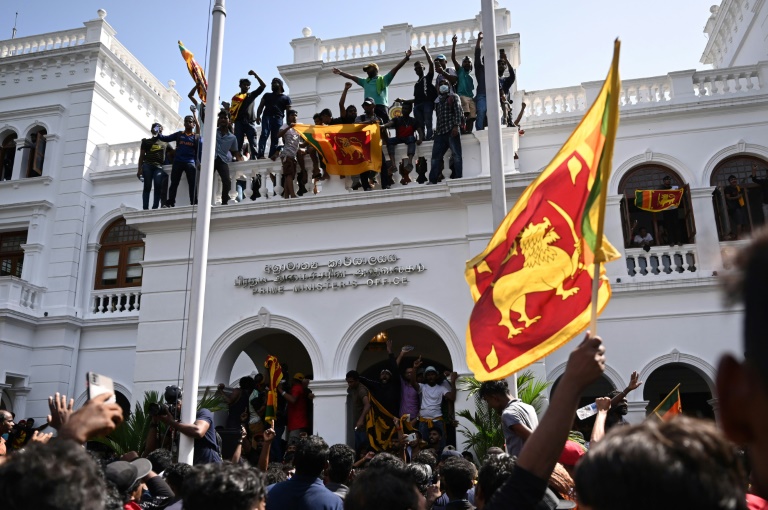
Sri Lanka’s anti-government demonstrators said Thursday they were ending their occupation of official buildings, as they vowed to press on with their bid to bring down the president and prime minister in the face of a dire economic crisis.

Protesters overran President Gotabaya Rajapaksa’s palace at the weekend, forcing him to flee to the Maldives on Wednesday, when activists also stormed the office of Prime Minister Ranil Wickremesinghe.

Rajapaksa, 73, flew onwards Thursday to Singapore from Male, but there was still no announcement of his resignation, despite his earlier promise to step down on Wednesday.

He is expected to look to stay in the city-state for some time, according to Sri Lankan security sources, before potentially moving to the United Arab Emirates. 

As president, Rajapaksa enjoys immunity from arrest, and he is believed to have wanted to go abroad before stepping down to avoid the possibility of being detained. 

Hundreds of thousands of people have visited his compound since it was opened to the public after he fled and his security guards backed down.

At the site, business owner Gihan Martyn, 49, accused him of “playing for time”.

“He’s a coward,” he said. “He ruined our country along with the Rajapaksa family. So we don’t trust him at all. We need a new government.”

Security sources in Colombo said Rajapaksa’s resignation letter had already been prepared. 

“No sooner he gives the green light, the Speaker will issue it,” a source told AFP.

But Wickremesinghe, whom Rajapaksa named as acting president in his absence, demanded the evacuation of occupied state buildings and instructed security forces to do “what is necessary to restore order”, as a nationwide state of emergency and curfew were declared.

A spokeswoman for the protesters announced Thursday: “We are peacefully withdrawing from the Presidential Palace, the Presidential Secretariat and the Prime Minister’s Office with immediate effect, but will continue our struggle.”

A top Buddhist monk who has supported the protests had earlier called for the more than 200-years-old presidential palace to be handed back to authorities and ensure its valuable art and artefacts were preserved.

“This building is a national treasure and it should be protected,” monk Omalpe Sobitha told reporters. “There must be a proper audit and the property given back to the state.”

The curfew was lifted at dawn on Thursday before being reimposed in the capital later in the day.

Police said a soldier and a constable were injured in overnight clashes with protesters outside the national parliament.

The attempt on the legislature was beaten back, unlike at other locations where the protesters had spectacular success. 

The main hospital in Colombo said about 85 people were admitted with injuries on Wednesday, with one man suffocating to death after being tear-gassed at the premier’s office.

But student Chirath Chathuranga Jayalath, 26, said: “You cannot stop this protest by killing people. They’ll shoot our heads but we do this from our hearts.”

– Jeers –

According to Maldivian media, Rajapaksa was jeered and insults thrown at him at Male airport on Wednesday, while another group staged a demonstration in the capital urging authorities not to allow him safe passage.

Maldivian media reported that he had spent the night at the Waldorf Astoria Ithaafushi super luxury resort.

They contrasted the opulent accommodation with the economic plight of his compatriots — four out of five Sri Lankans skipping meals because of the country’s dire economic crisis.

Rajapaksa is accused of mismanaging the economy to a point where the country has run out of foreign exchange to finance even the most essential imports, leading to severe hardships for its 22 million people.

Sri Lanka defaulted on its $51-billion foreign debt in April and is in talks with the IMF for a possible bailout.

The island has nearly exhausted its already scarce supplies of petrol with the government ordering the closure of non-essential offices and schools to reduce commuting and save fuel.

Diplomatic sources said Rajapaksa’s attempts to secure a visa to the United States had been turned down because he had renounced his US citizenship in 2019 before running for president.

Russia's war in Ukraine 'greatest challenge' to global economy: Yellen

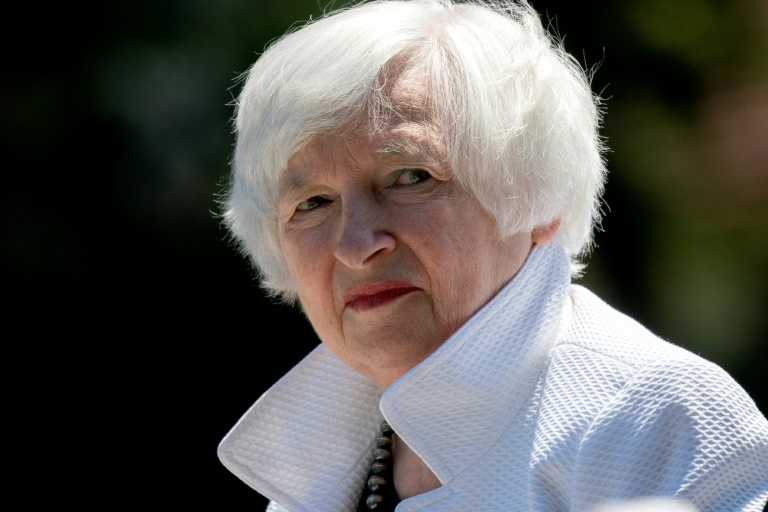
Russia’s war in Ukraine poses the greatest threat to the global economy, US Treasury Secretary Janet Yellen said Thursday as G20 ministers prepare to start talks in Indonesia.

Moscow’s invasion has sent inflation soaring at a time when the world is struggling to recover from the Covid-19 pandemic, endangering the gains of the past two years and threatening widespread hunger and poverty.

“Our greatest challenge today comes from Russia’s illegal and unprovoked war against Ukraine,” she said on the resort island of Bali ahead of a meeting between finance ministers from the world’s top economies and central bank governors on Friday and Saturday.

“We are seeing negative spillover effects from that war in every corner of the world, particularly with respect to higher energy prices, and rising food insecurity,” she added.

“The international community must be clear-eyed about holding Putin accountable for  the global economic and humanitarian consequences of his war.”

Yellen said she will continue to press G20 allies at the meeting for a price cap on Russian oil to choke off Putin’s war chest and pressure Moscow to end its invasion while bringing down energy costs.

“A price cap… is one of our most powerful tools,” she said, adding that a limit would deny Putin “the revenue his war machine needs”.

She expressed hope that India and China would join such a cap, saying it “would serve their own interests” to put downward pressure on prices for consumers across the world.

But she refused to be drawn on whether Western officials will stage a multi-nation walkout when Russian officials speak, as they did at a G20 meeting in Washington in April.

“It cannot be business as usual,” she said. “I can tell you that I can certainly expect to express in the strongest possible terms my views on Russia’s invasion… to talk about its impact on Ukraine and the entire global economy and to condemn it.”

“I expect that many of my colleagues will do the same.”

– Global outlook ‘darkened’ –

Russia’s finance minister will not attend the Bali talks, instead addressing it virtually, a week after Foreign Minister Sergei Lavrov found himself outnumbered by G20 counterparts in their criticism of Moscow’s military assault.

Yellen’s comments echo the head of the International Monetary Fund, who said Wednesday that the global economic outlook had “darkened significantly” because of Moscow’s invasion, just months after it revised down its global growth forecast for 2022 and 2023.

The IMF is “projecting a further downgrade to global growth” in 2022 and 2023, Kristalina Georgieva said in a blog post published ahead of this weekend’s meeting.

The risk of “social instability” was also increasing because of rising food and energy prices, she wrote.

But there was substantive progress made in attempts to break the impasse on Wednesday after Russia and Ukraine met in Turkey for their first direct talks since March on a deal to relieve the food crisis caused by blocked Black Sea grain exports.

UN Secretary General Antonio Guterres called it a “ray of hope to ease human suffering and alleviate hunger around the world” ahead of another planned round of talks next week.

Chinese homebuyers halt mortgage payments on unfinished projects

Chinese homebuyers in dozens of cities have stopped making mortgage payments for unfinished projects, according to data from industry groups, worsening fears of financial contagion in the country’s troubled real estate sector.

Authorities launched a crackdown on excessive debt in the property sector in 2020, and giants such as Evergrande and Sunac have since struggled to make payments and renegotiate with creditors, leaving them teetering on the edge of bankruptcy.

In the latest blow, a growing number of homebuyers have refused to pay mortgages if developers do not resume construction on units already sold.

As of Wednesday, homebuyers had halted payments for units in at least 100 residential property projects in 50 cities, according to data from research firm China Real Estate Information Corporation (CRIC).

This was up from 28 projects on Monday and 58 on Tuesday, according to a report by analysts at financial firm Jefferies.

“The names on the list doubled every day in the past three days,” they said.

These include projects that have experienced significant delays and others that have yet to reach their delivery date, the report said, adding that the incident will dampen buyer sentiment and weigh on a recovery in sales.

The housing ministry held emergency meetings with financial regulators and major Chinese banks this week to discuss the mortgage strikes, Bloomberg News reported Thursday, citing people familiar with the matter.

The regulators requested that local authorities and banks notify them of affected developments in their jurisdictions over fears that more buyers may jump on the bandwagon, the report said.

If every homebuyer defaulted, non-performing loans will increase by 388 billion yuan ($58 billion), Jefferies said.

The buyers’ actions came after postponed deliveries of pre-sold homes, unclear delivery times and halted construction, Nomura analysts said in a report Thursday.

“Pre-sales are the most common way of selling homes in China, so the stakes there are high,” it said.

“We are especially concerned about the financial impact of the homebuyers’ ‘stopping mortgage repayments’ movement, as China’s property downturn may finally adversely affect onshore financial institutions.”

The developments come at a time of slowing growth for China and weak property sales, adding to the risk to stability ahead of the Communist Party’s 20th Congress this fall, when President Xi Jinping is expected to be given a third term.

Asian markets swing as US inflation spikes see rate hike bets soar

Asian markets were mixed Thursday as another forecast-busting US inflation print ramped up bets on a quick series of sharp interest rate hikes by the Federal Reserve as other central banks also race to tighten.

The keenly awaited consumer price index came in at a blistering 9.1 percent in June, the highest since November 1981, as energy costs continued to rocket on the back of rising demand and weak supplies partly caused by the Ukraine war.

Months of soaring inflation have rocked global markets as central banks, fearing prices will run too high, are forced to quickly withdraw the ultra-cheap cash policies put in place at the start of the pandemic.

But that has fanned fears that policymakers could go too far and tip leading economies into recession.

Wednesday’s CPI reading was followed by speculation the Fed could hike borrowing costs a full percentage point at its next meeting this month, with some top officials refusing to rule it out just yet.

The bank last month unveiled its first 75 basis point rise for three decades and is one of dozens to hike rates. Singapore and the Philippines became the latest to tighten policy on Thursday, a day after Canada, New Zealand, Chile and South Korea announced hikes.

The inflation reading followed Friday’s surprise spike in US jobs creation, which suggested the world’s top economy was withstanding the rate hikes, giving the Fed more room for further increases.

“Stubbornly high inflation increases the risk that the (Fed) continues to hike aggressively and triggers a recession,” said Kristina Clifton at Commonwealth Bank of Australia, adding that that belief was picking up momentum on trading floors.

– ‘Glimmers of hope’ –

And Federated Hermes senior economist Silvia Dall’Angelo said the reading suggested “inflation will likely remain sticky at elevated levels for the balance of the year, as external and domestic price pressures continue to pass through to consumer prices”.

She added that while commodity prices were off their recent peaks, they were still elevated and were at risk of further supply shocks.

With the jobs market still strong and inflation resiliently high, “the Fed will likely resort to hawkish rhetoric and further front-loading of tightening at least until late autumn, as it fights to maintain its credibility”, she said.

Wall Street’s three main indexes ended in the red, though they were off their intra-day lows on hopes the Fed will see results by the end of the year and begin to cut rates in the new year.

Asia was mixed, with Tokyo, Sydney, Wellington, Taipei and Jakarta all up but Hong Kong, Shanghai, Singapore, Seoul, Mumbai, Bangkok and Manila down.

London, Paris and Frankfurt opened lower.

“The more prolonged inflation remains high, the more central banks will need to tighten, and the slower growth will become,” said SPI Asset Management’s Stephen Innes.   

But while there is a general sense of gloom, eToro global markets strategist Ben Laidler said there were some “glimmers of hope” in the CPI data.

“Recent falls in super-charged oil and agricultural prices, along with a decline in airfares, provide hope we are near the peak of headline inflation,” he said in a note, adding that inflation was “the most important number in global markets right now”.

“But early signs of easing inflation pressure give some hope of an end to dramatic interest rate hikes and stronger financial markets by Christmas.”

The Fed’s drive to tighten monetary policy continues to send the dollar higher, and on Wednesday it finally broke parity with the euro before easing slightly.

Still, an energy crisis in the eurozone and the European Central Bank’s decision to move slower in lifting rates, has led commentators to forecast the single currency could fall to as low as $0.95.

The greenback also broke the 138 yen mark for the first time since late 1998 as the Bank of Japan refuses to shift from its ultra-loose monetary policies to support the country’s torpid economy.

– Key figures at around 0720 GMT –

Tokyo – Nikkei 225: UP 0.6 percent at 26,643.39 (close)

Hong Kong – Hang Seng Index: DOWN 0.4 percent at 20,723.96

Shanghai – Composite: DOWN 0.1 percent at 3,281.74 (close)

London – FTSE 100: DOWN 0.1 percent at 7,152.29

Euro/dollar: DOWN at $1.0005 from $1.0061 Wednesday

Pound/dollar: DOWN at $1.1837 from $1.1893 

Euro/pound: DOWN at 84.54 pence from 84.59 pence

Dollar/yen: UP at 138.74 yen from 137.36 yen

West Texas Intermediate: DOWN 0.2 percent at $96.10 per barrel

Brent North Sea crude: UP 0.1 at $99.63 per barrel

New York – Dow: DOWN 0.7 percent at 30,772.79 (close)

Libya's oil firm chief resists move to replace him

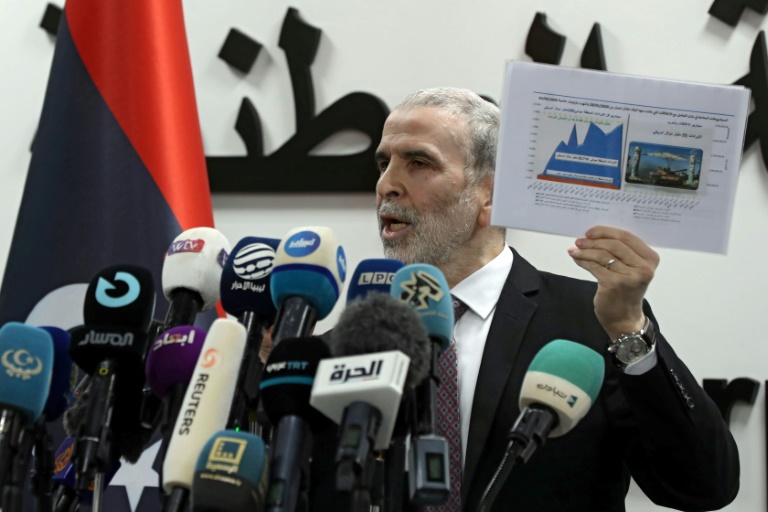
Libya’s Tripoli-based government has named a new head of the state oil company to replace veteran technocrat Mustafa Sanalla, who refused to give up his post.

Unlike many other Libyan state bodies, the National Oil Corporation, led by Sanalla since 2014, has largely managed to remain neutral in the face of political wrangling.

But petrol is at the heart of political rivalries in Libya, which has two governments, one in Tripoli led by Abdulhamid Dbeibah, appointed last year as part of a United Nations-backed peace process to end more than a decade of violence in the North African country.

Dbeibah has refused to cede power to Fathi Bashagha, named in February as prime minister by a parliament based in Libya’s east and backed by military strongman Khalifa Haftar.

According to a July 7 decree made public on Wednesday, Farhat Bengdara and four others will from now on make up the “board of directors of the National Oil Corporation”.

Bengdara, 57, was governor of Libya’s central bank from 2006 to 2011 before he joined the revolt which overthrew dictator Moamer Kadhafi.

An ad hoc committee that was on Wednesday to organise the handover at the head of the NOC had to suspend its work because of employee reluctance — including from the very top.

Sanalla said late Wednesday he would not give up his post.

“This institution belongs to all Libyans and not to you,” he said in a live video address to Dbeibah.

“The mandate of your government has expired,” he said, emphasising the technical and apolitical nature of the oil firm.

Sanalla has positioned himself as an interlocutor with foreign powers and oil firms. He has also skillfully mediated disputes to keep Libya’s crude flowing during times of war, as well as boosting production during peacetime.

However, Dbeibah’s Oil and Gas Minister Mohammed Aoun has on several occasions attempted to oust Sanalla.

In an April interview with AFP, Aoun accused Sanalla of not respecting laws governing the sector “and exceeding his prerogatives”.

Bengdara is reputedly close to the United Arab Emirates which backs Libya’s eastern camp. Sanalla accused the UAE of involvement in his sacking.

Despite sitting on Africa’s biggest proven oil reserves, war-battered Libya suffers chronic power outages and rising poverty. This has fuelled public anger that has piled pressure on both the Tripoli-based administration and its eastern rival.

On Wednesday the NOC said it was lifting a force majeure at two eastern export terminals. They had been blockaded for three months by groups demanding Dbeibah’s departure.

US, Israel to sign security pledge as Biden visits Jerusalem

US President Joe Biden and Israel’s Prime Minister Yair Lapid will sign a security “declaration” on Thursday affirming their united front against Iran, an American official said, as Biden holds bilateral talks in Jerusalem.

“This declaration is pretty significant and it includes a commitment to never allow Iran to acquire a nuclear weapon and to address Iran’s destabilising activities, particularly threats to Israel,” said a Biden administration official, who requested anonymity.

Biden touched down at Ben Gurion Airport near Tel Aviv on Wednesday for the first Middle East tour of his presidency, which will see him meet Israeli and Palestinian leaders before flying to Saudi Arabia.

Lapid, Israel’s caretaker leader ahead of an election in November, had previously said Iran would top the agenda in his talks with the US president.

The declaration they sign would reaffirm “unbreakable bonds between our countries and expanding on the long standing security relationship between the United States and Israel”, said the US official.

An Israeli official, also speaking on condition of anonymity, said the document was “going to be a living testimony to the unique quality, health, scope, depth and intimacy of the US-Israel relationship.”

Israel is staunchly opposed to a nuclear deal Iran signed with world powers in 2015 and which Biden is trying to get back on track after his predecessor Donald Trump withdrew US support.

Biden said pulling out of the landmark accord was a “gigantic mistake”.

Iran is “closer to a nuclear weapon now than they were before”, the US president said in an interview aired Wednesday by Israel’s Channel 12.

Asked whether the United States would use force to prevent Iran from acquiring nuclear weapons, Biden said: “If that was the last resort, yes.”

– Saudi oil talks –

The president’s meeting with Lapid will be followed by multilateral talks on investment with India and the United Arab Emirates, which will join remotely.

In addition to meeting with Israeli President Isaac Herzog, Biden will hold brief talks with Israeli opposition leader Benjamin Netanyahu.

The right-wing former prime minister is readying for another election campaign, with Israelis set to go to the polls for the fifth time in less than four years on November 1.

Biden is marking his tenth visit to Israel and is well-acquainted with Netanyahu.

Russia’s invasion of Ukraine will remain a top priority for the Biden administration during his regional tour, with volatile oil prices due to be the focus of talks with Saudi officials.

The president will seek to persuade Saudi Arabia to pump more oil in order to drive down prices, which have fuelled US inflation to the highest levels in decades.

Israel has sought a delicate balance towards the Ukraine war, conscious of Russian forces in neighbouring Syria, its million citizens with ties to the former Soviet Union, and its firm US alliance.

Israeli officials have condemned the conflict in broad terms but the government has refused to send weapons to the Ukrainian army.

– No ‘top down peace plan’ –

The president on Wednesday renewed Washington’s long-standing call for a two-state solution, but has not reversed Trump’s controversial decision to recognise Jerusalem as Israel’s capital.

Biden is due to meet Palestinian president Mahmud Abbas on Friday in Bethlehem, in the occupied West Bank, and pledge US financial support.

The US official that would include “a significant funding package” for hospitals that serve Palestinians in Israeli-annexed east Jerusalem, which Palestinians claim as their future capital.

Biden’s administration will also announce measures towards providing 4G internet access in the West Bank and Israeli-blockaded Gaza strip, the US official said, addressing a long-standing Palestinian frustration.

But, with Israel in political limbo ahead of the November 1 election, Biden is not expected to push Lapid for significant policy changes regarding the Palestinians.

“We are not going to come in with a top down peace plan because we don’t believe that would be the best approach,” the US official said.

But, “if the two parties are prepared to talk, we will be there, and we will be there to help,” the official added.

aue-rsc/bs/dv

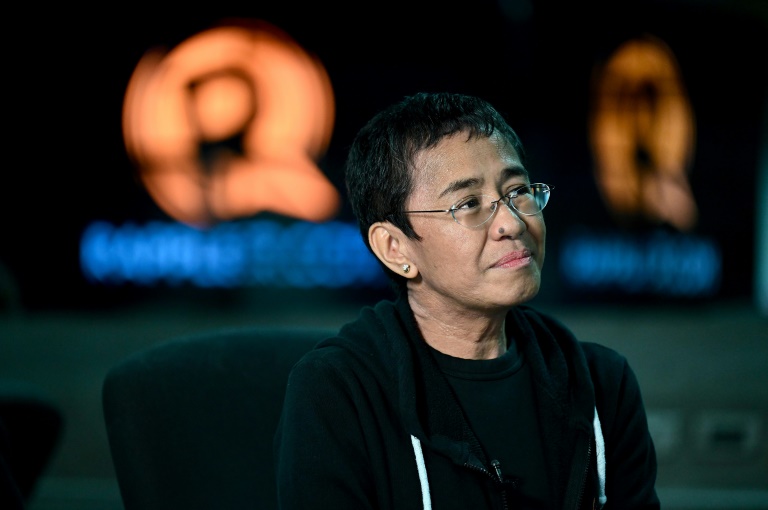
Defiant Philippine Nobel laureate Ressa fights for her freedom

Less than a year after winning the Nobel Peace Prize for her efforts to protect free speech, Philippine journalist Maria Ressa is fighting to stay out of jail while her news site Rappler faces possible closure.

But the spirited veteran reporter — a vocal critic of former president Rodrigo Duterte and his deadly drug war — refuses to be cowed into silence.

“This is a newsroom that’s been under attack for six years and we’ve prepared ourselves,” Ressa, 58, told AFP this week at Rappler’s office in suburban Manila.

“We will not voluntarily give up our rights.”

Rappler, which Ressa co-founded a decade ago, had to battle for survival under Duterte as his government accused it of violating a constitutional ban on foreign ownership, as well as tax evasion.

Days before Duterte’s term ended on June 30, the company received a shutdown order from the Philippine Securities and Exchange Commission (SEC). 

Less than two weeks later, Ressa lost an appeal against a 2020 conviction for cyber libel, putting her one step closer to serving up to nearly seven years behind bars.

Drawing on decades of experience working as a journalist across Asia, including in conflict zones, Ressa said she had to be “ready for anything”. 

“This is something I do as a person, whatever it is I’m most afraid of, I think about the worst-case scenario and then I plan it out,” said the former CNN correspondent, who is on bail.

Ressa is facing seven court cases, including the cyber libel conviction, while Rappler faces eight. 

Their lawyers describe the cases as “state-sponsored legal harassment”.

Trouble for Ressa and Rappler started in 2016 when Duterte came to power and launched a drug war in which more than 6,200 people died in police anti-narcotics operations, official data show.

Rights groups estimate tens of thousands were killed.

Rappler was among the domestic and foreign media outlets that published shocking images of the killings and questioned the crackdown’s legal basis.

Local broadcaster ABS-CBN — also critical of Duterte — lost its free-to-air licence, while Ressa and Rappler endured what press freedom advocates say was a grinding series of criminal charges, probes and online attacks. 

Duterte’s government said previously it had nothing to do with any of the cases against Ressa.

After the SEC shutdown order, Ressa said the online harassment increased “exponentially” and has continued since the son and namesake of former Philippine dictator Ferdinand Marcos succeeded Duterte.

“This was the largest spike for sure. It hasn’t stopped, it’s been pretty much non-stop,” said Ressa.

“The attacks are always connected to a defence of the Marcos administration.” 

– ‘Make or break’ – 

Ressa became a journalist in 1986, the same year that the elder Marcos was ousted in a popular revolt and his family chased into exile in the United States.

Ferdinand Marcos Jr won the May 9 presidential polls by a landslide, completing a remarkable comeback for the clan, helped by relentless online whitewashing of their past and powerful alliances with rival elite families.  

Ressa said she was hopeful Marcos Jr would rule differently to his father, who presided over human rights abuses, corruption and the shuttering of independent media. 

But the pattern in the past three weeks, including the social media attacks, “bodes ill for press freedom and for Filipino journalists”, she said.

“It hasn’t been magnanimity in victory,” said Ressa.

“This is not one or two people not being nice — these are concerted information operations.”

Some of her colleagues at Rappler, where the average age of staff, including reporters, is about 25, have also been targeted.

As Ressa and the company fight to have the SEC and cyber libel decisions overturned, their future is uncertain.  

She had hoped that winning the Nobel Peace Prize in October, which she shared with Russian journalist Dmitry Muratov, would shield her and other journalists in the Philippines.

While Marcos Jr has given few clues about his views on Rappler and the broader issue of freedom of speech, activists fear he could make the situation worse.

Ressa said the outcome of the cases against her and Rappler could have broader implications for Filipinos and their rights.

She points to the controversial cyber libel law, which she has been accused of violating. It was introduced in 2012 and applied to an article published by Rappler months before the law took effect.

“This is make or break,” Ressa said.

“What’s at stake goes beyond my freedom or Rappler. It really will determine where this country will go.” 

Sri Lanka protesters to end occupation of official buildings

Sri Lanka’s anti-government demonstrators said Thursday they were ending their occupation of official buildings, as they vowed to press on with their bid to bring down the president and prime minister in the face of a dire economic crisis.

Protesters overran President Gotabaya Rajapaksa’s palace at the weekend, forcing him to flee to the Maldives on Wednesday, when activists also stormed the office of Prime Minister Ranil Wickremesinghe.

Rajapaksa had promised to resign on Wednesday, but there was no announcement he had done so.

The premier, whom Rajapaksa named as acting president in his absence, had demanded the evacuation of state buildings and instructed security forces to do “what is necessary to restore order”.

“We are peacefully withdrawing from the Presidential Palace, the Presidential Secretariat and the Prime Minister’s Office with immediate effect, but will continue our struggle,” a spokeswoman for the protesters said.

A top Buddhist monk supporting the campaign had earlier called for the more than 200-years-old presidential palace to be handed back to authorities and ensure its valuable art and artefacts were preserved.

“This building is a national treasure and it should be protected,” monk Omalpe Sobitha told reporters. “There must be a proper audit and the property given back to the state.”

Hundreds of thousands have visited the compound since it was opened out to the public after Rajapaksa fled and his security guards backed down.

In a televised address after thousands of people captured his office in Colombo, Wickremesinghe declared: “Those who go to my office want to stop me from discharging my responsibilities as acting president.

“We can’t allow fascists to take over. That is why I declared a nationwide emergency and a curfew,” he added.

The curfew was lifted at dawn on Thursday, but police said a soldier and a constable were injured in overnight clashes with protesters outside the national parliament.

The attempt on the legislature was beaten back, unlike at other locations where the protesters had spectacular success. 

The main hospital in Colombo said about 85 people were admitted with injuries on Wednesday, with one man suffocating to death after being tear-gassed at the premier’s office.

– Jeers –

Rajapaksa remained in the Maldives on Thursday, reportedly awaiting a private jet to take him, his wife Ioma and two bodyguards to Singapore. 

Local media reports said he had refused to take a commercial flight with other passengers after receiving a hostile reception when he arrived in the Maldives early Wednesday.

He was jeered and insults thrown at him as he walked out of the Velana International airport, and another group staged a demonstration in the capital in the afternoon urging Maldivian authorities not to allow him safe passage.

Maldivian media reported that he had spent the night at the Waldorf Astoria Ithaafushi super luxury resort.

They contrasted the opulent accommodation with the economic plight of his compatriots — four out of five Sri Lankans skipping meals because of the country’s dire economic crisis.

Security sources in Colombo said Rajapaksa was most likely to leave the Maldives Thursday and his resignation could be announced after he was airborne.

“The resignation letter has been prepared,” the source told AFP. “No sooner he gives the green light, the Speaker will issue it.”

Diplomatic sources said Rajapaksa’s attempts to secure a visa to the United States had been turned down because he had renounced his US citizenship in 2019 before running for president.

Close Bitnami banner
Bitnami