World

UK issues extreme heat warning as temperatures soar

Britain on Monday issued an extreme heat warning, with temperatures predicted to hit more than 30 degrees Celsius (86 Fahrenheit) across large parts of England and Wales.

Forecasters said the warm weather would remain for much of the week, particularly in southern and central England and Wales, with peaks of 33C possible in southeast England on Tuesday.

Temperatures were still several degrees cooler than the heatwave in parts of Spain and Portugal, where the mercury was set to soar past 40C.

But Met Office deputy chief meteorologist Rebekah Sherwin said the UK highs would continue into early next week.

“From Sunday and into Monday, temperatures are likely to be in excess of 35C in the southeast (of England), although the details still remain uncertain,” she said.

“Elsewhere, temperatures could be fairly widely above 32C in England and Wales, and in the mid-to-high 20s Celsius further north.”

Britain’s highest recorded temperature was 38.7C at Cambridge Botanic Garden, in eastern England, on July 25, 2019.

Sherwin said meteorologists could not rule out that record being broken but it was “still only a low probability”.

“A number of weather scenarios are still possible and at the current time, mid- or perhaps high-30s are looking more likely,” she added.

The extreme heat warning was classified as “amber”, the second-highest of three, indicating a “high impact” on daily life and people.

Mark McCarthy, head of the Met Office National Climate Information Centre, said “strongly embedded warming due to climate change” across Europe was increasing the chances of a new UK record.

Argentina will honor economic goals agreed with IMF: new minister

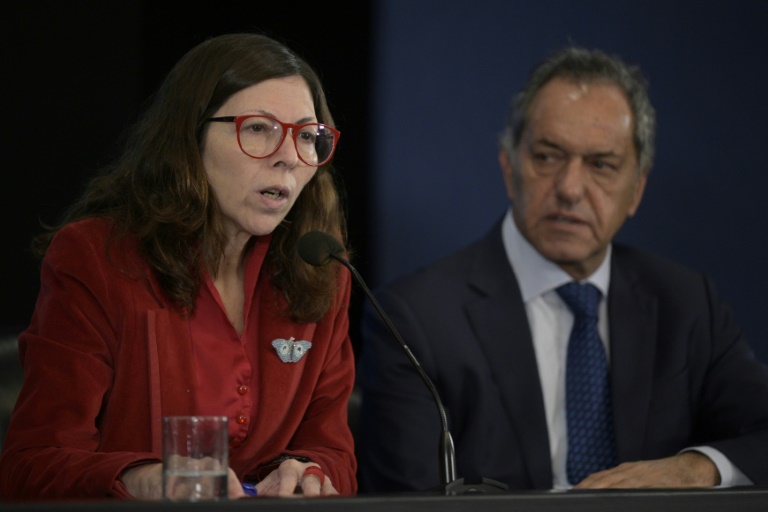
Argentina’s new economy minister said Monday the country would honor fiscal deficit goals and other commitments made under a deal struck with the IMF to refinance a debt of some $44 billion.

Under the agreement negotiated by Silvina Batakis’ predecessor Martin Guzman, who resigned suddenly nine days ago, Argentina committed to reducing its fiscal deficit from 3.0 percent of GDP last year to 2.5 percent in 2022, 1.9 percent in 2023 and 0.9 percent in 2024.

“The goals agreed with the IMF are maintained,” Batakis said in Buenos Aires at her first press conference since taking office a week ago.

“It is an agreement we signed as a state and we must comply.”

In 2018, under the government of conservative President Mauricio Macri, the International Monetary Fund granted its biggest-ever loan of $57 billion to Argentina.

The country received $44 billion of that amount and Macri’s successor Alberto Fernandez refused to accept the rest.

As the country struggled to repay its debt, a refinancing agreement was reached this year after protracted negotiations.

Guzman resigned suddenly on July 2 amid a power struggle between Argentina’s president and vice president, sparking fresh uncertainty in Latin America’s third largest economy.

The peso fell sharply last Monday against the US dollar after Batakis’ appointment.

On Monday, the 53-year-old said there was a need to “give order and balance to the public finances,” and vowed that “we will not spend more than we have.”

Among her proposals: to reduce energy subsidies, which in 2021 amounted to $11 billion or 2.3 percent of GDP, by applying a sliding scale to prices for gas and electricity based on income.

In 2020, the Argentine economy contracted 9.9 percent before rebounding the following year by 10.3 percent.

For this year, the IMF predicts growth of 4.0 percent.

At the time the refinancing agreement was reached, Argentina’s inflation was projected to reach 52 percent in 2022 — already one of the highest in the world.

Since then, the war in Ukraine has sent prices soaring worldwide, and Argentina marked year-on-year inflation of 60 percent in May.

“The agreement was signed before the rise in global inflation,” said Batakis, adding a new estimate for 2022 was being compiled.

“It is a methodological issue we are evaluating, not a shifting of the goal,” she insisted.

A survey by Argentina’s central bank of projections for 2022 inflation put the rate at some 76 percent.

Excitement builds as Biden to release first image from Webb telescope

US President Joe Biden will Monday release one of the first images taken by the James Webb Space Telescope, the most powerful observatory ever sent into orbit and a leap forward in uncovering the secrets of the distant universe.

The unveiling will take place at 5:00 pm (2100 GMT) during a livestreamed event at the White House, official statements said, leaving the space community in a state of keen anticipation.

NASA revealed last week Webb’s first targets included distant galaxies, bright nebulae and a faraway giant gas planet.

The very first image, released by the US president, will be of the “deep field” — an image taken with very long exposure time, to detect the faintest of objects in the distance — according to a person familiar with the matter.

NASA previously said Webb would achieve this shot by pointing its primary imager towards massive foreground galaxy clusters called SMACS 0723, which bend the light of objects far behind them towards the observer, an effect called “gravitational lensing.”

This promises to be what NASA chief Bill Nelson called last month the “deepest image of our Universe that has ever been taken.”

The rest of the first wave of images are set to be released by NASA on Tuesday.

Webb’s infrared capabilities are what make it uniquely powerful, allowing it to both pierce through cosmic dust clouds and detect light from the earliest stars, which has been stretched into infrared wavelengths as the universe expanded.

This lets it peer further back in time than any previous telescope, to the period shortly after the Big Bang, 13.8 billion years ago.

“When I first saw the images… I suddenly learned three things about the Universe that I didn’t know before,” Dan Coe, a Space Telescope Science Institute (STSI) astronomer and expert on the early Universe, told AFP. “It’s totally blown my mind.”

– First targets –

An international committee decided the first wave of images would include the Carina Nebula, an enormous cloud of dust and gas 7,600 light years away.

Carina Nebula is famous for its towering pillars that include “Mystic Mountain,” a three-light-year-tall cosmic pinnacle captured in an iconic image by the Hubble Space Telescope, until now humanity’s premier space observatory.

Webb has also carried out a spectroscopy — an analysis of light that reveals detailed information — on a faraway gas giant called WASP-96 b, which was discovered in 2014.

Nearly 1,150 light-years from Earth, WASP-96 b is about half the mass of Jupiter and zips around its star in just 3.4 days.

Nestor Espinoza, an STSI astronomer, told AFP that previous exoplanet spectroscopies carried out using existing instruments were very limited compared to what Webb could do.

“It’s like being in a room that is very dark and you only have a little pinhole you can look through,” he said of the prior technology. Now, with Webb, “You’ve opened a huge window, you can see all the little details.”

– Million miles from Earth –

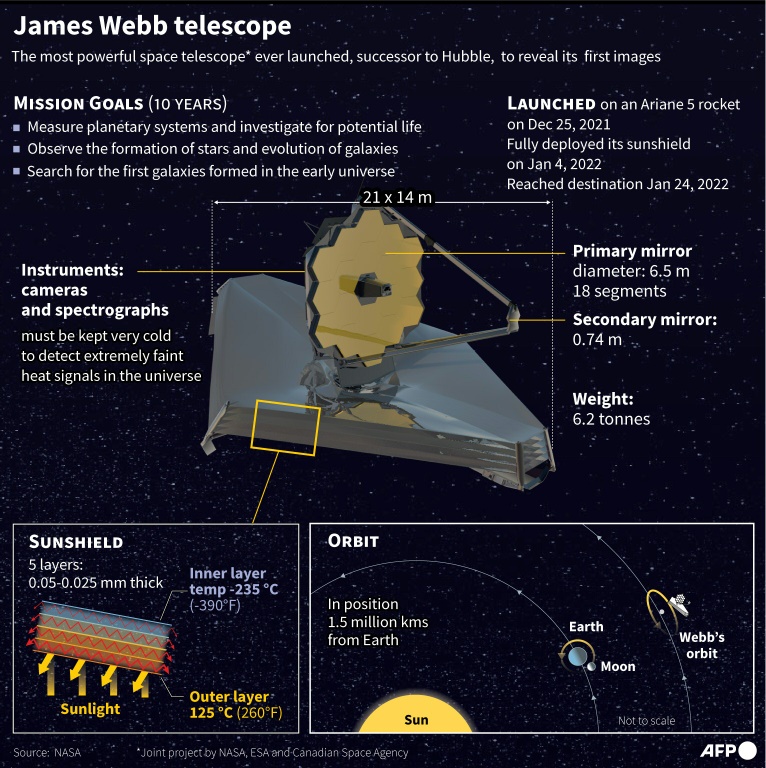
Launched in December 2021 from French Guiana on an Ariane 5 rocket, Webb is orbiting the Sun at a distance of a million miles (1.6 million kilometers) from Earth, in a region of space called the second Lagrange point.

Here, it remains in a fixed position relative to the Earth and Sun, with minimal fuel required for course corrections. 

A wonder of engineering, the total project cost is estimated at $10 billion, making it one of the most expensive scientific platforms ever built, comparable to the Large Hadron Collider at CERN.

Webb’s primary mirror is over 21 feet (6.5 meters) wide and is made up of 18 gold-coated mirror segments. Like a camera held in one’s hand, the structure must remain as stable as possible to achieve the best shots.

Charlie Atkinson, chief engineer on the James Webb Space Telescope program at lead contractor Northrop Grumman, told AFP that it wobbles no more than 17 millionths of a millimeter.

After the first images, astronomers around the globe will get shares of time on the telescope, with projects selected competitively through a process in which applicants and selectors don’t know each others’ identities, to minimize bias.

Thanks to an efficient launch, NASA estimates Webb has enough propellant for a 20-year life, as it works in concert with the Hubble and Spitzer space telescopes to answer fundamental questions about the cosmos.

Excitement builds as Biden to release first image from Webb telescope

US President Joe Biden will Monday release one of the first images taken by the James Webb Space Telescope, the most powerful observatory ever sent into orbit and a leap forward in uncovering the secrets of the distant universe.

The unveiling will take place at 5:00 pm (2100 GMT) during a livestreamed event at the White House, official statements said, leaving the space community in a state of keen anticipation.

NASA revealed last week Webb’s first targets included distant galaxies, bright nebulae and a faraway giant gas planet.

The very first image, released by the US president, will be of the “deep field” — an image taken with very long exposure time, to detect the faintest of objects in the distance — according to a person familiar with the matter.

NASA previously said Webb would achieve this shot by pointing its primary imager towards massive foreground galaxy clusters called SMACS 0723, which bend the light of objects far behind them towards the observer, an effect called “gravitational lensing.”

This promises to be what NASA chief Bill Nelson called last month the “deepest image of our Universe that has ever been taken.”

The rest of the first wave of images are set to be released by NASA on Tuesday.

Webb’s infrared capabilities are what make it uniquely powerful, allowing it to both pierce through cosmic dust clouds and detect light from the earliest stars, which has been stretched into infrared wavelengths as the universe expanded.

This lets it peer further back in time than any previous telescope, to the period shortly after the Big Bang, 13.8 billion years ago.

“When I first saw the images… I suddenly learned three things about the Universe that I didn’t know before,” Dan Coe, a Space Telescope Science Institute (STSI) astronomer and expert on the early Universe, told AFP. “It’s totally blown my mind.”

– First targets –

An international committee decided the first wave of images would include the Carina Nebula, an enormous cloud of dust and gas 7,600 light years away.

Carina Nebula is famous for its towering pillars that include “Mystic Mountain,” a three-light-year-tall cosmic pinnacle captured in an iconic image by the Hubble Space Telescope, until now humanity’s premier space observatory.

Webb has also carried out a spectroscopy — an analysis of light that reveals detailed information — on a faraway gas giant called WASP-96 b, which was discovered in 2014.

Nearly 1,150 light-years from Earth, WASP-96 b is about half the mass of Jupiter and zips around its star in just 3.4 days.

Nestor Espinoza, an STSI astronomer, told AFP that previous exoplanet spectroscopies carried out using existing instruments were very limited compared to what Webb could do.

“It’s like being in a room that is very dark and you only have a little pinhole you can look through,” he said of the prior technology. Now, with Webb, “You’ve opened a huge window, you can see all the little details.”

– Million miles from Earth –

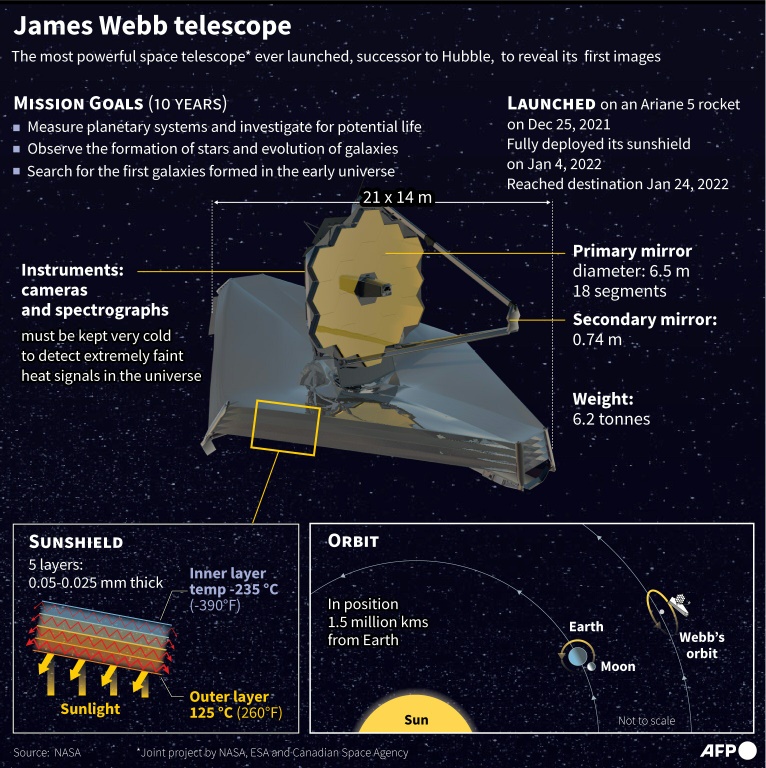
Launched in December 2021 from French Guiana on an Ariane 5 rocket, Webb is orbiting the Sun at a distance of a million miles (1.6 million kilometers) from Earth, in a region of space called the second Lagrange point.

Here, it remains in a fixed position relative to the Earth and Sun, with minimal fuel required for course corrections. 

A wonder of engineering, the total project cost is estimated at $10 billion, making it one of the most expensive scientific platforms ever built, comparable to the Large Hadron Collider at CERN.

Webb’s primary mirror is over 21 feet (6.5 meters) wide and is made up of 18 gold-coated mirror segments. Like a camera held in one’s hand, the structure must remain as stable as possible to achieve the best shots.

Charlie Atkinson, chief engineer on the James Webb Space Telescope program at lead contractor Northrop Grumman, told AFP that it wobbles no more than 17 millionths of a millimeter.

After the first images, astronomers around the globe will get shares of time on the telescope, with projects selected competitively through a process in which applicants and selectors don’t know each others’ identities, to minimize bias.

Thanks to an efficient launch, NASA estimates Webb has enough propellant for a 20-year life, as it works in concert with the Hubble and Spitzer space telescopes to answer fundamental questions about the cosmos.
Autopsy in Spain for ex-Angola leader amid foul play claims

An autopsy has been carried out on in Spain on former Angolan President Jose Eduardo dos Santos, who died last week in Barcelona, at the request of one of his daughters who suspects foul play, her lawyers said Monday.

The results of the autopsy, which was carried out over the weekend, are not yet available, a spokesperson for Tchize dos Santos’ lawyers said.

A Barcelona court authorised the post-mortem on Friday, the day of his death, a court spokeswoman said.

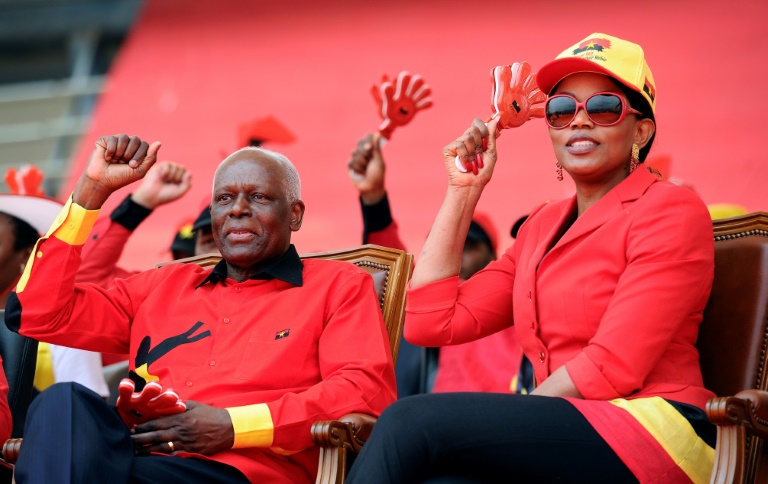
Dos Santos, who ruled Angola with an iron fist between 1979 and 2017, had lived in Barcelona since April 2019.

The 79-year-old was taken to hospital and placed in intensive care after suffering a cardiac arrest on June 23. 

His 44-year-old daughter — whose full name is Welwitschia dos Santos — swiftly demanded the hospital retain his body “until an appropriate autopsy is carried out.”

She said in a statement on Saturday there were “a series of signs” that her father’s death occurred under “suspicious circumstances”.

Tchize has filed a legal case in Spain against the former Angolan president’s widow, Ana Paula, and his personal physician for “attempted murder”.

The complaint also includes allegations relating to “failure to exercise a duty of care, injury resulting from gross negligence and disclosure of secrets by people close to him,” her lawyers said in a statement on Friday.

Tchize claimed her father and his wife — a former flight attendant 18 years his junior — had been separated for some time, meaning that his spouse had no right to make decisions about his health. 

She said her father’s health “seriously deteriorated” after Ana Paula arrived in Barcelona and moved into her father’s home in the Spanish city.

Police confirmed receiving the complaint and said they had opened an inquiry. 

Tchize also argues her father wanted to be buried privately in Spain and not in Angola in a state funeral “which could favour the current government” in the former Portuguese colony.

– Corruption allegations –

Angolan Foreign Minister Tete Antonio declined to comment on her accusations on Friday as he left the Barcelona hospital where the former president had been treated.

“We did not come here to deal with these things,” he told reporters.

Born in the slums of Luanda, dos Santos was one of Africa’s longest-serving leaders.

Critics say he used his nation’s oil wealth to enrich his family but left his people among the poorest on the planet.

When he stepped down in 2017, dos Santos handed over to former defence minister Joao Lourenco whom he had handpicked to succeed him. 

But Lourenco quickly turned on his erstwhile patron, unleashing an anti-corruption drive to recoup the billions he suspected had been embezzled under dos Santos.

Dos Santos’s son Jose Filomeno has been in prison since 2019 on corruption charges.

His eldest daughter Isabel who was once named by Forbes as Africa’s richest woman, faces a slew of investigations into her multinational business dealings.

Lourenco, who is seeking re-election in August, nonetheless declared five days of national mourning over the death of dos Santos, calling it a “big loss” for Angola. 

China lockdown fears hit equities, oil prices

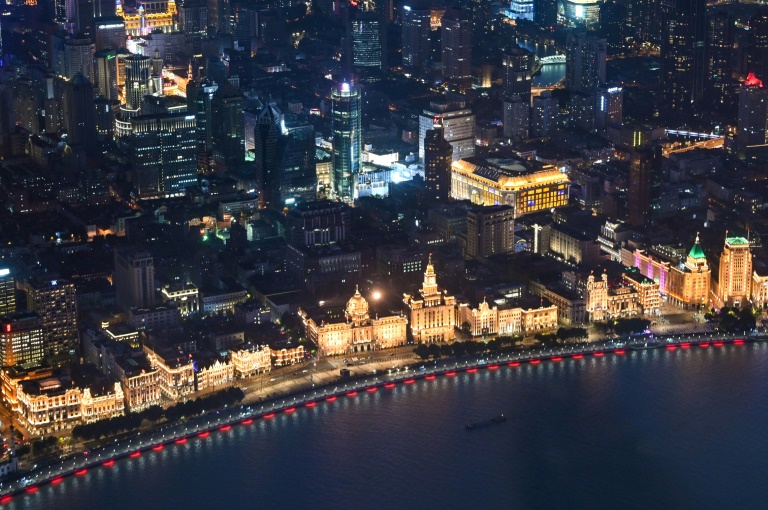
Stock markets and oil prices slid Monday with a fresh Covid flare-up in Shanghai fanning fears of another painful lockdown in China’s biggest city.

European equities headed south following hefty losses for most main Asian markets, and Wall Street followed suit as investors braced for the beginning of the corporate earnings season later this week.

The euro continued to weaken against the dollar, heading towards parity with the greenback for the first time in more than 20 years.

And the European Commission said it would again cut its growth forecast for the current year and hike its expectations for inflation.

“It is no longer a question of if euro-dollar will fall to one, but more a question of how quickly and will it stop there,” City Index analyst Fiona Cincotta told AFP.

“With energy security concerns rising by the day in Europe, a recession seems almost impossible to avoid. Meanwhile, the strong US jobs report means that a 100-basis-point rate hike this month can’t be discounted. The diverging economic outlooks and the significantly more hawkish Fed means that euro-dollar could comfortably fall below parity,” she said.

AJ Bell investment analyst Danni Hewson said “three catalysts… could shake investors out of their torpor as we get the latest reading of US inflation, GDP (gross domestic product) figures from China and the big US banks kick-off the second quarter earnings season across the Atlantic.” 

Traders were keeping tabs on US President Joe Biden as he weighs removing some of the tariffs on Chinese goods worth hundreds of billions of dollars that were imposed by predecessor Donald Trump.

– China growth fears –

The prospect of another lockdown sparked an equities sell-off in Hong Kong and Shanghai on Monday.

Chinese tech firms took a battering after authorities fined giant Tencent and Alibaba over not properly reporting past deals.

Hong Kong-listed casino operators were also sharply lower after officials in Macau embarked on a week-long lockdown to curb its worst coronavirus outbreak.

There were also losses in Sydney, Seoul, Taipei, Manila, Mumbai, Jakarta and Wellington.

However, Tokyo rose as traders welcomed Japan’s ruling bloc securing a strong win in Sunday’s upper house election, held days after the assassination of former premier Shinzo Abe.

The result should provide the government with some stability, while there were also hopes for a cabinet reshuffle and economic stimulus.

Shanghai recorded more than 120 virus cases at the weekend, having seen its first one of the highly contagious BA.5 Omicron strain, forcing officials to launch another mass testing drive.

With China fixated on its zero-Covid strategy to wipe out the disease, there is increasing concern that authorities will revert to another painful lockdown. Shanghai residents only emerged from a two-month confinement in June.

There have meanwhile been new infections uncovered in other parts of the country, including Beijing.

Data this week will provide a fresh update on the economic impact of those measures, as well as similar strict controls in Beijing.

– Key figures at around 1345 GMT –

New York – Dow: DOWN 0.5 percent at 31,181.08 points

London – FTSE 100: DOWN 0.2 percent at 7,178.74

Frankfurt – DAX: DOWN 1.5 percent at 12,823.32

Paris – CAC 40: DOWN 1.1 percent at 5,969.67

EURO STOXX 50: DOWN 1.2 percent at 3,466.34

Tokyo – Nikkei 225: UP 1.1 percent at 26,812.80 (close)

Hong Kong – Hang Seng Index: DOWN 2.8 percent at 21,124.20 (close)

Shanghai – Composite: DOWN 1.3 percent at 3,313.58 (close)

West Texas Intermediate: DOWN 2.3 percent at $102.35 per barrel

Brent North Sea crude: DOWN 2.0 percent at $104.85 per barrel

Euro/dollar: DOWN at $1.0062 from $1.0183 on Friday

Pound/dollar: DOWN at $1.1892 from $1.2034 

Euro/pound: UP at 84.63 pence from 84.59 pence

Dollar/yen: UP at 137.37 yen from 136.10 yen

burs-spm/bp

Love letters and tax returns: Bolivia's sidewalk scribes prefer typewriters

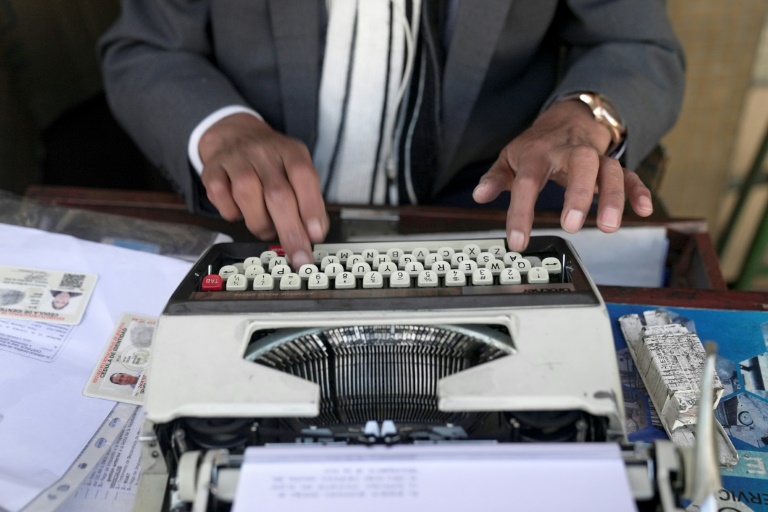
Dressed in a suit, a feather in his hat, Rogelio Condori sits bent over a small table on a sidewalk in La Paz, tapping on a typewriter with his index fingers.

As clients line up by his desk, which is perched at an angle, 61-year-old Condori fills out a tax form here, a divorce application there, on his Brother Deluxe 1350 vintage typewriter in the Bolivian capital.

For a fee of up to seven bolivianos (about $1) per page, “we handle everything related to national taxes,” he told AFP with obvious pride from behind a full-face plastic mask. 

Condori and his colleagues also dole out what advice they can.  

“We can’t complain,” he said of his livelihood, which covers “the bread of the day” in a poor country with a minimum monthly wage of about $320.

Condori competes with nine other typewriter scribes on the same street, but said he has regular clients.

In Bolivia, much administrative paperwork is unavailable online and must instead be submitted in typed form. 

About 60 percent of Bolivians have internet access, but connections are often slow.

“I have not had good experiences with accountants and lawyers,” said Lazario Cucho, a 56-year-old farmer who has used Condori’s services.

“And on top of that, they charge a lot.”

– Love letters –

As the sun climbs in the sky, Condori opens an umbrella to cast some shade over his workspace.

He looks up from his work to see a couple, both grim-faced, who have come for help with a divorce form.

Another client wants him to fill out a bank loan application.

“Every now and then, we do love letters,” Condori said, smiling amid the din of traffic and street vendors on the corner that has been his outdoor office for the last 37 years.

Once, a man approached him for help with a souring relationship.

“I wrote: ‘My love… let our years together not be in vain. Please reconsider our situation,'” Condori recounted the letter he composed for the man.

The man “sent the letter and came back a month later to say: ‘Mr Rogelio, we have reconciled thanks to the love letter,'” the typist said.

Condori recently set up an office complete with internet and a computer, but he much prefers his “exciting” sidewalk perch.

“Typewriters are easier to use, and they are fast,” he said. 

At 3:00 pm, Condori packs his mobile desk onto a cart, which he pushes to a nearby warehouse where it will stay overnight.

“I think this typewriting thing will continue,” said Condori of his craft.

“They will always come for love letters.”

Former Japan PM Abe mourned at wake as US hails 'man of vision'

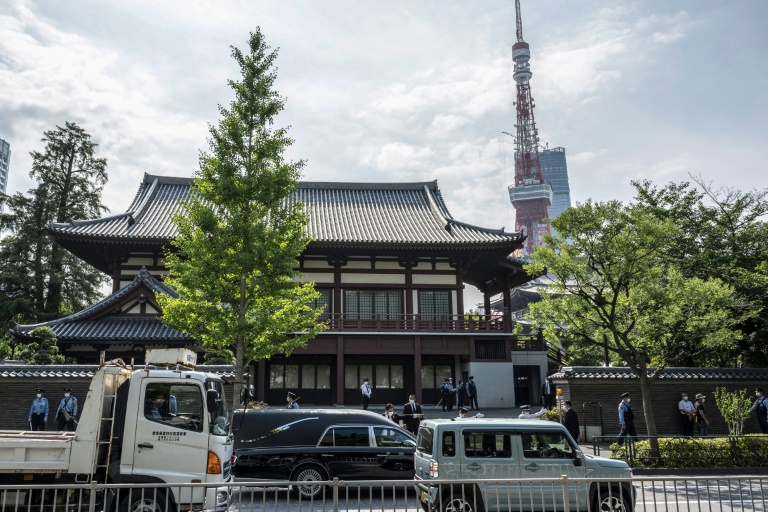
Family and friends of Japan’s assassinated former prime minister Shinzo Abe paid their respects Monday at a wake in Tokyo as Washington’s top diplomat hailed the ex-premier as a “man of vision”.

Japan’s ruling coalition meanwhile declared victory in a sombre election held Sunday, just two days after Abe was gunned down on the campaign trail.

Abe’s body was moved from his family home to the Zojoji temple on Monday afternoon, where his wake is being held ahead of tomorrow’s private funeral.

Public memorials for him are expected at a later date, with no immediate plans set for the events.

Earlier, US Secretary of State Antony Blinken made a previously unscheduled trip to Japan while travelling in Asia to offer Washington’s condolences.

He handed Prime Minister Fumio Kishida letters from US President Joe Biden for Abe’s family and said he had come because “we’re friends, and when one friend is hurting, the other friend shows up”.

Abe “did more than anyone to elevate the relationship between the United States and Japan”, Blinken added, calling him “a man of vision with the ability to realise that vision”.

US Treasury Secretary Janet Yellen — in Tokyo for meetings ahead of a gathering of G20 finance chiefs in Bali — also attended the wake, as did ambassador Rahm Emanuel, according to a Treasury official.

– Religious group –

The man accused of Abe’s murder, 41-year-old Tetsuya Yamagami, is in custody and has told police he targeted the former leader because he believed he was linked to a specific organisation that authorities have not yet named.

Japanese media reports said he blamed the group, described as a religious organisation, for his family’s financial troubles because his mother made large donations to it.

The Unification Church, a global religious movement founded in Korea in the 1950s, said on Monday that Yamagami’s mother was a member.

“She has been attending our events about once a month,” Tomihiro Tanaka, president of the church in Japan, told a hastily organised press conference in Tokyo, declining to comment on donations she may have made.

Tanaka said the church was horrified by Abe’s “barbaric” murder and would cooperate with police investigations.

Yamagami, believed to have spent three years in Japan’s navy, had watched YouTube videos to help learn how to build homemade guns like the one used in the attack, investigative sources told local media.

– Election victory –

Sunday’s election went ahead despite the assassination, with Kishida saying it was important to show violence would not defeat democracy.

Abe’s long-ruling Liberal Democratic Party and its coalition partner Komeito won 76 of the 125 upper house seats up for grabs, up from the 69 seats they previously held, according to national news outlets.

The victory had been widely expected even before the assassination.

Both parties belong to what is now a two-thirds supermajority open to amending the country’s pacifist constitution. Abe long sought to reform the charter to recognise the country’s military.

Kishida told reporters on Monday that the seats gained represented a chance to “protect Japan” and build on the achievements of Abe, who local media said Monday would receive Japan’s highest decoration.

Kishida, who took office in September, has pledged to tackle the pandemic, inflation and issues related to Russia’s invasion of Ukraine, and there was speculation that Friday’s attack could bolster his support.

But turnout was up only marginally, and still low at a reported 52 percent.

A record 35 female candidates were elected, and some fringe candidates also won for the first time, including one from an anti-vaccination party.

Abe was the scion of a political family and became the country’s youngest post-war prime minister when he took power for the first time in 2006, aged 52.

His hawkish, nationalist views were divisive, particularly his desire to reform the pacifist constitution, and he weathered a series of scandals, including allegations of cronyism.

But he was lauded by others for his economic strategy, dubbed “Abenomics”, and his efforts to put Japan firmly on the world stage, including by cultivating close ties with Biden’s predecessor Donald Trump.

Top US envoy in Hong Kong rebukes China's crackdown in farewell speech

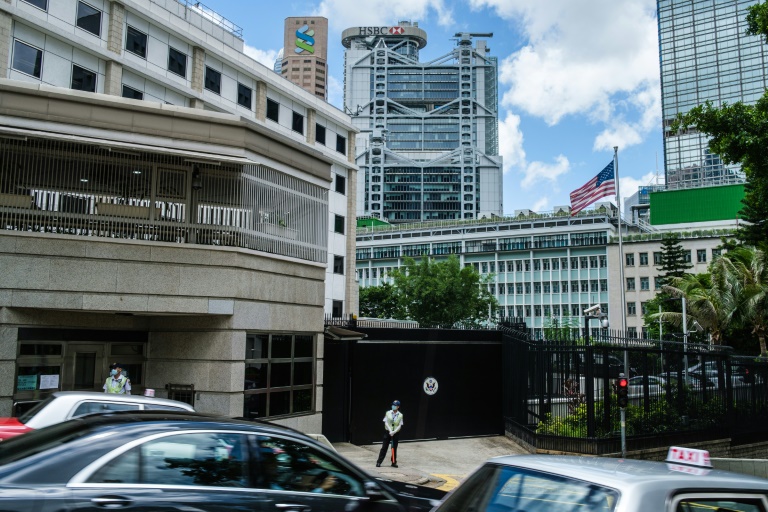
Washington’s top diplomat in Hong Kong said China should not be “terrified of dissenting opinions” as he used a farewell speech on Monday to rebuke Beijing’s crackdown on freedoms in the business hub.

Hanscom Smith’s three-year term as consul general was caught in mounting challenges as Beijing and Washington took opposing sides on the city’s huge, sometimes violent pro-democracy protests in 2019.

China imposed a sweeping national security law on the city following the protests and Washington implemented sanctions against top Hong Kong officials. US officials confirmed privately that since then city officials refused to meet with Smith.

The consul general complained that routine diplomatic activities were characterised as “interference” and diplomats have been threatened under the security law.

“Strong nations are not terrified of dissenting opinions. An exchange of views is not collusion. Attending an event is not interference. A handshake is not ‘a black hand’,” Smith said in his farewell speech at the American Chamber of Commerce in Hong Kong.

He reaffirmed that Washington did not support Hong Kong independence and “we simply ask Beijing to … give the city the autonomy Beijing promised”.

Since its handover to China in 1997, Hong Kong has been governed under a “one country, two systems” principle agreed by Britain and China and codified in the city’s mini-constitution.

Under it, China promised to allow Hong Kong to keep its capitalist system, independent judiciary, a high degree of autonomy and certain liberties rarely enjoyed on the mainland, for 50 years.

But the security law and ensuing political crackdown have profoundly changed Hong Kong’s political landscape, effectively stifling dissent.

“No other major global business centre has witnessed such a significant erosion in the political environment in such a short period of time,” Smith said.

Beijing said the law was necessary for safeguarding national security and accused “hostile external forces” — in particular the United States — and “anti-China elements in Hong Kong” of colluding to instigate secessionist protests in the city.

Chinese President Xi Jinping, during a rare visit to Hong Kong to celebrate the 25th anniversary of the handover on July 1, said the city had been “reborn from the fire” and the law had “turned chaos into stability”.

Smith refuted such claims.

The diplomat said millions of Hong Kongers protested in 2019 not for independence but “for the freedoms and autonomy they were promised”.

“Blaming ‘foreign forces’ for unrest and violence, a beloved trope of authoritarian governments, is merely the PRC leadership’s effort to shirk responsibility and pin its shortcomings on a foreign scapegoat,” Smith said, using the acronyn for the People’s Republic of China.

“Efforts to depict Hong Kong as a ‘pawn’ in a great power struggle are another attempt to evade the truth: America’s policy on Hong Kong has been steadfast for decades.”

Smith also warned that Beijing cannot expect Hong Kong to maintain its status as an international financial and business hub as it continued to degrade the city’s political institutions.

“By constraining political and social freedoms, the PRC will inevitably compromise the attributes that have allowed Hong Kong to develop as a global services hub,” he said.

“Beijing can’t have it both ways.” 

Spain, Portugal swelter under new heat wave

Temperatures were set to soar above 40 degrees Celsius across large parts of Spain and Portugal on Monday as the Iberian Peninsula faces a second heat wave in less than a month.

The mercury was to hit 42 degrees Celsius (107.6 Fahrenheit) in Spain’s southeastern region of Extremadura and 41 degrees in Andalusia, Spain’s meteorological agency AEMET said.

Temperatures in Spain’s normally cooler northwestern region of Galicia were predicted to rise above 35C.

“This heatwave really has the potential to be exceptional,” said AEMET spokesman Ruben del Campo.

The heat wave began Sunday and could “last nine or ten days, which would make it one of the three longest heat waves Spain has seen since 1975,” he told AFP.

Heat waves have become more likely due to climate change, scientists say. As global temperatures rise over time, heat waves are expected to become more frequent and intense.

June also saw Spain grapple with temperatures above 40C in swathes of the country.

And the previous month was Spain’s hottest May since the beginning of the century.

In August 2021 Spain recorded its highest ever temperature when the mercury reached 47.4C in the southern town of Montoro.

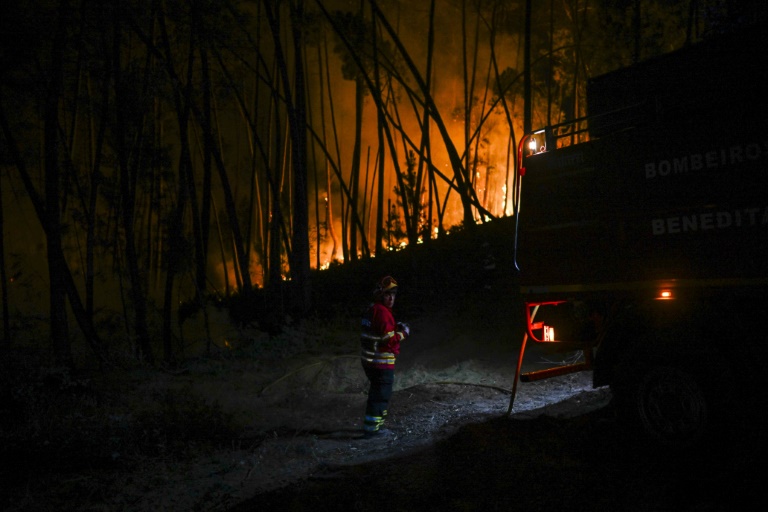
In neighbouring Portugal the thermometer topped 44C over the weekend, fuelling wildfires and vast smoke clouds which were visible in the capital Lisbon.

Firefighters brought under control Monday the largest blaze which was burning in the central municipality of Ourem, local officials said.

While temperatures eased somewhat in Portugal on Monday they were expected to soar again in the coming days with 44C forecast for the southeastern city of Evora.

Water reservoirs in Spain stood at 45.3 percent of capacity on Monday, well below the average of 65.7 percent recorded during this period over the past decade.

Close Bitnami banner
Bitnami