World

Troubled waters: Iraqi spa reborn after IS massacres

A mineral spa in northern Iraq is regaining popularity as renovation work has brought back visitors, in a city once ruled by jihadists who carried out mass executions.

Hisham Khaled often visited the Hamam al-Alil baths as a child with his father but since the facility’s restoration he comes alone. 

His father, a policeman, was executed near the baths by the Islamic State (IS) group in 2016.

Located 30 kilometres (20 miles) south of Mosul, Hamam al-Alil — meaning the baths of the sick in Arabic — built a solid reputation over decades with its therapeutic sulphurous waters.

But the spa and surrounding village, which shares the same name, is now also known for massacres committed by IS during its occupation of the area.

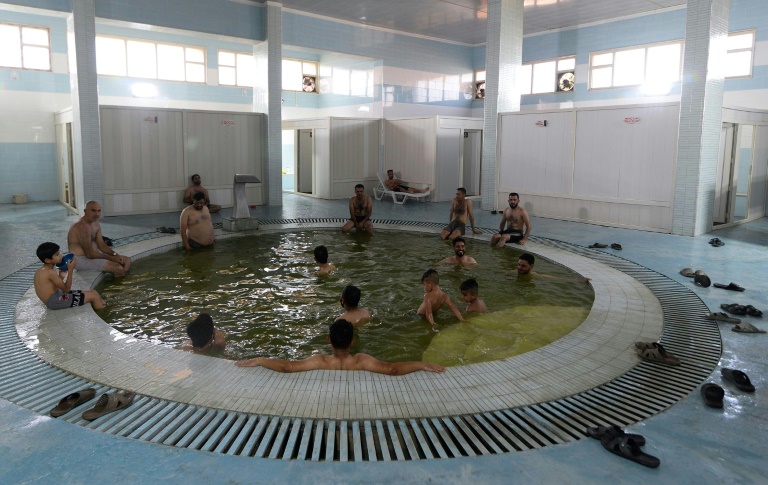
“I lost the people who were dearest to me,” says Khaled, 21, sitting shirtless and in his underpants near the spa’s circular pool. 

His father, a police colonel, was among hundreds of local officers rounded up and executed by IS. Their bodies were discovered in November 2016 in a mass grave close to an agricultural college in the village.

“It pains my heart. My father and I used to come to the baths together. Now he’s gone and I’ve come here alone,” adds the 21-year-old father of twins.

– Rebuilding –

Like other parts of the Mosul area, the slow pace of reconstruction, five years after the jihadists were driven out, leaves locals frustrated.

But last month’s reopening of the baths, on the banks of the Tigris River, contributes to a return to normality, even if the scars of conflict remain. 

Khaled is now a masseur at the spa and bathes regularly. He says the sulphur-rich waters have cured him of an allergy and dermatological problems.

In its newly tiled rooms, men and children enjoy a moment of therapeutic relaxation for 5,000 dinars ($3). 

In underpants or shorts they fill tubs with green, hot spring water, pouring it over their heads and then vigorously rubbing their bodies — despite the nauseating smell characteristic of sulphur.

An old man exits his wheelchair and bathes in the waters, doing stretching exercises with his arms.

The resort, built in 1984, accommodates between 75 and 100 people, with men and women using separate areas. 

On surrounding sidewalks, makeshift stalls sell plastic bottles filled with sulphurous mud. 

Salam Adel Hassan has made the trip from Baghdad and says he first visited the spa 20 years ago. 

“The spa was very rudimentary, not like now. The renovations are a success, I’m delighted,” the 30-year-old says with a smile. 

“My brother has psoriasis. He couldn’t come. I’m going to take him water and mud,” he says. 

After the defeat of IS in 2017, the baths remained popular although the building had fallen into disrepair, with chipped tiles and broken windows. 

In 2019, authorities undertook renovation work costing $500,000. 

Construction materials were carefully selected to resist wear and oxidation caused by sulphurous waters, says Ahmed Aziz Ahmed, an employee at the spa. 

“The day after the inauguration, we began to receive groups of visitors from all the provinces” of Iraq, he says. 

Families originally from Mosul but now living abroad have come, as have British and German tourists, he adds.

– Mass grave – 

In late 2016, months before being driven out of Mosul by the Iraqi army and a US-led international coalition, IS rounded up and executed hundreds of people.

The bodies of some of the victims were initially found dumped in the open among garbage, leading investigators to the mass grave estimated to hold “the bodies of at least 300 former local police officers”, Human Rights Watch said at the time.

Today, local officials denounce the slow pace of identifying the bodies as DNA testing is still underway.

The jihadists “worked at night, they executed them and buried them with a bulldozer”, explains Ahmed, the spa employee.
Sri Lanka's president to resign after being chased from home

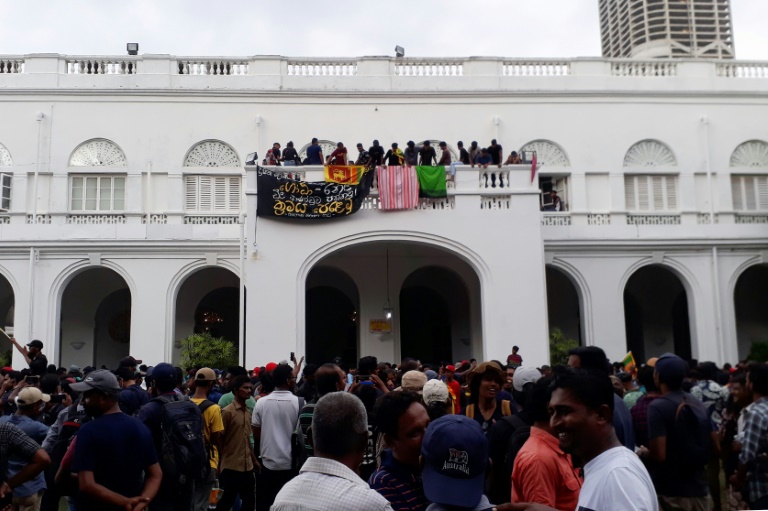
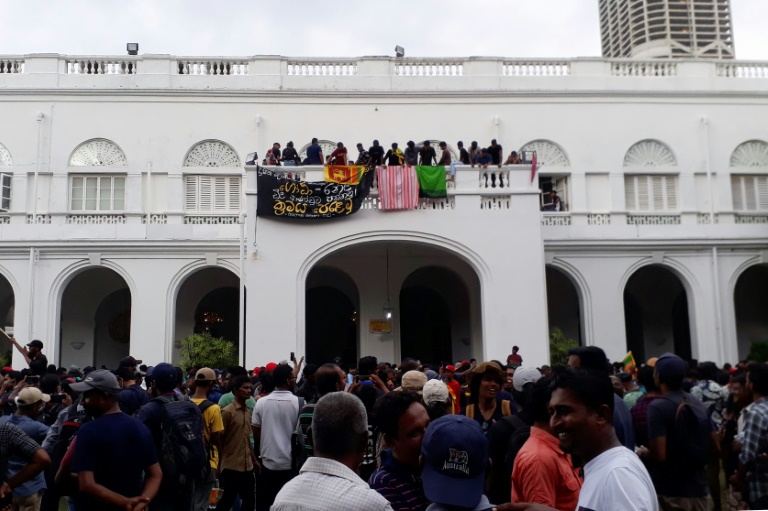
Sri Lanka’s President Gotabaya Rajapaksa was preparing Sunday to finally give up power after he fled from protesters who stormed his home, forcing him to announce his resignation.

The events on Saturday were the culmination of months of anti-government protests fuelled by an unprecedented economic crisis that bankrupted the South Asian island nation, and fury over the ruling Rajapaksa clan’s corruption.

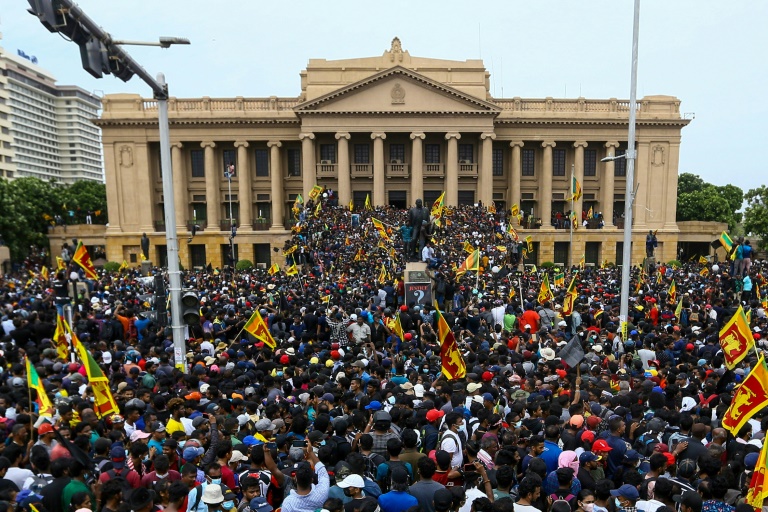
Hundreds of thousands of people had massed in the capital, Colombo, on Saturday to demand the government take responsibility for mismanaging the nation’s finances, and for crippling food and fuel shortages.

After storming the gates of the presidential palace, a throng of protesters walked through its rooms, with some among the boisterous crowd jumping into the compound’s pool.

Others were seen laughing and lounging in the stately bedrooms of the residence, with one pulling out what he claimed was a pair of Rajapaksa’s underwear.

After fleeing, Rajapaksa boarded a naval craft at the Colombo port and was taken to the island’s southern waters, where he said would finally bow to demands for him to step down. 

“To ensure a peaceful transition, the president said he will step down on July 13,” parliamentary speaker Mahinda Abeywardana said in a televised statement.

Rajapaksa had to be extracted from his residence by troops who fired into the air to keep the crowd outside at bay. 

Soon after the protesters stormed the presidential palace, Rajapaksa’s nearby seafront office also fell into the hands of protesters.

Prime Minister Ranil Wickremesinghe, the first person in line to succeed Rajapaksa, called a meeting with political leaders and said he was willing to step down to pave the way for a unity government.

But that failed to placate protesters, who stormed the premier’s private residence and set it alight after night fell. 

Footage shared on social media showed a crowd cheering the blaze, which broke out shortly after a security detachment guarding Wickremesinghe attacked several journalists outside the home. 

No casualties have been reported in the fire so far, and police said Wickremesinghe and his family were away at the time.

Rajapaksa’s resignation announcement was set to trigger a power struggle.

The United States on Sunday urged Sri Lankan leaders to act quickly to seek long-term solutions.

The United States calls on “the Sri Lankan parliament to approach this juncture with a commitment to the betterment of the nation — not any one political party,” a State Department spokesperson said as Secretary of State Antony Blinken visited Thailand.

-Default, desperation –

Security forces attempted to disperse the huge crowds that had mobbed Colombo’s administrative district earlier in the day, with dozens injured in the resulting clashes. 

A spokeswoman for Colombo’s main hospital said three people were being treated for gunshot wounds, along with 36 others suffering breathing difficulties after being caught up in tear gas barrages.

Sri Lanka has suffered through months of shortages of basic goods, lengthy blackouts and galloping inflation after running out of foreign currency to import necessities.

The government has defaulted on its $51 billion external debt and is seeking an International Monetary Fund bailout.

Sri Lanka has nearly exhausted its already scarce supplies of petrol, and people unable to travel to the capital held protests in other cities across the island on Saturday. 

Demonstrators had already maintained a months-long protest camp outside Rajapaksa’s office demanding his resignation. 

The camp was the scene of clashes in May when a gang of Rajapaksa loyalists attacked peaceful protesters gathered there. 

Nine people were killed and hundreds were wounded after the violence sparked reprisals against pro-government mobs and arson attacks on the homes of lawmakers. 

– Cricket goes on –

The unrest comes at the tail end of Australia’s ongoing cricket tour of Sri Lanka, with Pakistan’s squad also on the island for their upcoming series. 

Cricket officials said there were no plans to change their schedules, adding that the sport was unaffected by the political turmoil.

“The Australian Test is coming to an end and we are due to start the Pakistan series,” a cricket board official told AFP. 

“There is no opposition to having the games. In fact, fans are supportive and we have no reason to reschedule.”

Festivals, guesthouses breathe life back into old Tunis

Children’s cries echo through the alleyways as they hunt for hidden treasure — part of growing efforts to bring life back to the Old City of Tunis.

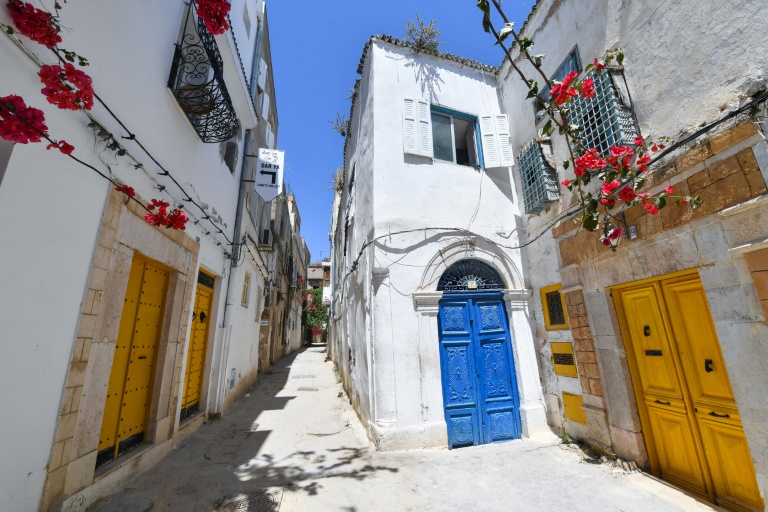
While parts of the ninth-century medina are packed with tourists during the day, it is largely deserted at night and at the weekend.

Writer Hatem Bourial said the medina, one of the first cities built after the Muslim conquests of North Africa and home to the renowned Zitouna mosque, has a deep “emotional charge”.

“It’s the haven of the first madrassas (Koranic schools), and the Zitouna is one of the most famous and oldest mosque-universities in the world,” he said.

But, he added, “people traditionally don’t go in the medina at night, as every souk closes its doors.”

The medina was founded in the ninth century, but its real expansion began in the 13th century, when Tunis became the capital of the Hafsid dynasty’s kingdom, stretching along the Mediterranean coast to Tripoli in what is now Libya.

The kingdom survived an attempt by King Louis IX to capture it, with the French monarch dying of dysentery in the process.

Under the Hafsids, Tunis was one of the biggest cities in the Islamic world, and their legacy has remained in the form of narrow, crowded souks that contributed to the medina being awarded UNESCO heritage status in 1979.

– ‘Create experiences’ –

The district also has some two dozen small souks devoted to specific artisans such as tanners, perfume sellers and shoemakers.

“The medina is the lung of Tunisia, and it’s where Tunis began,” said Salma Garbi, a 38-year-old architect who was taking part in a guided walk.

While visitors mostly stick to its two main arteries, “new cultural events are popping up and breathing life into the medina”, she said.

Garbi welcomed the launch of two art festivals, Interference (art and lights) and Dream City, which involves young artistic productions in unusual places like chapels, often in the evenings.

“They’ve breathed life back into the medina,” she said.

She also pointed out that in Ramadan, shops and cafes stay open late and the medina bustles with concerts and modern dance shows into the small hours.

The district has also found new life from the creation of Art Rue, which organises art workshops with local schools, and a string of guesthouses.

Leila Ben Gacem, who set up her first guesthouse in the UNESCO-listed old city in 2013, is on a mission to brighten up the neighbourhood.

She has brought together a group of small businesses to “create experiences so people enjoy coming to the medina, spend the weekend there, meet craftspeople and enjoy authentic moments,” she said.

The Mdinti project (“my city” in Arabic), financed by German aid agency GIZ, which also campaigns for better lighting and cleaner streets, has 21 members including artisanal workshops, guesthouses, cafes and restaurants.

They are hosting activities across the year, from treasure hunts to walking tours and classes in North African cooking, Arabic calligraphy and making traditional “balgha” shoes (heelless leather slippers).

“If there’s something to do at night or on Sundays, shopkeepers will close later or keep their shops open,” said Souhail Fitouri, who is involved in the Mdinti project.

– Funding constraints –

For this summer, Ben Gacem has a list of potential events for tourists and residents: rooftop cinema screenings, meetings with craft workers, historians and some of the medina’s 25,000 residents.

But residents say that for the medina to experience a real revival, more state support is needed — a big request, given the sorry state of Tunisia’s public finances.

The government has this month begun bailout negotiations with the International Monetary Fund, as its tourism and import-dependent economy has been battered by the coronavirus pandemic and elevated global food and energy prices.

Hatem Bourial bemoans the fact that both the Sidi Bou Khrissane lapidary (gem-carving) museum and the Dar Ben Abdallah museum of popular arts and traditions have been closed for 15 years. The same applies to the famous Tourbet el Bey mausoleum.

And the Zitouna mosque is completely off-limits for non-Muslims. Bourial recommends opening “at least the patio” to visitors.

“The signs currently say entrance is only for Muslims and women with their hair covered. That’s an insult to the very notion of hospitality,” he said.

Twitter's future uncertain as it faces messy breakup with Musk

Courted and then jilted by the world’s richest person, Twitter looks well positioned to win a court battle with Elon Musk over a $1 billion breakup fee and more — but the company will not emerge unscathed.

The entire saga has left observers baffled by what Wedbush analyst Dan Ives described as “one of the craziest business stories ever.”

“I think it starts off as a circus show and it’s ending as a circus show,” Ives told AFP. 

Musk, the founder of electric car company Tesla, sent a letter to Twitter on Friday saying he was pulling out of the controversial deal he made in April to buy the platform for $54.20 per share, or $44 billion in total. 

But such merger agreements are “designed to prevent buyers from getting cold feet and deciding they want to walk away,” explains Ann Lipton, a professor of law at Tulane University who specializes in corporate litigation.

Musk, who also heads SpaceX, has accused the social media giant of “false and misleading representations” about the number of fake accounts on its platform.

His lawyers also point to recent Twitter employee layoffs and hiring freezes, which they say are contrary to the company’s obligation to continue operating normally. 

Those arguments may be valid, but they do not merit pulling out of the deal, says Lipton, dismissing them as “nitpicky.”

“It’s not enough, unless he can show that the representations (about fake accounts) are not just false, but also that they dramatically call the fundamentals of the deal into question,” she explains. 

“Looks very much like Musk is legally wrong.”

– ‘Twitter would die off’ –

That leaves the possibility that the multi-billionaire is actually trying to renegotiate the price down. 

This tactic has been used successfully elsewhere, such as by LVMH: two years ago, the global luxury giant broke off a deal to acquire Tiffany before getting a discount. 

But experts don’t see how Musk and Twitter could agree on a different price at this point, given that the platform’s stock has lost more than a quarter of its value since late April. 

“Both have a lot to lose,” Lipton points out. 

If Twitter wins in court, the mercurial entrepreneur will, at a minimum, have to pay a few billion dollars in damages. 

At worst, he could be forced to honor his commitment and buy Twitter at a price that has become exorbitant, while his fortune has melted down by tens of billions of dollars in recent months.

But though this would be a victory for shareholders, it would still leave Twitter in Musk’s hands — and his libertarian vision of absolute free speech is not aligned with that of many of the employees, users and advertisers on whom the platform’s business model depends.

“Twitter is worse off than six months ago, but in the long run, it’s better off without him,” says Creative Strategies analyst Carolina Milanesi. 

“It feels like a toy that a spoiled kid wants, but doesn’t really know what to do with, so he would get bored of it, and not give it the attention it deserves, and forget it in a corner … Twitter would die off slowly and painfully,” she predicts.

– ‘Battle on all fronts’ –

Any court proceedings are expected to last for months, especially since Musk “will drag it out,” according to Lipton. 

“Twitter is in a strong position,” she says.

But Musk, followed by more than 100 million people on the platform, “will try to embarrass them — it will be distracting and demoralizing for employees,” she argues.

He has already harassed the platform with highly critical tweets, mockery and outlandish suggestions, encouraged by his many fans. 

For Twitter, “it’s going be a battle on all fronts — keeping employees, competitors going after their business, brand issues, investors believing the numbers,” says Ives, the Wedbush analyst. 

Unlike its Silicon Valley neighbors, Twitter has never been a money-making machine, able to turn users’ attention into astronomical advertising revenues. 

“The past few months have been a huge distraction for Twitter, keeping it from focusing on its business fundamentals,” notes Debra Williamson of eMarketer. 

“If Musk is able to terminate the deal, Twitter will still be left with the same problems it had before he came on the scene,” she says.

“Its user growth is slowing. And while ad revenue is still growing marginally, Twitter is now dealing with a slowing economy that could squeeze ad spending on all social platforms.”

Several Tory heavyweights enter already fractious race to replace Johnson

A trio of Conservative heavyweights, including former health ministers Sajid Javid and Jeremy Hunt, late Saturday announced their bids to succeed Prime Minister Boris Johnson, meaning eight contenders have entered the already acrimonious leadership race.

Javid, also a former finance minister, and Hunt, who finished runner-up to Johnson in the last contest in 2019, were joined on the growing candidate list by current Chancellor of the Exchequer Nadhim Zahawi, who was only appointed to that post on Tuesday. 

None of the trio are frontrunners in recent polls of Conservative party members who will ultimately choose their new leader and Johnson’s replacement, but are among the most high-profile to have launched campaigns so far.

Hours earlier, Transport Secretary Grant Shapps said he would run, adding yet another candidate to the typically unpredictable political contest. Shapps is an experienced lawmaker who first served in the cabinet in 2010, but not a frontrunner in the polls either.

But Defence Secretary Ben Wallace, who has impressed in the role and been one of Tory members’ favourites in several recent surveys, announced he would not stand after a discussion with colleagues and family.

The likely months-long campaign, potentially pitting more than a dozen Conservative MPs and multiple factions of the ruling party against each another, is set to be formalised Monday when a committee of backbenchers will meet to agree the timetable and rules.

– Tax debate –

The early frontrunner is former finance minister Rishi Sunak, who helped kickstart the cabinet revolt that led to Johnson’s forced resignation on Thursday.

Sunak and Javid both resigned late Tuesday, triggering dozens of more junior colleagues to follow suit and forcing their ex-boss to then quit as Tory leader 36 hours later.

But Johnson, whose three-year premiership has been defined by scandal, the country’s departure from the European Union and the Covid pandemic, said he would stay on until his successor is selected. 

Party members will eventually select their new leader — from a two-person shortlist whittled down in multiple rounds of voting by all 358 Tory MPs — before the Conservatives’ annual conference in early October.

Attorney general and arch-Brexiteer Suella Braverman, the relatively unknown former equalities minister Kemi Badenoch, and backbench Tory MP Tom Tugendhat have also announced their candidacies.

Foreign Secretary Liz Truss is among those expected to still join the crowded field.

Taxation is set to be a key feature of the race, alongside candidates’ Brexit credentials, as Britain faces the toxic combination of high inflation and rampant cost-of-living increases alongside stagnant growth and relatively high tax rates.

– ‘Plotting’ –

Announcing their bids separately in the Sunday Telegraph, Javid and Hunt both vowed to cut corporation tax from 25 to 15 percent.

Javid said he would also slash or change other taxes, including reversing a recent rise in national insurance that is ringfenced to raise health service funding.

Zahawi also pledged to lower taxes for individuals, families and business, boost defence spending, and continue with education reforms that he started in his previous role heading that government department.

Sunak, narrowly ahead of Truss atop the latest poll of party members, drew immediate support from several senior MPs after declaring he was standing in a slick video on social media late Friday.

He has also been attacked by Johnson loyalists and rival candidates in a sign of the acrimony that could blight the contest.

The Financial Times said Saturday there was “huge anger” within the outgoing prime minister’s team at Sunak over his resignation, with a senior official calling him “a treacherous bastard”.

In a veiled swipe at Sunak, Shapps said in his leadership announcement that he had “not spent the last few turbulent years plotting or briefing against the prime minister… (or) mobilising a leadership campaign behind his back”.

– Fiscal decisions delayed –

Following the nearly 60 resignations that triggered his decision to quit, Johnson assembled a new team to govern in the interim, announcing a flurry of junior appointments late Friday.

At a first meeting of his hastily convened top ministers, the 58-year-old conceded Thursday that “major fiscal decisions should be left for the next prime minister”, Downing Street said.

The Conservatives have declined to say how many eligible members they have, but note it will be more than the 160,000 who voted at the last leadership contest in 2019.

As the list of candidates grows, some senior lawmakers have warned the field must narrow quickly and suggested that the final two-person shortlist to be put to members should be decided within weeks, before parliament’s summer recess starting after July 21.

Jabeur still Tunisia's pride despite Wimbledon loss

Hailing her as the “nation’s pride” and “ambassador of happiness”, Tunisians remained enthralled with tennis star Ons Jabeur Saturday, celebrating her presence in the prestigious Wimbledon final despite her loss.

Jabeur became the world number two player and then made history as the first African or Arab woman to reach a Grand Slam singles final in the modern era.

Although she missed out on the title at the All England Lawn Tennis Club, she said she’ll learn from the experience and can’t wait to play in another final.

“I just try to inspire as many generations as I can,” she said.

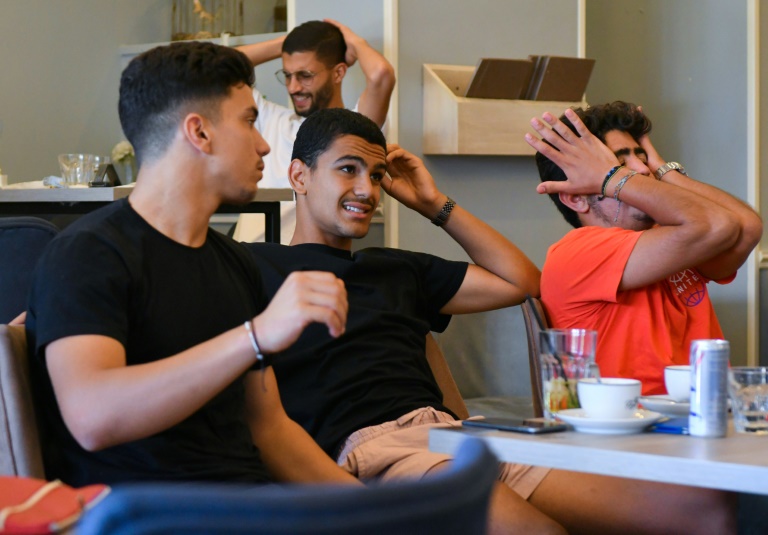
At a cafe not far from the Hammam Sousse tennis club where the 27-year-old began her career, a group of young Tunisian men had been intently watching the match, yelling in excitement at each point she won.

“She’s our Tunisian national product,” said Safwen Ghairi, a 21-year-old student.

He and his friends had rushed through their traditional Eid al-Adha meal to get to the cafe — one of the few open on the national holiday which began Saturday — to watch the match.

Jabeur represents the African continent “and the region at Wimbledon”, Ghairi said. “It’s a real achievement.”

– ‘Nation’s pride’ –

His friend Zaher Edine Dahman, 27, called Jabeur “our ambassador of happiness”.

“The authorities could never match the publicity Ons Jabeur has brought for Tunisia, even if they spent millions,” he said.

“We used to dream of a Tunisian player simply qualifying for Wimbledon, and today, Tunisia is at the final,” he added.

Her former trainer Nabil Mlika told AFP after the match that Jabeur was “the nation’s pride”, wishing her luck for the US Open, which begins next month.

Cafe worker Hafedh Amrouni, 25, said that Jabeur had “honoured” the country despite her coming in runner-up.

Her success has been a rare good news story for a North African country mired in economic and political crisis, made more acute by the coronavirus pandemic and the impact of the war in Ukraine.

On Friday, the country’s Sports Minister Kamel Deguiche said celebrations were planned for after Wimbledon and that he wanted to officially award Jabeur the title of “Minister of Happiness”, adding: “It’s the state’s duty to her.”

– Inspired by her mum –

The youngest of four, born on August 28, 1994 in Ksar Hellal, Jabeur started her career as a child on hotel tennis courts in the nearby resort town of Hammam Sousse.

She has called her mother her inspiration.

“She is a big fan of tennis and took me to a tennis club when I was only three years old,” she said in a BBC column.

“My mum used to play with her friends and I used to commentate… I used to spend the whole day there in the tennis club and I loved it,” she added.

Jabeur said her mother was not in the crowd to watch her play on Saturday because there “wasn’t enough time” for her to apply for a visa. 

Jabeur moved to the capital, Tunis, at the age of 12 to train at a highly rated state-backed sports club.

She made a splash on the global scene in 2011, winning the girls’ singles at the French Open when she was 16.

She reached the world’s top 50 at the Australian Open in January 2020 — the first Arab woman to reach a Grand Slam quarter-final — and has since surged up the rankings.

Her fame has sparked an increased interest in tennis in her home country, and membership levels have skyrocketed at her home club, from 320 in 2018 to more than 700 today.

Relief, disappointment as Musk abandons Twitter deal

Elon Musk’s move to abandon his purchase of Twitter has been greeted with a mix of relief and disappointment across the political spectrum, with many criticizing the Tesla founder but others applauding his “exposure” of the influential messaging platform.

The announcement of the deal valued at $44 billion in late April sparked fears the platform would see a surge in abuse and disinformation after Musk — a self-proclaimed free speech absolutist — said he would largely let anyone say anything allowed by law on Twitter.

Musk’s announcement Friday that he no longer wants to buy Twitter triggered celebration by advocacy groups that had launched a campaign to stop the wealthiest man in the world from going through with the purchase. 

“A Twitter under Musk’s leadership would have ripped open Pandora’s box and reopened the floodgates for hate and baseless conspiracy theories — making the platform, and the country a more dangerous place,” said Bridget Todd, communications director at UltraViolet, an advocacy group.

The deal breakdown “is a welcome reprieve for women, people of color and members of the LGBTQ+ community.” 

Nicole Gill, co-founder and executive director of the left-leaning watchdog Accountable Tech, slammed Musk’s bid as “a chaotic crusade.”

“Our information ecosystem, safety, and democracy cannot remain at the whim of unaccountable billionaires,” she said.

But hopes were dashed for others who believed Musk’s stearing of the platform would lead to a decrease in measures aimed at curbing bullying, lies and other abuses deemed politically motivated and anti-free speech.  

“The party is really over here. The purge is coming,” tweeted conservative commentator Dave Rubin. 

Donald Trump Jr, the son of the former president, predicted “censorship” at Twitter “will be back tenfold.”

“Zero chance of free thought or speech there at this point,” he said on his father’s fledgling Truth Social platform, launched after he was booted from his preferred medium where he’d amassed some 88.7 million followers.

The former president was banned from Twitter following accusations he had used it to incite his followers to assault the US Capitol on January 6 last year.

While Musk said he would lift the ban on the elder Trump, the fellow billionaire said he would stick to Truth Social — a message he reiterated on Friday.

“THE TWITTER DEAL IS DEAD, LONG LIVE THE ‘TRUTH’,” he posted on Truth Social.

Another conservative Twitter competitor, GETTR, also took the opportunity to tout itself as an alternative platform that would “protect online freedom of expression.”

CEO Jason Miller praised Musk “for further exposing the incurable, rotting, politically discriminatory culture” within Twitter.

The deal may be off but the Musk-Twitter tug-of-war is far from over, as the company says it will pursue legal action to enforce the agreement.

UK transport minister latest Tory MP to unveil bid to replace Johnson

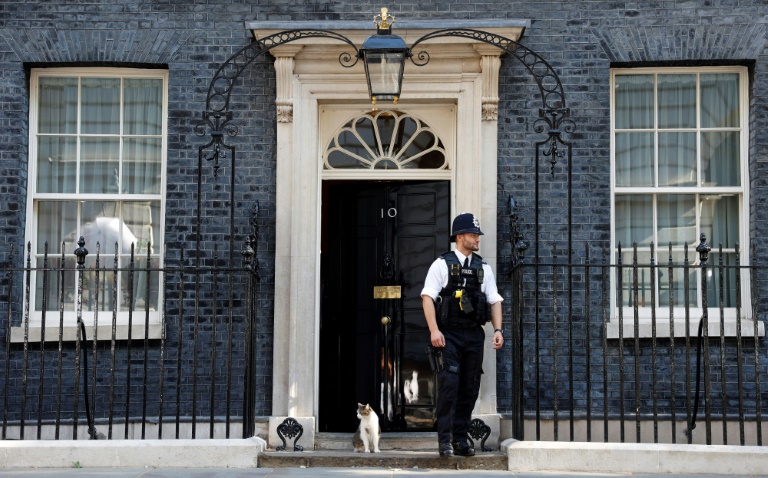
Britain’s transport secretary on Saturday became the fifth Conservative MP to launch a bid to succeed Prime Minister Boris Johnson, a long-shot addition to the growing and already acrimonious leadership race.

Grant Shapps, an experienced lawmaker who first served in the cabinet under former premier David Cameron back in 2010 but not among the current frontrunners in the polls to replace Johnson, vowed to provide “strategic” and “sober” government.

His announcement came hours after Defence Secretary Ben Wallace, who has impressed in the role amid the war in Ukraine and has been one of Tory members’ favourites in several recent surveys, said he will not run after discussing standing with colleagues and family.

“It has not been an easy choice to make, but my focus is on my current job and keeping this great country safe,” he added on Twitter.

The likely months-long campaign, potentially pitting more than a dozen Conservative MPs and multiple factions of the ruling party against each another, is set to be formalised Monday when a committee of backbenchers will meet to agree the timetable and rules.

– Tax debate –

The early frontrunner is former finance minister Rishi Sunak, who helped kickstart the cabinet revolt that led to Johnson’s forced resignation on Thursday.

Sunak resigned late Tuesday, triggering dozens of more junior colleagues to follow suit and forcing his ex-boss to then quit as Tory leader 36 hours later.

But Johnson, whose three-year premiership has been defined by scandal, the country’s departure from the European Union and Covid, said he would stay on until his successor is selected.

A summer of rancorous campaigning now looms. 

Party members will eventually choose their new leader — from a two-person shortlist whittled down in multiple rounds of voting by all 358 Tory MPs — before the Conservatives’ annual conference in early October.

Taxation is set to be a key feature of the race, alongside candidates’ Brexit credentials, as Britain faces the toxic combination of high inflation and rampant cost-of-living increases alongside stagnant growth and relatively high tax rates.

– ‘Plotting’ –

Alongside Sunak, attorney general and arch-Brexiteer Suella Braverman, the relatively unknown former equalities minister Kemi Badenoch and backbench Tory MP Tom Tugendhat have announced their candidacies.

Foreign Secretary Liz Truss and new finance minister Nadhim Zahawi — who replaced Sunak in the treasury — are expected to join the crowded field.

Former foreign secretary Jeremy Hunt, who was runner-up to Boris Johnson in 2019, is also “virtually certain” to run again, allies told UK media.

Former finance and health minister Sajid Javid, who also quit Johnson’s government Tuesday, may also stand but had been asked by Sunak’s allies to step aside to give him a clear run at the leadership, The Times reported.

Sunak, narrowly ahead of Truss atop the latest poll of party members, drew immediate support from several senior MPs after declaring he was standing in a slick video on social media late Friday.

He has also been attacked by Johnson loyalists in a sign of the acrimony that could blight the contest.

The Financial Times said Saturday there was “huge anger” within the outgoing prime minister’s team at Sunak over his resignation, with a senior official calling him “a treacherous bastard”.

In a veiled swipe at Sunak, Shapps said in his leadership announcement that he had “not spent the last few turbulent years plotting or briefing against the prime minister… (or) mobilising a leadership campaign behind his back”.

– Interim government –

Following the nearly 60 resignations that triggered his decision to quit, Johnson assembled a new team to govern in the interim, announcing a flurry of junior appointments late Friday.

At a first meeting of his hastily convened top ministers, the 58-year-old conceded Thursday that “major fiscal decisions should be left for the next prime minister”, Downing Street said.

The Conservatives have declined to say how many eligible members they have but note it will be more than the 160,000 who voted at the last leadership contest in 2019.

As the list of candidates grows, some senior lawmakers have warned the field must narrow quickly and suggested that the final two-person shortlist to put to members be decided within weeks, before parliament’s summer recess starting after July 21.

Sri Lanka's president to resign after being chased from home

Sri Lanka’s President Gotabaya Rajapaksa announced his resignation on Saturday, hours after a crowd of angry protesters chased him from his residence, as months of frustration brought on by an unprecedented economic crisis boiled over.

Hundreds of thousands of people massed in the capital Colombo to demand the government take responsibility for mismanaging the nation’s finances, and for crippling food and fuel shortages.

After storming the gates of the presidential palace, a throng of protesters walked through its rooms, with some among the boisterous crowd jumping into the compound’s pool.

Others were seen laughing and lounging in the stately bedrooms of the residence, with one pulling out what he claimed was a pair of Rajapaksa’s underwear.

At around the same time, the leader had boarded a naval craft at the Colombo port and was taken to the island’s southern waters, where he let it be known he was finally bowing to months of calls for his resignation. 

“To ensure a peaceful transition, the president said he will step down on July 13,” parliamentary speaker Mahinda Abeywardana said in a televised statement.

Rajapaksa had to be extracted from his residence by troops who fired into the air to keep the crowd outside at bay. 

Soon after they stormed the presidential palace, Rajapaksa’s nearby seafront office also fell into the hands of protesters.

Prime Minister Ranil Wickremesinghe, the first person in line to succeed Rajapaksa, called a meeting with political leaders and said he was willing to step down to pave the way for a unity government.

But that failed to placate protesters, who stormed the premier’s private residence and set it alight after night fell. 

Footage shared on social media showed a crowd cheering the blaze, which broke out shortly after a security detachment guarding Wickremesinghe attacked several journalists outside the home. 

No casualties have been reported in the fire so far, and police said Wickremesinghe and his family were away at the time.

Security forces attempted to disperse the huge crowds that had mobbed Colombo’s administrative district earlier in the day, with dozens injured in the resulting clashes. 

A spokeswoman for Colombo’s main hospital said three people were being treated for gunshot wounds, along with 36 others suffering breathing difficulties after being caught up in tear gas barrages.

– ‘Not a deterrent’ –

Sri Lanka has suffered through months of shortages of basic goods, lengthy blackouts and galloping inflation after running out of foreign currency to import necessities.

The government has defaulted on its $51 billion external debt and is seeking an International Monetary Fund bailout.

Thousands of people had poured into the capital for Saturday’s demonstration, the latest outbreak of unrest sparked by the crisis.

Police had withdrawn a curfew issued on Friday after opposition parties, rights activists and the bar association threatened to sue the police chief.

Thousands of anti-government protesters ignored the stay-home order and even forced railway authorities to operate trains to take them to Colombo for Saturday’s rally, officials said.

“The curfew was not a deterrent. In fact, it encouraged more people to get on the streets in defiance,” the defence official said.

Sri Lanka has nearly exhausted its already scarce supplies of petrol, and people unable to travel to the capital held protests in other cities across the island. 

Demonstrators had already maintained a months-long protest camp outside Rajapaksa’s office demanding his resignation. 

The camp was the scene of clashes in May when a gang of Rajapaksa loyalists attacked peaceful protesters gathered there. 

Nine people were killed and hundreds were wounded after the violence sparked reprisals against pro-government mobs and arson attacks on the homes of lawmakers. 

– Cricket goes on –

The unrest comes at the tail end of Australia’s ongoing cricket tour of Sri Lanka, with Pakistan’s squad also on the island for their upcoming series. 

Cricket officials said there were no plans to change their schedules, adding that the sport was unaffected by the political turmoil.

“The Australian Test is coming to an end and we are due to start the Pakistan series,” a cricket board official told AFP. 

“There is no opposition to having the games. In fact, fans are supportive and we have no reason to reschedule.”

Sri Lanka's president to resign after being chased from home

Sri Lanka’s President Gotabaya Rajapaksa announced his resignation on Saturday, hours after a crowd of angry protesters chased him from his residence, as months of frustration brought on by an unprecedented economic crisis boiled over.

Hundreds of thousands of people massed in the capital Colombo to demand the government take responsibility for mismanaging the nation’s finances, and for crippling food and fuel shortages.

After storming the gates of the presidential palace, a throng of protesters walked through its rooms, with some among the boisterous crowd jumping into the compound’s pool.

Others were seen laughing and lounging in the stately bedrooms of the residence, with one pulling out what he claimed was a pair of Rajapaksa’s underwear.

At around the same time, the leader had boarded a naval craft at the Colombo port and was taken to the island’s southern waters, where he let it be known he was finally bowing to months of calls for his resignation. 

“To ensure a peaceful transition, the president said he will step down on July 13,” parliamentary speaker Mahinda Abeywardana said in a televised statement.

Rajapaksa had to be extracted from his residence by troops who fired into the air to keep the crowd outside at bay. 

Soon after they stormed the presidential palace, Rajapaksa’s nearby seafront office also fell into the hands of protesters.

Prime Minister Ranil Wickremesinghe, the first person in line to succeed Rajapaksa, called a meeting with political leaders and said he was willing to step down to pave the way for a unity government.

But that failed to placate protesters, who stormed the premier’s private residence and set it alight after night fell. 

Footage shared on social media showed a crowd cheering the blaze, which broke out shortly after a security detachment guarding Wickremesinghe attacked several journalists outside the home. 

No casualties have been reported in the fire so far, and police said Wickremesinghe and his family were away at the time.

Security forces attempted to disperse the huge crowds that had mobbed Colombo’s administrative district earlier in the day, with dozens injured in the resulting clashes. 

A spokeswoman for Colombo’s main hospital said three people were being treated for gunshot wounds, along with 36 others suffering breathing difficulties after being caught up in tear gas barrages.

– ‘Not a deterrent’ –

Sri Lanka has suffered through months of shortages of basic goods, lengthy blackouts and galloping inflation after running out of foreign currency to import necessities.

The government has defaulted on its $51 billion external debt and is seeking an International Monetary Fund bailout.

Thousands of people had poured into the capital for Saturday’s demonstration, the latest outbreak of unrest sparked by the crisis.

Police had withdrawn a curfew issued on Friday after opposition parties, rights activists and the bar association threatened to sue the police chief.

Thousands of anti-government protesters ignored the stay-home order and even forced railway authorities to operate trains to take them to Colombo for Saturday’s rally, officials said.

“The curfew was not a deterrent. In fact, it encouraged more people to get on the streets in defiance,” the defence official said.

Sri Lanka has nearly exhausted its already scarce supplies of petrol, and people unable to travel to the capital held protests in other cities across the island. 

Demonstrators had already maintained a months-long protest camp outside Rajapaksa’s office demanding his resignation. 

The camp was the scene of clashes in May when a gang of Rajapaksa loyalists attacked peaceful protesters gathered there. 

Nine people were killed and hundreds were wounded after the violence sparked reprisals against pro-government mobs and arson attacks on the homes of lawmakers. 

– Cricket goes on –

The unrest comes at the tail end of Australia’s ongoing cricket tour of Sri Lanka, with Pakistan’s squad also on the island for their upcoming series. 

Cricket officials said there were no plans to change their schedules, adding that the sport was unaffected by the political turmoil.

“The Australian Test is coming to an end and we are due to start the Pakistan series,” a cricket board official told AFP. 

“There is no opposition to having the games. In fact, fans are supportive and we have no reason to reschedule.”

Close Bitnami banner
Bitnami