World

Libya traditional jewellery hangs on by silver thread

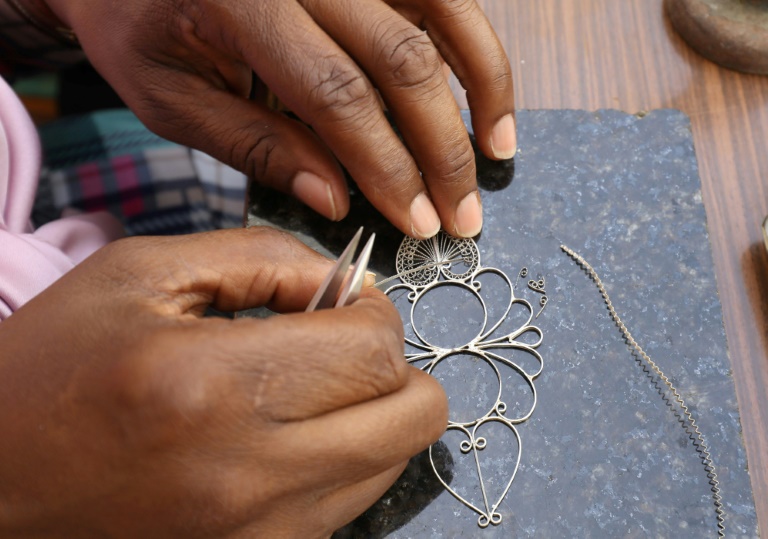
In Tripoli’s Old City, young Libyans weave delicate patterns with threads of silver and gold to create traditional filigree jewellery — reviving an art almost lost through decades of dictatorship and war.

Abdelmajid Zeglam is just 12 years old, but his minutely detailed creations are already selling fast in the streets around a Roman-era archway dedicated to emperor Marcus Aurelius. 

“I hesitated at first for fear of failing because I’m young, but my mum encouraged me,” Zeglam said.

He is the youngest of 20 or so students, around half of them female, studying at the Libyan Academy for Traditional Gold and Silver Crafts, in a building that once served as a French consulate to the Ottoman Empire.

Trainees learn about precious metal alloys before studying the art of filigree, in which beads and threads of the precious materials are woven into intricate designs then soldered together to create jewellery.

“I love it,” Zeglam said. “I want to become a petroleum engineer in the mornings and a jeweller in the afternoons.”

Mohamed al-Miloudi, a 22-year-old civil engineering student in a baseball cap, said he had not missed a class since signing up in September.

“It’s a hobby, but I’d like to make it into my trade,” he said.

The institute’s founder, Abdelnasser Aboughress, said filigree jewellery was an ancient tradition in the North African country.

“Craftsmen in the medina of Tripoli were trained by Jewish masters and later by Arabs, at the prestigious School of Arts and Trades” founded in the late 19th century, he said.

– Secret jewellers –

But generations of tradition were abruptly halted after Moamer Kadhafi took power in a 1969 coup.

The capricious ruler scrapped the constitution and established his “jamahiriya” — a medley of socialism, Arab nationalism and tribal patronage.

He also scrapped the private sector, seizing companies and confiscating their assets.

Overnight, self-employed artisans lost everything: their workshops, their livelihoods and their students. 

“The state reduced Libyan crafts to nothing and forced a generation of young apprentices, who should have taken up the baton, to instead leave the traditional crafts and join the army” or become civil servants, said Aboughress.

The 55-year-old was born just a few streets away in the medina, and despite Kadhafi’s ban, he took up the craft at the age of 15.

Along with his father, for decades he worked in secret on jewellery for trusted clients.

Now, he hopes to pass the craft on to younger generations, as well as fighting back against a tide of “lower-quality jewellery imported from Egypt and China (which) has flooded the market”.

Aboughress is working on a project to document and preserve as much of this cultural heritage as possible.

– ‘People with passion’ –

Student Fatima Boussoua hit out at the practice of selling old Libyan silver jewellery at cheap prices to be exported then melted down.

“It’s part of Libya’s artisanal heritage that’s disappearing!” she said. 

A dentist in her 40s who also teaches at the University of Tripoli, Boussoua has been training at the centre for the past year, hoping to master the craft.

“We should be training artists to preserve our heritage,” she said. “All it needs is people with passion.”

While becoming a true expert takes years of training, Aboughress’s students are already producing works for sale online or at the centre itself.

That said, he admits the project needs financial help to buy the expensive raw materials — as well as “moral support”.

He hopes that with enough resources, he will one day be able to set up a string of other workshops across Libya.

“It’s time to bring this craft back to life,” he said.
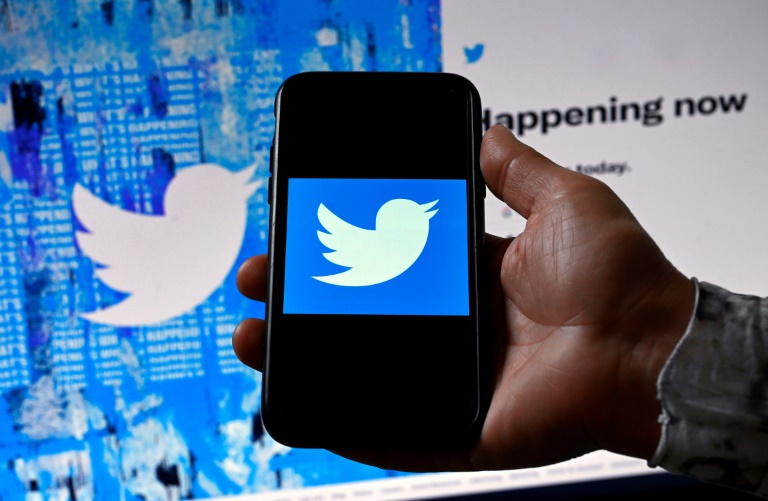
Musk and Twitter: From volatile courtship to messy divorce

Elon Musk’s pursuit of Twitter was a melodrama from beginning to end — a volatile courtship between a mercurial billionaire and the massively influential social media platform.

That relationship — an obvious love-hate affair from Musk’s side — now seems set to end in an acrimonious divorce.

– The courtship –

It all began with an expensive first date: Musk — a longtime Twitter user known for inflammatory tweets — snapped up 73.5 million shares at a cost of nearly $2.9 billion.

The purchase, which was revealed in an April 4 regulatory filing and gave him a 9.2 percent stake in the company, sent Twitter shares soaring and sparked speculation that Musk was seeking an active role in the social media company’s operations.

It also earned him a seat on the board. CEO Parag Agrawal announced the offer — in a tweet, of course — and called Musk “a passionate believer and intense critic of the service which is exactly what we need.”

But the honeymoon didn’t last long: Agrawal said on April 10 that Musk had decided against joining the board, a move the Twitter CEO believed was “for the best.”

Rather than amicably parting ways, Musk launched a hostile takeover bid for the company, offering $54.20 a share, an April 13 filing showed.

After saying it would “carefully review” the offer, Twitter adopted a “poison pill” defense, announcing a plan that would allow shareholders to purchase additional stock.

– The engagement –

Then came the plans for a walk down the corporate aisle: Twitter reversed course and said on April 25 that it was selling to Musk in a deal valued at $44 billion.

But weddings can be expensive, so Musk took action to cover the cost, parting with $8.4 billion in shares in electric carmaker Tesla. He pledged up to $21 billion from his personal fortune, with the rest financed by debt.

Musk was already planning his new life with Twitter, saying a few days later that he would lift the ban on Donald Trump, which was handed down after the January 2021 riot at the US Capitol by the then-president’s supporters.

– The breakup –

But Musk soon began showing signs of cold feet, saying on May 13 that the deal to buy Twitter was “temporarily on hold” pending details on spam and fake accounts on the platform.

In early June, advocacy groups decided to speak now instead of forever holding their peace, launching a campaign to stop Musk from going through with the purchase, which they said would allow him to “hand a megaphone to demagogues and extremists.”

Musk meanwhile accused Twitter of failing to provide data on fake accounts, and threatened to withdraw his bid.

On June 16, however, he offered signs that the match was still a go, pitching a vision to Twitter staff of a one-billion-user platform. But he was hazy on issues such as potential layoffs and free speech limits.

It all came crashing down on July 8, when Musk called off the wedding and accused Twitter of making “misleading” statements about the number of fake accounts.

The breakup between the billionaire and the social media platform is set to be far from friendly.

Twitter’s chairman tweeted that the company will pursue legal action to enforce the deal, setting up a pricey showdown as the divorce heads to court.

Elon Musk: smasher of elites or self-serving pragmatist?

He has scorned organized labor, mocked political correctness and espoused small government — so conservatives may be disappointed that he wants to pull out of his deal to buy Twitter.

Yet smoking marijuana during interviews, courting Hollywood with movie cameos and musing about nuking Mars make Elon Musk an improbable talisman for political traditionalists.

In polarized America, the 51-year-old triple divorcee’s opposition to Covid-19 restrictions is often taken to demonstrate Republican sympathies, although his disdain for draconian immigration control suggests the opposite.

The world’s richest man has berated President Joe Biden for proposing a tax credit for electric cars produced by unionized workers. He has even called for an end to all US federal subsidies.

Yet he has aggressively pursued government support himself, taking billions in handouts for his own companies.

James Hickman, founder of the libertarian-leaning Sovereign Man newsletter, sees Musk as a check on the “tyranny of the minority” — a supposed cabal of elites in tech, media and academia who make decisions for the rest of us and “consistently get it wrong.”

“What makes someone a true libertarian is an outright rejection of labels and being completely independent in one’s thinking,” Hickman told AFP.

“Musk clearly qualifies in this regard.”

Other analysts have suggested that, as inconsistent as his political philosophy appears, Musk rarely diverges from his business interests.

Meanwhile his political donations don’t cleave to one party or point of view either.

A self-styled “moderate” independent — although he has described himself as a “socialist” too — Musk ostentatiously moved to deeply conservative Texas from ultra-liberal California in 2020.

He has given donations to the governors of both states, despite criticizing Texas anti-abortion laws and a “complacent” business environment in California.

– Free speech, or not? –

Other donations have gone to Democratic grandees Hillary Clinton and Barack Obama, right-wing House Minority Leader Kevin McCarthy and the Republican Party itself. 

He is also not averse to lashing out on social media at Washington establishment figures, from one-time presidential nominee Elizabeth Warren (“Senator Karen”) to Biden himself.

And then there’s the issue of free speech, which he has called “the bedrock of a functioning democracy.”

Musk has complained that Twitter is too censorious, simultaneously illustrating and undermining his point in a tweet depicting the company’s CEO Parag Agrawal as brutal Soviet dictator Joseph Stalin.

Critics say his passion for unfettered conversation has often appeared less profound when his own interests are at stake.  

Some media outlets have raised questions over Musk’s reaction to journalists writing stories critical of Tesla.

Accused of unleashing his army of supporters on individual reporters, he once mulled creating a website for the profession as a whole called Pravda — presumably a tribute to the Soviet propaganda outlet.

“Going to create a site where the public can rate the core truth of any article & track the credibility score over time of each journalist, editor & publication,” he tweeted in 2018. Nothing came of it.

– ‘Pragmatic’ and ‘self-interested’ –

Former Hillary Clinton campaign staffer Judd Legum has pointed to a tweet — also 2018 — in which Musk appeared to threaten to rescind employee stock options at Tesla if workers decided to join a union.

Critics say there is a pattern of suppressing less powerful voices that has also included forcing workers to sign restrictive non-disclosure agreements (NDAs).

A Tesla NDA reportedly warned employees that “they were not allowed to speak with media without explicit written permission” — but the company neglected to add that labor laws protected them from reprisals when discussing work conditions.

Baruch Labunski, an internet marketing expert and web consultancy CEO, says that, amid much “contradictory evidence,” it’s safest to describe Musk’s politics as “pragmatic.”

“He is frequently characterized as a libertarian but that designation doesn’t accurately describe the man whose businesses have benefited from government tax breaks and business subsidies,” Labunski told AFP.

Musk is a “fundamentally self-interested” celebrity, says Labunski.

“Musk gets to play in and around politics because he’s rich and he’s outspoken.”

Musk ditches Twitter deal, triggering defiant response

Elon Musk on Friday pulled the plug on his $44 billion deal to buy Twitter, accusing the social media giant of “misleading” statements about the number of fake accounts, a regulatory filing showed.

Musk’s effort to terminate the deal that he inked in April sets the stage for an epic court battle over a billion-dollar breakup fee and more.

“Mr. Musk hereby exercises (the) right to terminate the Merger Agreement and abandon the transaction,” his lawyers said in a letter to Twitter, a copy of which was filed with the Securities and Exchange Commission.

Musk’s change of heart appeared to suggest some “buyer’s remorse” for offering a price of $54.20 per share that now appears “laughable,” CFRA Research senior equity analyst Angelo Zino said in a note to investors before the deal was officially nixed.

Twitter has held firm that no more than five percent of accounts are run by software instead of people, while Musk has said he believes the number to be much higher.

Immediately after the news broke, Twitter board chair Bret Taylor vowed to sue Musk to hold him to the terms of the buyout deal, saying “we are confident we will prevail.”

The clock was ticking for Musk to make a decision, with Twitter’s board recommending shareholders approve the buyout at a special vote expected to be held in August.

Musk — the world’s richest man — used a chunk of his fortune in Tesla shares to back loans to buy Twitter, but the tumult and market factors have pushed down the electric car maker’s stock price.

“The Twitter deal has clearly caused chaos at Twitter and has resulted in an overhang on Tesla’s stock since April given the Musk financing angle, coupled by a brutal market backdrop for risk,” Wedbush analyst Dan Ives said in a note to investors.

“This soap opera has seen many twists and turns… this was always a head scratcher to go after Twitter at a $44 billion price tag for Musk and never made much sense to (Wall) Street, now it ends in a Twilight Zone.”

– ‘Erratic behavior’ –

Concerns about Tesla included worries that its chief executive was being distracted by the Twitter saga, and that the tech platform would certainly demand his attention if he owned it.

“I am sure Musk thought he could come out of the gate strong, generate a wave of buzz and then ride it to get investors who want a piece of something that looks like it is going to be big,” said Angelo Carusone, president of nonprofit group Media Matters for America.

“His erratic behavior obviously affected the price of Tesla shares, which undermined the financing everything was set on.”

Musk, 51, proclaimed in May that he would largely let anyone say anything allowed by law on Twitter, becoming a hero to ultra-conservatives offended by attempts to curb bullying, lies and other abuses on the platform.

His comments came during an annual event at which Twitter and other social media companies typically lock in bulk ad contracts worth hundreds of millions of dollars.

But a Twitter free-for-all would scrap precautions that brands want in place to make sure their ads aren’t associated with abusive posts, Carusone said.

“Musk couldn’t control himself long enough,” Carusone said. “He opened his mouth and pushed the first domino that has cascaded into blowing up the deal.”

Musk also faces a lawsuit accusing him of pushing down Twitter’s stock price in order to give himself an escape hatch from his buyout bid.

Twitter shares jumped to $51.70 in April when Musk’s deal was announced, only to plunge to $35.76 a month later as his commitment came into doubt. Twitter was priced at just below $37 a share in after-market trades on Friday.

Carusone believed Twitter shareholders should be furious with the company board as well as Musk.

“They got into bed with a madman and significantly harmed shareholder value as a result,” he said.

'No to war': Ukraine children recount invasion through art

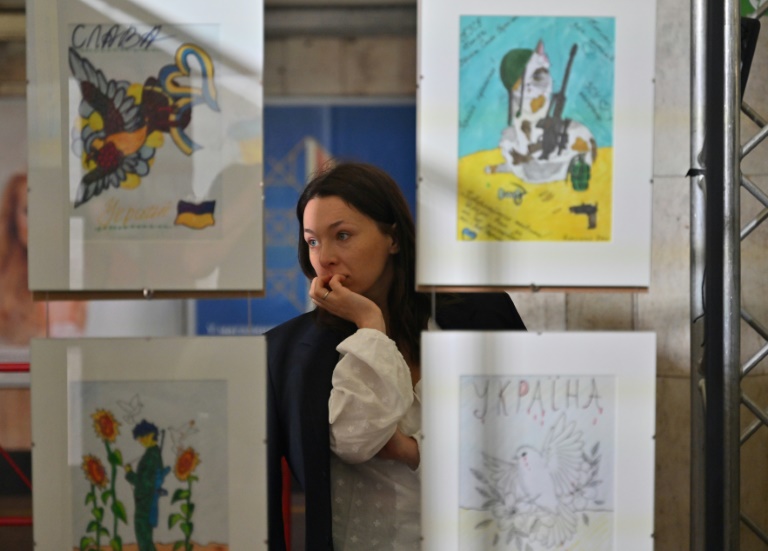
A woman’s portrait painted in blue and yellow — the colours of the Ukrainian flag — and streaked with blood-red paint is among 300 pictures by Ukrainian children displayed in a Kyiv bomb shelter Friday.

“It’s worth reminding adults — the whole world — that children see all this, experience it, feel it. And unlike us, they can’t make decisions,” said Olena Sotnyk, a Ukrainian politician and advisor to the prime minister, as well as one of the exhibition’s organisers.

“They expect adults and the world to act to stop the war.”

The exhibition, titled “Children. War. Future”, opened to journalists Friday in a central Kyiv metro station that has been closed since the beginning of Russia’s invasion on February 24.

The Maidan Independence stop has instead functioned as a bomb shelter beneath the site of massive pro-democracy protests in 2014 that toppled Ukraine’s Kremlin-friendly leader.

The paintings by Ukrainian children from across the country depict horrors from places like Mariupol — a city brutally besieged and bombed by Russian forces — and Bucha, one of the first towns where civilians were found killed en masse.

Others are optimistic: a smiling soldier straps on a helmet, a woman wears a blue and yellow wreath of flowers with a dove surrounded by multicoloured flowers.

But the captions are unambiguous: “No to war,” “I don’t want to die.”

“What these children feel is the fear of war, anxiety. But on the other hand, there is faith, hope, support, understanding that there will be bright days in the future,” said Danylo Tsvyok, who was also involved in staging the collection. 

Sotnyk said there were plans in place to create a digital exhibition of several thousand images by children reflecting on the conflict.

The Ukrainian prosecutor general says that at least 347 children have been killed and another 646 wounded since the beginning of Russia’s invasion.

US shares flat on strong job growth, euro closes in on dollar parity

Global stock markets finished mostly higher Friday, though Wall Street was flat following a surprisingly strong jobs report, while the euro was near parity with the dollar as traders bet on the prospect of a eurozone recession caused by soaring inflation.

The yen initially strengthened against the dollar following the assassination of Japan’s former prime minister, Shinzo Abe, before falling back.

Major US indices see-sawed throughout the day but still notched solid gains for the week, with investors weighing optimism that the US economy can withstand higher borrowing costs against fears the Fed will do too much to choke off growth and cause a downturn.

American employers added 372,000 new positions in the month, the Labor Department reported, far more than economists expected, while wage growth slowed slightly. 

The resilient US labor market gives the Federal Reserve more of a free hand to raise interest rates sharply to combat soaring inflation, although some investors still fear policymakers could do too much, choking off growth and causing a downturn.

Gregori Volokhine of Meeschaert Financial Services said the hope is the US economy avoids the “worst-case scenario,” where the economy slows but inflation stays high and the Fed continues to hike rates.

The jobs report was “not necessarily ideal but it offers comfort about the economy and gives the impression that the Fed will not do too much damage too quickly,” Volokhine said.

Fed officials have signaled they are still on target for another aggressive 75 basis point interest rate increase later this month, matching the move in June — the biggest since 1994 — but they will reassess later in the year.

– Dollar parity? –

The euro on Friday slumped to $1.0072, a fresh 20-year low, before recovering back above $1.018.

“The depreciation in the euro to its lowest level in almost two decades against the dollar this week in large part reflects investors’ view that the ECB will tighten less aggressively than the Fed,” said Jessica Hinds, senior Europe economist at Capital Economics.

Meanwhile, world oil prices rose following the US jobs report, comforted about the health of the world’s top economy and demand for oil.

Asian stock markets closed higher, boosted by hopes that US President Joe Biden would remove some tariffs from Chinese goods, and amid reports Beijing was considering a huge stimulus push to aid the struggling Chinese economy.

– Political upheaval –

Markets are also tracking political unrest in Britain and Japan.

London’s benchmark FTSE 100 index edged 0.1 percent higher — and the pound was mixed — one day after Prime Minister Boris Johnson said he was stepping down later this year following a string of scandals.

In Japan, Abe was assassinated by a gunman who opened fire at close range as the hugely influential politician delivered a campaign speech ahead of upper house elections. 

The murder of the 67-year-old, who had been Japan’s longest-serving leader, stunned the nation and prompted an international outpouring of grief and condemnation.

The killing “could be negative for markets if the government’s policy, including its stance on monetary easing, is affected, as it was evident that he was pulling the strings behind the scenes in many ways,” said Masahiro Yamaguchi at SMBC Trust Bank.

“If it becomes possible for (current Prime Minister Fumio) Kishida to carry out policies he wanted to, such as financial tax and regulations on share buy-back, that would be negative for markets.”

– Key figures at around 2100 GMT –

New York – Dow: UP 1.1 percent at 31,384.55 (close)

New York – S&P 500: UP 1.5 percent at 3,902.62 (close)

New York – Nasdaq: UP 2.3 percent at 11,621.35 (close)

Euro/dollar: UP at 1.0183 from $1.0162 on Thursday

Pound/dollar: UP at 1.2034 from $1.2024 

Euro/pound: UP at 84.59 pence from 84.49 pence

Dollar/yen: UP at 136.10 yen from 136.01 yen

EURO STOXX 50: UP 0.5 percent at 3,505.40 (close)

London – FTSE 100: UP 0.1 percent at 7,196.24 (close)

Frankfurt – DAX: UP 1.3 percent at 13,105.23 (close)

Paris – CAC 40: UP 0.4 percent at 6,033.13 (close)

Tokyo – Nikkei 225: UP 0.1 percent at 26,517.19 (close)

Hong Kong – Hang Seng Index: UP 0.4 percent at 21,725.78 (close)

Shanghai – Composite: DOWN 0.4 percent at 3,356.08 (close)

Brent North Sea crude: UP 2.4 percent at $107.12 per barrel

West Texas Intermediate: UP 2.0 percent at $104.78 per barrel

Spain labour minister launches new political movement

Spain’s popular Labour Minister Yolanda Diaz Friday launched a new leftist political movement ahead of general elections expected in late 2023, vowing a new way of doing politics.

Diaz said she would go on a nationwide listening tour to gather ideas about what people want for the country, and then decide whether it would take part in the next polls with her at the helm.

“In this citizens’ movement, I am just one more piece. You are the protagonists and if you want I will step up,” she told a crowd of around 5,000 people gathered at a Madrid cultural centre.

Diaz said the new movement called “Sumar”, which means “to add” in Spanish, would seek “a new social contract” and work to end to the politics of “confrontation”.

Politics should be about “extending a hand, and then being able to reach agreements that change people’s lives,” she added.

Diaz currently represents the far-left Podemos party, the junior partner in Socialist Prime Minister Pedro Sanchez’s minority coalition government.

Polls consistently indicate she is Spain’s most popular politician.

As labour minister, she was responsible for a recent labour reform which is credited with a sharp fall in the number of temporary job contracts.

She also oversaw a generous job furlough scheme at the height of the Covid-19 pandemic, which ensured people had an income even when large parts of the economy were closed due to lockdowns.

The launch of the new political movement comes as both the Socialists and Podemos have slumped in the polls, with Spain battered by high inflation as is the case across Europe.

The main opposition conservative Popular Party (PP) have overtaken the Socialists as Spain’s most popular party, according to a poll published Monday in daily newspaper El Pais.

The PP, which in April picked a moderate new leader, had 27.4 percent support, ahead of the Socialist at 26.3 percent.

Podemos was in fourth place, behind far-right party Vox.

The PP last month secured a landslide win in a regional election in Andalusia, winning an absolute majority of seats in the former Socialist stronghold.

It will now govern the southern region, Spain’s most populous, on its own for the first time.

Syria's Assad in first official visit to Aleppo since war

Syria’s President Bashar al-Assad on Friday visited the former rebel bastion of Aleppo, including its historic Old City, for the first time since war broke out 11 years ago.

The visit to Syria’s second city and previously the economic capital is highly symbolic as Assad’s 2016 victory there — with crucial military support from Russia — was a turning point in the war.

Assad and his wife “visited Aleppo’s historic Ummayad mosque”, the Syrian presidency said on the Telegram messaging app.

They also “walked through the Old City’s souks, which were open on the occasion of Eid al-Adha”, it added, referring to the Muslim feast set to begin on Saturday.

Both sites had suffered massive damage in the fighting.

Before the war, the northern city — considered to be one of the world’s longest continuously inhabited — boasted markets, mosques, caravanserais, and public baths, but a brutal siege on rebels left it disfigured.

Fighting damaged as much as 60 percent of Aleppo’s Old City, according to estimates by the UN’s cultural agency, UNESCO.

Aleppo province was also the scene of fierce battles between government forces, rebels and Islamic State group jihadists from 2012 until Russian-backed government forces gradually ousted them.

Earlier Friday, Assad visited a major power plant in the province’s eastern countryside to supervise its partial relaunch after war damage.

Assad was also present for the relaunching of a water pumping station, statements from the Syrian presidency said on Telegram.

Electricity networks and other infrastructure across the country were ravaged by the war, which is estimated to have killed nearly half a million people and displaced millions.

The Syrian government does not have authority over all of Aleppo province, with areas on the Turkish border still controlled by Ankara-backed groups and the Kurdish Syrian Democratic Forces.

The recently rehabilitated part of the power station, one of the country’s largest, will generate 200 megawatts of electricity for the province, the presidency said.

In 2021, Aleppo’s state-run electricity company announced the power station would be rehabilitated with support from Iran, another Assad ally.

Tehran signed several agreements with Damascus in 2017 to improve the production and distribution of electricity in war-ravaged Syria.

The deals included the rehabilitation of the Aleppo power plant, building a power station in Latakia, as well as repair and maintenance work in other regions.

Impoverished Havana neighborhood reeling from protest convictions

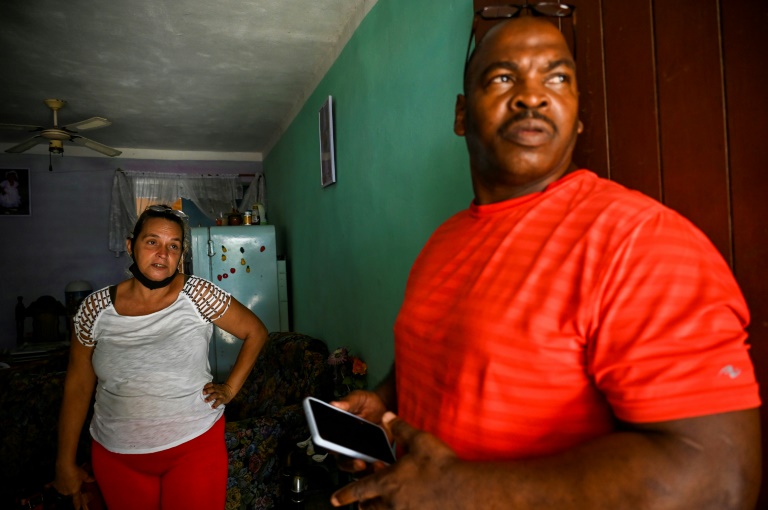
When Wilbert Aguilar had to tell his wife that their son was sentenced to 23 years in prison for taking part in anti-government protests in Cuba, the 49-year-old day laborer’s life fell apart.

“I had to wash, scrub, cook, because my wife lost her mind,” he told AFP.

After that, he had to look after his daughter-in-law and his two granddaughters.

Aguilar’s 22-year-old son Wagniel was one of more than 160 people from La Guinera, a poor Havana neighbrohood, to have been jailed for taking part in the unprecedented protests that broke out all over Cuba in July 2021.

Communist Cuba was, and still is, mired in an economic crisis and demonstrators chanted “We’re hungry!” and demanded “Freedom!”

The government has since tried to make amends in La Guinera, a largely Black neighborhood that is part of Havana’s most populous municipality, Arroyo Naranjo, also one of the capital’s poorest.

Authorities have filled potholes, painted warehouses, reopened and restocked medical centers, and promised new homes to some families.

It is part of a program implemented in 60 Havana neighborhoods to improve people’s lives.

But the demonstrators remain in jail.

Elizabet Leon Martinez, 51, worked as a manicurist before three of her five children were jailed.

“I can’t give any more, my nerves are frayed, I don’t have a life, I have nothing,” she said, never taking her eyes off her telephone in case someone might call from prison.

“I look after my grandchildren because I have no work, nor could I work.”

– ‘Tough sentences’ –

On July 12, 2021, hundreds of protesters converged on the police station at the entrance to La Guinera.

Communist Party (PCC) activists backed by a massive contingent of riot police blocked them.

Rocks, bottles and sticks were thrown and the streets became strewn with broken glass and rocks.

The only person killed during the protests died in this neighborhood. Dozens of people were injured and more than 1,300 arrested across the country, the rights NGO Cubalex said.

Of the 790 people tried, 488 received custodial sentences of up to 25 years, the government said, mostly for sedition.

The United States has said it would work with allies to support those “unjustly” jailed and hit out at the “tough sentences.”

Pensioner Jorge Gil, 72, a PCC representative for La Guinera, says the protests were due to years of abandonment.

He lives with his family in temporary accommodation after his house was demolished — and due to be rebuilt — as part of the neighborhood improvement program.

But the materials to rebuild his house never arrived.

Opposite Gil lives Isabel Hernandez, 44, in a recently repainted house with a corrugated metal roof.

One of her sons was also jailed over the protests.

Despite this, her house was refurbished in just six months thanks to the improvement program.

“I’m very happy,” she said.

– ‘Their weapon was their voice’ –

Some people view the suppression of the July 2021 protests as a triumph for the communist revolution.

“We are more than super thankful, president, for all the changes in our neighborhood,” said Ileana Macias, a local leader and member of the Santeria religious community, during a meeting between women from the community and the country’s leader Miguel Diaz-Canel.

But Wilbert Aguilar is sad. He denies the protesters were “counter-revolutionaries.”

“They weren’t armed, their only weapon was their voice,” he said.

His son Wagniel’s sentence was reduced to 12 years on appeal.

Even Gil, who vehemently defends the island nation’s socialist system, admits he feels pain.

“I hope this is a problem that will be quickly resolved and that the majority of these youngsters will be freed because at the end of the day they’re youngsters and need to learn.”

Fourth arrest in Amazon murders of journalist, guide: police

A fourth person has been arrested as part of the investigation into the killings last month of British journalist Dom Phillips and Brazilian Indigenous expert Bruno Pereira in the Amazon, authorities said on Friday.

The man presented himself to police to deny claims in the press that he may have ordered the murders, police chief Eduardo Fontes of the Amazonas state told reporters.

He was arrested for allegedly presenting fake identity documents.

Fontes said the man, known as “Colombia,” told police that he buys merchandise from fishermen in the area where the murders happened.

He said that one of his suppliers was Amarildo da Costa de Oliveira, known as “Pelado,” who is under arrest after confessing to his role in the crime.

Phillips, 57, and Pereira, 41, were shot dead while returning from an expedition in a remote region of the rainforest that is plagued by drug trafficking, illegal gold mining and fishing.

Phillips, the author of dozens of articles on the Amazon and a long-time contributor to The Guardian newspaper and other major news organizations, was traveling to the Javari Valley as part of research for an upcoming book.

Pereira was serving as his guide, and had previously traveled with him to the area.

An outspoken defender of Indigenous rights, Pereira had received multiple death threats prior to his death.

Police are investigating a possible link to illegal fishing on protected Indigenous lands as a motive for the murder.

“We are investigating whether that person known as ‘Colombia’ … participates in any illegal fishing scheme, whether he finances” that activity, said Fontes, adding the man had denied any involvement.

“We don’t know what his true identity is,” Fontes added.

The man had documents from Brazil, Colombia and Peru, each in a different name, he said.

Three men are under arrest for the murders and five others stand accused of helping to dispose of the bodies, which were found 10 days after the pair disappeared.

Close Bitnami banner
Bitnami