World

UN Security Council at impasse over cross-border Syria aid

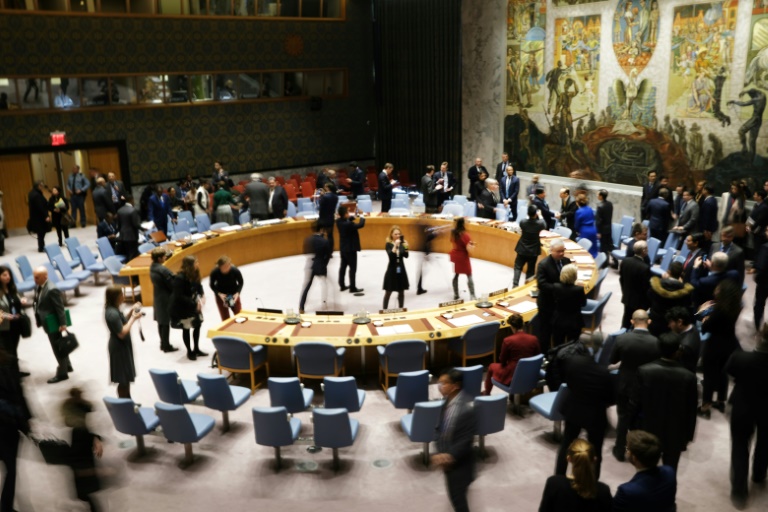
Russia on Friday vetoed a UN Security Council resolution that would have extended cross-border aid to Syria by one year without Damascus’s backing.

Western powers then voted down a competing resolution put forward by Moscow that proposed extending approval by just six months.

The authorization for the aid deliveries across the Syrian-Turkish border at Bab al-Hawa, which has been in effect since 2014, is set to expire Sunday.

The aid is a lifeline for more than 2.4 million people in the northwestern Idlib region of Syria, under the control of jihadists and rebels.

Thirteen of the fifteen Council members voted in favor of the text proposed by Norway and Ireland. China, which often votes the same way as Russia, chose to abstain.

The vote had been due to be held Thursday but was scrapped following disagreement between Russia and the West.

The Norway-Ireland text would have provided for a six-month extension until mid-January 2023, and then an additional six-month extension “unless the Council decides otherwise.”

The extension would also be conditional on a “substantive report” by the secretary-general, including on the operation’s transparency, progress on channeling aid across the front line, and progress on meeting humanitarian needs.

That text was already “an extreme compromise,” said America’s ambassador to the UN, Linda Thomas-Greenfield, accusing Russia of putting its “own political interests above the humanitarian needs of the Syrian people.”

“Tragically people will die because of this vote,” she told the chamber.

British ambassador Barbara Woodward said Moscow had deployed a “deeply irresponsible veto that will have a tragic impact.”

Russia’s deputy ambassador to the world body, Dmitry Polyanskiy, meanwhile accused the west of “stubbornness” and said the resolution “ignored the sovereignty of Damascus.”

– Key aid route –

The United States, France and Britain voted against Russia’s draft text, while the 10 non-permanent members of the Security Council abstained. Moscow secured Beijing’s vote.

Western nations had deemed the text unacceptable, as there is no guarantee of an extension at the start of the new year.

For resolutions to be adopted, at least nine of the 15 members must support it with none of the permanent members wielding their veto.

Sunday’s deadline still leaves time for members of the Security Council to find common ground, observers note.

Diplomats said the council’s non-permanent members may propose a nine-month extension to try to break the impasse.

Nearly 10,000 trucks loaded with humanitarian aid passed through Bab al-Hawa last year, bound for Idlib. 

It is the only crossing through which aid can be brought into Idlib without navigating areas controlled by Syrian government forces.

Moscow, an ally of Damascus, has curtailed a number of Western-backed measures in recent years, using its veto 17 times in relation to Syria since the war’s outbreak in 2011.

Russia views the authorization as a violation of Syria’s sovereignty, and believes the delivery of aid to the northwest region should only be carried out from Damascus across the front line.

Russia had hinted in recent months that it would oppose an extension, having already forced a reduction in the number of allowed border crossings.

Dozens of NGOs and several senior UN officials had lobbied Security Council members for the year-long cross-border aid clearance.
Morocco 'detains' employees of French tycoon accused in sex case

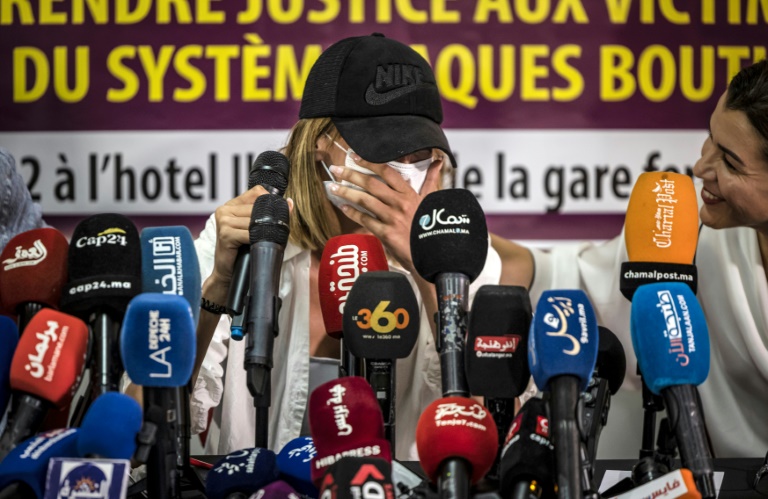
Several employees of French insurance tycoon Jacques Bouthier, under arrest in Paris on charges of raping a minor, have been placed in Moroccan custody, a lawyer for the plaintiffs said Friday.

The employees appeared before the public prosecutor in the northern city of Tangiers earlier this week and a judge placed “five of them under a committal order”, while the sixth was released, lawyer Karima Salama told AFP.

Bouthier, 75 and one of France’s richest men, is ex-CEO of insurance group Assu2000, later renamed Vilavi.

He was indicted on May 21 and arrested by Paris prosecutors after a preliminary investigation into accusations of people trafficking and rape of a minor.

A Frenchman and five Moroccan suspects including two women are accused of “having recruited and psychologically groomed” women, said Salama, of the Moroccan Association for the Rights of Victims (AMDV).

“They also justified (Bouthier’s) conduct,” she said.

Several young Moroccan women filed a complaint against Bouthier last month, accusing him of various acts of “people trafficking, sexual harassment and verbal and moral violence” between 2018 and this year, according to Salama.

Some told a press conference at the time that they had faced repeated sexual harassment and intimidation as well as threats to their jobs, in a city where many struggle to find work.

The women said they had been sacked after refusing to “give in to harassment and blackmail” over their employment by Bouthier and other French and Moroccan executives.

Such public declarations are rare in Morocco, where sexual abuse victims often face social stigma.

AMDV appealed on Friday for any other victims to “break the wall of fear and actively be part of the fight against impunity for people who have gravely harmed their dignity as women”.

Bouthier is also being prosecuted in France for conspiracy to kidnap, kidnapping in an organised gang and possession of child pornography.

900 firefighters battle 'mega-fire' in southern France

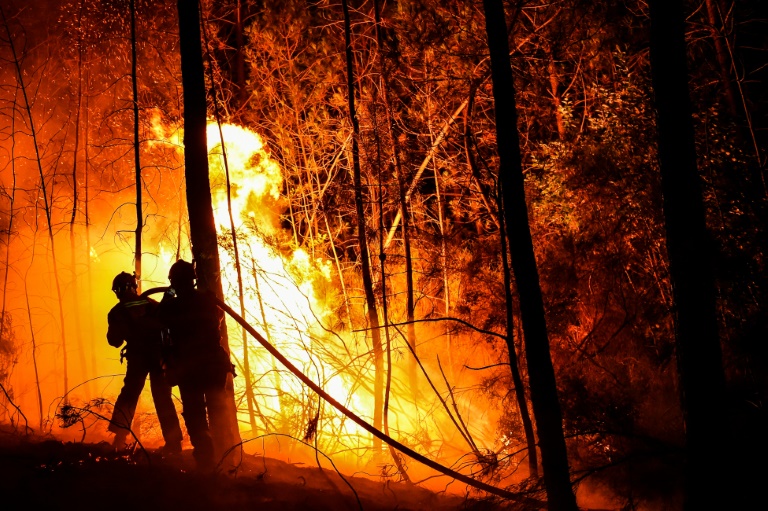
More than 900 firefighters backed by aircraft were deployed on Friday to battle a massive blaze in France’s southern Gard region that burned 600 hectares (1,500 acres) overnight.

“This fire is far from being done. There are fronts in hard-to-reach areas that we haven’t tackled and that are advancing freely,” said Eric Agrinier, a senior member of the fire service.

“It’s going to be a feat of endurance,” he added later, warning the blaze may not be brought under control until Sunday because of unfavourable weather conditions.

Working into the night after the blaze began late Thursday, firefighters set backfires to protect inhabited areas.

“We burn some parts (of the forest) so when the fire spreads it reaches an already-burned zone and slows down, that makes it easier to stop its advance,” said Jacques Pages, standing in front of a line of flames lighting up the pitch-black forest.

Described by emergency responders as a “mega-fire”, the blaze started near the village of Bordezac and forced evacuations from nearby Besseges and other settlements on Thursday night.

The local prefect’s office said around 100 people had to be put up in holiday homes and restaurants in the area, which is about 90 kilometres (55 miles) north of Montpellier and the Mediterranean coast.

“I’ve been finding rooms for people and all the holiday homes are doing the same,” said Regine Marchand, manager of a restaurant in nearby Aujac, on Thursday night.

“We’ve made them pasta, people left quickly without bringing anything, but they’re keeping their spirits up, there’s a good atmosphere.”

By Friday, people’s homes were no longer in danger, with only a garage and a small hut damaged.

The Gard region fire service said Friday morning that 13 firefighters were slightly injured.

As well as personnel on the ground, two planes have been dumping water since the early morning.

On Thursday, the air deployment had stretched to 12 firefighting planes and two helicopters.

Roads were closed to traffic entering the Besseges area, while hundreds of firefighters remained on the scene, some drawn from neighbouring regions.

– Drought raises risk –

Like large swathes of the country, southeast France has suffered from drought this year, increasing the risk of fires.

During an unseasonable heatwave last month, around 600 hectares were burned in a fire started by shelling on an army artillery training range near the Mediterranean port city Marseille.

Firefighters in that Bouches-du-Rhone region were called out to 35 outbreaks on Thursday, many of them close to inhabited areas.

Four houses were destroyed near southern city Arles and 250 firefighters were called out to a brushfire in Saint-Mitre-les-Remparts.

Although several other fires began in southern France on Thursday, most were put out before nightfall.

The fire service said thousands of hectares of heavily wooded land were under threat, as winds gusting at up to 80 km/h (50 mph) fanned the flames through the dried-out trees.

Wind is “the worst enemy” of firefighters, Lieutenant Colonel Agrinier said.

Biden hits back on abortion, calls Supreme Court 'out of control'

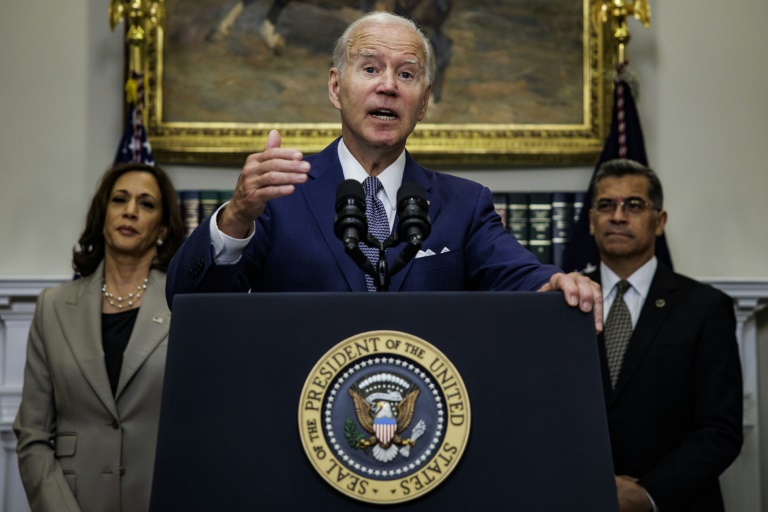
President Joe Biden said Friday that federal legislation offered the fastest route to restoring US abortion rights and urged voters to elect pro-choice legislators in upcoming elections in defiance of an “out of control” Supreme Court.

Under pressure to take a tougher line on defending women’s reproductive rights, Biden signed an executive order aimed at shoring up access to abortion after what he described as the court’s “terrible, extreme” decision to remove the constitutional right to terminate a pregnancy.

But the president, whose room for manoeuvre on the issue is limited, said the most effective response would be made through the ballot box in the November mid-term elections by handing him firm control of the legislature.

“Vote, vote, vote,” he said in an appeal particularly aimed at American women.

“The fastest route to restore Roe is to pass a national law codifying Roe, which I will sign immediately upon its passage at my desk. We cannot wait,” Biden said, referring to the 1973 Roe v Wade ruling that established the right to abortion.

If Republicans were to take control of Congress, he also vowed to veto any effort to pass a federal ban on abortion.

“We cannot allow an out of control Supreme Court working in conjunction with extremist elements of the Republican Party to take away freedoms and our personal autonomy,” he said.

Biden has been criticized from within his own Democratic Party for perceived inaction since the Supreme Court ruling on June 24.

After the ruling, several states have banned or severely restricted abortion and others are expected to follow suit. 

– ‘Not nearly enough’ –

Many Democrats, often speaking anonymously in the press, have complained that Biden and his team have failed to respond adequately to the bombshell judgment by the Supreme Court.

Seeking to recover, Biden on Friday signed an executive order designed to protect women’s sensitive health-related data and “fight digital surveillance related to reproductive health care services.”

Advocacy groups are warning of the risks posed by women’s online data such as their geolocation and apps that monitor their menstrual cycles, which they say could be used to go after women who have had abortions.

Biden’s order also seeks to protect mobile clinics deployed to the borders of states that have banned abortion.

The administration wants to guarantee access to contraception and abortion medication and set up a network of volunteer lawyers to help women on abortion issues, the White House said.

“The executive actions being undertaken are needed first steps, but it’s not nearly enough,” said Women’s March director Rachel O’Leary Carmona in a statement.

“I call on the administration to recognize the true emergency we are in. Get creative. Get caught trying.  Don’t let norms, or decency, or ‘tradition’ stand in your way. Lives are on the line.”

But Biden cannot do much to battle the Supreme Court, or the states hostile to him when he lacks a solid majority in Congress.

So he is calling on Americans to turn out in droves and vote Democrat in the midterm elections.

The goal is to codify the right to abortion as a federal law, which would nullify state decisions to ban the procedure.

Many Democrats fear this drive to get out the vote will flop. Biden is now an unpopular president and Americans’ biggest worry these days is sky-high inflation. 

And beyond the abortion issue some Democrats wonder if Biden, 79, a centrist who shuns headline-grabbing action, has the ability to take on an aggressively conservative American right in an era of acute political tension.

All he has to do is look at press editorials of recent days, including in news outlets seen as sympathetic.

“Is Joe Biden the wrong president at the wrong time?” read a headline Thursday in The Washington Post, while The Atlantic magazine asked “Is Biden a Man out of Time?”

NASA reveals Webb telescope's first cosmic targets

NASA said Friday the first cosmic images from the James Webb Space Telescope will include unprecedented views of distant galaxies, bright nebulae, and a faraway giant gas planet.

The US, European and Canadian space agencies are gearing up for a big reveal on July 12 of early observations by the $10 billion observatory, the successor to Hubble that is set to reveal new insights into the origins of the universe.

“I’m looking very much forward to not having to keep these secrets anymore, that will be a great relief,” Klaus Pontoppidan, an astronomer at the Space Telescope Science Institute (STSI) that oversees Webb, told AFP last week.

An international committee decided the first wave of full-color scientific images would include the Carina Nebula, an enormous cloud of dust and gas 7,600 light years away, as well as the Southern Ring Nebula, which surrounds a dying star 2,000 light years away.

Carina Nebula is famous for its towering pillars that include “Mystic Mountain,” a three-light-year-tall cosmic pinnacle captured in an iconic image by Hubble.

Webb has also carried out a spectroscopy — an analysis of light that reveals detailed information — on a faraway gas giant called WASP-96 b, which was discovered in 2014.

Nearly 1,150 light-years from Earth, WASP-96 b is about half the mass of Jupiter and zips around its star in just 3.4 days.

Next comes Stephan’s Quintet, a compact galaxy 290 million light years away. Four of the five galaxies within the quintet are “locked in a cosmic dance of repeated close encounters,” NASA said.

Finally, and perhaps most enticing of all, Webb has gathered an image using foreground galaxy clusters called SMACS 0723 as a kind of cosmic magnifying glass for the extremely distant and faint galaxies behind it. 

This is known as “gravitational lensing” and uses the mass of foreground galaxies to bend the light of objects behind them, much like a pair of glasses.

Dan Coe, an astronomer at STSI, told AFP on Friday that even in its first images, the telescope had broken scientific ground.

“When I first saw the images… of this deep field of this galaxy cluster lensing, I looked at the images, and I suddenly learned three things about the universe that I didn’t know before,” he said.

“It’s totally blown my mind.”

Webb’s infrared capabilities allow it to see deeper back in time to the Big Bang, which happened 13.8 billion years ago, than any instrument before it.

Because the Universe is expanding, light from the earliest stars shifts from the ultraviolet and visible wavelengths it was emitted in, to longer infrared wavelengths — which Webb is equipped to detect at an unprecedented resolution.

Oldest European human fossil possibly found in Spain

A jawbone fragment discovered in northern Spain last month could be the oldest known fossil of a human ancestor found to date in Europe, Spanish paleontologists said Friday.

The researchers said the fossil found at an archaeological site on June 30 in northern Spain’s Atapuerca mountain range is around 1.4 million years old.

Until now, the oldest hominid fossil found in Europe was a jawbone found at the same site in 2007 which was determined to be 1.2 million years old.

Atapuerca contains one of the richest records of prehistoric human occupation in Europe.

Researchers will now have to “complete” their first estimate for the age of the jawbone fragment using scientific dating techniques, palaeoanthropologist Jose-Maria Bermudez de Castro, the co-director of the Atapuerca research project, said during a news conference.

But since the jawbone fragment was found some two metres below the layer of earth where the jawbone in 2007 was found, “it is logical and reasonable to think it is older,” he added.

The scientific dating of the jawbone fragment will be carried out at the National Centre for Research on Human Evolution in Burgos, a city located about 10 kilometres (six miles) from Atapuerca.

The process should take between six to eight months to complete, Bermudez de Castro said.

The analysis could help identify which hominid species the jawbone fragment belongs to and better understand the human beings evolved on the European continent.

Scientists have so far been unable to determine with certainty which species the jawbone discovered in 2007 belonged to.

The fossil could correspond to the species called Homo antecessor, discovered in the 1990s.

The Atapuerca Foundation which runs the archaeological site said in a statement that is “very likely” that the jawbone fragment “belongs to one of the first populations that colonised Europe”.

The archaeological site of Atapuerca was in 2000 included on UNESCO’s list of world heritage sites, giving it access to United Nations conservation funding.

It contains thousands of hominid fossils and tools including a flint discovered in 2013 that is 1.4 million years old.

Oldest European human fossil possibly found in Spain

A jawbone fragment discovered in northern Spain last month could be the oldest known fossil of a human ancestor found to date in Europe, Spanish paleontologists said Friday.

The researchers said the fossil found at an archaeological site on June 30 in northern Spain’s Atapuerca mountain range is around 1.4 million years old.

Until now, the oldest hominid fossil found in Europe was a jawbone found at the same site in 2007 which was determined to be 1.2 million years old.

Atapuerca contains one of the richest records of prehistoric human occupation in Europe.

Researchers will now have to “complete” their first estimate for the age of the jawbone fragment using scientific dating techniques, palaeoanthropologist Jose-Maria Bermudez de Castro, the co-director of the Atapuerca research project, said during a news conference.

But since the jawbone fragment was found some two metres below the layer of earth where the jawbone in 2007 was found, “it is logical and reasonable to think it is older,” he added.

The scientific dating of the jawbone fragment will be carried out at the National Centre for Research on Human Evolution in Burgos, a city located about 10 kilometres (six miles) from Atapuerca.

The process should take between six to eight months to complete, Bermudez de Castro said.

The analysis could help identify which hominid species the jawbone fragment belongs to and better understand the human beings evolved on the European continent.

Scientists have so far been unable to determine with certainty which species the jawbone discovered in 2007 belonged to.

The fossil could correspond to the species called Homo antecessor, discovered in the 1990s.

The Atapuerca Foundation which runs the archaeological site said in a statement that is “very likely” that the jawbone fragment “belongs to one of the first populations that colonised Europe”.

The archaeological site of Atapuerca was in 2000 included on UNESCO’s list of world heritage sites, giving it access to United Nations conservation funding.

It contains thousands of hominid fossils and tools including a flint discovered in 2013 that is 1.4 million years old.

Pilgrims pack Mount Arafat for climax of biggest Covid-era hajj

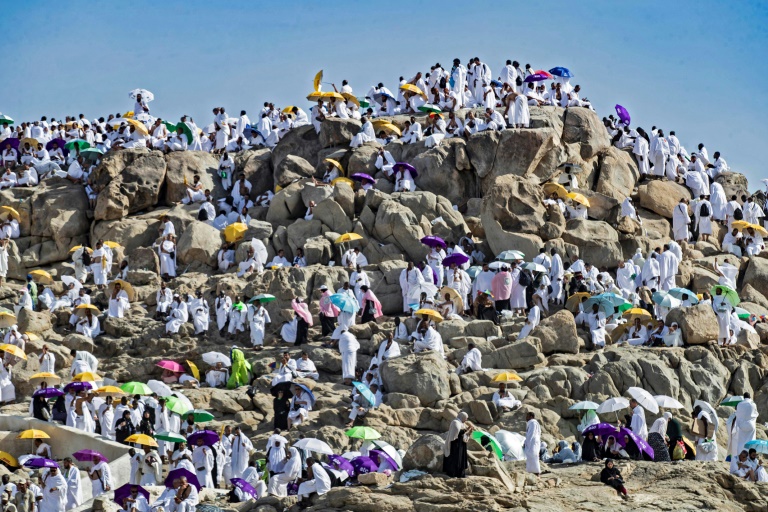
Huge crowds of robed Muslim pilgrims prayed on Saudi Arabia’s Mount Arafat on Friday, the climax of the biggest hajj pilgrimage since the pandemic forced drastic cuts in numbers for two years.

Groups of worshippers, many holding umbrellas against the fierce sun, recited verses from the Koran on the rocky rise where the Prophet Mohammed is believed to have given his final sermon.

Prayers on Mount Arafat are the highlight of the annual pilgrimage, capped this year at one million people including 850,000 from abroad.

Authorities said Friday that the number of pilgrims reached 899,353, including 779,919 from outside the kingdom.

Pilgrims, many in white robes, chanted “Oh God, here I am” as they reached Mount Arafat on foot or in buses from their nearby tents.

They will sleep under the stars in nearby Muzdalifah before performing the symbolic “stoning of the devil” ceremony on Saturday. 

“I am so happy to be here… This is the biggest hajj in the coronavirus era, but it isn’t big enough yet,” Egyptian pilgrim Saad Farhat Khalil, 49, told AFP.

“If the Saudis allowed more, 10 million would have come,” he added.

Entry roads were packed with worshippers as helicopters buzzed overhead and volunteers handed out water and collected rubbish. 

The hajj, usually one of the world’s largest annual religious gatherings, is among the five pillars of Islam and must be undertaken by all Muslims with the means at least once in their lives.

In 2019, as in previous years, some 2.5 million Muslims from around the world took part, a figure that dropped to a few thousand in 2020 and 60,000 in 2021.

State media platforms said some 21 percent of this year’s pilgrims were from Arab countries and more than 53 percent were from Asia, while 412,895 women attended.

– Covid fears –

“In 2020 I thought I would never do hajj. It seemed like the end of time. But here we are today, God is great,” said Bassam Mohammed, another Egyptian pilgrim.

Minutes before sunset, huge crowds started walking towards their tents before taking buses or continuing their journey on foot.

The remaining pilgrims descended Mount Arafat as they recited their last prayers, some breaking into tears, while worshippers thronged nearby streets.

The large crowds have spurred fears Covid will spread, especially after many pilgrims were maskless at the Grand Mosque in Mecca, despite reports that face coverings would be mandatory. 

A Covid resurgence in the region has seen some Gulf countries tighten restrictions.

All pilgrims were required to submit proof of vaccination and negative PCR tests.

Health ministry spokesman Dr Muhammad al-Abdulaali said Thursday evening that so far no Covid cases had been detected among the pilgrims, though it was unclear what testing was taking place. 

– Heat warnings –

The pilgrimage can be physically draining even in ideal conditions, but worshippers this year faced an added challenge: scorching sun and temperatures well over 40 degrees Celsius (104 Fahrenheit).

On Friday, the temperature hit 44 degrees Celsius at Mount Arafat, state-run Al-Ekhbariya television reported.

Islam forbids men from wearing hats once the rites start, and many have been seen shielding themselves with umbrellas, prayer mats and even, in one case, a small bucket filled with water. 

Women, meanwhile, are obliged to cover their heads with scarves.

“We can tolerate (the heat)… The more we tolerate, the more our pilgrimage is accepted,” Laila, a 64-year-old Iraqi pilgrim who gave only her first name, told AFP.

Saudi officials have touted their preparations for the extreme conditions, highlighting the hundreds of hospital beds allocated for heatstroke patients and the “large number of misting fans” provided. 

Dozens of trucks distributed umbrellas, water bottles and small fans.

The National Centre for Meteorology, which has set up an office in Mina, sent mobile phone messages to pilgrims, urging them to avoid outdoor rituals at certain times of the day.

On Saturday, pilgrims will take part in the “stoning”, the last major ritual of the hajj which has previously led to deadly stampedes, as hundreds of thousands converge on a small space.

They will then return to the Grand Mosque in Mecca to perform a final “tawaf” or circling of the Kaaba, the cubic structure that is the focal point of Islam.

Eid al-Adha, the feast of the sacrifice that begins on Saturday, marks the end of hajj.

mah-rs/rcb/lg/hc

Fed's Brainard says recent upheavel shows need for crypto rules

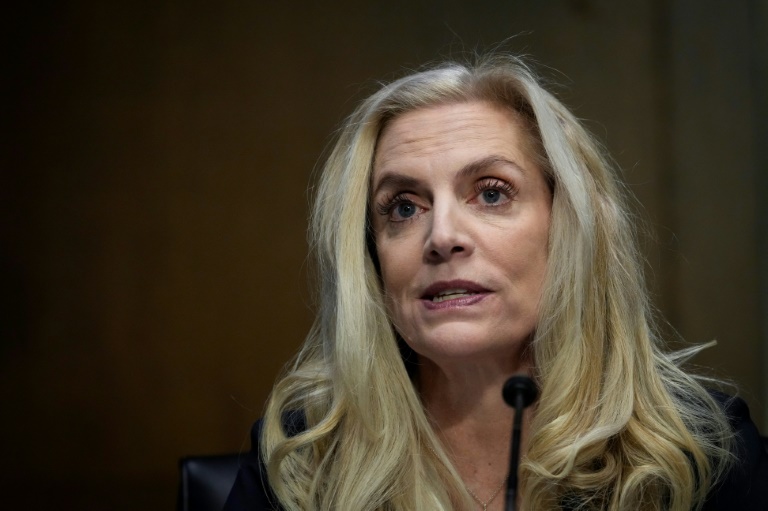
Recent upheaval in the cryptocurrency markets shows the sector is subject to similar risks as conventional investments, underscoring the need for regulation to protect against the “false allure” of a quick profit, Federal Reserve Vice Chair Lael Brainard said Friday.

“The crypto financial system turns out to be susceptible to the same risks that are all too familiar from traditional finance,” Brainard said at a Bank of England conference.

“So this is the right time to ensure that like risks are subject to like regulatory outcomes and like disclosure so as to help investors distinguish between genuine, responsible innovation and the false allure of seemingly easy returns that obscures significant risk.”

The comments come as the slump in bitcoin and other digital currencies continues to reverberate across the industry, denting players in the fledgling financial universe.

This includes a bankruptcy filing by US crypto lender Voyager Digital, the crash of the Terra cyptocurrency, the liquidation of Singapore-based cryptocurrency hedge fund Three Arrows Capital, and moves by crypto lender Celsius to suspend customer redemptions.

Brainard said despite investment losses so far, “the crypto financial system does not yet appear to be so large or so interconnected with the traditional financial system as to pose a systemic risk.”

Her remarks came a day after Fed Governor Christopher Waller also highlighted risks from cryptocurrencies, while saying that the turbulence had not yet threatened major financial institutions.

“That doesn’t mean if it was 10 times bigger wouldn’t have had an impact,” Waller said in a discussion with the National Association for Business Economics.

“It is important that the foundations for sound regulation of the crypto financial system be established now before the crypto ecosystem becomes so large or interconnected that it might pose risks to the stability of the broader financial system.”

Waller said the recent decline in virtual currencies has exposed the falsity of claims that such investments can be a hedge against inflation, or a way to offset other risky assets.

“Crypto-assets have plummeted in value and have proven to be highly correlated with riskier equities and with risk appetite more generally,” Waller said.

Biden hits back on abortion, calls Supreme Court 'out of control'

US President Joe Biden said Friday that federal legislation offered the fastest route to restoring abortion rights and urged voters to elect pro-choice legislators in upcoming elections as he ordered new measures to secure reproductive freedoms.

Condemning the “terrible, extreme” decision by the Supreme Court to remove the constitutional right to an abortion, Biden said the most effective response would be made at the ballot box in the November mid-term elections by electing lawmakers to give him firm control of the legislature he now lacks.

“The fastest route to restore Roe is to pass a national law codifying Roe, which I will sign immediately upon its passage at my desk. We cannot wait,” Biden said, referring to the 1973 Roe v Wade ruling that established the right to abortion.

“We cannot allow an out of control Supreme Court working in conjunction with extremist elements of the Republican Party to take away freedoms and our personal autonomy,” he said.

Under pressure to take a harder line on defending abortion access, Biden signed an executive order offering fresh but limited measures to bolster women’s reproductive rights.

Biden has been criticized from within his own Democratic Party for perceived inaction since the Supreme Court ruling on June 24.

After the court ruling, several states have banned or severely restricted abortion and others are expected to follow suit. 

Many Democrats, often speaking anonymously in the press, have complained that Biden and his team have failed to respond adequately to the bombshell judgment by the Supreme Court.

On the day of the ruling, the administration seemed caught off guard even though a draft had been leaked weeks before.

The president announced two packages of regulatory measures on June 24: on access to abortion pills and the rights of women to travel to another state for an abortion if their own state bans the procedure.

But, in a rare move, press secretary Karine Jean-Pierre cancelled her daily briefing on the day.

Biden left shortly after on a trip to Europe, frustrating abortion-rights activists and lawmakers who were eager for more decisive action from the president. 

Seeking to recover, Biden on Friday signed an executive order designed to protect women’s sensitive health-related data and “fight digital surveillance related to reproductive health care services.”

Advocacy groups are warning of the risks posed by women’s online data such as their geolocation and apps that monitor their menstrual cycles, which they say could be used to go after women who have had abortions.

Biden’s order also seeks to protect mobile clinics deployed to the borders of states that have banned abortion.

The administration also wants to guarantee access to contraception and abortion medication and set up a network of volunteer lawyers to help women on abortion issues, the White House said.

– ‘A man out of time?’ –

But these measures will have limited effect. Biden cannot do much to battle the Supreme Court or states hostile to him when he lacks a solid majority in Congress.

So Biden is calling on Americans to turn out in droves and vote Democrat in the midterm elections.

The goal is to codify the right to abortion as a federal law, which would nullify state decisions to ban the procedure.

But many Democrats fear this drive to get out the vote will flop. Biden is now an unpopular president and Americans’ biggest worry these days is sky-high inflation. 

And beyond the abortion issue some Democrats wonder if Biden, 79, a centrist who shuns headline-grabbing action, has the ability to take on an aggressively conservative American right in an era of acute political tension.

All he has to do is look at press editorials of recent days, including ones in news outlets seen as sympathetic.

“Is Joe Biden the wrong president at the wrong time?” read a headline Thursday in The Washington Post, while The Atlantic magazine asked “Is Biden a Man out of Time?”

Close Bitnami banner
Bitnami