World

Stocks enjoy bounce, sterling and FTSE up as Johnson to resign

Equities rose Thursday following a recent sharp drop, though recession fears continue to cast a shadow over markets with the euro stuck around 20-year lows and crude struggling to bounce back from this week’s hefty selling.

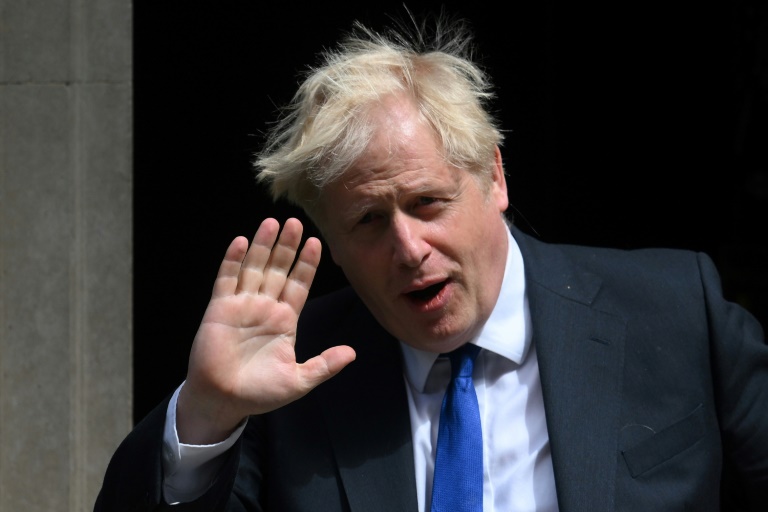
London’s FTSE rose more than one percent and the pound was slightly higher as traders kept an eye on events in Westminster where Boris Johnson was said to have decided to step down as leader of the ruling Conservative Party.

UK stocks were up more than one percent in early trade, while sterling rose towards $1.20, though the currency remains under pressure from an ongoing economic crisis.

Expectations for a contraction in some of the world’s leading economies have increased in recent weeks owing to central bank interest rate hikes aimed at taming decades-high inflation, while a new Covid flare-up in China has added to the angst.

The surge in inflation has been caused by soaring energy costs and rising post-lockdown demand, but observers said concerns about a contraction — along with signs that consumers were being put off by high prices — were weighing on the oil market.

Both main contracts fluctuated Thursday but have fallen about 10 percent this month, dipping below $100 for the first time since April.

Data on Wednesday showed US demand appeared to be waning as stockpiles rose, confounding expectations for a drop, while there are also some concerns that the China outbreaks — including another spike in Shanghai — could see major cities put into lockdown again.

Still, Vandana Hari, of Vanda Insights, said: “There isn’t much rational assessment going on — it’s panic selling.

“The fears may not end but could get brushed aside when supply constraints are back to the fore. The market balance is tight.”

While the drop in prices could temper inflation and give central banks some room to ease up on their rate hike cycle, the Federal Reserve remains on course for several more increases.

On Wednesday, minutes from its June policy meeting indicated officials were set for a second straight three-quarter-point rate hike this month, saying they were worried “inflation pressures had yet to show signs of abating”.

They also noted a need to maintain credibility among Americans, saying there was “a significant risk… that elevated inflation could become entrenched if the public began to question the resolve of the Committee”.

“It was clear from the minutes that the committee members remained highly focused on culling inflation, even if it was at the expense of a sharp economic slowdown,” said Jeffrey Halley at OANDA. 

“The minutes touched on the need for credibility and as such, I believe there will be no wimp-out by the (policy board) at the end of this month, as that would achieve exactly the opposite, plus interest.”

– Johnson under pressure –

Despite the prospect of higher borrowing costs, Wall Street ended higher.

And Asia rose thanks to bargain-buying and a pick-up in tech firms following a positive earnings forecast from Samsung Electronics.

Tokyo, Shanghai, Sydney, Seoul, Singapore, Taipei, Mumbai, Bangkok and Jakarta all rose though Wellington and Manila fell.

Hong Kong edged up, helped by news that the city’s new government had suspended a five-day flight ban on airlines that bring in Covid cases. Cathay Pacific rose more than three percent.

Paris and Frankfurt were on the front foot.

London’s FTSE was given a lift by hopes that a new government will press ahead with economy-boosting measures, though gains were tempered by an expected period of uncertainty in British politics.

Johnson’s reported decision came after dozens of cabinet members — including his finance minister and foreign secretary — stepped down and others called for him to leave, leaving his position untenable.

But he will likely stay on until the autumn as a caretaker prime minister while the ruling Conservative Party selects a new leader.

The Fed’s determination to lift rates has sent the greenback soaring, with the euro particularly hit by the European Central Bank’s much slower response to inflation.

The single currency hit a 20-year low $1.0162 Wednesday, with fears for the eurozone economy rising as it faces a severe energy crunch owing to sanctions on Russia, while there is a possibility Moscow will cut off its gas supplies.

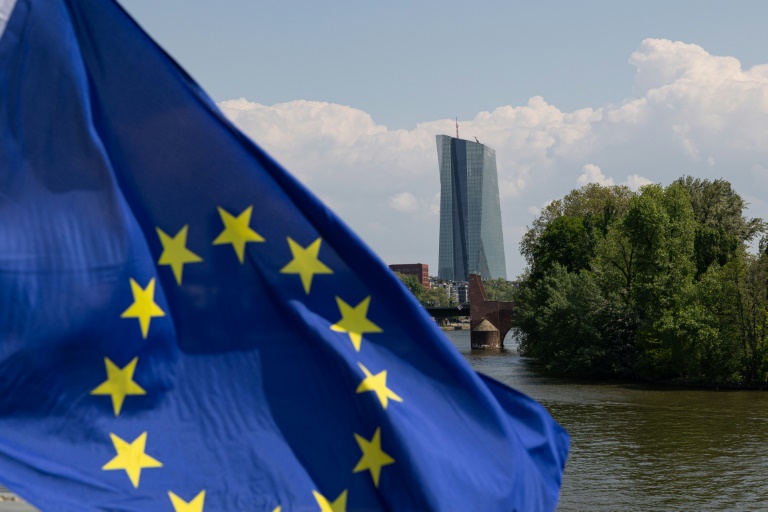
The ECB has said it will start hiking rates this month but analysts said uncertainty remained, as officials had to balance supporting the currency with avoiding a fragmentation, in which members’ borrowing costs diverge too much.

Now there is a growing belief the euro will soon fall to parity.

“I’m getting really worried about the recent speeches that have come out the past couple of days that show that there are a lot of concerns and a lot of disagreement” within the ECB governing council, said Vasileios Gkionakis of Citigroup.

“If the ECB wants to tame inflation and support exchange rates… then it needs to do two things: hike rates and come up with an effective anti-fragmentation mechanism,” he told Bloomberg.

– Key figures at around 0840 GMT –

Tokyo – Nikkei 225: UP 1.5 percent at 26,490.53 (close)

Hong Kong – Hang Seng Index: DOWN UP 0.3 percent at 21,643.58 (close)

Shanghai – Composite: UP 0.3 percent at 3,364.40 (close)

London – FTSE 100: UP 1.3 percent at 7,196.41

Pound/dollar: UP at $1.1994 from $1.1921 

Euro/dollar: UP at $1.0209 from $1.0186 on Wednesday

Euro/pound: DOWN at 85.23 pence from 85.43 pence

Dollar/yen: UP at 136.04 yen from 135.93 yen

West Texas Intermediate: UP 0.6 percent at $99.09 per barrel

Brent North Sea crude: UP 0.6 percent at $101.29 per barrel

New York – Dow: UP 0.2 percent at 31,037.68 (close)
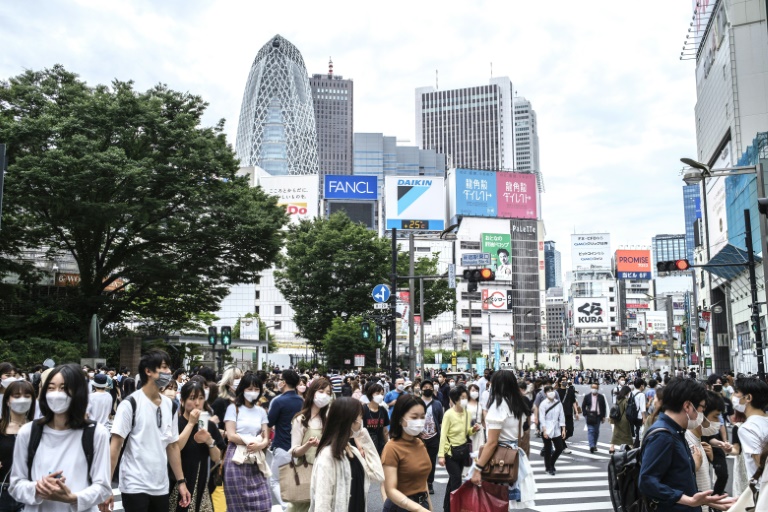
Japan introduces up to one-year jail time for cyberbullying

People found guilty of cyberbullying in Japan now face up to a year in prison under rules implemented Thursday, which were toughened up after the suicide of a reality star who had been trolled online.

Pink-haired professional wrestler Hana Kimura, a 22-year-old cast member of the hit Netflix series “Terrace House” died by suicide in 2020. 

The revised legislation follows a passionate campaign by her mother, and now imposes fines of up to 300,000 yen ($2,200) or a year in prison — an increase from previous penalties of up to 10,000 yen in fines or 30 days detention.

The beefed-up punishments are intended to make clear that cyberbullying is a criminal offence, said Justice Minister Yoshihisa Furukawa.

“It is our belief that it’s important for us to work to eradicate spiteful insults that can push people to their deaths at times,” he told a press conference on Tuesday.

Though the issue of cyberbullying had been raised in Japan before Kimura’s death, the wrestler’s suicide prompted domestic and international scrutiny and put pressure on lawmakers to take action.

But some free speech advocates and legal experts are opposed to the new rules and have warned the government to ensure the tougher law is not used to target free speech and political criticism. 

UK PM clinging to power as resignations pile up

British Prime Minister Boris Johnson was clinging to power Thursday, despite more than 50 resignations from his government, including Northern Ireland minister Brandon Lewis.

Lewis on Thursday became the fourth cabinet minister to resign, writing in a letter published on his Twitter account that Johnson was “past the point of no return”.

The Conservative leader on Wednesday defiantly responded to calls from his loyalists and cabinet colleagues to step down by sacking minister and former top ally Michael Gove. 

The Communities Secretary was reportedly the first to tell him that he must resign for the good of the Tory party and country, with a source close to Johnson telling the BBC that Gove was “a snake”. 

Gove was Johnson’s right-hand man in Britain’s 2016 Brexit referendum campaign, but dramatically chose to run against him for the Conservative leadership that same year, and again in 2019. 

The Sun newspaper said Johnson had told colleagues they would have to “dip (their) hands in blood” to push him out of office. 

Allies of the prime minister said he was going to “fight on”, with his parliamentary private secretary (PPS) James Duddridge telling Sky News Johnson was in a “buoyant mood”. 

But on Thursday morning, the front pages of British newspapers highlighted the apparently hopeless position the scandal-hit leader was in. 

The normally staunchly pro-Conservative Daily Express spoke of Johnson’s “last stand”, with the Daily Telegraph calling Johnson “mortally wounded”, and The Times saying Johnson was “fight(ing) for his life”. 

– ‘No functioning government’ –

The shock resignations of finance chief Rishi Sunak and Health Secretary Sajid Javid late Tuesday set off a chain of others. 

They quit after Johnson apologised for appointing as deputy chief whip senior Conservative MP Chris Pincher, who was forced to step down following accusations he drunkenly groped two men.

Days of shifting explanations had followed Pincher’s resignation, with Downing Street at first denying Johnson knew of the prior allegations — a defence that collapsed after a former top civil servant said he was told in 2019 about another incident.

Tory critics said the Pincher affair had tipped many over the edge, angry at having to defend what they saw as more lies by Johnson.

Johnson was confronted by members of his cabinet on Wednesday when he returned to Downing Street from a lengthy grilling by a parliamentary committee.

The delegation was said to include hardline interior minister Priti Patel and Nadhim Zahawi, who has barely been 24 hours in his new job as Sunak’s successor — though Johnson’s PPS Duddridge later denied Zahawi was there. 

A third member of Johnson’s cabinet — Welsh Secretary Simon Hart — quit on Wednesday evening.  

Former head of Downing Street’s Policy Unit Camilla Cavendish told the BBC that Britain no longer had “a functioning government”.

The calls for Johnson to go persisted late into the evening.  

Attorney General Suella Braverman told broadcaster ITV that while she wouldn’t resign, “the balance has tipped now in favour of saying… it’s time to go”.

She also said she would stand in a leadership contest. 

– ‘Bye, Boris’ –

A culture of scandal has dogged Johnson for months, including lockdown-breaking parties in Downing Street.

The prime minister, who received a police fine for the Covid lockdown-breaking “Partygate” affair, faces a parliamentary probe into whether he lied to MPs about the revelations.

Johnson only narrowly survived a no-confidence vote among Conservative MPs a month ago, which ordinarily would mean he could not be challenged again for another year.

But the influential “1922 Committee” of non-ministerial Tory MPs is reportedly seeking to change the rules, with its executive committee announcing Wednesday it will elect a fresh line up of members next week.

Johnson’s refusal to resign means he will likely face a second confidence vote, although the prime minister has been evasive when asked if he was thinking about triggering a general election.

“It’s not clear he could call a general election if his party or his cabinet don’t wish for him to do so,” Vernon Bogdanor, professor of government at King’s College, told LBC radio.

“The Queen might well ask whether the Conservative Party as a whole wants a general election.”

In parliament on Wednesday, Johnson insisted the country needed “stable government, loving each other as Conservatives, getting on with our priorities”.

But addressing MPs, Javid urged other ministers to resign.

“The problem starts at the top, and I believe that is not going to change,” he told a hushed House of Commons. 

Cries of “bye, Boris” echoed around the chamber at the end of his speech. 

Taliban excavate ex-leader Mullah Omar's 'getaway car'

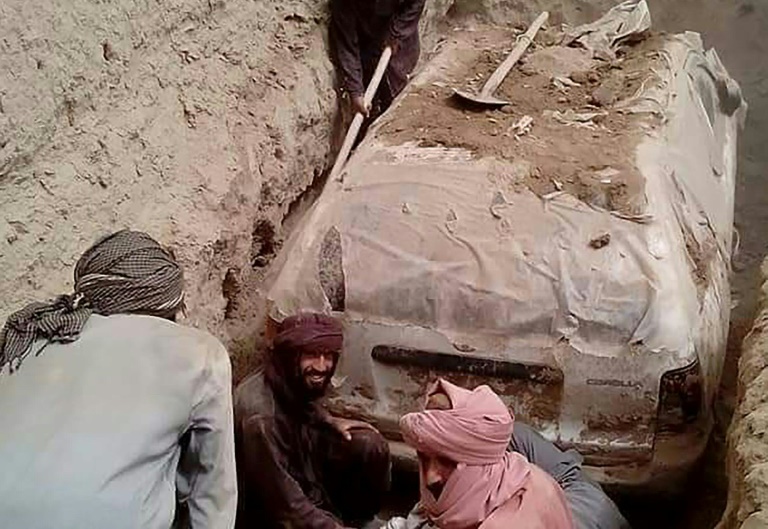
The car used by Taliban founder Mullah Omar to escape being targeted by US forces after the 9/11 attacks has been excavated in eastern Afghanistan, where it lay buried for more than two decades, officials said.

The white Toyota Corolla was buried in a village garden in Zabul province by former Taliban official Abdul Jabbar Omari, who ordered it to be dug up this week. 

“It is still in good condition, only its front is a bit damaged,” Rahmatullah Hammad, the director of information and culture of Zabul province, told AFP.

“This vehicle was buried by the mujahideen as a memorial to Omar in 2001 to avoid it being lost,” he said.

Taliban media officials published pictures of the car being dug from its vehicular grave by men using hand shovels.

The Taliban want the car to be displayed in the capital’s national museum as a “great historical monument”, Hammad added.

The Taliban were formed in Kandahar by Mullah Omar, who led the hardline Islamist movement to power in 1996 after a bloody civil war, and imposed a strict interpretation of Islamic law on the country. 

Afghanistan then became a sanctuary for jihadist groups, including Osama bin Laden and Al-Qaeda, the architects of the September 11 attacks.

When the Taliban refused to hand over bin Laden, the US and its allies launched air strikes on Afghanistan, before invading, removing the Taliban from power and installing a new government.

Taliban officials said this week that Mullah Omar made his getaway from Kandahar in the Toyota Corolla.

He died in hiding in 2013, although officials kept his death secret for several years.

After two decades of attempting to hold back a bloody insurgency, Washington withdrew the last of its troops last year as the Taliban swept across the country, seized Kabul and returned to power. 

Muslim pilgrims stream out of Mecca for hajj high point

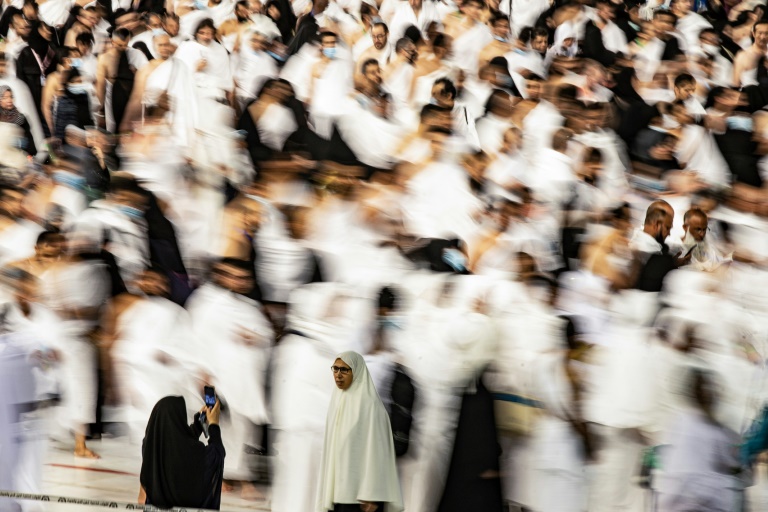
Hundreds of thousands of hajj pilgrims began streaming out of Mecca Thursday ahead of the highlight of the annual rites, which have attracted huge crowds despite the continuing pandemic and unforgiving heat.

Many of the robed worshippers are making the journey on foot to Mina, seven kilometres (four miles) from Mecca’s Grand Mosque, Islam’s holiest site, where they circled the imposing black Kaaba at the start of the rituals on Wednesday.

The crowds, capped at one million including 850,000 from abroad chosen by lottery, are the biggest at the hajj since 2019 after two Covid-hit years when only tens of thousands were allowed to take part.

All the worshippers are fully vaccinated and submitted negative PCR tests, but the rituals are taking place against the backdrop of a resurgence of Covid-19 in the region, with some Gulf countries tightening restrictions to keep outbreaks in check.

The pilgrims, dressed in simple robes, will spend the night in air-conditioned white tents in Mina, which sits in a narrow valley surrounded by rocky mountains and is transformed each year into a vast encampment.

On Friday comes the highlight of the hajj: ascending Mount Arafat, where the Prophet Mohammed is believed to have delivered his final sermon.

Worshippers will pray and recite the Koran for several hours at the mountain and sleep nearby.

On Saturday, they will gather pebbles and perform the symbolic “stoning of the devil”.

Many pilgrims held umbrellas as protection from the sun as temperatures climbed to 42 degrees Celsius (108 degrees Fahrenheit) on Wednesday.

Four hospitals and 26 health centres have been prepared at Mina.

– Tight security –

The hajj, usually one of the world’s largest annual religious gatherings, is one of the five pillars of Islam and must be undertaken by all Muslims with the means at least once in their lives.

In 2019, some 2.5 million Muslims from around the world participated in the hajj which poses a considerable security challenge and has seen several disasters over the years, including a 2015 stampede that killed up to 2,300 people.

The rituals are being performed under strict security measures that include police check-points in parts of Mecca. In 1979, gunmen barricaded themselves inside the Grand Mosque in an assault that left 153 dead, according to the official toll.

The Commander of the Air Force Group participating in this hajj season, Colonel Pilot Khaled bin Abdullah Al-Mutairi, told state media Wednesday that military helicopters will be used “around the clock… to support the public security”.

Overseas pilgrims, who were banned from the hajj in 2020 and 2021 to prevent Covid infections, are back to the mountainous region this year to fill its hotel rooms and visit its shops as business owners hope to recover huge losses.

Since the start of the pandemic, Saudi Arabia has registered more than 795,000 coronavirus cases, more than 9,000 of them fatal. Some 67 million vaccine doses have been administered in the country of over 34 million people.

The hajj ministry has said it is working on the highest levels of health precautions in light of the pandemic and the emergence of new variants. However, a requirement to wear masks has been largely ignored.

Hong Kong suspends 'not effective' Covid flight ban

Hong Kong’s new government on Thursday suspended a longstanding flight route ban that penalised airlines for bringing in coronavirus cases and severely impeded travel into the city, saying it was “not very effective”.

The financial hub has become increasingly isolated under harsh pandemic restrictions as it mirrors a lighter version of China’s strict zero-Covid policy, with the once busy Hong Kong airport now a relative aviation graveyard. 

On Thursday, new city leader John Lee’s government said the “circuit breaker” rule was being suspended to “achieve the most in fighting the pandemic with the minimum cost on the society”.

“At the current stage, continued implementation of the ‘circuit breaker’ mechanism is not very effective in preventing imported cases,” the government said. 

“Large number of passengers will have their itineraries disrupted due to the mechanism, and as the supply of seats on planes and quarantine hotel rooms fall short, the social costs generated will be remarkably high.” 

Travelling to Hong Kong will still pose a challenge as the city holds on to its mandatory seven-day hotel quarantine for all arrivals. 

Rooms at the designated hotels are booked up for months in advance.

Previous city leader Carrie Lam introduced the rule last April which banned airlines bringing in more than a handful of infected passengers from flying the designated route for a fixed period. 

The penalty was reduced from two weeks to a shorter five-day suspension during its one-year imposition. 

It was heavily criticised by industry representatives who said Hong Kong was in danger of losing its position as a global aviation hub.

So far in 2022 there had been more than 100 flight route bans, even though the coronavirus had become endemic within Hong Kong after a mass outbreak at the start of the year. 

Reopening Hong Kong’s border both with mainland China and the rest of the world was one of former top-cop John Lee’s main campaign objectives before being selected to run the city by a small committee of Beijing loyalists in May. 

But it is unclear how his ad ministration can achieve both objectives at the same time. 

Lee told the city’s legislature on Wednesday that Hong Kong was not ready to abandon its  zero-Covid policy. 

Hong Kong is currently facing an uptick of Covid-19 cases with numbers at their highest level since April. 

US hopes for G20 action on Ukraine even with Russia presence

The United States believes Group of 20 talks in Bali can make progress related to the Ukraine crisis despite the participation of Russia, a senior official said Thursday.

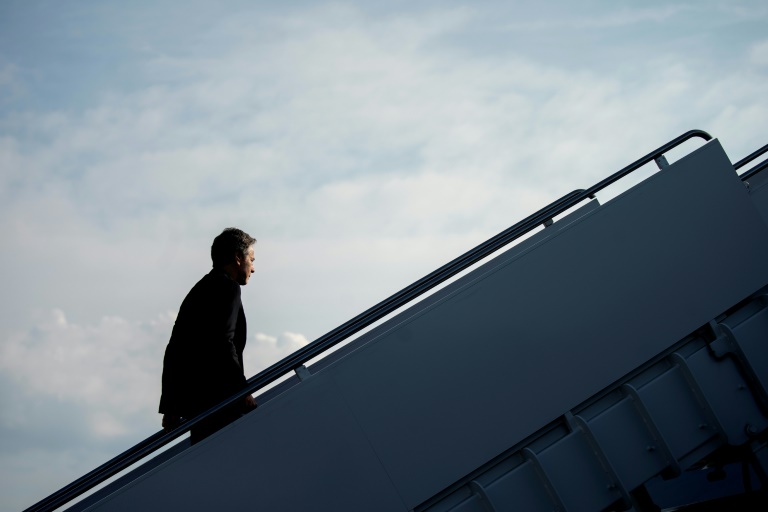
Secretary of State Antony Blinken is expected to arrive Thursday on the Indonesian resort island for talks of the club of major economies — with the State Department saying he will not meet Russian Foreign Minister Sergei Lavrov.

A senior US official expected that “virtually all the G20 countries” would agree on initiatives to address global food insecurity and energy volatility triggered by Russia’s invasion of Ukraine.

The official acknowledged that joint G20 statements would be impossible on Ukraine due to Russia’s participation.

“Whether or not the G20 as an entity endorses or doesn’t endorse something is less important than whether most if not all of the G20 countries put their weight behind something that we’re trying to do,” the official told reporters on a refuelling stop in Tokyo.

“You’ll see that we will have an ability as necessary to make clear Russia’s responsibility for some of the very problems that the G20 is going to be tackling,” he said.

Despite shunning Russia, Blinken will meet separately on Saturday with Chinese Foreign Minister Wang Yi to address high tensions between the world’s two largest economies.

The official said not to expect a keenly awaited announcement on whether President Joe Biden will ease tariffs on China, which he said was an issue for the US Trade Representative’s office.

Blinken’s talks with Wang are among a series of recent engagements between the United States and China which included a meeting last month in Singapore between the two powers’ defence chiefs.

Host Indonesia has invited Russian President Vladimir Putin to the G20 summit later this year despite US-led efforts to isolate him.

But in a compromise, Ukrainian President Volodymyr Zelensky was also invited.

Russia's plastic surgery sector feels pinch from western sanctions

When it comes to looking good, Russian women are happy to splash out, even on a bit of nip-and-tuck plastic surgery.

But Western sanctions in the wake of Russia’s military intervention in Ukraine mean that supplies of products such as botox and breast implants — largely imported from countries such as the United States and Germany — could become increasingly hard to get hold of. 

Anastasia Yermakova, 37, is worried: she had her last injection of botox (botulinum toxin) in February to reduce facial wrinkles.

“My beautician assures us that she still has stocks of botox,” she told AFP.

“But I worry,” she said, arguing that local botox replacements are of inferior quality. 

Russia ranks ninth globally in the number of aesthetic procedures carried out annually — 621,600 in 2020, according to the International Society of Aesthetic Plastic Surgery. 

And the Russian aesthetic medicines sector was worth $969 million in 2021, up two percent from the year before, according to the Russian consultancy Amiko.

Soon after President Vladimir Putin sent troops into Ukraine on February 24, US drugmaker AbbVie, which is behind the wrinkle treatment Botox, withdrew from the flourishing Russian market over what it called “tragic events” in Ukraine. 

As a result, Botox stocks are “melting”, Yuliya Frangulova, co-founder of the National Association of Aesthetic Medicine Clinics, told AFP.

Frangulova said it is “causing concern of clinic managers accustomed to using this reference product”.

– ‘Say goodbye to fillers’ –

“In March, we saw a panic among patients, doctors and suppliers,” said Oksana Vlasova, director of development at the Grandmed beauty clinic in Russia’s second city Saint Petersburg. 

“The demand exploded, the stocks of botox were emptying.”

In April and May, there were no botox imports at all, said Nikolay Bespalov of RNC Pharma which analyses the Russian pharmaceutical market. 

He hopes supplies could resume “towards the end of the summer.”

Russians are also running out of some Western-made face fillers, in particular injections of hyaluronic acid to plump up lips — a very popular procedure in the country. 

“We are also forced to say goodbye” to fillers from AbbVie, Vlasova said, hoping that European producers can fill in the gap.

It is also getting harder to get breast implants — due to a lack of Russian producers. 

All breast implants in Russia are imported, with 60 percent coming from the United States and 13 percent from Germany, according to industry estimates.

The sanctions do not target the supply of implants, but the disrupted logistics and other factors affected both breast reconstruction and aesthetic operations.

In March, prices of implants rose threefold, before stabilising at a level 20 percent higher than before the start of Moscow’s military intervention in Ukraine, plastic surgeon Evgeny Dobreikin told AFP.

– Patriotic breasts –

Alexander Saversky, president of the League of Patient Advocates, fears that cheap but potentially dangerous products could soon start arriving in clinics, recalling the scandal of the French firm PIP’s poor quality breast implants. 

Saversky predicted that the problems will soon apply to the rest of the health industry. 

“In a few months, the shortages of medical equipment in Russia, 80 percent of which is imported from abroad, will be critical,” he said.

Soaring inflation and uncertain future also create problems for beauty professionals, as Russians have begun to tighten their belts.

In Saint Petersburg, Vlasova has already seen a drop in her clientele.

“The population’s income has gone down,” she said.

“People are reducing their expenses.” 

But in the midst of dark times, plastic surgeon Dobreikin sees an opportunity.

He wants to win new clients with patriotic themes. 

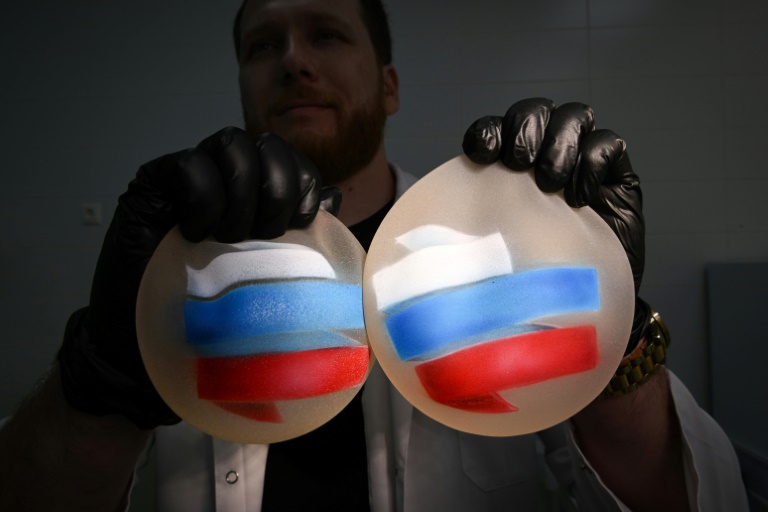
In late May, he floated the idea of “RosGrud” (Russian Breasts) implants, which instead of being translucent are in the colours of the Russian flag or military fatigues. 

One of his clients, Nastella Sokolova, a 28-year-old designer, is enthusiastic. 

“It’s my way of defending my homeland,” she said.

The surgeon is now looking to find a supplier abroad who is willing to create such implants for him.

Dobreikin warns wits against mocking his project, alluding to harsh penalties introduced in the country for anyone criticising the army. 

“Perhaps those who are against our patriotic implants are also against our country?”

One year after Haiti's president assassinated, investigation stalls

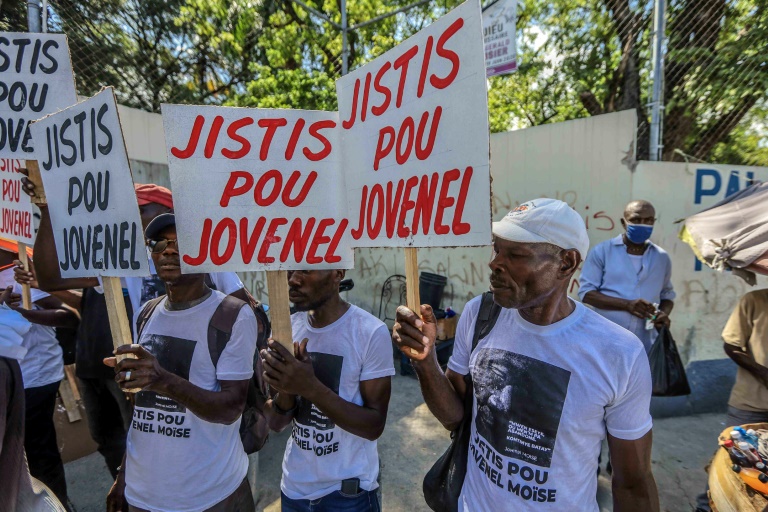
One year after Haitian president Jovenel Moise was shot to death at his home in Port-au-Prince, no suspected mastermind or motive has yet been identified, with the investigation stalling amid a crumbling political environment.

Moise was assassinated in the early hours of July 7, 2021, when a commando group entered the president’s private home and shot him 12 times, killing him. 

The same day, Haitian police mobilized exceptionally quickly to arrest about 20 people, including 18 former Colombian soldiers presumed to be hired as mercenaries.

But that initial speed has since been followed by a crawling legal process in Haiti and the United States.

The sluggishness has only worsened in recent weeks as the prosecutor’s offices in the Haitian capital have for the last month been invaded by one of the many gangs plaguing the country, whole sections of which are controlled by the often violent criminal bands. 

The inquiry’s delays have also further complicated Haiti’s existing political crisis. 

The Caribbean island nation’s presidency has been vacant since Moise’s death, with no date set for a vote to fill the office. 

No fewer than five successive judges have been in charge of the case, but none of them have issued any charges for the 40 people currently imprisoned in connection with it.

Prime Minister Ariel Henry, who was named to his post just two days before Moise’s death, is suspected of speaking with one of the prime suspects via telephone just hours after the attack — a line of investigation which he calls a “distraction.”

Parliament has not functioned properly in two years, as Moise had not organized elections since he himself took office in 2017. And without a head of state to appoint judges, the country’s judicial system has also flagged.

– Suspects charged in US –

With confidence in their own government all but gone, many Haitians have instead placed their hopes in the hands of the American judicial system.

Three suspects have been charged in Miami, Florida, where Haitian police also say the plot originated. Those suspects are: Colombian Mario Palacios, who is believed to be one of the five armed men who ultimately gained access to the room where Moise was killed, Colombian-Haitian citizen Rodolphe Jaar and former Haitian senator John Joel Joseph.

A fourth man was arrested at an airport in Istanbul in November, though Turkish courts rejected Haiti’s extradition request for him just this week.

Despite the case’s progress in the United States, a judge in April ruled to seal the evidence, citing two of the suspects’ previous involvement as informants for the US Drug Enforcement Agency and the FBI.

A Haitian judicial source, speaking on condition of anonymity, lamented the US move, telling AFP: “A whole section of this story will remain unknown.” 

South Korean auteur behind 'Oldboy' returns with 'pure' love story

Filmmaker Park Chan-wook, known for his ultra-violent thrillers that helped catapult South Korean cinema onto the global stage, is back with an altogether different work — a restrained yet deeply emotional love story. 

“Decision to Leave” arrives after the world-smashing success of South Korean entertainment, including Bong Joon-ho’s “Parasite” and Netflix’s “Squid Game”, and has been the top-grossing domestic film in South Korea since opening last week. 

It stars Chinese star Tang Wei and Korean actor Park Hae-il, who plays a detective investigating a man’s fatal plunge from a mountain. He falls for the victim’s mysterious wife, whom he suspects of being behind her husband’s death. 

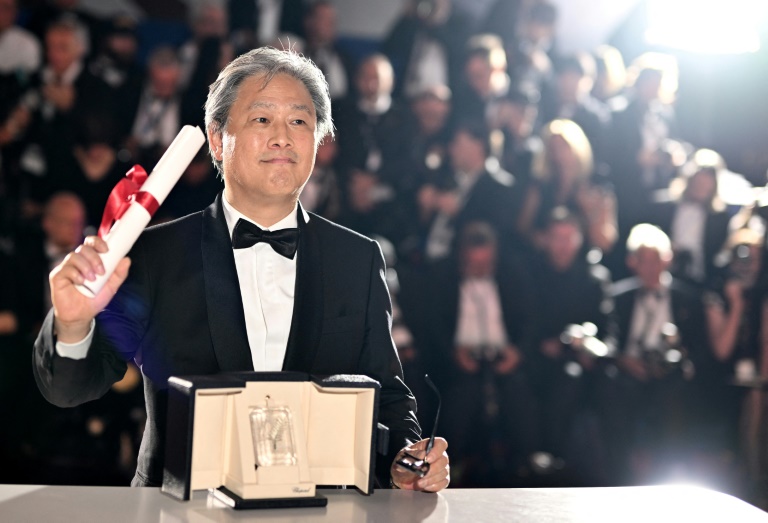
The film has already won Park the Best Director prize at this year’s Cannes Film Festival, which had previously awarded him the Grand Prix for his 2003 cult-classic revenge thriller “Oldboy”.

However, unlike many of his previous works, “Decision to Leave” contains almost no adult or graphically violent scenes.

IndieWire has called it “the most romantic movie of the year (so far)”, while early reviews praised it as a gorgeously rendered love story marked by elegance and restraint.

“I agree that it’s a romantic film, and I wanted to make such a movie,” Park said in an interview with reporters in Seoul last month.

The 58-year-old said he started thinking about the project while working on the BBC’s English-language miniseries “The Little Drummer Girl”. Set against the backdrop of the Israeli-Palestinian conflict, Park found himself yearning to do something different — away from politics and disputes.

“I wanted to make a film that’s pure — pure in the sense that it is faithful to the basics of cinema as an art form while no elements other than the theme of love get in the way,” he said.

The result is a poetic exploration of time, loss and longing, combining Park’s signature lush cinematography with the audience-arresting sexual tension simmering between the well-mannered detective and beguiling murder suspect.

The two characters are a departure from Park’s previous, more extreme characters — like the repressed Catholic priest-turned-vampire in the horror flick “Thirst” and a man held captive for 15 years in “Oldboy”. 

The director has said before that love stories, just like his blood-lusty tales of revenge, reveal how “human beings essentially are”.

Even so, none of the characters in his movies have much common ground with him.

“I’m not at all a person who goes after such romantic ideals or lives my life that way. I tend to be very realistic and pragmatic,” said the soft-spoken auteur.

“I’m the kind of filmmaker who has a big gap between my life and the movies I’ve made.”

– ‘Arthouse’ barrier – 

Park has long been credited for inspiring a generation of filmmakers behind the “Korean noir” genre — movies about bloody crimes, brutal revenge or the criminal underworld, presented with sumptuous cinematography.

One such director, Bong Joon-ho, became the first South Korean to win the top Palme d’Or prize at Cannes for his dark comedy “Parasite” in 2019. It was also the first non-English-language film to win the Oscar’s Best Picture.

While Park believes he has always directed his movies for the general public, he recognises that “South Korean films, Asian films and foreign films are still being consumed as arthouse cinema” outside the region. 

“No matter how they are made, that’s how they are being categorised as,” he said. 

“I don’t think that’s ideal. But ‘Parasite’ has broken that barrier.”

Critics say his “Oldboy” paved the crucial way for South Korean cinema’s global triumph, but Park has been making conscious efforts to also work on non-Korean projects. 

Aside from “The Little Drummer Girl”, he produced Bong’s first English-language film, 2013’s “Snowpiercer”, and made his own Hollywood debut that year with “Stoker” starring Nicole Kidman and Mia Wasikowska.

His next project is with HBO — an espionage drama series based on Viet Thanh Nguyen’s Pulitzer Prize-winning novel “The Sympathizer”, which will feature Robert Downey Jr.

Park said the global entertainment industry needs more international collaborations.

“It’s important how your movies are being perceived right now, but you also wonder whether your films will survive and be remembered,” he said.

“There is no way for me to know what viewers 50 or 100 years from now would think. Yet the slightest hint you can still get is by responses from today’s foreign viewers,” he added. 

Close Bitnami banner
Bitnami