World

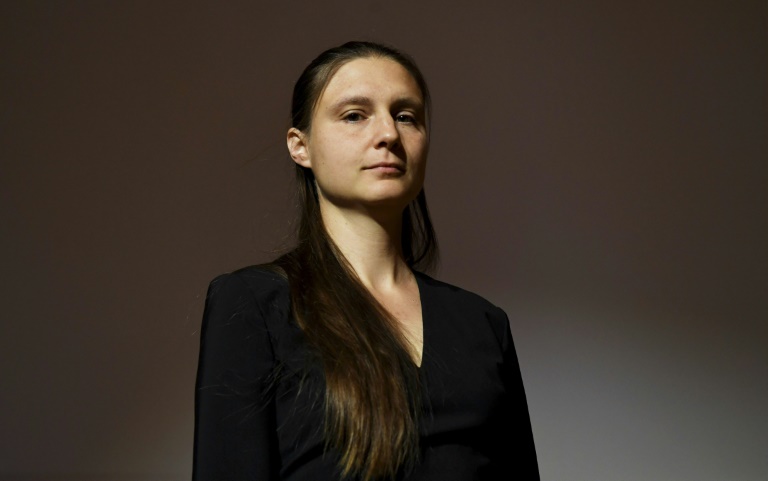
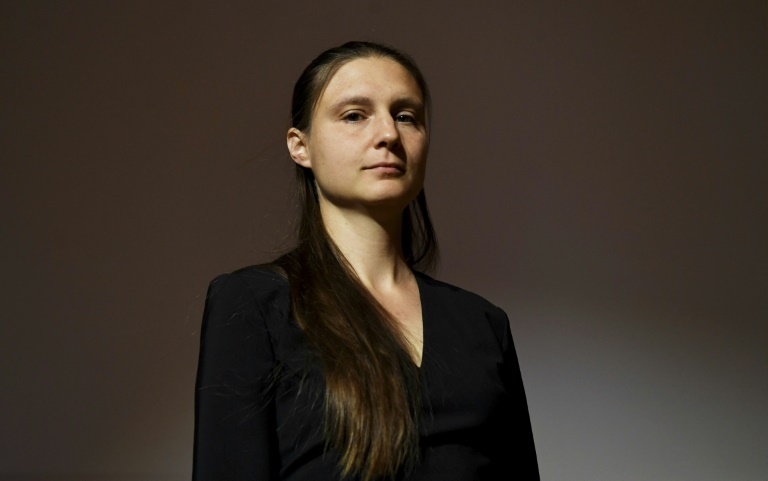
Maryna Viazovska, Ukrainian Fields winner 'changed forever' by war

Ukrainian maths professor Maryna Viazovska, who on Tuesday won the top mathematics prize, the Fields Medal, said her life “changed forever” when Russia invaded her home country.

The 37-year-old’s parents and sisters were living in Ukraine’s capital, Kyiv, when the war began in February.

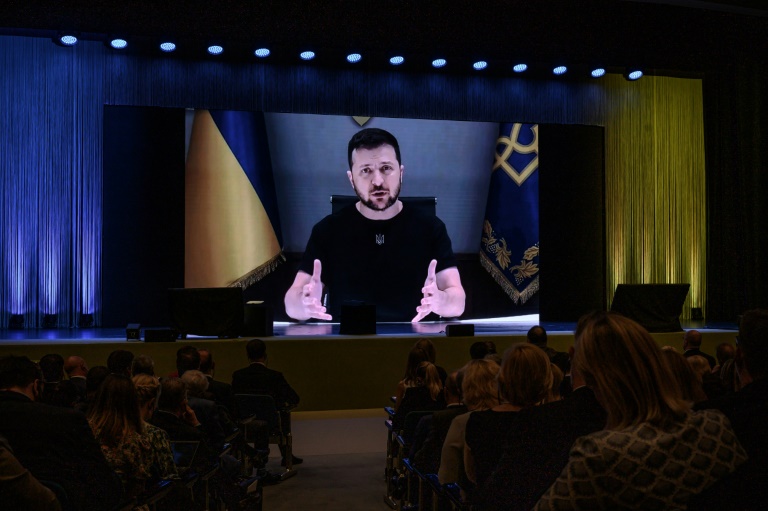
“I could not think of anything else, including mathematics,” she in a video as she received the prize at a ceremony in Helsinki. 

Her sisters — along with her young nephew and niece — were evacuated from Kyiv and are now staying with her in Switzerland, where she works at the Ecole Polytechnique Federale de Lausanne.

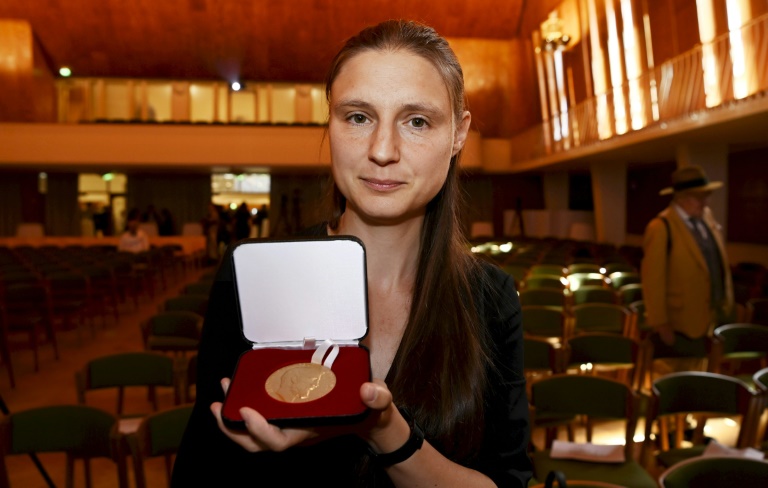
Viazovska and three other mathematicians received the Fields Medal, dubbed the Nobel prize in maths, in Helsinki after the ceremony was moved from Saint Petersburg to the Finnish capital in response to Moscow’s war.

She is only the second woman to receive the award, which is awarded to mathematicians under 40, since it was created in 1936. 

The other female laureate, Iran’s Maryam Mirzakhani, died of breast cancer in 2017 just three years after winning the prize.

– ‘Terrible war’ –

Viazovska was born in 1984 in Kyiv, when Ukraine was part of the Soviet Union.

In Ukraine, she studied at the Taras Shevchenko National University of Kyiv, before earning a masters degree at Germany’s University of Kaiserslautern and a PhD at the University of Bonn.

Since 2018, she has been chair of number theory at the Ecole Polytechnique Federale de Lausanne. Her husband Daniil Evtushinsky is a physicist at the Swiss institute.

In the first days of the war, teaching maths to students “helped me to forget about this fear and pain inside myself”, she said.

At the ceremony she paid tribute to Yulia Zdanovska, a 21-year-old mathematician who was killed by a Russian missile attack on the Ukrainian city of Kharkiv in March.

“Yulia was a person filled with light and her big dream was teaching mathematics to kids in Ukraine,” Viazovska said.

“When young people die you think, ‘What is the point of my work as a teacher if young, talented people are just wasted in this terrible war?'”

– 13 years to find ‘magic formula’ –

She won the Fields Medal for her work on sphere packing, which has plagued mathematicians for hundreds of years.

It fundamentally involves how to put spheres in a container in the most compact way. 

According to legend, it was first a question of how many cannonballs could be packed into a ship, Viazovska said.

After hundreds of years, mathematicians had solved the problem in three dimensions, which involved stacking them in a pyramid, like oranges at a supermarket.

But expanding the theory out into other dimensions — possible in mathematics — had proved elusive.

Viazovska however worked on the problem from 2003 to 2016 and found a “magic formula” that solved the problem in dimensions eight and 24, she said.

“Maryna pulled off something really miraculous here,” mathematician Henry Cohn of MIT told the ceremony. “As soon as this paper became available, everyone was astonished by it.”

Philippe Moustrou of France’s Toulouse University told AFP that it was “not as if she found something that was just waiting to be discovered — she found the extra ingredient”.

But Viazovska’s thoughts remain with the war — and the hopeful return of a peace she once took for granted.

“The thing I like about Kyiv the most are the green parks, the quiet places and the ancient churches. I understand that now there will be marks of war there and this is a scary thought,” she said.

“But Kyiv is one of the eternal cities. One day soon, I hope to return.”
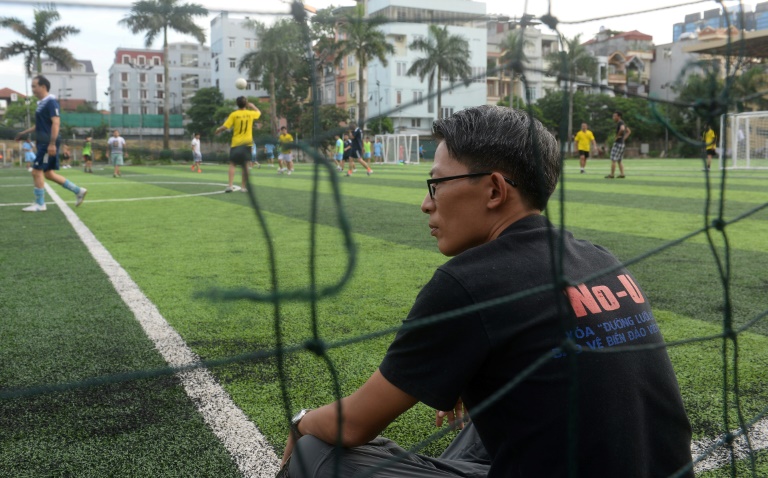
Vietnam arrests prominent rights activist over 'propaganda'

Vietnam arrested a prominent human rights activist on Tuesday, accusing him of distributing anti-state propaganda.

Nguyen Lan Thang is well known in the communist country for his social activism as well as his online criticism of the government, which has become increasingly intolerant of any dissent.

The 46-year-old was arrested at his home in Hanoi “for making, hoarding, disseminating and spreading propaganda against the state of the Socialist Republic of Vietnam under article 117 of the 2015 Penal Code”, the capital’s police said in an official statement.

Officers did not provide any other details, stating that the case was currently under investigation.

Vietnam is notorious for its harsh treatment of those holding viewpoints diverging from the official pro-government line.

Thang has endured short spells in detention, as well as harassment from officers, in the past.

“I’m a focal point for police,” Thang previously told the Committee for Protecting Journalists.

Human Rights Watch on Tuesday called for his “immediate and unconditional release”.

“Vietnam’s outrageous and unacceptable crackdown on freedom of expression has just snared another victim who will invariably face a kangaroo court trial and years in prison for speaking his mind,” said deputy Asia director Phil Robertson.

He added: “Thang’s peaceful advocacy for democratic reforms and justice should be respected and listened to rather than face this kind of unjustified repression.”

Social media reports claimed that authorities had also confiscated digital devices, as well as human rights-related books, from Thang’s home during the arrest.

His family could not be reached for comment.

NATO launches membership process for Sweden, Finland

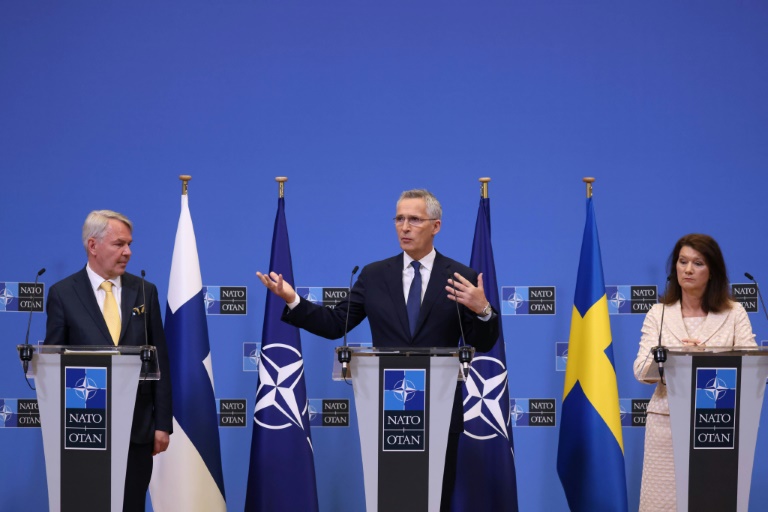
NATO on Tuesday kicked off momentous accession procedures for Sweden and Finland, aiming to expand the military alliance to 32 countries in reaction to Russia’s war in Ukraine.

“This is an historic day, for Finland, for Sweden, for NATO, and for Euro-Atlantic security,” NATO chief Jens Stoltenberg said after protocols were signed launching the required ratification process in all alliance countries.

The foreign ministers of Sweden and Finland, alongside Stoltenberg, also qualified the occasion as “historic”.

“The membership of both Finland and Sweden will not only contribute to our own security, but to the collective security of the alliance,” said Finland’s Pekka Haavisto.

The two Nordic countries had long maintained non-alignment status, even though they have held exercises with NATO and have inter-operable weapons systems.

They announced intentions to join NATO in May, triggered by Russia’s February invasion of Ukraine and ongoing war there.

In a sudden change of course, Sweden and Finland — the latter of which fought a Soviet invasion in 1939-1940 and shares a 1,340-kilometre (830-mile) border with Russia — asked to come under NATO’s mutual-defence umbrella.

Their bids hit a road-bump when Turkey, a NATO member, threatened to block their entry. 

Turkish President Recep Tayyip Erdogan had accused Sweden and Finland of being havens for Kurdish militants he has sought to crush, and for promoting “terrorism”. 

He also demanded they lift arms embargoes imposed for Turkey’s 2019 military incursion into Syria.

But Erdogan dropped his objections last week, in time for a NATO summit in Spain, after negotiations resulted in concessions — and a US promise of new warplanes for Turkey.

The summit ended up extending invitations to Sweden and Finland to formally apply, leading to lightning-fast negotiations on Monday then Tuesday’s signing.

– Security commitments –

Erdogan says he could still slam the door shut if Sweden and Finland don’t follow through on their promises, which include possible extradition agreements.

The months-long period during which all NATO countries have to ratify the Nordic countries’ membership is a risky moment, not only because of Turkey’s threat but also because the NATO mutual-defence clause is not yet applicable.

Stoltenberg said: “I count on allies to deliver a quick and swift and smooth ratification process.” 

He emphasised that “many allies have already made clear commitments to Finland and Sweden’s security” during the interim period, and pointed out a boosted NATO presence in their region.

Swedish Foreign Minister Ann Linde said security assurances had been made by the United States, Britain, France, Germany, Spain, Italy, Poland and NATO members in the Nordic and Baltic regions.

Several NATO members flagged expedited ratification for Sweden and Finland.

“Moments after Finland and Sweden’s accession protocols were signed in Brussels, I summoned my government and proposed to Estonian parliament to convene tomorrow for accelerated ratification,” Estonian Prime Minister Kaja Kallas tweeted.

Germany’s parliament was poised to ratify as early as the end of this week. Sources in the ruling coalition said a first reading of the text was likely on Wednesday, with the final two readings on Friday.

“This is the fastest accession process in NATO’s history so far,” Stoltenberg said.

Ukraine, allies adopt principles for reconstruction

Dozens of countries committed Tuesday to support Ukraine through what is expected to be a long and expensive recovery, and agreed on the need for broad reforms to boost transparency and battle corruption.

Wrapping up a two-day conference in the southern Swiss city of Lugano, leaders from some 40 countries signed on to the Lugano Declaration laying out a set of principles for rebuilding Ukraine.

Swiss President Iganzio Cassis, who co-hosted the conference with Ukraine, hailed the declaration as a “key first step on the long road of Ukraine’s recovery”.

“Our work prepares for the time after the war even as the war is still raging,” he told the closing ceremony.

“This should give the people in Ukraine hope and the certainty that they are not alone.”

Ukrainian Prime Minister Denys Shmyhal on Monday told the conference the recovery following Russia’s February 24 invasion was expected to cost at least $750 billion. 

He said Tuesday the declaration was “definitely the start of our long distance” process.

“We have to make everything that was destroyed better than it was,” he said.

– Fight corruption –

The declaration said the countries, in addition to Ukraine and the European Union, “fully commit to supporting Ukraine throughout its path from early to long-term recovery”. 

It added that it supported “Ukraine’s European perspective and EU candidate country status”.

Among the principles, the countries agreed Ukraine itself must be in the driving seat on how to rebuild.

As billions of dollars in aid flow into Ukraine, lingering concerns about widespread corruption in the country has meant there has been much focus on the necessity of reforms.

The Lugano principles stressed “the recovery process has to contribute to accelerating, deepening, broadening and achieving Ukraine’s reform efforts and resilience in line with Ukraine’s European path”.

“The recovery process has to be transparent and accountable to the people of Ukraine,” the document said.

It also called for the recovery process to be “inclusive and ensure gender equality, and it called for Ukraine to be rebuilt in a “sustainable manner”.

Shmyhal on Monday laid out the government’s phased reconstruction plan, focused on the immediate needs of those affected by the war, followed by the financing of longer-term reconstruction projects aimed at making Ukraine European, green and digital.

On Tuesday, he stressed his country was eager to move swiftly to put in place the framework to ensure rapid change.

“When we say we are ready to move fast, we really mean fast,” he said, pointing out a meeting was planned to start implementation later Tuesday.

He also noted that two follow-up conferences have already been planned, with one led by the EU in a few months time, and London agreeing to host a Ukraine Recovery Conference next year.

French music streamer Deezer flops at stock market debut

French music streaming service Deezer’s shares failed to strike the right note with investors at its Tuesday launch on the Paris stock market, plunging in morning trading by over 35 percent.

The steep fall — as low as 5.52 euros ($5.70) before a slight rebound — was a blow for the Spotify competitor, whose 9.6 million subscribers account for around two percent of the global streaming market, according to Midia Research.

That makes it a minnow compared with the Swedish streaming giant, which boasts market share of around 31 percent.

But as one of the few French digital firms to become a household name, Deezer’s flotation event in Paris was attended by Economy Minister Bruno Le Maire, who told bosses “you have to grow” after chief executive Jeronimo Folgueira rang the opening bell.

“I don’t accept seeing all the American firms coming to Europe without seeing European firms go to the US, to explain to our American friends that European firms are the best,” Le Maire said.

As well as Spotify, Deezer has yet to catch up with other giants in the streaming world, including Apple, Amazon and China’s Tencent.

The firm is doubling down on music, rather than expanding into neighbouring fields like podcasting and audio books as Spotify and Amazon have done.

Deezer hopes deals with mobile network operators like France’s Orange and Brazil’s Tim, as well as broadcaster RTL in Germany, will help it reach more listeners in a global streaming market growing at more than 25 percent per year by users.

“With the right distribution, we know we can win market share and become rivals to the major players,” CEO Folgueira told AFP ahead of the stock market launch.

Compared with 2015, when a first attempt to float the company had to be postponed because of hostile market conditions, “the business has changed, the market has changed: it’s the right moment to take this step,” he added.

“Music streaming is really established, it makes up almost two-thirds of revenue for recorded music, which wasn’t true back then.”

Deezer’s top investor before its arrival on the market was British-American billionaire Len Blavatnik, with 43 percent, while French businesspeople including billionaire Francois Pinault have also bet on the firm.

burs/tgb/spm

War in Ukraine: Latest developments

Here are the latest developments in the war in Ukraine:

– Ukraine torturing prisoners: Moscow –

Russia says it is investigating the torture of Russian soldiers held prisoner in Ukraine that were recently released as part of a prisoner swap. 

The Russian Investigative Committee, which probes major crimes, says one of the 144 Russian soldiers exchanged last week related being treated by doctors without an anaesthetic and being “beaten” and “tortured with electricity” in captivity.

The soldier allegedly said he was left without food and water for days.  

Numerous Ukrainian soldiers and citizens held captive by Russian forces have also alleged torture and inhumane treatment.

– NATO starts to ratify Sweden, Finland –

NATO launches the process to ratify Sweden and Finland as the newest members of the 30-member defence alliance.

“This is a good day for Finland and Sweden and a good day for NATO,” the alliance’s chief Jens Stoltenberg tells reporters in a joint statement with the Swedish and Finnish foreign ministers.

“With 32 nations around the table, we will be even stronger and our people will be even safer as we face the biggest security crisis in decades,” he says.

– Cosmonauts hail Russian gains –

Russian cosmonauts onboard the International Space Station congratulate Russian forces on capturing the eastern Ukrainian region of Lugansk by being photographed with the flag of the area’s pro-Russian rebels.

Russian space agency Roscosmos posted the photograph on the messaging network Telegram of Oleg Artemyev, Denis Matveyev and Sergei Korsakov holding the flag of the self-proclaimed separatist Lugansk People’s Republic. 

“We celebrate on earth and in space,” Roscosmos said.

– Ukrainian woman wins ‘maths Nobel’ –

Ukraine’s Maryna Viazovska becomes only the second woman to be awarded the prestigious Fields medal, dubbed the Nobel prize for mathematics,

Viazovska, a 37-year-old Kyiv-born math professor, shared the prize with three other winners.

She accepted the award at a ceremony in Helsinki, which was chosen to replace Saint Petersburg as the venue for the congress after Russia invaded Ukraine in late February.

– Russian metal giants eye merger –

The head of Russian mining company Nornickel, Vladimir Potanin, says he is ready to discuss a merger with aluminium group Rusal to create a metals giant capable of resisting the effects of Western sanctions.

Potanin told Russian business paper RBK that he made the proposal to Rusal on Monday. 

Potanin had always opposed a merger of the world leader in nickel and palladium with Rusal, which already owns 25.25 percent of Nornickel.  

But both companies are affected by Western sanctions targeting Russia over its military campaign in Ukraine. Potanin also cited the challenges they face to make their companies greener.

burs-cb/eab/jv

Euro slumps as recession risk stalks eurozone

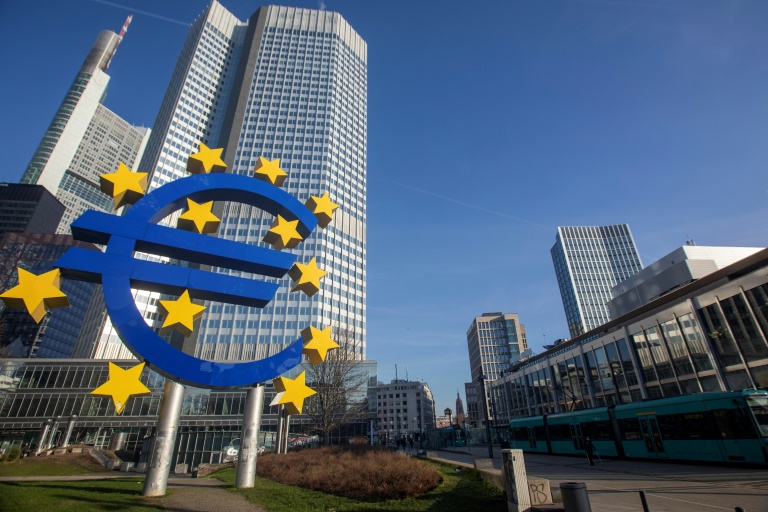
The euro on Tuesday slumped to its lowest level since 2002 and European stock markets sank as growing recession risks sent shockwaves around the region.

The shared currency fell as low as $1.0298, threatening a push towards dollar parity.

It also dived as investors eyed aggressive interest rate hikes by the US Federal Reserve in its fight against inflation, in contrast with the European Central Bank which plans more modest increases.

Stocks indices in Frankfurt, London and Paris shed more than one percent in late morning deals on heightened fears of a prolonged economic downturn across Europe.

Economic growth in the eurozone floundered in June, a key survey showed Tuesday, hit by soaring consumer prices.

S&P Global’s closely-watched monthly purchasing managers’ index (PMI), which measures corporate confidence, fell to 52.0 in June from 54.8 in May.

Nevertheless, the reading, which was a 16-month low, remains above the 50-point level signalling expansion.

“Growing fears of a recession are hammering the euro lower, whilst the dollar is soaring on bets that the Fed will keep hiking rates aggressively to tame inflation,” City Index analyst Fiona Cincotta told AFP.

“Today’s PMI data from Europe have highlighted the risk of slowing growth at the end of the second quarter and raise the prospect of a contraction in activity in the coming months.”

By contrast, most Asian stock markets closed higher on growing speculation that US President Joe Biden is about to roll back some of the Trump-era tariffs on Chinese goods.

The mood on trading floors has nevertheless become increasingly gloomy in recent months as observers warn that sharp interest rate hikes aimed at curbing price rises could cause a contraction, compounding uncertainty caused by Russia’s war in Ukraine.

Oil prices were mixed as traders assessed the market with demand outstripping supplies.

Investors were keeping tabs also on fresh Covid outbreaks in China that have triggered City lockdowns.

US markets were set to reopen later Tuesday following July 4 celebrations.

– Key figures at around 1000 GMT –

Euro/dollar: DOWN at $1.0301 from $1.0431 Monday

Pound/dollar: DOWN at $1.2040 from $1.2116

Euro/pound: DOWN at 85.59 pence from 86.09 pence

Dollar/yen: UP at 135.76 yen from 135.69 yen

London – FTSE 100: DOWN 1.2 percent at 7,144.11 points

Frankfurt – DAX: DOWN 1.1 percent at 12,637.22

Paris – CAC 40: DOWN 1.3 percent at 5,878.26

EURO STOXX 50: DOWN 1.0 percent at 3,417.26

Tokyo – Nikkei 225: UP 1.0 percent at 26,423.47 (close)

Hong Kong – Hang Seng Index: UP 0.1 percent at 21,853.07 (close)

Shanghai – Composite: FLAT at 3,404.03 (close)

New York – Dow: Closed for public holiday

Brent North Sea crude: DOWN 1.4 percent at $111.88 per barrel

West Texas Intermediate: UP 0.4 percent at $108.90 per barrel

Ukrainian becomes second woman to win Fields math medal

Ukraine’s Maryna Viazovska paid tribute to those suffering in her war-torn country on Tuesday as she became the second woman to be awarded the Fields medal, known as the Nobel prize for mathematics.

Viazovska, a 37-year-old Kyiv-born math professor, received the prestigious award alongside three other winners at a ceremony in Helsinki.

“My life changed forever” when Moscow invaded Ukraine in February, she said in a video displayed at the ceremony, adding that her sisters had been evacuated from Kyiv.

“Right now Ukrainians are really paying the highest price for our beliefs and our freedom,” she said.

The International Congress of Mathematicians, where the prize is awarded, was initially scheduled to be held in Russia’s second city Saint Petersburg — and opened by President Vladimir Putin.

Earlier in the year hundreds of mathematicians signed an open letter protesting the choice of the host city, and after Moscow invaded Ukraine in late February the event was moved to the Finnish capital.

The other Fields winners were France’s Hugo Duminil-Copin of the University of Geneva, Britain’s James Maynard of Oxford University and June Huh of Princeton in the United States.

The medal, along with $15,000 Canadian dollars ($11,600), is awarded every four years to between two to four candidates under the age of 40 for “outstanding mathematical achievement”.

– ‘Tour de force’ – 

Viazovska was born in 1984 in Ukraine, then still part of the Soviet Union, and has been a professor at the Ecole Polytechnique Federale de Lausanne in Switzerland since 2017.

At the ceremony she paid tribute to Yulia Zdanovska, a young mathematician who studied under the same teachers she had in Kyiv, who was killed by a Russian missile attack on the Ukrainian city of Kharkiv in March.

“Yulia was a person filled with light, and her big dream was teaching mathematics to kids in Ukraine,” Viazovska said.

“When someone like her dies, it’s like the future dies.”

In a decision made before the war in Ukraine began, Viazovska was awarded for her work in sphere packing — a problem first posed by German astronomer and mathematician Johannes Kepler nearly 400 years ago.

In what is called the Kepler conjecture, he proposed that the most compact way to pack spheres was in a pyramid, like oranges at a supermarket.

But it was such a complex problem that it was not considered proved correct until 1998 via intense computer number-crunching.

Then in 2016, Viazovska solved the problem in the eighth dimension, using what is called an E8 lattice.

Marcus du Sautoy, a British mathematics professor at Oxford University, told AFP it was a surprise when Viazovska came up with such “slick proof” compared to the “tortuous proof needed in three dimensions”.

Renaud Coulangeon of Bordeaux University told AFP the solution was a “tour de force”.

The only previous female laureate in the prize’s more than 80-year history was Iranian mathematician Maryam Mirzakhani, who died of breast cancer in 2017 just three years after winning the award.

Du Sautoy said he hopes Viazovska’s win “will contribute to inspiring more women to choose mathematics as a career.”

– ‘Express the inexpressible’ –

Duminil-Copin, born in France in 1985, is a professor at the Institut des Hautes Etudes Scientifiques, focusing on the mathematical branch of statistical physics.

He was honoured for solving “long-standing problems in the probabilistic theory of phase transitions”, which, according to the jury, has opened up several new research directions.

Maynard, 35, received the medal “for contributions to analytic number theory, which have led to major advances in the understanding in the structure of prime numbers,” Kenig said.

“His work is highly ingenious, often leading to surprising breakthroughs on important problems that seemed to be inaccessible by current techniques,” the International Mathematical Union said in a statement.

June Huh, 39, was given the award for “transforming” the field of geometric combinatorics, “using methods of Hodge theory, tropical geometry and singularity theory”, the jury said.

He is a rare Fields winner who did not focus on mathematics in his teen years, after a bad elementary school test score convinced him he didn’t have a talent for it, he told Quanta Magazine.

“When I was young, math was like a faraway land, surrounded by giant walls that I could not climb,” Huh said in his video.

“I grew up in Korea and I dreamed of becoming a poet, to express the inexpressible. I eventually learned that mathematics is a way of doing that.”

Ukrainian becomes second woman to win Fields math medal

Ukraine’s Maryna Viazovska paid tribute to those suffering in her war-torn country on Tuesday as she became the second woman to be awarded the Fields medal, known as the Nobel prize for mathematics.

Viazovska, a 37-year-old Kyiv-born math professor, received the prestigious award alongside three other winners at a ceremony in Helsinki.

“My life changed forever” when Moscow invaded Ukraine in February, she said in a video displayed at the ceremony, adding that her sisters had been evacuated from Kyiv.

“Right now Ukrainians are really paying the highest price for our beliefs and our freedom,” she said.

The International Congress of Mathematicians, where the prize is awarded, was initially scheduled to be held in Russia’s second city Saint Petersburg — and opened by President Vladimir Putin.

Earlier in the year hundreds of mathematicians signed an open letter protesting the choice of the host city, and after Moscow invaded Ukraine in late February the event was moved to the Finnish capital.

The other Fields winners were France’s Hugo Duminil-Copin of the University of Geneva, Britain’s James Maynard of Oxford University and June Huh of Princeton in the United States.

The medal, along with $15,000 Canadian dollars ($11,600), is awarded every four years to between two to four candidates under the age of 40 for “outstanding mathematical achievement”.

– ‘Tour de force’ – 

Viazovska was born in 1984 in Ukraine, then still part of the Soviet Union, and has been a professor at the Ecole Polytechnique Federale de Lausanne in Switzerland since 2017.

At the ceremony she paid tribute to Yulia Zdanovska, a young mathematician who studied under the same teachers she had in Kyiv, who was killed by a Russian missile attack on the Ukrainian city of Kharkiv in March.

“Yulia was a person filled with light, and her big dream was teaching mathematics to kids in Ukraine,” Viazovska said.

“When someone like her dies, it’s like the future dies.”

In a decision made before the war in Ukraine began, Viazovska was awarded for her work in sphere packing — a problem first posed by German astronomer and mathematician Johannes Kepler nearly 400 years ago.

In what is called the Kepler conjecture, he proposed that the most compact way to pack spheres was in a pyramid, like oranges at a supermarket.

But it was such a complex problem that it was not considered proved correct until 1998 via intense computer number-crunching.

Then in 2016, Viazovska solved the problem in the eighth dimension, using what is called an E8 lattice.

Marcus du Sautoy, a British mathematics professor at Oxford University, told AFP it was a surprise when Viazovska came up with such “slick proof” compared to the “tortuous proof needed in three dimensions”.

Renaud Coulangeon of Bordeaux University told AFP the solution was a “tour de force”.

The only previous female laureate in the prize’s more than 80-year history was Iranian mathematician Maryam Mirzakhani, who died of breast cancer in 2017 just three years after winning the award.

Du Sautoy said he hopes Viazovska’s win “will contribute to inspiring more women to choose mathematics as a career.”

– ‘Express the inexpressible’ –

Duminil-Copin, born in France in 1985, is a professor at the Institut des Hautes Etudes Scientifiques, focusing on the mathematical branch of statistical physics.

He was honoured for solving “long-standing problems in the probabilistic theory of phase transitions”, which, according to the jury, has opened up several new research directions.

Maynard, 35, received the medal “for contributions to analytic number theory, which have led to major advances in the understanding in the structure of prime numbers,” Kenig said.

“His work is highly ingenious, often leading to surprising breakthroughs on important problems that seemed to be inaccessible by current techniques,” the International Mathematical Union said in a statement.

June Huh, 39, was given the award for “transforming” the field of geometric combinatorics, “using methods of Hodge theory, tropical geometry and singularity theory”, the jury said.

He is a rare Fields winner who did not focus on mathematics in his teen years, after a bad elementary school test score convinced him he didn’t have a talent for it, he told Quanta Magazine.

“When I was young, math was like a faraway land, surrounded by giant walls that I could not climb,” Huh said in his video.

“I grew up in Korea and I dreamed of becoming a poet, to express the inexpressible. I eventually learned that mathematics is a way of doing that.”

Rescuers gather body parts after Italy glacier collapse

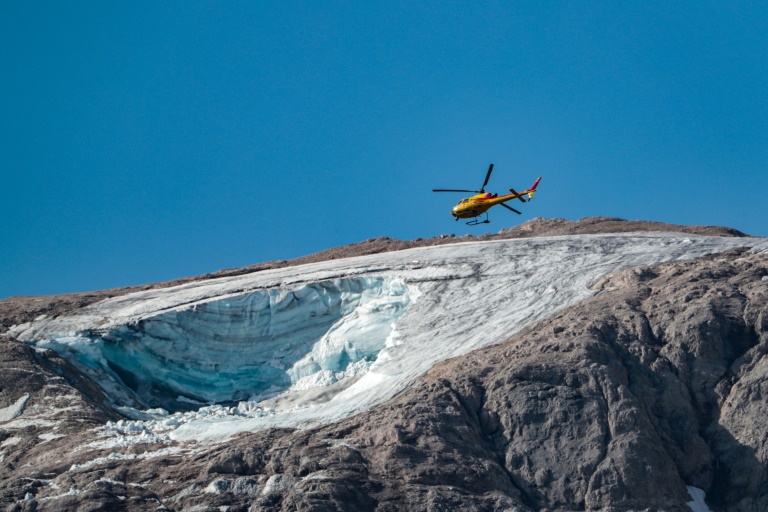
Emergency services at the scene of a deadly avalanche in the Italian Dolomites recovered what body parts they could on Tuesday, with the dangers of venturing under the partially collapsed glacier slowing the search.

Rescue teams sent helicopters and drones up for a second day after Sunday’s disaster, which saw at least seven hikers killed when a section of the country’s largest Alpine glacier gave way, sending ice and rock hurtling down the mountain.

Italy has blamed the collapse on climate change and fears more of the glacier could come crashing down have prevented access to much of the area where hikers, some roped together, are believed to be buried.

Authorities have declared 14 missing but stressed the exact number of climbers at the scene when the avalanche hit was unknown.

“Operations on the ground will only be carried out to recover any remains discovered by the drones, to ensure rescuers’ safety,” the Trentino Alpine Rescue Service said Tuesday.

Experts were surveying the area to determine how best to enable teams with sniffer dogs to get out onto the site safely on Wednesday or Thursday, the Service’s national chief Maurizio Dellantonio told AGI news agency.

Relatives of people reported missing gathered at the town of Canazei, where recovered remains were placed in a make-shift morgue at a gymnasium.

“The important finds, not just bones, are first photographed, then recovered and put onto a helicopter” and flown to Canazei to be “catalogued and placed in cold storage”, Dellantonio said.

Such finds were “bones that have not been flayed, a piece of hand with a ring, tattoos, anything that can enable a person to be identified”, including shoes, backpacks and ice-picks.

– Last selfie –

The disaster struck one day after a record-high temperature of 10 degrees Celsius (50 degrees Fahrenheit) was recorded at the summit of Marmolada, the highest mountain in the Italian Dolomites.

Prime Minister Mario Draghi said Monday the collapse was certainly “linked to the deterioration of the environment and the climate situation”.

One of the bodies recovered belonged to a Czech who was travelling with a friend now registered as missing, the Czech foreign ministry told AFP.

Also missing, according to Italian media reports, was Filippo Bari, 27, who had snapped a grinning selfie of himself on the mountain earlier Sunday and sent it to family and friends saying “look where I am!”

Bari, who has a four-year old son, has not responded to repeated attempts to contact him, nor have the five friends he was believed to be hiking with, the Corriere della Sera said.

The Trento public prosecutor’s office has opened an investigation to determine the causes of the tragedy.

The glacier, nicknamed “queen of the Dolomites”, feeds the Avisio river and overlooks Lake Fedaia in the autonomous Italian province of Trento.

According to a March report by the UN Intergovernmental Panel on Climate Change (IPCC), melting ice and snow is one of 10 major threats caused by global warming, disrupting ecosystems and infrastructure.

Close Bitnami banner
Bitnami