World

Rescuers gather body parts after Italy glacier collapse

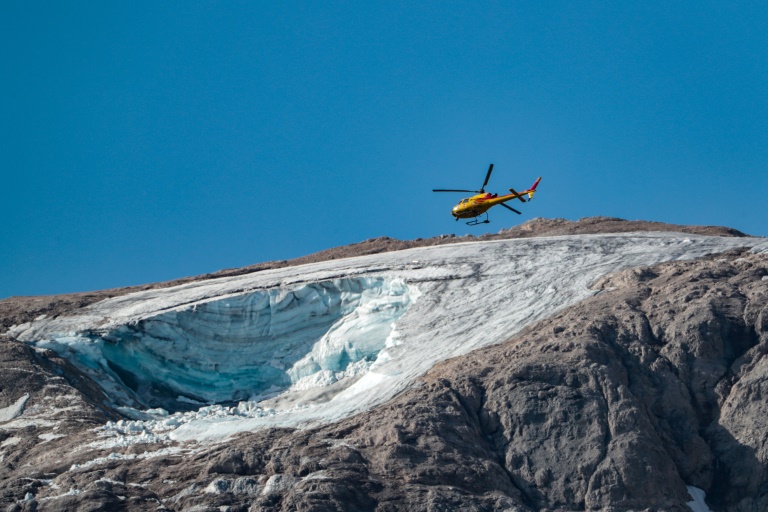
Emergency services at the scene of a deadly avalanche in the Italian Dolomites recovered what body parts they could on Tuesday, with the dangers of venturing under the partially collapsed glacier slowing the search.

Rescue teams sent helicopters and drones up for a second day after Sunday’s disaster, which saw at least seven hikers killed when a section of the country’s largest Alpine glacier gave way, sending ice and rock hurtling down the mountain.

Italy has blamed the collapse on climate change and fears more of the glacier could come crashing down have prevented access to much of the area where hikers, some roped together, are believed to be buried.

Authorities have declared 14 missing but stressed the exact number of climbers at the scene when the avalanche hit was unknown.

“Operations on the ground will only be carried out to recover any remains discovered by the drones, to ensure rescuers’ safety,” the Trentino Alpine Rescue Service said Tuesday.

Experts were surveying the area to determine how best to enable teams with sniffer dogs to get out onto the site safely on Wednesday or Thursday, the Service’s national chief Maurizio Dellantonio told AGI news agency.

Relatives of people reported missing gathered at the town of Canazei, where recovered remains were placed in a make-shift morgue at a gymnasium.

“The important finds, not just bones, are first photographed, then recovered and put onto a helicopter” and flown to Canazei to be “catalogued and placed in cold storage”, Dellantonio said.

Such finds were “bones that have not been flayed, a piece of hand with a ring, tattoos, anything that can enable a person to be identified”, including shoes, backpacks and ice-picks.

– Last selfie –

The disaster struck one day after a record-high temperature of 10 degrees Celsius (50 degrees Fahrenheit) was recorded at the summit of Marmolada, the highest mountain in the Italian Dolomites.

Prime Minister Mario Draghi said Monday the collapse was certainly “linked to the deterioration of the environment and the climate situation”.

One of the bodies recovered belonged to a Czech who was travelling with a friend now registered as missing, the Czech foreign ministry told AFP.

Also missing, according to Italian media reports, was Filippo Bari, 27, who had snapped a grinning selfie of himself on the mountain earlier Sunday and sent it to family and friends saying “look where I am!”

Bari, who has a four-year old son, has not responded to repeated attempts to contact him, nor have the five friends he was believed to be hiking with, the Corriere della Sera said.

The Trento public prosecutor’s office has opened an investigation to determine the causes of the tragedy.

The glacier, nicknamed “queen of the Dolomites”, feeds the Avisio river and overlooks Lake Fedaia in the autonomous Italian province of Trento.

According to a March report by the UN Intergovernmental Panel on Climate Change (IPCC), melting ice and snow is one of 10 major threats caused by global warming, disrupting ecosystems and infrastructure.

Struggling SAS files for Chapter 11 bankruptcy proceedings in US

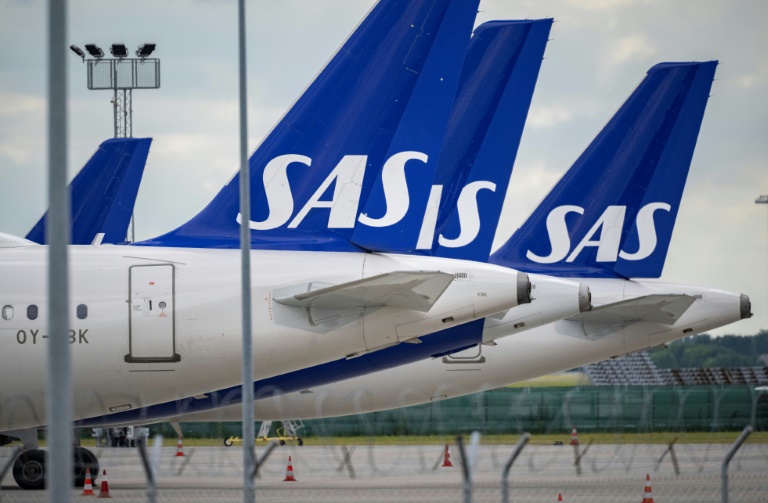
Faced with financial difficulties and a massive pilot strike, Scandinavian airline SAS said Tuesday it has filed for so-called Chapter 11 bankruptcy proceedings in the United States, as a part of restructuring plan.

“We simply need to do much more and do it much faster,” SAS chairman Carsten Dilling told a press conference where defended what he called “a well thought-through decision.”

In the US, Chapter 11 is a mechanism allowing a company to restructure its debts under court supervision while continuing to operate.

The move was made in order “to proceed with the implementation of key elements” of its business transformation plan, the troubled carrier, which employs nearly 7,000 people, said in a statement.

Asked why the company chose initiate the proceedings in the US, rather than Sweden where it is headquartered, Dilling said they had considered several countries where they could file, but “ended up concluding that the US framework is the right one for the company.”

Chief executive Anko van der Werff said they expected “to complete the Chapter 11 process in nine to 12 months.”

SAS said its “operations and flight schedule are unaffected by the Chapter 11 filing, and SAS will continue to serve its customers as normal,” while noting that the ongoing strike by Scandinavian pilot unions would continue to impact operations.

– ‘Last thing SAS needs’ –

“A strike is the last thing the company needs right now,” van der Werff told reporters.

Pilots walked out on Monday after negotiations between the unions and the company broke down.

The pilots are protesting against salary cuts demanded by management as part of a restructuring plan aimed at ensuring the survival of the company, which has suffered a string of losses since the start of the coronavirus pandemic in early 2020. 

On Monday, SAS said that the strike “is estimated to lead to the cancellation of approximately 50 percent of all scheduled SAS flights,” impacting around 30,000 passengers a day.

SAS management announced in February the savings plan to cut costs by 7.5 billion Swedish kronor ($700 million), dubbed “SAS Forward”, which was supplemented in June by a plan to increase capital by nearly one billion euros ($1.04 billion). 

Denmark and Sweden are the biggest shareholders with 21.8 percent each. 

Denmark said in June it was ready to increase its stake to 30 percent. Sweden has refused to provide fresh funds, but is willing to turn debt into capital. 

Norway, which left SAS in 2018, has said it is ready to return to the airline, but only by converting debt into equity. 

Suffering, like the rest of the sector, from the impact of Covid-19, SAS cut 5,000 jobs, or 40 percent of its workforce, in 2020. The carrier now had around 6,900 employees at the end of May, a number which fell below 5,000 at the height of the pandemic.

Shares in SAS, already at all-time lows, fell by more than 11 percent in the early hours of trading on the Stockholm Stock Exchange.

SAS’s troubles comes as the summer is shaping up to be difficult for European airlines and airports, faced with staff shortages affecting traffic. 

After widespread job losses linked to Covid-19, airlines and airports are struggling to recruit new staff in many countries. 

China mulls dipping into pork reserves to rein in costs

Chinese authorities said Tuesday they could dip into pork reserves and ordered suppliers to slaughter more pigs in a bid to rein in the cost of the staple meat, after prices soared by almost a third year-on-year.

Beijing’s top economic planner was forced to respond after pork prices in the country spiked, with regulators blaming suppliers for “blindly holding supplies” and being reluctant to sell.

The National Development and Reform Commission (NDRC) said that reluctance was aimed at boosting profits, ordering major suppliers to kill pigs at a “regular pace” and stop hoarding, Xinhua said.

Late last month the meat sold for 32 percent more than in June 2021, it added.

On Tuesday, the commission said it was “looking into a release of central pork reserves”.

It has also instructed local governments to release supplies “in a timely manner” to guard against sharp price increases.

The Chinese government keeps massive stores of frozen pork in warehouses, occasionally releasing reserve meat to stabilise prices, especially during periods of peak demand including Lunar New Year.

Pork is the most commonly consumed meat in China, with the average person in the country eating more than 25 kilogrammes per year, according to OECD data.

The world’s second largest economy has mostly been spared the impact of a global surge in food prices caused by Russia’s war in Ukraine.

But pork prices were hit hard after the country’s herds were devastated by African swine fever in recent years, causing consumer inflation to spike.

In 2019, authorities said they would free up land to restore production to pre-swine fever levels, and officials have since released supplies from stockpiles to rein in costs.

“As the prices of hogs continue to rise, pig farmers are turning losses into profits… farmers are now profiting about 60 yuan (about $9) per head,” Ministry of Agriculture and Rural Affairs hog expert Wang Zuli told state broadcaster CCTV in an interview in June.

“We can say the darkest days for pig farmers are over,” Wang said, adding that supplies were expected to grow.

Even Pay, an agriculture analyst at consultancy Trivium China, told AFP it was common during periods of rising pork prices for pig farmers to “delay sales of pigs that are ready for slaughter now, assuming they’ll be able to make more next week, and the week after”.

“But if the rise in pig prices is driven by real market factors rather than mostly by speculation, the reserve releases won’t have much of an impact,” Pay said, pointing to high feed and energy costs as well as rebounding demand from restaurants post-lockdown.

Beijing is keeping a close eye on food prices as Covid disruptions, on top of higher fertiliser and fuel costs and issues with access to equipment, threaten the autumn harvest of key crops such as soybean and corn.

Hacker claims major Chinese citizens' data theft

A hacker claiming to have stolen personal data from hundreds of millions of Chinese citizens is now selling the information online.

A sample of 750,000 entries posted online by the hacker showed citizens’ names, mobile phone numbers, national ID numbers, addresses, birthdays and police reports they had filed. 

AFP and cybersecurity experts have verified some of the citizen data in the sample as authentic, but the scope of the entire database is hard to determine.

Advertised on a forum late last month but only picked up by cybersecurity experts this week, the 23-terabyte database — which the hacker claims contains the records of a billion Chinese citizens — is being sold for 10 bitcoin (approximately $200,000).

“It looks like it’s from multiple sources. Some are facial recognition systems, others appear to be census data,” said Robert Potter, co-founder of cybersecurity firm Internet 2.0. 

“There is no verification of the total number of records and I’m sceptical of the one billion citizens number,” he added.

China maintains an extensive nationwide surveillance infrastructure that siphons massive amounts of data from its citizens, ostensibly for security purposes. 

Growing public awareness of data privacy has led to stronger data protection laws targeting individuals and private firms in recent years, although there is little citizens can do to stop the state from collecting their data. 

Some of the leaked data appeared to be from express delivery user records, while other entries contained summaries of incidents reported to police in Shanghai over a span of more than a decade, with the most recent from 2019.

The incident reports ranged from traffic accidents and petty theft to rape and domestic violence.

– ‘Heads will roll’ –

At least four people out of over a dozen contacted by AFP confirmed their personal details, such as names and addresses, as listed in the database.

“So that’s why so many people have been adding my WeChat over the past few days. Should I report this to the police?” said one woman surnamed Hao.

“I’m really confused about why my personal data has been leaked,” said another woman surnamed Liu.

In replies to the original post, users speculated that the data may have been hacked from an Alibaba Cloud server where it was apparently being stored by the Shanghai police. 

Potter, the cybersecurity analyst, confirmed that the files were hacked from Alibaba Cloud, which did not respond to an AFP request for comment.

If confirmed, the breach would be one of the largest in history and a major violation of the recently approved Chinese data protection laws.

“Heads will roll over this one,” tweeted Kendra Schaefer, tech partner at research consultancy Trivium China.

China’s cybersecurity administration did not respond to a fax requesting comment.

Hacker claims major Chinese citizens' data theft

A hacker claiming to have stolen personal data from hundreds of millions of Chinese citizens is now selling the information online.

A sample of 750,000 entries posted online by the hacker showed citizens’ names, mobile phone numbers, national ID numbers, addresses, birthdays and police reports they had filed. 

AFP and cybersecurity experts have verified some of the citizen data in the sample as authentic, but the scope of the entire database is hard to determine.

Advertised on a forum late last month but only picked up by cybersecurity experts this week, the 23-terabyte database — which the hacker claims contains the records of a billion Chinese citizens — is being sold for 10 bitcoin (approximately $200,000).

“It looks like it’s from multiple sources. Some are facial recognition systems, others appear to be census data,” said Robert Potter, co-founder of cybersecurity firm Internet 2.0. 

“There is no verification of the total number of records and I’m sceptical of the one billion citizens number,” he added.

China maintains an extensive nationwide surveillance infrastructure that siphons massive amounts of data from its citizens, ostensibly for security purposes. 

Growing public awareness of data privacy has led to stronger data protection laws targeting individuals and private firms in recent years, although there is little citizens can do to stop the state from collecting their data. 

Some of the leaked data appeared to be from express delivery user records, while other entries contained summaries of incidents reported to police in Shanghai over a span of more than a decade, with the most recent from 2019.

The incident reports ranged from traffic accidents and petty theft to rape and domestic violence.

– ‘Heads will roll’ –

At least four people out of over a dozen contacted by AFP confirmed their personal details, such as names and addresses, as listed in the database.

“So that’s why so many people have been adding my WeChat over the past few days. Should I report this to the police?” said one woman surnamed Hao.

“I’m really confused about why my personal data has been leaked,” said another woman surnamed Liu.

In replies to the original post, users speculated that the data may have been hacked from an Alibaba Cloud server where it was apparently being stored by the Shanghai police. 

Potter, the cybersecurity analyst, confirmed that the files were hacked from Alibaba Cloud, which did not respond to an AFP request for comment.

If confirmed, the breach would be one of the largest in history and a major violation of the recently approved Chinese data protection laws.

“Heads will roll over this one,” tweeted Kendra Schaefer, tech partner at research consultancy Trivium China.

China’s cybersecurity administration did not respond to a fax requesting comment.

Sydney floods force thousands more to flee

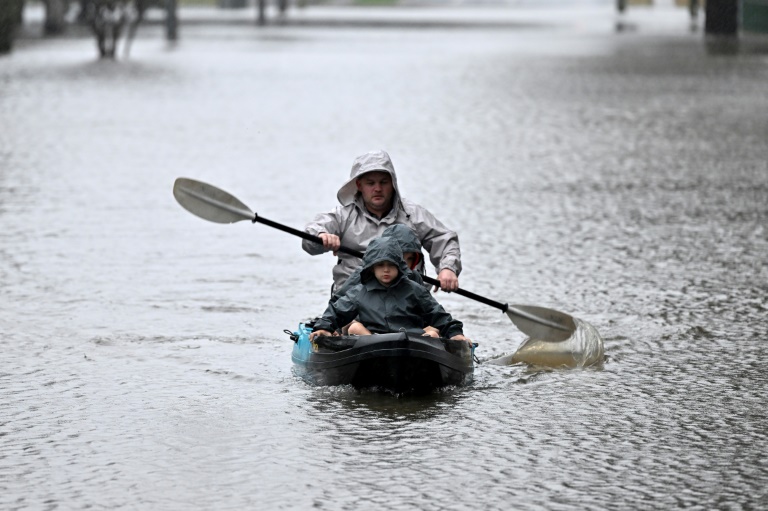
Rain-swollen rivers spilled mud-brown waters across swathes of Sydney on Tuesday, swamping homes and roads while forcing thousands to flee.

The authorities have now instructed about 50,000 people to evacuate and another 28,000 to prepare to escape the rising waters in New South Wales, officials said.

Emergency workers carried out 142 flood rescues in New South Wales over 24 hours, they said, with the support of 100 army troops deployed to the state.

Australia has been at the sharp end of climate change, with droughts, deadly bushfires, bleaching events on the Great Barrier Reef and floods becoming more common and intense as global weather patterns change.

Higher temperatures mean the atmosphere holds more moisture, unleashing more rain.

With much of the ground already sodden, the water rose rapidly in worst-hit areas and was soon lapping around the walls of some homes in the western Sydney suburbs.

“All of a sudden it just came up so quick,” said resident Gordon Lee after parts of his western Sydney suburb of Shanes Park were engulfed overnight.

“We didn’t even have time to take anything, just got our pet dogs and went out to higher ground up the street there,” he told AFP.

Lee said he had retired from farming about 15 years ago when flooding was less frequent.

“I see younger people move in trying to farm here but they are getting a hiding,” he said. “They are losing everything.”

– ‘Risky’ –

Meteorologists predicted the weather front would move northwards along the east coast after dumping rain on Sydney for four days.

“Sydney is not out of danger, this is not a time to be complacent,” State Emergency Services commissioner Carlene York told a news conference.

“It’s risky out there.”

The federal government has declared a natural disaster in 23 flooded parts of New South Wales, unlocking relief payments to stricken residents.

Many people affected have lived through successive east coast floods that struck in 2021 and then again in March this year when more than 20 people were killed.

In the western suburb of Windsor, 62-year resident Alan Dalrymple said his home had now been flooded four times in 18 months.

“You get a bit pissed off,” he told AFP. 

“There’s not much you can do about it, mate. You just smile and keep going. No good whinging because no one wants to hear people whinge, that’s for sure.”

Staff at Windsor police station were evacuated as the floods rose, police said.

– ‘Stay safe’ –

Much of the flooding has occurred in a major river system downstream of western Sydney’s Warragamba Dam, which has been overspilling large volumes of excess water since Sunday.

The huge concrete dam provides most of the city’s drinking water.

“People on the east coast are doing it really tough at the moment,” said Prime Minister Anthony Albanese. 

“My heart goes out to people who have suffered again and again and again and again, and for many of those communities, they were also impacted by the bushfires,” he told reporters.

“I say to people, stay safe, keep vigilant.”

The rain has eased in some Sydney areas but flood warnings will likely persist for days, warned Jane Golding of the state’s bureau of meteorology.

Sydney floods force thousands more to flee

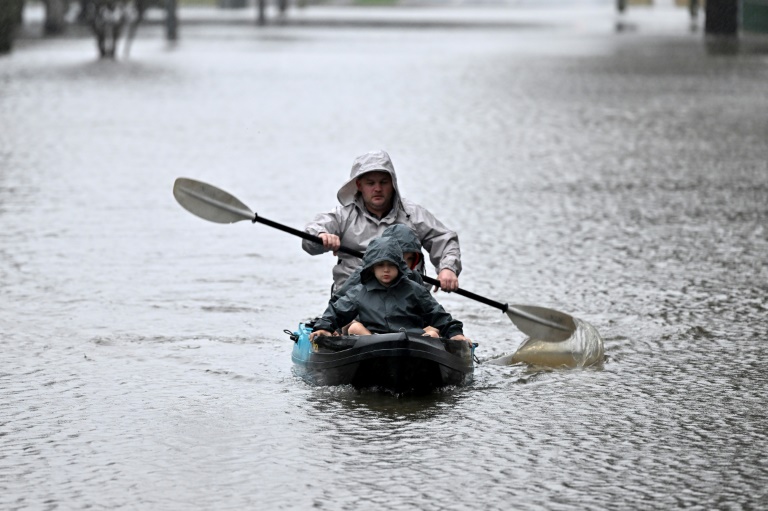
Rain-swollen rivers spilled mud-brown waters across swathes of Sydney on Tuesday, swamping homes and roads while forcing thousands to flee.

The authorities have now instructed about 50,000 people to evacuate and another 28,000 to prepare to escape the rising waters in New South Wales, officials said.

Emergency workers carried out 142 flood rescues in New South Wales over 24 hours, they said, with the support of 100 army troops deployed to the state.

Australia has been at the sharp end of climate change, with droughts, deadly bushfires, bleaching events on the Great Barrier Reef and floods becoming more common and intense as global weather patterns change.

Higher temperatures mean the atmosphere holds more moisture, unleashing more rain.

With much of the ground already sodden, the water rose rapidly in worst-hit areas and was soon lapping around the walls of some homes in the western Sydney suburbs.

“All of a sudden it just came up so quick,” said resident Gordon Lee after parts of his western Sydney suburb of Shanes Park were engulfed overnight.

“We didn’t even have time to take anything, just got our pet dogs and went out to higher ground up the street there,” he told AFP.

Lee said he had retired from farming about 15 years ago when flooding was less frequent.

“I see younger people move in trying to farm here but they are getting a hiding,” he said. “They are losing everything.”

– ‘Risky’ –

Meteorologists predicted the weather front would move northwards along the east coast after dumping rain on Sydney for four days.

“Sydney is not out of danger, this is not a time to be complacent,” State Emergency Services commissioner Carlene York told a news conference.

“It’s risky out there.”

The federal government has declared a natural disaster in 23 flooded parts of New South Wales, unlocking relief payments to stricken residents.

Many people affected have lived through successive east coast floods that struck in 2021 and then again in March this year when more than 20 people were killed.

In the western suburb of Windsor, 62-year resident Alan Dalrymple said his home had now been flooded four times in 18 months.

“You get a bit pissed off,” he told AFP. 

“There’s not much you can do about it, mate. You just smile and keep going. No good whinging because no one wants to hear people whinge, that’s for sure.”

Staff at Windsor police station were evacuated as the floods rose, police said.

– ‘Stay safe’ –

Much of the flooding has occurred in a major river system downstream of western Sydney’s Warragamba Dam, which has been overspilling large volumes of excess water since Sunday.

The huge concrete dam provides most of the city’s drinking water.

“People on the east coast are doing it really tough at the moment,” said Prime Minister Anthony Albanese. 

“My heart goes out to people who have suffered again and again and again and again, and for many of those communities, they were also impacted by the bushfires,” he told reporters.

“I say to people, stay safe, keep vigilant.”

The rain has eased in some Sydney areas but flood warnings will likely persist for days, warned Jane Golding of the state’s bureau of meteorology.

Markets mostly up on talk Biden to roll back some China tariffs

Most markets rose Tuesday on growing speculation US President Joe Biden is about to roll back some of the Trump-era tariffs on Chinese goods as he looks for ways to rein in inflation, though sentiment remains at a premium owing to fears of a recession.

The mood on trading floors has become increasingly gloomy in recent months as observers warn that sharp interest rate hikes aimed at curbing price rises could cause a contraction, compounding uncertainty caused by Russia’s war in Ukraine.

Still, equities were on the up Tuesday on talk that the White House is about to remove duties on some of the hundreds of billions of dollars worth of imports from China, with reports saying an announcement could come this week.

With some of the tariffs due to expire soon, officials in Washington have been discussing the measures with an eye on inflation, which is sitting at four-decade highs.

And in a sign that something could be on the cards, China’s state-run Xinhua news agency said Treasury Secretary Janet Yellen and Vice Premier Lui He had held discussions.

“The two sides agree that as the world economy is facing severe challenges, it is of great significance to strengthen macro-policy communication and coordination between China and the United States,” it said. 

“And jointly maintaining the stability of the global industrial and supply chains is in the interests of both countries and the whole world.”

Reports also said that Biden was considering launching new probes into industrial subsidies — allowing for more targeted measures in strategic areas — to appease China hawks.

Hong Kong, Tokyo, Sydney, Seoul, Taipei, Mumbai, Wellington, Manila and Jakarta were all in positive territory. However, Shanghai gave up early gains and ended marginally down, while Singapore was also off.

London dipped but Paris and Frankfurt were up in early trade.

US markets were closed Monday for a holiday.

“Given that inflation remains the White House public enemy number one, (investors are) leaning toward a gradual rollback of some China tariffs as it would reduce end costs to US consumers,” said SPI Asset Management’s Stephen Innes.

However, some commentators said that while the removal of some tariffs would be widely welcomed by traders, they were unlikely to have a long-lasting effect on inflation.

“Markets are likely to react positively on a knee-jerk because at this point we are hungry for any signs of positive news,” Charu Chanana, of Saxo Capital Markets, said.

“But we don’t see the move impacting the global growth and inflation dynamics in a significant way.”

Oil prices were mixed as traders assess the market with demand outstripping supplies as the Ukraine war rages with no sign of an end, while investors are keeping tabs on China as it sees fresh Covid outbreaks that have led to some cities being put into lockdown.

Months-long flare-ups in Shanghai and Beijing earlier in the year saw millions of people ordered to stay home, sending shockwaves through the domestic economy and battering supply chains.

“China is the real wildcard here: it’s going to be two steps forward, one step back,” said Australia & New Zealand Banking Group’s Daniel Hynes.

“A demand recovery in China could potentially offset weakness in developed economies as central banks tighten monetary policy.”

– Key figures at around 0810 GMT –

Tokyo – Nikkei 225: UP 1.0 percent at 26,423.47 (close)

Hong Kong – Hang Seng Index: UP 0.1 percent at 21,853.07 (close)

Shanghai – Composite: FLAT at 3,404.03 (close)

London – FTSE 100: DOWN 0.3 percent at 7,208.64

Dollar/yen: UP at 136.00 yen from 135.69 yen Monday

Euro/dollar: DOWN at $1.0400 from $1.0431 

Pound/dollar: DOWN at $1.2068 from $1.2116

Euro/pound: UP at 85.09 pence from 86.09 pence

West Texas Intermediate: UP 1.7 percent at $110.26 per barrel

Brent North Sea crude: DOWN 0.4 percent at $113.00 per barrel

New York – Dow: Closed for public holiday

Israel PM visits France with Lebanon gas row topping agenda

Israeli Prime Minister Yair Lapid departed on his first foreign trip in office Tuesday to France, where he will ask for backing on a gas dispute with Lebanon that days ago saw Israel shoot down three Hezbollah drones.

Lapid took over the premiership on Friday following the collapse of Israel’s coalition government, which will see the country return to the polls in November for its fifth election in less than four years.

The new leader was confronted with his first test a day later, when Lebanon’s Hezbollah movement launched three drones towards an offshore gas field in the eastern Mediterranean.

Speaking before his departure from Tel Aviv, Lapid said he will raise the matter with French President Emmanuel Macron.

“We will also discuss of course what has occurred recently off the coast of Lebanon,” Lapid said.

“There have been repeated attacks on Israeli gas rigs. Israel will not accept this type of attacks on its sovereignty.”

Lebanon rejects Israel’s claim that the Karish gas field lies within its territorial waters.

Israel and Lebanon resumed negotiations on their maritime border in 2020, though the Karish site sits outside of the disputed area and is marked as Israeli on previous United Nations maps.

The US-backed talks have been stalled by Beirut’s demand that the UN maps must be modified.

Hezbollah’s backers Iran will also be on the agenda at the bilateral talks in Paris, as Israel stands firmly opposed to international efforts to revive a nuclear accord with Tehran.

“It’s important that our position against this agreement is heard,” Lapid said Tuesday.

Israeli officials fear that giving Iran sanctions relief in exchange for curbs on its nuclear programme could allow Tehran to boost funding to Hezbollah, as well as the Palestinian militant group Hamas.

– Ukraine war prompts energy deal –

A senior Israeli official said the Lebanon gas issue will be high on agenda during talks at the Elysee Palace in Paris.

“We will ask France to intervene to secure the negotiations that we want to lead until the end of the gas issues,” the official told journalists travelling with the premier.

Lapid’s Paris visit comes days ahead of US President Joe Biden travelling to Israel and the Palestinian territories, before flying to Saudi Arabia for energy talks.

Washington is seeking to stabilise the global energy market following the Russian invasion of Ukraine, which led Moscow to cut its gas supplies to some European countries.

Israel and Egypt signed a deal last month to boost gas exports to the European Union, as the bloc attempts to end its dependency on Russian energy.

“The Lebanon issue is essential and Lapid will come back to the Israeli position, according to which Hezbollah is first and foremost a threat to the future of Lebanon,” said the Israeli official, who requested anonymity.

Israel and Lebanon remain technically at war but agreed to talks aimed at delineating their maritime border to allow both countries to boost gas exploration.

Freeze-dried mice: how a new technique could help conservation

Japanese scientists have successfully produced cloned mice using freeze-dried cells in a technique they believe could one day help conserve species and overcome challenges with current biobanking methods.

The United Nations has warned that extinctions are accelerating worldwide and at least a million species could disappear because of human-induced impacts like climate change.

Facilities have sprung up globally to preserve samples from endangered species with the goal of preventing their extinction by future cloning.

These samples are generally cryopreserved using liquid nitrogen or kept at extremely low temperatures, which can be costly and vulnerable to power outages.

They also usually involve sperm and egg cells, which can be difficult or impossible to harvest from old or infertile animals.

Scientists at Japan’s University of Yamanashi wanted to see whether they could solve those problems by freeze-drying somatic cells — any cell that isn’t a sperm or egg cell — and attempting to produce clones.

They experimented with two types of mice cells, and found that, while freeze-drying killed them and caused significant DNA damage, they could still produce cloned blastocysts — a ball of cells that develops into an embryo.

From these, the scientists extracted stem cell lines that they used to create 75 cloned mice.

One of the mice survived a year and nine months, and the team also successfully mated female and male cloned mice with natural-born partners and produced normal pups.

The cloned mice produced fewer offspring than would have been expected from natural-born mice, and one of the stem cell lines developed from male cells produced only female mice clones.

“Improvement should not be difficult,” said Teruhiko Wakayama, a professor at the University of Yamanashi’s Faculty of Life and Environmental Sciences, who helped lead the study published in the journal Nature Communications this month.

“We believe that in the future we will be able to reduce abnormalities and increase the birth rate by searching for freeze-drying protectant agents and improving drying methods,” he told AFP.

– ‘Very exciting advance’ –

There are some other drawbacks — the success rate of cloning mice from cells stored in liquid nitrogen or at ultra-low temperatures is between two and five percent, while the freeze-dried method is just 0.02 percent.

But Wakayama says the technique is still in its early stages, comparing it to the study that produced “Dolly” the famous sheep clone — a single success after more than 200 tries.

“We believe the most important thing is that cloned mice have been produced from freeze-dried somatic cells, and that we have achieved a breakthrough in this field,” he said.

While the method is unlikely to entirely replace cryopreservation, it represents a “very exciting advance for scientists interested in biobanking threatened global biodiversity”, said Simon Clulow, senior research fellow at the University of Canberra’s Centre for Conservation Ecology and Genomics.

“It can be difficult and costly to work up cryopreservation protocols and so alternatives, especially those that are cheaper and robust, are extremely welcome,” added Clulow, who was not involved in the research.

The study stored the freeze-dried cells at minus 30 degrees Celsius, but the team has previously showed freeze-dried mouse sperm can survive at least a year at room temperature and believes somatic cells would do too.

The technique could eventually “allow genetic resources from around the world to be stored cheaply and safely”, Wakayama said.

The work is an extension of years of research on cloning and freeze-drying techniques by Wakayama and his partners.

One of their recent projects involved freeze-drying mouse sperm that was sent to the International Space Station. Even after six years in space the cells were successfully rehydrated back on Earth and produced healthy mice pups.

Close Bitnami banner
Bitnami