World

Saudi welcomes 1 million for biggest hajj pilgrimage since pandemic

White-robed worshippers from around the world have packed the streets of Islam’s holiest city ahead of the biggest hajj pilgrimage since the coronavirus pandemic began.

Banners welcoming the faithful, including the first international visitors since 2019, adorned squares and alleys, while armed security forces patrolled the ancient city, birthplace of the Prophet Mohammed.

“This is pure joy,” Sudanese pilgrim Abdel Qader Kheder told AFP in Mecca, before the event which officially starts Wednesday. “I almost can’t believe I am here. I am enjoying every moment.”

One million people, including 850,000 from abroad, are allowed at this year’s hajj after two years of drastically curtailed numbers due to the pandemic. The pilgrimage is one of five pillars of Islam, which all able-bodied Muslims with the means are required to perform at least once.

On Monday afternoon, pilgrims carrying umbrellas to shield themselves from the scorching sun flocked to souvenir and barber shops in Mecca, while others shared meals under palm trees on streets close to the Grand Mosque.

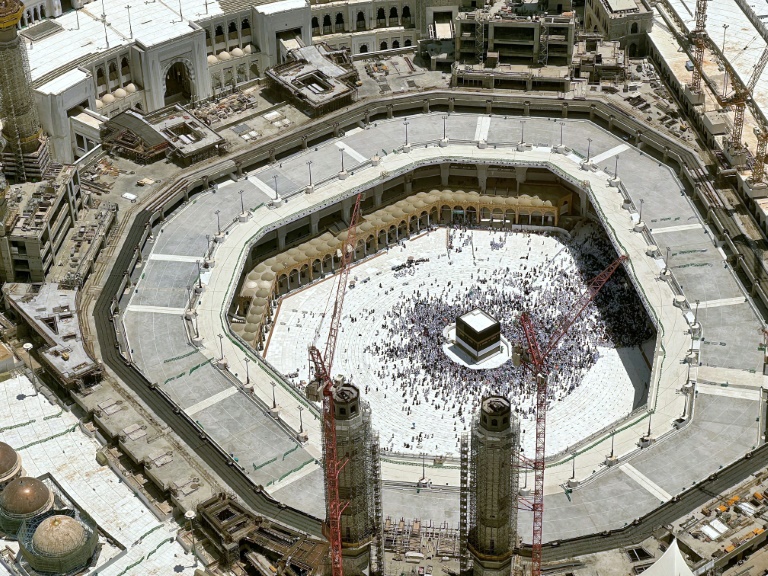
Many new arrivals had already begun performing the first ritual, which requires walking seven times around the Kaaba, the large black cubic structure at the centre of the Grand Mosque. 

Made from granite and draped in a cloth featuring verses from the Koran, the Kaaba stands nearly 15 metres (50 feet) tall. It is the structure all Muslims turn towards to pray, no matter where they are in the world. 

“When I first saw the Kaaba I felt something weird and started crying,” Egyptian pilgrim Mohammed Lotfi told AFP.

At least 650,000 overseas pilgrims have arrived so far in Saudi Arabia, the authorities said on Sunday.

In 2019, about 2.5 million people took part in the rituals, which also include gathering at Mount Arafat and “stoning the devil” in Mina.

The following year, when the pandemic took hold, foreigners were barred and worshippers were restricted to just 10,000 to stop the hajj from turning into a global super-spreader.

That figure rose to 60,000 fully vaccinated Saudi citizens and residents in 2021.

Pilgrims this year — only those younger than 65 are allowed — will participate in the hajj under strict sanitary conditions.

The hajj has seen numerous disasters over the years, including a 2015 stampede that killed up to 2,300 people and a 1979 attack by hundreds of gunmen that, according to the official toll, left 153 dead.

– Unaccompanied women –

The pilgrimage is a powerful source of prestige for the conservative desert kingdom and its de facto ruler, Crown Prince Mohammed bin Salman, who is returning from the diplomatic wilderness.

Days after the hajj, Prince Mohammed will welcome US President Joe Biden who, with oil prices soaring following Russia’s invasion of Ukraine, has reneged on a vow to turn Saudi Arabia into a “pariah” over the 2018 murder of journalist Jamal Khashoggi by Saudi agents.

The hajj, which costs at least $5,000 per person, is a money-spinner for the world’s biggest oil exporter trying to diversify its economy. In normal years the pilgrimage brings in billions of dollars.

It is also a chance to showcase the kingdom’s rapid social transformation, despite persistent complaints about human rights abuses and limits on personal freedoms.

Saudi Arabia — which has under recent reforms permitted raves in Riyadh and mixed-gender beaches in Jeddah — now allows women to attend the hajj unaccompanied by male relatives, a requirement that was dropped last year.

– ‘Serenity’ –

Masks are no longer compulsory in most enclosed spaces in Saudi Arabia but they will be mandatory at the Grand Mosque, the holiest site in Islam. Pilgrims from abroad will have to submit a negative PCR test result. 

The Grand Mosque will be “washed 10 times a day… by more than 4,000 male and female workers”, with more than 130,000 litres (34,000 gallons) of disinfectant used each time, authorities said.

Since the start of the pandemic, Saudi Arabia has registered more than 795,000 coronavirus cases, 9,000 of them fatal, in a population of about 34 million.

Aside from Covid, another challenge is the scorching sun in one of the world’s hottest and driest regions, which is becoming even more extreme through the effects of climate change.

Although summer has only just begun, temperatures have already topped 50 degrees Celsius (122 Fahrenheit) in parts of Saudi Arabia.

But Iraqi pilgrim Ahmed Abdul-Hassan al-Fatlawi said the heat is the last thing he thinks of when in Mecca.

“I am 60 years old, so it’s normal if I get physically tired because of the hot weather, but I am in a state of serenity, and that’s all that matters to me,” he told AFP.   
'Slim' chance of finding survivors after Italy glacier collapse

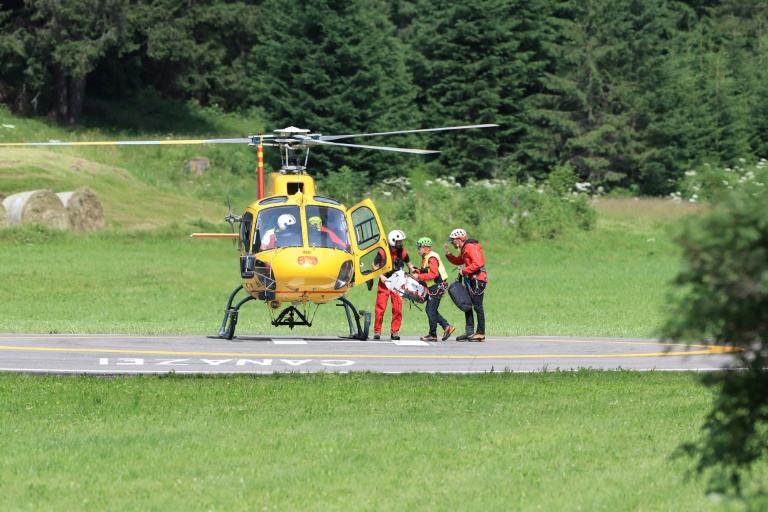
Rescuers warned on Monday that hopes of finding survivors were diminishing after an avalanche set off by the collapse of an Italian glacier during a heatwave killed at least six people.

Authorities said they did not know how many climbers were caught when the glacier gave way on Sunday on Marmolada, the highest mountain in the Italian Dolomites.

Ice and rock thundered down the slope at 300 kilometres an hour (185 miles per hour), according to the head of Trento province, Maurizio Fugatti.

On Monday, rescuers armed with thermal drones searched for body heat from potential survivors trapped in ice, although hope was rapidly dwindling. 

Chances of finding survivors “are slim to nothing”, the region’s Alpine Rescue Service head Giorgio Gajer told AGI news agency.

The six bodies recovered so far were found “torn apart”, rescuer Gino Comelli said.

The disaster struck one day after a record-high temperature of 10 degrees Celsius (50 degrees Fahrenheit) was recorded at the summit of the glacier, the largest in the Italian Alps.

The glacier had been weakened by decades of global warming, experts said.

Alpine Rescue spokeswoman Michela Canova told AFP an “avalanche of snow, ice and rock” hit an access path at a time when there were several roped parties, “some of whom were swept away”.

A spokesman for Trento province said people were still being reported missing.

Trento’s chief prosecutor Sandro Raimondi was quoted by Corriere della Sera newspaper as saying he feared the number of dead “could double if not triple”, based on the number of cars in the car park.

But Canova urged caution, saying the total number of climbers involved was “not yet known”. Eight people were recovered with injuries.

– ‘Heard a roar’ –

“I heard a roar, I turned to my left and saw a mass of ice coming down from the mountain,” ski instructor Luca Medici, 54, told AFP.

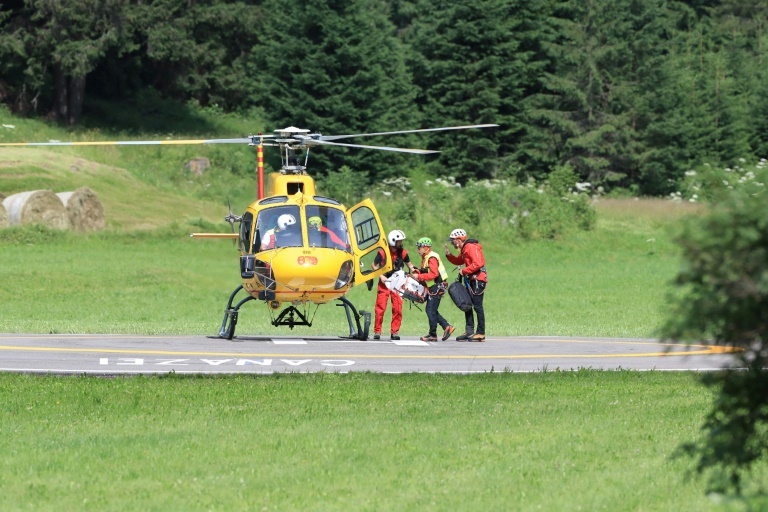
Bodies dug out of the ice and rock were taken to the village of Canazei, where Italian Prime Minister Mario Draghi visited rescue workers on Monday.

Helicopters and sniffer dogs were called off as night fell on Sunday and amid fears the glacier may still be unstable.

“It is difficult for the rescuers in (such) a dangerous situation,” Canazei mayor Giovanni Bernard told AFP.

Images of the avalanche filmed from a refuge close by show snow and rock hurtling down the mountain slopes.

“It’s a miracle we’re alive,” Stefano Dal Moro, an engineer who was hiking with his Israeli partner, told Corriere della Sera.

“It’s useless to run. You can only pray that it doesn’t come your way. We crouched down and hugged each other tightly as the ice passed”.

– Heat ‘beyond normal’ –

Massimo Frezzotti, a science professor at Roma Tre University, told AFP the collapse was caused by unusually warm weather linked to global warming. Last winter was very dry, with precipitation down 40 to 50 percent.

“The current state of the glacier is something we’d expect to see in mid-August, not early July,” he said.

Glacier specialist Renato Colucci told AGI the phenomenon was “bound to repeat itself” because “for weeks the temperatures at altitude in the Alps have been well above normal values”.

The recent warm temperatures had generated a large quantity of water from the melting glacier. It had accumulated at the bottom of the block of ice and caused it to collapse, he added.

Pope Francis tweeted his prayers for the victims, saying tragedies provoked by climate change, such as this, “must push us to seek urgently new ways to respect people and nature”.

The Trento public prosecutor’s office has opened an investigation to determine the causes of the tragedy.

United Nations scientists from the Intergovernmental Panel on Climate Change (IPCC) said in March that melting ice and snow was one of 10 major threats caused by global warming, disrupting ecosystems and infrastructure.

Jonathan Bamber, director of the Glaciology Centre at Bristol University, said glacier decline was “making the high mountains of Europe an increasing dangerous and unpredictable environment to be in”.

'Slim' chance of finding survivors after Italy glacier collapse

Rescuers warned on Monday that hopes of finding survivors were diminishing after an avalanche set off by the collapse of an Italian glacier during a heatwave killed at least six people.

Authorities said they did not know how many climbers were caught when the glacier gave way on Sunday on Marmolada, the highest mountain in the Italian Dolomites.

Ice and rock thundered down the slope at 300 kilometres an hour (185 miles per hour), according to the head of Trento province, Maurizio Fugatti.

On Monday, rescuers armed with thermal drones searched for body heat from potential survivors trapped in ice, although hope was rapidly dwindling. 

Chances of finding survivors “are slim to nothing”, the region’s Alpine Rescue Service head Giorgio Gajer told AGI news agency.

The six bodies recovered so far were found “torn apart”, rescuer Gino Comelli said.

The disaster struck one day after a record-high temperature of 10 degrees Celsius (50 degrees Fahrenheit) was recorded at the summit of the glacier, the largest in the Italian Alps.

The glacier had been weakened by decades of global warming, experts said.

Alpine Rescue spokeswoman Michela Canova told AFP an “avalanche of snow, ice and rock” hit an access path at a time when there were several roped parties, “some of whom were swept away”.

A spokesman for Trento province said people were still being reported missing.

Trento’s chief prosecutor Sandro Raimondi was quoted by Corriere della Sera newspaper as saying he feared the number of dead “could double if not triple”, based on the number of cars in the car park.

But Canova urged caution, saying the total number of climbers involved was “not yet known”. Eight people were recovered with injuries.

– ‘Heard a roar’ –

“I heard a roar, I turned to my left and saw a mass of ice coming down from the mountain,” ski instructor Luca Medici, 54, told AFP.

Bodies dug out of the ice and rock were taken to the village of Canazei, where Italian Prime Minister Mario Draghi visited rescue workers on Monday.

Helicopters and sniffer dogs were called off as night fell on Sunday and amid fears the glacier may still be unstable.

“It is difficult for the rescuers in (such) a dangerous situation,” Canazei mayor Giovanni Bernard told AFP.

Images of the avalanche filmed from a refuge close by show snow and rock hurtling down the mountain slopes.

“It’s a miracle we’re alive,” Stefano Dal Moro, an engineer who was hiking with his Israeli partner, told Corriere della Sera.

“It’s useless to run. You can only pray that it doesn’t come your way. We crouched down and hugged each other tightly as the ice passed”.

– Heat ‘beyond normal’ –

Massimo Frezzotti, a science professor at Roma Tre University, told AFP the collapse was caused by unusually warm weather linked to global warming. Last winter was very dry, with precipitation down 40 to 50 percent.

“The current state of the glacier is something we’d expect to see in mid-August, not early July,” he said.

Glacier specialist Renato Colucci told AGI the phenomenon was “bound to repeat itself” because “for weeks the temperatures at altitude in the Alps have been well above normal values”.

The recent warm temperatures had generated a large quantity of water from the melting glacier. It had accumulated at the bottom of the block of ice and caused it to collapse, he added.

Pope Francis tweeted his prayers for the victims, saying tragedies provoked by climate change, such as this, “must push us to seek urgently new ways to respect people and nature”.

The Trento public prosecutor’s office has opened an investigation to determine the causes of the tragedy.

United Nations scientists from the Intergovernmental Panel on Climate Change (IPCC) said in March that melting ice and snow was one of 10 major threats caused by global warming, disrupting ecosystems and infrastructure.

Jonathan Bamber, director of the Glaciology Centre at Bristol University, said glacier decline was “making the high mountains of Europe an increasing dangerous and unpredictable environment to be in”.

Copenhagen shooting suspect remanded in psychiatric ward

The chief suspect in a Copenhagen mall shooting was Monday remanded into a psychiatric care facility, one day after three people, including two teenagers, were shot dead.

“The court remands the 22-year-old in a closed psychiatric ward,” Copenhagen police said in a statement, following a two-hour hearing involving the suspect.

The suspected perpetrator of the attack, which took place late on Sunday afternoon, would be kept in custody for at least 24 days, which can then be extended, according to police.

The young man was brought before a judge at midday at the Copenhagen district court on Monday.

Wearing a blue T-shirt, he listened as the indictment for murder was read out, before the hearing continued behind closed doors.

According to public broadcaster DR, citing several unnamed sources, the suspected gunman had tried to reach a psychological help line shortly before the attack, but authorities would not confirm this.

Copenhagen police chief Soren Thomassen had already told a morning press conference that the “suspect is also known among psychiatric services”, but declined to comment further. 

The attack occurred on the heels of the city playing host to the start of the Tour de France cycling competition and seeing the return of the Roskilde music festival after being cancelled due to Covid-19 curbs.

“I think we have rarely experienced such a violent contrast as yesterday,” Danish Prime Minister Mette Frederiksen said as she arrived to pay tribute to the victims at the scene.

– ‘Violent contrast’ –

“But today I think we must pay tribute to the victims, show our sympathy, our help and support, and support all those who have been affected,” she told reporters.

The three killed have been identified as two Danish teens, a girl and boy both aged 17, and a 47-year-old Russian living in Denmark.

Another four were injured in the shooting: two Danish women, aged 19 and 40, and two Swedes, a 50-year-old man and a 16-year-old girl.

Given the varied ages and genders among the victims, Thomassen said they appeared to have been randomly targeted and there was nothing to indicate it was an act of terror.

“Our assessment is that the victims were random, that it isn’t motivated by gender or something else,” Thomassen said.

The police chief could not yet comment on a motive, but said there seemed to have been preparation ahead of the attack and that he was not aided by anyone else.

“As things stand, it seems he was acting alone,” he said of the 22-year-old suspect.

– No licence –

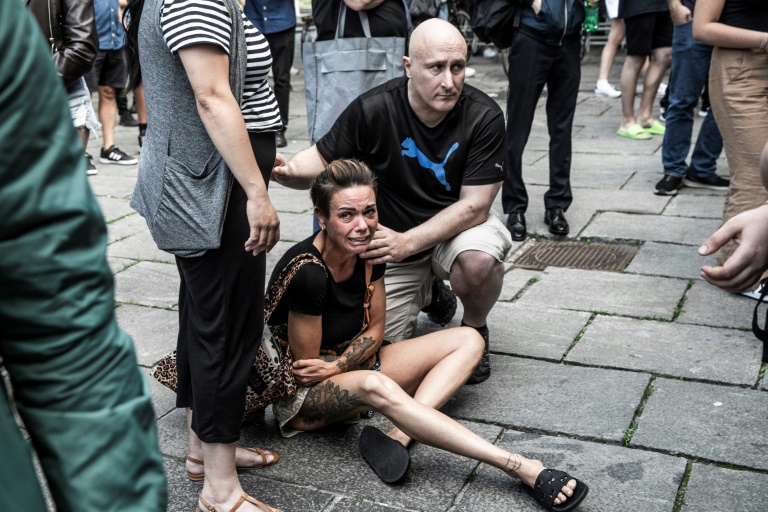
About 20 more were lightly injured in the panicked evacuation after the shooting.

Thomassen added that they believed videos of the suspect, which have circulated since late Sunday on social media, to be authentic.

In some of the images, the young man can be seen posing with weapons, mimicking suicide gestures and talking about psychiatric medication “that does not work”. 

Three videos believed to have been posted to YouTube by the suspect were all titled “I don’t care”.

YouTube and Instagram accounts believed to belong to him were closed overnight, AFP noted.

The shooting occurred Sunday afternoon at the busy Field’s shopping mall, located between the city centre and Copenhagen airport. 

According to police, the shooter was armed with a rifle, a pistol and a knife, and while the guns were not believed to be illegal, the suspect did not have a licence for them.

– ‘Are you OK?’ –

Witnesses quoted by Danish media described how the suspect tried to trick people by saying his weapon was fake to get them to approach.

“He was sufficiently psychopathic to go and hunt people, but he wasn’t running,” one witness told public broadcaster DR.

Other eyewitnesses told Danish media they had seen more than 100 people rush towards the mall’s exit as the first shots were fired.

The mall was busy because of a planned concert with British singer Harry Styles at the nearby Royal Arena that had sold 13,500 tickets but was cancelled at the last minute.

“We got dressed for the concert, we were on our way,” Maria Enevoldsen, who had returned to the mall Monday to pick up her car, told AFP.

“Our friend (in the mall) called, asking ‘are you OK?’ and then we heard gunshots over the phone,” she said.

The shooting came just over a week after a gunman opened fire near a gay bar in Oslo in neighbouring Norway, killing two people and wounding 21 others, though on Monday Norwegian police said they saw no link between the events.

In February 2015, two people were killed and five injured in Copenhagen in a series of Islamist-motivated shootings.

Putin orders Russians to fight on after key Ukraine city taken

President Vladimir Putin on Monday ordered Russian troops to press their offensive deeper into the Donbas region of eastern Ukraine after Moscow’s forces seized the strategic city of Lysychansk.

With the war now well into its fifth month after Russia’s invasion of Ukraine on February 24, governments and organisations gathered for a conference in Switzerland to launch a plan to rebuild the country even as the conflict shows no sign of abating.

The loss of Lysychansk over the weekend prompted Ukrainian President Volodymyr Zelensky to step up calls for an increased supply of weapons from the West so Kyiv can keep up the resistance and regain lost territories.

After giving up on its initial war aim of capturing Kyiv following tough Ukrainian resistance, Russia has focused its efforts on securing control of the Donetsk and Lugansk areas which make up the Donbas region.

Russian Defence Minister Sergei Shoigu told President Vladimir Putin at a meeting that Moscow’s forces were now in full control of the Lugansk region. 

In a sign there would be no let-up in the fighting and that Russia now had its eyes on the entire Donetsk region, Putin told Shoigu that troops stationed there must continue their operations.

“Military units, including the East group and the West group, must carry out their tasks according to previously approved plans,” Putin said.

“I hope that everything will continue in their direction as has happened in Lugansk so far.” 

The Ukrainian army said on Sunday it was retreating from Lysychansk to preserve the lives of its troops after finding itself outnumbered and outgunned by Russian forces there.

– ‘Most modern weapons’ –

But in a symbolic boost for Ukraine, the Ukrainian flag was raised on Snake Island, an rocky outcrop in the Black Sea, after Russia withdrew from the strategically important Ukrainian territory last week.

Moscow’s capture of Lysychansk — one week after the Ukrainian army also retreated from the neighbouring city of Severodonetsk — frees up Russian forces to advance on Kramatorsk and Sloviansk in Donetsk.

Lugansk region governor Sergiy Gayday said on Telegram that there was still fighting in the town of Bilogorivka outside Lysychansk.

“We keep defending a small part of the Lugansk region so that our army could build protective redoubts,” he added.

In an address late Sunday, Zelensky vowed Kyiv would fight on and ensure the military had “the most modern weapons”.

“Ukraine will reach the level when the fire superiority of the occupiers will be levelled.”

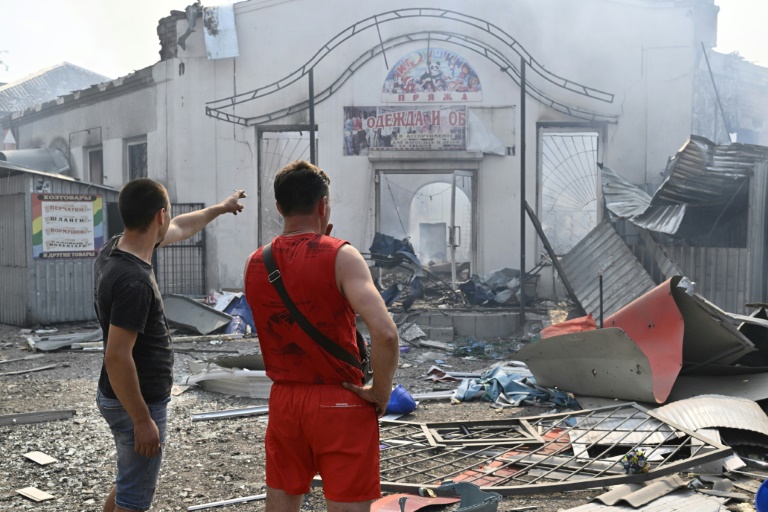
In Sloviansk, about 75 kilometres (45 miles) west of Lysychansk, there were few people on the streets on Monday, the day after Russian strikes that left at least six dead, among them a nine-year-old girl, and 19 injured. 

In the large downtown market largely ravaged by a fire caused by a Russian strike, a few vendors offered basic goods while others cleared charred debris. 

Vendors and residents who spoke to AFP, some still in shock, expressed concern for the days and weeks to come, as sounds of shelling were heard again.

– ‘Task of democratic world’ –

The city of Siversk, 30 kilometres west of Lysychansk, also saw overnight shelling, residents and an official told AFP.

But Zelensky’s address Sunday evening was defiant, pointing to Ukrainian troops would “win back” territory in the Donbas just has they had in other regions earlier in the war.

On Monday, leaders from dozens of countries and international organisations were meeting in the Swiss city of Lugano, where they aim to hash out a roadmap for Ukraine’s reconstruction — expected to cost hundreds of billions of dollars.

Lugano is not a pledging conference but will instead attempt to lay out the principles and priorities for a rebuilding process aimed to begin even as the war rages.

The meeting is seen giving birth to a scheme along the lines of the “The Marshall Plan”, the US-devised giant economic rescue scheme to rebuild Europe after World War II.

In a video address to the conference that was attended in person by Prime Minister Denys Shmyhal, Zelensky described rebuilding Ukraine as the “common task of the whole democratic world” and the “biggest contribution to the support of global peace.”

But for residents in Bucha — a Ukrainian town synonymous with war crimes blamed on Moscow’s forces after their retreat in April — fear remains even as talk begins of reconstruction. 

“We’re going to bed without knowing if we’ll wake up tomorrow,” said Vera Semeniouk, 65. 

“Everyone has come back, is starting to repair houses, many are putting in new windows. It would be terrible if it started again, and we had to leave everything again.”

Central African Republic dives into crypto with the Sango

Undeterred by the turmoil hitting crypto, the Central African Republic (CAR) — one of the poorest and most troubled countries in the world — has unveiled plans to launch its own digital currency.

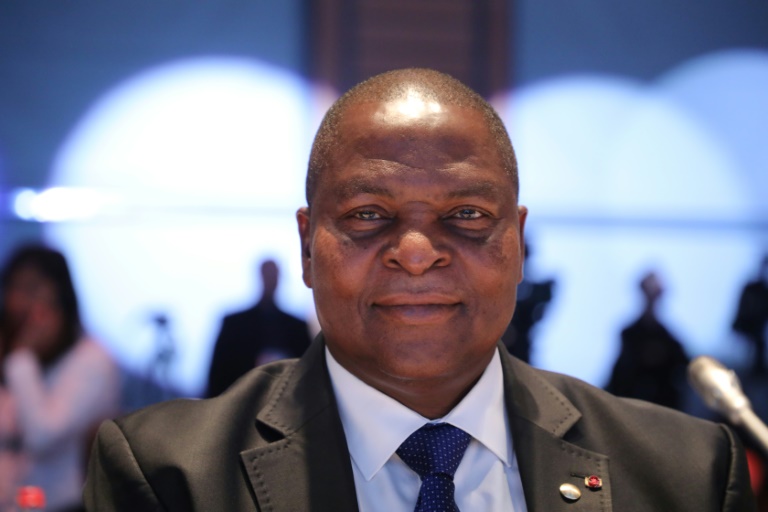
President Faustin Archange Touadera, in an “online event” on Sunday, announced CAR would create the Sango Coin and a zero-taxation “crypto-hub”, the first in Africa.

The currency is named after Sango, which with French is one of the two official languages in the landlocked country, rated the world’s second poorest nation under the UN’s Human Development Index.

Through a platform called Crypto Island, the Sango will become “the catalyst for tokenising (CAR’s) vast natural resources,” Touadera declared, providing no timeline or other details.

He hailed Sango and Crypto Island as “a new digital system fed by blockchain,” the internet-based ledger that underpins crypto currencies.

“Sango Coin will give the whole world direct access to our resources,” attracting investors and “getting the engines of the economy going,” he enthused.

On April 27, Touadera’s office abruptly announced that the CAR had adopted Bitcoin as legal tender alongside the CFA franc, a currency the country shares with five other central African economies.

It became the first country in Africa to embrace Bitcoin as a national currency, and the second in the world after El Salvador last September.

The April announcement sparked bemusement among analysts, given the entrenched poverty and lack of infrastructure in the CAR, where only one person in seven has access to mains electricity. 

They also voiced concern about the impact of crypto volatility on savings.

Virtual currencies have gone into a tailspin as investors look to safer havens at a time of inflation and uncertainty sparked by the Ukraine war.

Bitcoin has lost nearly 60 percent of its value over the past six months.

– ‘Digital gold’ –

Touadera on Sunday said 57 percent of Africa’s population does not have access to a bank.

“The solution,” he said, was “the smartphone, the alternative to the traditional bank, cash and financial red tape”.

On Twitter, he said, “gold served as the engine of our civilisation for ages! In this new age, digital gold will serve the same for the future.”

The CAR’s rush to crypto has been seen by some critics in the context of its closer ties with Russia.

Touadera has been accused of using Russian paramilitaries to buttress his regime and offering CAR’s natural resources in exchange. 

The country has a treasure chest of minerals, ranging from copper and gold to diamonds and uranium.

The CAR, a former French colony, plunged into a civil war along sectarian lines in 2013 after the then-president, Francois Bozize, was ousted.

Touadera was first elected in 2016 after an interim period and re-elected in disputed circumstances in 2020.

Violence diminished in 2018 but rebel forces remain active.

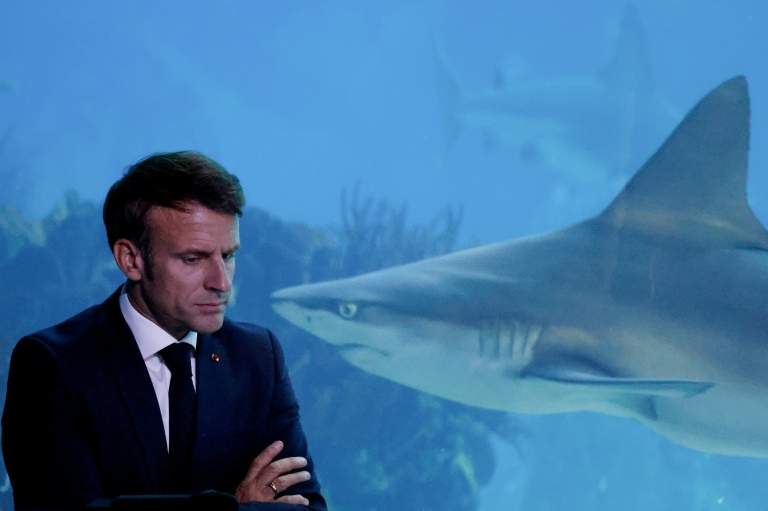
Macron reshuffles French cabinet for tricky second term

French President Emmanuel Macron on Monday reshuffled his government looking to reset a second term off to a rocky start after his failure to win a parliamentary majority.

While he finally ceded to public pressure by sacking Damien Abad, the solidarity and social cohesion minister accused of rape, there was little sign of a major renewal that could turn Macron’s fortunes around.

Other posts in the 41-strong cabinet — exactly divided between men and women — mostly went to politicians from the different factions in Macron’s camp. The foreign, finance and defence ministers all remained in place.

Abad later told reporters he had been targeted by a “sinister movement” of “despicable slanders organised around a calendar” designed to drive him out of government after just 45 days.

Chrysoula Zacharopoulou, who has been accused by former patients of rape during gynaecological examinations, is staying on as state secretary for development, Francophony and international partnerships. 

Monday’s reshuffle brought in some new faces, including Abad’s replacement, French Red Cross chief Jean-Christophe Combe, and emergency doctor Francois Braun as health minister.

OECD chief economist Laurence Boone was named Europe minister, replacing Macron loyalist Clement Beaune who became notorious for verbal jousting with Brexit supporters. Beaune was moved to the transport ministry.

– Short of majority –

Christophe Bechu, mayor of the Loire city of Angers and a close ally of former prime minister Edouard Philippe, was named environment minister.

Although Macron has long trailed environmental protection as a priority, Bechu has “no experience of what’s at stake in the green transition and has almost never taken a stance on national or international questions of climate or the environment,” Greenpeace France said.

The reshuffle was “a message to the troops: loyalty will be rewarded. Looking ahead to the coming months, when passing new laws is likely to come down to just a few votes,” tweeted Frederic Says, a political commentator for broadcaster France Culture.

Far-right leader Marine Le Pen charged that “those who failed are all reappointed” to the government. Communist boss Fabien Roussel told broadcaster LCI it “feels like they’re just starting over again with the same people”.

A first test for the new government will come on July 6, when Prime Minister Elisabeth Borne will lay out her policies before parliament.

The government is still mum on whether it will hold a traditional high-stakes confidence vote afterwards.

Macron beat Le Pen a second time in April’s presidential run-off to win a new five-year term.

But a lacklustre campaign for last month’s parliamentary vote saw his supporters win just 250 seats, 39 short of the absolute majority needed to push through new laws.

– ‘Ideological vagueness’ –

Macron was largely absent from the domestic political stage between the presidential election and the vote for the National Assembly — absorbing himself instead on the international scene with Russia’s invasion of Ukraine.

But where the image of the head of state fighting France’s corner abroad might once have assured presidents backing in the parliamentary poll, this time around it reinforced Macron’s image as distant and arrogant.

His far-right and hard-left opponents enjoyed free rein to attack what few concrete policies the majority offered, such as an unpopular plan to push back the legal retirement age to 65.

And after a first term buffeted by crises including “yellow-vest” protests against the government and the Covid-19 pandemic, Macron could point to few successes in the reform programme on which he was elected in 2017.

The once all-powerful president will now need to find allies in a parliament with large blocs from the far right and left-wing alliance NUPES — both broadly hostile to his leadership.

Opposition forces have ruled out any formal coalition, leaving the government to glean support where it can as bills come up for the vote.

“Whereas yesterday he opposed ‘imperfect compromises’, from now on the president will have to resign himself to them,” newspaper Le Monde commented this weekend, bemoaning “presidential hesitations” and “ideological vagueness” at the Elysee.

European equities recover as optimism creeps back in

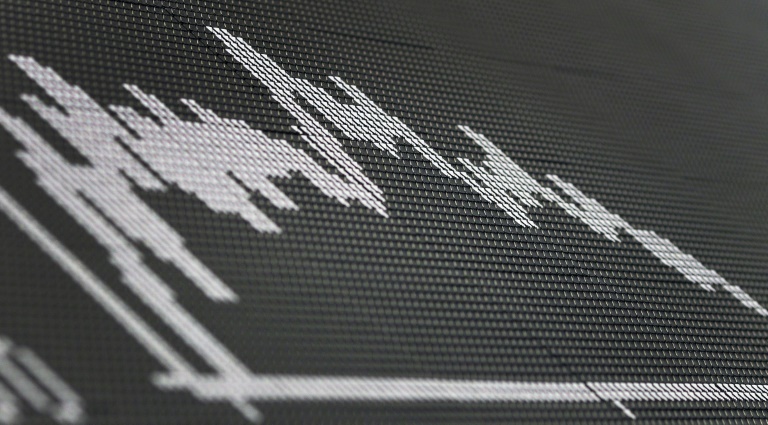
Europe’s stocks recovered somewhat Monday as investors tentatively regained some optimism following the heavy losses in the financial markets last week on fears that rising interest rates could spark recession.

London stocks won 1.1 percent at midday, while Frankfurt and Paris gained 0.5 percent and 1.0 percent respectively in afternoon deals.

Tokyo and Shanghai also advanced but Hong Kong nudged lower. The dollar traded mixed while oil prices were subdued.

– ‘Sliver of optimism’ –

“A sliver of optimism has broken through on global markets at the start of the week,” said Susannah Streeter, senior investment and markets analyst at Hargreaves Lansdown.

Europe’s investors on Friday absorbed news of record-high eurozone inflation that reinforced expectations of a European Central Bank interest rate hike in July.

Markets have suffered sharp losses in recent weeks on fears that global rate hikes — aimed at fighting soaring inflation — could send economies into a downturn.

“Overall caution is still the name of the game as investors nurse wounds from a bruising first half of the year,” Streeter said.

Wall Street meanwhile remains shut for the Independence Day holiday on Monday.

City Index analyst Fawad Razaqzada cautioned that global markets might yet have further to fall.

– ‘Pinch of salt’ –

“Nothing has changed fundamentally to suggest the markets have bottomed out,” Razaqzada told AFP.

“It is a quiet day with the US out and economic calendar light. So anything we see today should be taken with a pinch of salt.”

Back in Asia, data showing a flare-up of fresh Covid-19 cases in China revived concerns about the government’s policy of locking down towns and cities to eradicate the disease, despite the economic cost.

The jump in new Covid cases weighed on sentiment among investors who fear a return to the painful lockdowns in major cities including Shanghai, which hammered the world’s number-two economy.

In a sign of the struggle officials will have in controlling rising prices, data showed Friday that eurozone inflation hit a record 8.6 percent in June. 

The European Central Bank is due to lift rates this month for the first time in more than a decade.

– Key figures at around 1100 GMT –

London – FTSE 100: UP 1.1 percent at 7,247.24 points

Frankfurt – DAX: UP 0.5 percent at 12,870.48

Paris – CAC 40: UP 1.0 percent at 5,991.47

EURO STOXX 50: UP 0.7 percent at 3,472.61

Tokyo – Nikkei 225: UP 0.8 percent at 26,153.81 (close)

Hong Kong – Hang Seng Index: DOWN 0.1 percent at 21,830.35 (close)

Shanghai – Composite: UP 0.5 percent at 3,405.43 (close)

New York – Dow: UP 1.1 percent at 31,097.26 (close)

Euro/dollar: UP at $1.0454 from $1.0414 Friday

Pound/dollar: UP at $1.2130 from $1.2095

Euro/pound: UP at 86.20 pence from 86.10 pence

Dollar/yen: UP at 135.43 yen from 135.21 yen

Brent North Sea crude: UP 0.4 percent at $112.04 per barrel

West Texas Intermediate: FLAT at $108.44 per barrel

'Win war first, then rebuild,' say Ukrainians in shattered Bucha

On a sunny morning in Bucha, customers buy fresh cherries at a small market, a couple pushes a baby buggy and a teenager with piercings skateboards down the street.

It’s a picture of apparent calm in the Kyiv suburb, where just three months ago on April 2 AFP journalists found 20 bodies in civilian clothes lying along nearby Yablunska Street. 

They were among the first to witness atrocities committed by Russian forces during the occupation of Kyiv’s leafy northwestern suburbs of Bucha, Irpin and Borodianka, quiet residential areas previously known for their easy access to nature.

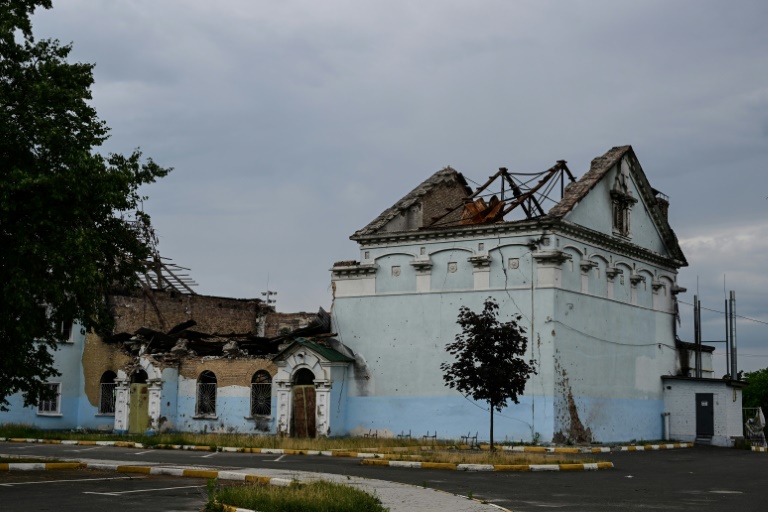
In early July, scars from the war are still highly visible — broken windows, shell craters and gaping holes in walls.

Along Vokzalna Street, the long avenue that links Bucha to Irpin, numerous buildings have been destroyed or massively damaged — houses, apartment blocks, stores and a shopping mall.

These suburbs swiftly became a symbol of the brutality of the Russian invasion and an essential stop on the itinerary for all Western dignitaries visiting Kyiv.

“We will rebuild everything,” Italian Premier Mario Draghi promised on June 16 when he visited Irpin with French President Emmanuel Macron and German Chancellor Olaf Scholz.

The leaders of a dozen countries and international organisations are meeting on Monday and Tuesday in Lugano, Switzerland, to map out a new “Marshall Plan” intended to speed up the rebuilding of Ukraine. It could cost hundreds of billions of dollars.

 – ‘No information’ –

For many, though, rebuilding seems a distant prospect.

Resident Katiya Yolshina, 66, points to two large shell blast holes in the walls of her top-floor flat, in a block where she has lived for two decades.

The eight-storey building was shelled in early March and is not even the worst damaged in the area.

“The man in charge (of the block) told us to fill out forms and we would get money. But he hasn’t been back since and we have no information,” says Yolshina, who returned to Bucha in early May after an absence of six weeks. 

“What will we get and when will we get it? I don’t know anything,” she says. There is no trace of complaint in her voice but her face trembles from holding back tears.

In fact, for many locals rebuilding is not yet a priority although many came back a few weeks ago after fleeing Russian occupation and are already busily planting flowers or digging vegetable patches.

Despite the calm in the region around Kyiv, many point to the fact that the war is still raging in many other parts of Ukraine, particularly in the south and east. And the dread of another Russian offensive here remains strong.

 – ‘If it starts again’ –

In recent days rumours have buzzed of an imminent attack from Belarus, whose border is only around 100 kilometres (62 miles) to the north.

These have gained credence due to statements by Belarusian President Alexander Lukashenko, a key ally of Russian President Vladimir Putin. 

On Saturday, Lukashenko accused Ukraine of firing missiles into Belarusian territory and threatened to retaliate.

“It’s terrifying,” says Nadezhda Stenenkova, 75.

“Obviously everything is fine now. Things are calm. But we still have this fear that they (Russian forces) will come back because they’re not far away and they’re still destroying towns and villages,” she says. 

“We can’t feel at peace, because the Russian ‘fascists’ could return at any moment.”

Given these fears, she says some people are reluctant to carry out repairs yet, even if workmen have already taken measurements for replacement windows and doors that could be installed within weeks.

“No-one feels ready to get repairs done. They’re afraid of Lukashenko. They don’t know what he’ll do next,” says Stenenkova.

“We go to bed not knowing if we’ll wake up in the morning,” adds 65-year-old pensioner Vera Semeniuk tearfully.

Nevertheless, she says, “Everyone has come back and started fixing up their homes and a lot of people are putting in new windows. It would be terrible if it starts again and we all have to leave again.”

“Of course we hope that foreign countries will help us (to rebuild),” she adds.

“But our main hope is that our military bring us victory, with the help of support and weapons from abroad.”

Russia holds key Ukraine city in setback for Kyiv

Russian troops were on Monday holding the strategic Ukrainian city of Lysychansk after Kyiv’s forces retreated, in a major boost for Russia’s campaign to seize the entire Donbas region of eastern Ukraine.

With the war now well into its fifth month after Russia’s invasion of Ukraine on February 24, governments and organisations gathered for a conference in Switzerland to launch a plan to rebuild the country even as the conflict shows no sign of abating.

The loss of Lysychansk over the weekend prompted Ukrainian President Volodymyr Zelensky to step up calls for an increased supply of weapons from the West so Kyiv can keep up the resistance and regain lost territories.

After giving up on its initial war aim of capturing Kyiv following tough Ukrainian resistance, Russia has focused its efforts on securing control of the Donetsk and Lugansk areas which make up the Donbas region.

Russian Defence Minister Sergei Shoigu told President Vladimir Putin at the weekend that Moscow’s forces were now in full control of the Lugansk region. 

Moscow’s capture of Lysychansk — one week after the Ukrainian army also retreated from the neighbouring city of Severodonetsk — frees up Russian forces to advance on Kramatorsk and Sloviansk in Donetsk.

“The continuation of the defence of the city (Lysychansk) would lead to fatal consequences” in the face of Russia’s superiority in numbers and equipment, the Ukrainian army said on Sunday, announcing its retreat. 

“In order to preserve the lives of Ukrainian defenders, a decision was made to withdraw.”

– ‘Most modern weapons’ –

Lugansk region governor Sergiy Gayday said on Telegram that there was still fighting in the town of Bilogorivka outside Lysychansk.

“We keep defending a small part of the Lugansk region so that our army could build protective redoubts,” he added.

In an address late Sunday, Zelensky vowed Kyiv would fight on and ensure the military had “the most modern weapons”.

“Ukraine will reach the level when the fire superiority of the occupiers will be levelled.”

In Sloviansk, about 75 kilometres (45 miles) west of Lysychansk, there were few people on the streets on Monday, the day after Russian strikes that left at least six dead, among them a nine-year-old girl, and 19 injured. 

In the large downtown market largely ravaged by a fire caused by a Russian strike, a few vendors offered basic goods while others cleared charred debris. 

Vendors and residents who spoke to AFP, some still in shock, expressed concern for the days and weeks to come, as sounds of shelling were heard again.

– ‘Win back the land’ –

The city of Siversk, 30 kilometres west of Lysychansk, also saw overnight shelling, residents and an official told AFP.

But Zelensky’s address Sunday evening was defiant, pointing to Ukrainian troops progressing in the Kharkiv and Kherson regions, and vowed “there will be a day when we will say the same about Donbas”.

“We will rebuild the walls, we will win back the land, and people must be protected above all else,” Zelensky said. 

“Ukraine does not give anything up.”

On Monday, leaders from dozens of countries and international organisations were meeting in the Swiss city of Lugano, where they aim to hash out a roadmap for Ukraine’s reconstruction — expected to cost hundreds of billions of dollars.

Lugano is not a pledging conference but will instead attempt to lay out the principles and priorities for a rebuilding process aimed to begin even as the war rages.

– ‘Democracy over autocracy’ –

Ukraine will also face demands for broad reforms, especially in cracking down on corruption after Brussels recently granted Kyiv candidate status in its push to join the 27-member European Union.

Zelensky will address the conference by video, but the event is also being attended by Ukrainian Prime Minister Denys Shmyhal in a rare trip outside the country. 

British Foreign Secretary Liz Truss is due to pledge both immediate humanitarian assistance as well as access to British financial and economic expertise, the foreign office said.

She will tell delegates that Ukraine’s recovery “will be a symbol of the power of democracy over autocracy”, it added.

But for residents in Bucha — a Ukrainian town synonymous with war crimes blamed on Moscow’s forces after their retreat in April — fear remains even as talk begins of reconstruction. 

“We’re going to bed without knowing if we’ll wake up tomorrow,” said Vera Semeniouk, 65. 

“Everyone has come back, is starting to repair houses, many are putting in new windows. It would be terrible if it started again and we had to leave everything again.”

Close Bitnami banner
Bitnami