World

Chile president to receive draft constitution

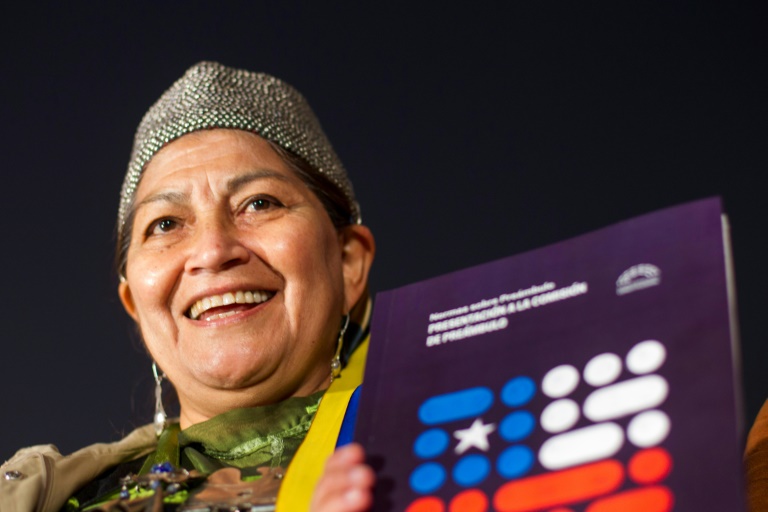
After being worked on for a year, Chile’s new draft constitution will be officially submitted to President Gabriel Boric on Monday before eventually being put to a referendum in the deeply polarized country.

The new text, which will replace the constitution written during the Augusto Pinochet dictatorship (1973-1990), aims to establish new social rights.

It was drawn up by a constituent assembly of 154 citizens, most of whom were independent of political affiliation, that will be dissolved a year to the day after it began work on July 4, 2021.

The document will then be put to a referendum on September 4, with voting obligatory for 15 million Chileans, who will decide whether to accept or reject the new constitution.

Rewriting the dictatorship-era constitution was a major demand of protesters who flooded onto the streets in 2019 and kept up weekly demonstrations for months before the coronavirus pandemic curtailed them.

In the first of the new constitution’s 388 articles, Chile is described as “a social and democratic State of law,” as well as “plurinational, intercultural and ecological.”

“It recognizes the dignity, freedom, substantial equality of human beings and their indissoluble relationship with nature as intrinsic and inalienable values.”

“I think we have met the social demands, with the desires of the citizens, which is what people hoped for and wanted of this process,” Barbara Sepulveda, a draft assembly member from the communist party, told AFP.

“It is a proposal that represents a historic advance in terms of democracy and the guarantee of social rights for our country, and on top of that, it is filled with feminism from head to tail,” added Alondra Carrillo, from the leftist Broad Front.

Other right-wing constituent members were less enthusiastic.

For Cristian Monckeberg, this is a “missed” opportunity to “build something that unites rather than divides” the country.

But with just 37 out of 154 seats in the constituent assembly, the political right was in a minority.

The process “was not as simple and friendly as many of us would have wanted and dreamed of,” writer and journalist Patricio Fernandez, one of the 104 independent members of the assembly, told AFP.

– ‘From another era’ –

But with a two-thirds majority needed to approve each article, the only source of solution was dialogue and compromise, even where tensions arose.

And if the constitution is adopted, it will make Chile one of the most progressive countries in the region.

The nationwide right to abortion — something that has been overturned in the United States — would become enshrined in law.

“It’s a constitution from another era. I’m totally convinced that if it is approved, when we look back at this process… it will be seen with a lot more tenderness and affection than we see it now,” said Fernandez.

Split equally between men and women, the constituent assembly also contained 17 seats reserved for Indigenous people, who make up around 13 percent of Chile’s 19 million population.

One of those members, Natividad Llanquileo, an activist for Chile’s largest Indigenous group, the Mapuche, said the constitutional process represented “the most democratic space that we have known in the history of this country.”

As well as recognizing the different peoples that make up the Chilean nation, the new constitution accords a certain amount of autonomy to Indigenous institutions, notably in matters of justice.

Several times in recent weeks, millennial leader Boric has reiterated his support for the constitutional project, adding that the current document represents an “obstacle” to profound social reform.

Even so, several opinion polls suggest the new constitution may yet be rejected. With the full text still to be published, many Chileans say they are unsure.

Over the next two months, those in favor of the change “have to work to convince that it will genuinely change people’s lives, while Reject will attempt to attract more moderate sectors in their favor,” Claudio Fuentes, a political scientist at the Diego Portales University, told AFP.


PNG votes in heavily guarded elections

Voters headed to the polls Monday for heavily guarded elections in Papua New Guinea, where millions live in poverty despite vast mineral and energy riches.

About 10,000 police, army and corrections services personnel have been mobilised for the vote in the Pacific island nation, which has a history of corruption and election-related killings.

Australia deployed 130 troops with transport aircraft to help secure the lengthy voting process across the rugged, densely forested country of nine million.

“We want transparency, we want accountability and above all we want a safe, fair and secured polling period, Prime Minister James Marape said after casting his ballot on the first day of voting.

Election rivalries can quickly spill over into bloodshed in Papua New Guinea, especially in the remote and mountainous highlands provinces.

During the last vote in 2017, Australian National University monitors documented more than 200 election-related killings and widespread “serious irregularities”. 

This year, 15 election-related deaths have already been recorded, according to Papua New Guinea police.

In the highlands province of Enga, a candidate was charged with shooting and killing the supporter of a political rival on June 26, police told local media.

Marape conceded in an end-of-campaign message that there was still “rampant corruption in all strata of public service”.

The prime minister, who has promised to make Papua New Guinea the “richest black Christian nation”, said there had been a lack of development despite the country’s “God-given” resources.

“I admit there is much more to be done for our country,” said Marape, who leads the Pangu party.

He faces a stiff challenge from his predecessor Peter O’Neill, who resigned as leader three years ago under pressure over endemic corruption and a perceived failure to spread mining wealth to the people.

O’Neill, of the People’s National Congress party, has vowed to attract private investment and revive the resources industry.

The country boasts large deposits of gas, oil, gold and copper, and is an exporter of forestry and agricultural products.

– ‘Very violent’ –

“There are worrying signs around our nation that the election has been very poorly prepared for and interference seems rife,” O’Neill charged.

“I hope the good officers of our security forces at all levels can ensure we have free, fair and safe elections.”

Voting is scheduled to take up to 18 days and an outcome is not expected to be clear until August.

Analysts say the new leader will have to cobble together a coalition government in the male-dominated 118-seat parliament, which has had no women members since the last election in 2017.

“Elections are always messy and chaotic and they can get very violent,” said Jessica Collins, Pacific researcher at the independent Sydney-based Lowy Institute think tank.

In an ethnically diverse country with more than 800 languages, analysts say voters are less interested in national issues than the material benefits candidates can bring home to local communities.

“People want to know what their candidate is going to do for them and for the village: the real, hard currency stuff,” Collins said.

Further complicating the process, the electoral roll is not up to date, said Pacific analyst Henry Ivarature at the Australian National University.

“So the whole integrity of this election is already under question,” he said.

The government that emerges from the elections will face significant challenges.

Nearly 40 percent of the population lives below the international poverty line, according to a 2020 report by the World Bank.

The resources- and agriculture-dependent economy posted a “weak recovery” last year, the Asian Development Bank said, after being battered by the Covid-19 pandemic, with only about three percent of the total population fully vaccinated.

Protests in US after release of video of police killing Black man

Several hundred protesters marched Sunday in Akron, Ohio after the release of body camera footage that showed police fatally shooting a Black man with several dozen rounds of bullets.

As anger rose over the latest police killing of a Black man in the United States, and authorities appealed for calm, a crowd marched to City Hall carrying banners with slogans such as “Justice for Jayland.”

The slogan refers to Jayland Walker, 25, who was killed Monday after officers tried to stop his car over a traffic violation, police said.

Sunday marked the fourth straight day of protests in the city of 190,000 people. Demonstrations during the day were peaceful but for a tense moment in which some protesters got close to a line of police and shouted at them.

Derrick Johnson, president of the NAACP, denounced the shooting as “murder… point blank” as the civil rights group led a daytime rally. 

“This Black man was killed… for a possible traffic violation. This doesn’t happen to white people in America,” he said in a statement, also slamming the police department’s response. 

Protests continued into the evening, with a hundred-strong crowd still in the streets in front of the justice center, an AFP reporter said.

Despite calls from some protesters for calm, tensions mounted as the night wore on. 

Some protesters set dumpsters alight and broke windows of the snowplows and other heavy equipment authorities had moved near the police department as a barrier in anticipation of unrest.

Police in riot gear deployed and fired tear gas at the crowd to push it back from the justice center. 

After initially providing few details of the shooting, Akron authorities released two videos Sunday: a compilation of body-camera footage, body-cam still frames and voiceover, and another of the complete body-cam footage of the entire chase and shooting.

The voiceover explained that Walker did not stop and drove off. Police engaged in a car chase and said a shot had been fired from Walker’s vehicle.

After being chased for several minutes, Walker got out of his car while it was still moving and fled on foot. Officers tried to subdue him with their tasers, but he kept running.

Several officers finally chased Walker to a parking lot. The body-cam footage is too blurry to see clearly what happens, but an initial police statement released after the shooting says Walker behaved in a way that caused officers to believe he posed a “deadly threat.”

– ‘Over 60 wounds’ to body –

All of the officers at the scene opened fire on Walker, shooting multiple times in rapid succession.

He was pronounced dead at the scene.

The incident was the latest death of an African-American citizen at the hands of police, events that have sparked mass protests over racism and police brutality.

“Many will wish to air their grievances in public, and I fully support our residents’ right to peacefully assemble,” Akron mayor Dan Horrigan told a press conference, saying he was “heartbroken” over the events.

“But I hope the community can agree that violence and destruction are not the answer.”

He also said an independent investigation was being conducted.

Bobby DiCello, a lawyer for the Walker family, told The New York Times: “I’ve been a trial lawyer for 22 years and I’ve never seen anything remotely close to what that video is going to show.”

Police chief Steve Mylett said he didn’t know the exact number of bullets fired at Walker, but the medical examiner’s report “indicates over 60 wounds to Mr. Walker’s body.”

He added that the eight officers involved in Walker’s death have been placed on paid administrative leave until the investigation is complete.

Authorities canceled a festival planned for the July 4th Independence Day holiday weekend.

Basketball star LeBron James, an Akron native, said in a tweet Sunday he was praying for his city.

Tropical Storm Bonnie becomes hurricane, kills 3 in Central America

Tropical Storm Bonnie was upgraded to a category one hurricane on Sunday as it swept towards Mexico after killing three people in El Salvador and Nicaragua, the US National Hurricane Center said.

The hurricane, the third of the season off Mexico’s coast, is carrying maximum sustained winds of 80 miles (125 kilometers) per hour “with higher gusts,” the NHC said, citing satellite images.

“The core of Bonnie is expected to remain south of, but move parallel to, the coast of southern and southwestern Mexico during the next couple of days,” the center said in its latest advisory.

Before moving towards Mexico, the storm caused damage to property in the Central American countries of El Salvador and Nicaragua, felling trees and flooding rivers, streets and hospitals.

A 24-year-old woman died in El Salvador, emergency services said, while in Nicaragua the army said a 40-year-old man was swept away trying to cross a river and a 38-year-old man died trying to rescue passengers from a bus.

Rescuers in El Salvador were still searching Sunday evening for a missing man and the search efforts will continue on Monday, the country’s civil protection agency said.

“Bonnie generated very heavy rains and thunderstorms in the coastal area, the volcanic mountain range and the San Salvador metropolitan area, with strong gusty winds and hail in some areas,” the environment ministry said. 

El Salvador’s President Nayib Bukele said all classes would be suspended Monday.

Bonnie, which made landfall in Nicaragua overnight Friday to Saturday, is set to drench southern Mexico with heavy rain, the NHC said.

Swells caused by the hurricane are to “cause life-threatening surf and rip current conditions,” its advisory said.

Large Hadron Collider revs up to unprecedented energy level

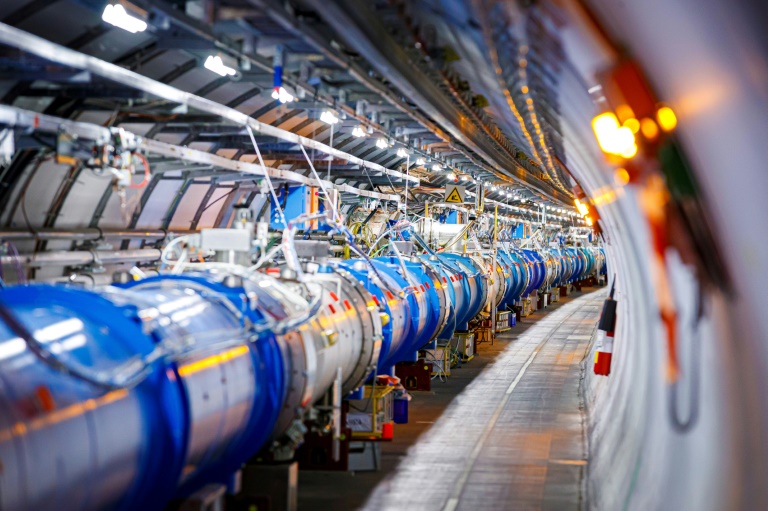
Ten years after it discovered the Higgs boson, the Large Hadron Collider is about to start smashing protons together at unprecedented energy levels in its quest to reveal more secrets about how the universe works.

The world’s largest and most powerful particle collider started back up in April after a three-year break for upgrades in preparation for its third run. 

From Tuesday it will run around the clock for nearly four years at a record energy of 13.6 trillion electronvolts, the European Organisation for Nuclear Research (CERN) announced at a press briefing last week. 

It will send two beams of protons — particles in the nucleus of an atom — in opposite directions at nearly the speed of light around a 27-kilometre (17-mile) ring buried 100 metres under the Swiss-French border.

The resulting collisions will be recorded and analysed by thousands of scientists as part of a raft of experiments, including ATLAS, CMS, ALICE and LHCb, which will use the enhanced power to probe dark matter, dark energy and other fundamental mysteries.

– 1.6 billion collisions a second –

“We aim to be delivering 1.6 billion proton-proton collisions per second” for the ATLAS and CMS experiments, CERN’s head of accelerators and technology Mike Lamont said.

This time around the proton beams will be narrowed to less than 10 microns — a human hair is around 70 microns thick — to increase the collision rate, he added.

The new energy rate will allow them to further investigate the Higgs boson, which the Large Hadron Collider first observed on July 4, 2012.

The discovery revolutionised physics in part because the boson fit within the Standard Model — the mainstream theory of all the fundamental particles that make up matter and the forces that govern them.

However several recent findings have raised questions about the Standard Model, and the newly upgraded collider will look at the Higgs boson in more depth.

“The Higgs boson is related to some of the most profound open questions in fundamental physics today,” said CERN director-general Fabiola Gianotti, who first announced the boson’s discovery a decade ago.

Compared to the collider’s first run that discovered the boson, this time around there will be 20 times more collisions.

“This is a significant increase, paving the way for new discoveries,” Lamont said.

Joachim Mnich, CERN’s head of research and computing, said there was still much more to learn about the boson.

“Is the Higgs boson really a fundamental particle or is it a composite?” he asked.

“Is it the only Higgs-like particle that exists — or are there others?”

– ‘New physics season’ – 

Past experiments have determined the mass of the Higgs boson, as well as more than 60 composite particles predicted by the Standard Model, such as the tetraquark.

But Gian Giudice, head of CERN’s theoretical physics department, said observing particles is only part of the job.

“Particle physics does not simply want to understand the how — our goal is to understand the why,” he said.

Among the Large Hadron Collider’s nine experiments is ALICE, which probes the matter that existed in the first 10 microseconds after the Big Bang, and LHCf, which uses the collisions to simulate cosmic rays.

After this run, the collider will come back in 2029 as the High-Luminosity LHC, increasing the number of detectable events by a factor of 10.

Beyond that, the scientists are planning a Future Circular Collider — a 100-kilometre ring that aims to reach energies of a whopping 100 trillion electronvolts.

But for now, physicists are keenly awaiting results from the Large Hadron Collider’s third run.

“A new physics season is starting,” CERN said.

Large Hadron Collider revs up to unprecedented energy level

Ten years after it discovered the Higgs boson, the Large Hadron Collider is about to start smashing protons together at unprecedented energy levels in its quest to reveal more secrets about how the universe works.

The world’s largest and most powerful particle collider started back up in April after a three-year break for upgrades in preparation for its third run. 

From Tuesday it will run around the clock for nearly four years at a record energy of 13.6 trillion electronvolts, the European Organisation for Nuclear Research (CERN) announced at a press briefing last week. 

It will send two beams of protons — particles in the nucleus of an atom — in opposite directions at nearly the speed of light around a 27-kilometre (17-mile) ring buried 100 metres under the Swiss-French border.

The resulting collisions will be recorded and analysed by thousands of scientists as part of a raft of experiments, including ATLAS, CMS, ALICE and LHCb, which will use the enhanced power to probe dark matter, dark energy and other fundamental mysteries.

– 1.6 billion collisions a second –

“We aim to be delivering 1.6 billion proton-proton collisions per second” for the ATLAS and CMS experiments, CERN’s head of accelerators and technology Mike Lamont said.

This time around the proton beams will be narrowed to less than 10 microns — a human hair is around 70 microns thick — to increase the collision rate, he added.

The new energy rate will allow them to further investigate the Higgs boson, which the Large Hadron Collider first observed on July 4, 2012.

The discovery revolutionised physics in part because the boson fit within the Standard Model — the mainstream theory of all the fundamental particles that make up matter and the forces that govern them.

However several recent findings have raised questions about the Standard Model, and the newly upgraded collider will look at the Higgs boson in more depth.

“The Higgs boson is related to some of the most profound open questions in fundamental physics today,” said CERN director-general Fabiola Gianotti, who first announced the boson’s discovery a decade ago.

Compared to the collider’s first run that discovered the boson, this time around there will be 20 times more collisions.

“This is a significant increase, paving the way for new discoveries,” Lamont said.

Joachim Mnich, CERN’s head of research and computing, said there was still much more to learn about the boson.

“Is the Higgs boson really a fundamental particle or is it a composite?” he asked.

“Is it the only Higgs-like particle that exists — or are there others?”

– ‘New physics season’ – 

Past experiments have determined the mass of the Higgs boson, as well as more than 60 composite particles predicted by the Standard Model, such as the tetraquark.

But Gian Giudice, head of CERN’s theoretical physics department, said observing particles is only part of the job.

“Particle physics does not simply want to understand the how — our goal is to understand the why,” he said.

Among the Large Hadron Collider’s nine experiments is ALICE, which probes the matter that existed in the first 10 microseconds after the Big Bang, and LHCf, which uses the collisions to simulate cosmic rays.

After this run, the collider will come back in 2029 as the High-Luminosity LHC, increasing the number of detectable events by a factor of 10.

Beyond that, the scientists are planning a Future Circular Collider — a 100-kilometre ring that aims to reach energies of a whopping 100 trillion electronvolts.

But for now, physicists are keenly awaiting results from the Large Hadron Collider’s third run.

“A new physics season is starting,” CERN said.

Thousands evacuate from 'dangerous' Sydney floods

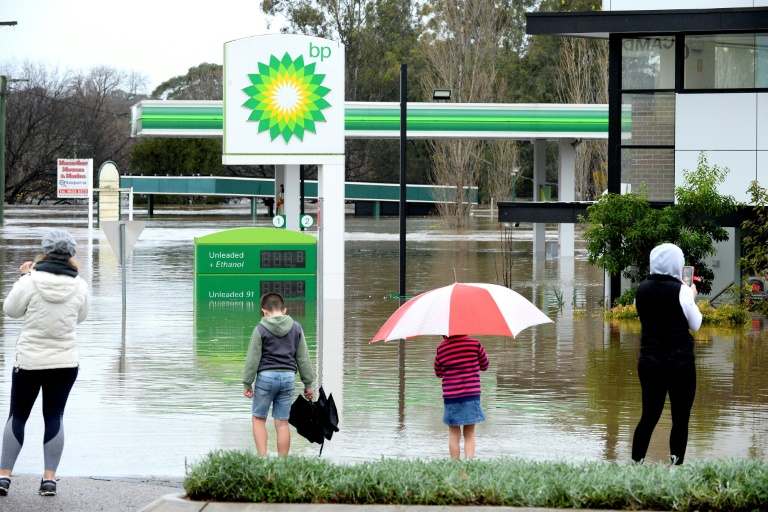
Rapidly rising rivers swamped swathes of rain-lashed Sydney on Monday, forcing thousands to flee “dangerous” floods as the city’s largest dam spilled torrents of water.

On the third day of torrential east coast rains, emergency workers said they had rescued more than 80 people since the previous evening.

Many people had been trapped in their cars trying to cross flood-swept roads or were unable to leave homes surrounded by rising waters.

Australia has been at the sharp end of climate change, with droughts, deadly bushfires, bleaching events on the Great Barrier Reef and floods becoming more common and intense as global weather patterns change.

Higher temperatures mean the atmosphere holds more moisture, unleashing more rain.

About 32,000 people were ordered to evacuate or be ready to flee across New South Wales, the emergency services department said, with the army sending 100 troops to help operations in the storm-battered state.

“The ground is saturated, the rivers are fast flowing, the dams are overflowing,” said State Emergency Services commissioner Carlene York.

“It is particularly dangerous out there,” she said at a news conference.

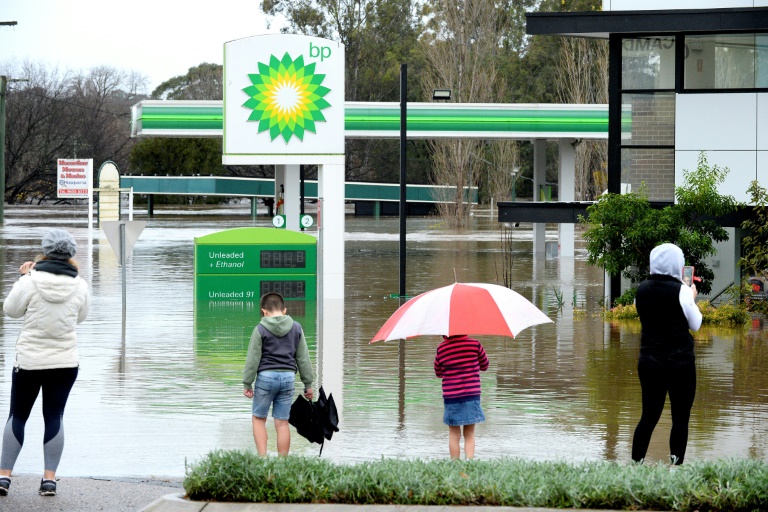
Mud-brown river waters transformed a large stretch of land into a lake in the southwestern Sydney suburb of Camden. 

Roads disappeared into the waters and mobile homes stood in knee-high water, at least one toppled on its side, television images showed.

Large volumes of water gushed from the Warragamba Dam, which has been spilling excess water since Sunday.

The huge concrete dam lies on the western outskirts of Sydney and provides most of the city’s drinking water.

Heavy rains in New South Wales may persist for at least another 24 hours, forecasters said.

– ‘Becoming more common’ –

The wild weather whipped up drama off the Sydney coast, as rescuers battled to help the 150-metre Portland Bay cargo ship with 21 crew which lost power in heavy seas.

The Hong Kong-registered bulk carrier is double-anchored, a police spokesman said. 

A plan to airlift crew members off the boat with two helicopters had been delayed because of safety concerns, he said. 

Two tugboats were headed to the ship to take it further offshore.

Australia’s east coast has suffered repeated flooding in the past 18 months.

More than 20 people died only in March this year as floodwaters lapped at rooftops and torrents swept cars off roads.

The current weather system over Sydney is being fed by warm, wet air from near the equator, said Kimberley Reid, an atmospheric scientist at Monash University. 

Rainfall in eastern Australia is highly variable, making it hard to pin this event to climate change, she said.

“However, our research of the March 2021 Sydney floods found that similar events over Sydney were likely to occur 80 percent more often by the end of the 21st century.”

Australia must prepare for more regular flooding events, New South Wales Premier Dominic Perrottet told a news conference.

“There is no doubt these events are becoming more common,” he said.

“Governments need to adjust and make sure that we respond to the changing environment we find ourselves in.”

Thousands evacuate from 'dangerous' Sydney floods

Rapidly rising rivers swamped swathes of rain-lashed Sydney on Monday, forcing thousands to flee “dangerous” floods as the city’s largest dam spilled torrents of water.

On the third day of torrential east coast rains, emergency workers said they had rescued more than 80 people since the previous evening.

Many people had been trapped in their cars trying to cross flood-swept roads or were unable to leave homes surrounded by rising waters.

Australia has been at the sharp end of climate change, with droughts, deadly bushfires, bleaching events on the Great Barrier Reef and floods becoming more common and intense as global weather patterns change.

Higher temperatures mean the atmosphere holds more moisture, unleashing more rain.

About 32,000 people were ordered to evacuate or be ready to flee across New South Wales, the emergency services department said, with the army sending 100 troops to help operations in the storm-battered state.

“The ground is saturated, the rivers are fast flowing, the dams are overflowing,” said State Emergency Services commissioner Carlene York.

“It is particularly dangerous out there,” she said at a news conference.

Mud-brown river waters transformed a large stretch of land into a lake in the southwestern Sydney suburb of Camden. 

Roads disappeared into the waters and mobile homes stood in knee-high water, at least one toppled on its side, television images showed.

Large volumes of water gushed from the Warragamba Dam, which has been spilling excess water since Sunday.

The huge concrete dam lies on the western outskirts of Sydney and provides most of the city’s drinking water.

Heavy rains in New South Wales may persist for at least another 24 hours, forecasters said.

– ‘Becoming more common’ –

The wild weather whipped up drama off the Sydney coast, as rescuers battled to help the 150-metre Portland Bay cargo ship with 21 crew which lost power in heavy seas.

The Hong Kong-registered bulk carrier is double-anchored, a police spokesman said. 

A plan to airlift crew members off the boat with two helicopters had been delayed because of safety concerns, he said. 

Two tugboats were headed to the ship to take it further offshore.

Australia’s east coast has suffered repeated flooding in the past 18 months.

More than 20 people died only in March this year as floodwaters lapped at rooftops and torrents swept cars off roads.

The current weather system over Sydney is being fed by warm, wet air from near the equator, said Kimberley Reid, an atmospheric scientist at Monash University. 

Rainfall in eastern Australia is highly variable, making it hard to pin this event to climate change, she said.

“However, our research of the March 2021 Sydney floods found that similar events over Sydney were likely to occur 80 percent more often by the end of the 21st century.”

Australia must prepare for more regular flooding events, New South Wales Premier Dominic Perrottet told a news conference.

“There is no doubt these events are becoming more common,” he said.

“Governments need to adjust and make sure that we respond to the changing environment we find ourselves in.”

Saudi welcomes 1 million for biggest hajj pilgrimage since pandemic

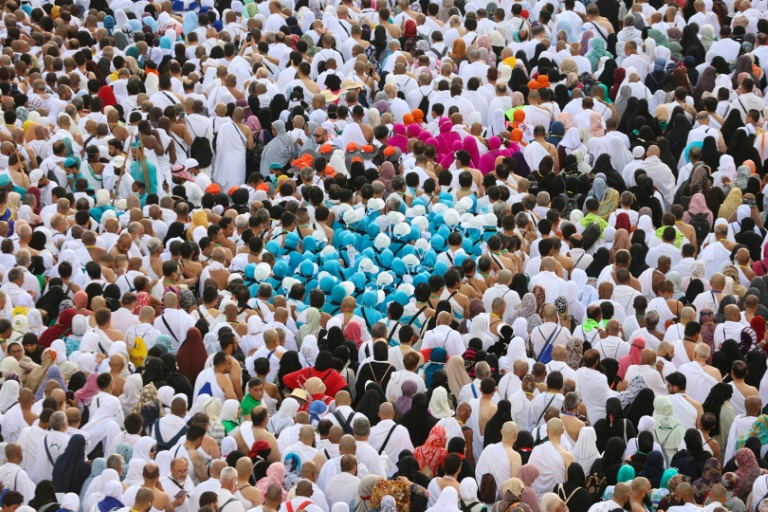
White-robed worshippers from across the world have packed the streets of Mecca as Islam’s holiest city prepares to host the biggest hajj pilgrimage since the coronavirus pandemic.

Banners welcoming the faithful, including the first international visitors since 2019, festooned squares and alleys, while armed security forces patrolled the ancient city, birthplace of the Prophet Mohammed.

“This is pure joy,” Sudanese pilgrim Abdel Qader Kheder told AFP in Mecca, ahead of the event expected to start on Wednesday. “I almost can’t believe I am here. I am enjoying every moment.”

One million people, including 850,000 from abroad, are allowed at this year’s hajj — a key pillar of Islam that all able-bodied Muslims are required to perform at least once — after two years of drastically curtailed numbers due to the pandemic.

At least 650,000 overseas pilgrims have arrived so far in Saudi Arabia, the authorities said Sunday.

In 2019, about 2.5 million people took part in the rituals, which include circling the Kaaba, the imposing black cube at Mecca’s Grand Mosque, gathering at Mount Arafat and “stoning the devil” in Mina.

The following year, foreigners were barred and worshippers were restricted to just 10,000, rising to 60,000 fully vaccinated Saudi citizens and residents in 2021, to stop the hajj turning into a global super-spreader.

One million vaccinated pilgrims under the age of 65 will attend the hajj under strict sanitary conditions, with the Grand Mosque, the holiest site in Islam, scrubbed and disinfected 10 times a day.

The rituals have seen numerous disasters, including a 2015 stampede that killed up to 2,300 people and a 1979 attack by hundreds of gunmen that left 153 dead, according to the official toll.

– Unaccompanied women –

The pilgrimage, one of the five pillars of Islam, is a powerful source of prestige for the conservative desert kingdom and its de facto ruler, Crown Prince Mohammed bin Salman, who is returning from the diplomatic wilderness.

Days after the hajj, Prince Mohammed will welcome US President Joe Biden who, with oil prices sent soaring by Russia’s invasion of Ukraine, has reneged on promises to turn Saudi Arabia into a “pariah” over the 2018 murder of journalist Jamal Khashoggi by Saudi agents.

The hajj, which costs at least $5,000 per person, is a money-spinner for the world’s biggest oil exporter, bringing in about $12 billion a year along with other religious visits.

It is also a chance to showcase a country that is undergoing rapid transformation, while still drawing regular complaints about human rights abuses and limits on personal freedoms.

Saudi Arabia — which has under recent reforms permitted raves in Riyadh and mixed-gender beaches in Jeddah — now also allows women to attend the hajj unaccompanied by a male relative, a requirement that was dropped last year.

– ‘Serenity’ –

Masks are no longer compulsory in most enclosed spaces in Saudi Arabia but they will be mandatory at the Grand Mosque. Pilgrims from abroad will have to submit a negative PCR test result. 

The Grand Mosque will be “washed 10 times a day… by more than 4,000 male and female workers”, with more than 130,000 litres (34,000 gallons) of disinfectant used each time, authorities said.

Since the start of the pandemic, Saudi Arabia has registered more than 795,000 coronavirus cases, 9,000 of them fatal, in a population of about 34 million.

Aside from Covid, another challenge is the scorching sun in one of the world’s hottest and driest regions, which is becoming even more extreme through the effects of climate change.

Although summer has only just begun, temperatures have already topped 50 degrees Celsius (122 Fahrenheit) in parts of Saudi Arabia.

But for Iraqi pilgrim Ahmed Abdul-Hassan al-Fatlawi, the hot weather is the last thing he thinks of when in Mecca.

“I am 60 years old, so it’s normal if I get physically tired because of the hot weather, but I am in a state of serenity, and that’s all that matters to me,” he told AFP.   

Chinese developer Shimao misses $1 bn bond payment

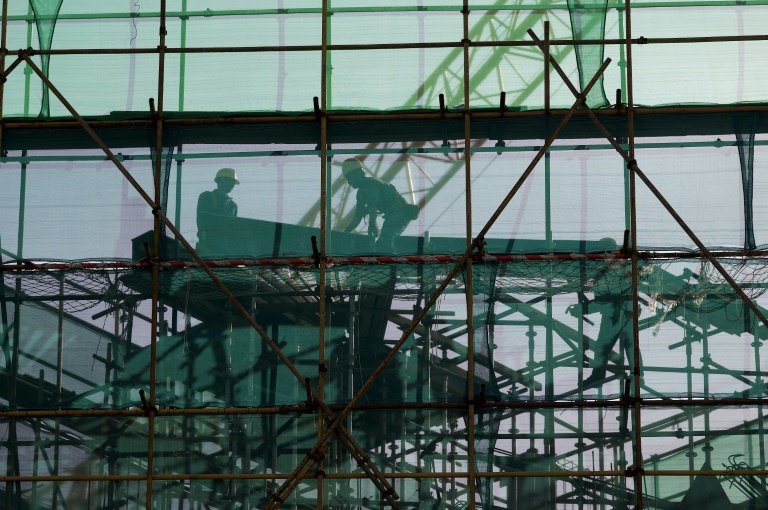
Chinese developer Shimao Group said it has failed to make payment on a $1 billion bond that matured Sunday, one of the biggest such defaults so far this year in the country’s troubled property sector.

China’s real estate sector has been struggling since authorities began a crackdown on excessive debt and rampant consumer speculation in 2020, with giants such as Evergrande and Sunac scrambling to make payments and renegotiate with creditors.

The crisis has sparked fears that the industry’s struggles could spread to the wider economy, and the latest jolt came Sunday when Shimao said it had not paid the principal and interest on a $1 billion offshore note.

In a filing to the Hong Kong Stock Exchange, where it is listed, Shimao said it has experienced a noticeable decline in contracted sales due to “significant changes to the macro environment of the property sector in China since the second half of 2021 and the impact of Covid-19”.

The firm added that it had attempted to negotiate refinancing and waivers but was unable to make some payments because of “challenging” market conditions.

It said it has not received notice from creditors for accelerated repayment, and that lenders have indicated they will not take enforcement action at this point.

Shimao develops residential, hotel, office and commercial properties in China, with projects in major cities such as Beijing and Shanghai.

It was China’s 14th biggest developer by contracted sales last year, according to Bloomberg News.

China’s developers have been struggling as homebuyers tightened their purse strings owing to an uncertain economic outlook.

One company in the eastern city of Nanjing said it would accept truckloads of watermelons as downpayment from local farmers, according to Chinese media.

“The contagion has spread from Evergrande to Sunac and now Shimao,” said Bloomberg Intelligence analyst Kristy Hung.

“That raises our concerns that the extent of the debt crisis is beyond any market watcher’s imagination.”

Close Bitnami banner
Bitnami