World

On the US border, migrants' desperation outweighs fear

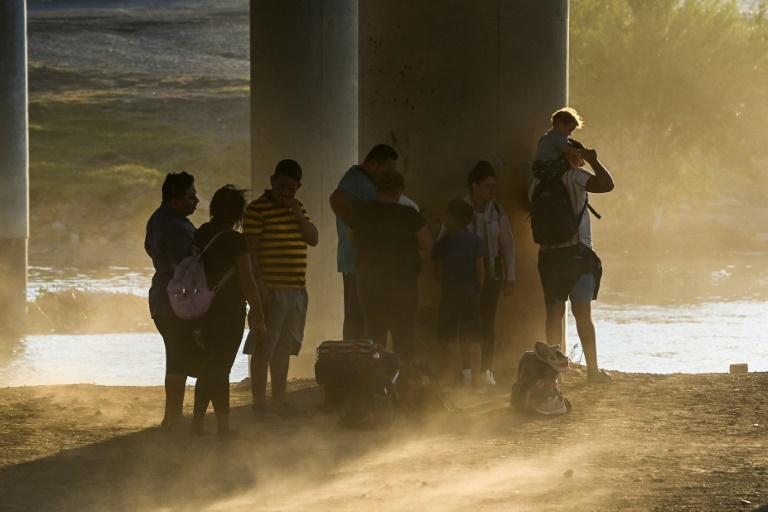
Selvin Allende is worn out. With his one-year-old daughter on his shoulders and his pregnant wife beside him, he crossed the Rio Grande from the Mexican city of Piedras Negras into Eagle Pass, Texas — a dangerous journey that thousands of migrants undertake every year seeking a better future. 

“I was afraid for my daughter in the river. I feel tired, defeated, but with the dream of working if the immigration services listen to us with their hearts,” says the 30-year-old Guatemalan.

The family left their home in Honduras because of crime and a lack of work, and made the long trip by train and on foot to get here.

He and his wife, walking with a painful gait and eyes half-closed, make their way over to the border patrol waiting for them under one of the bridges that link Mexico and the United States. Their belongings fit in a pair of plastic bags. 

The agents look over their passports and those of other people who recently arrived, and take them into custody to study their asylum claims. 

The scene repeats itself several times a day under the resigned gaze of the security forces. “This never stops. They can cross wherever and whenever,” said one National Guard soldier, who did not want to be named. 

The reinforcement of security in the last few months has not stemmed the arrival of migrants without visas. In May, authorities detained more than 239,000 people on the Mexican border, a record, though the figure also includes those who tried to enter the US multiple times.  

And yet, the journey comes with serious risks, as demonstrated by the case of 53 migrants found dead after being abandoned in a sweltering tractor trailer in San Antonio on Monday.  

The man suspected of driving the truck has said he was unaware the trailer’s air conditioning had failed, according to media reports.  

– ‘Crying with happiness’ –

On the Mexican bank of the river trucks come and go, letting off people crossing to the other side. 

This afternoon the temperature hits 37 degrees Celsius (99 degrees Fahrenheit), and some migrants cool off in the water as they wait for more people to arrive with whom they can cross the treacherous river, which has claimed many lives. 

One Venezuelan family – five men, two women and two children – decide the moment has come. Their crossing lasts 10 minutes, and halfway through, they grab onto each other to brace themselves against the strong currents. 

When they arrive on the American side, they shout with happiness before turning themselves over to the border patrol. 

The relief can be seen in every face. Alejandro Galindo, another Venezuelan crossing the river nearby, is emotional after 26 days of traveling with two companions. 

“I’m crying with happiness. I want to help my family. In Venezuela we have no future,” the 28-year-old says. 

– A changing profile –

Eagle Pass, a city of 22,000 people about 230 kilometres (143 miles) from San Antonio, has learned to live with the daily presence of the migrants. 

A few meters from the bridge over the border, several men play golf in the yellowish grass, paying no mind to the people crossing the river. 

Valeria Wheeler, the director of the shelter Mission Border Hope, witnesses every day the challenges of the wave of migration. 

In two years, her facilities have gone from taking in between 20 migrants a week to up to 600 a day. 

The recent arrivals spend a few hours there, in a large warehouse with benches, bathrooms and showers, waiting for a relative to pay for their transportation to another city. 

The migrants’ economic profile has changed in recent times, explains Wheeler, 35. 

Before, they were usually people who could buy an airplane ticket to somewhere near the border. But now they are poorer, and arrive after walking from Mexico or Central America. 

“They come with physical and emotional wounds,” says Wheeler, whose shelter receives only those released by the border patrol and able to seek asylum after getting around Title 42. 

The measure, invoked under the administration of former president Donald Trump, applies to all Mexicans and Central Americans, and allows for the deportation of migrants without visas, even if they are seeking asylum, under the pretext of stopping the spread of Covid-19. 

For those who try to elude the border patrol and deportation, the journey is even more dangerous than for others. 

So-called coyotes, or traffickers, are one option, but the price can climb as high as $10,000, and that’s not the worst part, as seen in the case of the 53 people found dead in San Antonio. 

“We’re here so the people who arrive at the shelter don’t have to go through the same thing,” says Wheeler. “That’s what we’re working for.” 
High up in Turkish valleys, Afghan shepherds dream of home

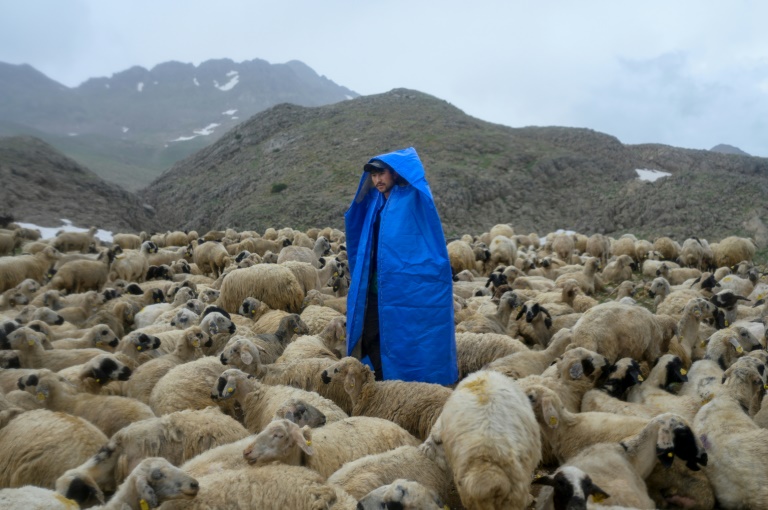
In Turkish mountains so high the silver clouds almost touch the top of his head, the homesick Afghan shepherd prepares his baaing flock for a good shear.

The pebbly valley around him was once full of Kurds, who staged a violently suppressed rebellion in Tunceli in the early years of the modern Turkish state.

But the Kurds in the eastern Mercan Valley have been gradually replaced by Afghans, who fled here by foot and truck across Iran from the poverty and bloodshed back home.

Now, with two decades of conflict behind them, some are thinking of going back, no matter the resurgent Taliban’s hardline rule.

“Nobody would leave their country unless they had to,” says Hafiz Hasimi Meymene, a 20-year-old with a fiancee impatiently waiting for him in Afghanistan.

“We come here, make money through shepherding, and send it to our families,” he says.

A handful of nylon tents are tied down to the hard ground around him, the Afghan families’ new homes.

A few men crouch in a shed, milking their sheep and goats. Their friend ushers the flock into in a pen with a whack of a slender stick.

– Mixed emotions –

“Next year, I will return to Afghanistan. The war is over,” Meymene says.

“When the (Afghan) state was fighting the Taliban, the economy was hit hard. But now we are planning to return.”

President Recep Tayyip Erdogan estimates that 300,000 Afghans now live in Turkey, which also hosts 3.7 million people from war-ravaged Syria.

Tunceli native Mustafa Acun says the locals have grown used to Afghans taking care of their herds.

The 67-year-old works alongside them, making cheese and yoghurt from sheep’s milk.

“I mean, our children either cannot or do not want to do this job,” he says looking up from his stool, tending to some steaming pots over an open flame.

It is surprisingly dangerous work.

– ‘Love the mountains’ –

An old rifle hangs off one of the men’s shoulders, the better to shoot the wolves and bears that come out hunting at night.

This is also a good time to graze the sheep, which suffer in the baking sun.

The rifle did not keep two of Abudullah Umari’s animals from being torn apart and eaten by a bear the other week.

“I take care of the flock like this,” the 55-year-old Afghan said, the rifle casually swinging behind his back.

“I have been here for seven years. I worked for three years and returned to Afghanistan. But then I decided to come here again,” he recalls, glossing over the pain and danger of each voyage.

“God willing, if my health allows, I will go back to Afghanistan in August,” when the summer heat begins to subside.

But although 29-year-old Suleyman Ezam had not seen his Afghan wife and two little children for four years, says he will miss working as a shepherd in the Turkish mountains with his dogs.

“I love the mountains,” Ezam says after showing a photograph of his four-year-old daughter on his phone. “The mountains of Turkey are so beautiful.”

Covid air war being lost, experts warn, urging mass ventilation

The world is still not using one of its most effective weapons against Covid — properly ventilating public spaces — more than two years into the pandemic, experts warn.

At the moment there is a “fragile, armed peace” with Covid-19, said Antoine Flahault, director of the Institute of Global Health at the University of Geneva.

“In the hopes of stemming the tide of the pandemic and reducing mortality, we need to reduce the level of contamination, which the vaccine cannot do alone,” he told AFP.

“We need a new phase — improving the quality of indoor air.” 

Covid-19 is primarily transmitted through the air. It is carried in large droplets or fine aerosols when an infected person breathes — and even more so when they talk, sing or shout.

In a closed off or poorly ventilated room, these aerosols can remain in the air for some time, moving around the space and greatly increasing the risk of infection.

While it is generally accepted that Covid can be transmitted within two metres (6.5 feet) via both droplets and aerosols, there is still no consensus on the importance of long-distance airborne transmission indoors.

A team of researchers from the UK Health Security Agency and the University of Bristol reviewed 18 studies in several countries on airborne transmission. 

In research published in the BMJ this week, they found that people can infect each other when they are more than two metres apart.

– Open that window – 

We know one thing for sure: if you open a window, or well-ventilate a space, the virus-carrying aerosols dissipate like smoke.

But experts say that nowhere near enough is being done to ventilate public and private spaces across the world.

“On the whole, this is an issue that governments have not yet taken up,” Flahault said.

He called for massively increased funding to ventilate many public spaces, starting with schools, hospitals, public transport, offices, bars and restaurants. 

“Just as we knew to filter and treat drinking water” in homes at the beginning of the 1900s, “one can imagine some households will equip themselves with air purifiers and consider opening their windows,” Flahault said.

Only a few countries have announced ventilation plans since the start of the pandemic.

In March the US government called on all building owners and operators, as well as schools and universities, to “adopt key strategies to improve indoor air quality”.

The plan, dubbed the Clean Air in Buildings Challenge, is covered by previously announced Covid funding and also includes a review of existing ventilation, heating and air conditioning systems.  

The European Union has not issued any binding statements on improving air quality in light of Covid.

However Belgium has announced a plan to have a carbon dioxide meter situated in all places open to the public. Having such a meter is voluntary until the end of 2024, when it becomes mandatory.

Stephen Griffin of the School of Medicine at Britain’s University of Leeds lamented that the UK had not acted more on ventilation.

“Sadly, the UK has not embraced the opportunity to safeguard its citizens in public spaces, its children in schools, or the longevity of the vaccination programme in this way,” he told the Science Media Centre.

He said that setting minimum safety standards for ventilation in public buildings would also “greatly mitigate the impact of other diseases”.

“Better ventilation also improves cognition by reducing carbon dioxide levels and, along with filtration, can reduce the impact of pollen and other allergies.”

Independent Algeria turns 60, but colonial-era wounds remain

Algeria marks 60 years of independence from France on Tuesday, but rival narratives over atrocities committed during more than a century of colonial rule still trigger bitter diplomatic tensions.

The North African country won its independence following a gruelling eight-year war which ended with the signing in March 1962 of the Evian Accords.

On July 5 of the same year, days after 99.72 percent voted for independence in a referendum, Algeria finally broke free from colonial rule — but memories of the 132-year occupation continue to mar its ties with France.

The country’s authorities are planning to mark the anniversary with pomp and ceremony, capped by a vast military parade in Algiers, the first of its kind in 33 years.

A show is also planned at the capital’s opera house that “retraces the long history of Algeria”, said the minister for independence fighters, Laid Rebiga.

The government has even commissioned a logo — a circle of 60 stars containing military figures and equipment — to mark “a glorious history and a new era”.

Algeria’s war of independence left hundreds of thousands of dead and, despite a string of gestures by French President Emmanuel Macron, a crisis late last year underlined how spiky the issue remains six decades on.

Macron reportedly questioned whether Algeria had existed as a nation before the French invasion and accused its “political-military system” of rewriting history and fomenting “hatred towards France”.

Algeria withdrew its ambassador in response.

“Relations between the power system in Algeria and ‘official France’ have been punctuated by crises and pseudo-reconciliations since independence,” said Athmane Mazouz, head of Algeria’s secularist opposition party RCD.

“At this point, all bets are off on whether they can establish better ties.” 

– ‘Take heat out of debate’ –

France has ruled out any form of apology for the colonial period. But Macron has also made a number of gestures aimed at mending ties with the former colony. 

Visiting Algiers during his first presidential campaign in February 2017, he described colonisation as a “crime against humanity”.

He has since acknowledged the French army was behind the death of Algerian nationalist lawyer Ali Boumendjel and anti-colonialist French mathematician Maurice Audin.

France has returned the skulls of 19th century Algerian resistance fighters and opened state archives on the Algerian war.

And the two sides appear to have moved on from the latest crisis. Macron and his Algerian counterpart Abdelmadjid Tebboune confirmed in a June 18 phone call their desire to “deepen” relations.

Tebboune even congratulated Macron on his “brilliant” re-election and invited him to visit Algeria.

Historian Amar Mohand-Amer said it was time for “a quick return to a normal situation”.

“Sixty years after independence, isn’t it time we took the heat out of this debate?”

– ‘Unstable geopolitics’ –

Mohand-Amer pointed out that the anniversary celebrations come at a time of raised tensions in the wider region around Algeria.

The country cut ties with regional arch-rival Morocco last August, accusing it of “hostile acts”.

In early June, Algiers suspended a two-decade-old cooperation pact with Madrid after Spain backed Morocco’s stance in the long-running dispute over Western Sahara.

To the east, in war-scarred Libya, the emergence of two rival governments has raised fears of a return to armed conflict after a two-year truce.

And to the south, Mali is in crisis after army officers, disgruntled at the government’s failure to roll back a jihadist uprising, ousted president Ibrahim Boubacar Keita in 2020.

“The very unstable regional geopolitics demand strong positions in the mid to long term and the consolidation of political and economic relations” between Algeria and France, Mohand-Amer said.

But the historian fears that Macron’s move towards reconciliation could face a major test due to gains by extreme right leader Marine Le Pen’s party the Rassemblement National in June elections.

Le Pen said in March that colonialism had “contributed to Algeria’s development” and accused Macron of “spending his life apologising without asking anything in return from an Algerian government that continues to insult France”.

Mohand-Amer warned that “the French far right will transform this mandate into a big battlefield of memories, where revisionism and the falsification of history will be omnipresent.”

Protesters rally in Spain, Morocco over migrant deaths

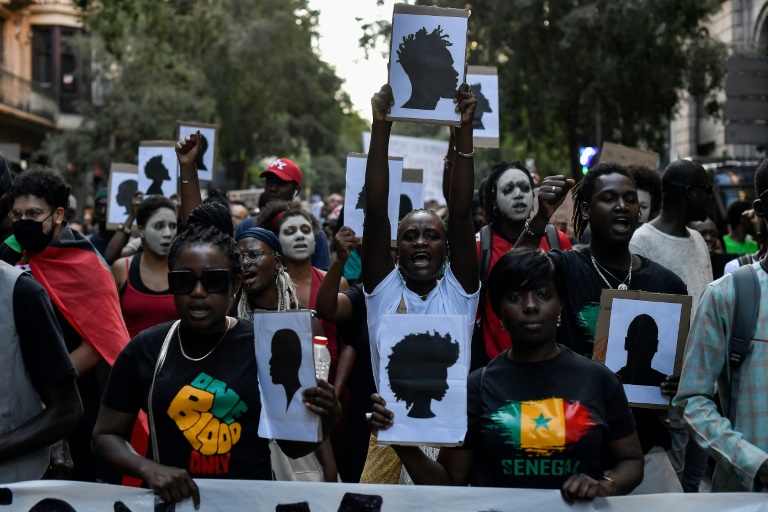
Demonstrators held rallies in several Spanish cities and in Rabat late Friday to protest over the deaths of 23 African migrants who died in a crush trying to enter the Spanish enclave of Melilla in northern Morocco.

Thousands of protesters gathered in Barcelona, Malaga, Vigo and San Sebastian and in Melilla itself to denounce migration policies and the “militarisation of borders”.

In the Moroccan capital, a few dozen representatives of the Collective of Sub-Saharan Communities in Morocco and associations helping migrants demonstrated in front of parliament calling for Rabat to “stop playing the role of EU policeman”.

“We demand an end to the migration policy funded by the European Union, the opening of an independent investigation and the return of the bodies to the families,” activist Mamadou Diallo told AFP. 

“The Europeans colonised us and took everything from us to develop. Today, if we go to them, it means that we have the right to leave,” he said.

Moroccan prosecutors have initiated proceedings against 65 migrants, mostly Sudanese, accused of having taken part in the mass attempt to enter Melilla from Morocco a week ago. 

At least 23 migrants died when around 2,000, mostly from sub-Saharan Africa, tried to break through the fence into the Spanish enclave, according to Moroccan authorities, while NGOs say at least 37 lost their lives.

The death toll was by far the worst recorded in years of attempts by migrants to cross into Spain’s Ceuta and Melilla enclaves, which have the EU’s only land borders with Africa, making them a magnet for those desperate to escape grinding poverty and hunger.

– ‘Borders kill’ –

The tragedy has provoked international indignation, including an unusually strong response from the United Nations, and the opening of investigations by Spain and Morocco.

In Madrid, several hundred people took up the slogans of the “Black Lives Matter” movement and chanted “No human being is illegal!” and held up signs that read: “Borders kill.”

“This country makes me ashamed,” said Carmen Reco, 77, attending the protest after this “injustice which resulted in the murder of migrants because they were trying to enter Spain”.

Renzo Rupay, who works in transport, said he was shocked by “the images of the border”.

“I too am a migrant, arrived with a child’s travel papers. Not everyone has the possibility of arriving legally in Spain,” the 28-year-old said.

“It’s not normal that so many people die. We’re talking about human lives, people fleeing war and we kill them at the border,” said Eva Ruiz, a 24-year-old student.

According to Rabat, the victims died “in jostling and falling” from the top of the metal gate that separates Morocco from Melilla during an attempt to storm the border “marked by the use of very violent methods on the part of migrants”. 

But images quickly emerged that “show bodies strewn on the ground in pools of blood, Moroccan security forces kicking and beating people, and Spanish Guardia Civil launching teargas at men clinging to fences,” according to Human Rights Watch.

The migrant rush in Melilla came after Madrid and Rabat normalised their diplomatic relations following an almost year-long crisis centred on the disputed Western Sahara territory.

For Spain, the main objective of the diplomatic thaw was to ensure Morocco’s cooperation in controlling illegal immigration.

Libyan protesters storm parliament building in Tobruk

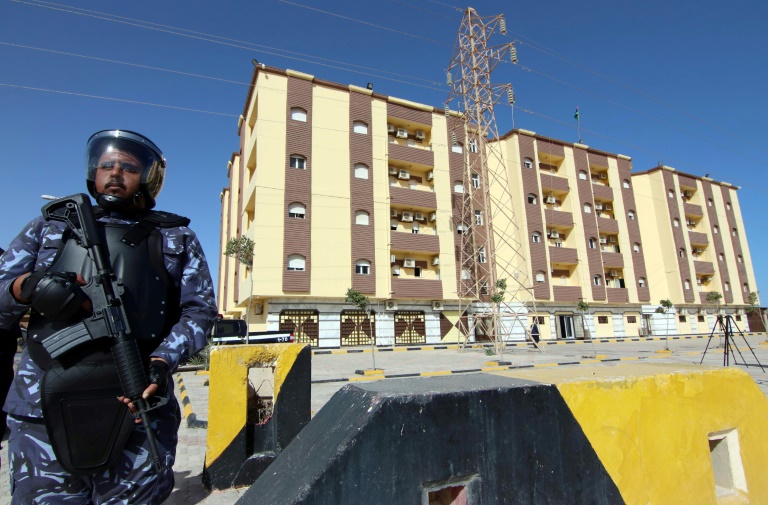
Protesters stormed Libya’s parliament building in the eastern city of Tobruk on Friday, demonstrating against deteriorating living conditions and political deadlock, Libyan media reported.

Several television channels said that protesters had managed to penetrate the building and committed acts of vandalism, while media outlets showed images of thick columns of black smoke coming from its perimeter as angry young demonstrators burned tyres.

Other media reports said part of the building had been burned.

The parliament building was empty, as Friday falls on the weekend in Libya.

Libya’s parliament, or House of Representatives, has been based in Tobruk, hundreds of kilometres (miles) east of the capital Tripoli, since an east-west schism in 2014 following the revolt that toppled dictator Moamer Kadhafi three years earlier.

A rival body, formally known as the High Council of State, is based in Tripoli.

Images Friday showed that a protester driving a bulldozer had managed to smash through part of a gate, allowing other demonstrators to enter more easily, while cars of officials were set on fire.

Later, protesters began to break through the building’s walls with construction equipment.

Others, some brandishing the green flags of the Kadhafi regime, threw office documents into the air.

While recognising “the right of citizens to demonstrate peacefully”, parliament condemned “acts of vandalism and the burning” of its headquarters.

The interim prime minister of the Tripoli-based government, Abdulhamid Dbeibah, said on Twitter that he would add his voice to those of the protesters and called for the holding of elections.

Libya has endured several days of power cuts, worsened by the blockade of several oil facilities against the backdrop of political rivalries.

“We want the lights to work,” protesters chanted.

– Talks fail to resolve stalemate –

Two governments have been vying for power for months: one based in Tripoli, led by Dbeibah, and another headed by former interior minister Fathi Bashagha, appointed by the parliament and supported by eastern-based strongman Khalifa Haftar.

“I call on my parliamentary colleagues as well as members of the High Council of State to collectively resign to respect the will of the Libyan people and preserve Libya’s stability,” lawmaker Ziad Dgheim, was quoted as saying by Libyan channel Al-Ahrar on Friday.

Lawmaker Balkheir Alshaab said: “We must recognise our failure and immediately withdraw from the political scene.”

Presidential and parliamentary elections, originally set for December last year, were meant to cap a UN-led peace process following the end of the last major round of violence in 2020. 

But the vote never took place due to several contentious candidacies and deep disagreements over the polls’ legal basis between rival power centres in the east and west.

The United Nations said Thursday that talks between the rival Libyan institutions aimed at breaking the deadlock had failed to resolve key differences.

Parliament speaker Aguila Saleh and High Council of State president Khaled al-Mishri met at the UN in Geneva for three days of talks to discuss a draft constitutional framework for elections.

While some progress was made, it was not enough to move forward towards elections, with the two sides still at odds over who can stand in presidential elections, said the UN’s top Libya envoy Stephanie Williams, who facilitated the talks.

– ‘Escalating quickly’ –

The prospect of elections appears as distant as ever since the HoR, elected in 2014, appointed Bashagha, arguing that Dbeibah’s mandate had expired.

After Bashagha failed to enter Tripoli in an armed standoff in May, the rival administration has taken up office further east in Sirte, Kadhafi’s hometown.

Recent weeks have seen repeated skirmishes between armed groups in Tripoli, prompting fears of a return to full-scale conflict.

Protests took place in other Libyan cities on Friday including Tripoli, where protesters held images of Dbeibah and Bashagha crossed out.

“Popular protests have erupted across Libya in exasperation at a collapsing quality of life, the entire political class who manufactured it, and the UN who indulged them over delivering promised change,” tweeted analyst Tarek Megerisi of the European Council on Foreign Relations.

“Things are escalating quickly and the response will define Libya’s summer,” he added. 

Libya’s National Oil Corporation said Monday that a blockade at oil installations in the central coastal region of Sirte meant it may declare force majeur, a measure freeing it of contractual obligations due to circumstances beyond its control.

A blockade of two major oil export terminals and several oilfields began in April.

Eastern-based strongman Haftar’s forces control major oil facilities.

A drop in gas production contributed to chronic power cuts, which can last around 12 hours a day. 

Google to delete user location history on US abortion clinic visits

Google announced Friday it would delete users’ location history when they visit abortion clinics, domestic violence shelters and other places where privacy is sought.

“If our systems identify that someone has visited one of these places, we will delete these entries from Location History soon after they visit,” Jen Fitzpatrick, a senior vice president at Google, wrote in a blog post. “This change will take effect in the coming weeks.” 

Other places from which Google will not store location data include fertility centers, addiction treatment facilities, and weight loss clinics.

The announcement comes a week after the US Supreme Court made the tectonic decision to strip American women of constitutional rights to abortion, leading a dozen states to ban or severely restrict the procedure and prompting mass protests across the country.

Activists and politicians have been calling on Google and other tech giants to limit the amount of information they collect to avoid it being used by law enforcement for abortion investigations and prosecutions.

Fitzpatrick also sought to reassure users that the company takes data privacy seriously.

“Google has a long track record of pushing back on overly broad demands from law enforcement, including objecting to some demands entirely,” she wrote. 

“We take into account the privacy and security expectations of people using our products, and we notify people when we comply with government demands.”

Concerns over smartphone data and reproductive rights arose even before the Supreme Court ruling, when several conservative US states in recent months passed laws that give members of the public the right to sue doctors who perform abortions — or anyone who helps facilitate them.

That led a group of top Democratic lawmakers in May to send a letter to Google chief executive Sundar Pichai, asking him to stop collecting smartphone location data lest it become “a tool for far-right extremists looking to crack down on people seeking reproductive health care.”

Waterways in Brazil's Manaus choked by tons of trash

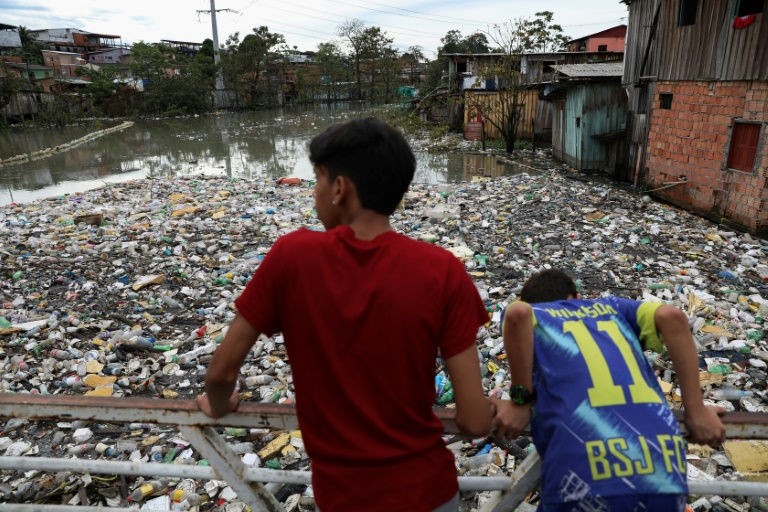
In Manaus, the largest city in Brazil’s Amazon rainforest, tons of stinking trash fill the canals and streams, giving one the feeling that they’re visiting a post-apocalyptic wasteland.

On the west side of the city, in a poor neighborhood where homes have been erected on stilts, a worker uses an excavator to scoop up a bucket-load of bottles, pieces of plastic and even home appliances that have been tossed in the water.  

Not far from the city’s main port, municipal workers wearing orange uniforms gather garbage from a boat and pile it onto a big barge floating on the Rio Negro, one of the Amazon River’s main tributaries.

With the rising water levels signaling an end to the rainy season, the mounds of trash are often intermingled with leaves and tree branches.

Each day, nearly 30 tonnes of debris is plucked from the water. In some areas, the water is almost completely covered.

The massive influx of trash to Manaus’s waterways occurs around this time every year, but city authorities believe the situation has gotten worse in recent weeks.

From January to May, city workers have removed 4,500 tonnes of trash, most of which could have been recycled instead of being thrown in the river.

“The people who live on the water’s edge throw garbage straight into the streams… few people put it in the trash,” says Antonino Pereira, a 54-year-old Manaus resident who complains that the stench is unbearable.

According to the city’s undersecretary of sanitation, Jose Reboucas, if the population was more aware of the costs associated with littering, the city could save one million reais (about $190,000) per month.

“The awareness of the population will be very beneficial for our city and especially for our environment,” he told AFP.

The Amazonian region is also facing a major threat from deforestation, with more than 3,750 square kilometers (1,450 square miles) of jungle chopped down since the beginning of the year.

Kerry vows US to meet climate goal despite court setback

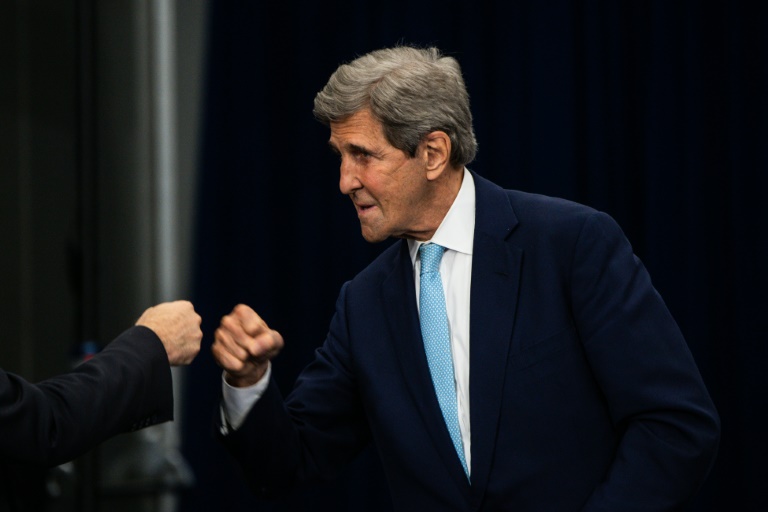
US climate envoy John Kerry vowed Friday the United States will meet goals it submitted to the United Nations on slashing greenhouse gas emissions, despite a Supreme Court ruling that curtailed the government’s powers.

“We are determined to achieve our goals. We can achieve our goals,” Kerry told AFP.

“But obviously it would help if we had a majority of the Supreme Court in the United States of America that actually understood the gravity of the situation and was more willing to try to be helpful rather than present a hurdle of one kind or another,” he said.

President Joe Biden, after defeating the climate-skeptic Donald Trump, in April last year said the United States would reduce greenhouse gas emissions by 50 to 52 percent by 2030 from 2005 levels, dramatically increasing the climate ambitions of the world’s largest economy.

He submitted the so-called nationally determined contribution to the UN climate body in line with the 2015 Paris Agreement, the landmark deal brokered by Kerry when he was secretary of state.

China, the world’s largest carbon emitter, called Friday on all nations to live up to Paris commitments, with foreign ministry spokesman Zhao Lijian saying of the United States, “it is not enough to just chant slogans.”

Kerry, who has worked with Chinese officials in his climate role despite soaring tensions between Beijing and Washington, said that he was “not surprised by the messaging” from the Asian power.

“We will show China precisely how we’re going to get the job done,” Kerry said.

Stephane Dujarric, the spokesman for UN Secretary-General Antonio Guterres, called the Supreme Court decision “a setback in our fight against climate change.”

– Biden proposes drilling –

Despite Biden’s pledges to wean the United States off fossil fuels, the Interior Department on Friday released a five-year proposal that would authorize offshore oil and gas drilling in federal waters in the Gulf of Mexico and Alaska, although it would still ban drilling in the Atlantic and Pacific Oceans.

The proposal comes amid soaring gas prices and as Biden seeks to woo Senator Joe Manchin, a Democrat from coal-producing West Virginia with the crucial vote, to back a package that would also boost clean energy. 

Environmentalists see the legislation as a last hope amid expectations that Trump’s Republican Party will make advances in November congressional elections.

The Supreme Court, finishing a term in which three justices nominated by Trump pushed it sharply to the right, on Thursday cut the wings off a key way in which the government could have tackled climate change without fresh legislation.

In a 6-3 ruling branded “devastating” by Biden, the top court said the Environmental Protection Agency did not have authority to order sweeping cuts on emissions from coal-fired power plants.

“I am convinced — and our legal people are looking at it very carefully — that this decision leaves plenty of latitude for us to be able to do a lot of things that we need to do,” Kerry said.

Asked about calls by some lawmakers from his Democratic Party for Biden to declare a climate emergency, Kerry said, “I think the president needs to evaluate every option available.”

– ‘Pin into balloon’ –

Coal accounts for around 20 percent of US electricity generation — still roughly on par with renewables. China, despite investing heavily in wind and solar, has also kept building coal production capacity.

But Kerry said that the marketplace showed that coal was not the future.

“Nobody’s going to fund any new coal power in the United States — no bank, no private lender. Coal is the dirtiest fuel in the world,” he said.

Scientists warn that the world is far off track in avoiding the worst ravages of climate change including severe heatwaves, floods, droughts, rising sea levels and storm surges. 

The Paris accord set the goal of limiting end-of-century warming to two degrees Celsius (3.6 Fahrenheit) above pre-industrial levels — and preferably not beyond 1.5 degrees — but the planet has already warmed by nearly 1.2 Celsius.

Ruth Greenspan Bell, a climate expert at the Woodrow Wilson International Center for Scholars, said it was difficult for the United States to show climate leadership while also fighting internally on whether it is a priority.

“It’s kind of putting a pin into a balloon. There’s a little bit less air in the balloon than there was before,” she said of the court decision. 

“The times call for a moonshot but imagine trying to pull off a moonshot when you are at the same time in a defensive crouch.”

Kerry vows US to meet climate goal despite court setback

US climate envoy John Kerry vowed Friday the United States will meet goals it submitted to the United Nations on slashing greenhouse gas emissions, despite a Supreme Court ruling that curtailed the government’s powers.

“We are determined to achieve our goals. We can achieve our goals,” Kerry told AFP.

“But obviously it would help if we had a majority of the Supreme Court in the United States of America that actually understood the gravity of the situation and was more willing to try to be helpful rather than present a hurdle of one kind or another,” he said.

President Joe Biden, after defeating the climate-skeptic Donald Trump, in April last year said the United States would reduce greenhouse gas emissions by 50 to 52 percent by 2030 from 2005 levels, dramatically increasing the climate ambitions of the world’s largest economy.

He submitted the so-called nationally determined contribution to the UN climate body in line with the 2015 Paris Agreement, the landmark deal brokered by Kerry when he was secretary of state.

China, the world’s largest carbon emitter, called Friday on all nations to live up to Paris commitments, with foreign ministry spokesman Zhao Lijian saying of the United States, “it is not enough to just chant slogans.”

Kerry, who has worked with Chinese officials in his climate role despite soaring tensions between Beijing and Washington, said that he was “not surprised by the messaging” from the Asian power.

“We will show China precisely how we’re going to get the job done,” Kerry said.

Stephane Dujarric, the spokesman for UN Secretary-General Antonio Guterres, called the Supreme Court decision “a setback in our fight against climate change.”

– Biden proposes drilling –

Despite Biden’s pledges to wean the United States off fossil fuels, the Interior Department on Friday released a five-year proposal that would authorize offshore oil and gas drilling in federal waters in the Gulf of Mexico and Alaska, although it would still ban drilling in the Atlantic and Pacific Oceans.

The proposal comes amid soaring gas prices and as Biden seeks to woo Senator Joe Manchin, a Democrat from coal-producing West Virginia with the crucial vote, to back a package that would also boost clean energy. 

Environmentalists see the legislation as a last hope amid expectations that Trump’s Republican Party will make advances in November congressional elections.

The Supreme Court, finishing a term in which three justices nominated by Trump pushed it sharply to the right, on Thursday cut the wings off a key way in which the government could have tackled climate change without fresh legislation.

In a 6-3 ruling branded “devastating” by Biden, the top court said the Environmental Protection Agency did not have authority to order sweeping cuts on emissions from coal-fired power plants.

“I am convinced — and our legal people are looking at it very carefully — that this decision leaves plenty of latitude for us to be able to do a lot of things that we need to do,” Kerry said.

Asked about calls by some lawmakers from his Democratic Party for Biden to declare a climate emergency, Kerry said, “I think the president needs to evaluate every option available.”

– ‘Pin into balloon’ –

Coal accounts for around 20 percent of US electricity generation — still roughly on par with renewables. China, despite investing heavily in wind and solar, has also kept building coal production capacity.

But Kerry said that the marketplace showed that coal was not the future.

“Nobody’s going to fund any new coal power in the United States — no bank, no private lender. Coal is the dirtiest fuel in the world,” he said.

Scientists warn that the world is far off track in avoiding the worst ravages of climate change including severe heatwaves, floods, droughts, rising sea levels and storm surges. 

The Paris accord set the goal of limiting end-of-century warming to two degrees Celsius (3.6 Fahrenheit) above pre-industrial levels — and preferably not beyond 1.5 degrees — but the planet has already warmed by nearly 1.2 Celsius.

Ruth Greenspan Bell, a climate expert at the Woodrow Wilson International Center for Scholars, said it was difficult for the United States to show climate leadership while also fighting internally on whether it is a priority.

“It’s kind of putting a pin into a balloon. There’s a little bit less air in the balloon than there was before,” she said of the court decision. 

“The times call for a moonshot but imagine trying to pull off a moonshot when you are at the same time in a defensive crouch.”

Close Bitnami banner
Bitnami