World

India's women water warriors transform parched lands

As the monsoon storms bear down on India, a dedicated group of women hope that after years of backbreaking labour, water shortages will no longer leave their village high and dry.

The world’s second-most populous country is struggling to meet the water needs of its 1.4 billion people — a problem worsening as climate change makes weather patterns more unpredictable. 

Few places have it tougher than Bundelkhand, a region south of the Taj Mahal, where scarce water supplies have pushed despairing farmers on the plains to give up their lands and take up precarious work in the cities. 

“Our elders say that this stream used to run full throughout the year, but now there is not a single drop,” said Babita Rajput while guiding AFP past a bone-dry fissure in the earth near her village.

“There is a water crisis in our area,” she added. “All our wells have dried up.”

Three years ago, Rajput joined Jal Saheli (“Friends of Water”), a volunteer network of around 1,000 women working across Bundelkhand to rehabilitate and revive disappeared water sources. 

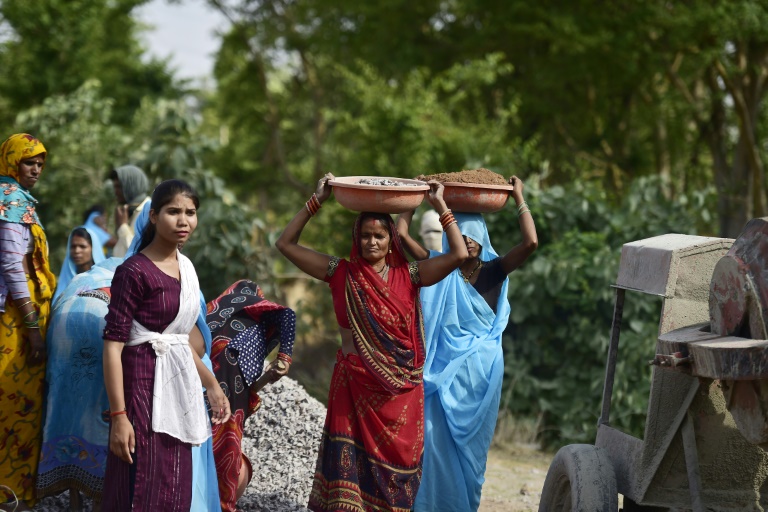
Together they carry rocks and mix concrete to build dams, ponds and embankments to catch the fruits of the June monsoon, a season which accounts for about 75 percent of India’s annual rainfall. 

Agrotha, where Rajput lives, is one of more than 300 villages where women are chalking out plans for new catchment sites, reservoirs and waterway revitalisations. 

Rajput said their work had helped them retain monsoon rainwater for longer and revive half a dozen water bodies around their village.

Though not yet self-sufficient, Agrotha’s residents are no longer among the roughly 600 million Indians that a government think-tank says face acute water shortages daily. 

The women’s efforts provide a rare glimmer of hope as national shortages worsen.

Water utilities in the capital New Delhi fail to meet demand in summer, with trucks regularly travelling into slums to supply residents unable to draw water from their taps.

India’s NITI Aayog public policy centre forecasts that around 40 percent of the country’s population could be without access to drinking water by the end of the decade.

– ‘Government has failed’ –

Erratic rainfall patterns and extreme heat have been linked to climate change in Bundelkhand, which has suffered several long dry spells since a drought was declared at the turn of the century.

Civil society activist Sanjay Singh helped train women in Agrotha to harvest and store rainwater after the surrounding land was desiccated by drought.

By doing so he helped the village rediscover knowledge that was lost decades earlier, when water went from being a community-managed resource to one administered by India’s government.  

“But government has failed to ensure water to every citizen, particularly in rural areas, pushing villagers to go back to the old practice,” he told AFP.

Before Agrotha’s irrigation project began, women had to walk miles every day in a desperate and often fruitless search for a well that was not dry.

In India’s villages, fetching water is traditionally the responsibility of women, several of whom have faced violence from their husbands after being unable to find enough for their households, Singh said.  

He added that drought had brought big social changes to the region, pushing men to move to cities and leave their families behind. 

But since it was founded in 2005, the Jal Saheli initiative has helped more than 110 villages become self-reliant for their water needs and aided in reversing the outward flow of people. 

– Dust bowl to oasis –

In the nearby Lalitpur district, the elderly Srikumar has seen the initiative transform her community from a dust bowl into an oasis.

She heard about the volunteer group a decade ago after suffering through years of water shortages, by the end of which every well and hand pump in her village of 500 people had run dry. 

Most of the farms in the area had turned barren because of a lack of irrigation, and dehydrated cattle herds were dying in summer temperatures close to 50 degrees Celsius (122 degrees Fahrenheit). 

“Villagers suffered a lot during those days,” Srikumar said. “Farming was impossible and men were fleeing their homes to cities to earn a living.”

With the help of Singh’s charity, Srikumar and a dozen other volunteers dug a football field-sized reservoir near the village that holds up to 10 feet (three metres) of water after the monsoon rains arrive.

The village now has enough water reserves to meet its needs year-round and replenish the earth that had dried out before their intervention.

“Things have changed for good. We have enough water now, not just for our homes but also for our cattle,” she told AFP. 

“Our lives would have been miserable without this pond,” she added. “It would have been very difficult to survive.”
Expanding NATO squares up to Russia as Putin slams 'imperial' alliance

The United States vowed to reinforce Europe’s defences in the wake of Russia’s invasion of Ukraine, as NATO declared Moscow the West’s greatest threat — prompting Vladimir Putin to lash out at the alliance’s “imperial ambitions”.

Meeting in Madrid Wednesday, NATO leaders said Russia “is the most significant and direct threat to allies’ security and to peace and stability in the Euro-Atlantic area”.

This came as NATO officially invited Sweden and Finland to join the alliance, and US President Joe Biden announced new deployments of US troops, ships and planes.

Biden said that the US move was exactly what Russian President Putin “didn’t want” — and Moscow, facing fierce resistance from Ukrainian forces equipped with Western arms, reacted with predictable fury.

Putin accused the alliance of seeking to assert its “supremacy”, telling journalists in the Turkmenistan capital of Ashgabat that Ukraine and its people are “a means” for NATO to “defend their own interests.”

“The NATO countries’ leaders wish to… assert their supremacy, their imperial ambitions,” the Russian president added.

NATO leaders have funnelled billions of dollars of arms to Ukraine and faced a renewed appeal from President Volodymyr Zelensky for more long-range artillery.

“Ukraine can count on us for as long as it takes,” NATO chief Jens Stoltenberg said at the summit, which ends Thursday, announcing a new strategic overview that focuses on the Moscow threat.

The document, updated for the first time since 2010, warned that the alliance “cannot discount the possibility” of an attack on its members.

– ‘No problem’ –

“Today in Madrid, NATO proved it can take difficult but essential decisions. We welcome a clear-eyed stance on Russia, as well as the accession for Finland and Sweden,” Ukraine’s foreign minister Dmytro Kuleba said. 

But Putin dismissed NATO’s invites to Finland and Sweden, which abandoned decades of military non-alignment in response to the invasion, as “no problem”.

Russian missiles continued to rain down across Ukraine. Zelensky said that a missile strike on the southern city of Mykolaiv destroyed a five-storey building, killing at least five people. 

The city of Lysychansk in the eastern Donbas region — the current focus of Russia’s offensive — was also facing sustained bombardment.

The frequency of the shelling there is “enormous,” the regional governor of Lugansk, Sergiy Gaiday, said in televised comments Wednesday, adding that the evacuation of some 15,000 civilians still in the city “might be dangerous at the moment.”

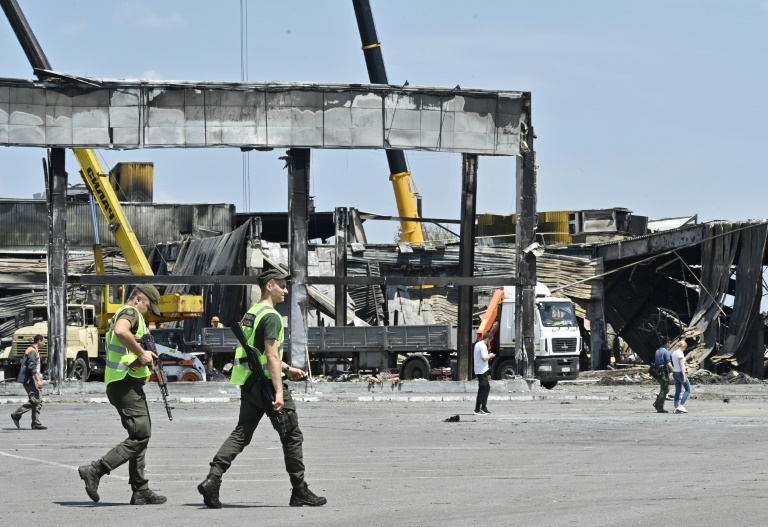
In Kremenchuk, the town where a Russian missile on Monday destroyed a shopping centre and killed at least 18 civilians, clearing operations continued.

A giant crane was working near the site of impact, and in the rubble-strewn parking area shopping trolleys piled with clothes and household goods lay abandoned.

At a hospital in the city, some of the wounded recalled the moment of the attack.  

“We didn’t hear the sound of the missile hit — a sudden clap, flash, and we got blown away,” said Petr Ozhereliev, an employee at the mall.

“I guess I lost consciousness, because when I woke up I was crawling out of the rubble.”

Western leaders have dubbed the Kremenchuk strike a war crime. Russia says it hit a depot storing Western arms, and Putin on Wednesday denied Moscow’s forces were responsible for the attack.

Meanwhile, Ukrainian officials said that 144 of their soldiers, most of them former defenders of the Azovstal steelworks in the southern port city of Mariupol, had been freed in a prisoner swap with Moscow.

– Theatre strike ‘war crime’ –

Moscow’s invasion triggered massive economic sanctions and a wave of support for Zelensky’s government, including deliveries of advanced weapons, as well as the reinforcement of Europe’s defences.

Washington has announced that it will shift the headquarters of its 5th Army Corps to Poland.

An army brigade will rotate in and out of Romania, two squadrons of F-35 fighters will deploy to Britain, US air defence systems will be sent to Germany and Italy, and the fleet of US Navy destroyers in Spain will grow from four to six.

Britain also pledged another $1.2 billion in military aid for Ukraine on Wednesday, including air defence systems and drones.

In a report released Thursday, Amnesty International said a theatre sheltering civilians destroyed in March in the besieged city of Mariupol was likely hit by a Russian airstrike in a war crime.

“Until now, we were speaking about an alleged war crime. Now we can clearly say it was one, committed by the Russian armed forces,” Oksana Pokalchuk, head of Amnesty’s Ukraine branch, told AFP.

Nevertheless, the group also found the death toll may have been smaller than initially believed. Amnesty believes at least a dozen people died in the attack although it is likely many additional fatalities remain unreported. 

Mariupol city authorities had provided an initial estimate of around 300 deaths.

burs-sr/ssy

Japan's Kirin offloads Myanmar beer business over coup

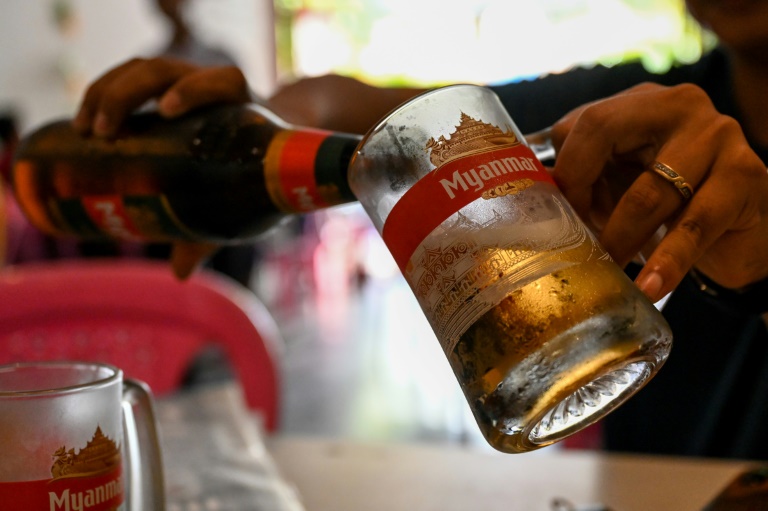
Japanese drinks giant Kirin said Thursday it has agreed to a buyout of its shares in a Myanmar joint venture with a junta-linked conglomerate, completing its exit from the market over the 2021 coup.

Days after the putsch in February 2021, Kirin announced it would end its joint venture Myanmar Brewery with the junta-linked MEHPCL, saying it was “deeply concerned by the recent actions of the military in Myanmar”.

But it struggled to disentangle itself from the secretive conglomerate and contested a bid by MEHPCL to dissolve the joint venture as it feared liquidation proceedings would not be fair.

Kirin said Thursday that a share buyback agreement worth about 22.4 billion yen ($164 billion) had been reached to transfer its 51 percent stake back into the subsidiary, ending the joint venture.

“We are relieved to settle this matter within the announced deadline by the most appropriate means among several options,” Yoshinori Isozaki, Kirin’s president and CEO, said in a statement.

According to figures published by Kirin in 2018, Myanmar Brewery — whose beverages include the ubiquitous Myanmar Beer brand — boasted a market share of nearly 80 percent.

But Kirin had been under pressure even before the coup over its ties to the military, and launched an investigation after rights groups called for transparency into whether money from its joint venture had funded rights abuses.

Investors piled into Myanmar after the military relaxed its iron grip in 2011, paving the way for democratic reforms and economic liberalisation.

They poured money into telecoms, infrastructure, manufacturing and construction projects — before the coup upended the democratic interlude and damaged the economy.

But a raft of foreign companies have exited the market since the military seized power from Aung San Suu Kyi’s government, including oil giants TotalEnergies and Chevron and Norwegian telecoms operator Telenor.

Kirin’s Myanmar business generated 32.6 billion yen ($240 million at today’s rates) in revenue in 2019-20, less than two percent of the firm’s annual sales.

Services, manufacturing rebound in China after Covid curbs eased

China’s factory and services activity picked up in June, official data showed Thursday, fuelled by the easing of Covid-19 restrictions in major cities such as Shanghai and Beijing.

The non-manufacturing Purchasing Managers’ Index (PMI), a key gauge of activity in the world’s second-biggest economy, defied expectations and surged to 54.7 points in June after three months of sluggish performance.

It was the first time since February that the reading was above the 50-point mark separating growth from contraction. It sat at 47.8 in May.

“As the situation of domestic epidemic prevention and control continued to improve and a package of policies… to stabilise the economy was implemented at a quicker pace, the overall recovery of our country’s economy has accelerated,” National Bureau of Statistics (NBS) senior statistician Zhao Qinghe said in a statement.

In particular, business activity in industries severely hit by the pandemic such as rail and air transport picked up in June, the statement said.

Construction activity also helped fuel the PMI boost.

But the “surprisingly rapid recovery in services” likely reflects a one-off boost from reopening, said Julian Evans-Pritchard, senior China economist at Capital Economics.

Manufacturing PMI rose to 50.2 points in June — similar to analyst expectations — up from 49.6 in May.

As work resumed after Covid lockdowns, production and demand in the sector picked up and delivery times improved, according to the NBS.

China is the only major economy still pursuing a zero-Covid approach of eliminating outbreaks as they emerge, using snap lockdowns and mass testing.

While the country is shortening quarantine times for new international arrivals, President Xi Jinping warned this week that China “would have faced unimaginable consequences” had it adopted a herd immunity or hands-off approach, signalling the government would persist with its current policy.

The approach has taken a harsh toll on the economy, with shops and factories forced to stop operations and supply chains strained.

The non-manufacturing rebound in June was “mainly due to more construction activity”, said Iris Pang, chief economist for Greater China at ING.

“We think that it will be challenging for the government to achieve the 5.5 percent GDP target set in March. There will need to be a lot more infrastructure activity if the government is to achieve this target.”

Ecuador government, protesters to restart talks amid state of emergency

The Ecuadoran government said late Wednesday it would restart talks with Indigenous-led protesters, mediated by the Catholic Church, as a fresh state of emergency was issued more than two weeks into disruptive and often violent daily rallies against rising living costs.  

To “return peace to the Ecuadoran people, we have decided to accept the mediation now offered by the Episcopal Conference of Ecuador (CEE),” government minister Francisco Jimenez said. 

Without revealing when the talks might begin, Jimenez said the CEE would arrange the details of the negotiations, “so that we can arrive at a final solution in this conflict.” 

Discussions to end the protests that have rocked the South American country were suspended Tuesday — on what would have been their second day — after the government blamed the death of a soldier on demonstrators.  

And as protesters took to the streets again Wednesday, President Guillermo Lasso declared a state of emergency in four of the 24 provinces where the “most violence is concentrated.”

The state of emergency did not include the capital, where most of an estimated 14,000 protesters have congregated.

Chanting “We don’t want 10 cents, we want results,” a reference to fuel price concessions offered by the government, several hundred people demonstrated in the city center, which was blocked off by police, metal fencing and razor wire.

A protester with a traditional red poncho leading a group of men with makeshift shields addressed the rest by megaphone: “If we need to sleep here… we will.” 

Lasso has imposed a month-long state of emergency on the provinces of Azuay, Imbabura, Sucumbios and Orellana, the general secretary of presidential communication said.

The aim is to create a “security zone” — enforced by military and police and where demonstrations are banned — around the country’s oil wells and to protect food, medicine and fuel supplies in those provinces as well as oxygen used in hospitals.

Lasso on Saturday lifted a previous state of emergency in six other provinces — including Pichincha, where the capital lies — in one of several concessions to protesters.

– Country held ‘hostage’ –

The government had called off talks after the military said Tuesday that a soldier died and five police and seven soldiers were injured in an attack by demonstrators on a tanker truck escort in the country’s east. 

Lasso, hours before surviving an impeachment vote, then accused Conaie leader Leonidas Iza of self-serving politics and vowed “we will not negotiate with those who hold Ecuador hostage.” 

It was the powerful Confederation of Indigenous Nationalities of Ecuador (Conaie) — credited with unseating three presidents between 1997 and 2005 — that called the protests. 

But government minister Jimenez struck a different tone Wednesday evening in announcing a return to negotiations.

“The goal of the national government is firstly to guarantee peace to Ecuadorans, and in pursuit of that standard, we will not abandon efforts that allow us to arrive at that long-awaited peace,” he said.

The protests, which began on June 13, have been costly, with losses of some $50 million per day to the economy, according to the government, which has warned oil production — already halved — could come to a complete halt soon. 

The nationwide show of discontent over deepening hardship comes in an economy dealt a serious blow by the coronavirus pandemic.  

Indigenous people make up more than a million of the South American nation’s 17.7 million inhabitants.  

The protesters want fuel price cuts, jobs, food price controls and more public spending on health care and education.   

Over the weekend, Lasso announced other concessions in a bid to unlock talks, including a 10-cents-per-gallon cut in diesel and gasoline prices to $1.80 and $2.45, respectively.

That received short shrift from protesters, who want a reduction to $1.50 for diesel and $2.10 for gasoline. 

Five demonstrators have died and hundreds on both sides have been wounded in clashes between the security forces and protesters blockading roads and disrupting supply lines. 

Some 150 people have been arrested, according to observers. 

Asian markets mostly down but China data offers some light

Most Asian markets fell again Thursday as traders fear that hefty rate hikes to rein in soaring inflation will spark a recession, though a slight improvement in Chinese data did provide some cheer.

The rally enjoyed across the world last week appears to have given way to nervousness about the economic outlook, while the Ukraine war continues to sow uncertainty.

The surge in inflation to multi-decade highs has forced central banks to swiftly tighten pandemic-era monetary policies, dealing a hefty blow to equities, particularly tech firms who are susceptible to higher borrowing costs.

The Federal Reserve has already sharply lifted rates and is expected to announce a second successive 75-basis-point lift next month.

There had been hope that policymakers would ease off their hikes as economies show signs of slowing, but analysts say some officials are less concerned about a recession than letting prices run out of control.

Fed boss Jerome Powell this month admitted the moves could lead to a contraction, suggesting he was not averse to it.

On Wednesday, Cleveland Fed chief Loretta Mester said was keen to see the benchmark rate hit 3-3.5 percent this year and “a little bit above four percent next year”.

“There are risks of recession,” she told CNBC. “We’re tightening monetary policy. My baseline forecast is for growth to be slower this year.”

The threat of an extended period of elevated inflation and rate hikes has left traders weary, and markets in the red.

While Wall Street ended on a tepid note Wednesday it was unable to bounce back from the previous day’s plunge.

And Asia also struggled, with Tokyo, Sydney, Seoul, Singapore, Taipei, Manila and Wellington all down.

– China support hope –

However, Hong Kong and Shanghai edged up. That came after official figures showed a forecast-beating improvement in China’s services sector thanks to the easing of painful Covid-19 restrictions in major cities including Shanghai and Beijing.

The non-manufacturing Purchasing Managers’ Index surged to 54.7 points in June, the first time it has been above the 50-point growth mark since February.

The manufacturing gauge hit 50.2, which was also its first time in growth since February and provided some hope that the world’s number two economy could be picking up after the pain caused by lockdowns.

“As the situation of domestic epidemic prevention and control continued to improve and a package of policies… to stabilise the economy was implemented at a quicker pace, the overall recovery of our country’s economy has accelerated,” National Bureau of Statistics statistician Zhao Qinghe said.

And SPI Asset Management strategist Stephen Innes added that the government and People’s Bank of China could now have some room to provide growth support.

“With (consumer price) inflation low in China relative to its peers, there is plenty of scope for monetary and fiscal conditions to loosen in the second half of the year, supporting activity,” he said in a note.

Crude fluctuated after dropping on Wednesday as data showed demand in the United States appeared to be softening even as the driving season gets under way, and as recession fears begin to kick in.

“The higher price environment appears to be doing its job when it comes to demand,” Warren Patterson, of ING Groep NV, said.

The drop comes as OPEC and other major producers including Russia prepare to meet on their output agreement, with most predicting they are unlikely to open the taps further.

“I am not expecting any surprises from the group. I would imagine it will be a fairly quick meeting,” Patterson said.

– Key figures at around 0300 GMT –

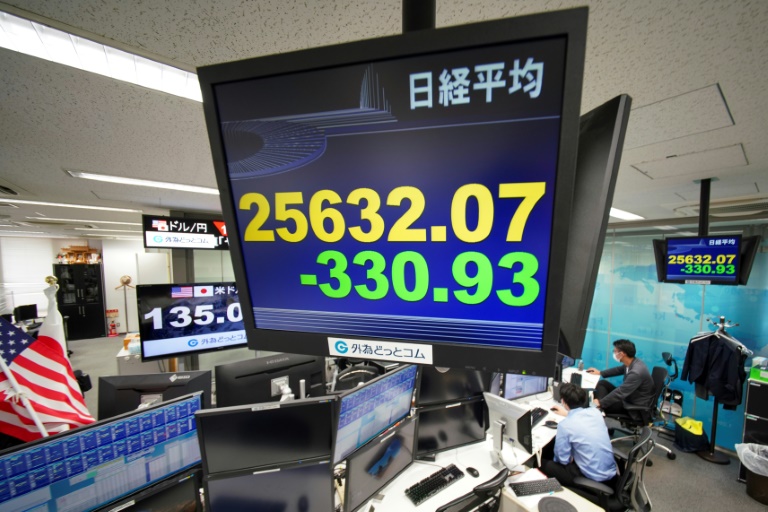
Tokyo – Nikkei 225: DOWN 0.9 percent at 26,561.05 (break)

Hong Kong – Hang Seng Index: UP 0.3 percent at 22,048.60

Shanghai – Composite: UP 0.8 percent at 3,387.96

West Texas Intermediate: UP 0.2 percent at $109.95 per barrel

Brent North Sea crude: DOWN 0.4 percent at $115.77 per barrel

Dollar/yen: DOWN at 136.56 yen from 136.66 yen Wednesday

Euro/dollar: UP at $1.0456 from $1.0444 

Pound/dollar: UP at $1.2139 from $1.2119

Euro/pound: DOWN at 86.13 pence from 86.15 pence

New York – Dow: UP 0.3 percent at 31,029.31 (close)

London – FTSE 100: DOWN 0.2 percent at 7,312.32 (close)

Maximum life term for sole surviving Paris 2015 attacker

The sole surviving member of an Islamic State terror cell that killed 130 people in Paris in November 2015 was handed a whole-life sentence on Wednesday at the end of a trial that aimed to draw a line under the worst peace-time atrocity in modern French history.

Salah Abdeslam, a 32-year-old Frenchman of Moroccan origin, was captured alive by police four months after the bloodbath at the Bataclan concert hall and other locations.

His sentence, the toughest possible, was read out by the head of a five-judge panel overseeing the trial of 20 men accused of involvement in the assault on the capital.

Wearing a khaki-coloured polo shirt, he stood motionless and showed no emotion as he was declared guilty and sentenced by chief judge Louis Peries during an hour-long speech.

“The sentences are quite heavy,” one tearful survivor, Sophie, told AFP as she left the court in central Paris. “I feel a lot of relief. Ten months of hearings — it’s helped us to rebuild.”

The trial has been the biggest in modern French history, the culmination of a six-year international investigation whose findings run to more than a million pages.

The other 19 suspects, accused of either plotting or offering logistical support, were also found guilty, with their sentences ranging from two years to life in prison.

All of the attackers except for Abdeslam blew themselves up or were killed by police during or after the assault.

Hundreds of victims and witnesses packed out the benches of the specially constructed courtroom as the sentences were read out.

“My first reaction is that we have the feeling of turning a page after the verdicts,” Gerard Chemla, a lawyer representing victims at the trial, told reporters.

– Change of heart? –

Abdeslam had begun his appearances last September by defiantly declaring himself as an “Islamic State fighter” but finished tearfully apologising to victims and asking for leniency.

In his final statement, he urged the judges not to give him a full-life term, seeking to emphasise that he had not killed anyone himself.

“I made mistakes, it’s true. But I’m not a murderer, I’m not a killer,” he said. 

His lawyers had also argued against the whole-life sentence, which prosecutors had demanded.

It offers only a small chance of parole after 30 years and has been pronounced only four times previously since being created in 1994. 

Abdeslam, a one-time pot-smoking lover of parties, discarded his suicide belt on the night of the attack and fled back to his hometown, Brussels, where many of the extremists lived.

He told the court that he had had a change of heart and decided not to kill people. 

“I changed my mind out of humanity, not out of fear,” he insisted.

But after hearing that his suicide belt was defective, the judges concluded that this “cast serious doubt” on his apparent “renunciation”.

They ruled he was a “co-author” of the attacks which “constituted  a single crime scene.”

– Trauma –

A team of 10 jihadists laid siege to the French capital, attacking the national sports stadium, bars, and the Bataclan in an assault immediately claimed from Syria by the IS group.

The attacks shocked France, with the choice of targets and the manner of the violence seemingly designed to inflict maximum fear, just 10 months after a separate assault on the Charlie Hebdo magazine.

In one instance, the court heard a recording of gunmen taunting people trapped in the Bataclan as they fired on them with Kalashnikov machine guns from a balcony above. 

The huge loss of life marked the start of a gruesome and violent period in Europe as IS ramped up attacks across the continent.

France, under then president Francois Hollande, declared the country “at war” with the extremists and their self-proclaimed caliphate in Syria and Iraq.

Hollande, who testified in November, called the trial “exceptional” and “exemplary”, adding in a statement that the accused had been “judged with respect for the law”.

The 10-month process had “enabled us to look for the truth in order to better understand the course of Islamist terrorism”, he said.

– Other culprits –

In the absence of the rest of the attackers, the men on trial besides Abdeslam were suspected of offering mostly logistical support or plotting other attacks.

Only 14 out of the 20 appeared in person, with the rest missing, presumed dead.

One of them, Mohamed Abrini, admitted to driving some of the Paris attackers to the capital and explained how he was meant to take part but backed out.

The court handed him a life sentence with 22 years as a minimum term.

Also on trial was Swedish citizen Osama Krayem, who has been identified in a notorious IS video showing a Jordanian pilot being burned alive in a cage.

He was sentenced to 30 years in jail and ordered to serve two thirds of it behind bars, as was fellow jihadist Sofian Ayari, a Tunisian arrested along with Abdeslam in Brussels in March 2015. 

The pair were suspected of planning an attack on Amsterdam airport. 

All of the convicted are able to appeal their verdicts and sentences.

burs-adp-sjw/spm

Cairo's floating heritage risks being towed away by grand projects

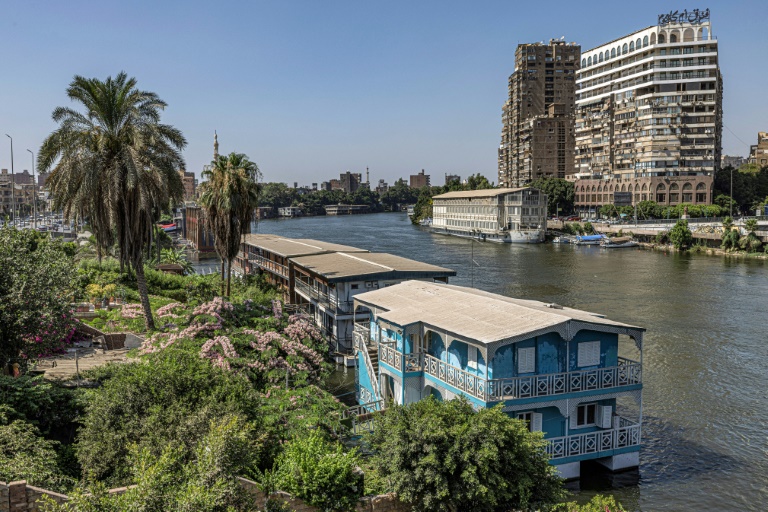
Dozens of vibrantly coloured floating homes have for decades dotted the banks of the River Nile, rare havens of leafy seclusion in the Egyptian capital’s hustle and bustle — but maybe not for much longer.

Residents of the 30 or so houseboats  that remain moored on the banks of the Nile last week received eviction orders, giving them less than two weeks before their homes are taken away to be demolished.

“Buying this houseboat was my dream,” celebrated British-Egyptian novelist Ahdaf Soueif told AFP. “I furnished it to accommodate my grandchildren and spend my last days here.”

The boats have long occupied a special place in the Egyptian collective consciousness, having been the centrepiece of conversations in Nobel Prize laureate Naguib Mahfouz’s “Chitchat on the Nile”, as well as various classics from the golden age of Egyptian cinema.

But while many have campaigned to protect the houseboats for their historic value, the authorities have argued they are an eyesore standing in the way of the state’s grand development plans.

Residents have been offered no alternative accommodation or compensation, unlike others who previously faced evictions, and many have nowhere else to go.

For Manar, a 35-year-old engineer who poured everything into buying her houseboat four years ago, it’s a devastating blow.

“I sold my apartment, my father sold his car, and we used my two retired parents’ severance pay,” said Manar, who did not wish to give her full name.

“People from the slums have been rehoused, the state even moved graves when it built a road through a cemetery, but for us, nothing.”

– ‘Uncivilised sight’ –

Barely a week after the eviction order, some boats have already been towed off and impounded in a state marina, despite petitions and campaigning, even by pro-government television pundits.

Soon, the sight of these houses, perched on metal caissons along the banks of the working-class neighbourhood of Imbaba opposite the upscale island of Zamalek, will only remain a memory.

The first warning came in 2020, when the governor of Cairo “suspended new houseboat parking authorisations”.

Residents had since received no news, until the eviction order came on June 20, leaving them “with no time to file an appeal”, according to one resident.

Adding to the pressures, authorities have been demanding parking and registration fees amounting to between 400,000 and one million pounds per residence ($21,000 to $53,000) — about 20 times more than previous annual fees.

Ayman Anwar, head of the state-affiliated Central Administration for the Protection of the Nile River in Cairo, said residents were given ample warning.

“In 2020, the state banned the use of barges as dwellings, because they are an uncivilised sight and pollute the Nile,” he said on a talk show this week.

The process echoes previous forced evictions and demolitions in Cairo’s central neighbourhoods, such as Bulaq and Maspero.

But while it may have started in poor informal settlements, the steamroller of development has now made its way into more affluent neighbourhoods and homes.

The only alternative appears to be to transform every houseboat into a commercial enterprise.

“At my age, to become a cafe manager?” exclaimed Soueif, who is in her 70s. “It’s forced eviction, no matter what you call it.”

– ‘A lost cause’ –

The banks of the Nile were once among the few public spaces where residents of Cairo –- a sprawling megalopolis of more than 20 million people –- could escape the din.

Dotted with cafes, visitors from across social strata would sip tea and juice by the water, for a modest price.

On the opposite bank of the Nile, the development Mamsha Ahl Masr (“the Egyptian people’s promenade” in Arabic) has drawn a lukewarm response.

The promenade is heralded by the state as one of many “megaprojects” launched by President Abdel Fattah al-Sisi and executed by the army, the crowning jewel of which is a sparkling new capital, rising out of the sands 50 kilometres (30 miles) east of Cairo.

“It’s a disaster,” Soueif said. “Every square inch must be profitable. There is no more public space, people can no longer be outside without paying.”

But the promenade, with its restaurants, a planned marina and open-air theatre, will “guarantee public access to the Nile”, the government insists.

Awad, who has lived with his family on their houseboat for 25 years, says “a square metre of commercial space is worth 1,000 pounds, so of course they’d rather rent the space out to cafes than keep us”.

“It’s tragic,” said Awad, who also did not wish to give his last name.

Now in his sixties, he laments the loss of “pieces of Cairo’s heritage” dating back to the times of the late King Farouk as well as Umm Kalthoum and Mounira al-Mahdiyya, iconic divas of the 20th century.

“It’s a lost cause. We can’t do anything, we are told that it’s a decision from above,” he said, cigarette in hand, gesturing towards the sky.

Sex Pistols show shines light on 'violence of punk'

Dennis Morris was the official Sex Pistols photographer, taking some of the most iconic images of the 1970s punk trailblazers.

More than 40 years after the band shot to notoriety, an exhibition of Morris’s classic photographs is revealing the mayhem and violence that surrounded the band to a new generation of fans.

The immersive show — “SID: Superman is Dead” — also features a recreation of a hotel room bassist Sid Vicious smashed up in 1977.

The floor surrounding an unmade bed is littered with glass from smashed pictures, pages ripped from a Bible and a wrecked television. 

Drugs paraphernalia cover a bedside table.

“You read about Sid Vicious and you would think he was really a violent person, but he was actually quite a gentle person, very shy,” Morris told AFP at the central London gallery staging the show.

Vicious epitomised the “live fast, die young” mantra and ended up dead in New York at the age of 21 from a drugs overdose.

Months earlier he had been charged with stabbing his girlfriend Nancy Spungen to death.

“When he took heroin he completely changed, he became a completely different person and that was awful, he basically just fell apart,” said Morris.

– Razors –

In Morris’s original photograph of the hotel scene recreated for the exhibition, Vicious is seen half-naked lying between two beds while an unidentified person — “probably a fan” — is curled up asleep on one of them.

“One night Sid went absolutely berserk and completely destroyed his bedroom,” he said.

“My room was next door to his and eventually when the commotion stopped I pushed the door open to his room and there was complete devastation.”

Morris, 62, originally wanted to be a war photographer, but made his name photographing reggae legend Bob Marley.

One of the aims of the installation was to give a sense of the “energy and violence of punk”.

The Sex Pistols’ 1977 anti-monarchy tirade “God Save the Queen” coincided with Elizabeth II’s Silver Jubilee and provoked strong reactions.

Singer John Lydon — aka Johnny Rotten — and two producers were attacked with razors.

At other times Morris remembers being “chased down the road” by pro-monarchists when they spotted Lydon.

“With Sid I found my war… they came out against the queen and there was this reaction which was shocking because people became quite violent sometimes,” the British photographer said.

“It became quite scary but for me it was really an opportunity to live out my dream (of documentary photography). I was there 24/7.”

– Respect for Queen –

Lydon — now 66 and a US citizen — recently said he had attended a street party for the queen’s Platinum Jubilee this month.

He said his dislike of the monarchy as an institution was as strong as ever, but he “totally respected” the 96-year-old head of state.

Whether Vicious would have changed his views will never be known, but Morris said he had also developed a “deep respect” for the queen.

“She’s held it together over the generations, despite coming to it at a very young age, and that’s a really tough thing to do,” he added.

“I was never really against them (the royals) but over the years I’ve grown up.

“None of us were against it really, it was just something that was said to create a reaction. All our parents had a picture of the queen on their wall or of Jesus, that’s how it was… we were just rebelling.”

– Sid was ‘innocent’ –

Morris firmly believes that Vicious had “star quality” but his damaged background made an early death almost inevitable.

“His problem was that at the age of 14 his mother gave him heroin. And it was his mother who gave him the heroin that killed him,” he added.

After being released on bail from New York’s notorious Rikers Island jail following Spungen’s death, he was terrified of going back, he said.

“Because of his reputation he got raped quite a few times so when he came out on bail he said to his mother, ‘I just can’t go back to prison, I just can’t do it’, so she went out and scored and that’s what killed him.”

Spungen was found in the couple’s room at New York’s Chelsea Hotel with a fatal stab wound to the abdomen. Morris, however, remains convinced Vicious was innocent.

One of his favourite photographs is of the pair backstage in which Nancy is seen talking animatedly to a docile-looking Vicious.

“He would never have done that,” he said.

Hong Kong on high alert as Xi Jinping visit expected for handover

Chinese President Xi Jinping is expected to visit Hong Kong Thursday, prompting a massive security effort ahead of celebrations marking the 25th anniversary of the city’s handover to communist China.

Government leaders have been forced into a closed-loop system, parts of the city shut down, and multiple journalists barred from Friday events that will showcase the Communist Party’s control over the city after a political crackdown that dismantled a democracy movement and crushed dissent. 

Details around the trip, Xi’s first outside mainland China since the Covid-19 pandemic began, have been kept under wraps, but he is expected to make appearances in Hong Kong on Thursday and Friday. 

However, the Chinese leader will likely spend the night in neighbouring Shenzhen on the mainland, according to local media.

Those coming into Xi’s orbit during the trip, including the highest-ranking government officials, have been made to limit their social contacts, take daily PCR tests and check into a quarantine hotel in the days leading up to the visit. 

“To play safe, if we are going to meet the paramount leader and other leaders in close quarters, I think it is worthwhile to go into the closed-loop arrangements,” veteran pro-Beijing politician Regina Ip told AFP.

Authorities have moved to eliminate any potential source of embarrassment during Xi’s time in the city, with national security police making at least nine arrests over the past week.

The League of Social Democrats, one of Hong Kong’s few remaining opposition groups, said it will not demonstrate on July 1 after national security officers spoke with volunteers associated with the group.

And Hong Kong’s top polling group announced that it would delay publishing the results of a survey that gauged government popularity “in response to suggestions from relevant government departments after their risk assessment”.

The July 1 handover anniversary in Hong Kong has traditionally been marked by tens of thousands taking to the streets in peaceful rallies every year.

But mass gatherings have essentially disappeared in Hong Kong over the past few years under a mixture of coronavirus restrictions and a security crackdown aimed at eliminating any public opposition to China’s uncompromising rule over the city. 

– Patriotism on display –

Authorities have tightly restricted media coverage of Xi’s visit, with the government barring multiple journalists from covering events around it.  

As of Wednesday, AFP has confirmed that 13 local and international journalists were denied accreditation to cover the handover celebrations.

Two AFP reporters were among those rejected, with a government official citing unspecified “security reasons”. A third AFP reporter was later granted accreditation.

The Hong Kong Journalists Association expressed “deep regret” at the rejections and said the quarantine and testing requirements reporters were made to undergo made staff substitutions difficult. 

The government told media the decision was “a balance as far as possible between the needs of media work and security requirements”.

Police on Tuesday announced large-scale road closures on Hong Kong island and temporarily banned the flying of drones in the entire city, citing security concerns.

Select sites across the financial hub have also been closed off, including the high-speed rail terminus, a performance venue for Chinese opera and Hong Kong’s Science Park.

A number of Science Park workers told AFP they had not received any notification about a visit by Xi but said they were told to work from home on Thursday.

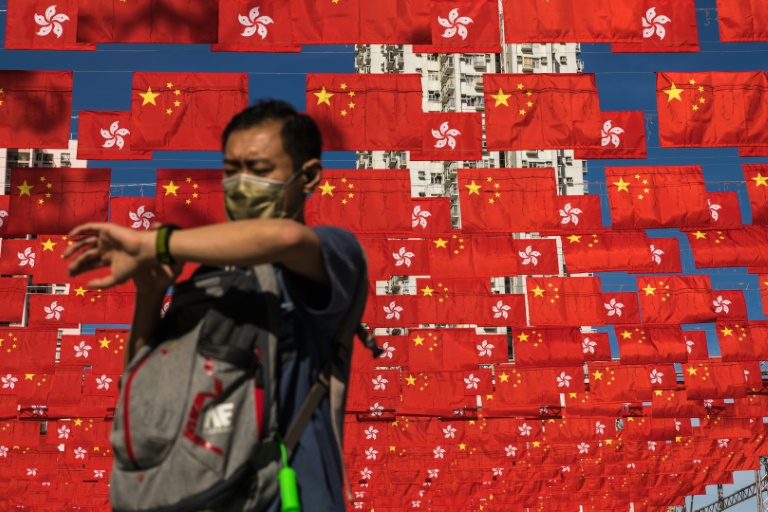
Authorities have also sought to portray an image of public support for the celebrations, including with mass displays of Hong Kong and China flags draped across dozens of public housing estates.

At one estate, a 26-year-old resident surnamed Chan complained at small flags that had been placed outside every floor at a stairwell. “It is unnecessary and too much,” he told AFP.

Tony, a worker at the estate, said the display would be better if it was done by residents voluntarily.

“Are we really embracing this ideology so much?” he told AFP.

“People may be repelled… if it is overdone.”

Close Bitnami banner
Bitnami