World

Russian account of Ukraine mall strike 'absurd', residents say

Residents in the Ukrainian city where a missile strike on a crowded mall killed at least 20 people have dismissed the Russian army’s version of events as “absurd”.

Dozens were injured and many are still missing after the strike set off a blaze inside a shopping centre in Kremenchuk on Monday.

The Russian army claimed Tuesday it had hit a nearby weapons depot with the explosion sparking the blaze at the shopping centre, which according to Moscow was “not operational” at the time.

But several Kremenchuk residents interviewed by AFP said they had not heard of arms being stored in the area.

“We heard that, it’s absurd,” said Polina Pushintseva. 

“When you live here, I wonder how you can believe such things that are pure invention,” she added.

Pushintseva was in the kitchen of her fourth-floor apartment when the windows shattered from the impact of the attack across the street.

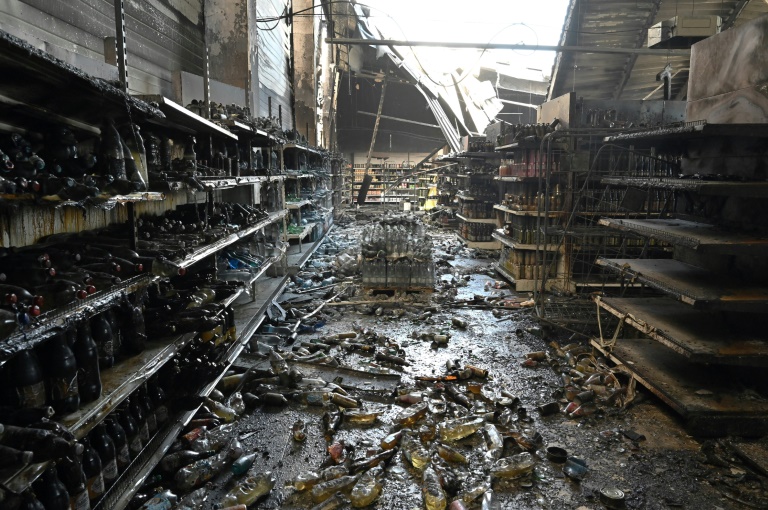
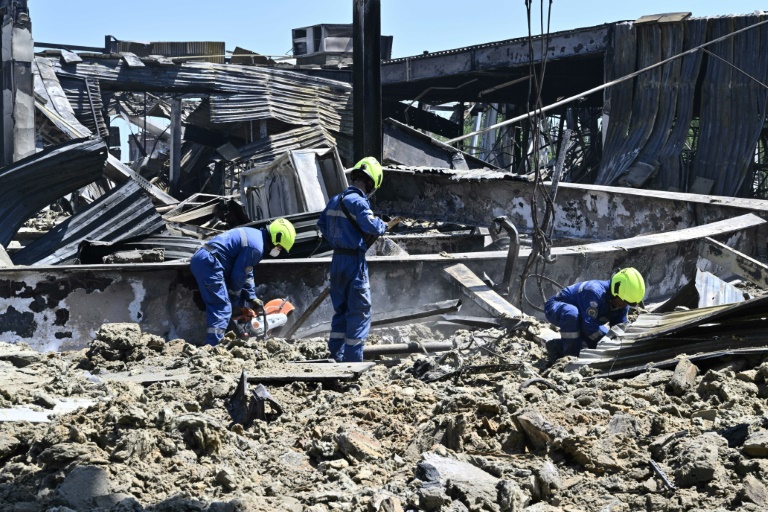
All that remains of the mall is piles of charred debris, wrecked concrete walls blackened by smoke and a few green plastic letters that once made up the sign with the store’s name — “Amstor”.

“Next to ‘Amstor’ in this neighbourhood there is absolutely no military infrastructure, nothing at all,” said resident Antonina Shumilova.

“And behind the shopping centre there is a football field.” 

A 10-minute walk from “Amstor” is a factory that makes construction machinery. AFP journalists visited on Tuesday and found that one of its buildings had been destroyed, while others remained intact. No military equipment could be seen.

– ‘No chance of surviving’ –

A day after the attack, residents are still coming to terms with what happened.

“It was such a shock,” Pushintseva said. “My brother quickly arrived at my house, we took our things, papers, money and left.” 

“Everything burned, absolutely everything. Like a spark. I heard people screaming, it was horrible,” she added.

Pushintseva returned to her apartment on Tuesday after a sleepless night away. 

“I knew people who work in this centre. But they are no longer with us,” she said. 

“I can’t find words to explain this,” she added, pointing to cuts from glass shards on her arm.

Local people laid flowers and left children’s toys next to the burnt-out store on Tuesday.

Clearing operations were halted for more than an hour as air raid sirens sounded across the central Ukrainian city.

Four large cranes were deployed at the site to lift pieces of heavy metal and gather debris, with fire trucks, rescue vehicles and several army trucks lined up in the mall’s parking lot.

Across the street from the mall, Shumilova looked at the scene from inside her beauty salon. The glass of its front door had been shattered by the blast.

Shortly before the strike “there was an air-raid siren and 10 minutes later, two explosions one second apart,” said Shumilova, who was with a customer at the time.

They rushed for cover and waited before stepping into the street, she said.

“After a quarter of an hour, everything had already burned down and there were a lot of people. It’s horrible,” she said, referring to the victims.

In a fire of such intensity, “you have no chance of surviving”, said Ivan Melekhovets, a commander of a fire brigade which took part in the rescue operation on Monday.

“The hardest thing is to see the corpses — adults, children,” he told AFP, adding that they were still looking for between 50 and 60 missing people.

Ukraine’s President Volodymyr Zelensky on Tuesday denounced the attack, accusing Russia of “calculated strikes” on civilian infrastructure. 

“The Russians simply kill people who have done nothing wrong,” Pushintseva said.
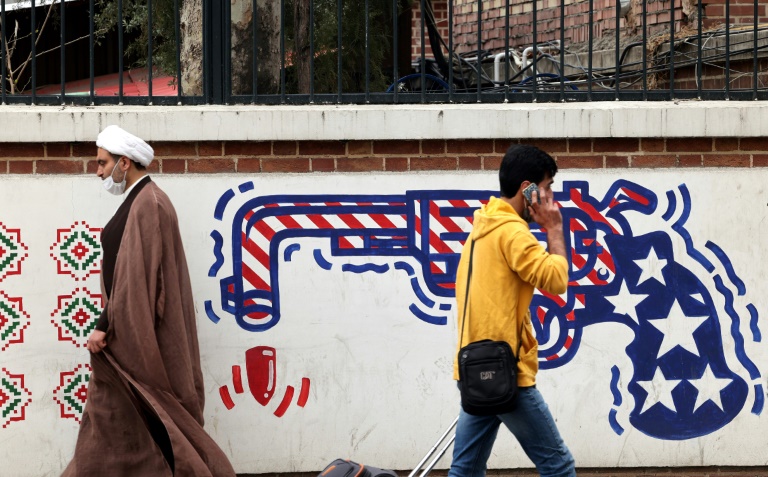
Iran court confirms Frenchman's 8-year sentence: lawyer

An Iranian appeals court has upheld an eight-year prison sentence against a Frenchman convicted on spying charges, his Paris-based lawyer said Tuesday.

Benjamin Briere was arrested in May 2020 after taking pictures in a national park with a recreational drone. His lawyers and family have accused Iran of holding him as a “hostage”.

The lawyer, Philippe Valent, said Briere’s case was being “instrumentalised” by the Iranian authorities.

“It’s shocking and dramatic,” he told AFP, adding that the verdict coincided with the resumption of negotiations between Tehran and Western powers on Iran’s nuclear programme.

“This trial is a masquerade — the submerged part of a huge issue that is beyond us,” Briere’s sister, Blandine, told AFP.

The appeals court explained its decision by accusing Briere of being “an agent in the service of an enemy state” in its verdict, which was translated by Briere’s Iranian lawyer, Valent said.

Briere, 36, who was convicted in January for spying and propaganda against Iran’s Islamic system, had appealed the sentence.

His lawyer said he had not even been given access to the full indictment against him.

The verdict against Briere comes as Iran and world powers are seeking to reach agreement at talks in Vienna on reviving the 2015 deal over the Iranian nuclear programme.

Chief negotiators from the United States and Iran were due to start indirect talks in Qatar on Tuesday, to try to remove obstacles stalling attempts to revive a landmark nuclear deal.

Nationals of all three European powers involved in the talks on the Iranian nuclear programme — Britain, France and Germany — are among foreigners being held in Iran.

“We ask the French, American and British authorities to make the liberation of hostages a pre-condition for the resumption of negotiations,” Valent said.

During his original trial, Briere’s sister Blandine told AFP her brother was a “political hostage” subjected to a “parody of justice”.

“It is a political trial, and it is useful to Iran, which is sending a message to the French government,” she said.

The French foreign ministry at the time described the verdict as “unacceptable”, saying Briere was a “tourist”.

Three other French nationals are also being held in Iran.

Franco-Iranian researcher Fariba Adelkhah was jailed for five years in May 2020 on a national security charge.

Two other French nationals were arrested in May, accused by Iran of having entered the country with the aim of destabilising.

Paris has denounced that claim as groundless.

Iran insists all the foreigners held are tried in line with domestic law but has repeatedly expressed its readiness to carry out prisoner swaps.

burs-jh/sjw/jj/cdw

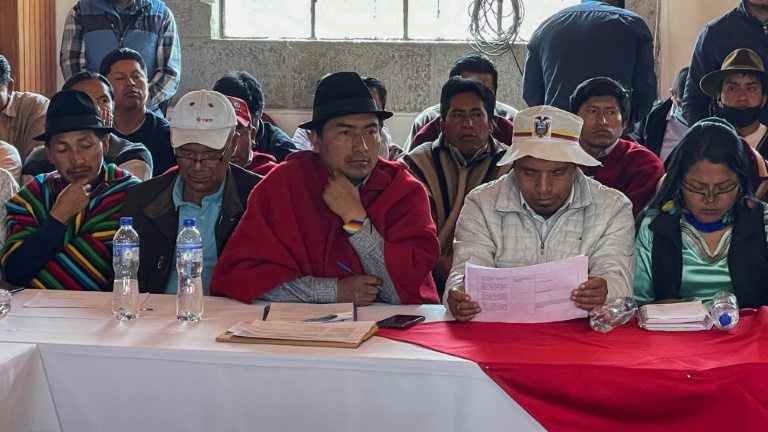
Ecuador govt suspends talks with protesters after soldier killed

Ecuador’s government has suspended negotiations with protesting Indigenous groups, President Guillermo Lasso said Tuesday, after a soldier was killed in an attack blamed by a minister on “violent demonstrators.”

Lasso, in an address to the nation, accused Indigenous leader Leonidas Iza of self-serving politics, and said: “We will not negotiate with those who hold Ecuador hostage.”

The military said a soldier was killed and five police and seven soldiers injured in an early-morning attack by an armed group on a tanker truck escort in the country’s east.

Interior Minister Patricio Carillo expressed condolences to the family of fallen soldier Jose Chimarro in a tweet, and described the attackers as “violent demonstrators.”

Indigenous representatives had met with the government on Monday in an attempt to end nationwide demonstrations against high living costs that have rocked the country for two weeks.

A second day of talks scheduled for Tuesday morning failed to get underway as negotiators from the government did not show up.

“The country has witnessed all the efforts we have made to establish a fruitful and sincere dialogue,” said Lasso, a former banker who took office just over a year ago.

“But we will not sit down again to dialogue with Leonidas Iza, who only defends his political interests and not those of his base.”

US, Iran chief negotiators to start nuclear talks in Qatar

Chief negotiators from the United States and Iran began indirect talks in Qatar on Tuesday, bidding to remove obstacles that have stalled attempts to revive a landmark nuclear deal.

The indirect negotiations headed by US special envoy Robert Malley and Iran’s Ali Bagheri come after more than a year of European Union-mediated talks in Vienna on a return to the 2015 agreement between Tehran and world powers.

The Doha talks also come just two weeks before US President Joe Biden’s first visit to the region since taking office, when efforts to curb Iran’s nuclear ambitions will be high on the agenda.

“Indirect messages have been exchanged between the parties involved,” a diplomat in the region told AFP.

Iran’s state news agency IRNA published a photo of Bagheri meeting with the European Union’s coordinator for the talks, Enrique Mora.

EU foreign affairs spokesman Peter Stano said earlier that the Doha discussions were the start of a process to “unblock” the long-running Vienna negotiations that have stalled since March.

“We managed to unblock the process and we are going to move forward, and as a first step at this stage we have these proximity talks,” he said in Brussels.

The 2015 deal gave Iran sanctions relief in exchange for curbs on its nuclear programme to guarantee that Tehran could not develop a nuclear weapon — something it has always denied wanting to do.

The deal has been hanging by a thread since 2018, when then US president Donald Trump unilaterally withdrew from it and began reimposing harsh economic sanctions on America’s arch-enemy.

– Separate rooms –

The delegations are in separate rooms and communicating via intermediaries. The US and Iran do not have diplomatic relations.

US President Joe Biden’s administration has sought to return to the agreement, saying it would be the best path ahead with the Islamic republic, although it has voiced growing pessimism in recent weeks.

Malley earlier met Qatar’s Deputy Prime Minister and Foreign Minister Sheikh Mohammed bin Abdulrahman Al-Thani to discuss “joint diplomatic efforts to address issues with Iran”, the US embassy in Doha tweeted.

Bagheri meanwhile met Qatar’s foreign ministry secretary-general, Ahmad bin Hassen al-Hammadi, Qatar’s foreign ministry said.

Sheikh Mohammed also discussed the Iran talks with his French counterpart Catherine Colonna in a phone call on Tuesday, the official Qatar News Agency said.

Qatar hopes the indirect talks will culminate in “positive results that contribute to the revival of the nuclear deal signed in 2015”, the foreign ministry said.

EU foreign policy chief Josep Borrell said during a visit to Tehran on Saturday that the Iran-US talks would be held in a Gulf country to avoid confusion with the broader talks in Vienna.

Qatar, which has better relations with Iran than most Gulf Arab monarchies, also hosted US-Taliban talks before the withdrawal of American troops from Afghanistan last year.

– ‘Moment of reckoning’ –

The Vienna talks began in April 2021 but hit a snag in March following differences between Tehran and Washington, notably over Iran’s demand that its Islamic Revolutionary Guard Corps be removed from a US terror list.

Alex Vatanka, director of the Iran programme at the Washington-based Middle East Institute think tank, called the Doha talks a “moment of reckoning” for the nuclear process.

“The Iranians and the Americans both seem to believe the talks in Doha represent a sink-or-swim moment for US-Iran nuclear negotiations,” he wrote in an analysis.

The timing appears good, with Iran likely to want a deal before US congressional elections in November, where Biden’s Democrats are predicted to lose seats and possibly lose interest in the nuclear talks, Vatanka said.

High oil prices and the lack of spare capacity were also an opportunity for Iran to push for relief from its crippling economic sanctions, he added.

US sanctions imposed since 2018 have extended to Iran’s oil exports, but Biden and the EU are keen to see a dramatic fall in energy prices after they were sent surging by Russia’s invasion of Ukraine

Ali Vaez, Iran project director at the International Crisis Group think tank, tweeted: “Having the two key protagonists in one place is a necessary ingredient for diplomacy to succeed.

“But a breakthrough is far from assured.”

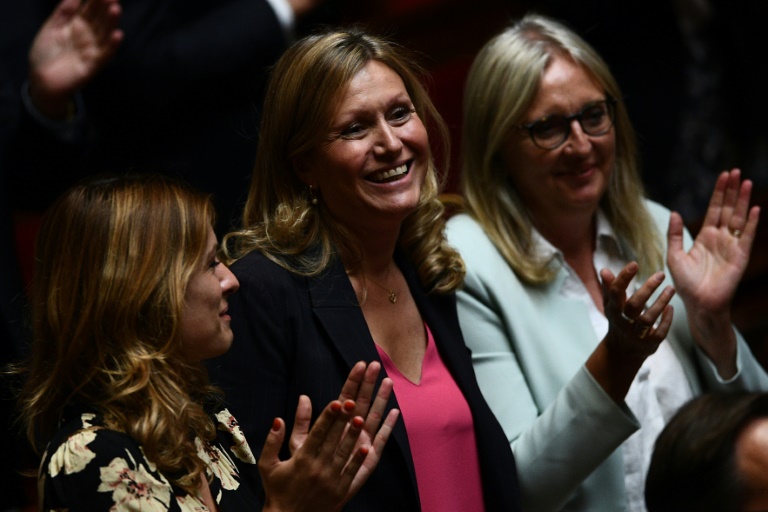
Pro-Macron MP becomes France's first woman speaker

France’s lower house of parliament on Tuesday agreed to pick an MP from President Emmanuel Macron’s centrist coalition as the first woman speaker, despite the ruling alliance losing its majority in legislative elections.

The June 19 poll saw surges for the far right and hard left and opposition forces have said they will not be lured into a lasting arrangement to support Macron’s government, which is 37 seats short of an overall majority.

Yael Braun-Pivet, who had been serving as the minister for overseas territories, is the first woman to ever hold the post of speaker in the history of the National Assembly.

Despite the loss of the majority, Macron’s ruling alliance still managed to push through her appointment in the second round of voting.

Prime Minister Elisabeth Borne and other senior Macron backers have been trying to win over individual right-wing and moderate left parliamentarians to bolster their ranks. 

Borne, appointed last month, is France’s second woman prime minister after the brief stint by Edith Cresson in the 1990s.

Olivier Marleix, head of the conservative Republicans group seen as most compatible with Macron, met Borne on Tuesday. “We’ve told her again there is no question of any kind of coalition,” he said.

But he added that the prime minister “really showed that she wanted to listen to us. That’s quite a good sign.

“We’re here to try and find solutions,” he added.

“There will be some draft laws where I think we should be able to work together,” including one to boost households’ purchasing power in the face of food and energy inflation.

“It’s not in the interest of parties who have just been elected” to make a long-term deal to support the government, said Marc Lazar, a professor at Paris’s Institute of Political Studies (Sciences Po).

– PM under pressure –

One key question will be whether Thursday’s vote to head the finance committee — with its extensive powers to scrutinise government spending — will be won by an MP from the far-right National Rally (RN).

Led by Macron’s defeated presidential opponent Marine Le Pen, the RN would usually have a claim on the post as the largest single opposition party.

It faces a stiff challenge from the NUPES left alliance — encompassing Greens, Communists, Socialists and the hard-left France Unbowed (LFI) — who agreed Tuesday on a joint candidate after some internal jostling.

Next week could see exchanges heat up in the chamber, as government chief Borne delivers a speech setting out her policy priorities.

It is not yet clear whether Borne will call the traditional vote of confidence following her appearance — which is not strictly required under France’s Fifth Republic constitution.

Macron told AFP at the weekend that he had “decided to confirm (his) confidence in Elisabeth Borne” and asked her to continue talks to find either allies for the government in parliament or at least backing for crucial confidence and budget votes.

The president has ruled out both tax increases and higher public borrowing in any compromise deals with other parties.

Even as the government projects business almost as usual, hard-left LFI especially has vowed to try to prevent key proposals, such as the flagship reform to raise the legal retirement age from 62 to 65.

Party deputy chief Adrien Quatennens said Sunday there was “no possible agreement” with Macron, saying cooperation would “make no sense”.

“We haven’t heard (Macron) move or back down one iota on pension reform” or other controversial policies, he added.

burs-tgb-jh/sjw/imm

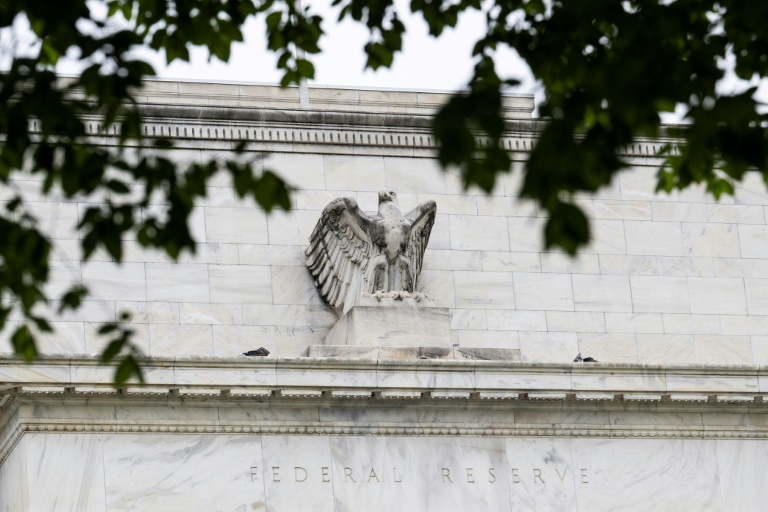
US likely to avoid recession, but rates need to climb: Fed official

The US economy will slow this year as intended and is expected to avoid a downturn, but the Federal Reserve will have to raise borrowing rates quickly, a top central bank official said Tuesday.

“Recession is not my base case right now. I think the economy is strong,” New York Fed President John Williams said on CNBC.

But he said policymakers need to hike rates “expeditiously” to tamp down inflationary pressures and get the key policy interest rate to 3.0-3.5 percent by later this year.

With American families struggling in the face of soaring gas and food prices, the Fed has shifted into high gear, implementing the biggest rate hike in nearly 30 years earlier this month to try to cool the economy and rein in inflation.

The Fed since March has raised the benchmark borrowing rate 1.5 percentage points, from zero where it had been since the start of the Covid-19 pandemic, and is expected to announce another three-quarter-point increase at its July policy meeting, with further hikes coming.

That has raised fears the campaign to quell the highest inflation in four decades will tumble the world’s largest economy into recession.

But Williams echoed the cautiously optimistic view of Fed chief Jerome Powell, saying there is a path forward that avoids a contraction.

“I’m expecting growth to slow this year quite a bit relative to what we had last year,” with GDP expanding by 1.0 to 1.5 percent, he said.

“It’s not a recession, it’s a slowdown that we need to see in the economy to reduce the inflationary pressures and bring inflation down.”

However, other economists are not as sanguine.

Dana Peterson, chief economist of The Conference Board, said the United States will likely face a short downturn.

“We are anticipating a brief yet shallow recession starting in the fourth quarter of this year and extending into the first quarter of next year,” she said during a Politico event on Tuesday.

Williams noted that the main risks to the US economy “are coming from abroad.”

The Russian invasion of Ukraine has been a major factor contributing to rising food and oil prices worldwide.

He said it was “perfectly reasonable” to expect the Fed to raise the policy rate to 3.5-4.0 percent next year, but that the final path will depend on the economic data.

“We need to raise interest rates quite a bit this year and into next year,” he said. “We’ve got to get interest rates higher and we have to do that expeditiously.”

Early human ancestors one million years older than thought

The fossils of our earliest ancestors found in South Africa are a million years older than previously thought, meaning they walked the Earth around the same time as their East African relatives like the famous “Lucy”, according to new research.

The Sterkfontein caves at the Cradle of Humankind world heritage site southwest of Johannesburg have yielded more Australopithecus fossils than any other site in the world.

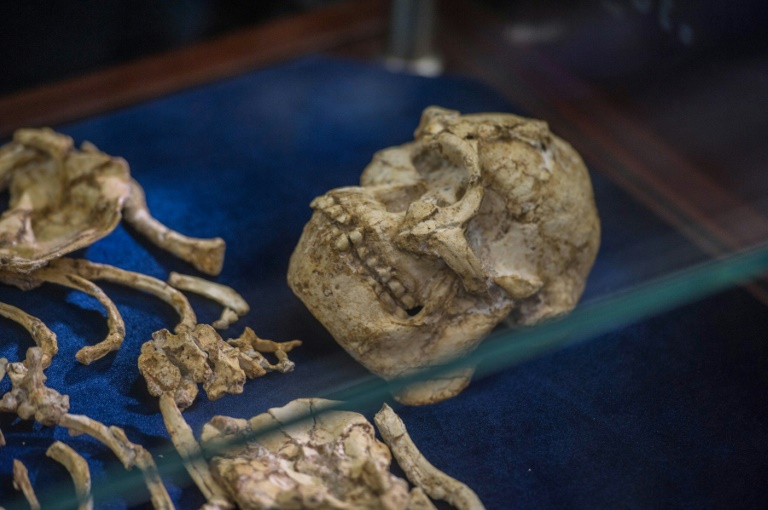
Among them was “Mrs Ples”, the most complete skull of an Australopithecus africanus found in South Africa in 1947.

Based on previous measurements, Mrs Ples and other fossils found at a similar depth of the cave were estimated to be between 2.1 and 2.6 million years old.

But “chronologically that didn’t fit,” said French scientist Laurent Bruxelles, one of the authors of a study published Monday in the PNAS science journal.

“It was bizarre to see some Australopithecus lasting for such a long time,” the geologist told AFP. 

Around 2.2 million years ago the Homo habilis — the earliest species of the Homo genus that includes Homo sapiens — was already roaming the region.

But there were no signs of Homo habilis at the depth of the cave where Mrs Ples was found.

– ‘Contemporaries’ –

Also casting doubt on Mrs Ples’s age was recent research showing that the almost-complete skeleton of an Australopithecus known as “Little Foot” was 3.67 million years old.

Such a big gap in ages between Mrs Ples and Little Foot seemed unlikely given they were separated by so few sedimentary layers.

Because the fossils are too old and fragile to test, scientists analyse the sediment near where they were found.

The previous dates underestimated the age of the fossils because they measured calcite flowstone mineral deposits, which were younger than the rest of that cave section, the study said.

For the latest study, the researchers used a technique called cosmogenic nuclide dating, which looked at levels of rare isotopes created when rocks containing quartz were hit by high-speed particles that arrived from outer space.

“Their radioactive decay dates when the rocks were buried in the cave when they fell in the entrance together with the fossils,” said the study’s lead author, Darryl Granger of Purdue University in the US.

The researchers found that Mrs Ples and other fossils near her were between 3.4 and 3.7 million years old.

This means that members of Australopithecus africanus like Mrs Ples were “contemporaries” of East Africa’s Australopithecus afarensis, including 3.2-million-year-old Lucy who was found in Ethiopia, said Dominic Stratford, director of research at the caves and one of study’s authors.

– Our family tree ‘more like a bush’ –

It could also possibly alter our understanding of our ancestral history.

The South African Australopithecus had previously been considered “too young” to be the ancestor of the Homo genus, Stratford said. That meant that Lucy’s home of East Africa was thought to be the more likely place where the Homo genus evolved.

But the new research shows that the South African Australopithecus had almost a million years to evolve into our Homo ancestor.

Or they could have worked on it together.

“Over a timeframe of millions of years, at only 4,000 kilometres (2,500 miles) away, these species had plenty of time to travel, to breed with each other… so we can largely imagine a common evolution across Africa,” Bruxelles said.

The research showed that the history of hominids was “more complex than linear evolution”, he added.

Our family tree is in fact “more like a bush, to use the words of our late friend Yves Coppens,” Bruxelles said, referring to the French palaeontologist credited with co-discovering Lucy. Coppens died last week.

“He had long understood the pan-African nature of evolution,” Bruxelles said.

Nearly 1 in 4 globally at risk from severe flooding: study

Almost a quarter of the world’s population are exposed to significant flood risks, according to new research published Tuesday, which warned those in poorer countries were more vulnerable.

Inundations from heavy rainfall and storm surges affect millions of people every year and cause billions of dollars of damage to homes, infrastructure and economies. 

And the risks are rising as climate change causes more extreme precipitation and sea level rise, as exposed populations swell. 

The new study, published in the journal Nature Communications, looked at global data on flood risks from the sea, rivers and rainfall, as well as population distribution and poverty estimates from the World Bank.

It found about 1.81 billion people — or 23 percent of the people on the planet — are directly exposed to floods of over 15 centimetres (six inches) in 1-in-100-year flooding. 

“This would pose significant risks to lives and livelihoods, especially of vulnerable population groups,” the study said. 

Overall, nearly 90 percent of those exposed to inundations live in lower or middle income countries, according to the study.

It also concluded the number of people living in poverty and under severe flood risk is “substantially higher than previously thought”. 

Researchers found some $9.8 trillion of economic activity globally — around 12 percent of the global gross domestic product in 2020 — is located in areas exposed to severe flooding.

But they said concentrating simply on a monetary value could cause a bias of attention towards higher income countries and economic hubs.

“By accounting for the poverty levels of exposed populations, we show that low-income countries are disproportionately exposed to flood risks, while being more vulnerable to disastrous long-term impacts,” said the study by Jun Rentschler of the World Bank and colleagues.  

– Growing risks –

Overall, the study estimated most people exposed to flooding — 1.24 billion — are in South and East Asia, with China and India accounting for over a third of the global total.

Some 780 million people living on under $5.50 a day are at risk from once-in-a-hundred-year floods, it found.

The research provides “the first global estimates of the interaction between exposure to flood risk, and poverty”, said Thomas McDermott, of the National University of Ireland Galway, in a linked commentary published in Nature Communications.

The authors said previous studies were often limited by geography or the type of flood risk assessed and had underestimated just how many people across the world are exposed.

“Climate change and risky urbanisation patterns are expected to further aggravate these risks in coming years,” they added.

According to World Weather Attribution, a network of scientists tracing the impacts of climate change, global warming has made extreme rainfall more common and more intense across most of the world.

This has likely made flooding more severe in these areas, although scientists stress the other human factors also play a part, such as decisions about where homes and infrastructure are built. 

This month, record floods in southern China displaced more than half a million people. 

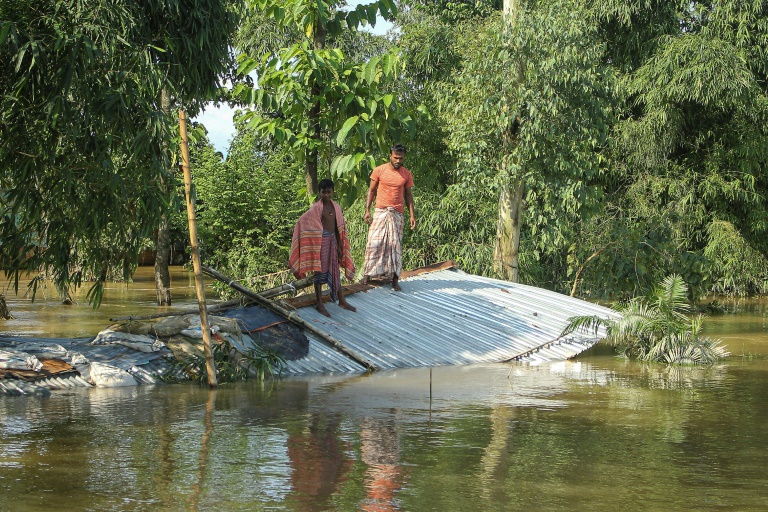
In Bangladesh, the Red Cross said Tuesday seven million people are still in “desperate” need of shelter and aid after some of the heaviest rains in a century swelled rivers to record levels and inundated rural villages.

Russia demands Ukraine surrender as G7 vows to make Moscow pay

Western allies vowed on Tuesday to boost NATO’s defences and to back Ukraine to the end as Moscow demanded Kyiv’s surrender.

Allied leaders were gathered in Madrid for a NATO summit, even as Russian missiles continued to pound Ukrainian cities.

The NATO leaders faced tough talks with Turkey to unblock Sweden’s and Finland’s bids to defy Russian threats join the Atlantic alliance. 

But they were determined to preserve a united front in the face of Moscow’s four-month-old invasion of pro-Western Ukraine.

US National Security Advisor Jake Sullivan told reporters arriving with President Joe Biden that Washington will announce “historic” new long-term military deployments in Europe.

The reinforcements will join NATO’s eastern flank, Russia’s nervous neighbours like the Baltic states, and reflect a long-term change “in the strategic reality” elsewhere in Europe.

Ahead of the summit, NATO chief Jen Stoltenberg has said the allies would boost their high-readiness forces from 40,000 to 300,000 men.

Before travelling to Madrid, Biden and other leaders of the G7 powers — the world’s richest democracies — had held a summit in the German Alps.

Germany’s Chancellor Olaf Scholz boasted afterwards that his country, a laggard in defence spending, would build “the largest conventional army within the NATO framework in Europe”.

Russia’s invasion, he said, had convinced Berlin “that we should spend more… an average of around 70 to 80 billion euros a year on defence over the next few years”.

NATO member Bulgaria announced just ahead of the summit that it would expel 70 staff from Russia’s diplomatic mission accused of working against its interests.

At the G7 summit, the leaders agreed to impose new sanctions targeting Moscow’s defence industry, raising tariffs and banning gold imports from the country.

The US Treasury said the measures “strike at the heart of Russia’s ability to develop and deploy weapons and technology used for Vladimir Putin’s brutal war of aggression against Ukraine,” 

The new set of sanctions target Rostec, Russia’s largest defence conglomerate, as well as military units and officers implicated in human rights abuses in Ukraine, the Treasury said.

Putin’s Kremlin was not fazed by the sanctions, warning that Ukraine’s forces’ only option was to lay down their arms in the face of the Russian invasion.

“The Ukrainian side can stop everything before the end of today,” Kremlin spokesman Dmitry Peskov said.

“An order for the nationalist units to lay down their arms is necessary,” he said, adding that Kyiv had to fulfil a list of Moscow’s demands.

– ‘Everything burned’ –

The consequences of Russia’s four-month-old invasion were on display in the central Ukrainian city of Kremenchuk, where shaken civilians recounted Monday’s missile strike on a shopping mall.

“Everything burned, really everything, like a spark to a touchpaper. I heard people screaming. It was horror,” witness Polina Puchintseva told AFP.

All that was left of centre — scene of at least 18 deaths — was charred debris, chunks of blackened walls and lettering from a smashed store front.

Russia claims its missile salvo was aimed at an arms depot — but none of the civilians who talked to AFP knew of any weapons store in the neighbourhood.

And, outside Russia, the latest carnage sparked only Ukrainian fury and western solidarity.

“Indiscriminate attacks on innocent civilians constitute a war crime,” the G7 leaders said in a statement, condemning the “abominable attack”.

Ukraine’s President Volodymyr Zelensky declared on his social media channels: “Only total insane terrorists, who should have no place on Earth, can strike missiles at civilian objects.

“Russia must be recognised as a state sponsor of terrorism. The world can and therefore must stop Russian terror,” he added.

The G7 leaders did not go so far as to brand Putin a terrorist — but they vowed that Russia, already under tough sanctions, would face more economic pain.

“The G7 stands united in its support for Ukraine,” Scholz told reporters. 

“We will continue to keep up and drive up the economic and political costs of this war for President Putin and his regime.”

– Oil price cap? –

Over the three days of their summit, the G7 had announced several new measures to put the squeeze on Putin, including a plan to work towards a price cap on Russian oil.

The group also agreed to impose an import ban on Russian gold. At the same time, the G7 powers heaped financial support on Ukraine, with aid now reaching $29.5 billion.

British Prime Minister Boris Johnson said the West was “to give the Ukrainians the strategic endurance they need to try to shift the dial, to try to change the dynamic of the position”.

The Madrid summit will also try to overcome Turkey’s objections to Sweden and Finland joining NATO, and Biden is to talk to Turkey’s President Recep Tayyip Erdogan.

French President Emmanuel Macron urged NATO allies to show they were united.

“The message that should come out of Madrid is a message of unity and strength for member countries, as well as for those that wish to join and whose applications we are supporting,” Macron said.

Sweden and Finland, traditionally non-aligned militarily, asked to join NATO after Putin’s February 24 invasion of Ukraine, but Turkey accuses them of harbouring wanted Kurdish militants.

Erdogan met Finnish President Sauli Niinisto and Swedish premier Magdalena Andersson ahead of the NATO talks as the would be allies struggled to persuade him to drop their veto.

Meanwhile, with fierce artillery duels continuing in the eastern Donbas region, Ukrainian officials said the central city of Dnipro and several other sites had been hit by more Russian missiles.

Pro-Moscow forces detained Igor Kolykhayev, the elected mayor of the southern Ukrainian city of Kherson.

Russian media said the “nationalist” was an opponent of Moscow’s supposed efforts to “de-Nazify” Ukraine, but Kolykhayev’s aides said he had been “kidnapped” by the city’s illegitimate occupiers.

The United Nations said that 6.2 million people are now estimated to have been displaced within Ukraine, in addition to 5.26 million who have fled abroad.

“Ukraine now faces a brutality which we haven’t seen in Europe since the Second World War,” NATO Stoltenberg said as leaders began to gather in the Spanish capital.

burs-dc/spm

Netflix 'actively' working on ad-supported subscription

Netflix is “actively” working on building its cheaper, ad-supported deal, the company’s French team said on Tuesday, but added there was no clear timeline. 

It was revealed last month that the streaming platform was planning to introduce a new cheaper subscription model by the end of the year that would break its taboo on advertising. 

That leak to the New York Times followed news that Netflix had lost 200,000 subscribers in the first quarter of the year — its first decline in a decade. 

“We don’t have a precise timeline yet,” Anne-Gabrielle Dauba-Pantanacce, head of communications for Netflix France, told AFP. 

“We are actively working on it. It’s a priority — this idea of giving subscribers more options in the context of high inflation,” she added. 

Bloomberg reported over the weekend that Netflix has yet to appoint a head of advertising or build a sales team. 

The Wall Street Journal said Netflix is actively looking into partnerships with Google and Comcast to provide ads. 

There are also tricky questions about where to place the ads. 

Should they come only at the start of programming? Or will their teams have to go back through countless hours of content to find suitable moments for an ad break in shows like “Stranger Things” that were never created with ads in mind? 

“For now, nothing is decided,” said Dauba-Pantanacce. 

In its bid to rake in more cash, Netflix is also looking to crackdown on users who share their passwords with others. 

Despite losing subscribers, which led to a tumble in its share price, Netflix remains by far the most popular streaming service in the world with 222 million subscribers. 

But they are shared with an estimated 100 million other households that are not paying for the service. 

Close Bitnami banner
Bitnami