World

A promise kept or betrayal? Hong Kong 25 years on from handover

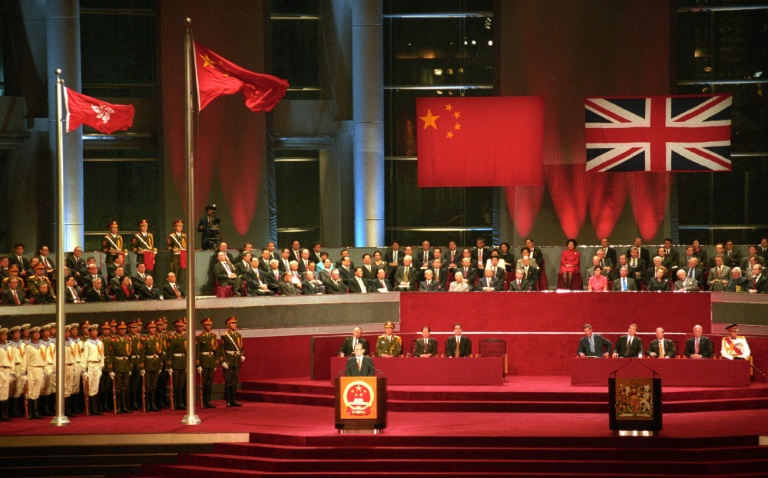
As midnight struck on June 30, 1997 and Hong Kong transitioned from British to Chinese rule, pro-democracy lawmaker Lee Wing-tat stood with colleagues on the balcony of the city’s legislature, holding a defiant protest.

Hong Kong will mark the 25th anniversary of the handover on Friday and the halfway point of One Country, Two Systems — the governance model agreed by Britain and China under which the city would keep some autonomy and freedoms.

That model was set to last 50 years. But even in its first hours, battle lines that would define Hong Kong’s politics for the next two decades were drawn.

Furious at outgoing British governor Chris Patten’s last-gasp attempts at democratisation, China had announced that any legislator who had openly supported the measures would be thrown out.

So the minute the handover became effective, Lee and many of his colleagues became seatless, but remained within the legislature to protest their expulsion.

Other opposition figures went to the handover ceremony to show goodwill, but returned to join the rally later.

“This is a moment when all Chinese people should feel proud,” Martin Lee, founder of Hong Kong’s Democratic Party, said in a speech at the time. “We hope Hong Kong and China can progress together.” 

Lee Wing-tat had more mixed feelings.

“We were no longer that optimistic and I no longer believed we would have full-fledged democracy,” he told AFP.

Twenty-five years later, there are no opposition lawmakers left in Hong Kong’s legislature at all.

Many have been arrested under a national security law Beijing imposed in 2020 or disqualified from standing for office under new “patriots only” electoral rules. 

Others have fled — including Lee Wing-tat, who now lives in Britain.

– Escalating mistrust –

Like many, Lee had been hopeful in 1984, when the Sino-British Joint Declaration laid the path to ending more than 150 years of British colonial rule.

One Country, Two Systems promised a high degree of autonomy, independent judicial power, and that the city’s leader would be appointed by Beijing on the basis of local elections or consultations. 

“Deng (Xiaoping, China’s then leader) back then said a lot about things like ‘Hong Kong people administering Hong Kong’, which was rather compelling,” Lee said.

But China’s deadly 1989 Tiananmen crackdown, which saw Beijing send in tanks to crush a democracy movement, shattered his faith in the ruling Communist Party (CCP).

In the years after the handover, mistrust between Beijing and Hong Kongers like Lee only escalated. 

The pro-democracy camp saw Beijing as ruthless authoritarians set on denying Hong Kongers their promised rights. And the CCP increasingly saw their demands as a challenge to China’s sovereignty.

There were successful mass protests in 2003 and 2012 that led to government climbdowns.

But campaigns to let Hong Kong pick its own leaders, including the 2014 Umbrella Movement, came to nothing.

Tensions finally exploded in the huge, sometimes violent protests of 2019, which China responded to with a comprehensive crackdown that has transformed the once outspoken city.

– ‘Not overkill’ – 

Critics like Patten, the last British governor, accuse the CCP of betraying its promises to Hong Kong.

“China has ripped up the joint declaration and is vengefully and comprehensively trying to remove the freedoms of Hong Kong because it regards them as a threat, not to the security of China but to the ability of the Chinese Communist Party to hang on to power,” Patten told AFP last week.

But former Hong Kong leader Leung Chun-ying said the crackdown over the last three years was “not overkill”.

“You can’t say, ‘We want to have a high degree of autonomy and you stand aside’ — that will be de facto independence of Hong Kong,” he told AFP.

Leung, whose administration faced down the Umbrella Movement, blamed years of social and political unrest on people being misled by political figures and misunderstanding Hong Kong’s mini-constitution.

He also suggested hostile “external forces” were involved, but declined to be specific.

Echoing Beijing, Leung described One Country, Two Systems as a success and said the arrangement might continue beyond its 50-year term, calling July 1, 2047 “a non-event”.

– ‘One Country’ –

Many Hong Kongers remain unconvinced. 

Public confidence in One Country, Two Systems hit a historic low in mid-2020, according to polls carried out by the Hong Kong Public Opinion Research Institute since 1994.

Some, like Herman Yiu, a young politician born in the year of the handover, have lost all hope of ever being able to make change within the system.

“Being born in 1997… it felt like my fate was connected to Hong Kong’s fate,” Yiu told AFP. “I wanted to participate to make Hong Kong better.”

As a fresh graduate, Yiu was part of a pro-democracy landslide at one-person-one-vote district council elections in 2019.

His career was short-lived, though — in June he became one of the many politicians disqualified from office.

“I think now the emphasis of One Country, Two Systems is on ‘one country’,” Yiu said. 

“I feel helpless, for Hong Kong and myself.”
Hong Kong's history: From backwater to trading metropolis

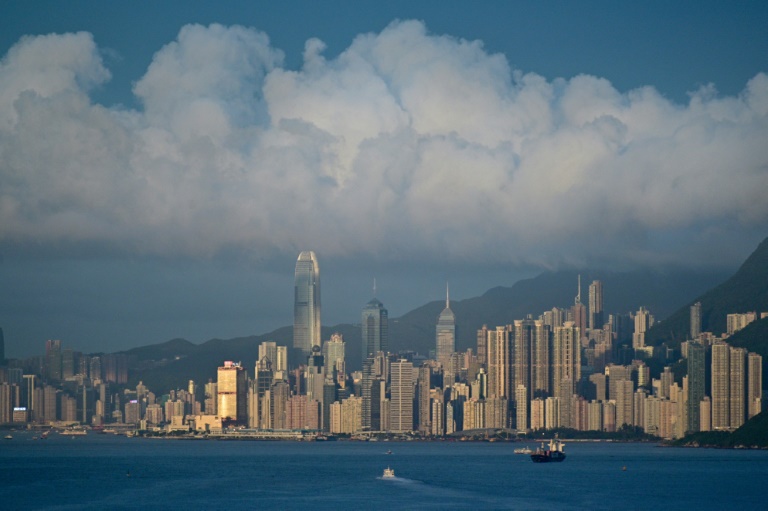
Modern-day Hong Kong is best known for its sprawl of skyscrapers and role as a bustling financial hub and regional trade conduit off the southern coast of mainland China.

But the territory was once a quiet backwater of rural hamlets and fishing communities, where mountainous terrain dominated sparse human settlement. 

Twenty-five years since the city was handed back to China by colonial power Britain, here are key points in its evolution:

– Ancient history –

Remnants of burial grounds and early rock carvings show human life in Hong Kong as far back as the Stone Age. 

The territory is thought to have come into the fold of the Chinese empire under the Han dynasty between 206 BC and 220 AD.

Increasing numbers of Han Chinese from the mainland began to settle in Hong Kong, alongside boat-dwelling communities also thought to have originated from southern China.  

– Trade boom –

Hong Kong’s sheltered main harbour became a place to replenish supplies for trading ships plying the maritime silk road between Asia, Africa and the Middle East, flourishing from around the 7th century. 

As well as silk, China exported porcelain and tea and received everything from spices to plants and textiles. 

Hong Kong’s outlying islands were also a haven for Chinese pirates — its current territory includes 260 islands, many of them uninhabited.

– European arrival –

Portuguese, Dutch and French traders arrived on the south coast of China in the 1500s and Portugal set up a base in Macau, which neighbours Hong Kong. 

But in the 18th century, China imposed restrictions on the Europeans in a bid to contain their influence.  

Britain was angered after an imperial edict banned its trade in opium from India to China, which had led to the spread of addiction.  

After Chinese authorities seized a vast haul of the drug, Britain attacked in 1840 and reached northern China, threatening Beijing, in the First Opium War.

To make peace, China agreed to cede Hong Kong Island to Britain in 1841. 

The Kowloon peninsula followed in 1860 after a second Opium War, and Britain extended north into the rural New Territories in 1898, leasing the area for 99 years.

– British rule –

Hong Kong was part of the British empire until 1997, when the lease on the New Territories expired and the entire city was handed back to China. 

Under British rule, Hong Kong transformed into a commercial and financial hub boasting one of the world’s busiest harbours.

Anti-colonial sentiment fuelled riots in 1967 that led to some social and political reforms — by the time it was handed back to China, the city had a partially elected legislature and retained an independent judiciary.  

Hong Kong boomed as China opened up its economy in the late 1970s, becoming a gateway between the ascendant power and the rest of the world. 

– Return to China –

After lengthy negotiations, including between former leader Deng Xiaoping and British ex-prime minister Margaret Thatcher, the two sides signed off on the future handover of Hong Kong in 1984.  

The Sino-British declaration said Hong Kong would be a Special Administrative Region of China and would retain its freedoms and way of life for 50 years after the handover date on July 1, 1997. 

Beijing says Hong Kong’s One Country, Two Systems model remains intact.

But critics, including Britain and other Western powers, say China has eviscerated the city’s unique freedoms, especially in the wake of huge democracy protests that broke out in 2019.

G7 denounces 'war crime' as Russian strike kills shoppers

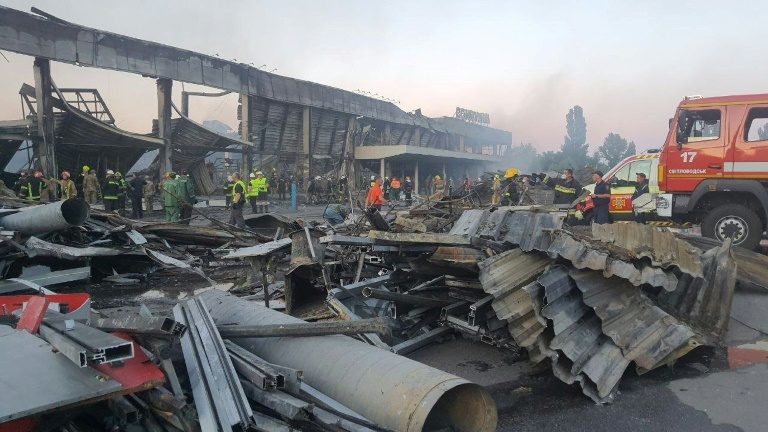
A Russian missile strike on a crowded mall in central Ukraine killed at least 18 people in what Group of Seven leaders branded “a war crime” at a meeting in Germany where they looked to step up sanctions on Moscow.

The leaders vowed that Russian President Vladimir Putin and those responsible would be held to account for Monday’s strike in the city of Kremenchuk, carried out during the shopping mall’s busiest hours.

“Indiscriminate attacks on innocent civilians constitute a war crime,” they said in a statement condemning the “abominable attack.”

Ukraine accused Russia of deliberately targeting civilians, with President Volodymyr Zelensky calling it “one of the most brazen terrorist acts in European history” in his evening broadcast posted on Telegram.

“A peaceful town, an ordinary shopping centre — women, children ordinary civilians inside,” said Zelensky, who earlier shared a video of the mall engulfed in flames with dozens of rescuers and a fire truck outside.

Dmytro Lunin, governor of the Poltava region where Kremenchuk is located, said Tuesday that 18 people were killed in the attack. 

Fifty-nine were wounded, according to emergency services chief Sergiy Kruk.

“All response groups are working in intense mode,” Kruk said. “The work will go on around the clock.”

In a separate attack Monday, Russian rockets killed at least eight civilians as they were out collecting water in the eastern city of Lysychansk, said Lugansk region governor Sergiy Gaiday.

Lysychansk has become the focus of heavy Russian attacks following the fall of its twin city, Severodonetsk.

“Our defenders are holding the line, but the Russians are turning the city into rubble… the infrastructure is completely destroyed,” Gaiday said on Telegram.

After failing to capture Kyiv following their February invasion, Russian troops have focused on seizing a swathe of eastern Ukraine, and have been gaining ground.

A strike in Kharkiv, in Ukraine’s northeast, killed four people and wounded 19 others, including four children, authorities said.

– ‘Cruelty, barbarism’ –

British Prime Minister Boris Johnson, speaking from the G7 gathering in the Bavarian Alps, said the Kremenchuk attack demonstrated Putin’s “depths of cruelty and barbarism.”

US Secretary of State Antony Blinken said the world was “horrified”, while UN chief Antonio Guterres’s office condemned the strike as “totally deplorable”.

French President Emmanuel Macron denounced the attack as an “abomination”.

Diplomats said Ukraine requested a Tuesday meeting on the strikes at the UN Security Council, where Russia wields veto power but has not been able to prevent critical discussion of the invasion.

US President Joe Biden and his peers from the wealthy Group of Seven nations are seeking to tighten the economic screws on Moscow, even as soaring energy and food prices drive up global inflation.

“We will continue to provide financial, humanitarian, military and diplomatic support and stand with Ukraine for as long as it takes,” the G7 said in a statement on the summit’s second day.

Zelensky, addressing the leaders virtually, had urged them to “intensify sanctions” to help end the war before the bitter winter.

“We will continue to increase pressure on Putin,” summit host German Chancellor Olaf Scholz said in response. “This war has to come to an end.”

G7 leaders are discussing a price cap on Russian oil imports and sanctions targeting Russia’s defence sector.

But European officials fear difficulty in implementation.

To help bring down surging prices, France urged oil-producing nations to raise output in an “exceptional manner” and Macron backed a return to the market of crude from Iran and Venezuela, both under US sanctions.

On Sunday, the G7 announced plans to stop imports of Russian gold.

– NATO boost –

Washington plans to send Ukraine sophisticated anti-aircraft missiles, National Security Advisor Jake Sullivan told reporters, meeting a long-standing request from Zelensky.

The summit of the G7 — which comprises Britain, Canada, France, Germany, Italy, Japan and the United States — ends Tuesday and will be immediately followed by a NATO meeting in Spain.

Ukraine is again expected to dominate the agenda.

NATO said Monday it would boost its high-readiness force from 40,000 to 300,000 troops and send more heavy weaponry to its eastern flank, in what chief Jens Stoltenberg called “the biggest overhaul of our collective defence and deterrence since the Cold War”.

Lithuania, a NATO member at the forefront of pressuring Russia, announced it had been targeted Monday by a massive cyberattack.

The Russian hackers’ group Killnet claimed responsibility, saying it was acting in retaliation for restrictions imposed by Lithuania earlier in June.

Russia last week threatened reprisals against the Baltic state for having banned the rail transit of certain goods to the Russian outpost of Kaliningrad. Vilnius said it was simply applying European Union sanctions.

Sweeping Western sanctions designed to choke off Moscow’s access to the international financial system have pushed Russia closer to its first foreign debt default in a century.

Russia said Monday that two of its debt payments had been prevented from reaching creditors after a key deadline expired.

But “there are no grounds to call this situation a default”, Kremlin spokesman Dmitry Peskov said.

bur-jj-sct-sr/

Former Nazi camp guard, 101, faces German court verdict

A German court will give its verdict on Tuesday in the trial of a 101-year-old former Nazi concentration camp guard, the oldest person so far to be charged with complicity in war crimes during the Holocaust.

Josef Schuetz is accused of involvement in the murders of 3,518 prisoners at the Sachsenhausen camp in Oranienburg, north of Berlin, between 1942 and 1945.

The pensioner, who now lives in Brandenburg state, has pleaded innocent, saying he did “absolutely nothing” and was not aware of the gruesome crimes being carried out at the camp.

“I don’t know why I am here,” he said at the close of his trial on Monday.

But prosecutors say he “knowingly and willingly” participated in the crimes as a guard at the camp and are seeking to punish him with five years behind bars. 

More than 200,000 people including Jews, Roma, regime opponents and gay people were detained at the Sachsenhausen camp between 1936 and 1945.

Tens of thousands of inmates died from forced labour, murder, medical experiments, hunger or disease before the camp was liberated by Soviet troops, according to the Sachsenhausen Memorial and Museum. 

The allegations against Schuetz include aiding and abetting the “execution by firing squad of Soviet prisoners of war in 1942” and the murder of prisoners “using the poisonous gas Zyklon B”.

He was 21 years old at the time.

– Contradictory statements –

During the trial, Schuetz made several inconsistent statements about his past, complaining that his head was getting “mixed up”.

At one point, the centenarian said he had worked as an agricultural labourer in Germany for most of World War II, a claim contradicted by several historical documents bearing his name, date and place of birth.

After the war, Schuetz was transferred to a prison camp in Russia before returning to Germany, where he worked as a farmer and a locksmith.

Schuetz has remained at liberty during the trial, which began in 2021 but has been delayed several times because of his health. 

Even if convicted, he is highly unlikely to be put behind bars given his age.

He intends to appeal if found guilty, his lawyer Stefan Waterkamp told AFP.

More than seven decades after World War II, German prosecutors are racing to bring the last surviving Nazi perpetrators to justice.

The 2011 conviction of former guard John Demjanjuk, on the basis that he served as part of Hitler’s killing machine, set a legal precedent and paved the way to several of these twilight justice cases.

Since then, courts have handed down several guilty verdicts on those grounds rather than for murders or atrocities directly linked to the individual accused.

– ‘Moral responsibility’ –

Among those brought to late justice were Oskar Groening, an accountant at Auschwitz, and Reinhold Hanning, a former SS guard at Auschwitz.

Both were convicted at the age of 94 of complicity in mass murder, but died before they could be imprisoned.

A former SS guard, Bruno Dey, was found guilty at the age of 93 in 2020 and was given a two-year suspended sentence.

Separately in the northern German town of Itzehoe, a 96-year-old former secretary in a Nazi death camp is on trial for complicity in murder.

She dramatically fled before the start of her trial, but was caught several hours later.

While some have questioned the wisdom of chasing convictions related to Nazi crimes so long after the events, Guillaume Mouralis, a research professor at France’s National Centre for Scientific Research (CNRS), said such trials send an important signal.

“It is a question of reaffirming the political and moral responsibility of individuals in an authoritarian context (and in a criminal regime) at a time when the neo-fascist far right is strengthening everywhere in Europe,” he told AFP.

Asian markets' rally fizzles as rates, inflation fears return

Asian markets mostly fell Tuesday as investors struggled to maintain a recent rally while weighing central banks’ inflation-fighting rate hikes and the possibility of a recession.

Renewed concerns about thinning supplies and rising demand also helped push oil even higher, after enjoying a big bounce Monday. 

Shares rallied last week as the prospect of a contraction saw traders lower their bets on how long finance chiefs will tighten monetary policy, with some commentators eyeing possible cuts at the back end of 2023.

But the global advance fizzled Monday in New York, and on Tuesday, Asian investors ran out of puff. 

Meanwhile, analysts said there was a worry on trading floors that the upcoming earnings season could see a lot of firms lower their forecasts for the year ahead.

“There is a clear lack of conviction by investors, with light trading volumes favouring the notion of an exhausted market with big declines set to be recorded this quarter, notwithstanding the outsized gains logged last week,” said National Australia Bank’s Rodrigo Catril.

Hong Kong was among the big losers, with tech firms reversing the previous day’s surge, while there were also losses in Shanghai, Tokyo, Seoul, Singapore, Taipei, Jakarta and Wellington.

Sydney and Manila bucked the trend.

Another pledge by the central People’s Bank of China to provide support to the world’s number two economy had little impact on sentiment.

Still, some commentators remain relatively upbeat as the second half of the year approaches.

Market strategist Louis Navelier said in a note: “While it’s sobering that the first half of the year is the worst since 1970, history also says that when the first half of the year is down at least 15 percent the second half of the year is up every single time with an average return of 24 percent.”

And Ben Laidler, a global markets strategist at eToro, added that a lot of the expected economic weakness had been largely factored in by dealers.

“Much is already discounted by markets, which may be in ‘bad news is good news’ mode, as a slowdown cools inflation and interest rate fears,” he said.

“A ‘less bad’ gradual easing of inflation risks is possible, as is a slowdown — not recession — driving a ‘U-shaped’ rebound. The focus for investors is on cheap and defensive assets while managing rising risks.”

Oil prices jumped, building on a rally that has seen Brent and WTI pile on more than eight percent since Wednesday. Both main contracts had fallen heavily earlier in the month on recession worries.

The gains have come on the back of a pick-up in demand from China as it gradually emerges from lockdowns, while supply fears have been raised by political crises in producers Libya and Ecuador.

– Key figures at around 0230 GMT –

Tokyo – Nikkei 225: DOWN 0.2 percent at 26,830.69 (break)

Hong Kong – Hang Seng Index: DOWN 0.8 percent at 22,046.66

Shanghai – Composite: DOWN 0.4 percent at 3,366.48

West Texas Intermediate: UP 1.1 percent at $110.72 per barrel

Brent North Sea crude: UP 1.1 percent at $116.39 per barrel

Dollar/yen: DOWN at 135.25 yen from 135.48 yen on Monday

Euro/dollar: DOWN at $1.0575 from $1.0583

Pound/dollar: DOWN at $1.2263 from $1.2268

Euro/pound: DOWN at 86.22 pence from 86.24 pence

New York – Dow: DOWN 0.2 percent at 31,438.26 (close)

London – FTSE 100: UP 0.7 percent at 7,258.32 (close) 

'Shoot them dead': Philippine president Duterte in his own words

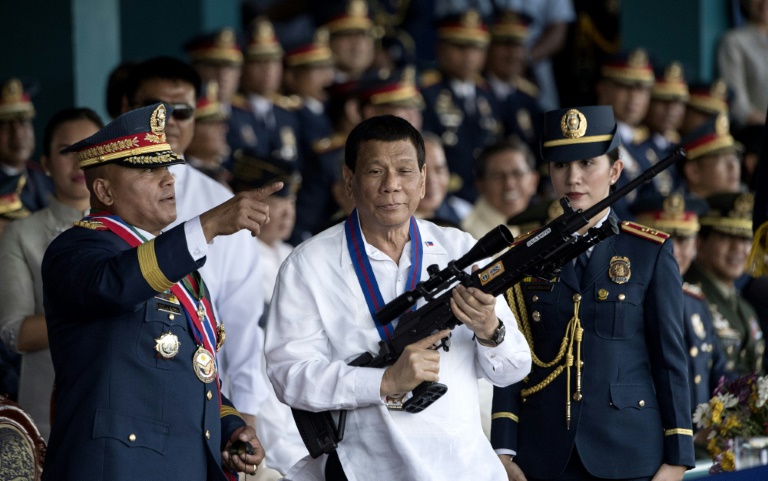
Philippine President Rodrigo Duterte, who steps down on Thursday, was infamous for his foul-mouthed tirades, off-colour jokes, and threats to kill people. 

His unfiltered remarks lashed everyone from drug users and critics to world leaders and even God — but he remained popular among Filipinos fed up with out-of-touch politicians and corruption. 

Here are some of his quotes since taking power in 2016: 

– Drug users –

“Hitler massacred three million Jews. Now there are three million drug addicts (in the Philippines). I’d be happy to slaughter them.” 

On September 30, 2016, Duterte likens his deadly crackdown on drug users to Hitler’s efforts to exterminate Jews, although vastly underestimating the number of people killed in the Holocaust by the Nazi leader’s regime.

– ‘Kill them yourself’ –

“If you know of any addicts, go ahead and kill them yourself as getting their parents to do it would be too painful.”

Hours after being sworn into office on June 30, 2016, Duterte visits a dockside slum and urges Filipinos to kill drug users.

– ‘Stupid God’ –

“Who is this stupid God? This son of a whore is really stupid in that sense. You created something perfect and then you think of an event that would tempt and destroy the quality of your work.”

Taking aim at the biblical creation story, Duterte questions why God would create Adam and Eve and then expose them to temptation on June 22, 2018. 

– ‘Shoot them dead’ –

“My orders are to the police and military, also village officials, that if there is trouble or the situation arises that people fight and your lives are on the line, shoot them dead.”

On April 1, 2020, Duterte issues a shoot-to-kill order against coronavirus lockdown troublemakers after a protest over food aid.

– Corrupt officials –

“If you commit corruption, whoever you are, I will have you flown by helicopter to Manila and I will toss you out. I have done it before, why would not I do it again?”

Duterte alludes to a past crime in explaining to typhoon survivors how he will take drastic measures against drugs and graft on December 27, 2016.

– Media threats –

“Just because you’re a journalist you are not exempted from assassination, if you’re a son of a bitch.”

On May 31, 2016, President-elect Duterte endorses the killing of corrupt journalists.

– Sexual assault –

“I lifted the blanket… I tried to touch what was inside the panty.”

On December 29, 2018, Duterte recalls how he molested a maid when he was a teenager.

– ‘Shoot your vagina’ – 

“Tell the soldiers, there’s a new order coming from the mayor. ‘We won’t kill you. We will just shoot your vagina so that, if there are no vaginas (the woman) would be useless’.”

On February 7, 2018, Duterte says soldiers should shoot female communist insurgents in the vagina.

– ‘Over my dead body’ –

“You know if you really want me — it’s over my dead body. You will only be able to take me to the Netherlands dead. You will have a carcass. I will not go there alive, you fools. But if I see you here, I will have made the first move.”

On August 2, 2021, Duterte blasts the International Criminal Court whose prosecutors want to launch a full-blown investigation into the drug war that rights groups say has killed tens of thousands of people. 

– ‘Son of a whore’ –

“You must be respectful. Do not just throw away questions and statements. You son of a whore I will curse you at that forum.”

Duterte reacts on September 5, 2016, to warnings that he would face questioning by then US president Barack Obama over a war on drugs in the Philippines. 

Macron seeks allies as new French parliament opens

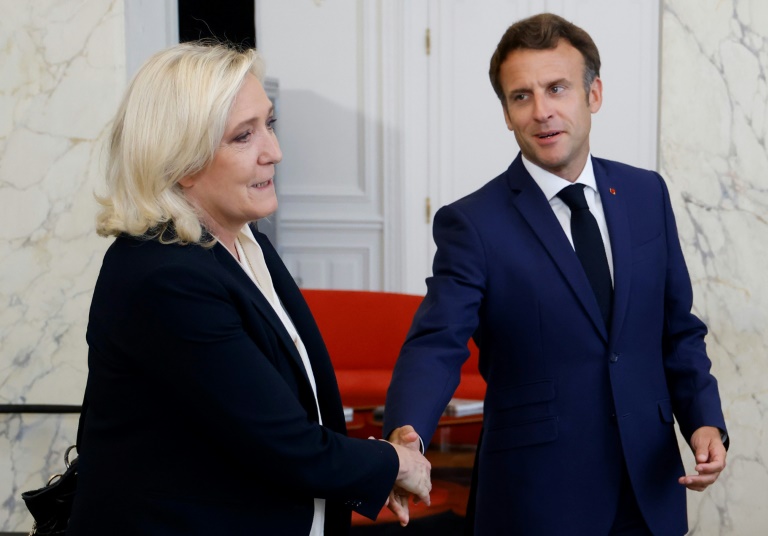
France’s lower house of parliament reopens Tuesday after an election upset for President Emmanuel Macron whose centrist allies are little closer to building a stable majority, putting Prime Minister Elisabeth Borne’s job potentially on the line.

After this month’s ballot brought surges for the far right and hard left, opposition forces have made clear that they will not be lured into a lasting arrangement to support Macron’s government which is 37 seats short of a majority.

Borne and other senior Macron backers have been trying to win over individual right-wing and moderate left parliamentarians to bolster their ranks, with one MP telling AFP that “the phones are running hot.”

But Olivier Marleix, head of the conservative Republicans group seen as most compatible with Macron, said that “we have much better things to do today than selling ourselves piecemeal”.

“It’s about making progress for the French people,” he told Europe 1 radio on Monday.

But he added that his MPs would “do everything we can to reach an agreement with the government” on an upcoming draft law to boost households’ purchasing power in the face of food and energy inflation.

“It’s not in the interest of parties who have just been elected” to make a long-term deal to support the government, said Marc Lazar, a professor at Paris’ Institute of Political Studies (Sciences Po).

– First woman speaker –

The first days of the new National Assembly will be taken up with elections for the speaker and other senior parliamentary officials and committee chiefs.

Pro-Macron candidate Yael Braun-Pivet is expected to be the first woman in French history to claim the speaker’s chair in a series of votes Tuesday.

The same day, parties with at least 15 members will be able to form official groups, which enjoy more influence and speaking time.

One key question is whether Thursday’s vote to head the Finance Committee — with its extensive powers to scrutinise government spending — will be won by an MP from the far-right National Rally (RN).

Led by Macron’s defeated presidential opponent Marine Le Pen, the RN would usually have a claim on the post as the largest single opposition party.

It could face a stiff challenge if the NUPES left alliance encompassing Greens, Communists, Socialists and the hard-left France Unbowed (LFI) can agree on a joint candidate.

– Confidence vote? –

Next week could see exchanges heat up in the chamber, as government chief Borne delivers a speech setting out her policy priorities.

It is not yet clear whether Borne will call the traditional vote of confidence following her appearance — which is not strictly required under France’s Fifth Republic constitution.

Macron told AFP at the weekend that he had “decided to confirm (his) confidence in Elisabeth Borne” and asked her to continue talks to find either allies for the government in parliament or at least backing for crucial confidence and budget votes.

Macron has ruled out both tax increases and higher public borrowing in any compromise deals with other parties.

After the president promised a “new government of action… in the first few days of July” once he returns from this week’s G7 and NATO meetings in Germany and Belgium, some observers see the compressed calendar as ambitious.

“In all other European countries, when they’re in talks to form a government, it can take months” rather than the days Macron has allowed, political scientist Lazar said.

Even as the government projects business almost as usual, hard-left LFI especially has vowed to try to prevent key proposals like a flagship reform to raise the legal retirement age from 62 to 65.

Party deputy chief Adrien Quatennens said Sunday there was “no possible agreement” with Macron, saying cooperation would “make no sense”.

“We haven’t heard (Macron) move or back down one iota on pension reform” or other controversial policies, he added.

burs-tgb/adp/pvh

Duterte unlikely to face court over Philippines drug war killings

Philippine President Rodrigo Duterte often incited violence and ordered police to shoot dead suspects in a drug war that has killed thousands. But analysts say he is unlikely to face charges after he steps down Thursday.

Duterte’s signature policy to rid the country of drugs has been widely condemned and sparked an international probe into a possible crime against humanity.

But the 77-year-old is still hugely popular among many in the Philippines who support his quick-fix solutions to crime, and he remains a potent political force.

Last month’s election results reinforced Duterte’s bulwark against potential prosecution after he leaves office, analysts said.

Ferdinand Marcos Jr, son of the country’s late dictator, won the presidency after striking a powerful alliance with Duterte’s daughter, Sara, who was elected vice president.

Marcos Jr has backed Duterte’s drug war and signalled his government will not cooperate with the International Criminal Court’s (ICC) investigation into the killings. 

“The election basically decided that there would not be a serious investigation into President Rodrigo Duterte’s role in the drug war for the next six years,” said Greg Wyatt, director for business intelligence at PSA Philippines Consultancy.

A self-professed killer, Duterte told officers to fatally shoot narcotics suspects if their lives were at risk.

He defended the crackdown, saying it had saved families and prevented the Philippines from turning into a “narco-politics state”.

Government data show more than 6,200 people have died in police anti-drug operations since Duterte was swept to power in 2016.

Rights groups say Duterte created a climate of impunity and estimate that tens of thousands have been killed by police, hitmen and vigilantes, even without proof they were involved in drugs.

Only three policemen have been convicted for slaying a drug suspect. 

Under pressure from the UN Human Rights Council and the ICC, the government has examined around 300 cases of drug operations that led to deaths.

Justice Secretary Menardo Guevarra told AFP in October that a review of 52 cases had cast doubt on the officers’ common claim of self-defence.

Charges have been filed in five cases.

Lawyers representing families of victims have vowed to take legal action against Duterte in the Philippines after June 30.

But they admit the odds are stacked against them.

“We are not that hopeful but it’s worth a shot,” said Edre Olalia, president of the National Union of Peoples’ Lawyers.

Olalia said it can take years for a case to be resolved in the creaky judicial system. And lawyers struggle to gain access to evidence held by police.

– ‘Window dressing’ –

A major challenge to mounting a case against Duterte will be the Ombudsman he appointed, said jailed Duterte critic and Senator Leila de Lima.

“His clout with the present Ombudsman, the only official authorised to file charges against him in relation to the EJKs (extra-judicial killings), survives even after he leaves office,” de Lima said in a statement to AFP.

The last hope for many families seeking justice is the ICC, said Carlos Conde, a senior researcher at Human Rights Watch.

ICC judges authorised a full-blown investigation into the anti-narcotics campaign in September, saying it resembled an illegitimate and systematic attack on civilians.

It suspended the probe two months later, after Manila said it was looking into the alleged crimes.

Conde said the government was trying to “hoodwink” the international community, particularly the ICC.

“A lot of what they’ve been doing is just window dressing, they are just trying to buy time,” he said.

ICC prosecutor Karim Khan announced Friday that he intended to resume his probe into the drug war “as quickly as possible”, saying Manila’s request to defer the investigation was unjustified.

Duterte has refused to cooperate with The Hague-based court, claiming it has no jurisdiction.

He pulled the Philippines out of the ICC in 2019 after it launched a preliminary investigation into his drugs crackdown.

Even if the ICC gathers enough evidence to bring a case against Duterte, its rules prevent him from being tried in absentia.

“ICC, I know you’re listening, stop the drama that you’ll indict me,” Duterte said Thursday, offering to act as a lawyer for anyone in uniform who shoots dead a criminal after he leaves office.

Another option for justice was an “unofficial truth commission”, said Ruben Carranza, a senior expert at the New York-based International Center for Transitional Justice.

Carranza, who was previously involved in efforts to recover money and assets stolen by the Marcoses, said it would allow families of drug war victims to tell their stories.

“In a country like the Philippines,” he said, “I think it’s important to fight for the truth whenever it’s possible.”

UN meet sees blitz of pledges to protect ailing oceans

A major UN conference on how to restore the faltering health of global oceans kicked off in Lisbon this week with a flurry of promises to expand marine protected areas, ban deep-sea mining, and combat illegal fishing.

UN chief Antonio Guterres set the tone Monday for the five-day meet by warning that the world’s oceans are in deep crisis. 

“Today we face what I would call an ocean emergency,” he told thousands of policymakers, experts and advocates, detailing how seas have been hammered by climate change and pollution.

“The ocean is not a rubbish dump. It is not a source on infinite plunder. It is a fragile system on which we all depend.”

Surangel Whipps, Jr., president of the Pacific island state of Palau, asked world leaders to join a moratorium on extracting rare Earth metals from the ocean floor.

“Deep sea mining compromises the integrity of our ocean habitat and should be discouraged to the greatest extent possible,” he said, flanked by Fiji Prime Minister Frank Bainimarama.

Indigenous leader Debbie Ngawera-Packer, a member of New Zealand’s parliament, told conference participants she had submitted a bill calling for such a moratorium in her country’s waters.

Companies seeking to mine so-called polymetallic nodules containing manganese, cobalt and nickel say they are a greener source of minerals needed to build electric vehicle batteries. 

Scientists counter that seabed ecosystems at depth are fragile, and could take decades or longer to heal once disrupted. 

“Mining, wherever it occurs, is well known to have environmental costs,” said former US National Oceanic and Atmospheric Administration (NOAA) chief scientist Sylvia Earle.

– ‘No-take’ zones –

“On the land at least we can monitor, see and fix problems, and minimise the damage. Six thousand metres (20,000 feet) beneath the surface, who’s watching?” 

A so-called high ambition coalition, meanwhile — backing a proposal to set aside 30 percent of the planet’s land and ocean surface by 2030 as protected areas — grew to 100 nations,  UK minister of state Zac Goldsmith announced in a side event.

Currently, less than 10 percent of global oceans are protected.

The “30 X 30” plan could be the cornerstone of a treaty slated for completion at a UN biodiversity summit to be held in December in Montreal. 

Nearly a quarter of a billion dollars in government, development bank and philanthropic funding to lock-in protection of marine and land ecosystems in Colombia, announced last week, could be the template for other countries. 

“Working with scientists, we decided to get 30 percent of our maritime area as protected, and we did it,” outgoing Colombian President Ivan Duque told AFP.

More than half of newly protected marine areas will be “no-take” zones off-limits to fishing, mining, drilling or other extractive activities, he said. 

The United Sates, European Union nations, Mexico, Canada, Japan and India have joined the 30 x 30 drive, while China, Russia, Indonesia and Brazil have yet to do so.

Steps were also taken Monday to fight illegal fishing, another topic on the table at the long-delayed UN Ocean Conference, originally set for April 2020. 

In Washington, US President Joe Biden issued a national security memorandum to combat illegal, unreported, and unregulated (IUU) fishing and related labour abuses. 

– Wreaking havoc –

The aim is to “make sure that the seafood products that are coming into the US market are caught in accordance with international rules and national rules,” a senior administration official told journalists.

A report by the International Trade Commission found that the United States imported $2.4 billion worth of seafood derived from IUU fishing in 2019.

“The ocean is the most underappreciated resource on our planet,” Kenyan President Uhuru Kenyatta told the conference, flanked by co-host Portuguese President Antonio Costa.

Oceans harbour 80 percent of life on Earth and generate 50 percent of the oxygen in the atmosphere.

They also absorb a quarter of CO2 pollution and 90 percent of excess heat from global warming, keeping the planet livable for life on land.

But these services rendered come at a cost.

Sea water has turned acidic, threatening aquatic food chains and the ocean’s capacity to absorb carbon. Global warming has spawned massive marine heatwaves that are killing off precious coral reefs and expanding dead zones bereft of oxygen.

“We have only begun to understand the extent to which climate change is going to wreak havoc on ocean health,” said Charlotte de Fontaubert, the World Bank’s global lead for the blue economy.

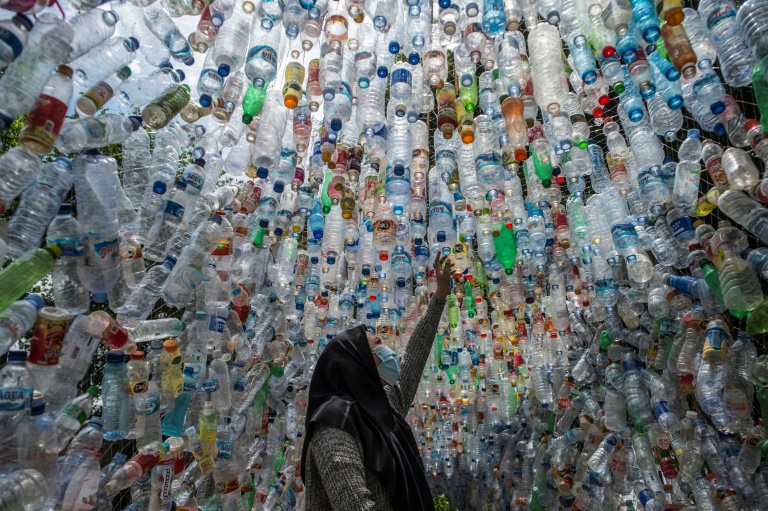
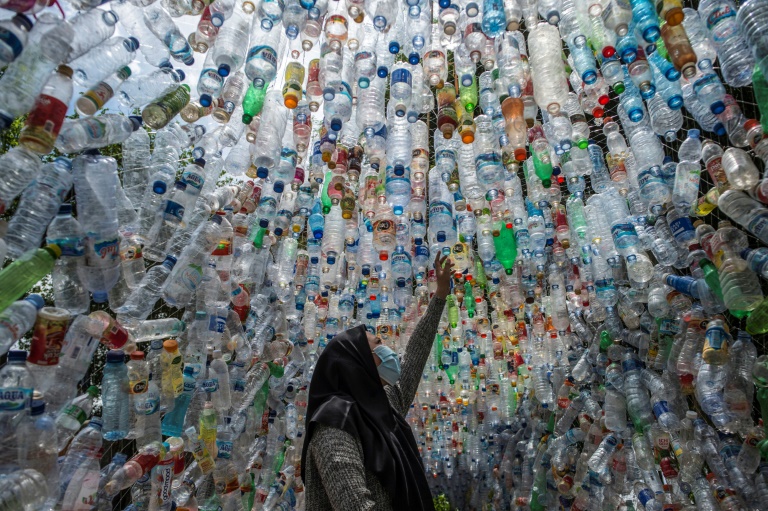
Making things worse is an unending torrent of pollution, including a garbage truck’s worth of plastic every minute, according to the United Nations Environment Programme (UNEP). 

UN meet sees blitz of pledges to protect ailing oceans

A major UN conference on how to restore the faltering health of global oceans kicked off in Lisbon this week with a flurry of promises to expand marine protected areas, ban deep-sea mining, and combat illegal fishing.

UN chief Antonio Guterres set the tone Monday for the five-day meet by warning that the world’s oceans are in deep crisis. 

“Today we face what I would call an ocean emergency,” he told thousands of policymakers, experts and advocates, detailing how seas have been hammered by climate change and pollution.

“The ocean is not a rubbish dump. It is not a source on infinite plunder. It is a fragile system on which we all depend.”

Surangel Whipps, Jr., president of the Pacific island state of Palau, asked world leaders to join a moratorium on extracting rare Earth metals from the ocean floor.

“Deep sea mining compromises the integrity of our ocean habitat and should be discouraged to the greatest extent possible,” he said, flanked by Fiji Prime Minister Frank Bainimarama.

Indigenous leader Debbie Ngawera-Packer, a member of New Zealand’s parliament, told conference participants she had submitted a bill calling for such a moratorium in her country’s waters.

Companies seeking to mine so-called polymetallic nodules containing manganese, cobalt and nickel say they are a greener source of minerals needed to build electric vehicle batteries. 

Scientists counter that seabed ecosystems at depth are fragile, and could take decades or longer to heal once disrupted. 

“Mining, wherever it occurs, is well known to have environmental costs,” said former US National Oceanic and Atmospheric Administration (NOAA) chief scientist Sylvia Earle.

– ‘No-take’ zones –

“On the land at least we can monitor, see and fix problems, and minimise the damage. Six thousand metres (20,000 feet) beneath the surface, who’s watching?” 

A so-called high ambition coalition, meanwhile — backing a proposal to set aside 30 percent of the planet’s land and ocean surface by 2030 as protected areas — grew to 100 nations,  UK minister of state Zac Goldsmith announced in a side event.

Currently, less than 10 percent of global oceans are protected.

The “30 X 30” plan could be the cornerstone of a treaty slated for completion at a UN biodiversity summit to be held in December in Montreal. 

Nearly a quarter of a billion dollars in government, development bank and philanthropic funding to lock-in protection of marine and land ecosystems in Colombia, announced last week, could be the template for other countries. 

“Working with scientists, we decided to get 30 percent of our maritime area as protected, and we did it,” outgoing Colombian President Ivan Duque told AFP.

More than half of newly protected marine areas will be “no-take” zones off-limits to fishing, mining, drilling or other extractive activities, he said. 

The United Sates, European Union nations, Mexico, Canada, Japan and India have joined the 30 x 30 drive, while China, Russia, Indonesia and Brazil have yet to do so.

Steps were also taken Monday to fight illegal fishing, another topic on the table at the long-delayed UN Ocean Conference, originally set for April 2020. 

In Washington, US President Joe Biden issued a national security memorandum to combat illegal, unreported, and unregulated (IUU) fishing and related labour abuses. 

– Wreaking havoc –

The aim is to “make sure that the seafood products that are coming into the US market are caught in accordance with international rules and national rules,” a senior administration official told journalists.

A report by the International Trade Commission found that the United States imported $2.4 billion worth of seafood derived from IUU fishing in 2019.

“The ocean is the most underappreciated resource on our planet,” Kenyan President Uhuru Kenyatta told the conference, flanked by co-host Portuguese President Antonio Costa.

Oceans harbour 80 percent of life on Earth and generate 50 percent of the oxygen in the atmosphere.

They also absorb a quarter of CO2 pollution and 90 percent of excess heat from global warming, keeping the planet livable for life on land.

But these services rendered come at a cost.

Sea water has turned acidic, threatening aquatic food chains and the ocean’s capacity to absorb carbon. Global warming has spawned massive marine heatwaves that are killing off precious coral reefs and expanding dead zones bereft of oxygen.

“We have only begun to understand the extent to which climate change is going to wreak havoc on ocean health,” said Charlotte de Fontaubert, the World Bank’s global lead for the blue economy.

Making things worse is an unending torrent of pollution, including a garbage truck’s worth of plastic every minute, according to the United Nations Environment Programme (UNEP). 

Close Bitnami banner
Bitnami