World

'Unimaginable': Austria prepares to reopen coal power station

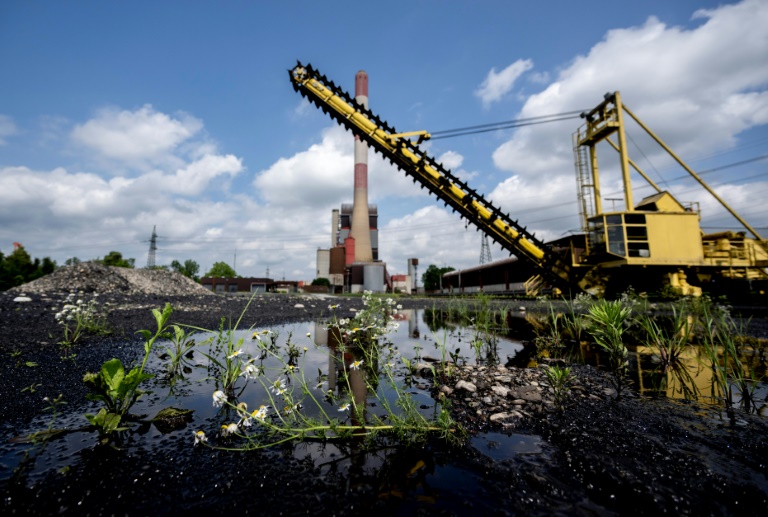
At the Mellach coal power plant in southern Austria, spider webs have taken over the conveyor belts, and plants and flowers have sprung up around the vast lot that once stored coal.

The plant, Austria’s last coal-fuelled power station, was closed in the spring of 2020, but now the government — nervous that Russia may cut its crucial gas deliveries further — has decided to get the site ready again in case it’s needed.

“I never would have imagined that we would restart the factory,” Peter Probst, a 55-year-old welder, told AFP during a visit of the plant.

“It’s really sad to be so dependent on gas,” he added.

Europe had been trying to move away from coal in the fight against climate change.

But as Russia has cut gas deliveries in the wake of sanctions the West has imposed on it for the war in Ukraine, European countries are turning back to coal.

Today, the Mellach plant’s white and red chimney stands out amid fields of corn and pumpkins, the city of Graz in the distance.

Inside, the walls are black, and coal dust clings to the doors and railings.

Some 450,000 tonnes of coal were stored at the plant before its closure as Austria’s conservative-Greens coalition aimed to have all electricity come from renewable resources by 2030.

Site manager Christof Kurzmann-Friedl says the plant operated by supplier Verbund can be ready again in “about four months” — just in time to help tackle any gas shortages in winter.

– ‘Emergency measure’ –

Chancellor Karl Nehammer insisted on Monday that the plant would only go online if necessary, while Austria holds on to its goals to reduce emissions.

“It’s really an emergency measure,” the conservative told foreign correspondents at a briefing.

“It’s really something that shows how extraordinary our times are… We must prepare for any eventuality.”

The 230 megawatt power plant would take over from the nearby gas-fired plant, also operated by Verbund, which currently supplies heating to Graz’s 300,000 inhabitants, according to Kurzmann-Friedl.

He warned, however, that the site must still be readied, hooking up all the equipment again, in addition to hiring qualified personnel and above all finding enough coal. 

Before, the coal mainly came from mines in Poland’s Silesia region, which the Polish government is aiming to shut.

Because coal prices have risen by as much as three times since 2020, the power produced by the plant will also be more expensive, Kurzmann-Friedl said.

Criticism has already flared with the opposition Social Democrats slamming the decision to reactivate the coal plant as “an act of desperation by the Greens”.

“Will the next step be the reactivation of Zwentendorf?” the opposition asked, referring to the country’s only nuclear power plant.

The Alpine nation of nine million people has been fiercely anti-nuclear with an unprecedented vote in 1978 against nuclear energy that prevented the plant from ever opening.
US, Iran chief negotiators in Qatar for nuclear talks

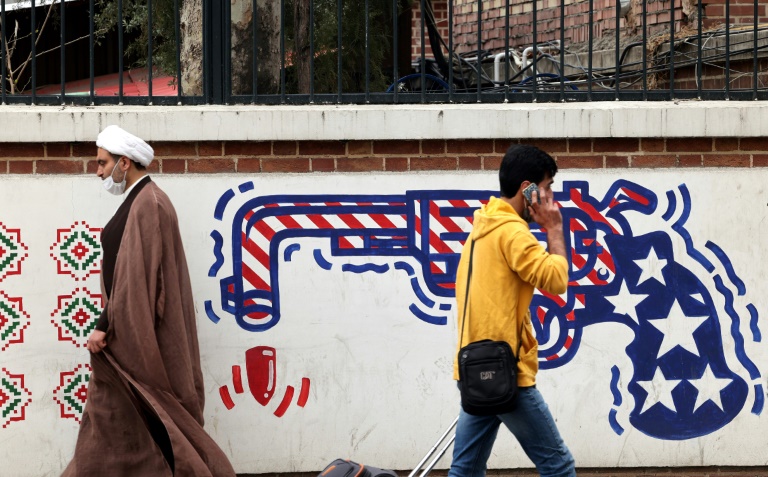
Iran’s chief negotiator joined his US counterpart in Qatar on Tuesday ahead of indirect talks between the two rivals aimed at reviving a landmark nuclear deal, officials and media said.

Ali Bagheri and his delegation arrived in Doha, Iran’s IRNA news agency said, after US special envoy Robert Malley held talks with Qatar’s Deputy Prime Minister and Foreign Minister Mohammed bin Abdulrahman Al Thani.

The US-Iran talks, due to take place this week, will be separate from broader EU-mediated negotiations in Vienna between Iran and major powers which have been going on for more than a year.

Malley and Sheikh Mohammed met “to discuss the strong partnership and our joint diplomatic efforts to address issues with Iran”, the US embassy in Doha tweeted.

The 2015 nuclear deal has been hanging by a thread since 2018, when then US president Donald Trump unilaterally withdrew from it and began reimposing harsh economic sanctions on America’s arch-enemy.

US President Joe Biden’s administration has sought to return to the agreement, saying it would be the best path ahead with the Islamic republic, although it has voiced growing pessimism in recent weeks.

The talks in Doha will take place indirectly — with the delegations in separate rooms, communicating via an intermediary. The US and Iran do not have diplomatic relations.

Sheikh Mohammed also discussed the Iran talks with his French counterpart Catherine Colonna in a phone call on Tuesday, the official Qatar News Agency said.

Qatar’s foreign ministry said it hopes the “indirect talks will be culminated in positive results that contribute to the revival of the nuclear deal signed in 2015”.

Talks to revive the nuclear deal began in Vienna in April last year but hit a snag in March following differences between Tehran and Washington, notably over Iran’s demand that its Islamic Revolutionary Guard Corps be removed from a US terror list.

Asian markets bounce as China eases quarantine measures

Most Asian markets reversed early losses Tuesday and oil continued its recent rally after China slashed the quarantine time for visitors, fuelling hope for a boost to the embattled economy.

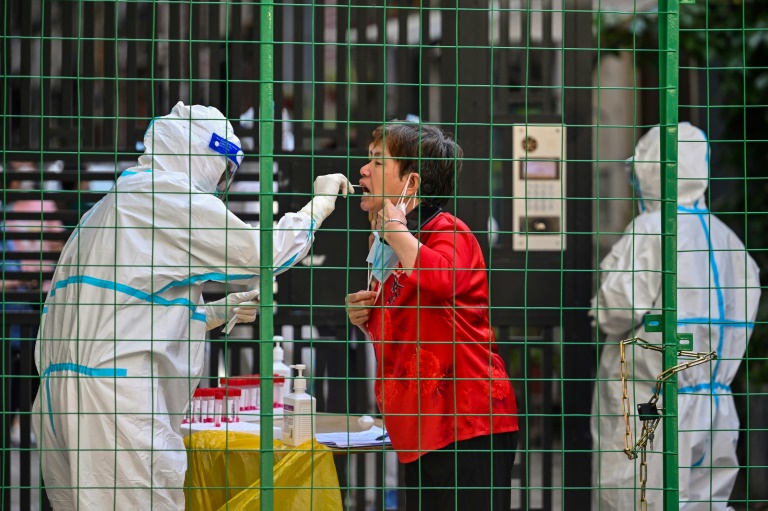
The news came as Beijing and Shanghai appeared to have contained a Covid outbreak that had forced officials to impose lockdowns which compounded global supply chain snarls.

Authorities said inbound travellers would now only have to quarantine for 10 days, instead of the three weeks that had been in place during the pandemic.

The news provided a much-needed boost to shares, which had mostly been down on renewed concerns about central bank interest rate hikes and soaring inflation.

On Monday the central People’s Bank of China pledged to provide support to the world’s number two economy.

The gains extended a rally enjoyed last week on bets that a possible recession next year could allow finance chiefs to ease up on their monetary tightening campaign.

“This relaxation sends the signal that the economy comes first,” Li Changmin, at Snowball Wealth, said. “It is a sign of the importance of the economy at this point.”

After spending the morning in the red, Hong Kong, Shanghai, Tokyo, Seoul and Wellington turned higher, while there were also gains in Sydney, Manila and Bangkok. Mumbai, Taipei and Jakarta slipped while Singapore was flat.

London, Paris and Frankfurt were all up as traders digest comments from European Central Bank boss Christine Lagarde, who said it would go “as far as necessary” to bring inflation back down to its two percent goal.

However, Huang Yanzhong of the New York-based Council on Foreign Relations warned: “It’s not surprising that China has managed to return to so-called zero, after all the huge effort it’s made.

“But that doesn’t mean it can claim a thorough and durable victory because it didn’t eradicate the virus,” he said. “Unless they thoroughly fence off Beijing and Shanghai, the virus could sneak in anytime.”

– Inflation fears –

Still, while the inflation and rate situation remains a worry, compounded by the war in Ukraine, some commentators remain relatively upbeat as the second half of the year approaches.

Market strategist Louis Navellier said in a note: “While it’s sobering that the first half of the year is the worst since 1970, history also says that when the first half of the year is down at least 15 percent the second half of the year is up every single time with an average return of 24 percent.”

And Ben Laidler, a global markets strategist at eToro, added that a lot of the expected economic weakness had been largely factored in by dealers.

“Much is already discounted by markets, which may be in ‘bad news is good news’ mode, as a slowdown cools inflation and interest rate fears,” he said.

“A ‘less bad’ gradual easing of inflation risks is possible, as is a slowdown — not recession — driving a ‘U-shaped’ rebound. The focus for investors is on cheap and defensive assets while managing rising risks.”

Oil prices surged more than one percent to build on a rally that has seen Brent and WTI pile on more than eight percent since Wednesday. Both main contracts had fallen heavily earlier in the month on recession worries.

The gains have come on the back of a pick-up in demand from China, while supply fears have been raised by political crises in producers Libya and Ecuador.

“The rhetoric around declaring victory in Shanghai over Omicron seems to be prompting Asian traders to continue buying,” said OANDA’s Jeffrey Halley.

Meanwhile, Moody’s ratings agency confirmed Russia had defaulted on foreign debt for the first time in a century after bondholders did not receive $100 million in interest payments.

The missed payments follow a series of Western sanctions that have increasingly isolated Moscow following its invasion of Ukraine.

Russia lost the last avenue to service its foreign-currency loans after the United States removed an exemption last month that allowed US investors to receive Moscow’s payments.

– Key figures at around 0810 GMT –

Tokyo – Nikkei 225: UP 0.7 percent at 27,049.47 (close)

Hong Kong – Hang Seng Index: UP 0.9 percent at 22,418.97 (close)

Shanghai – Composite: UP 0.9 percent at 3,409.21 (close)

London – FTSE 100: UP 0.8 percent at 7,316.77

West Texas Intermediate: UP 1.2 percent at $110.90 per barrel

Brent North Sea crude: UP 1.2 percent at $116.43 per barrel

Dollar/yen: UP at 135.77 yen from 135.48 yen on Monday

Euro/dollar: DOWN at $1.0577 from $1.0583

Pound/dollar: DOWN at $1.2266 from $1.2268

Euro/pound: DOWN at 86.23 pence from 86.24 pence

New York – Dow: DOWN 0.2 percent at 31,438.26 (close)

Bunkers, barricades for showcase Hindu pilgrimage in Indian Kashmir

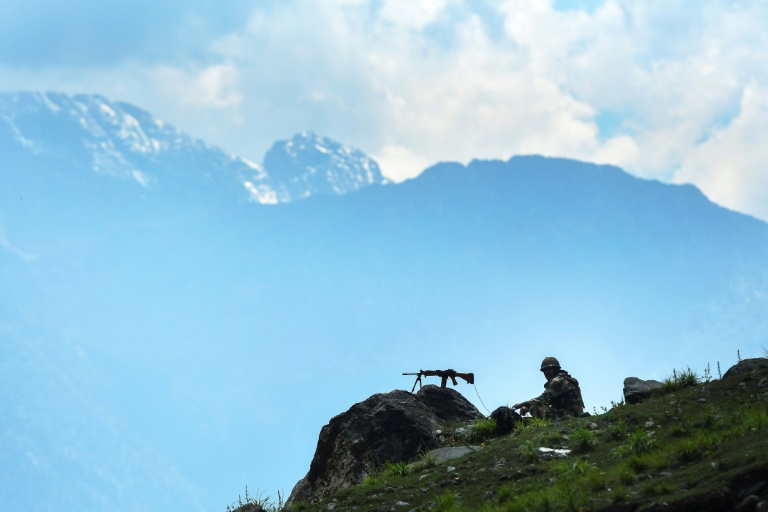
Indian flags fluttering over a sea of khaki army tents will form the backdrop to a mass pilgrimage starting this week in Kashmir that Delhi’s Hindu nationalist government hopes will reinforce its claims to the blood-soaked territory.

The region split between India and Pakistan has been the cause of several wars, and three years ago Prime Minister Narendra Modi imposed direct rule over the Indian-administered part where an insurgency has raged for decades.

His government is hoping a million Hindu pilgrims from all over India will take part in this year’s Amarnath pilgrimage, a trek to an ice stalagmite representing the Hindu destroyer god Shiva.

Once a modest, sparsely attended annual event, the pilgrimage — and the accompanying security mobilisation — has swelled in size as its political significance grew.

Put on hold for two years by the pandemic, the pilgrimage sees devotees hike for several days to the cave at 3,900 metres (12,800 feet),  sleeping on the route in tents and using bio-toilets lining the fast-flowing glacial streams.

Dozens of makeshift kitchens give out free food. 

The old and infirm can take a shorter route or be taken by donkey, mule or palanquin carried by local Muslims. The wealthy can go by helicopter.

Businessman Vinod Kumar, 40, who travelled from the northern Indian state of Punjab said he has come every year for two decades. 

“I don’t enjoy (pilgrimages) anywhere else more than I do in Kashmir,” Kumar told AFP.

– Snowstorms and bullets –

The weather can be treacherous — sudden snowstorms killed 243 people in 1996 — but it’s not the conditions that worry the Indian security forces.

Rebel groups opposed to India’s rule of Kashmir have often said that the pilgrimage was not among their targets.

But they have warned in the past that they would act if the religious practice was used for establishing the Hindu domination of Muslim-majority Kashmir.

In 2017, suspected rebels sprayed bullets at a pilgrim bus, killing 11 people.

This year, tens of thousands of security personnel have been deployed, reportedly three or four times the number at the last pilgrimage in 2019, when 600,000 devotees took part.

A police officer told AFP on condition of anonymity that over 400 sandbagged bunkers manned by armed soldiers dot villages and forests around the shrine and the route to the base camp at Chandanwari.

Over the 43 days of the pilgrimage, the devotees — many shouting religious and Hindu nationalist slogans — will be transported through Kashmir in armed convoys.

Arriving in the nearby main town of Pahalgam, they are welcomed by a  billboard with Modi’s smiling face.

The base camp is a mini township of prefabricated huts and flimsy tents housing security personnel, communications towers and a bustling temporary bazaar full of braying mules.

– Exponential –

Before an armed insurgency against Indian rule of Kashmir erupted in 1989, the pilgrimage was a relatively low-key affair lasting 15 days and undertaken by a few thousand pilgrims.

Now it is highly militarised and has grown exponentially in scale and almost all government departments are involved in the huge logistical operation.

“In the past 25 to 30 years, the annual trek to Amarnath shrine has mushroomed from being an inner journey by pilgrims to being a political shout of majoritarian defiance,” said Siddiq Wahid, historian and political commentator.

“In this context, neither the Kashmiri hosts nor the pilgrims can be faulted for being fearful of violence, through no fault of either,” he told AFP.

Death toll in Jordan chlorine gas leak rises to 13

Thirteen people were killed, including at least four Asian migrants, when toxic chlorine gas escaped on the dockside in the Jordanian Red Sea port of Aqaba, officials said.

More than 250 people were injured in the accident Monday, of whom 123 remained in hospital on Tuesday, according to the latest toll update.

Most were being treated for the effects of breathing chlorine gas, a common cleaning agent that also has a range of other industrial uses and can be employed as a chemical weapons agent.

The port began returning to normal Tuesday, with all docks due to be reopen except for Dock Four, where further safety checks were to be carried out, said Interior Minister General Mazen al-Faraya.

“The situation in Aqaba is now under control,” Prime Minister Bisher al-Khasawneh told state television after visiting the port late Monday.

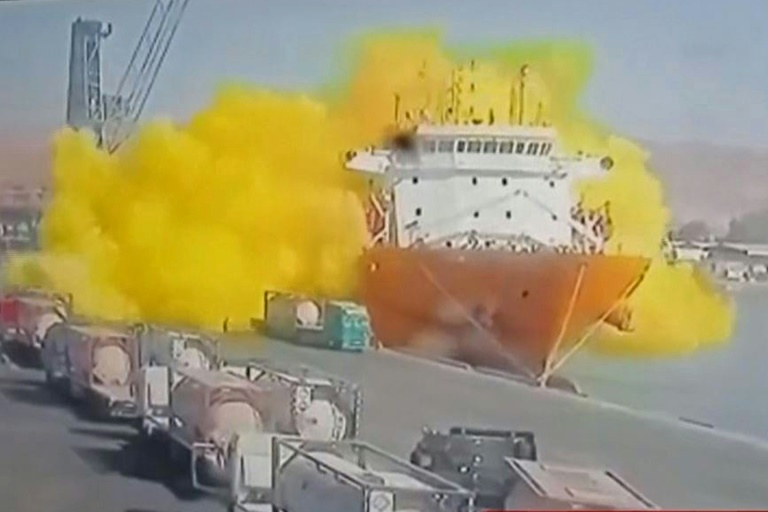
The chlorine escaped when the cable snapped on a crane loading a tank of liquefied gas onto a ship, sending it crashing to the ground on the dockside.

The force of the fall punctured the pressurised container, enveloping the freighter Forest 6 in a shroud of the bright yellow gas, closed circuit TV images from the port showed. 

The fallen white tank, punctured and stained yellow from where the gas burst out, came to rest on the dock directly beside the Forest 6 vessel. Ship-tracking websites say the deck cargo ship was built only this year and sails under a Hong Kong flag.

The nearby south beach, which is popular with tourists, was evacuated after Monday’s accident, as were adjacent residential areas but residents were later told they could return to their homes.

Aqaba tourist department official Nidal al-Majali said the lack of wind on Monday helped to prevent the gas cloud spreading outside the port.

Jordan’s Aqaba port is the country’s only maritime gateway and a transit point for the lion’s share of its imports and exports.

Chlorine has a range of industrial uses and is infamous for its use as a chemical weapons agent in World War I. It attacks the respiratory system, skin and eyes.

G7 denounces 'war crime' as Russian strike kills shoppers

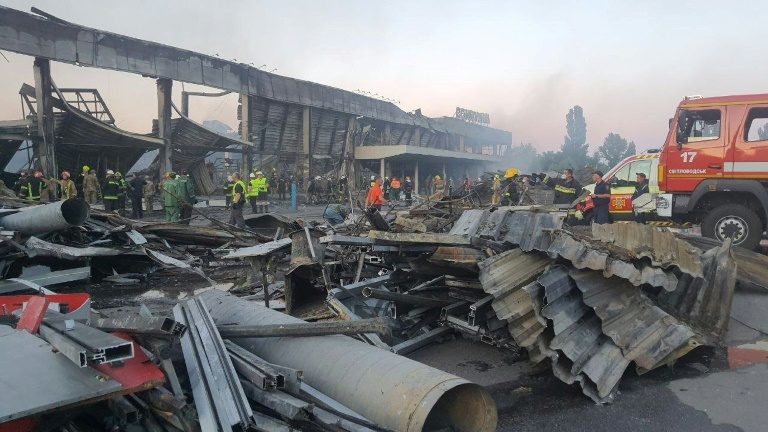
A Russian missile strike on a crowded mall in central Ukraine killed at least 18 people in what Group of Seven leaders branded “a war crime” at a meeting in Germany where they looked to step up sanctions on Moscow.

The leaders vowed that Russian President Vladimir Putin and those responsible would be held to account for Monday’s strike in the city of Kremenchuk, carried out during the shopping mall’s busiest hours.

“Indiscriminate attacks on innocent civilians constitute a war crime,” they said in a statement condemning the “abominable attack.”

Ukraine accused Russia of deliberately targeting civilians, with President Volodymyr Zelensky calling it “one of the most brazen terrorist acts in European history” in his evening broadcast posted on Telegram.

“A peaceful town, an ordinary shopping centre — women, children ordinary civilians inside,” said Zelensky, who earlier shared a video of the mall engulfed in flames with dozens of rescuers and a fire truck outside.

Dmytro Lunin, governor of the Poltava region where Kremenchuk is located, said Tuesday that 18 people were killed in the attack.  Fifty-nine were wounded, according to the emergency services.

In a separate attack Monday, Russian rockets killed at least eight civilians as they were out collecting water in the eastern city of Lysychansk, said Lugansk region governor Sergiy Gaiday.

Lysychansk has become the focus of heavy Russian attacks following the fall of its twin city, Severodonetsk.

“Our defenders are holding the line, but the Russians are turning the city into rubble… the infrastructure is completely destroyed,” Gaiday said on Telegram.

After failing to capture Kyiv following their February invasion, Russian troops have focused their campaign on seizing a swathe of eastern Ukraine, and have been gaining ground.

A strike in Kharkiv, in Ukraine’s northeast, killed four people and wounded 19 others, including four children, authorities said.

– ‘Cruelty, barbarism’ –

British Prime Minister Boris Johnson, speaking from the G7 gathering in the Bavarian Alps, said the Kremenchuk attack demonstrated Putin’s “depths of cruelty and barbarism”.

US Secretary of State Antony Blinken said the world was “horrified”, while UN chief Antonio Guterres’s office condemned the strike as “totally deplorable”.

French President Emmanuel Macron denounced the attack as an “abomination”.

Diplomats said Ukraine requested a Tuesday meeting on the strikes at the UN Security Council, where Russia wields veto power but has not been able to prevent critical discussion of the invasion.

US President Joe Biden and his peers from the wealthy G7 nations are seeking to tighten the economic screws on Moscow, even as soaring energy and food prices drive up global inflation.

“We will continue to provide financial, humanitarian, military and diplomatic support and stand with Ukraine for as long as it takes,” the G7 said in a statement on the summit’s second day.

Zelensky, addressing the leaders virtually, had urged them to “intensify sanctions” to help end the war before the bitter winter.

“We will continue to increase pressure on Putin,” summit host German Chancellor Olaf Scholz said in response. “This war has to come to an end.”

G7 leaders are discussing a price cap on Russian oil imports and sanctions targeting Russia’s defence sector.

But European officials fear difficulty in implementation.

To help bring down surging prices, France urged oil-producing nations to raise output in an “exceptional manner” and Macron backed a return to the market of crude from Iran and Venezuela, both under US sanctions.

On Sunday, the G7 announced plans to stop imports of Russian gold.

– ‘Nowhere to hide’ –

The summit of the G7 — which comprises Britain, Canada, France, Germany, Italy, Japan and the United States — ends Tuesday and will be immediately followed by a NATO meeting in Spain.

Ukraine is again expected to dominate the agenda.

NATO said Monday it would boost its high-readiness force from 40,000 to 300,000 troops, in what chief Jens Stoltenberg called “the biggest overhaul of our collective defence and deterrence since the Cold War”.

Moody’s ratings agency confirmed that Russia defaulted on foreign debt for the first time in a century after bond holders did not receive $100 million in interest payments.

Russia has been hit by sweeping Western sanctions designed to choke off its access to the international financial system.

Moscow said Monday there were “no grounds to call this situation a default” as the payments did not reach creditors because of western sanctions, not a shortage of funds.

In the strategic eastern city of Sloviansk, a man’s body still wearing one slipper lay in courtyard after a missile strike hit apartment blocks, according to AFP journalists. 

The city is experiencing heavy strikes as the advancing Russians shell it from just a few kilometres away.

“How can I live? All the rooms are damaged, see?” said resident Tatiana Levchenko, surveying her row of cracked and blown-out windows on the ground floor and shrapnel-scored wallpaper.

“Where will I go, all of Ukraine is under fire! You see, there’s nowhere to hide,” added the 67-year-old.

US CVS pharmacies limit morning-after pill purchases to avoid shortage

The US drugstore chain CVS said on Monday that it had temporarily limited purchases of the morning-after pill to three boxes per transaction, in order to avoid a shortage following a recent US Supreme Court verdict that revoked the constitutional right to abortion.

In a statement, the company said it had “ample supply” of Plan B and Aftera, two products intended to be taken by women to prevent pregnancy after unprotected sex or if a birth control method fails.

The drugs — commonly known as morning-after pills — are distinct from abortion drugs, which terminate pregnancies.

The move comes after the US Supreme Court overturned on Friday the landmark 1973 “Roe v Wade” decision that enshrined a woman’s right to an abortion, saying that individual US states can now permit or restrict the procedure themselves.

“To ensure equitable access and consistent supply on store shelves, we’ve implemented a temporary purchase limit of three (boxes) on these products,” the CVS statement said. 

Walgreens, another major US drugstore chain, said it had no plans “at this time” to place restrictions on sales of morning-after pills.

“Walgreens is still able to meet demand in-store,” a spokeswoman said. “At this time, we are working to restock online inventory for ship-to-home.”

According to the Wall Street Journal, the Walmart supermarket chain was also limiting sales of morning-after pills to four or six for orders to be delivered by the end of the month but not for those to be shipped beginning in early July.

The company did not immediately respond to a request from AFP.   

US CVS pharmacies limit morning-after pill purchases to avoid shortage

The US drugstore chain CVS said on Monday that it had temporarily limited purchases of the morning-after pill to three boxes per transaction, in order to avoid a shortage following a recent US Supreme Court verdict that revoked the constitutional right to abortion.

In a statement, the company said it had “ample supply” of Plan B and Aftera, two products intended to be taken by women to prevent pregnancy after unprotected sex or if a birth control method fails.

The drugs — commonly known as morning-after pills — are distinct from abortion drugs, which terminate pregnancies.

The move comes after the US Supreme Court overturned on Friday the landmark 1973 “Roe v Wade” decision that enshrined a woman’s right to an abortion, saying that individual US states can now permit or restrict the procedure themselves.

“To ensure equitable access and consistent supply on store shelves, we’ve implemented a temporary purchase limit of three (boxes) on these products,” the CVS statement said. 

Walgreens, another major US drugstore chain, said it had no plans “at this time” to place restrictions on sales of morning-after pills.

“Walgreens is still able to meet demand in-store,” a spokeswoman said. “At this time, we are working to restock online inventory for ship-to-home.”

According to the Wall Street Journal, the Walmart supermarket chain was also limiting sales of morning-after pills to four or six for orders to be delivered by the end of the month but not for those to be shipped beginning in early July.

The company did not immediately respond to a request from AFP.   

GlobalWafers announces plans for massive US plant

Taiwan’s GlobalWafers on Monday unveiled plans to establish a massive plant in northern Texas to produce a component vital to making semiconductors with an investment of up to $5 billion.

However, the plan to produce silicon wafers, which would reinforce fragile supplies of computer chips, is contingent largely on legislation pending in the US Congress.

“With the global chips shortage and ongoing geopolitical concerns, GlobalWafers is taking this opportunity to address the United States semiconductor supply chain resiliency,” GW Chairperson and CEO Doris Hsu said in a statement.

“Instead of importing wafers from Asia, GlobalWafers USA (GWA) will produce and supply wafers locally.”

The material is used to produce chips needed for everything from cars to smartphones, and the global shortage in recent months has been a factor in driving up US prices.

Construction of the new facility — the first of its kind in more than two decades — is due to begin this year in Sherman, Texas, with the first production coming off the line as early as 2025, creating as many as 1,500 jobs, the statement said.

However, GW President Mark England said the impasse in Congress over the $52 billion “CHIPS Act” designed to boost the US industry could hinder the plans.

“The size and possibly the actuality of the Texas investment” are at stake, he said in an email to AFP.

Democrats and Republicans are wrangling over the differing versions passed by the Senate and House of Representatives and have not agreed on the final form of the legislation that would provide subsidies to manufacturers.

England said in a statement that the legislation would help “level the global incentive playing field,” and would be instrumental in ensuring semiconductor investments and supply.

US and state officials cheered the announcement but Commerce Secretary Gina Raimondo urged quick passage of the CHIPS Act.

“We are at a make-or-break moment to expand domestic semiconductor production,” she said. “Moving quickly to pass this bill will demonstrate America’s commitment to robust domestic semiconductor capacity and provide more companies throughout the supply chain the confidence they need to move forward with investments here.”

The 300-millimeter silicon wafers are the starting material for all advanced semiconductor fabrication sites (or fabs), including recently announced US expansions by GlobalFoundries, Intel, Samsung, Texas Instruments and TSMC, but most are imported from Asia.

On Monday, Intel said that it was postponing a ceremony to celebrate the start of construction of two semiconductor plants in Ohio, at a cost of $20 billion, due to a lack of concrete progress in Congress.

Construction work continues at the site, an Intel spokesman told AFP, but a groundbreaking ceremony scheduled for July 22 had been postponed. 

46 migrants found dead in truck in Texas

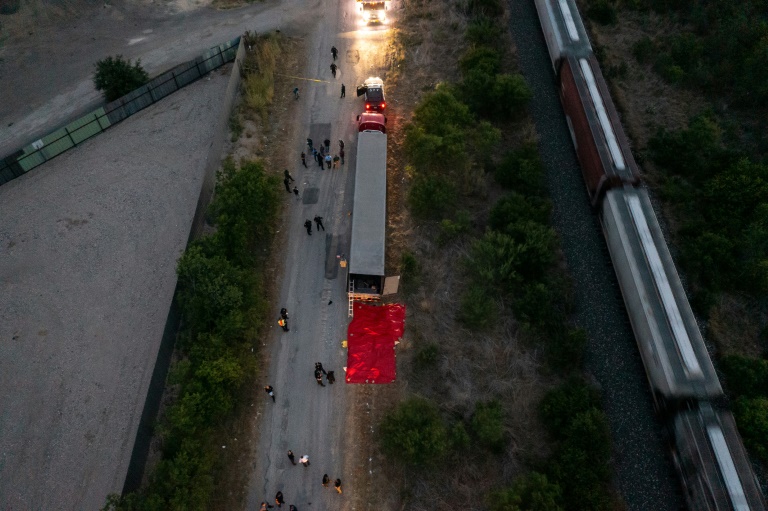
At least 46 migrants were found dead Monday in and around a truck that was abandoned on the roadside on the outskirts of the Texas city of San Antonio.

The grim discovery was one of the worst disasters involving migrants in the United States in recent years — and came five years after a similar deadly incident in the same central Texas city, a few hours from the Mexican border.

“At this time we have processed approximately 46 bodies that have been triaged and tagged and declared deceased,” San Antonio Fire Chief Charles Hood told reporters.

He said that 16 people had been transported to hospital alive and conscious — 12 adults and four children.

There were no initial details on the age or nationality of the deceased.

“The patients that we saw were hot to the touch, they were suffering from heat stroke, heat exhaustion, no signs of water in the vehicle, it was a refrigerated tractor-trailer but there was no visible working A/C unit on that rig,” Hood said.

Officials said three people were in custody over the incident.

“Tonight we are dealing with a horrific human tragedy,” San Antonio Mayor Ron Nirenberg told a press conference.

“So I would urge you all to think compassionately and pray for the deceased, the ailing, the families,” he said.

“And we hope that those responsible for putting these people in such inhumane conditions are prosecuted to the fullest extent of the law.” 

San Antonio, which lies about 250 kilometers (150 miles) from the border, is a major transit route for people smugglers.

It has also been gripped by a record-breaking recent heat wave, and temperatures in the area hit 103 degrees Fahrenheit (39.5 degrees Celsius) on Monday. 

The vehicle was found on a road near Highway I-35, a major US artery that stretches all the way to the border with Mexico.

A massive emergency operation was underway at the scene involving police, firefighters and ambulances.

According to San Antonio police chief William McManus, authorities were first alerted by an emergency call at about 5:50 pm local time (2250 GMT).

“A worker who works in one of the buildings up here behind me heard a cry for help,” he told reporters. “(He) came out to investigate, found a trailer with the doors partially open, opened them up to take a look, and found a number of deceased individuals inside.”

He said the probe had been turned over to the federal Department of Homeland Security.

Dozens of emergency responders who had worked at the scene were meanwhile undergoing a stress debriefing.

“We’re not supposed to open up a truck and see stacks of bodies in there, none of us come to work imagining that,” Hood said.

– ‘A better life’ –

Texas Governor Greg Abbott, a Republican who advocates a tough line on immigration, hit out at President Joe Biden over the disaster — blaming the Democrat’s “deadly open border policies.”

“These deaths are on Biden,” Abbott tweeted. “They show the deadly consequences of his refusal to enforce the law.”

Mexico’s foreign minister, Marcelo Ebrard, called the incident a “tragedy” and said the Mexican consul was headed to the site. 

Ebrard said the nationalities of the victims were not yet known, but that two Guatemalans were among the survivors.

San Antonio was the site of a similar migrant tragedy in 2017, when 10 people suffocated to death in a sweltering trailer with broken air conditioning and clogged ventilation holes as they traveled into the United States.

Dozens more had been hospitalized with heat stroke and dehydration — with the truck believed to have been holding as many as 200 people, most of whom fled when it stopped in a parking lot. The truck driver later pleaded guilty to charges related to the deaths.

After news broke of Monday’s discovery, the archbishop of San Antonio, Gustavo Garcia-Siller tweeted “Lord have mercy on them. They hoped for a better life.”

“Once again, the lack of courage to deal with immigration reform is killing and destroying lives.”

Close Bitnami banner
Bitnami