World

Energy shock tests G7 leaders' climate resolve

Leaders of the Group of Seven rich nations will be under pressure to stick to climate pledges in Bavaria from Sunday, as Russia’s energy cuts trigger a dash back to planet-heating fossil fuels.

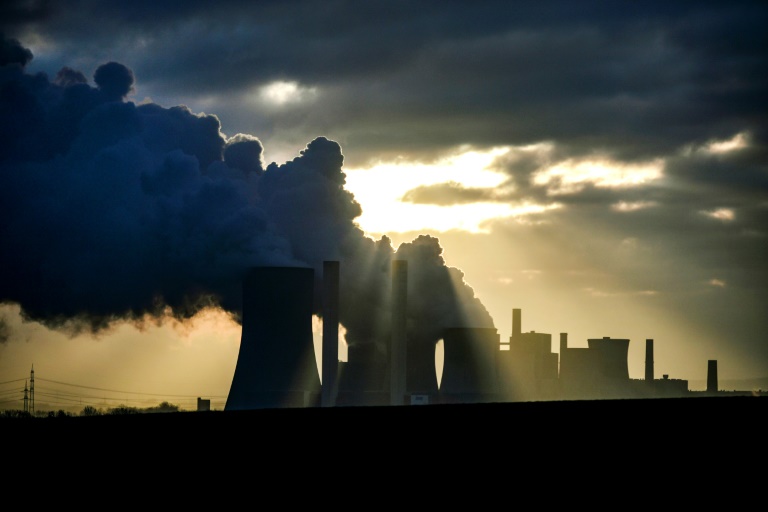
Germany finds itself in an awkward position as G7 summit host, having recently announced that Europe’s biggest economy will burn more coal to offset a drop in Russian gas supplies amid deteriorating ties over the war in Ukraine.

Chancellor Olaf Scholz nevertheless insists the G7 remains committed to the Paris agreement of limiting global temperature increases to 1.5 degrees Celsius, and achieving carbon neutrality by 2050.

But concerns are growing that Scholz will use the gathering to push G7 partners to water down a previous promise to stop financing gas and oil projects abroad by the end of the year.

“That would be a real setback,” said Alden Meyer, a senior associate at climate policy think tank E3G. 

“Scholz could go down in history as the climate backtracking chancellor.”

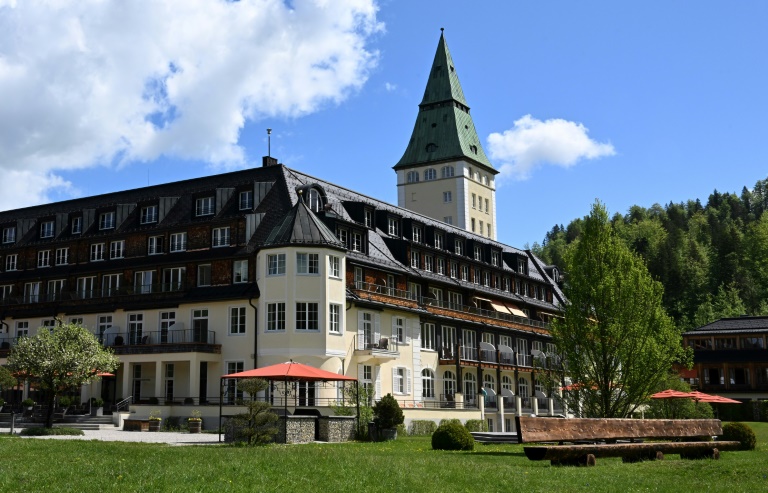
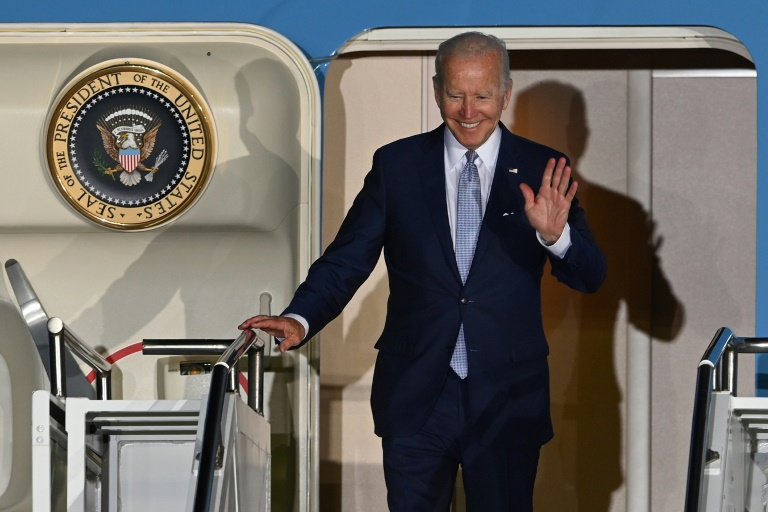
US President Joe Biden, French President Emmanuel Macron and their counterparts from Britain, Italy, Canada and Japan will all be joining Scholz at the luxurious Elmau Castle from Sunday to Tuesday.

Thousands of people marched in the city of Munich on the eve of the summit to urge G7 leaders to do more to fight climate change.

– ‘Bitter’ coal comeback –

With the impact of the climate crisis already being felt across the globe through devastating floods, rising seas and crop-wilting droughts, the summit will be closely watched for fresh funding pledges to help poor nations cope.

But hopes of a breakthrough are low, as the conflict in Ukraine dominates the agenda and Western attention shifts to the vast sums that will be needed to rebuild the country.

“Before the war there was a clear intent, also from Germany, to really deliver on climate finance and this seems off the table now,” said Susanne Droege, a climate policy analyst at Germany’s Institute for International and Security Affairs (SWP).

Soaring energy prices and fears that Moscow could abruptly cut off supplies have left European nations scrambling to wean themselves off Russian oil, coal and gas.

With renewables like solar and wind power not yet a widely available alternative, countries including Germany, Italy, the Netherlands and Austria are reverting to fossil fuels to plug the gap.

German Energy Minister Robert Habeck, a Green party politician, called the decision to reactivate mothballed coal-fired plants “bitter” but necessary for energy security.

He stressed that Germany was still on track to close its coal plants by 2030 and remained committed to a massive shift towards renewable energy.

Droege said Russia’s aggression in Ukraine had exposed the risks of fossil fuel dependency.

“The only benefit of this war is that… understanding has increased that renewable sources of energy will pay off,” said Droege.

– ‘Empty promises’ –

Environmentalists say a key focus of the G7 climate talks should be on helping the most vulnerable nations that are already bearing the brunt of the climate emergency.

“In the Horn of Africa, a terrible drought is leaving over 18 million people suffering from food insecurity,” Ugandan youth activist Vanessa Nakate told reporters ahead of the summit.

“We are tired of empty promises. We need the G7 countries to put money on the table for loss and damage.”

Scholz himself aims to launch a “climate club” that would see willing nations agree to play by the same rules to avoid competitive disadvantages.

This could include setting carbon pricing standards or uniform regulations on what constitutes green hydrogen. Japan and the United States however have no plans to introduce a national carbon price.

Observers say strong signals are needed from the G7 ahead of the United Nations COP27 climate talks in Egypt in November.

The final G7 statement will be scoured for any walking back of previous pledges, including a promise to largely decarbonise their countries’ electricity sectors by 2035.

A long-standing promise by wealthy nations to spend $100 billion a year from 2020 to help developing countries adapt to climate change remains unmet.
Energy shock tests G7 leaders' climate resolve

Leaders of the Group of Seven rich nations will be under pressure to stick to climate pledges in Bavaria from Sunday, as Russia’s energy cuts trigger a dash back to planet-heating fossil fuels.

Germany finds itself in an awkward position as G7 summit host, having recently announced that Europe’s biggest economy will burn more coal to offset a drop in Russian gas supplies amid deteriorating ties over the war in Ukraine.

Chancellor Olaf Scholz nevertheless insists the G7 remains committed to the Paris agreement of limiting global temperature increases to 1.5 degrees Celsius, and achieving carbon neutrality by 2050.

But concerns are growing that Scholz will use the gathering to push G7 partners to water down a previous promise to stop financing gas and oil projects abroad by the end of the year.

“That would be a real setback,” said Alden Meyer, a senior associate at climate policy think tank E3G. 

“Scholz could go down in history as the climate backtracking chancellor.”

US President Joe Biden, French President Emmanuel Macron and their counterparts from Britain, Italy, Canada and Japan will all be joining Scholz at the luxurious Elmau Castle from Sunday to Tuesday.

Thousands of people marched in the city of Munich on the eve of the summit to urge G7 leaders to do more to fight climate change.

– ‘Bitter’ coal comeback –

With the impact of the climate crisis already being felt across the globe through devastating floods, rising seas and crop-wilting droughts, the summit will be closely watched for fresh funding pledges to help poor nations cope.

But hopes of a breakthrough are low, as the conflict in Ukraine dominates the agenda and Western attention shifts to the vast sums that will be needed to rebuild the country.

“Before the war there was a clear intent, also from Germany, to really deliver on climate finance and this seems off the table now,” said Susanne Droege, a climate policy analyst at Germany’s Institute for International and Security Affairs (SWP).

Soaring energy prices and fears that Moscow could abruptly cut off supplies have left European nations scrambling to wean themselves off Russian oil, coal and gas.

With renewables like solar and wind power not yet a widely available alternative, countries including Germany, Italy, the Netherlands and Austria are reverting to fossil fuels to plug the gap.

German Energy Minister Robert Habeck, a Green party politician, called the decision to reactivate mothballed coal-fired plants “bitter” but necessary for energy security.

He stressed that Germany was still on track to close its coal plants by 2030 and remained committed to a massive shift towards renewable energy.

Droege said Russia’s aggression in Ukraine had exposed the risks of fossil fuel dependency.

“The only benefit of this war is that… understanding has increased that renewable sources of energy will pay off,” said Droege.

– ‘Empty promises’ –

Environmentalists say a key focus of the G7 climate talks should be on helping the most vulnerable nations that are already bearing the brunt of the climate emergency.

“In the Horn of Africa, a terrible drought is leaving over 18 million people suffering from food insecurity,” Ugandan youth activist Vanessa Nakate told reporters ahead of the summit.

“We are tired of empty promises. We need the G7 countries to put money on the table for loss and damage.”

Scholz himself aims to launch a “climate club” that would see willing nations agree to play by the same rules to avoid competitive disadvantages.

This could include setting carbon pricing standards or uniform regulations on what constitutes green hydrogen. Japan and the United States however have no plans to introduce a national carbon price.

Observers say strong signals are needed from the G7 ahead of the United Nations COP27 climate talks in Egypt in November.

The final G7 statement will be scoured for any walking back of previous pledges, including a promise to largely decarbonise their countries’ electricity sectors by 2035.

A long-standing promise by wealthy nations to spend $100 billion a year from 2020 to help developing countries adapt to climate change remains unmet.
Moscow tightens economic grip on southern Ukraine

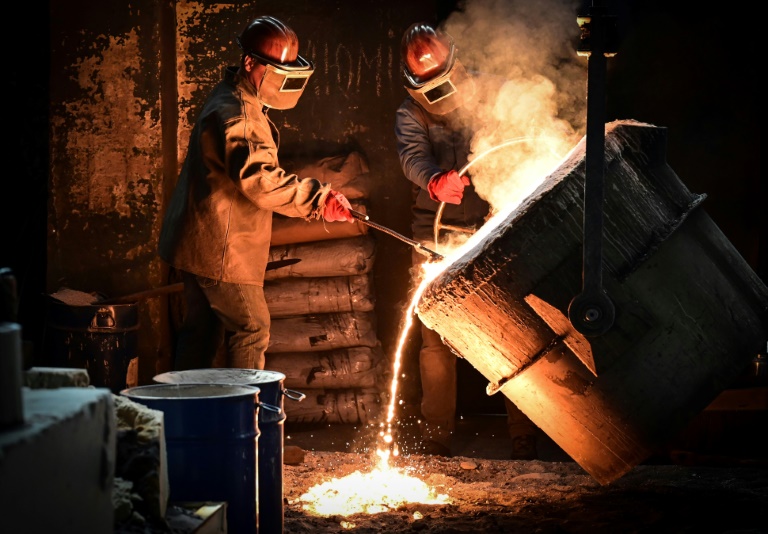
Little appears to have changed for Alexei Andrusenko, the head of a foundry in Ukraine’s southern city of Berdyansk, who is happy to have kept all his staff since Moscow took control of the city.

Andrusenko and his 50 or so employees continue showing up to work every morning to the grey building in the outskirts of the port city on the shores of the Sea of Azov.

But now the factory’s produce — once sold to Ukrainian or international steel groups — will likely be bound for Russia and Kremlin ally Belarus. 

Since Russia sent troops into Ukraine on February 24 and captured territories in the south of the pro-Western country, Moscow has sought to strengthen their economic ties.

“We have no other supply chain,” Andrusenko told AFP during a press trip organised by the Russian army.

He also raised concerns about the depleting stocks of their raw materials that previously came from neighbouring Mariupol, another key Ukrainian city on the shores of the Sea of Azov.

Andrusenko says they are “interested” in working with the Alchevsk steelworks, a large factory with over 10,000 employees that since 2014 has been under the control of pro-Russian separatists of eastern Ukraine’s Lugansk region.

Before Russia sent troops to Ukraine, these deals would never have been possible. 

“The most important thing is to build the right supply chain and to be able to work,” Andrusenko said.

– Port ‘100 percent ready’ – 

The southern Ukrainian regions of Kherson and Zaporizhzhia have been largely under Russia’s control since the first weeks of Moscow’s military campaign, and are now being forcefully integrated into Russia’s economy. 

The main economic asset of Berdyansk is its port, which has remained mostly intact unlike that of Mariupol, the scene of a devastating siege.

In late March, an attack attributed to Ukrainian forces reportedly sank a Russian warship in Berdyansk waters, but today the port is “almost 100 percent ready” to ship grain, says Alexander Saulenko, the Moscow-installed head of Berdyansk.

Ukraine has accused Russia and its allies of stealing its wheat, contributing to a global food shortage caused by grain exports blocked in Ukrainian ports.

According to Saulenko, grain will soon be shipped out from the port, since silos will need to be freed up for the new harvest.

“We have prospects for contracts with Turkey. Russia is an agricultural country, it has enough grain of its own so it would be more profitable to trade elsewhere,” Saulenko said. 

But the most tangible influence of Moscow on the local economy is the introduction of Russia’s national currency since last month.

“Now you can buy everything in both rubles and hryvna,” Ukraine’s currency, the pro-Russian official added. 

According to him, Berdyansk received some 90 million rubles ($1.7 million) from Russia, but state employees are still paid in hryvna and it is impossible to withdraw cash rubles from ATMs. 

– Ties with Russia ‘resuming’ –

Neighbouring Melitopol, about 100 kilometres (60 miles) west of Berdyansk that came under Russian control on March 1, also uses the Russian ruble that is delivered from Crimea, the Black Sea peninsula Moscow annexed from Ukraine in 2014.

“It’s a two-currency zone…. The ruble is delivered thanks to the open road to Crimea. Commercial ties with Russia, interrupted after 2014, are resuming,” says Melitopol’s pro-Russian mayor, Galina Danilchenko. 

“People are happy to accept the ruble… I don’t see any problems,” she added, but for reporters on the press trip it was difficult to speak freely with the city’s residents. 

Back at the Berdyansk foundry, 41-year-old worker Sergey Grigoryev says he just hopes to get paid his salary. 

“In cash, not to my card, because you can’t withdraw from it. In hryvnas or in rubles — I don’t care”. 

Moscow tightens economic grip on southern Ukraine

Little appears to have changed for Alexei Andrusenko, the head of a foundry in Ukraine’s southern city of Berdyansk, who is happy to have kept all his staff since Moscow took control of the city.

Andrusenko and his 50 or so employees continue showing up to work every morning to the grey building in the outskirts of the port city on the shores of the Sea of Azov.

But now the factory’s produce — once sold to Ukrainian or international steel groups — will likely be bound for Russia and Kremlin ally Belarus. 

Since Russia sent troops into Ukraine on February 24 and captured territories in the south of the pro-Western country, Moscow has sought to strengthen their economic ties.

“We have no other supply chain,” Andrusenko told AFP during a press trip organised by the Russian army.

He also raised concerns about the depleting stocks of their raw materials that previously came from neighbouring Mariupol, another key Ukrainian city on the shores of the Sea of Azov.

Andrusenko says they are “interested” in working with the Alchevsk steelworks, a large factory with over 10,000 employees that since 2014 has been under the control of pro-Russian separatists of eastern Ukraine’s Lugansk region.

Before Russia sent troops to Ukraine, these deals would never have been possible. 

“The most important thing is to build the right supply chain and to be able to work,” Andrusenko said.

– Port ‘100 percent ready’ – 

The southern Ukrainian regions of Kherson and Zaporizhzhia have been largely under Russia’s control since the first weeks of Moscow’s military campaign, and are now being forcefully integrated into Russia’s economy. 

The main economic asset of Berdyansk is its port, which has remained mostly intact unlike that of Mariupol, the scene of a devastating siege.

In late March, an attack attributed to Ukrainian forces reportedly sank a Russian warship in Berdyansk waters, but today the port is “almost 100 percent ready” to ship grain, says Alexander Saulenko, the Moscow-installed head of Berdyansk.

Ukraine has accused Russia and its allies of stealing its wheat, contributing to a global food shortage caused by grain exports blocked in Ukrainian ports.

According to Saulenko, grain will soon be shipped out from the port, since silos will need to be freed up for the new harvest.

“We have prospects for contracts with Turkey. Russia is an agricultural country, it has enough grain of its own so it would be more profitable to trade elsewhere,” Saulenko said. 

But the most tangible influence of Moscow on the local economy is the introduction of Russia’s national currency since last month.

“Now you can buy everything in both rubles and hryvna,” Ukraine’s currency, the pro-Russian official added. 

According to him, Berdyansk received some 90 million rubles ($1.7 million) from Russia, but state employees are still paid in hryvna and it is impossible to withdraw cash rubles from ATMs. 

– Ties with Russia ‘resuming’ –

Neighbouring Melitopol, about 100 kilometres (60 miles) west of Berdyansk that came under Russian control on March 1, also uses the Russian ruble that is delivered from Crimea, the Black Sea peninsula Moscow annexed from Ukraine in 2014.

“It’s a two-currency zone…. The ruble is delivered thanks to the open road to Crimea. Commercial ties with Russia, interrupted after 2014, are resuming,” says Melitopol’s pro-Russian mayor, Galina Danilchenko. 

“People are happy to accept the ruble… I don’t see any problems,” she added, but for reporters on the press trip it was difficult to speak freely with the city’s residents. 

Back at the Berdyansk foundry, 41-year-old worker Sergey Grigoryev says he just hopes to get paid his salary. 

“In cash, not to my card, because you can’t withdraw from it. In hryvnas or in rubles — I don’t care”. 

Do signs point to an Israel-Saudi normalisation deal?

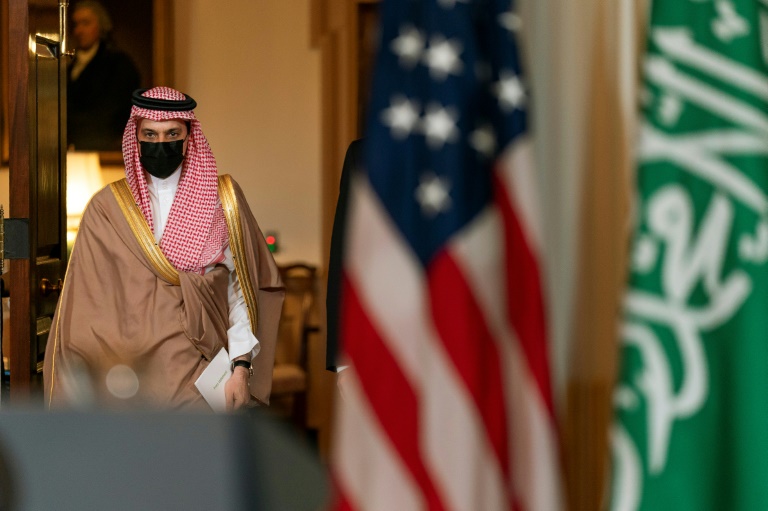
The United States has hinted that more Arab nations could take steps to improve ties with Israel, ahead of President Joe Biden’s trip to the Middle East.

All eyes are on Saudi Arabia, which Biden will visit in mid-July after he once vowed to treat the kingdom as a “pariah” state over the 2018 murder and dismemberment of Saudi journalist Jamal Khashoggi.

However, despite the recent signs of a US-Saudi rapprochement, analysts say it is improbable Riyadh will agree to diplomatic ties with Israel — not during Biden’s visit or while King Salman, 86, still reigns.

The king’s official policy is that there should be no peace with Israel until it withdraws from occupied territories and accepts Palestinian statehood.

Biden’s visit will likely focus on convincing the world’s biggest crude exporter to boost its oil output. 

Here are some questions and answers about the possibility of a normalisation deal between Saudi Arabia and Israel: 

– What are the signs? –

Saudi’s de facto ruler Crown Prince Mohammed bin Salman has said Israel was a “potential ally, with many interests that we can pursue together”, state media reported in March, attributing the statement to an interview with The Atlantic. 

Additionally, the kingdom never showed any opposition when its regional ally, the United Arab Emirates, established diplomatic ties with Israel in 2020, followed by Bahrain and Morocco under the US-brokered Abraham Accords. 

In January 2021, Sudan’s transitional government also agreed to do so but the northeast African country has yet to finalise the deal.

Saudi Arabia also at the time allowed direct flights from the Emirates to Israel to travel through its airspace, in another implicit sign of approval.

Biden, who will also visit Israel, is to travel directly from the Jewish state to Saudi Arabia, becoming the first US president to fly from there to an Arab nation that does not recognise Israel. 

In 2017 his predecessor, Donald Trump, made the journey in reverse.

In recent months, Saudis have taken to social media — which is tightly controlled in the kingdom — to express their support for normalisation, which would be a shift from the kingdom’s long-standing pan-Arab policy to isolate Israel until the conflict with the Palestinians is resolved. 

Esawi Frej, Israel’s minister of regional cooperation, told Saudi newspaper Arab News earlier in June that Riyadh would be “central” to any solution to the Israeli-Palestinian conflict. 

The Axios news website reported, also this month, that the United States was working on a “road map” for normalisation between Israel and Saudi Arabia, while The Wall Street Journal said the region’s two most influential nations were engaging in secret economic and security talks. 

– In both countries’ interests? –

Yasmine Farouk of the Carnegie Endowment for International Peace said a relationship with Israel will contribute to greater acceptance of Saudi Arabia.

“It will open doors for the crown prince, with Western people and parliaments accepting the kingdom, and granting Saudi Arabia a greater role,” she said. 

“It will make a change, whether just in regards to the image of Saudi Arabia… especially since (Prince Mohammed) sees it as a global power, not just an Arab and Islamic one.” 

She said that Israel would want normalisation “because not only will it open the door to Saudi Arabia, but to other (Arab and Muslim) countries that may already engage in secret discussions with Israel but don’t dare normalise yet.”

The two countries share a common enemy in Iran, said a Riyadh-based diplomat who spoke on condition of anonymity.

“They are looking at it in the sense of ‘the enemy of my enemy is my friend’,” he said. 

Two Saudi officials contacted by AFP refused to comment due to the “sensitivity” of the issue. 

– Is it the right time? –

Dan Shapiro, who served as former US president Barack Obama’s ambassador to Israel, told AFP he expects Biden’s trip can produce “some important steps” towards Saudi diplomatic recognition of Israel, “probably not full normalisation, but a road map that leads in that direction”.

But “not now”, said Farouk. “It’s difficult as long as King Salman is alive.

“The word ‘normalisation’ should be used more cautiously… There might be some forms of relations but going as far as the Emirates and Bahrain, I’m still a bit sceptical.”

Kristian Ulrichsen of Rice University’s Baker Institute said full diplomatic ties are likely only when Prince Mohammed becomes king. 

“In the meantime, we are likely to see a continuation of the current approach of normalising the idea that Saudi Arabia and Israel are not enemies but share certain regional and geopolitical interests,” he told AFP. 

Russians 'fully occupy' Severodonetsk, shift focus to Lysychansk

Russia’s army has “fully occupied” the key Ukrainian city of Severodonetsk after weeks of fighting, its mayor said, as Russian President Vladimir Putin pledged to send nuclear-capable missiles to Belarus within months.

As the war enters its fifth month, the capture of Severodonetsk marks an important strategic win for Moscow, which is seeking to gain full control over the east of the country after failing in its early objectives.

The industrial hub was the scene of weeks of running battles before the Ukrainian army began withdrawing its outgunned forces to better defend the neighbouring city of Lysychansk.

“The city has been fully occupied by the Russians,” Mayor Oleksandr Striuk said Saturday.

A few hours earlier, pro-Moscow separatists said Russian troops and their allies had entered Lysychansk, which faces Severodonetsk on high ground across the Donets river. Its capture would give Russia control of the entire Lugansk region of the Donbas.

“Street fighting is currently taking place,” a representative of the separatists, Andrei Marochko, said on Telegram, in a claim that could not be independently verified.

Far from the embattled Donbas, meanwhile, a flurry of Russian missiles was striking targets in northern and western Ukraine.

“More than 50 missiles of various types were fired: air, sea and ground-based,” Ukraine’s air force command said Saturday, noting the difficulty of intercepting Russian models such as the Iskander. 

Ukrainian President Volodymyr Zelensky, who will address G7 leaders on Monday, said cities as far away as Lviv, near the Polish border, had been struck.

“This confirms … that Ukraine needs more assistance with weapons, and that air defence systems — the modern systems which our partners have — should not be on the sites or in storage, but in Ukraine,” he said in his daily address.

– Pull in Belarus – 

In Saint Petersburg on Saturday, Putin said Russia would deliver Iskander-M missiles capable of carrying nuclear warheads to Belarus in the coming months, as he received Belarusian leader Alexander Lukashenko.

He also offered to upgrade Belarus’ warplanes to make them capable of carrying nuclear weapons, in comments broadcast on Russian television.

Putin has referred to nuclear weapons several times since his country invaded Ukraine on February 24, in what the West has seen as a warning to the West not to intervene.

Ukraine said it had come under “massive bombardment” Saturday morning from neighbouring Belarus which, although a Russian ally, is not officially involved in the conflict.

Twenty rockets “fired from the territory of Belarus and from the air” targeted the village of Desna in the northern Chernigiv region, Ukraine’s northern military command said.

It said infrastructure was hit, but no casualties had yet been reported.

Belarus has provided logistic support to Moscow since its February 24 invasion, particularly in the first few weeks, and like Russia has been targeted by Western sanctions.

“Today’s strike is directly linked to Kremlin efforts to pull Belarus as a co-belligerent into the war in Ukraine,” the Ukrainian intelligence service said.

– ‘Ukraine can win’ –

Russia’s weekend breakthrough in Severodonetsk came on the eve of a week of feverish Western diplomacy, as US President Joe Biden flew to Europe for a G7 summit that starts Sunday, and NATO talks later in the week.

“Ukraine can win and it will win, but they need our backing to do so,” said British Prime Minister Boris Johnson in a statement on the eve of the summit. 

“Now is not the time to give up on Ukraine.”

The Western allies will take stock of the effectiveness of sanctions imposed so far against Moscow, consider possible new aid for Ukraine, and begin turning their eye to longer-term reconstruction plans. 

The European Union offered a strong show of support on Thursday when it granted Ukraine candidate status, although the path to membership is long.

– Evacuating the Azot plant –

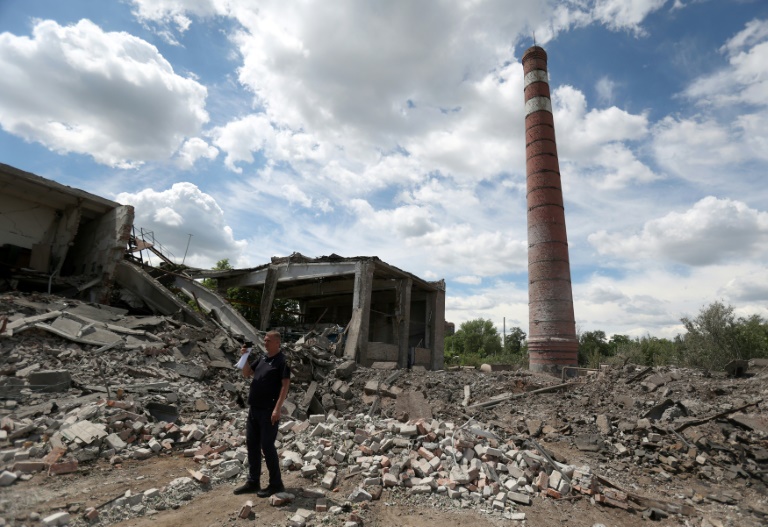
As in the southern port of Mariupol before it, the battle for Severodonetsk has devastated the city.

On Saturday, Mayor Striuk said civilians had begun to evacuate the Azot chemical plant, where several hundred people had been hiding from shelling.

“These people have spent almost three months of their lives in basements, shelters,” he said. “That’s tough emotionally and physically.”

They would now need medical and psychological support, he added.

Pro-Moscow separatists said Russian forces and their allies had taken control of the Azot factory and “evacuated” more than 800 civilians sheltering there.

Since 2014, the mainly Russian-speaking Donbas has been partially under the control of pro-Moscow separatists, who set up self-declared breakaway republics in Lugansk and Donetsk.

– ‘Finishing what they started’ –

While millions of Ukrainians have fled their homes and their country since the invasion, most to neighbouring Poland, some foreigners have gone the other way to fight.

Russia said Saturday its troops had killed up to 80 Polish fighters in strikes on a factory in Konstantinovka in the Donetsk region, a claim that could not be verified.

Russia has also intensified its offensive in the northern city of Kharkiv in recent days. 

An AFP team on Saturday saw a 10-storey administrative building in the city centre hit by missiles overnight, causing a fire but no casualties.

It had already been bombed, prompting one soldier on the scene to note: “The Russians are finishing what they started.”

Ukraine war robs India's 'Diamond City' of its sparkle

Yogesh Zanzamera lays out his bed on the floor of the factory where he works and lives, one of around two million Indians polishing diamonds in an industry being hit hard by the Ukraine war.

The air reeking from the only toilet for 35-40 people, conditions at workshops like this in Gujarat state leave workers at risk of lung disease, deteriorating vision and other illnesses.

But Zanzamera and others like him have other more immediate worries: the faraway war in Europe and the resulting sanctions on Russia, India’s biggest supplier of “rough” gemstones and a long-standing strategic ally.

“There are not enough diamonds. Because of that, there is not enough work,” Zanzamera, 44, told AFP at the workshop, situated up some dingy stairs in Surat where he has worked since leaving school at 13.

“The war should end. Everybody’s livelihood depends on the war ending.”

His monthly pay packet of 20,000 rupees ($260) is already down 20-30 percent, he says. 

But he is one of the lucky ones — the local trade union estimates that between 30,000 and 50,000 diamond workers in Surat have lost their jobs.

– Rough times –

Originally founded as a port city at the mouth of the Tapi river, Surat earned a reputation as the “Diamond City of India” in the 1960s and ’70s.

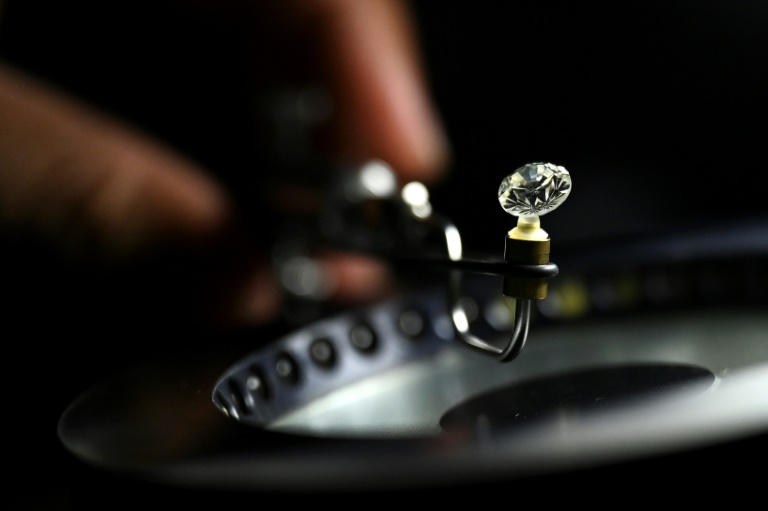
Now, some 90 percent of the world’s diamonds are cut and polished in the bustling industrial city and elsewhere in the western state of Gujarat.

Traders in Surat’s crowded Mahidharpura market openly trade diamonds worth millions of dollars on the streets each day, carrying the precious gems loose in paper wrappings.

“If it doesn’t go through Surat, a diamond is not a diamond,” said Chirag Patel, CEO of Chirag Gems.

Russian mining giants like Alrosa traditionally accounted for over a third of India’s rough diamonds, but supply has all but stopped because of Western sanctions.

For Chirag Gems, Russia was even more important, accounting for half the 900 “roughs” that his firm turns into dazzling gems that sell anywhere from $150 to $150,000.

Using state-of-the-art scanning and laser-cutting machines, his factory is better than most, with air-conditioning and exhaust systems protecting workers from inhaling dangerous dust.

But supply has shrunk to a tenth of what it was in the months since Western sanctions cut Russia off from the SWIFT international payments network in March.

“We are not getting goods from Russia because the payments system is stuck due to the war,” Patel, 32, told AFP, saying he is trying to bridge the gap with supplies from South Africa and Ghana.

– Demand at Tiffany’s –

The June-to-September wedding season in the United States is a crucial period for diamond exporters, Patel says.

The US accounted for more than 40 percent of India’s $24 billion exports of cut and polished diamonds in the financial year to March, data from the Gem and Jewellery Export Promotion Council (GJEPC) shows.

But along with supply, traders say demand from the United States and Europe, too, has nosedived in recent months as companies like Signet, Tiffany & Co, Chopard and Pandora refuse to buy diamonds sourced from Russia.

Workers like Dipak Prajapati have suffered the consequences. In May he lost a job in May that paid $320 a month to support his family of six.

“I called the company to ask when I could resume work, but they said they don’t have any work for me and told me to stay home,” the 37-year-old told AFP.

“Sixty percent of the jobs in Surat run on diamonds. Diamonds are the biggest industry in Surat. I don’t know any work other than diamonds.”

His layoff comes close on the heels of pandemic shutdowns.

“We didn’t get any salaries for six to eight months. We had to borrow money from all sides to survive and are still paying back those loans,” Prajapati said.

The Gujarat Diamond Workers’ Union has asked Gujarat’s chief minister for a 10-billion-rupee ($128-million) relief package for workers who have lost their jobs.

“We told him that if the situation does not improve in the coming days, our workers will be compelled to commit suicide,” union vice-president Bhavesh Tank said.

“Surat has given the world so much,” Tank says. “Surat has scrubbed diamonds for the entire world but our diamond workers are now getting scrubbed.”

“We can only pray to God that the war will end. If the war does not end, we don’t know how bad things will get.”

Ukraine gives ICC new purpose after 20 troubled years

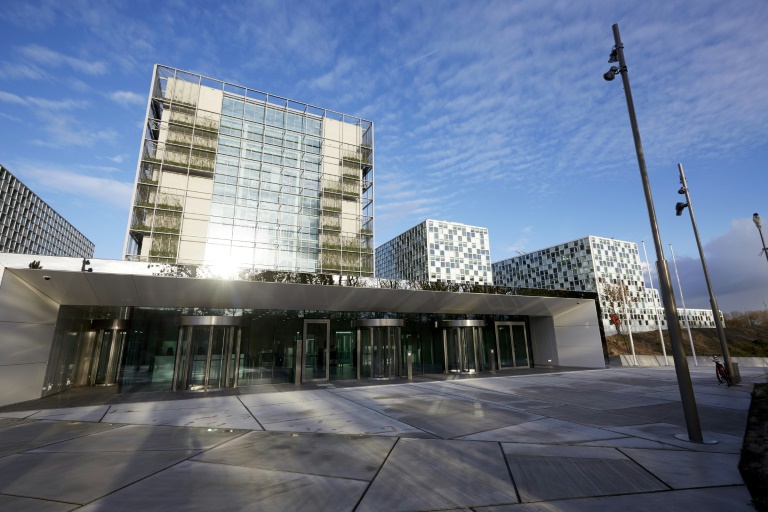
Its first two decades have brought criticism and controversy but as the International Criminal Court marks its 20th birthday the Ukraine war is giving it a new impetus.

Since its founding Rome Statute entered force on July 1, 2002, the world’s only permanent war crimes court has had a poor record of just five convictions.

The Hague-based ICC is also accused of focusing on African suspects and suffers from the absence of key countries like the United States, China, Russia and Israel.

But it remains the court of last resort for grave charges such as genocide, crimes against humanity, war crimes and aggression, when member states are unable or unwilling to prosecute.

Russia’s invasion of Ukraine has made the international community realise the importance of the rule of law, says ICC prosecutor Karim Khan.

“If we don’t hold on to the law today, I think there is very little hope for anybody’s tomorrow,” Khan told AFP.

“That growing realisation has been rendered more acute because of the events of the 24th of February and the events in Ukraine — and I think it’s long overdue.”

The ICC will hold a special 20th anniversary conference on Friday, which it says is “an occasion for reflections on how well the ICC has met expectations”.

And those expectations have always been high. 

– ‘Lofty goals’ – 

The ICC is the successor to the Nuremberg trials of Nazi war criminals, when the post-war international order sought an ideal of global justice.

Tribunals into the wars in the former Yugoslavia in the 1990s and the 1994 Rwandan genocide also laid the ground for a permanent court.

The Rome Statute was signed in 1998 and came into effect four years later, allowing the court to finally open its doors.

Yet since then, it has failed to snare any senior government leaders, and its five convictions so far have all been African rebels, including one former child soldier.

“Contemplating the ICC’s legacy in light of its lofty goals, the results are negligible,” Thijs Bouwknegt of the NIOD Institute for War, Holocaust and Genocide Studies told AFP.

It had high profile failures, with former Ivory Coast president Laurent Gbagbo being cleared, former DR Congo vice-president Jean-Pierre Bemba acquitted on appeal and Kenyan President Uhuru Kenyatta having charges dropped.

Just as damaging is the absence of key players.

The United States, which signed the Rome Statute in 2000 but never ratified it, has sometimes been actively hostile, at one point sanctioning the court over its Afghan probe.

China, Israel, Myanmar and Syria have also steered clear, along with Russia — which even allegedly sent a spy posing as an intern to target the ICC’s Ukraine probe. 

But while there was “deservedly” criticism of the ICC, the court had made a “significant contribution”, said Victoria Kerr of the Hague-based Asser Institute for International and European Law.

“The ICC is not a panacea, nor should its effectiveness be measured solely on its convictions,” Kerr told AFP.

– ‘Recipe for Armageddon’ –

In recent years the court has sought to improve.

New probes into the Israeli-Palestinian conflict, Afghanistan, Myanmar and the Philippines have taken the ICC into some of the world’s most contested conflicts.

Khan said when he took office last year that he wanted to “repair” the ICC’s record.

Bouwknegt however said Khan’s decision to “deprioritise” alleged US crimes in Afghanistan and focus on the Taliban and Islamic State “exposed that the court still curtsies to the most powerful”.

Ukraine is now where the court has a chance to prove its credentials.

Khan said the recent backing of 43 states for the ICC’s Ukraine probe was “not simply because of what’s happening in Ukraine”.

“It’s a realisation that when we view international law as an a la carte menu which states can pick and choose from … that is a recipe for Armageddon,” he told AFP.

Long under-funded and short-staffed, the ICC has had a surge in Western support since Russia’s invasion of Ukraine, including the help of dozens of foreign investigators. 

But Ukraine also throws up the same key difficulty the ICC has faced for the last two decades.

“The key challenge will be bringing high-level perpetrators before the court,” said Kerr.

Fairytale venue with dark past for G7 summit in Germany

G7 leaders will gather from Sunday in a quintessentially German venue handpicked by former chancellor Angela Merkel and recycled by her successor Olaf Scholz — a luxury hotel with a fairy-tale setting and a tumultuous past.

Elmau Castle, nestled in the Bavarian Alps, is a five-star resort that has been transformed into a fortress for the three-day meeting of the club of rich nations.

If the forecast for stormy weather holds, Scholz will have a fitting backdrop for the meeting that will have the Ukraine war, the global food crisis and the health of the world’s democracies and the planet on the agenda.

“This club for conversation began as the G6 with six countries (in the 1970s) to discuss how to deal with the oil crisis at that time,” Scholz said on Saturday.

“Now it’s important that we talk about today’s situation and ensure that we stop man-made climate change.”

At the last summit here in 2015, US president Barack Obama agreed to a village walkabout with Merkel among the feather-capped farmers and dirndl-clad women who make Bavaria famous, complete with a stop for a soft pretzel and a tall glass of beer.

Scholz, nicknamed Scholzomat for his often robotic style, is expected to stick to a tighter schedule given the crisis-packed programme.

– Arson, derailment –

G7 presidents typically choose picture-postcard spots when planning their annual summit, ideally in a remote location that is easier for police to seal off than an urban centre. Elmau Castle is no exception.

The sumptuous accommodation comes complete with 115 rooms and suites, swimming pools and spas.

To maintain security, high-level guests will be whisked by helicopter to the castle, while a ring of steel will keep the expected thousands of anti-G7 protesters at bay in the ski resort town of Garmisch-Partenkirchen, 15 kilometres (nine miles) down the road.

Some 18,000 police officers have been mobilised from across Germany, some housed for days in mountain huts near the venue. 

Scholz will be at pains to avoid the violent demonstrations that marred the Group of 20 summit in 2017 in Hamburg which nearly cost him his job at the time as the city’s mayor.

Despite the major security presence, red-faced Bavarian authorities this week admitted that eight buses used by federal police for the summit had been destroyed in an arson attack. 

State Interior Minister Joachim Hermann blamed “left-wing extremists” seeking to disrupt the event. 

A train accident earlier this month on the route to Garmisch that cost five lives also set local officials on edge. Bavarian police said they had opened a probe on suspicion of criminally negligent homicide against three railway employees over the derailment.   

– Home for Holocaust survivors –

Merkel said she picked Elmau Castle in part for the way the site’s proprietors have owned up to its Nazi-era history.

Protestant theologian and philosopher Johannes Mueller built the castle during World War I and when Adolf Hitler rose to power in 1933, Mueller pledged allegiance to the new Fuehrer although he never joined the Nazi party.

But he openly criticised the Nazis’ rabid anti-Semitism as a “disgrace for Germany”, according to the hotel’s website, which it says led to tight surveillance by the Gestapo.

After the start of World War II, he prevented his beloved hotel from being seized by the Nazi top brass for their own use by renting it out to the German army as a resort for soldiers on leave from the front.

Mueller faced prosecution after the war for “glorification of Hitler both verbally and in writing” and was convicted and lost ownership of the hotel.

Elmau Castle served as a US army hospital and later as a refuge for displaced people and Holocaust survivors in the immediate post-war years.

It says it now frequently hosts “events that contribute to German-Israeli and German-American understanding”, including lectures and debates.

Ukraine, hunger, inflation: G7 leaders navigate myriad of crises

G7 leaders including US President Joe Biden gather on Sunday in southern Germany, seeking emphatic backing for Ukraine against Russia’s invasion while grappling with the intensifying global fallout of the war.

From soaring inflation to a looming food crisis and energy shortages, the conflict in Ukraine, now in its fifth month, has mired the world in a series of crises.

As the leaders of the Group of Seven most industrialised nations meet at the Bavarian alpine resort Elmau Castle, they will also be confronted with the looming threat of recession as well as pressures over climate change.

On the eve of the gathering, thousands of protesters marched in Munich, about 100 kilometres (60 miles) away, warning leaders against rolling back on climate commitments amid tensions on the energy market as Russia slashes supplies to Europe.

Striking a confident tone, German Chancellor Olaf Scholz, who is hosting the summit, said: “We can make important decisions… if we act as one and with determination.”

– ‘Don’t give up’ –

Scholz and his counterparts have been locked in months of emergency action since Russia sent in troops to Ukraine on February 24. 

While Western allies have hammered the Russian economy with unprecedented sanctions, President Vladimir Putin’s troops have been digging in their heels for a drawn-out war. 

Ahead of the talks, British Prime Minister Boris Johnson urged allies not to waver in their support.

“Ukraine can win and it will win. But they need our backing to do so. Now is not the time to give up on Ukraine,” he said, as Britain announced another $525 million in guarantees for World Bank lending later this year.

Ukrainian President Volodymyr Zelensky will make the same plea when he joins in via video-link on Monday.

John Kirby, National Security Council spokesman at the White House, said the G7 will be seeking to hold Russia accountable and to increase the costs and consequences of the war on Putin and his economy.

At the same time, they will be seeking to minimise “as much as possible the effect of these rising oil prices and the way (Putin) has weaponised energy”.

The fallout on the economy will be at the centre of the G7’s opening session.

Just six months back, the global economy had been poised for a huge post-pandemic recovery but it was now staring down the barrel of a recession.

“Core problems that are on the top of mind for all of us” include “rising prices, supply chain disruptions all exacerbated by this war in Ukraine”, said Kirby.

– Systemic rival –

Scarred by a reliance on Russian energy that has hampered several European nations including Germany and Italy from going all out to punish Putin’s Russia, the West was also warily looking at China — which it views as a systemic rival.

The G7 leaders, who will head to Madrid right after the summit in Bavaria for a gathering of NATO powers, will also begin addressing the challenges posed by China.

“The impact that China’s coercive economic practices, use of forced labour, intellectual theft — all those are front and centre for the G7, and I think you’re going to see China very much at the forefront as the G7 goes on,” said Kirby.

As the gulf separating Western allies from Russia and China widens, the G7 will also be looking to broaden its base.

To this end, Scholz has invited the leaders of Argentina, India, Indonesia, Senegal and South Africa to the alpine summit.

While Argentina and Indonesia voted at a crucial UN vote to condemn Russia, the other three abstained.

But all are being directly hit by a looming hunger crisis sparked by the holdup in grain and wheat exports from Ukraine, and India for instance has imposed restrictions on wheat exports.

“We need to keep lines of trade open for products and avoid excessive stockpiling,” noted Kirby.

– Domestic woes –

For many of the G7 leaders, the crises facing the world also provide a distraction from domestic woes. 

French President Emmanuel Macron has been weakened at home after his movement failed to obtain an absolute majority at legislative elections a week ago.

Johnson’s Conservatives meanwhile suffered crushing defeats in two by-elections and a staunch ally stepped down after a slew of scandals.

Biden was faced with greater divisions in the US political landscape after the Supreme Court struck down the right to abortion, at a time when he was already struggling to deal with galloping inflation sparked by sky-high oil prices.

Close Bitnami banner
Bitnami