World

Myanmar junta trial of Australian economist shifted to prison complex: source

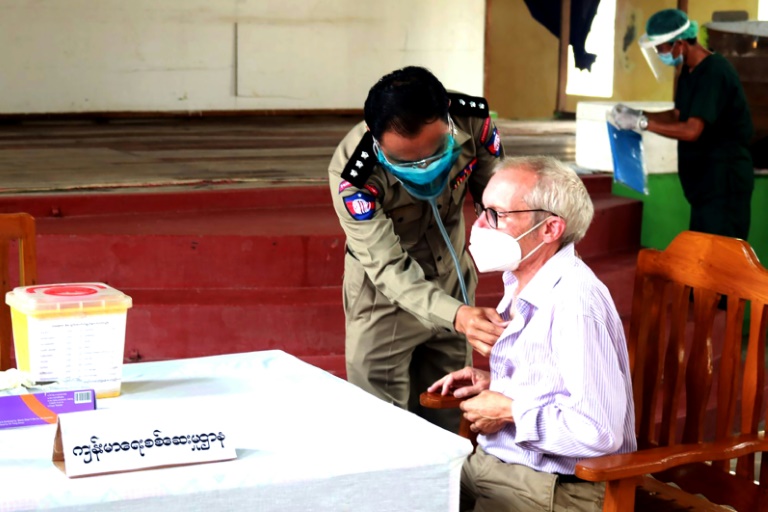
The Myanmar junta’s trial of a detained Australian economist will shift to a special court inside a prison compound in the capital Naypyidaw, a source with knowledge of the case said on Wednesday.

Sean Turnell was working as an adviser to Myanmar’s civilian leader Aung San Suu Kyi when he was detained shortly after the coup that ousted her government in February last year.

He has been charged with violating the country’s official secrets law and faces a maximum penalty of 14 years in prison if found guilty.

Since seizing power, Myanmar’s military government has detained thousands of pro-democracy protesters, with many facing secret trials that rights groups have decried as politically motivated.

Turnell and co-accused Aung San Suu Kyi had earlier appeared at weekly hearings in a special court in a municipal compound in the sprawling capital.

But both would appear on Thursday at a “special court in Naypyidaw prison”, said a source with knowledge of the case, without giving further details.

A junta spokesperson could not be reached for comment.

Hearings for Aung San Suu Kyi’s numerous other trials — which could see her sentenced to more than 150 years in prison — have already been transferred to the same prison compound, a source told AFP on Tuesday.

The exact details of Turnell’s alleged offence have not been made public, although state television has said he had access to “secret state financial information” and had tried to flee the country.

Human rights groups have raised concerns about Turnell’s prosecution, particularly after the Australian embassy was denied access to his court hearing last September.

Turnell was in the middle of a phone interview with the BBC when he was detained after the coup.

“I’ve just been detained at the moment, and perhaps charged with something, I don’t know what that would be, could be anything at all of course,” Turnell told the broadcaster at the time.

Passenger jet catches fire while landing at Miami airport

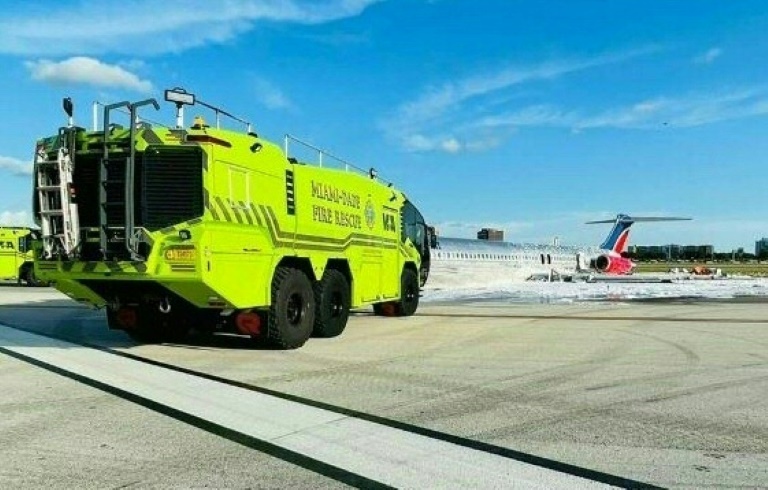
Investigators were headed to Miami Wednesday after a passenger jet’s landing gear collapsed and it caught fire as it touched down at the US city’s international airport, forcing 140 people to flee the burning and mangled aircraft.

Three people were hospitalized after the crash of Red Air Flight 203 late Tuesday, according to Miami-Dade fire officials, but no deaths or serious injuries have been reported among those on board.

Dramatic video footage showed people being evacuated from the McDonnell Douglas MD-82 aircraft, lying askew on the runway with its nose crumpled as thick black smoke billows from its body.

Red Air, a Dominican budget carrier which only launched in November last year, said the plane was arriving from Santo Domingo when it met with “technical difficulties.”

“Red Air #203 from Santo Domingo had its landing gear in the nose of the plane collapse, which seems to have caused a fire,” said a statement on the Miami International Airport’s Twitter account.

The National Transportation Safety Board (NTSB), the US government agency in charge of probing civil aviation accidents, tweeted that its team would arrive in Miami on Wednesday.

Red Air said there were 130 passengers and 10 crew on board. 

New UK statue unveiled to post-war Caribbean migrants

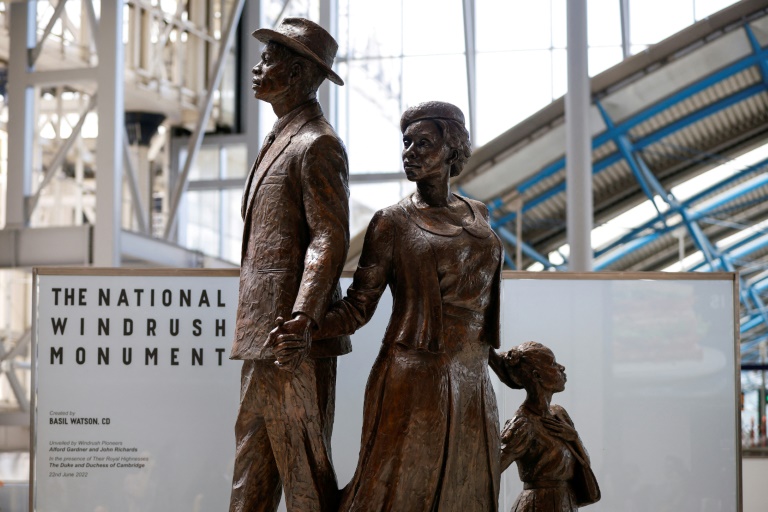
Prince William on Wednesday unveiled a new national monument to the “Windrush” generation of Caribbean migrants who moved to Britain following World War II, praising their “immense contribution” to national life.

The 12-foot (3.65-metre) bronze statue, which depicts a man, woman and child standing on top of suitcases, will greet millions of rail commuters at London’s Waterloo station.

“Over the past seven decades, the Windrush Generation’s role in the fabric of our national life has been immense,” said William.

“Every part of British life is better for the half a million men and women of the Windrush Generation.

“I want to say a profound thank you to every member of that generation, and the generations that have followed,” he added.

The decision to erect a monument followed a scandal that first emerged in 2017 and caused much soul-searching about racism past and present in Britain.

Campaigners revealed that thousands of Britons of Caribbean origin, who arrived legally between 1948 and the early 1970s, had been wrongly detained or deported under the government’s hardline immigration policies.

The government then announced that “Windrush Day” would be celebrated each year on June 22, and that it was contributing £1 million ($1.22 million) in funding for a national statue.

Jamaican artist Basil Watson was chosen by a Windrush Commemoration Committee from an initial long list of 16 artists to create the work. 

Watson said the monument recognised the “dreams and aspirations, courage and dignity, skills and talents” of the Windrush generation.

“My parents, along with a great many others, took the long arduous voyage from the Caribbean with very little or nothing other than their aspirations, their courage and a promise of opportunity for advancement.

“This monument tells that story of hope, determination, a strong belief in selves and a vison for the future,” he added.  

Watson’s own parents were members of the Windrush generation and he spent part of his childhood in Britain.

The community is named after the MV Empire Windrush ship, one of the vessels that brought workers from Jamaica, Trinidad and Tobago, and other islands to help fill post-war UK labour shortages during that period.

Cleaner, piano tuner: French parliament's fresh faces

A wave of new French MPs with more diverse profiles, including a cleaner and a blind piano tuner, are heading to parliament after legislative elections that saw President Emmanuel Macron lose his majority.

The centrist president’s setback came amid a surge in support for the hard left France Unbowed (LFI) and far right National Rally (RN) — the political homes of the new MPs from a working-class background who stand out in a sea of career politicians. 

The freshly-elected MPs are out to make their mark on the new parliament where opposition parties will have more room to make an impact than in the previous one where Macron enjoyed a large majority. 

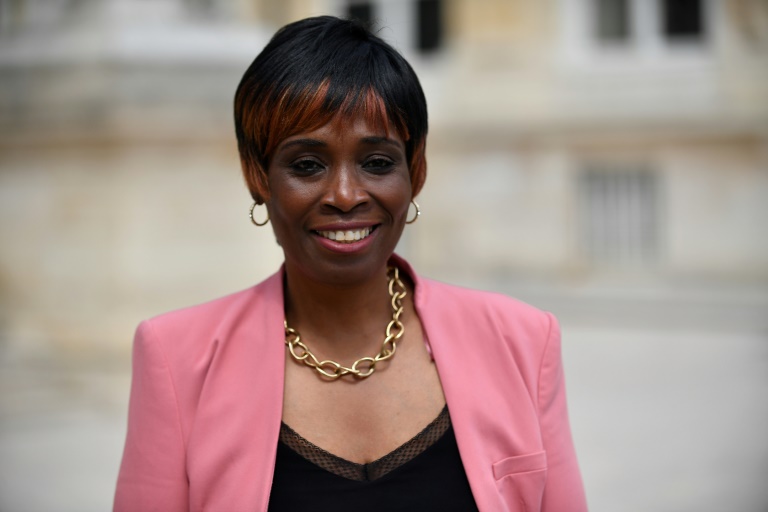
Former cleaner Rachel Keke beat Macron’s former sports minister Roxana Maracineanu after running on a left-wing alliance ticket led by LFI’s leftist firebrand Jean-Luc Melenchon. 

“I am the voice of the voiceless,” Keke said on Sunday after the results came in. 

“I am a maid, I am a cleaner, security guard, care assistant, home help, I am all these invisible jobs,” she added, promising these jobs would be visible with her in the lower house parliament. 

Keke made a name for herself after winning a gruelling battle for better working conditions in the Paris hotel where she cleaned.

LFI MPs supported Keke and her colleagues throughout the fight against global hotel giant Accor and have made the defence of France’s “invisible workers” a priority. 

-‘Average person on the street’-

National Rally’s new MP Katiana Levavasseur is also a former cleaner. 

She says she wants to defend “the employment of France’s unskilled workers who like me get up early in the morning to earn 11.75 euros ($12.40) an hour”.  

Since taking over from her father Jean Marie as leader of the then-National Front, Marine Le Pen has sought to widen her base of support by focusing on social and economic issues.

As a consequence the party has attracted profiles from lower economic backgrounds, such as delivery driver Jorys Bovet, 29, who says he wants to fight against poverty and deindustrialisation. 

“I’ve worked since I was 16,” he told the daily local La Montagne paper.

“I know the lives of the average person on the street, and I can see that purchasing power has been decreasing in the past few years,” Bovet added.

Critics still accuse the anti-immigration National Rally of being extremist, a charge Le Pen vehemently rejects. 

New RN MP Jose Beaurain, 50, also from a working-class background, is the first blind MP to enter parliament.

Beaurain used to work in a music shop as a piano tuner and is also a former bodybuilding vice-champion for France.

-‘Strict setting’-

Beyond a wave of working class profiles, the new parliament will also usher in the youngest-ever MPs, both 21 and from LFI — Tematai Le Gayic, elected to represent French Polynesia and law student Louis Boyard, who ran in the outskirts of Paris.

25-year-old Charles Rodwell, who says he used to write Finance Minister Bruno Le Maire’s speeches, will also be making his entrance to the Bourbon-Palace for Macron’s Ensemble (Together) coalition. 

But the string of young MPs will not lower the average age of the new parliament, which stands at 48.5, only slightly lower than in 2017 when it was 48.8. 

In another sign not everything has changed, some 37.26 percent of the new MPs are women, slightly less than in 2017 when 224 women were elected against the 215 this time round. 

And despite the high-profile cases such as Rachel Keke, MPs from a high socio-economic background remain the rule in the new parliament. 

Sociologist Etienne Ollion, professor at the Paris-based Ecole Polytechnique, says that introducing fresh profiles will not necessarily impact policy. 

“We don’t produce political change by changing only the faces but keeping the relatively strict rules,” he said.

“The institution imposes itself on the individuals, they’re in a very strict setting,” Ollion added. 

burs-ech/sjw/jv

At least 1,000 killed in Afghan quake as rescuers scramble for survivors

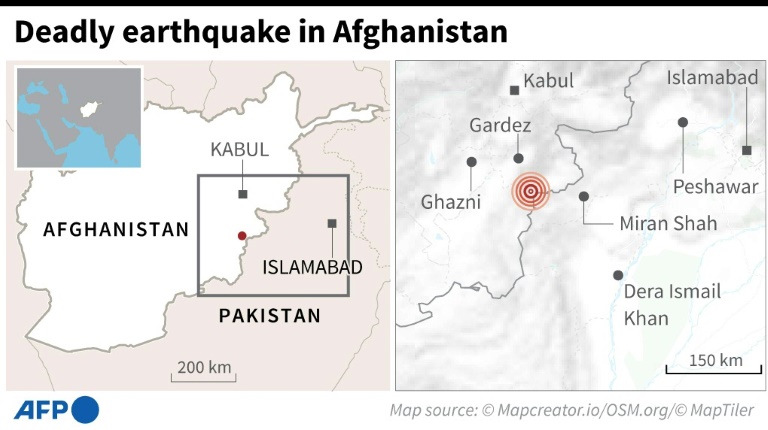
A powerful earthquake struck a remote border region of Afghanistan overnight killing at least 1,000 people and injuring hundreds more, officials said Wednesday, with the toll expected to rise as desperate rescuers dig through collapsed dwellings.

The 5.9 magnitude quake struck hardest in the rugged east, where people already lead hardscrabble lives in a country in the grip of a humanitarian disaster made worse by the Taliban takeover in August.

“People are digging grave after grave,” said Mohammad Amin Huzaifa, head of the Information and Culture Department in hard-hit Paktika, adding that at least 1,000 people had died in that province alone.

“It is raining also, and all houses are destroyed. People are still trapped under the rubble,” he told journalists.

The death toll climbed steadily all day as news of casualties filtered in from hard-to-reach areas in the mountains, and the country’s supreme leader, Hibatullah Akhundzada, warned it would likely rise further.

Earlier, a tribal leader from Paktika said survivors and rescuers were scrambling to help those affected.

“The local markets are closed and all the people have rushed to the affected areas,” Yaqub Manzor told AFP by telephone.

Photographs and video clips posted on social media showed scores of badly damaged mud houses in remote rural areas.

Some footage showed local residents loading victims into a military helicopter.

– Offers of help –

Even before the Taliban takeover, Afghanistan’s emergency response teams were stretched to deal with the natural disasters that frequently struck the country.

But with only a handful of airworthy planes and helicopters left since the hardline Islamists returned to power, any immediate response to the latest catastrophe is further limited.

“The government is working within its capabilities,” tweeted Anas Haqqani, a senior Taliban official.

“We hope that the International Community & aid agencies will also help our people in this dire situation.”

The United Nations and European Union were quick to offer assistance.

“Inter-agency assessment teams have already been deployed to a number of affected areas,” the UN Office for the Coordination of Humanitarian Affairs (UNOCHA) in Afghanistan tweeted.

Tomas Niklasson, EU special envoy for Afghanistan, tweeted: “The EU is monitoring the situation and stands ready to coordinate and provide EU emergency assistance to people and communities affected.”

Afghanistan is frequently hit by earthquakes — especially in the Hindu Kush mountain range, which lies near the junction of the Eurasian and Indian tectonic plates.

Scores of people were killed and injured in January when two quakes struck rural areas in the western province of Badghis, damaging hundreds of buildings.

In 2015, more than 380 people were killed in Pakistan and Afghanistan when a 7.5-magnitude earthquake ripped across the two countries, with the bulk of the deaths in Pakistan.

From the Vatican City, Pope Francis offered prayers for the victims of the latest quake.

“I express my closeness with the injured and those who were affected,” the 85-year-old pontiff said at the end of his weekly audience.

Aid agencies and the United Nations say Afghanistan needs billions of dollars this year to tackle its ongoing humanitarian crisis.

Aid agencies have particularly stressed the need for greater disaster preparedness in Afghanistan, which remains extremely susceptible to recurring earthquakes, floods and landslides.

The quake was felt as far away as Lahore in Pakistan, 480 kilometres (300 miles) from the epicentre, according to responses posted on the USGS and European Mediterranean Seismological Centre (EMSC) websites.

At least 1,000 killed in Afghan quake as rescuers scramble for survivors

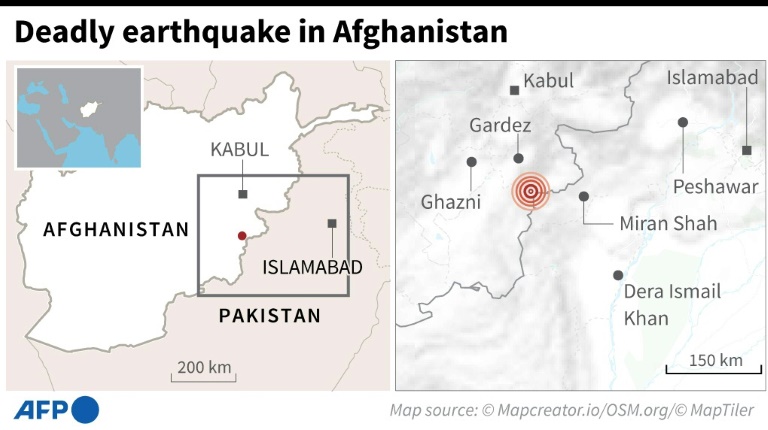
A powerful earthquake struck a remote border region of Afghanistan overnight killing at least 1,000 people and injuring hundreds more, officials said Wednesday, with the toll expected to rise as desperate rescuers dig through collapsed dwellings.

The 5.9 magnitude quake struck hardest in the rugged east, where people already lead hardscrabble lives in a country in the grip of a humanitarian disaster made worse by the Taliban takeover in August.

“People are digging grave after grave,” said Mohammad Amin Huzaifa, head of the Information and Culture Department in hard-hit Paktika, adding that at least 1,000 people had died in that province alone.

“It is raining also, and all houses are destroyed. People are still trapped under the rubble,” he told journalists.

The death toll climbed steadily all day as news of casualties filtered in from hard-to-reach areas in the mountains, and the country’s supreme leader, Hibatullah Akhundzada, warned it would likely rise further.

Earlier, a tribal leader from Paktika said survivors and rescuers were scrambling to help those affected.

“The local markets are closed and all the people have rushed to the affected areas,” Yaqub Manzor told AFP by telephone.

Photographs and video clips posted on social media showed scores of badly damaged mud houses in remote rural areas.

Some footage showed local residents loading victims into a military helicopter.

– Offers of help –

Even before the Taliban takeover, Afghanistan’s emergency response teams were stretched to deal with the natural disasters that frequently struck the country.

But with only a handful of airworthy planes and helicopters left since the hardline Islamists returned to power, any immediate response to the latest catastrophe is further limited.

“The government is working within its capabilities,” tweeted Anas Haqqani, a senior Taliban official.

“We hope that the International Community & aid agencies will also help our people in this dire situation.”

The United Nations and European Union were quick to offer assistance.

“Inter-agency assessment teams have already been deployed to a number of affected areas,” the UN Office for the Coordination of Humanitarian Affairs (UNOCHA) in Afghanistan tweeted.

Tomas Niklasson, EU special envoy for Afghanistan, tweeted: “The EU is monitoring the situation and stands ready to coordinate and provide EU emergency assistance to people and communities affected.”

Afghanistan is frequently hit by earthquakes — especially in the Hindu Kush mountain range, which lies near the junction of the Eurasian and Indian tectonic plates.

Scores of people were killed and injured in January when two quakes struck rural areas in the western province of Badghis, damaging hundreds of buildings.

In 2015, more than 380 people were killed in Pakistan and Afghanistan when a 7.5-magnitude earthquake ripped across the two countries, with the bulk of the deaths in Pakistan.

From the Vatican City, Pope Francis offered prayers for the victims of the latest quake.

“I express my closeness with the injured and those who were affected,” the 85-year-old pontiff said at the end of his weekly audience.

Aid agencies and the United Nations say Afghanistan needs billions of dollars this year to tackle its ongoing humanitarian crisis.

Aid agencies have particularly stressed the need for greater disaster preparedness in Afghanistan, which remains extremely susceptible to recurring earthquakes, floods and landslides.

The quake was felt as far away as Lahore in Pakistan, 480 kilometres (300 miles) from the epicentre, according to responses posted on the USGS and European Mediterranean Seismological Centre (EMSC) websites.

Israel lawmakers give initial approval for early election

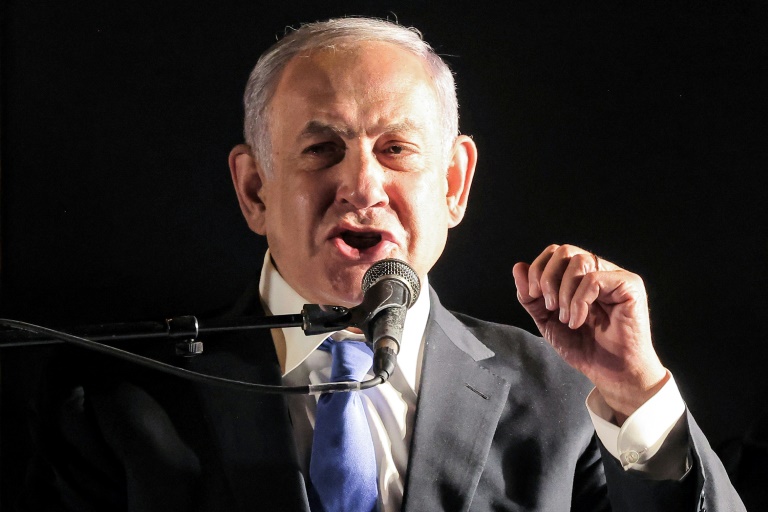
Israeli lawmakers voted overwhelmingly Wednesday to advance legislation to dissolve parliament and call an early election, after Prime Minister Naftali Bennett said his eight-party coalition was no longer tenable.

The government has said it wants to fast-track parliament’s dissolution but the opposition led by ex-premier Benjamin Netanyahu may attempt to derail the process, in a bid to form a replacement government without the need for what would be Israel’s fifth election in less than four years.

The government’s bill still needs to pass a committee vote and three further votes in the full parliament before an early election is called.

In a complex day of legislative manoeuvres that included fiery debate, Israel’s parliament gave near unanimous approval to 11 separate bills to dissolve parliament, drafted by both coalition and opposition lawmakers.  

The bills are expected to be united into one, but timelines for that process remain unclear and could depend on Netanyahu’s political calculations. 

If final dissolution legislation is approved, new elections could held in late October or early November, according to Israeli reports. 

Foreign Minister Yair Lapid would take charge as prime minister of a caretaker government, in accordance with a power-sharing deal he reached with Bennett after 2021 elections, when the pair forged an alliance of ideological rivals united in their desire to oust Netanyahu. 

Netanyahu has cheered the coalition’s collapse and vowed to form a new right-wing government, with or without fresh elections.

His Likud party has been courting potential defectors from coalition ranks to give him the parliamentary majority he needs for a snap return to power.

Those being wooed include religious nationalists from within Bennett’s own Yamina party and hawks from Justice Minister Gideon Saar’s New Hope party. 

“Until the dissolution law is finalised there’s still the option of an alternate government, a government headed by Netanyahu,” Likud lawmaker Miri Regev told army radio. 

A slew of opinion polls conducted after Bennett’s shock announcement late Monday that his coalition could no longer govern pointed to gridlock between supporters and opponents of Netanyahu. 

Four separate polls found that neither bloc would secure the 61 seats needed for a majority in the 120-seat parliament.

Key Ukrainian city under 'massive' Russian bombardment

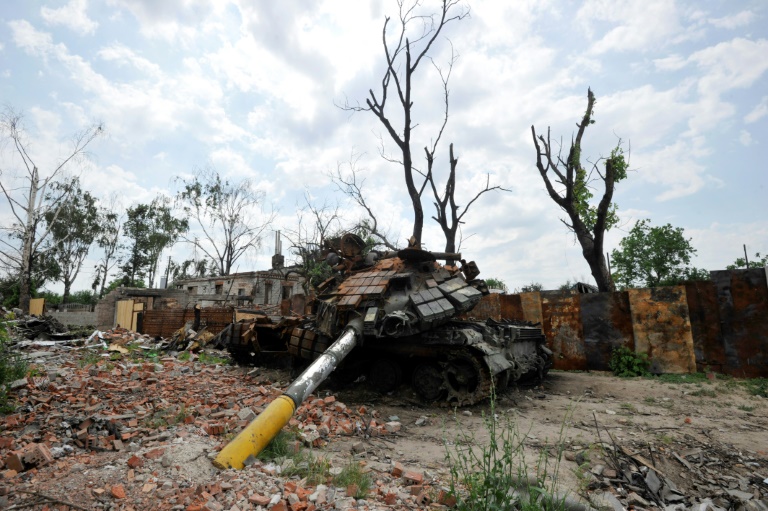
“Massive” Russian bombardment of Ukraine’s battleground eastern Lugansk region and key city Severodonetsk has been “hell” for soldiers there, Kyiv said, while insisting that defenders would hold “as long as necessary”.

Moscow’s troops have been pummelling eastern Ukraine for weeks and are slowly advancing, despite fierce resistance from the outgunned Ukrainian military. 

With President Vladimir Putin’s forces tightening their grip on the strategically important city of Severodonetsk in the Donbas, its twin city of Lysychansk is now coming under heavier bombardment.

“The Russian army is massively shelling Lysychansk,” Sergiy Gaiday, governor of the Lugansk region, which includes both cities, wrote on Telegram.

“They are just destroying everything there… They destroyed buildings and unfortunately there are casualties.”

He later wrote that “it’s just hell out there” after four months of shelling in Severodonetsk, across the Donets river — while adding that “our boys are holding their positions and will continue to hold on as long as necessary”.

Russian forces have been occupying villages in the area, and taking control of the two cities would give Moscow control of the whole of Lugansk, allowing them to press further into the Donbas.

After being pushed back from Kyiv and other parts of Ukraine following their February invasion, Moscow is seeking to seize a vast eastern swathe of the country.

In a briefing Wednesday, the Russian defence ministry claimed responsibility for a missile strike it said killed a number of Ukrainian troops in southern Mykolaiv.

In central Ukrainian city Zaporizhzhia, women were training to use Kalashnikov assault rifles in urban combat as Russian forces edged nearer.

“Of course, when you can do something, it’s not so scary to take a machine gun in your hands,” said Ulyana Kiyashko, 29, after moving through an improvised combat zone in a basement.

– ‘Simply destroys’ –

In his daily address Tuesday, Ukrainian President Volodymyr Zelensky also accused the Russian army of “brutal and cynical” shelling in the eastern Kharkiv region. 

“The Russian army is deaf to any rationality. It simply destroys, simply kills,” he said. 

Fifteen people were killed by Russian shelling in Kharkiv Tuesday, its governor said.

Aid group Doctors Without Borders (MSF) said it had gathered accounts of an “outrageous lack of care to distinguish and protect civilians”.

Among hundreds of patients evacuated by train, more than 40 percent were elderly people or children.

Most said Russian or Russian-backed forces were to blame for a spectrum of gruesome injuries.

“Although we cannot specifically point to an intention to target civilians, the decision to use heavy weaponry en masse on densely populated areas means that civilians are inescapably, and are therefore knowingly, being killed and wounded,” said MSF emergency coordinator Christopher Stokes.

On the Russian side, authorities in the Ukraine-bordering Rostov region said Wednesday that a fire at an oil refinery might have been caused by a drone strike, saying parts of unmanned aircraft had been found at the scene.

Away from the battlefield, Moscow was locked in an increasingly bitter dispute with EU member Lithuania over the country’s restrictions on rail traffic to the Russian outpost of Kaliningrad.

The territory is around 1,000 miles (1,600 kilometres) from Moscow, bordering Lithuania and Poland.

By blocking goods arriving from Russia, Lithuania says it is simply adhering to European Union-wide sanctions on Moscow.

But Moscow accused Brussels of an “escalation” and summoned the EU’s ambassador to Russia.

The United States made clear its commitment to Lithuania as an ally in NATO, which considers an attack against one member an attack on all.

“We stand by our NATO allies and we stand by Lithuania,” State Department spokesman Ned Price told reporters in Washington.

With US-Russia tensions soaring, the State Department on Tuesday confirmed a second American, 52-year-old Stephen Zabielski, was killed fighting for Ukraine.

Two other Americans were captured last week in eastern Ukraine. 

A White House spokesman, John Kirby, voiced alarm at Russian statements that it would not apply the Geneva Conventions on the humane treatment of prisoners to the pair.

“It’s appalling that a public official in Russia would even suggest the death penalty for two American citizens that were in Ukraine,” Kirby told reporters.

In a swipe at Washington, Moscow authorities announced that the official address of the US embassy there had been changed to “1 Donetsk People’s Republic Square” after the name of the breakaway Ukrainian region won a public poll.

Meanwhile in Brussels, ministers unanimously agreed Tuesday to grant Ukraine and neighbour Moldova candidate status for membership in the European Union.

Also on the diplomatic front, Moscow complained that its delegates to an Organization for Security and Cooperation in Europe (OSCE) assembly in Britain next month had been refused UK visas.

– ‘Fight for weapons’ –

Western nations have been pumping billions of dollars of weapons into Ukraine, where Defence Minister Oleksiy Reznikov tweeted that powerful German-made Panzerhaubitze 2000 howitzer artillery had reached his country’s forces.

But Zelensky reiterated Ukrainian calls for faster deliveries of weapons. 

“The lives of thousands of people depend directly on the speed of our partners,” he said in his daily address.

Ukraine meanwhile said it struck a Black Sea oil drilling platform off the Crimea peninsula because Russia was using it as a military installation. 

Ukrainian officials say the rig was being used for military purposes.

burs-sr/tgb/sjw/gw

'We must defend our families': In Zaporizhzhia, women learn urban combat

Down at a shooting range in Zaporizhzhia in south-eastern Ukraine, six women are learning how to use Kalashnikov assault rifles as part of an urban combat training programme.

Crouching down behind makeshift walls, one takes aim at a target in the distance, before scurrying over to another position. Most are young and many are dressed in olive-green fatigues.

It’s their third session at “The Sixth Sense”, a security training centre in the city where a team of experts has just set up the scheme teaching women gun skills and urban combat tactics.

With the fighting edging ever closer to the city, 47-year-old Natalia Basova didn’t think twice about signing up.

For her, the front line is just too close. 

“I knew how to use weapons before the war. I used to visit shooting ranges, I was very interested,” says Basova, who is on the course with her 29-year-old daughter Ulyana Kiyashko.

“But now everyone needs to know about it,” she says, wincing at the loud crack of a gunshot behind her.

Basova’s husband and son are now on the front line, as is her son-in-law. While their men are out fighting, she and her daughter are trying to learn as much as they can about urban combat.

“Our instructor teaches us how to take aim and how to use a weapon correctly,” she told AFP.

“We knew how to shoot but we didn’t know to do it properly, so you don’t injure your companions.”

Until now, the centre has only been training military personnel or territorial defence fighters.

But more and more women are coming forward to be trained in Zaporizhzhia so they are prepared if Russian forces push into the city.

Under martial law, the training is free for all of the city’s residents.

– ‘We won’t let the city down’ –

Sergey Yelin, who set up the training centre, says the basic course involves teaching students how to stand and take aim, trigger control techniques, breathing and different ways of firing weapons. 

For women, the programme lasts 15 hours but he says the basic course can be mastered in five or six.

“We put together a few tactical exercises for civilians because we all know that if the enemy enters the city, there is street fighting,” said Yelin, 47.

“And that usually happens in difficult locations like ruined houses, in basements or inside shops.”

The instructors work with both the military and civilians offering training in three areas: basic weapons handling, a specialised course and a tactical element for Kalashnikov assault rifles, normally for the special forces. 

Since the Russian invasion began on February 24, some 4,000 people have been trained at the centre. 

“We need to know how to do this for ourselves and for our families because we are right on the front line,” says 33-year-old Yana Piltek, another student. 

Piltek says she is not afraid of fighting and wouldn’t hesitate to defend her hometown. 

“We are training to win in a fight in the city. And if it comes to it, we won’t let the city down.” 

Macron struggles to find compromise in France impasse

French President Emmanuel Macron pressed on with efforts Wednesday to end the crisis created by his failure to retain a parliamentary majority but with no solution in sight to an impasse that jeopardises his reform plans.

Macron’s centrist alliance finished Sunday’s parliamentary elections 44 seats short of a majority in the National Assembly, as a new left-wing coalition and the far-right made major gains.

The situation has called into question Macron’s plans for reform in his second term after his April presidential re-election — including a key measure to reduce the retirement age — and risks denting his international stature.

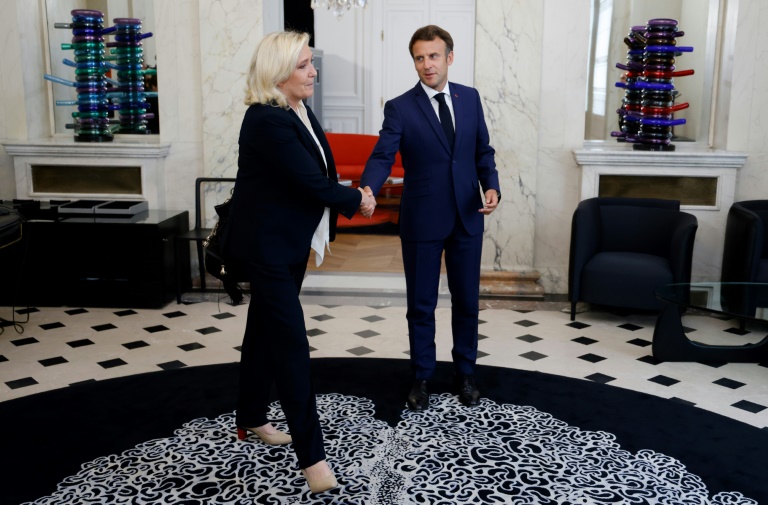
On Tuesday, Macron hosted rare talks at the Elysee Palace with opposition leaders, including the head of the far-right National Rally (RN) Marine Le Pen, to find a way out of the crisis.

He will meet other leaders on Wednesday, though the head of the left-wing NUPES alliance, hard-leftist Jean-Luc Melenchon is sending MP Adrien Quatennens, 32, to represent him in a clear snub to the president.

The meetings so far appear to have made little headway, and Macron has also rejected an offer from under-fire PM Elisabeth Borne to resign.

“The unfindable compromise? Emmanuel Macron is trying to regain the initiative but no consensus has been found,” said the right-wing Le Figaro daily.

– National unity government? –

Analysts have said the most viable solution would be a deal between Macron’s centrist alliance and the right-wing Republicans (LR), a party on the decline but which still won 61 seats.

But after talks with Macron on Tuesday, LR leader Christian Jacob ruled out any kind of “pact” with Macron’s Together alliance.

Former prime minister Edouard Philippe, whose Horizons party is part of Macron’s alliance, told BFM television late Tuesday that a “grand coalition” should now be formed.

“We need to hear what the voters have said and take them seriously,” he said.

Macron has remained characteristically remote, not making any public comment so far on what commentators see as one of the biggest setbacks of his political career.

Communist party chief Fabien Roussel, who is part of the NUPES alliance and held talks with Macron on Tuesday, said after the meeting that the president had evoked a “government of national unity” as a way out.

Speaking as she introduced new MPs at parliament on Wednesday, Le Pen said the president had floated the same idea with her.

Olivier Veran, the minister in charge of relations with parliament, told BFM on Wednesday that “all options” were on the table. But he ruled out working with Le Pen’s RN or the hard-left France Unbowed (LFI) of Melenchon to find a majority.

This could be achieved, he said, either through an alliance or on a “bill by bill” basis, the government finding a majority with the help of the right or left, depending on the legislation.

Julien Bayou, the leader of the Green EELV party that is part of NUPES, said after his talks with Macron on Wednesday that his party would be in opposition. But it would vote “according to the national interest” and would put forward its own legislation on climate change.

Melenchon has threatened to file a motion of no-confidence against Borne next month, but other opposition leaders have shown less appetite for such action.

Borne, an experienced technocrat with little experience of frontline campaign politics and in office for just over month, has been widely criticised for her performance in the election.

While Macron has rejected her offer to resign, her future remains in question.

Francois Bayrou, a key Macron ally who leads the MoDem party that is part of his coalition, increased the pressure on Borne on Wednesday.

France needed a “political” prime minister, he said.

Close Bitnami banner
Bitnami