World

French minister investigated after rape allegations

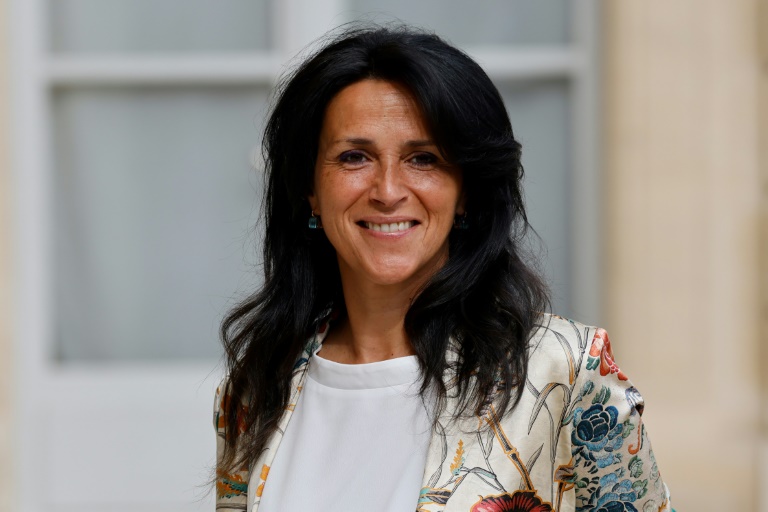
French prosecutors said on Wednesday they were investigating a junior minister in President Emmanuel Macron’s government after two allegations of rape were brought against her.

The rape allegations go back to when Chrysoula Zacharopoulou — who is now state secretary for development, Francophonie and international partnerships — still worked as a gynaecologist, according to French magazine Marianne.

One complaint was lodged May 25 and the investigation opened two days later, the prosecutors said. The second complaint was filed on June 16. Both allege that the assaults happened in the context of medical care.

Greece-born Zacharopoulou, 46, joined the government of Prime Minister Elisabeth Borne in May, having been a member of the European Parliament for the previous three years. She reports to Foreign Minister Catherine Colonna.

She gained prominence in the mid-2010s by campaigning for greater public awareness of endometriosis together with actress Julie Gayet, who this year married France’s former president Francois Hollande.

She also wrote a report on the illness for the French government.

Zacharopoulou was strongly involved in the UN’s COVAX coronavirus vaccine rollout effort, and has spoken out in favour of women’s reproductive rights.

She was a member of the European Parliament’s women’s rights commission during her time there.

Zacharopoulou studied medicine in Italy before moving to France to practice first in the Begin military hospital near Paris, and then in the Paris hospital service AP-HP.

Contacted by AFP Wednesday, AP-HP said it had no knowledge of any complaints against her.

The French foreign ministry did not respond to AFP’s requests for comment.

The accusations against Zacharopoulou are not the first rape allegations to shadow Macron’s government and come at a time of political difficulty for the president after he failed to retain an overall majority in parliamentary elections.

Prosecutors investigated Interior Minister Gerald Darmanin over an allegation for rape filed in 2017. He denied any wrongdoing and prosecutors in January asked for the case to be dropped.

Solidarities minister Damien Abad was also the target of rape allegations in a controversy that erupted last month, but French prosecutors have said they are not currently opening an investigation.
Saudi prince visits Turkey for talks clouded by Khashoggi murder

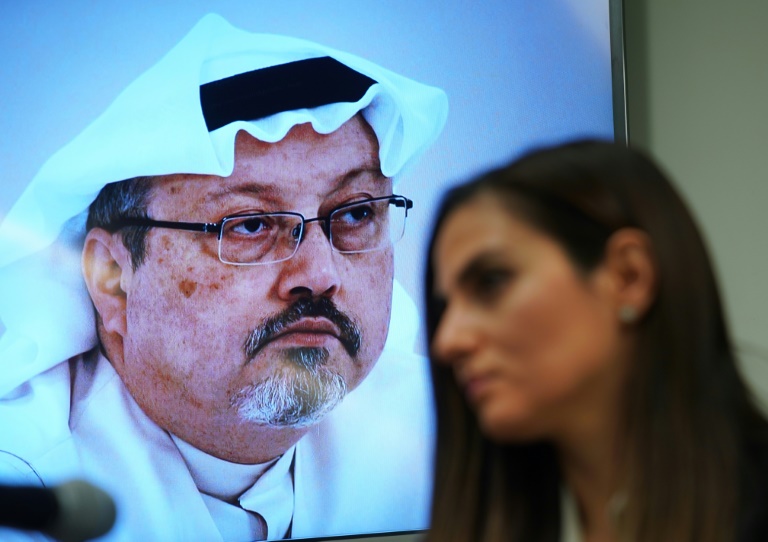
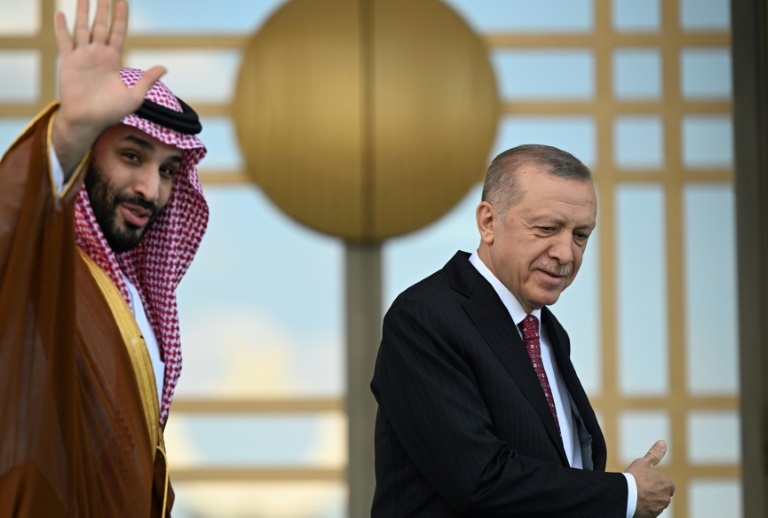
Saudi Arabia’s de facto ruler took a big step out of international isolation Wednesday, paying his first visit to Sunni rival Turkey since the 2018 murder of journalist Jamal Khashoggi in the kingdom’s Istanbul consulate.

The talks in Ankara between Crown Prince Mohammed bin Salman and Turkey’s Recep Tayyip Erdogan come one month before US President Joe Biden visits Riyadh for a regional summit. Those talks will focus on the energy crunch caused by Russia’s invasion of Ukraine.

President Erdogan’s decision to revive ties with one of his biggest rivals is driven in large part by economics and trade.

Turks’ living standards are imploding a year before a general election that poses one of the biggest challenges of Erdogan’s mercurial two-decade rule.

It was his Islamic-rooted government that released gruesome details of the Khashoggi murder, including allegations that his body had been dismembered and dissolved in acid.

But it is now drumming up investment and central bank assistance from the very countries it opposed on ideological grounds in the wake of the Arab Spring revolts.

– ‘Swallowing his pride’ 

“I think this is probably one of the most significant visits to Ankara by a foreign leader in almost a decade,” said The Washington Institute’s Turkey specialist Soner Cagaptay.

“Erdogan is all about Erdogan. He’s all about winning elections and I think he has decided to kind of swallow his pride.”

The Turkish leader personally welcomed the crown prince at his presidential palace at a grand ceremony featuring parade horses and a military honour guard.

They are scheduled to hold a private dinner but no joint press conference.

Analysts believe Prince Mohammed will be looking to see if he can win broader backing ahead of a possible new nuclear agreement between world powers and the Saudis’ arch-enemy Iran.

“There is increased confidence (in Riyadh) that Ankara could be more useful in the current geopolitical environment,” the Eurasia Group said in a research note.

Turkey’s rapprochement with the Saudis began with an Istanbul court decision in April to break off the trial in absentia of 26 suspects accused of links to Khashoggi’s killing and to transfer the case to Riyadh.

US intelligence officials have determined that Prince Mohammed approved the plot against Khashoggi — which Riyadh denies.

– ‘His bones would ache’ 

The court’s decision drew protests from Khashoggi’s Turkish fiancee Hatice Cengiz. On Wednesday, she told AFP she viewed the summit as “unacceptable”.

“If Jamal had a tomb, his bones would ache,” said Cengiz.

But the Istanbul ruling paved the way for a politically sensitive visit to Saudi Arabia by Erdogan just three weeks later.

The kingdom’s state media ended up releasing a picture of Erdogan hugging the crown prince, an image that created a furore in Turkey.

“He gets off the plane and hugs the killers,” fumed Turkey’s opposition leader Kemal Kilicdaroglu.

Ankara expects the mending of fences to help prop up the Turkish economy at a crucial stage of Erdogan’s rule.

A Turkish official said the sides would discuss a range of issues, including cooperation between banks and support for small- and medium-sized businesses.

– Lack of trust –

Erdogan’s unconventional economic approach has set off an inflationary spiral that has seen consumer prices almost double in the past year.

Analysts believe the resulting drop in Erdogan’s public approval and depletion of state reserves mean the Turkish leader can ill afford to maintain his hostile stance toward petrodollar-rich Gulf states.

Turkey’s problems with the Saudis began when Erdogan refused to accept Egyptian President Abdel Fattah al-Sisi’s ouster of the Muslim Brotherhood from power in Cairo in 2013.

The Saudis and other Arab kingdoms viewed the Brotherhood as an existential threat.

Those rivalries intensified after Turkey tried to break the nearly four-year blockade the Saudis and their allies had imposed on Qatar in 2017.

Analysts believe that Washington is watching this gradual return of regional calm with an approving nod.

“Encouraged by the United States, this rapprochement is relaxing tensions and building diplomacy across the region,” said the US-based Middle East Institute’s Turkish scholar Gonul Tol.

But Tol questioned whether Prince Mohammed was prepared to fully trust Erdogan.

The crown prince “will not easily forget the attitude adopted by Turkey after the Khashoggi affair”, she said.

Macron to address France over political impasse

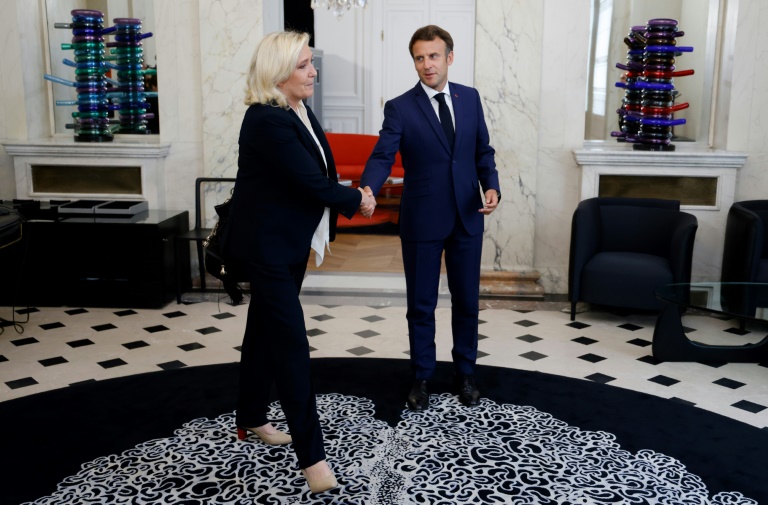
President Emmanuel Macron was to address France on Wednesday over the crisis created by his failure to retain a parliamentary majority, with no solution in sight to an impasse that jeopardises his reform plans.

Macron’s centrist alliance finished Sunday’s parliamentary elections 44 seats short of a majority in the National Assembly, as a new left-wing coalition and the far right made major gains.

The situation has called into question Macron’s plans for reform in his second term after his April presidential re-election — including a key measure to raise the retirement age — and risks denting his international stature.

Macron, who until now has kept a careful public silence on the deadlock, will make a televised address at 8:00 pm (1800 GMT), his office announced.

Over the past two days he has hosted rare talks at the Elysee Palace with opposition leaders to find a way out of the crisis.

He met the head of the far-right National Rally (RN) Marine Le Pen on Tuesday, while the head of the left-wing NUPES alliance, hard-leftist Jean-Luc Melenchon, sent MP Adrien Quatennens, 32, to represent him in talks on Wednesday in a clear snub to the president.

The meetings so far appear to have made little headway, and Macron has also rejected an offer from under-fire PM Elisabeth Borne to resign.

“The unfindable compromise? Emmanuel Macron is trying to regain the initiative but no consensus has been found,” said the right-wing Le Figaro daily.

– National unity government? –

Macron’s intervention Wednesday will be crucial for indicating his future strategy, especially as he is to be distracted by foreign policy and outside of France for much of the next week.

He is due to attend an EU summit on Thursday and Friday, then the G7 summit in Germany from Sunday and then the NATO summit in Madrid from Tuesday.

Analysts have said the most viable solution would be a deal between Macron’s centrist alliance and the right-wing Republicans (LR), a party on the decline but which still won 61 seats.

But after talks with Macron on Tuesday, LR leader Christian Jacob ruled out any kind of “pact” with Macron’s Together alliance.

Former prime minister Edouard Philippe, whose Horizons party is part of Macron’s alliance, told BFM television late Tuesday that a “grand coalition” should now be formed.

“We need to hear what the voters have said and take them seriously,” he said.

Communist party chief Fabien Roussel, who is part of the NUPES alliance and held talks with Macron on Tuesday, said after the meeting that the president had evoked a “government of national unity” as a way out of the impasse.

– ‘All options’ on table –

Speaking as she introduced new MPs at parliament on Wednesday, Le Pen said the president had floated the same idea with her.

Olivier Veran, the minister in charge of relations with parliament, told BFM on Wednesday that “all options” were on the table. But he ruled out working with Le Pen’s RN or Melenchon’s hard-left France Unbowed (LFI) to find a majority.

This could be achieved, he said, either through an alliance or on a “bill by bill” basis, with the government finding a majority thanks to certain MPs on the right or left, depending on the legislation.

Julien Bayou, the leader of the Green EELV party that is part of NUPES, said after his talks with Macron on Wednesday that his party would be in opposition. But it would vote “according to the national interest” and would put forward its own legislation on climate change.

Melenchon has threatened to file a motion of no-confidence against Borne next month, but other opposition leaders have shown less appetite for such action.

Borne, an experienced technocrat with little experience of frontline campaign politics and in office for just over month, has been widely criticised for her performance in the election.

While Macron has rejected her offer to resign, her future remains in question.

Francois Bayrou, a key Macron ally who leads the MoDem party that is part of his coalition, increased the pressure on Borne on Wednesday.

France needs a “political” prime minister, he said.

Saudi prince arrives in Turkey for talks clouded by Khashoggi murder

Saudi Arabia’s de facto ruler on Wednesday took another step out of his international isolation by paying his first visit to Turkey since the 2018 murder of journalist Jamal Khashoggi in the kingdom’s Istanbul consulate.

The talks in Ankara between Crown Prince Mohammed bin Salman and Turkey’s Recep Tayyip Erdogan come one month before US President Joe Biden visits Riyadh for a regional summit focused on the energy crunch caused by Russia’s invasion of Ukraine.

President Erdogan’s decision to revive ties with one of his biggest rivals is also driven in large part by economics and trade.

Turks’ living standards are imploding one year before a general election that poses one of the biggest challenges of Erdogan’s mercurial two-decade rule.

Erdogan’s Islamic-rooted government released gruesome details of the murder that included allegations that Khashoggi’s body was dismembered and its parts dissolved in acid.

But it is now drumming up investment and central bank assistance from the very countries it opposed on ideological grounds in the wake of the Arab Spring revolts.

“I think this is probably one of the most significant visits to Ankara by a foreign leader in almost a decade,” said The Washington Institute’s Turkey specialist Soner Cagaptay.

“Erdogan is all about Erdogan. He’s all about winning elections and I think he has decided to kind of swallow his pride.”

The Turkish leader is due to receive the crown prince at his presidential palace and then host him at a private dinner.

No press conference or signing ceremony is planned.

Analysts believe Prince Mohammed will be looking to see if he can win broader backing ahead of a possible new nuclear agreement between world powers and the Saudis’ arch-nemesis Iran.

“There is increased confidence (in Riyadh) that Ankara could be more useful in the current geopolitical environment,” the Eurasia Group said in a research note.

– ‘His bones would ache’ –

Turkey’s rapprochement with the Saudis began with an Istanbul court decision in April to break off the trial in absentia of 26 suspects accused of links to Khashoggi’s killing and to transfer the case to Riyadh.

US intelligence officials have determined that Prince Mohammed approved the plot against Khashoggi — which Riyadh denies.

The court’s decision drew strong protests from Khashoggi’s Turkish fiancee Hatice Cengiz. She told AFP on Wednesday that she viewed the summit as “unacceptable”.

“If Jamal had a tomb, his bones would ache,” said Cengiz.

But the Istanbul ruling paved the way for a politically sensitive visit to Saudi Arabia by Erdogan just three weeks later.

The kingdom’s state media ended up releasing a picture of Erdogan hugging the crown prince that created a furore in Turkey.

“He gets off the plane and hugs the killers,” fumed Turkey’s opposition leader Kemal Kilicdaroglu.

Ankara expects the mending of fences between the two Sunni powers to help prop up the Turkish economy at a crucial stage of Erdogan’s rule.

A Turkish official said the sides will discuss a range of issues that include cooperation between banks and support for small and medium-sized businesses.

– Lack of trust –

Erdogan’s unconventional economic approach has set off an inflationary spiral that has seen consumer prices almost double in the past year.

Analysts believe the resulting drop in Erdogan’s public approval and depletion of state reserves mean the Turkish leader can ill afford to maintain his hostile stance toward petrodollar-rich Gulf states.

Turkey’s problems with the Saudis began when Erdogan refused to accept Egyptian President Abdel Fattah al-Sisi’s ouster of the Muslim Brotherhood from power in Cairo in 2013.

The Saudis and other Arab kingdoms viewed the Brotherhood as an existential threat.

Those rivalries intensified after Turkey tried to break the nearly four-year blockade the Saudis and their allies imposed on Qatar in 2017.

Analysts believe that Washington is watching this gradual return of regional calm with an approving nod.

“Encouraged by the United States, this rapprochement is relaxing tensions and building diplomacy across the region,” said the US-based Middle East Institute’s Turkish scholar Gonul Tol.

But Tol questioned whether Prince Mohammed was prepared to fully trust Erdogan.

The crown prince “will not easily forget the attitude adopted by Turkey after the Khashoggi affair”, she said.

Dutch farmers protest livestock cuts to curb nitrogen

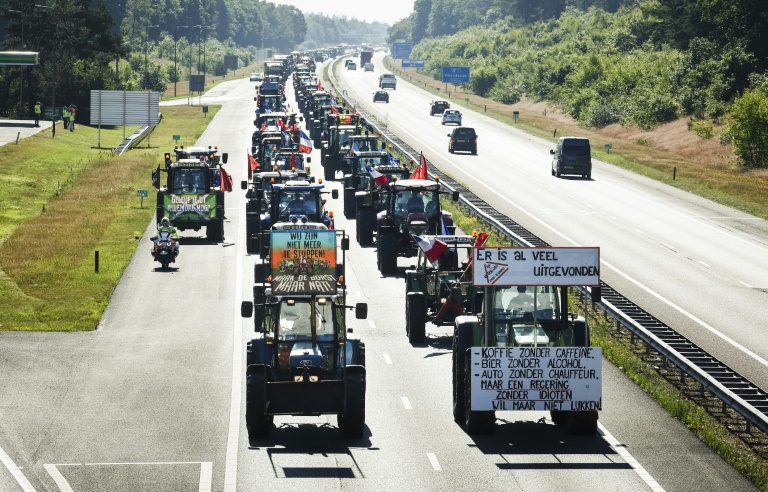
Thousands of tractor-driving farmers demonstrated in central Netherlands on Wednesday, causing widespread traffic chaos as they protested against the government’s far-reaching plans to cut nitrogen emissions.

In one of their largest-ever demonstrations, the farmers demanded the scrapping of recently announced plans by the Hague-based government, which could see a 30 percent reduction in livestock.

The Netherlands, the world’s second-largest agricultural exporter, is one of the top greenhouse gas emitters in Europe — especially of nitrogen — with much of this blamed on cattle-produced manure and fertiliser.

But farmers say they are being unfairly targeted as opposed to big business and industry, with many vowing to resist any plans to scale down or close farms.

Traffic came to a standstill for kilometres around the town of Stroe, east of Amsterdam, as farmers and their tractors arrived from across the country to protest.

– ‘Crazy’ –

“It’s not normal, what’s being done to the farmers,” one of the protesters Jan Poorter, 74, told AFP.

“It must happen gradually and that’s not the case,” added Poorter, a retired businessman as hundreds of tractors gathered on a field, many with horns blaring and safety lights flashing.

“You can’t just close farms that are hundreds of years old. You just can’t!”

Protesters carried signs saying “The future of farmers is being destroyed” and “Our children are afraid.”

Despite the numbers involved and the anger on display, the demonstration remained peaceful as an official programme got underway.

Police however did intervene when a number of farmers drove onto the wrong side of the highway past a police road block, the NOS public broadcaster said. 

Emergency services handed out water to farmers and motorists trapped in traffic as temperatures rose.

Prime Minister Mark Rutte said earlier this month the government’s plan to cut nitrogen emissions “will have an enormous impact on farmers”. 

“This sector will change, but unfortunately there’s no choice, we have to bring down nitrogen emissions,” he said.

The Dutch government plans to cut greenhouse gas nitrogen by as much as 70 percent in 131 key areas — many of them close to nature reserves — to reach climate goals by 2030.

For farmers this means a 40-percent drop in emissions is expected, which would require around 30 percent less cattle, according to reports. 

The government’s announcement comes in the wake of a 2019 ruling by the country’s highest administrative court, saying the Netherlands was not doing enough to protect its natural areas.

Thousands of pro-environment protesters marched on Sunday in the port city of Rotterdam to hail measures to reach climate goals fixed in Paris in 2015.

Recession fears send stocks, oil prices plunging

Equities and oil prices tumbled Wednesday after a brief respite from last week’s painful rout across world markets, with recession fears building as central banks hike interest rates to combat decades-high inflation.

Wall Street opened lower while European stock markets were down in afternoon trading and Asia closed in the red, a day after healthy gains.

Federal Reserve boss Jerome Powell’s two-day testimony to Congress this week will be pored over for an idea about officials’ plans for fighting runaway prices, which are being fanned by supply chain snarls, China’s Covid lockdowns and the war in Ukraine.

Powell warned lawmakers on Wednesday that US economy faces an “uncertain” global environment and could face further inflation “surprises”.

He once again stressed that the Fed is committed to bringing down inflation — which has reached a 40-year high — with higher interest rates, but said the world’s largest economy “is very strong and well positioned to handle tighter monetary policy.”

Most observers expect the Fed to aggressively hike US interest rates several more times this year having recently carried out the sharpest lift in almost 30 years.

“The ‘R’ word is likely to come up a lot today and the Chairman will have a tough time dodging it, especially with mid-terms in five months,” said OANDA market analyst Craig Erlam, referring to recession.

“Naturally, he’ll do his best to remain apolitical but I’m not sure investors will be able to ignore so much recession chat,” he added.

Expectations of more rate hikes are handing support to the dollar, which pushed the yen briefly to a fresh 24-year low Wednesday.

The Bank of Japan is holding back from lifting interest rates, in sharp contrast to other major central banks.

“Swiftly rising interest rates act as a vacuum for economic growth, and this isn’t lost on the market today,” noted Sophie Lund-Yates, equity analyst at Hargreaves Lansdown. 

“This is a darker day for global markets than has been seen in a while. Serious questions remain about the resilience of consumers, and it appears traders are bracing for a harsh hand where interest rates are concerned.”

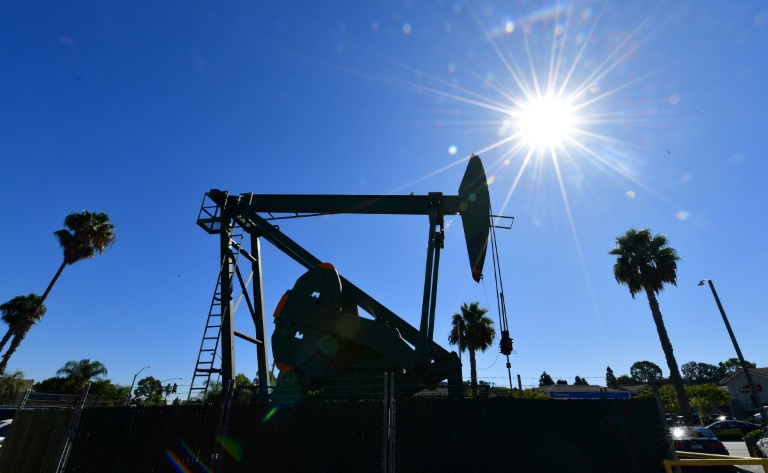
Oil prices were feeling the heat from recessionary fears, with both main contracts tanking more than six percent at one point.

Crude and gas prices have soared in recent months after major economies lifted pandemic lockdowns and following the invasion of Ukraine by major energy producer Russia.

Surging energy costs are fuelling global inflation, with official data Wednesday showing the British annual rate hitting a fresh 40-year high above nine percent.

In the United States, President Joe Biden will Wednesday ask Congress to suspend the federal gas tax for three months as skyrocketing prices cause widespread anger among Americans just months before crucial mid-term elections.

A senior administration official noted that US gas prices — averaging near $5 per gallon — had jumped almost $2 since Russian President Vladimir Putin began building up forces on the Ukrainian border earlier this year.

– Key figures at around 1330 GMT –

Brent North Sea crude: DOWN 6.0 percent at $107.83 per barrel

West Texas Intermediate: DOWN 6.5 percent at $102.36 per barrel

London – FTSE 100: DOWN 1.5 percent at 7,048.37 points

Frankfurt – DAX: DOWN 1.9 percent at 13,045.98

Paris – CAC 40: DOWN 1.6 percent at 5,867.49

EURO STOXX 50: DOWN 1.7 percent at 3,435.66

New York – Dow: DOWN 1.2 percent at 30,175.91

Tokyo – Nikkei 225: DOWN 0.4 at 26,149.55 (close)

Hong Kong – Hang Seng Index: DOWN 2.6 percent at 21,008.34 (close)

Shanghai – Composite: DOWN 1.2 percent at 3,267.20 (close)

Euro/dollar: UP at $1.0539 from $1.0535 late Tuesday

Pound/dollar: DOWN at $1.2257 from $1.2273

Euro/pound: UP at 85.99 pence from 85.80 pence

Dollar/yen: DOWN at 135.99 yen from 136.64 yen

burs-rl/lth

Passenger jet catches fire while landing at Miami airport

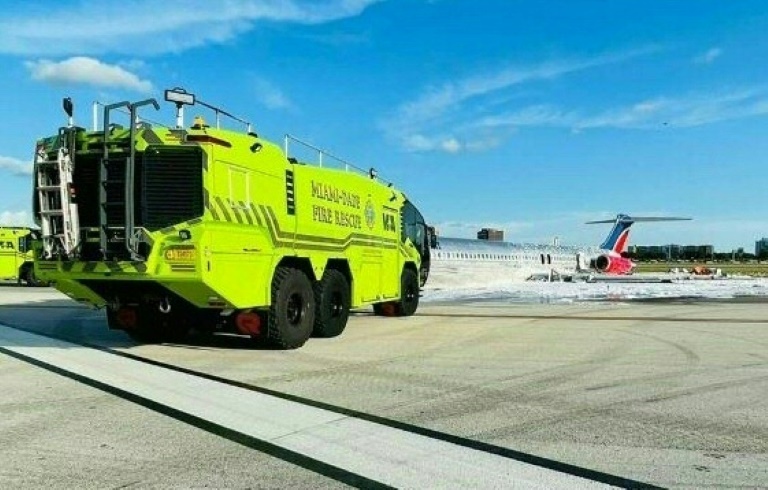
Investigators were headed to Miami Wednesday after a passenger jet’s landing gear collapsed and it caught fire as it touched down at the US city’s international airport, forcing more than 100 people to flee the burning and mangled aircraft.

Three people were hospitalized after the crash of Red Air Flight 203 late Tuesday, according to Miami-Dade fire officials, but no deaths or serious injuries have been reported among those on board.

Dramatic video footage showed people being evacuated from the McDonnell Douglas MD-82 aircraft, lying askew on the runway with its nose crumpled as thick black smoke billows from its body.

Red Air, a Dominican budget carrier which only launched in November last year, said the plane was arriving from Santo Domingo when it met with “technical difficulties.”

“Red Air #203 from Santo Domingo had its landing gear in the nose of the plane collapse, which seems to have caused a fire,” said a statement on the Miami International Airport’s Twitter account.

The National Transportation Safety Board (NTSB), the US government agency in charge of probing civil aviation accidents, tweeted that its team would arrive in Miami on Wednesday.

Red Air said there were 130 passengers and 10 crew on board. A Miami airport spokesman said there was “a total of 126 people on board” the plane. The reason for the discrepancy was not immediately clear.

Google agrees to pay for Wikipedia content

Google has agreed to pay Wikipedia for content displayed by its search engine, mirroring deals the US tech giant has struck with news outlets in Europe.

The Wikimedia Foundation, the charity that oversees the online encyclopedia, said Google was the first paying customer for its commercial venture Wikimedia Enterprise, which it launched last year.

The Internet Archive, a non-profit that runs a site called the Wayback Machine that saves snapshots of websites and is used to fix Wikipedia links, will be offered the commercial services for free.

“We’re thrilled to be working with them both as our longtime partners,” said Wikimedia’s Lane Becker in a statement on Tuesday.

Wikipedia, one of the world’s most visited websites, is free to use, updated by volunteers and relies on donations to keep afloat.

The new commercial arm will not change that arrangement for individual users, the foundation said.

Google uses material from the site for its “knowledge panel” — a sidebar that accompanies the main search results.

The source of the information is not always shown, a practice that had sparked complaints from Wikimedia.

Google has previously given money to Wikipedia through donations and grants.

“We have long supported the Wikimedia Foundation in pursuit of our shared goals of expanding knowledge and information access for people everywhere,” said Google’s Tim Palmer.

The foundation’s statement did not reveal the value of the Google contract.

French regulators and Google on Tuesday ended a years-long dispute by agreeing a framework for the US firm to pay news outlets for content.

Google said it had already made deals with hundreds of news outlets across Europe, Agence France-Presse among them.

Xi warns about 'expanding military alliances' at BRICS summit: state media

Chinese President Xi Jinping warned against “expanding” military ties on Wednesday in a speech ahead of a virtual summit with top leaders from Russia, India, Brazil and South Africa.

Beijing is hosting the meeting of the influential club of BRICS emerging economies, which accounts for more than 40 percent of the global population and nearly a quarter of the world’s gross domestic product.

Three of its members — China, India and South Africa — have abstained from voting on a United Nations resolution condemning Russia’s invasion of Ukraine.

Xi told the BRICS business forum that the “Ukraine crisis is… a wake-up call” and warned against “expanding military alliances and seeking one’s own security at the expense of other countries’ security”.

China and India have strong military links with Russia and buy large amounts of its oil and gas. 

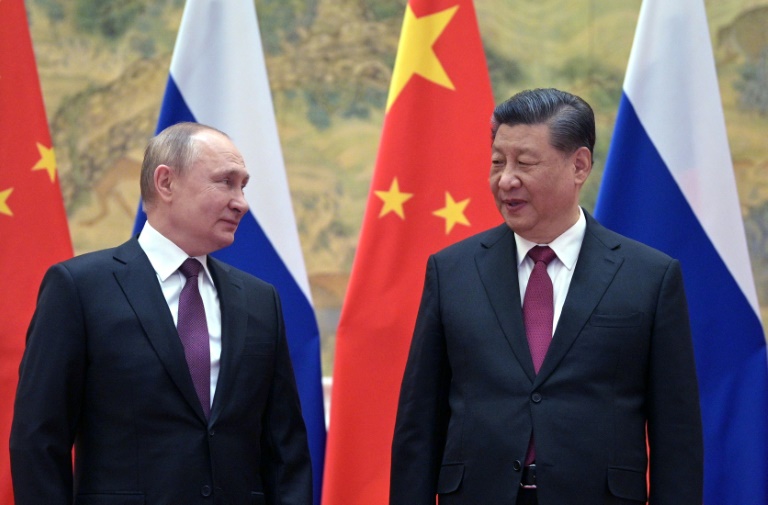
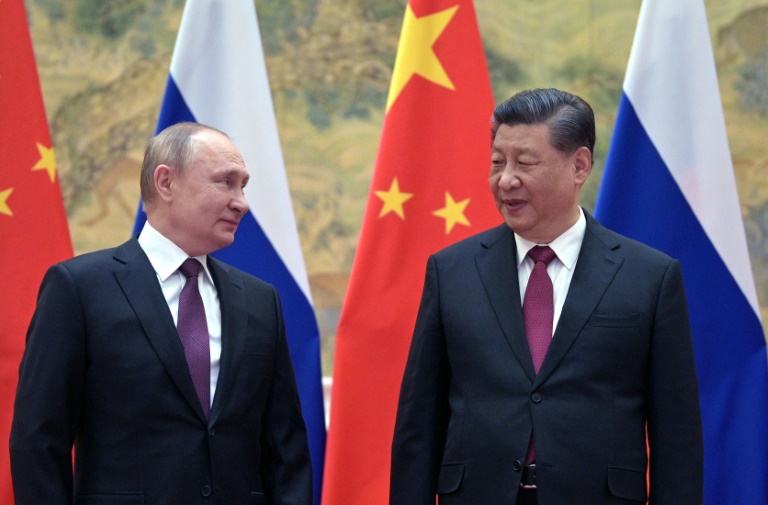
In a call last week, Xi assured his Russian counterpart Vladimir Putin that China would support Moscow’s core interests in “sovereignty and security” — leading the United States to warn Beijing that it risked ending up “on the wrong side of history”.

South Africa, one of the few African countries wielding diplomatic influence outside the continent, has also not condemned the Russian military action.

Xi took a swipe at US and European Union sanctions on Russia in the speech on Wednesday, saying “sanctions are a boomerang and a double-edged sword”.

Leaders of the Group of Seven (G7) nations will meet next week in Germany to discuss how to proceed with sanctions against Russia.

– ‘World divided’ –

The BRICS summit takes place as Russian troops continue to pummel eastern Ukraine after invading the country four months ago.

China and India have both ramped up crude oil imports from Russia, helping to offset losses from Western nations scaling back Russian energy purchases.

India bought six times more Russian oil from March to May compared with the same period last year, while imports by China during that period tripled, data from research firm Rystad Energy shows.  

Once bitter Cold War rivals, Beijing and Moscow have stepped up cooperation in recent years.

President Putin was in Beijing for the opening ceremony of the Winter Olympics in February, just days before the invasion of Ukraine started.

Beijing and Moscow also flew bomber aircraft over the Sea of Japan and East China Sea while US President Joe Biden  was in Tokyo in late May — signalling strong military links between the two countries.  

“The world has been divided into east and west after the Ukraine war,” Manoj Joshi, a New Delhi-based author and geopolitical commentator, told AFP. 

He added that BRICS gives a platform for Putin to stand with leaders from emerging economies.

“It sends a message to the US and the EU that they have not succeeded in isolating him and Russia,” he said.

Analysts say that Beijing will use the summit to promote its governance and development model at a time of global instability.

China said at a BRICS foreign ministers meeting in May that it wants other emerging economies to join the grouping, though it is unclear whether new members have been invited.

“Beijing would like to shape the BRICS agenda in line with… China-centric initiatives,” said Madhu Bhalla, professor and editor of the India Quarterly journal.

“Entry of other members… who follow the Chinese line will help steer the group’s agenda closer to the Chinese agenda,” she said. 

Xi warns about 'expanding military alliances' at BRICS summit: state media

Chinese President Xi Jinping warned against “expanding” military ties on Wednesday in a speech ahead of a virtual summit with top leaders from Russia, India, Brazil and South Africa.

Beijing is hosting the meeting of the influential club of BRICS emerging economies, which accounts for more than 40 percent of the global population and nearly a quarter of the world’s gross domestic product.

Three of its members — China, India and South Africa — have abstained from voting on a United Nations resolution condemning Russia’s invasion of Ukraine.

Xi told the BRICS business forum that the “Ukraine crisis is… a wake-up call” and warned against “expanding military alliances and seeking one’s own security at the expense of other countries’ security”.

China and India have strong military links with Russia and buy large amounts of its oil and gas. 

In a call last week, Xi assured his Russian counterpart Vladimir Putin that China would support Moscow’s core interests in “sovereignty and security” — leading the United States to warn Beijing that it risked ending up “on the wrong side of history”.

South Africa, one of the few African countries wielding diplomatic influence outside the continent, has also not condemned the Russian military action.

Xi took a swipe at US and European Union sanctions on Russia in the speech on Wednesday, saying “sanctions are a boomerang and a double-edged sword”.

Leaders of the Group of Seven (G7) nations will meet next week in Germany to discuss how to proceed with sanctions against Russia.

– ‘World divided’ –

The BRICS summit takes place as Russian troops continue to pummel eastern Ukraine after invading the country four months ago.

China and India have both ramped up crude oil imports from Russia, helping to offset losses from Western nations scaling back Russian energy purchases.

India bought six times more Russian oil from March to May compared with the same period last year, while imports by China during that period tripled, data from research firm Rystad Energy shows.  

Once bitter Cold War rivals, Beijing and Moscow have stepped up cooperation in recent years.

President Putin was in Beijing for the opening ceremony of the Winter Olympics in February, just days before the invasion of Ukraine started.

Beijing and Moscow also flew bomber aircraft over the Sea of Japan and East China Sea while US President Joe Biden  was in Tokyo in late May — signalling strong military links between the two countries.  

“The world has been divided into east and west after the Ukraine war,” Manoj Joshi, a New Delhi-based author and geopolitical commentator, told AFP. 

He added that BRICS gives a platform for Putin to stand with leaders from emerging economies.

“It sends a message to the US and the EU that they have not succeeded in isolating him and Russia,” he said.

Analysts say that Beijing will use the summit to promote its governance and development model at a time of global instability.

China said at a BRICS foreign ministers meeting in May that it wants other emerging economies to join the grouping, though it is unclear whether new members have been invited.

“Beijing would like to shape the BRICS agenda in line with… China-centric initiatives,” said Madhu Bhalla, professor and editor of the India Quarterly journal.

“Entry of other members… who follow the Chinese line will help steer the group’s agenda closer to the Chinese agenda,” she said. 

Close Bitnami banner
Bitnami