World

Global stocks bounce after sharp selloff; yen falls

Stock markets rose Tuesday as calm returned following last week’s rout, but analysts warned that recession fears have not gone away and will cause more turmoil.

After a three-day holiday weekend, Wall Street burst higher, with major indices finishing more than two percent higher after spending the entire session in positive territory.

European equities rose for a second straight day, but pared down some of their gains from the morning.

Oil prices extended gains on hopes of improving energy demand in key consumers China and the United States, while the euro climbed on the prospect of rising eurozone borrowing costs.

“Risk appetite has managed to recover for now, perhaps because we get a much needed-break from central bank decisions this week,” IG analyst Chris Beauchamp told AFP.

“But while a bounce is overdue, it is probably only temporary.”

There remains an overarching sense of gloom as traders speculate that the sharp rise in borrowing costs around the world will tip economies into recession.

The focus this week is on Federal Reserve boss Jerome Powell’s two days of testimony to lawmakers in Washington, which will be closely watched for clues regarding the bank’s plans for fighting surging consumer.

“Where we go from here depends largely on whether Federal Reserve Chair Powell spooks the markets with his pre-released comments and what inflation data from the UK shows tomorrow (Wednesday),” City Index analyst Fiona Cincotta told AFP.

The Fed announced a hefty interest rate hike last week, days after inflation data had smashed forecasts and returning to a four-decade high. 

Several officials — including at the Fed, Bank of England, Reserve Bank of Australia and European Central Bank — have come out in recent days to flag a further tightening of borrowing costs.

Inflation has rocketed to multi-decade highs around the world on a host of factors, including the global supply crunch and the Ukraine conflict, which has fueled surging food and energy prices.

“These small recoveries in stock markets shouldn’t provide any comfort,” said Craig Erlam, senior analyst at OANDA trading platform.

“Recession is increasingly becoming the base case and so equities are vulnerable to further losses,” he said.

In currencies, the yen struck a fresh 24-year low against the US dollar following comments by Prime Minister Fumio Kishida that it “is up to the central bank” how to maintain its easy money policy while central banks elsewhere are raising rates. 

“The market is clearly looking to test the resolve of the Bank of Japan in terms of how much they are prepared to tolerate further currency weakness,” said analyst Michael Hewson at CMC Markets UK.

In corporate news, shares in German chemicals group Bayer fell by 4.7 percent following the US Supreme Court declining to hear an appeal from Bayer-owned Monsanto to quash lawsuits claiming its weedkiller Roundup causes cancer, before clawing back part of the drop.

The decision marks a major blow to the German conglomerate’s legal fight against Roundup-related cases, and Bayer has set aside more than $15 billion to deal with a wave of US lawsuits linked to the weedkiller.

– Key figures at around 1530 GMT –

New York – Dow: UP 2.2 percent at 30,530.25 (close)

New York – S&P 500: UP 2.5percent at 3,764.79 (close)

New York – Nasdaq: UP 2.5 percent at 11,069.30 (close)

London – FTSE 100: UP 0.4 percent at 7,152.05 (close)

Frankfurt – DAX: UP 0.2 percent at 13,292.40 (close)

Paris – CAC 40: UP 0.8 percent at 5,964.66 (close)

EURO STOXX 50: UP 0.7 percent at 3,494.00 (close)

Tokyo – Nikkei 225: UP 1.8 percent at 26,246.31 (close)

Hong Kong – Hang Seng Index: UP 1.9 percent at 21,559.59 (close)

Shanghai – Composite: DOWN 0.3 percent at 3,306.72 (close)

Euro/dollar: UP at $1.0535 from $1.0511 late Monday

Pound/dollar: UP at $1.2273 from $1.2253

Euro/pound: UP at 85.80 pence from 85.78 pence

Dollar/yen: UP at 136.64 yen from 135.07 yen

Brent North Sea crude: UP 0.5 percent at $114.65 per barrel

West Texas Intermediate: UP 1.0 percent at $110.65 per barrel

burs-jmb/hs

Kellogg pops as it plans spin-off of legacy cereal business

Iconic breakfast food brand Kellogg became the latest US corporate giant to announce a breakup, unveiling plans Tuesday to split into three companies in a move that lifted its share price.

The company — known for such ubiquitous brands as Corn Flakes and Pop-Tarts — will spin off its North American cereal business into a new company, while a second venture will house Kellogg’s plant-based businesses.

The remaining corporation will be positioned as a higher-growth snacks business with exposure to emerging markets. This unit — which will also house the international cereal operation — accounted for roughly 80 percent of Kellogg’s $14.1 billion in 2021 revenues.

“This will unlock and create opportunity for all three businesses,” Kellogg Chief Executive Steve Cahillane said on a conference call with analysts.

The yet-to-be-named entities will initially be known as Global Snacking Co., North America Cereal Co., and Plant Co. The latter two will be created through tax-free spin-offs.

North American Cereal, covering the United States, Canada and the Caribbean, “will be solely dedicated to winning cereal and will not have to compete for resources with a fast-growing snack business,” said Cahillane, who will lead the new snacks company. 

North American Cereal and Plant Co. would remain headquartered in Battle Creek, Michigan, while Global Snacking will have dual headquarters — in Battle Creek and Chicago.

Leadership for the other two ventures has not yet been announced.

Kellogg’s announcement comes on the heels of earlier corporate break-ups including General Electric’s November 2021 announcement of a split into three ventures, which was followed a few weeks later and by Johnson & Johnson saying it will break in two.

– Growth markets –

The company’s origins date to 1894 when WK Kellogg created Corn Flakes breakfast cereal, launching the Kellogg company 12 years later in Battle Creek, Michigan. 

Subsequent products included Rice Krispies, released in 1928, and Frosted Flakes, which was unveiled in 1952 with the Tony the Tiger character on the box, which became famous for his “They’re gr-r-reat!” tagline.

But the bulk of the company’s revenues now come from global snacks, where about 50 percent of sales come from emerging markets and developed international markets.

Snack brands include Pringles, Pop-Tarts and Rice Krispies Treats, while the group also houses Eggo and other frozen breakfasts and products such as noodles in Africa, which Kellogg described as a “rapidly expanding business.”

Kellogg is aiming to complete the split by late 2023, subject to approval by US regulators.

Kellogg will continue to report as one company throughout 2022, said Chief Financial Officer Amit Banati.

The company expects to produce the required three years of audited financial statements for each of the ventures in the second half 2023.

Cahillane said it will be “business as usual over the next 18 months” while the company moves through the process.

He said Plant Co., which will house the MorningStar Farms alternative meat products, could also be acquired by another company if such an option arises and is better than an initial public offering.

Briefing.com praised the move, saying the cereal business had  “weighed down” the higher-margin snack business and adding, “we also think that Kellogg’s promising plant business has sort of been buried.”

Shares rose 2.0 percent to finish the day at $68.86.

US businessman John Textor completes Lyon takeover

Lyon president Jean-Michel Aulas said on Tuesday a deal had been struck for US businessman John Textor to complete a takeover of the seven-time French champions.

Eagle Football Holdings, a sports investment vehicle controlled by Crystal Palace shareholder Textor, is set to acquire a majority stake in the Ligue 1 club.

“We agreed, we shook hands overnight via video and at 3 a.m. Monday everything was signed,” said Aulas, adding that the board of directors had approved the deal.

The agreement will see Textor buy out minority shareholders Pathe and IDG Capital — who hold 19.36 percent and 19.85 percent stakes respectively — and a gradual sale of Holnest, the family holding company of Aulas, which holds 27.72 percent of the capital.

Aulas said he would continue as club president for “at least three years”.

“John wanted me to stay… it wasn’t an obligation but a wish of the fans” and of all those involved in the club, he said.

“OL… has stretched its wings beyond the borders, it has got a brand known everywhere, it is the 20th club in the world, so why would I show up and want to change any of that,” Textor told reporters.

“I believe in dreaming with your eyes wide open. Jean-Michel and I really want championship titles and winning Europe.”

Textor also owns Brazilian top-flight club Botafogo and Belgian second-division side RWD Molenbeek.

Lyon missed out on European competition for the second time in three seasons after finishing the 2021-22 campaign in eighth place under Peter Bosz.

White House says concerned about recession but US economy strong

The American economy remains strong, a White House economist asserted Tuesday, while acknowledging President Joe Biden’s team is concerned about a possible recession.

With inflation soaring at the fastest pace in more than four decades, sending prices for gas and housing rocketing, Americans are feeling the pain and the Federal Reserve is cranking up interest rates to try to cool the economy, fueling fears of a sharp downturn.

Despite a contraction in the first three months of the year, core parts of the world’s largest economy remain in good shape, including the labor market and consumer spending, Cecelia Rouse, head of Biden’s Council of Economic Advisers said on CNBC.

“When we look at recession (risks) … that’s obviously a concern, but the bones of our economy are solid,” she said, noting that the United States is better positioned to face the challenges than most other nations.

On Sunday, Treasury Secretary Janet Yellen also tried to quell recession fears, saying a downturn is not “inevitable” even while the economy will slow as it “transitions to stable growth.”

Rouse said Biden is focused on the inflation challenge, which is related to the Covid-19 pandemic: “It’s not easy to turn back on a global economy.”

Global supply chain snarls have been a key factor in fueling the prices increases, and pandemic lockdowns in China are adding to the ongoing uncertainty.

But Russia’s invasion of Ukraine was a “game changer,” she said.

“We all hope the Fed can get inflation under control without ceding too much on maximum employment,” Rouse said “We all hope for the longed-for soft landing.”

The Fed last week implemented the third interest rate hike this year, the biggest in nearly 30 years, and promised more big increases in coming months.

– ‘Relatively healthy’ –

Richmond Federal Reserve Bank President Thomas Barkin said there is a risk of recession, but agreed there are many signs the economy remains strong.

“Data on today’s economy still looks relatively healthy. Tomorrow is of course unclear,” Barkin said Tuesday in a speech prepared for delivery to an event in Richmond.

However, he acknowledged that with the Fed raising interest rates and an uncertain outlook for the global supply chain, fears of a coming downturn are not surprising.

But “not all recessions are equal,” he said, and “it’s worth remembering that most other recessions aren’t that long or that deep.”

Getting the economy back to normal in the wake of the supply disruptions “doesn’t have to require a calamitous decline in activity.”

Barkin echoed comments from Fed chief Jerome Powell that the central bank has the tools and will do whatever it takes to bring down inflation, but he cautioned that “we may or may not get help from global events and supply chains. There is of course recession risk.”

Earlier Tuesday, during a discussion with the National Association for Business Economics, Barkin said it was not yet clear how fast and how far the central bank will have to move.

“You want to get back to where you want to go as fast as you can without breaking anything,” he said.

US calls Russia's threat against captured Americans 'appalling'

The United States on Tuesday called it “appalling” for the Kremlin to suggest that two US citizens captured while fighting for Ukraine against the Russian invasion could face execution.

“It’s appalling that a public official in Russia would even suggest the death penalty for two American citizens that were in Ukraine,” John Kirby, a White House spokesman, told reporters after the Kremlin spokesman said the two men are not protected by the Geneva Conventions on prisoners of war.

Kirby, spokesman for foreign policy at the White House, said the Kremlin was being at minimum reckless with the comments.

“Whether they actually mean what they’re saying here, and that this could be an outcome, that they could levy a death penalty against two Americans that were fighting in Ukraine, or that they just feel that it’s a responsible thing for a major power to do, to talk about doing this…, either one of them is equally alarming,” he said.

An unknown number of foreigners, including Americans, have flocked to Ukraine since Russia invaded in February, joining the Ukrainian armed forces.

Ukraine has established an international legion for volunteers with varying degrees of previous military training. With many sent to the frontlines, there’s been a steady trickle of reports of individuals killed, captured or missing.

The State Department on Tuesday confirmed that a second American had been killed, identifying the man as 52-year-old Stephen Zabielski, and again issuing the now almost daily plea for US citizens to keep away.

“We once again reiterate US citizens should not travel to Ukraine due to the active armed conflict and the singling out of US citizens in Ukraine by Russian government security officials,” a State Department spokesperson said.

“If you want to help the people of Ukraine, there’s a whole lot of other better options to do that than to go in and put yourself in harm’s way,” Kirby said.

– Mercenaries claim –

The two captured Americans are both former servicemen and were taken prisoner in the east of Ukraine earlier this month.

Alexander Drueke and Andy Huynh, previously living in Alabama, have appeared in videos and pictures aired by Russian state media and social media, but President Joe Biden said last week he does not know exactly where they are being held.

The State Department says Russia is required to treat volunteers humanely as they would other prisoners of war in accordance with the Geneva Conventions, which prohibit execution and torture or other mistreatment of war detainees.

However, Kremlin spokesman Dmitry Peskov, in an interview with NBC News released on Monday, said the Americans were mercenaries and should be “held responsible for those crimes that they have committed” — without the Geneva Conventions applying.

A 22-year-old former Marine, Willy Joseph Cancel, was confirmed as the first American killed fighting for Ukraine in late April.

A third missing American, identified as a former US Marines captain with 20 years experience, was last heard from in late April, CNN quoted his wife as saying.

Two British men and a Moroccan captured in fighting have been sentenced to death by the Russian proxy authorities in the so-called Donetsk People’s Republic, a Moscow-controlled swath of eastern Ukraine.

Top court blocks French city's bid to allow 'burkini' in pools

France’s top administrative court on Tuesday blocked a bid to allow the “burkini” at municipal pools in the city of Grenoble, upholding a government challenge against a move that revived France’s intense debate on Islam.

The all-in-one swimsuit, used by some Muslim women to cover their bodies and hair while swimming, is a controversial issue in France where critics see it as a symbol of creeping Islamisation. 

The “very selective exception to the rules to satisfy religious demands… risks affecting the proper functioning of public services and equal treatment of their users” the Council of State ruled Tuesday.

Its judgment backed a lower court ruling in May that was prompted by a challenge by the national government to the council’s decision.

Led by Green party mayor Eric Piolle, Grenoble had in May changed its swimming pool rules to allow all types of bathing suits and for women to bathe topless.

Previously, only traditional swimming costumes for women and trunks for men were authorised.

“All we want is for women and men to be able to dress how they want,” Piolle said at the time.

But the judges disagreed.

They ruled Tuesday that “contrary to the objective declared by the city of Grenoble, the change to the pool rules aimed only to authorise wearing of the ‘burkini'”.

– A ‘victory for secularism’ –

The city council in Grenoble said in a statement Tuesday evening that it took note of the court ruling, while regretting that the court had attributed views to the council that it did not hold.

The changes it had tried to implement had been about allowing equal access to all users to public services, it argued.

Interior Minister Gerard Darmanin welcomed the ruling, describing it on Twitter as “a victory for the law against separatism, for secularism and beyond that, for the whole republic”.

France’s treatment of Islam is likely to remain a political battlefield following Sunday’s inconclusive parliamentary election, which denied President Emmanuel Macron an absolute majority in parliament.

Voters handed the anti-immigration, anti-Islam National Rally an unprecedented 89 seats.

The more mainstream Republicans conservative party is seen as the only possible partner for Macron to reach a governing deal or pass laws on a case-by-case basis.

Republicans lawmaker Eric Ciotti called on Twitter Tuesday for the burkini to be “clearly banned by law”.

– Fighting on the beaches –

Attempts by several local mayors in the south of France to ban the burkini on Mediterranean beaches in the summer of 2016 kicked off the first row around the bathing suit.

The restrictions were eventually overturned — also by the Council of State — for being discriminatory.

But Tuesday’s ruling did not call that previous one into question, said Patrice Spinosi of the Human Rights League (LDH). 

“This decision is only relevant to the specific situation in Grenoble and shouldn’t be generalised,” he said. The LDH had backed Grenoble’s rule change over swimwear.

Burkinis are not banned in French state-run pools on religious grounds, but for hygiene reasons. Swimmers are not under any legal obligation to hide their religion while bathing.

Grenoble is not the first French city to change its rules.

The northwestern city of Rennes quietly updated its pool code in 2019 to allow burkinis and other types of swimwear.

Ecuadorans teargassed at demos that military deems 'grave threat'

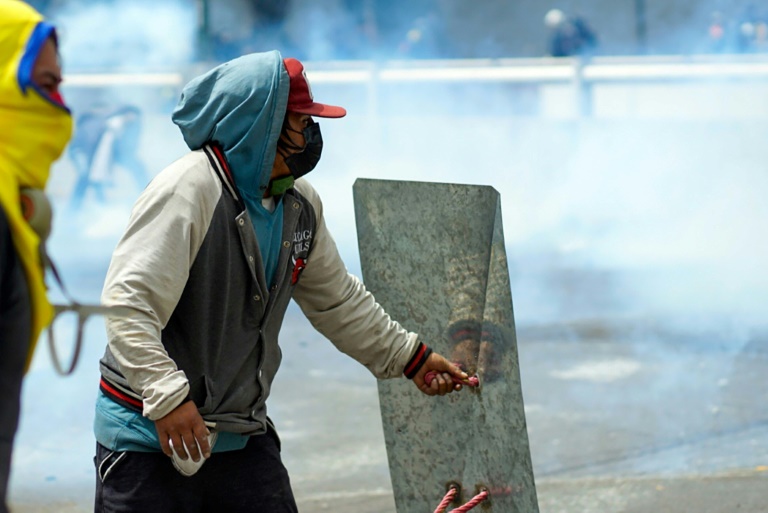
Police used tear gas Tuesday to disperse hundreds of Ecuadorans protesting in the capital Quito on the ninth day of Indigenous-led fuel price protests that the military described as a “grave threat.”

Some 500 protesters among thousands who arrived in the capital from around the country in recent days blockaded a key road with burning tree branches.

Dispersed with tear gas, they quickly regrouped to march with watery eyes on the CCE culture center — traditionally used by Indigenous people to launch protests but requisitioned by police on Sunday to use as a base. 

“The objective of today is to retake the Casa de la Cultura,” protester Wilson Mazabanda told AFP before police used mace for a second time to break up the group.

Earlier Tuesday, Defense Minister Luis Lara said Ecuador’s democracy “faces a grave threat from… people who are preventing the free movement of the majority of Ecuadorans” with widespread road blockades.

Flanked by the heads of the army, navy and air force, Lara warned that the armed forces “will not allow attempts to break the constitutional order or any action against democracy and the laws of the republic.”

Called by the powerful Confederation of Indigenous Nationalities of Ecuador (Conaie), demonstrations since June 13 have seen roads barricaded nationwide at a cost of hundreds of millions of dollars to the economy.

Dozens of people have been injured. 

– ‘Tired of this government’ –

Conaie — credited with helping topple three presidents between 1997 and 2005 — called the demonstrations as Ecuadorans increasingly struggle to make ends meet.

Indigenous people comprise more than a million of Ecuador’s 17.7 million inhabitants and wield much political clout, but are disproportionately affected by rising inflation, unemployment and poverty exacerbated by the coronavirus pandemic.

Conaie has vowed to maintain the protests until its demands are met.

Thousands of fresh protesters entered Quito from the south and north on Monday, after often long journeys on foot and on the backs of trucks.

They took to the streets afresh on Tuesday, burning tires and tree branches, some wielding sticks, fireworks and makeshift shields made of road signs or garbage can lids.

“We are already tired of this government,” said protester Mazabanda, a university student, of ex-banker President Guillermo Lasso’s one-year-old term.

– State of emergency –

Fuel prices have risen sharply since 2020, almost doubling for diesel from $1 to $1.90 per gallon and rising from $1.75 to $2.55 for gasoline.

Conaie is demanding a price cut to $1.50 a gallon for diesel and $2.10 for gasoline.

It also wants jobs, food price controls and a commitment to renegotiating the personal bank loans of about four million families.

The movement has since been joined by students, workers and other Ecuadorans feeling the economic pinch.

Police said on Monday that 63 armed forces personnel have been wounded in clashes and 21 others briefly held hostage since the protests began, while human rights observers reported 79 arrests and 55 civilians wounded.

Lasso on Monday extended a state of emergency to cover six of the country’s 24 provinces, with a night-time curfew in the capital Quito, as he sought to curtail the countrywide show of anger.

The state of emergency empowers Lasso to mobilize the armed forces to maintain order, suspend civil rights and declare curfews.

Conaie has vowed to maintain its blockade until the government meets its demands.

– ‘They seek chaos’ –

The president said in a video on Twitter Monday that the protesters “do not want peace” and have rejected government calls for dialogue.

“They seek chaos. They want to eject the president,” he charged.

Ecuador was losing about $50 million a day as a result of the protests, official figures show, without counting oil production — the country’s main export product.

State-owned Petroecuador has reported almost 64,300 barrels in lost production because of more than 230 wells shuttered by demonstrations in the Amazon.

Ecuador’s parliament voted 81 to 56 late Monday in favor of a resolution urging the government to conduct a “serious, clear and honest” dialogue with protesters.

It also proposed the convening of a “round table” of talks including the United Nations, Red Cross, universities and the powerful Catholic Church to find a solution to the stalemate.

In 2019, Conaie-led protests left 11 people dead and more than 1,000 injured but forced then-president Lenin Moreno to abandon plans to eliminate fuel subsidies.

Ecuadorans teargassed at demos that military deems 'grave threat'

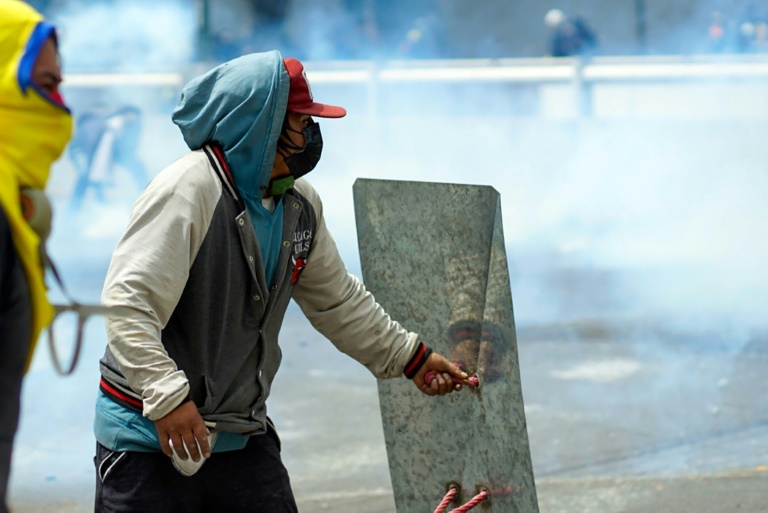
Police used tear gas Tuesday to disperse hundreds of Ecuadorans protesting in the capital Quito on the ninth day of Indigenous-led fuel price protests that the military described as a “grave threat.”

Some 500 protesters among thousands who arrived in the capital from around the country in recent days blockaded a key road with burning tree branches.

Dispersed with tear gas, they quickly regrouped to march with watery eyes on the CCE culture center — traditionally used by Indigenous people to launch protests but requisitioned by police on Sunday to use as a base. 

“The objective of today is to retake the Casa de la Cultura,” protester Wilson Mazabanda told AFP before police used mace for a second time to break up the group.

Earlier Tuesday, Defense Minister Luis Lara said Ecuador’s democracy “faces a grave threat from… people who are preventing the free movement of the majority of Ecuadorans” with widespread road blockades.

Flanked by the heads of the army, navy and air force, Lara warned that the armed forces “will not allow attempts to break the constitutional order or any action against democracy and the laws of the republic.”

Called by the powerful Confederation of Indigenous Nationalities of Ecuador (Conaie), demonstrations since June 13 have seen roads barricaded nationwide at a cost of hundreds of millions of dollars to the economy.

Dozens of people have been injured. 

– ‘Tired of this government’ –

Conaie — credited with helping topple three presidents between 1997 and 2005 — called the demonstrations as Ecuadorans increasingly struggle to make ends meet.

Indigenous people comprise more than a million of Ecuador’s 17.7 million inhabitants and wield much political clout, but are disproportionately affected by rising inflation, unemployment and poverty exacerbated by the coronavirus pandemic.

Conaie has vowed to maintain the protests until its demands are met.

Thousands of fresh protesters entered Quito from the south and north on Monday, after often long journeys on foot and on the backs of trucks.

They took to the streets afresh on Tuesday, burning tires and tree branches, some wielding sticks, fireworks and makeshift shields made of road signs or garbage can lids.

“We are already tired of this government,” said protester Mazabanda, a university student, of ex-banker President Guillermo Lasso’s one-year-old term.

– State of emergency –

Fuel prices have risen sharply since 2020, almost doubling for diesel from $1 to $1.90 per gallon and rising from $1.75 to $2.55 for gasoline.

Conaie is demanding a price cut to $1.50 a gallon for diesel and $2.10 for gasoline.

It also wants jobs, food price controls and a commitment to renegotiating the personal bank loans of about four million families.

The movement has since been joined by students, workers and other Ecuadorans feeling the economic pinch.

Police said on Monday that 63 armed forces personnel have been wounded in clashes and 21 others briefly held hostage since the protests began, while human rights observers reported 79 arrests and 55 civilians wounded.

Lasso on Monday extended a state of emergency to cover six of the country’s 24 provinces, with a night-time curfew in the capital Quito, as he sought to curtail the countrywide show of anger.

The state of emergency empowers Lasso to mobilize the armed forces to maintain order, suspend civil rights and declare curfews.

Conaie has vowed to maintain its blockade until the government meets its demands.

– ‘They seek chaos’ –

The president said in a video on Twitter Monday that the protesters “do not want peace” and have rejected government calls for dialogue.

“They seek chaos. They want to eject the president,” he charged.

Ecuador was losing about $50 million a day as a result of the protests, official figures show, without counting oil production — the country’s main export product.

State-owned Petroecuador has reported almost 64,300 barrels in lost production because of more than 230 wells shuttered by demonstrations in the Amazon.

Ecuador’s parliament voted 81 to 56 late Monday in favor of a resolution urging the government to conduct a “serious, clear and honest” dialogue with protesters.

It also proposed the convening of a “round table” of talks including the United Nations, Red Cross, universities and the powerful Catholic Church to find a solution to the stalemate.

In 2019, Conaie-led protests left 11 people dead and more than 1,000 injured but forced then-president Lenin Moreno to abandon plans to eliminate fuel subsidies.

Russia warns Lithuania, pushes into Ukraine's Donbas

Moscow on Tuesday warned Lithuania of “serious” consequences over its restriction of rail traffic to Russia’s Kaliningrad exclave, as Kremlin forces made gains in Ukraine’s strategic Donbas region.

The row over Lithuania, the arrival of sophisticated German weaponry in Ukraine’s arsenal, and an imminent decision on Kyiv’s candidacy to join the EU threaten to further ratchet up tensions between the West and Moscow.

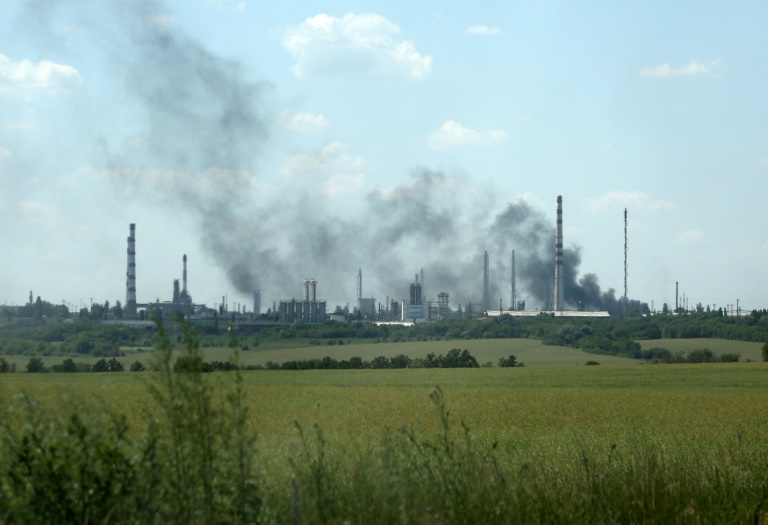
Kremlin troops were meanwhile gaining ground in the Donbas, causing “catastrophic destruction” in Lysychansk, an industrial city at the forefront of recent clashes, the region’s governor said. Ukraine confirmed Russia had taken the frontline village of Toshkivka.

Governor Sergiy Gaiday said “every town and village” in Ukrainian hands in the Lugansk region was “under almost non-stop fire”. 

Since being repelled from Kyiv and other parts of Ukraine following its invasion in February, Moscow has been focusing its offensive on the Donbas region.

In the eastern city of Sloviansk, which could become a flashpoint as Russian troops advance from the north, local people were preparing to withstand attacks and the authorities said the community would defend itself.

“We believe they’ll beat the Russian scum,” resident Valentina, 63, said of local Ukrainian forces.

– ‘Serious’ consequences –

Russia’s war of words with EU member Lithuania escalated on Tuesday, with Moscow vowing “serious” consequences over Vilnius’ restrictions on rail traffic to the exclave of Kaliningrad that borders Lithuania and Poland. 

Lithuania says it is simply adhering to EU-wide sanctions on Moscow but Russia countered, accusing Brussels of “escalation”.

Moscow summoned the EU’s ambassador to Russia. Its foreign ministry said Lithuania’s actions “violate the relevant legal and political obligations of the European Union”.

“Russia will certainly respond to such hostile actions,” security council chief Nikolai Patrushev said at a regional security meeting in Kaliningrad.

Ukraine’s Defence Minister Oleksiy Reznikov tweeted that powerful German-made Panzerhaubitze 2000 howizter artillery pieces had reached his country’s forces.

Russia said Tuesday it had repelled a Ukrainian attempt to re-take the symbolic Snake Island, a small territory in the Black Sea captured by Russian forces on the first day of the invasion. 

– ‘Significant losses’ –

In addition to Toshkivka, Ukraine said it had lost control of the eastern village of Metyolkine, a settlement adjacent to Severodonetsk, which has been a focus of fighting for weeks and is now largely under Russian control.

A chemical plant in Severodonetsk where hundreds of civilians are said to be sheltering was being shelled constantly, Ukraine warned.

But defence ministry spokesman Oleksandr Motuzyanyk told Ukrainian television that Russian forces had suffered “significant losses in the area of Severodonetsk”.

Ukraine on Tuesday said it struck a Black Sea oil drilling platform off the Crimea peninsula because Russia was using it as a military installation. 

The rig had Russian garrisons and equipment for air defence, radar warfare and reconnaissance, Sergiy Bratchuk of Odessa’s regional military administration told an online briefing.

Crimea’s Moscow-backed leader Sergey Aksyonov had said three people were injured and seven more were missing after the first reported strike against offshore energy infrastructure in the Russian-annexed peninsula since the war began.

Russian shelling killed 15 people including an eight-year-old in eastern Ukraine’s Kharkiv region on Tuesday, its governor said.

On the maritime front, Russia’s navy is blockading ports, which Ukraine says is preventing millions of tonnes of grain from being shipped to world markets, contributing to soaring food prices.

Prior to the war, Ukraine was a major exporter of wheat, corn and sunflower oil.

With European officials due to gather this week at a summit expected to approve Ukraine’s candidacy to join the EU, Brussels foreign policy chief Josep Borrell called the Russians’ port blockade “a real war crime”.

Moscow denies responsibility for the disruption to deliveries and, following Borrell’s comments, blamed the West’s “destructive” position for surging grain prices. 

Turkish media reported that Russian, Ukrainian and UN officials would meet in Istanbul next week to try to unblock Black Sea grain exports.

– $100-million medal –

In New York, Dmitry Muratov, the Russian editor-in-chief of the independent newspaper Novaya Gazeta, auctioned off his Nobel Peace Prize gold medal for $103.5 million to benefit children displaced by the war.

It was sold to an unidentified phone bidder.

Muratov won the prize in 2021 alongside journalist Maria Ressa of the Philippines.

With US-Russia tensions soaring, the US State Department on Tuesday confirmed a second American, 52-year-old Stephen Zabielski, was killed fighting for Ukraine.

Kremlin spokesman Dmitry Peskov earlier told NBC News that two Americans captured in Ukraine while fighting with Kyiv’s military were “endangering” Russian soldiers and should be “held accountable for those crimes”.

On the ground, the police chief of the Kyiv region said victims of the Russian attempt to seize Ukraine’s capital continued to be found. 

So far, the bodies of 1,333 civilians have been discovered and 300 people remain missing.

US Attorney General Merrick Garland visited Ukraine on Tuesday to discuss prosecution of individuals involved in war crimes.

“There is no place to hide,” Garland said, vowing to hold to account those responsible for “atrocities” and war crimes.

Spain said one of its citizens fighting for Ukraine had been killed, without giving further detail.

Denmark and Sweden meanwhile became the latest European countries to warn of potential gas supply problems. Their energy agencies issued early warnings, due to uncertainty over hydrocarbon imports from Russia.

Ukraine has called the reasons given for Russia’s reduction of gas supply to European customers “far-fetched” and “illegal”.

burs-sr/imm/ah

US vows enforcement as ban on Xinjiang imports takes effect

The United States on Tuesday promised enforcement as a landmark ban took effect on most imports from Xinjiang, the Chinese region where rights groups say the Uyghur people are being forced into slave labor.

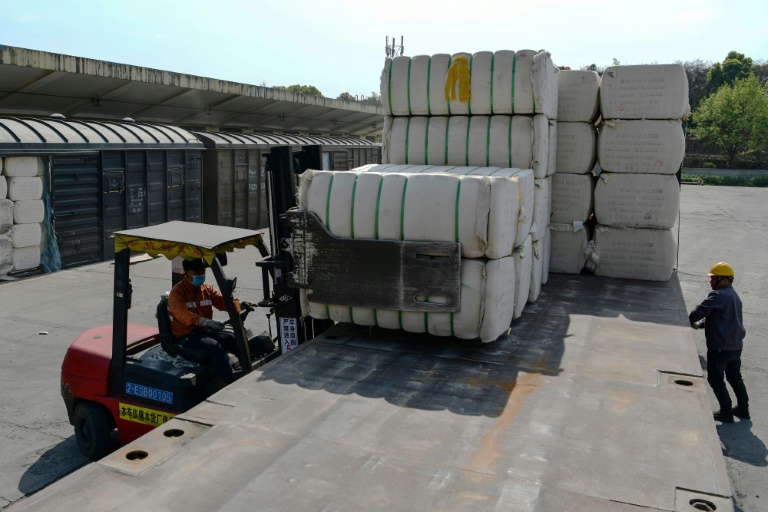
The Uyghur Forced Labor Prevention Act, which will be felt especially in the textile industry, took effect six months after it was signed into law by President Joe Biden following bipartisan support in Congress.

“We are rallying our allies and partners to make global supply chains free from the use of forced labor,” Secretary of State Antony Blinken said in a statement.

The US Customs and Border Protection service, which will enforce the new law, issued guidance that said it would presume products from Xinjiang involve forced labor and are therefore banned unless businesses can document otherwise.

The act “requires that importers demonstrate due diligence, effective supply chain tracing and supply chain management measures to ensure that they do not import any goods made, in whole or in part, by forced labor,” its advisory said.

It said it would look at the complete supply chain and not exempt goods shipped from other parts of China or third countries.

An estimated 20 percent of garments imported into the United States each year include some cotton from Xinjiang, according to labor rights groups.

The vast western region is also a major center of tomatoes canned for export.

Senator Marco Rubio, a Republican hawk who teamed up with liberal Democrats to push for the legislation, called the act “the most significant change in America’s relationship with China since 2001.”

“No longer will we look at images of bareheaded prisoners in shackles and blindfolds, lined up like animals for slaughter, and shrug,” he wrote in an opinion piece for Real Clear Politics.

– ‘Undermines free market principles’ –

China entered the World Trade Organization in 2001, helping usher in soaring growth as it became the manufacturing hub for the world.

US policymakers across party lines have gradually come to reject their bet that trade integration would moderate Beijing, which the Biden administration has identified as the top global competitor of the United States.

China again voiced anger over the trade ban and said it went against global efforts to decrease inflation and stabilize supply chains. 

“The act is solid evidence of the US’s arbitrariness in undermining international economic and trade rules,” foreign ministry spokesman Wang Wenbin said.

“The US move is against the trend of the times and bound to fail.”

But Omer Kanat, executive director of the Uyghur Human Rights Project, called the law a “huge win” for the movement and said it would push other governments to take similar action.

Rights groups, citing witness accounts, say that well more than one million Uyghurs and other predominantly Muslim Turkic-speaking people have been locked up in re-education camps in a bid to integrate them forcibly into China’s Han majority.

Beijing denies the charges and says it is providing vocational training to reduce the allure of Islamist extremism following violence.

Close Bitnami banner
Bitnami