World

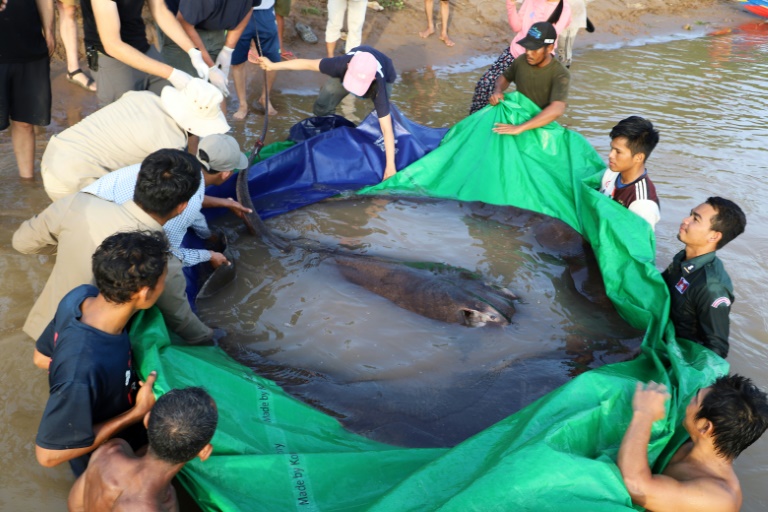
'World's biggest' freshwater fish netted in Cambodia

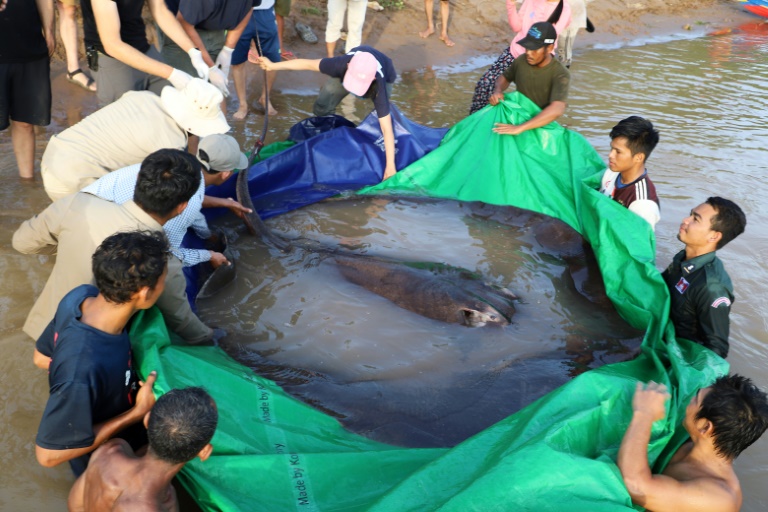
A fisherman on the Mekong river in Cambodia has hooked the biggest freshwater fish ever recorded, scientists said — a 300-kilogram stingray.

The giant freshwater stingray, which measured four metres (13 feet) from snout to tail, was caught last week and released back into the wild after being fitted with a tag to track its behaviour.

The monstrous bottom-dweller beat the previous record for biggest recorded freshwater fish, held by a 293-kilo (646-pound) Mekong giant catfish caught in Thailand in 2005, the US-funded Wonders of the Mekong research project said.

The stingray, caught in Stung Treng province in northern Cambodia, was more than twice the weight of an average lowland gorilla, the experts said.

“In 20 years of researching giant fish in rivers and lakes on six continents, this is the largest freshwater fish that we’ve encountered or that’s been documented anywhere worldwide,” Zeb Hogan, a fish biologist leading the Wonders of the Mekong project, said in a statement released Tuesday.

“This is an absolutely astonishing discovery, and justifies efforts to better understand the mysteries surrounding this species and the incredible stretch of river where it lives.”

The researchers fitted an acoustic tag to the stingray before returning it to the river, to try to learn more about the secretive creature’s elusive behaviour.

Last month, an endangered giant freshwater stingray four metres long and weighing 180 kilos was also hooked by a fisherman in the same province.

More than 1,000 fish species call the Mekong home and the stingray is not the only giant lurking in the muddy waters — the giant catfish and giant barb also reach up to three metres long and 270 kilos in weight.

Scientists have warned that plastic waste threatens wildlife even in the deepest stretches of the Mekong, along with “ghost nets” — abandoned by fishers but still able to snare fish.

The famous waterway starts in China and twists south through parts of Thailand, Laos, Myanmar, Cambodia and Vietnam, feeding 60 million people through its basin and tributaries.

But environmentalists have long voiced concerns about dam building along the Mekong River that will destroy fish stocks.

'World's biggest' freshwater fish netted in Cambodia

A fisherman on the Mekong river in Cambodia has hooked the biggest freshwater fish ever recorded, scientists said — a 300-kilogram stingray.

The giant freshwater stingray, which measured four metres (13 feet) from snout to tail, was caught last week and released back into the wild after being fitted with a tag to track its behaviour.

The monstrous bottom-dweller beat the previous record for biggest recorded freshwater fish, held by a 293-kilo (646-pound) Mekong giant catfish caught in Thailand in 2005, the US-funded Wonders of the Mekong research project said.

The stingray, caught in Stung Treng province in northern Cambodia, was more than twice the weight of an average lowland gorilla, the experts said.

“In 20 years of researching giant fish in rivers and lakes on six continents, this is the largest freshwater fish that we’ve encountered or that’s been documented anywhere worldwide,” Zeb Hogan, a fish biologist leading the Wonders of the Mekong project, said in a statement released Tuesday.

“This is an absolutely astonishing discovery, and justifies efforts to better understand the mysteries surrounding this species and the incredible stretch of river where it lives.”

The researchers fitted an acoustic tag to the stingray before returning it to the river, to try to learn more about the secretive creature’s elusive behaviour.

Last month, an endangered giant freshwater stingray four metres long and weighing 180 kilos was also hooked by a fisherman in the same province.

More than 1,000 fish species call the Mekong home and the stingray is not the only giant lurking in the muddy waters — the giant catfish and giant barb also reach up to three metres long and 270 kilos in weight.

Scientists have warned that plastic waste threatens wildlife even in the deepest stretches of the Mekong, along with “ghost nets” — abandoned by fishers but still able to snare fish.

The famous waterway starts in China and twists south through parts of Thailand, Laos, Myanmar, Cambodia and Vietnam, feeding 60 million people through its basin and tributaries.

But environmentalists have long voiced concerns about dam building along the Mekong River that will destroy fish stocks.

Ukraine says attacks escalating, as Russia-EU tensions surge

Russia’s blockade of Ukrainian grain exports sparked fresh tensions with Europe as fears grow of a global food crisis, while Kyiv accused Moscow of stepping up attacks in the east of the country.

In New York, Dmitry Muratov, the Russian editor-in-chief of the independent newspaper Novaya Gazeta, auctioned off his Nobel Peace Prize gold medal for $103.5 million to benefit children displaced by the war in Ukraine.

Since being repelled from Kyiv and other parts of Ukraine following their February invasion, Moscow is focusing its offensive on the eastern Donbas region.

Its navy is blockading ports, which Ukraine says is preventing millions of tonnes of grain from being shipped to world markets, contributing to soaring food prices.

Prior to the war, Ukraine was a major exporter of wheat, corn and sunflower oil. 

EU foreign policy chief Josep Borrell called the Russian blockade “a real war crime”, which was happening “while in the rest of the world people are suffering hunger”.

Moscow denies responsibility for the disruption to deliveries and, following Borrell’s comments, took aim at the “destructive” stance of the West for surging grain prices. 

Growing concerns about a food crisis are “the fault of Western regimes, which act as provokers and destroyers,” said foreign ministry spokeswoman Maria Zakharova.

Ukrainian President Volodymyr Zelensky said Kyiv was engaged in “complex negotiations” to unblock grain exports, although cautioned that there was no progress as yet. 

In an address to the African Union, he also warned that the continent was a “hostage” of the conflict, and rising food prices “have already brought (the war) to the homes of millions of African families”.

– ‘Extremely tough’ –

With the European Union set to decide at a summit this week on whether to grant Ukraine candidate status — allowing them to vie for membership — Kyiv has warned that attacks are escalating. 

Ukraine said it had lost control of the village of Metyolkine. The settlement is adjacent to Severodonetsk, which has been the focus of fighting for weeks and is now largely under Russian control.

A chemical plant in Severodonetsk where hundreds of civilians are said to be sheltering was being shelled “constantly”, Ukraine said.

Sergiy Gaiday — governor of the Lugansk region, which includes Severodonetsk — said the situation on the frontlines was “extremely tough”.

“Every town and village under Ukrainian control in the Lugansk region is under almost non-stop fire,” he said on Ukrainian TV.

Three people were injured and seven more missing after Ukrainian forces attacked oil drilling platforms in the Black Sea off the coast of Crimea, which was annexed by Russia in 2014, Moscow-backed Crimea leader Sergey Aksyonov said.

It was the first reported strike against offshore energy infrastructure in Crimea since Russia launched its invasion.

The city of Kramatorsk, about 50 kilometres (30 miles) from Severodonetsk, is yet to experience the intense battles seen closer to the frontline but residents are worried the conflict will reach them. 

“People worry a lot about the war, everyone is stressed,” Valentina, a 57-year-old food vendor at a market, told AFP. 

Another food seller, Sofiya, 16, said it was “frightening” being so close to the frontline. 

“But we are trying to hold on,” she said.

– Stiller meets Zelensky –

In the United States, Novaya Gazeta editor Muratov’s Nobel medal was sold to an as yet unidentified phone bidder.

Muratov, who won the prize in 2021 alongside journalist Maria Ressa of the Philippines, and others at the auction expressed shock when the final bid came in at tens of millions of dollars more than the previous offer. 

With US-Russia tensions soaring, Kremlin spokesman Dmitry Peskov told NBC News that two Americans captured in Ukraine while fighting with Kyiv’s military were “endangering” Russian soldiers and should be “held accountable for those crimes”.

The interview marks the first time the Kremlin has commented on the cases of Alexander Drueke and Andy Huynh, both US military veterans, according to NBC.

Denmark meanwhile became the latest European country to warn of potential gas supply problems when its energy agency issued an early warning, as Moscow reduces supplies in response to sanctions.

In a lighter moment, Hollywood star Ben Stiller met Zelensky in Kyiv, hailing the comedian-turned-president as “my hero”.

“What you’ve done, the way that you’ve rallied the country, the world, it’s really inspiring,” said the 56-year-old, best known for roles in “Meet the Parents” and the “Night at the Museum”. 

burs-sr/dhc

Kremlin spokesman says Americans captured in Ukraine committed 'crimes'

Two Americans captured in Ukraine while fighting with Kyiv’s military were “endangering” Russian soldiers and should be “held accountable for those crimes,” Kremlin spokesman Dmitry Peskov said in an interview released by NBC News on Monday.

The interview marks the first time the Kremlin has commented on the cases of Alexander Drueke and Andy Huynh, both US military veterans, according to NBC.

“They’re soldiers of fortune and they were involved in illegal activities on the territory of Ukraine. They were involved in firing and shelling our military personnel. They were endangering their lives,” Peskov told the network in English.

“They should be held responsible for those crimes that they have committed,” he added in the first bits of the interview made public.

“Those crimes have to be investigated.”

When pressed on what crimes the Americans had committed, Peskov admitted their specific offenses were not yet known but claimed that they would not be covered by the Geneva conventions on prisoners of war.

“They are not (in the) Ukrainian army, so they are not subject to the Geneva Conventions,” the Kremlin spokesman said.

Last week, a Russian state TV channel aired videos on social media of Drueke and Huynh.

The circumstances under which the two men were being held were not fully clear, nor who specifically was holding them. Peskov would only say they were being held by “authorities.”

As to whether they could face the death penalty, Peskov said: “It depends on the investigation.”

US President Joe Biden said Friday that he did not know the whereabouts of Drueke and Huynh, who are believed to have joined other foreigners in volunteering alongside Ukrainian troops.

A US State Department spokesperson on Saturday confirmed American authorities had seen the photos and videos of the two US citizens “reportedly captured by Russia’s military forces in Ukraine.”

“We are closely monitoring the situation and our hearts go out to their families during this difficult time,” the spokesperson told AFP.

Rolling Stone magazine also reported Monday that a second American citizen had died while fighting in Ukraine after stepping on a landmine.

— Kremlin says WNBA star not a ‘hostage’ —

An obituary for 52-year-old Stephen Zabielski, posted in early June to a Florida newspaper’s website, said that he had died on May 15 in Ukraine’s eastern Zaporizhia region.

A 22-year-old former marine, Willy Joseph Cancel, was confirmed as the first American killed fighting for Ukraine in late April.

On the case of WNBA superstar Brittney Griner, who is being held in pre-trial detention in Russia on drug charges, Peskow strongly rejected that she was being held as a hostage.

“We cannot call her a hostage. Why should we call her a hostage? She violated Russian law and now she is being prosecuted,” the Kremlin spokesman said.

Griner, a two-time Olympic gold medallist and WNBA champion, was detained at Moscow airport in February on charges of carrying vape cartridges with cannabis oil in her luggage, which could carry a 10-year prison sentence.

Washington says that Russia has “wrongfully detained” the 31-year-old Griner and turned her case over to the US special envoy in charge of hostages.

Her pre-trial detention has been extended until July 2.

Modern phoenix: The bird brought back from extinction in Japan

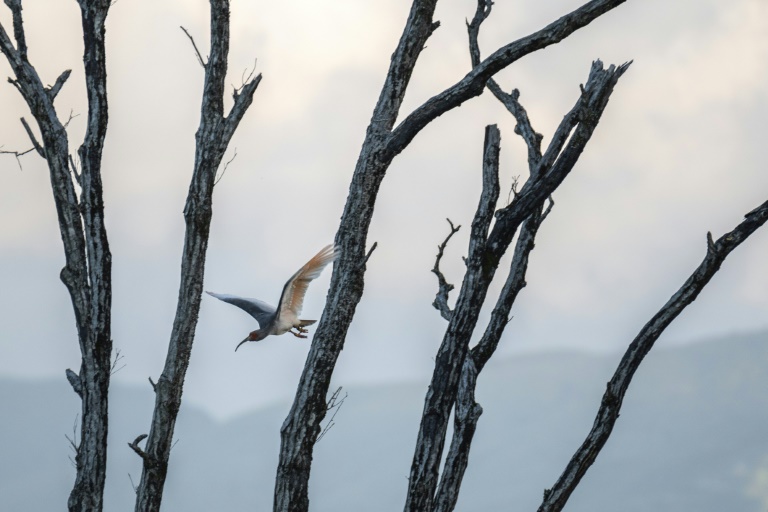
Every day for the past 14 years, 72-year-old Masaoki Tsuchiya has set out before sunrise to search for a bird rescued from extinction in Japan.

Starting his car under star-dotted skies unpolluted by light, he works alone in the pre-dawn chill, marking sightings or absences in a planner, interrupted only by the crackle of a walkie-talkie.

The bird he is looking for is called “toki” in Japanese, and its presence on his home of Sado island is testament to a remarkable conservation programme.

In just under two decades, Japan’s population of wild toki has gone from zero to nearly 500, all on Sado, where the bird’s delicate pink plumage and distinctive curved beak now draw tourists.

It’s a rare conservation success story when one in eight bird species globally are threatened with extinction, and involved international diplomacy and an agricultural revolution on a small island off Japan’s west coast.

– A cautionary tale –

Tsuchiya, stocky and spry with an impish grin, doesn’t eat breakfast until he has made all his stops, and after years of practice he can spot chicks hidden in nests through the monocular attached to his rolled-down car window.

He points to virtually imperceptible marks on a road or a wall that help him remember where to park and start surveying.

“The number I see at this spot depends on the season,” he explains.

Some days dozens of the birds appear in one area, something unimaginable in 2003, when a toki called Kin or “gold” died in a cage on Sado at the record-breaking age of 36.

Her death meant not a single wild-born toki was left in Japan, despite the bird being so synonymous with the country that it is also known as the Japanese crested ibis.

“I knew the day was coming. She was very old and frail,” Tsuchiya said. “But it was still a real pity.”

Efforts to get Kin to mate with Sado’s last wild-born male toki Midori — meaning “green” — had long since failed, and she lived out her last years as a curiosity and a cautionary environmental tale.

Her death made national headlines and appeared to mark the end of a long and seemingly futile battle to protect the toki in Japan, where its feathers even inspire the word for peach pink: “toki-iro”.

But now so many roam the skies and rice paddies of Sado that local officials have gone from discouraging eager birdwatchers to training guides to help visitors spot the local icon, and the government is even studying reintroducing the bird elsewhere.

– Wiped out –

Wild toki once lived across Japan, as well as in Russia, Taiwan and South Korea.

They were considered a pest that damaged rice plants, but during Japan’s Edo era, from 1603 to 1867, hunting restrictions meant only high-ranking officials could actively pursue birds like toki.

That changed in the Meiji era and as guns became more available. Toki meat was believed to have health benefits, and its feathers were favoured for everything from dusters to decorative flourishes on hats.

“Over just 40 years, the toki basically disappeared,” said Tsuchiya on an observation deck where visitors now try to spot the bird.

By the early 1930s, only a few dozen toki remained in Japan, mostly on Sado and the nearby Noto peninsula, and the species won protected status.

A fresh threat then emerged during Japan’s post-war drive for growth: rising use of chemical fertilisers and pesticides.

Toki feed primarily in rice paddies that mimic marshy wetland habitats and they are undiscriminating diners, eating everything from insects to small crabs and frogs.

The chemicals affected the birds and their food, and by 1981 just five wild toki remained in Japan, all on Sado, where officials took them into protective captivity.

But by bizarre coincidence, the same year a population of seven wild toki was discovered in a remote area of China’s Shaanxi province, reviving hopes for the bird’s survival.

Sado’s captive birds failed to mate, but China’s programme had more success, and when then-Chinese president Jiang Zemin made a historic first state visit in 1998 he offered Japan the gift of a pair of toki.

You You and Yang Yang arrived the following year on first-class seats, producing their first chick months later in an event that led national television broadcasts.

Other birds arrived from China, and with time Sado had a large enough population to consider reintroducing the toki to the wild.

But first they had to tackle the use of chemical fertilisers and pesticides on Sado.

“Back then people didn’t think about the environment when farming. Their priorities were selling products at a high price and harvesting as much as possible,” said Shinichiro Saito, a 60-year-old rice farmer.

Farmers were asked to cut chemical fertilisers and pesticides by half from the level allowed by local rules, but there was pushback.

Fewer chemicals meant smaller harvests, lost income, and more weeding.

And some farmers couldn’t see the point of other proposals like underground channels connecting rice fields to rivers to increase the flow of aquatic life.

– ‘Toki-friendly’ –

Local officials used a carrot-and-stick approach, refusing to buy rice from farmers who rejected the new chemical limits and creating a new premium brand of “toki-friendly” rice for those who did.

But Saito, who was an early adopter, said the real difference came when the first birds were released in 2008.

“It was the toki that changed their minds,” he said, with a lop-sided grin.

Even farmers reluctant to adapt were “delighted” to see a bird with almost mythical status on Sado wandering through their fields.

“This is a true story. The toki was almost like an environmental ambassador, it helped create a good environment for itself.”

Tsuchiya’s daily rounds began with the 2008 release. 

He has since witnessed triumphs including the first wild-born chick, and the first chick born to wild-born birds — moments he describes with the proud anxiety of a parent sending a child off to school for the first time.

He still runs his own business, though the toki feather tucked into his car’s folding mirror makes clear where his heart lies.

And the breeding programme has continued, supplemented by birds from China that help broaden the gene pool.

Around 20 birds are released twice a year after graduating from a three-month training programme that prepares them for life outside a cage.

“They learn how to fly, how to find food and to get used to being around humans,” explained Tomoki Tsuchiya, who works with Sado’s local government to make the island toki-friendly.

City officials even farm around the birds to acquaint them with the sound.

– ‘Like family’ –

When the first toki were released on Sado, there were so many gaps in knowledge about the species that volunteers analysed their droppings to find out what the birds were eating.

There were missteps: officials prepared a remote mountain location for the release, believing the birds would prefer seclusion, but the toki instead flew down to fields that were frequented by farmers.

Tomoki Tsuchiya’s interest in toki was fostered by his father, Masaoki.

But it is a fascination shared by many on Sado, where the bird is rendered in cute mascot form on everything from T-shirts to milk cartons.

“How can I express it? The toki is so important for people on Sado,” the 42-year-old said.

“It’s like family.”

Even after training, a toki’s future is precarious: only about half survive predators like snakes and weasels, and the survival rate for newborn chicks is similar.

But enough have thrived that Japan may expand the Sado programme, and there have been successes elsewhere. 

China’s wild population now numbers over 4,450, and a South Korean project released 40 toki for the first time in 2019.

For Saito, who speaks as toki squawk nearby, the bird’s resurrection is part of a bigger achievement on Sado — a new approach to farming and the environment.

“When this project started, what I dreamed of the most was seeing toki flying overhead while I farmed,” he said.

“An environment that is good for toki is an environment that is also safe for humans, and that’s something people on Sado can be proud of.”

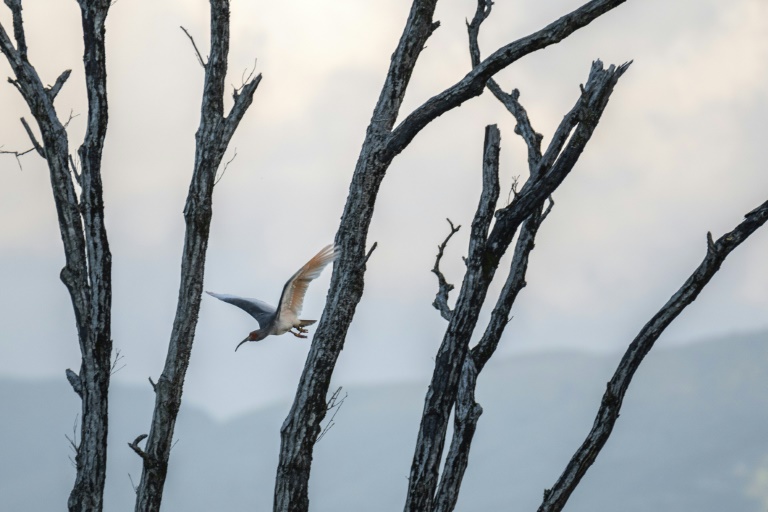
Modern phoenix: The bird brought back from extinction in Japan

Every day for the past 14 years, 72-year-old Masaoki Tsuchiya has set out before sunrise to search for a bird rescued from extinction in Japan.

Starting his car under star-dotted skies unpolluted by light, he works alone in the pre-dawn chill, marking sightings or absences in a planner, interrupted only by the crackle of a walkie-talkie.

The bird he is looking for is called “toki” in Japanese, and its presence on his home of Sado island is testament to a remarkable conservation programme.

In just under two decades, Japan’s population of wild toki has gone from zero to nearly 500, all on Sado, where the bird’s delicate pink plumage and distinctive curved beak now draw tourists.

It’s a rare conservation success story when one in eight bird species globally are threatened with extinction, and involved international diplomacy and an agricultural revolution on a small island off Japan’s west coast.

– A cautionary tale –

Tsuchiya, stocky and spry with an impish grin, doesn’t eat breakfast until he has made all his stops, and after years of practice he can spot chicks hidden in nests through the monocular attached to his rolled-down car window.

He points to virtually imperceptible marks on a road or a wall that help him remember where to park and start surveying.

“The number I see at this spot depends on the season,” he explains.

Some days dozens of the birds appear in one area, something unimaginable in 2003, when a toki called Kin or “gold” died in a cage on Sado at the record-breaking age of 36.

Her death meant not a single wild-born toki was left in Japan, despite the bird being so synonymous with the country that it is also known as the Japanese crested ibis.

“I knew the day was coming. She was very old and frail,” Tsuchiya said. “But it was still a real pity.”

Efforts to get Kin to mate with Sado’s last wild-born male toki Midori — meaning “green” — had long since failed, and she lived out her last years as a curiosity and a cautionary environmental tale.

Her death made national headlines and appeared to mark the end of a long and seemingly futile battle to protect the toki in Japan, where its feathers even inspire the word for peach pink: “toki-iro”.

But now so many roam the skies and rice paddies of Sado that local officials have gone from discouraging eager birdwatchers to training guides to help visitors spot the local icon, and the government is even studying reintroducing the bird elsewhere.

– Wiped out –

Wild toki once lived across Japan, as well as in Russia, Taiwan and South Korea.

They were considered a pest that damaged rice plants, but during Japan’s Edo era, from 1603 to 1867, hunting restrictions meant only high-ranking officials could actively pursue birds like toki.

That changed in the Meiji era and as guns became more available. Toki meat was believed to have health benefits, and its feathers were favoured for everything from dusters to decorative flourishes on hats.

“Over just 40 years, the toki basically disappeared,” said Tsuchiya on an observation deck where visitors now try to spot the bird.

By the early 1930s, only a few dozen toki remained in Japan, mostly on Sado and the nearby Noto peninsula, and the species won protected status.

A fresh threat then emerged during Japan’s post-war drive for growth: rising use of chemical fertilisers and pesticides.

Toki feed primarily in rice paddies that mimic marshy wetland habitats and they are undiscriminating diners, eating everything from insects to small crabs and frogs.

The chemicals affected the birds and their food, and by 1981 just five wild toki remained in Japan, all on Sado, where officials took them into protective captivity.

But by bizarre coincidence, the same year a population of seven wild toki was discovered in a remote area of China’s Shaanxi province, reviving hopes for the bird’s survival.

Sado’s captive birds failed to mate, but China’s programme had more success, and when then-Chinese president Jiang Zemin made a historic first state visit in 1998 he offered Japan the gift of a pair of toki.

You You and Yang Yang arrived the following year on first-class seats, producing their first chick months later in an event that led national television broadcasts.

Other birds arrived from China, and with time Sado had a large enough population to consider reintroducing the toki to the wild.

But first they had to tackle the use of chemical fertilisers and pesticides on Sado.

“Back then people didn’t think about the environment when farming. Their priorities were selling products at a high price and harvesting as much as possible,” said Shinichiro Saito, a 60-year-old rice farmer.

Farmers were asked to cut chemical fertilisers and pesticides by half from the level allowed by local rules, but there was pushback.

Fewer chemicals meant smaller harvests, lost income, and more weeding.

And some farmers couldn’t see the point of other proposals like underground channels connecting rice fields to rivers to increase the flow of aquatic life.

– ‘Toki-friendly’ –

Local officials used a carrot-and-stick approach, refusing to buy rice from farmers who rejected the new chemical limits and creating a new premium brand of “toki-friendly” rice for those who did.

But Saito, who was an early adopter, said the real difference came when the first birds were released in 2008.

“It was the toki that changed their minds,” he said, with a lop-sided grin.

Even farmers reluctant to adapt were “delighted” to see a bird with almost mythical status on Sado wandering through their fields.

“This is a true story. The toki was almost like an environmental ambassador, it helped create a good environment for itself.”

Tsuchiya’s daily rounds began with the 2008 release. 

He has since witnessed triumphs including the first wild-born chick, and the first chick born to wild-born birds — moments he describes with the proud anxiety of a parent sending a child off to school for the first time.

He still runs his own business, though the toki feather tucked into his car’s folding mirror makes clear where his heart lies.

And the breeding programme has continued, supplemented by birds from China that help broaden the gene pool.

Around 20 birds are released twice a year after graduating from a three-month training programme that prepares them for life outside a cage.

“They learn how to fly, how to find food and to get used to being around humans,” explained Tomoki Tsuchiya, who works with Sado’s local government to make the island toki-friendly.

City officials even farm around the birds to acquaint them with the sound.

– ‘Like family’ –

When the first toki were released on Sado, there were so many gaps in knowledge about the species that volunteers analysed their droppings to find out what the birds were eating.

There were missteps: officials prepared a remote mountain location for the release, believing the birds would prefer seclusion, but the toki instead flew down to fields that were frequented by farmers.

Tomoki Tsuchiya’s interest in toki was fostered by his father, Masaoki.

But it is a fascination shared by many on Sado, where the bird is rendered in cute mascot form on everything from T-shirts to milk cartons.

“How can I express it? The toki is so important for people on Sado,” the 42-year-old said.

“It’s like family.”

Even after training, a toki’s future is precarious: only about half survive predators like snakes and weasels, and the survival rate for newborn chicks is similar.

But enough have thrived that Japan may expand the Sado programme, and there have been successes elsewhere. 

China’s wild population now numbers over 4,450, and a South Korean project released 40 toki for the first time in 2019.

For Saito, who speaks as toki squawk nearby, the bird’s resurrection is part of a bigger achievement on Sado — a new approach to farming and the environment.

“When this project started, what I dreamed of the most was seeing toki flying overhead while I farmed,” he said.

“An environment that is good for toki is an environment that is also safe for humans, and that’s something people on Sado can be proud of.”
Hundreds of thousands evacuated in China after heaviest rains in decades

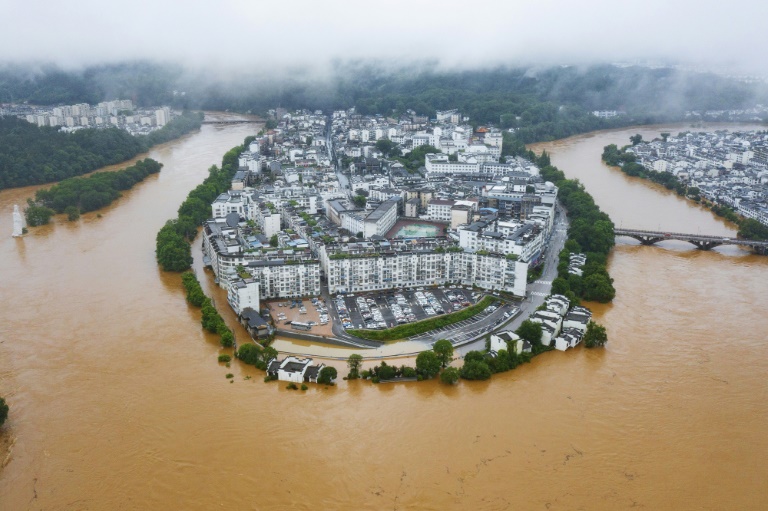
The heaviest rainfall in decades has triggered floods and landslides in southern China, forcing the evacuation of hundreds of thousands of people, state media reported.

The downpours have dangerously swelled waterways in the low-lying Pearl River basin in recent days, threatening manufacturing, shipping and logistics operations at a time when supply chains are already stressed because of China’s strict Covid-19 controls.

The average rainfall in Guangdong, Fujian and Guangxi provinces between early May and the middle of June reached 621 millimetres (24 inches), the highest since 1961, according to China’s National Meteorological Center.

State media photos showed people huddled on camp beds in schools converted into temporary shelters in Guangdong’s Shaoguan city, and hundreds of tents erected on a sports ground.

In neighbouring Guangxi region, muddy water was seen flooding urban areas and emergency rescuers were seen evacuating villagers on rubber dinghies, according to state media images.

Guangdong authorities said Monday that more than 200,000 people have been evacuated over the course of the disaster, and that the damage so far is estimated at 1.7 billion yuan ($254 million).

The evacuees were among almost 480,000 people impacted by the rains and floods, according to the officials.

Shaoguan issued a red flood alert — the most serious — Tuesday morning, after multiple rural counties and the major city of Foshan upgraded their flood warnings in recent days.

Guangxi was hit by the heaviest floods since 2005, local media reported.

Meteorological authorities said Monday that 28 of Guangxi’s rivers had exceeded warning levels, with rains continuing on Tuesday.

Jiangxi province issued a red alert for flooding on Monday.

And in Fujian, more than 220,000 people have been evacuated since the beginning of this month because of floods, China’s official Xinhua news agency said Monday.

Earlier this month, at least 21 people died after flooding induced by torrential rain in the central Chinese province of Hubei.

Catastrophic flooding in central China’s Henan province last summer killed 398 people and caused economic losses of more than $10 billion.

President of Panama announces blood cancer diagnosis

The President of Panama Laurentino Cortizo said on Monday that he has blood cancer, although the 69-year-old said he feels well and is in “good spirits.”

In late May, Cortizo’s doctors detected “a decrease in hemoglobin and white blood cell count” during routine testing, the president said in a televised statement.

Specialists recommended that a bone marrow biopsy be performed, and samples were sent to a US laboratory, and he was diagnosed with “intermediate risk” myelodysplastic syndrome, a type of cancer that hinders the production of blood cells.

Cortizo said he will undergo a second evaluation in the US city of Houston in July to find out the extent of the disease.

“I want to say that I feel well, I’m in good spirits and that I will continue with my regular work,” he added.

“The disease diagnosed to the president is a type of blood cancer,” Julio Sandoval, a doctor specializing in internal medicine and critical care, told AFP.

According to Sandoval, this type of cancer causes a decrease in hemoglobin, and abnormal levels of platelets and white blood cells, making the patient feel tired and weak, and leading to weight loss.

The disease can be caused “by a genetic disorder that develops silently and appears after the age of 60,” Sandoval said.

Life expectancy, which will depend on the specific type of cancer Cortizo has, can range “from six months to 15 years,” he added.

Honduran hydroelectric executive jailed for environmentalist murder

A senior executive of a hydroelectric dam in Honduras was handed a prison sentence of more than 22 years on Monday for his role in the 2016 murder of renowned environmentalist Berta Caceres.

A judge last July had ruled that Roberto David Castillo, a former member of the armed forces who graduated from the West Point military academy in New York, was the “co-perpetrator of the crime of murder.”

The victim, Berta Caceres, was a fervent opponent of Desarrollos Energeticos S.A. (DESA), which had developed a project in Indigenous territories in Honduras.

Castillo was the executive president of DESA, and evidence presented against him — including phone recordings — showed that he “participated directly” in the crime, according to a statement from the Supreme Court of Justice (CSJ) announcing his sentence of 22 years and 6 months in prison.

Castillo’s defense has 20 days to appeal the ruling.

During the trial, the court heard that Caceres was killed due to her opposition to DESA’s building of a hydroelectric plant on the Gualcarque river.

She was the coordinator of the COPINH group of Indigenous organizations and in 2015 won the prestigious Goldman Environmental Prize.

Less than a year later, on March 2, 2016, she was shot and killed by men who entered her home in the western village of La Esperanza.

In 2018, two DESA officials and a former military officer were sentenced to 30 years in prison as “co-perpetrators” to Caceres’s murder.

The four hitmen each received 50 years.

Caceres’s family and the COPINH leadership want more people punished, though, including the partners in DESA, made up of influential banking families.

“This is not easy but we are continuing the fight, collecting evidence to be able to bring them to trial because they are already people of economic and political power,” Roberto Caceres, the brother of the murdered environmentalist, told AFP.

Macron hosts Le Pen, French party leaders to break impasse

French President Emmanuel Macron will on Tuesday host far-right leader Marine Le Pen and other political party chiefs in a bid to break the impasse created by the failure of his coalition to win a majority in parliamentary elections. 

The meetings, which will also include talks with right-wing, Socialist and Communist party chiefs, are the first attempts by Macron to extract himself from a situation that risks wrecking his second-term reform plans.

Macron is due to start Tuesday’s flurry of discussions by talking with Christian Jacob, the head of the traditional right-wing the Republicans (LR), a party on the decline in recent months but which now may be courted by the president to give him a majority. 

Socialist Party leader Olivier Faure and Communist Party boss Fabien Roussel — members of the NUPES left-wing alliance — will also meet Macron, although the hard-left leader Jean-Luc Melenchon is not scheduled to do so.

And in a rare encounter, Macron will at 17:30 Paris time (1530 GMT) host Marine Le Pen, his rival in presidential elections and leader of the far-right National Rally (RN).

The aim is to “build solutions to serve the French” at a time when there is no “alternative majority” to that of Macron’s ruling alliance, said a presidential official who asked not to be named.

Representatives of the parliamentary parties will be received at the Elysee Palace separately and successively.

The result of the parliamentary elections was a stunning blow for the president and his reform agenda, leaving his camp facing the prospect of a political deadlock.

While Macron’s Ensemble (Together) coalition remains the largest party after Sunday’s National Assembly elections, it fell dozens of seats short of keeping the absolute majority it has enjoyed for the last five years.

Melenchon and Le Pen made big gains, leaving them as major players in the new parliament.

– Resurgent opposition –

The left-leaning Liberation daily called the results a “slap in the face” for Macron, while the conservative Figaro said he was now “faced with an ungovernable France”.

Macron’s Together alliance won 244 seats, well short of the 289 needed for an overall majority, in a low-turnout vote that resulted in an abstention rate of 53.77 percent.

Macron met Monday with his embattled Prime Minister Elisabeth Borne and two top allies, former premier Edouard Philippe and centrist leader Francois Bayrou.

The election saw NUPES become the main opposition force along with its allies on 137 seats, according to interior ministry figures.

But it appears unlikely the coalition of Socialists, Communists, Greens and the hard-left France Unbowed will be able to retain common cause in the legislature.

Melenchon, the France Unbowed chief who orchestrated the alliance, called its results “fairly disappointing” and proposed Monday to make NUPES a permanent left-wing bloc.

He said it would not be a full-on merger but simply an effective “alternative” force in parliament, though the offer was immediately rejected by the three other NUPES parties.

– Premier vulnerable? –

Meanwhile the far right under Le Pen posted the best legislative performance in its history, becoming the strongest single opposition party with 89 seats, up from eight in the outgoing chamber.

A confident Le Pen said her party would demand to chair the National Assembly’s powerful finance commission, as is tradition for the biggest opposition party.

“The country is not ungovernable, but it’s not going to be governed the way Emmanuel Macron wanted,” Le Pen told reporters Monday.

Melenchon said he would bring a motion of no confidence against Borne in early July, when she is to lay out her policy priorities for the next five years.

Borne could now be vulnerable as Macron faces a new cabinet shake-up after several of his top allies lost their seats.

His health and environment ministers were beaten and by tradition will have to resign, as did the parliament speaker and the head of Macron’s parliament group.

The outcome tarnished Macron’s April presidential election victory when he defeated Le Pen, becoming the first French president to win a second term in over two decades.

– ‘A lot of imagination’ –

The options available to Macron range from seeking to form a new coalition alliance, passing legislation based on ad hoc agreements, or even calling new elections.

One option would be an alliance with the Republicans, which has 61 MPs. 

But LR president Jacob has insisted his party intends to “stay in opposition”.

Macron had hoped to mark his second term with an ambitious programme of tax cuts, welfare reform and raising the retirement age. All that is now in question.

In a rare bit of good news for the president, Europe Minister Clement Beaune and Public Service Minister Stanislas Guerini — both young pillars of his party — won tight battles for their parliamentary seats.

burs-imm/pvh/dhc

Close Bitnami banner
Bitnami