World

Yours sincerely: singles charmed by Japan letter-writing scheme

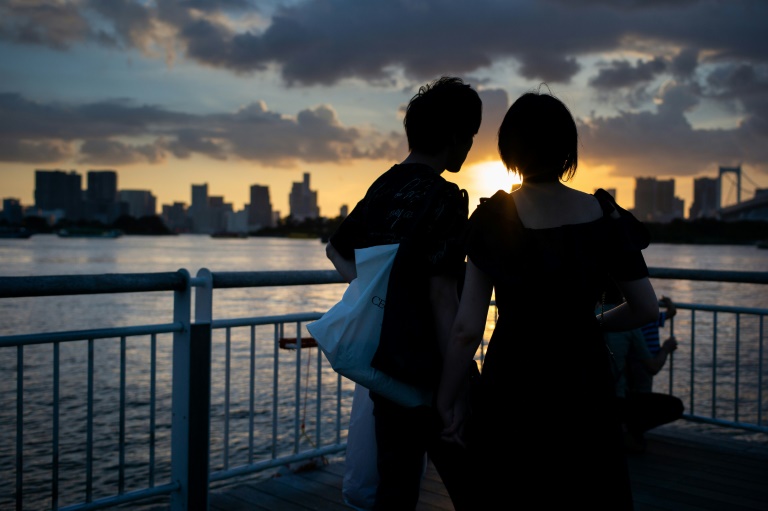
Sick of swiping and tired of Tinder? Old-fashioned love letters may be the answer, says one Japanese city whose unusual matchmaking scheme has been a surprising success.

Singles in southern Japan’s Miyazaki are being encouraged to put pen to paper in a low-tech search for their soulmate, part of municipal efforts to boost the low birth rate.

The charm of handwritten correspondence has attracted so many young residents that organisers have decided to expand the programme to people living farther afield.

Compared to online dating, “it takes longer, and inspires you to imagine the person you’re in communication with,” said Rie Miyata, head of a local consulting firm commissioned to run the scheme.

“It’s less about how good your penmanship is,” she told AFP, “and more the fact that you write every single character sincerely and with care, thinking deeply about the person you’re writing to.”

“That’s what makes letters so powerful,” she said.

Since 2020, when the project began, 450 people have signed up — more than double authorities’ initial estimates — with around 70 percent in their 20s and 30s.

Applicants are screened by Miyata’s team and paired with potential suitors based on information they submit about themselves like their favourite films, books and sports.

But unlike dating apps, the only thing revealed about each new pen pal is their age, with identifying details like their full name, job and address withheld — and of course, no profile pics on display.

“Looks are often a decisive factor” when searching for a partner, “but in letters, you are judged by your personality,” Miyata said.

Letters are posted to the organisers, who give them a quick read to make sure the note contains no obscenities or insults before sending it on to the eager recipient.

So far, 32 pairs have set up face-to-face meetings, with romance blooming for 17 couples who have started a relationship.

One participant, a 25-year-old Miyazaki resident, said the idea had brought back fond memories.

“As a kid, I used to write letters to the girl I had a crush on,” the man, who wished to remain anonymous, told AFP.

“I like how old-fashioned letters are. That made me want to join the programme.”

Despite the city’s original approach, it’s not unusual for local governments to fund matchmaking programmes in Japan, which has the world’s oldest population and one of the lowest fertility rates.

In 2021, the number of babies born hit a new record low of 811,604, and women are now expected to have an average of 1.3 children in their lifetime, far below the rate needed to maintain a population.

Russia to 'intensify' fighting, Zelensky warns as EU decision looms

Ukrainian President Volodymyr Zelensky warned Russia was likely to intensify its “hostile activity” this week, as Kyiv awaits a historic decision from the European Union on its bid for candidate status.

Nearly three months after Russia launched a bloody invasion of his country, Zelensky said there had been “few such fateful decisions for Ukraine” as the one it expects from the EU this week.

“Only a positive decision is in the interests of the whole of Europe,” he said in his evening address Sunday.

“Obviously, we expect Russia to intensify hostile activity this week … We are preparing. We are ready,” he continued. 

Moscow’s forces have been pummelling eastern Ukraine for weeks as they try to seize the Donbas region, after being repelled from other parts of the country following their February invasion.

On Friday, Brussels backed Kyiv’s bid for EU candidate status after the heads of the bloc’s biggest members — France, Germany and Italy — paid a visit to the Ukrainian capital.

Ukraine could join the list of countries vying for membership as early as this week, when member state leaders meet at a Brussels summit. 

But officials and leaders in the bloc caution that, even with candidacy status, membership could take years.

NATO’s chief Jens Stoltenberg meanwhile warned that the war could grind on “for years” and urged Western countries to be ready to offer long-term military, political and economic aid.

“We must not weaken in our support of Ukraine, even if the costs are high — not only in terms of military support but also because of rising energy and food prices,” Stoltenberg told German daily newspaper Bild.

Ukraine has repeatedly urged Western countries to step up their deliveries of arms, despite warnings from nuclear-armed Russia that it could trigger wider conflict.

– Energy crisis –

Zelensky made a rare trip outside Kyiv Saturday to the hold-out Black Sea city of Mykolaiv, where he visited troops nearby and in the neighbouring Odessa region for the first time since the invasion.

“We will not give away the south to anyone, we will return everything that’s ours and the sea will be Ukrainian and safe,” he said in a video posted on Telegram as he made his way back to Kyiv.

Russia’s defence ministry said Sunday it launched missile strikes during the past 24 hours, with one attack on a top-level Ukrainian military meeting near the city of Dnipro killing “more than 50 generals and officers”.

It said it also targeted a building housing Western-provided weapons in Mykolaiv, destroying Ukrainian artillery and armoured vehicles.

There was no independent verification of the claims.

Mykolaiv is a key target for Russia as it lies on the route to the strategic port of Odessa.

With Russia maintaining a blockade of Odessa that has trapped grain supplies and threatens a global food crisis, residents have turned their attention to rallying the home front effort.

“Every day, including the weekend, I come to make camouflage netting for the army,” said Natalia Pinchenkova, 49, standing by a large Union flag, a show of thanks to Britain for its support for Ukraine.

The Ukraine war is fuelling not only a global food crisis but an energy crisis too. 

Hit by punishing sanctions, Moscow has turned up the pressure on European economies by sharply reducing gas supplies, which has in turn sent energy prices soaring. 

Germany on Sunday announced emergency measures including increased use of coal to ensure it meets its energy needs after a drop in the supply of Russian gas.

Austria announced it will reopen a mothballed coal power station to combat shortages, and Italian company Eni joined a huge Qatari project to expand production from the world’s biggest natural gas field.

– Attack repelled –

The worst of the fighting is in the industrial Donbas region, with battles raging in villages outside the city of Severodonetsk, under unrelenting Russian fire for weeks.

Regional governor Sergiy Gaiday said the Russians had targeted the settlement of Toshkivka, south of Severodonetsk.

“But our artillery worked, and we can say the attempt to break through was not successful, even though they tried very powerfully to break our defence,” he wrote on Telegram.

Lysychansk, across a river from Severodonetsk, is also under heavy bombardment, with some residents sheltering in basements in dire conditions, with limited supplies of food and water. 

Natalia Khalaimova, 54, urged Russia and Ukraine to negotiate an end to the war. 

“Every war in any country ends — but the sooner, the better,” she told AFP. “So many civilians are killed. Most of them were not involved in the war at all.”

burs-sr/

Offshore detention survivors decry UK's Rwanda scheme

Britain’s plan to send migrants and asylum seekers to Rwanda has left survivors of a similar scheme in Australia wondering why the “failed” policy that shattered their lives is being revived elsewhere.

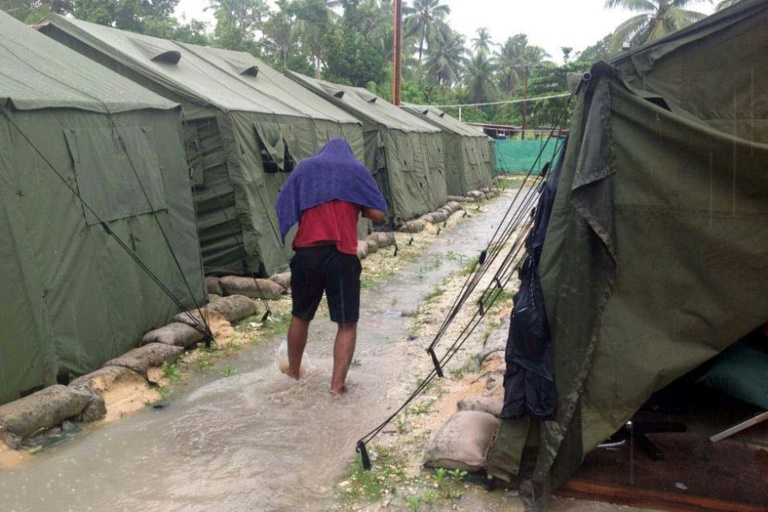
For more than six years, Sudan-born refugee Abdul Aziz Muhamat was detained by Australian authorities in a small tropical island camp off Papua New Guinea’s mainland, hidden from full legal and public oversight. 

“The simplest way to describe daily life on Manus Island is there’s no life,” Muhamat explained. 

“It’s worse than a prison,” he told AFP. “If you cry, no one will listen. If you shout, no one will come.” 

Muhamat’s detention was part of Australia’s “Pacific Solution”, under which thousands of people who attempted to reach the country by boat were moved to offshore centres on Manus and the tiny nation of Nauru.

There, they were processed, given identification numbers and barred from ever permanently settling in Australia. 

Many languished in the camps for years, in conditions described by rights groups as “hellish”. 

“They never could have got away with the conditions in those camps if they had been in Australia,” said Nick McKim, a Greens senator who visited Manus five times before being refused entry.

“I have no hesitation in describing what happened in those camps as torture.”

After vast taxpayer expense, 14 detainee deaths, a string of suicide attempts — some by detainees as young as five — and at least six referrals to the International Criminal Court, Australia’s scheme has been scaled back piece-by-piece. As of last month there were about 100 people still on Nauru.

Now the concept is being given new life by Britain, which plans to send asylum seekers to the land-locked African nation of Rwanda. 

– The Australian solution –

Manus-detainee-turned-author Behrouz Boochani has urged the British public to resist plans “to copy the deeply dehumanising asylum policies of Australia”. 

But UK Prime Minister Boris Johnson — who has taken advice from a series of prominent Australian political strategists — has offered a familiar explanation for why it needs to go ahead: deterrence.

Like his Australian counterparts, Johnson has argued the policy will convince would-be migrants not to undertake perilous sea journeys on often rickety and overloaded vessels.

But Australian legal expert Madeline Gleeson of the Kaldor Centre said data shows “definitively” that offshore detention did not deter asylum seekers.

Gleeson said the UK scheme most closely mirrors Australia’s policy between August 2012 and July 2013, when only some asylum seekers were sent to offshore camps.

“In that period, the number of people arriving by boat continued to rise to levels never before seen in Australia,” she said.

Muhamat, who attempted three times to reach Australia by boat from Indonesia, losing five of his closest friends en route, is more direct.

The policy “achieved nothing”, he said. “When you’re running to save your life. You don’t think about the tragedy you will encounter on your journey.”

“This is really one of the points that people don’t understand,” he added. “What option do people have? They have only one option; they will continue risking their life.”

Now living in Switzerland, Muhamat said the policy will simply condemn people to a “failed” system — and tarnish Britain’s status in the world. 

“It will destroy the reputation of an entire country,” he said. “The image of the UK will be replaced with an image of human misery.”

Yours sincerely: singles charmed by Japan letter-writing scheme

Sick of swiping and tired of Tinder? Old-fashioned love letters may be the answer, says one Japanese city whose unusual matchmaking scheme has been a surprising success.

Singles in southern Japan’s Miyazaki are being encouraged to put pen to paper in a low-tech search for their soulmate, part of municipal efforts to boost the low birth rate.

The charm of handwritten correspondence has attracted so many young residents that organisers have decided to expand the programme to people living farther afield.

Compared to online dating, “it takes longer, and inspires you to imagine the person you’re in communication with,” said Rie Miyata, head of a local consulting firm commissioned to run the scheme.

“It’s less about how good your penmanship is,” she told AFP, “and more the fact that you write every single character sincerely and with care, thinking deeply about the person you’re writing to.”

“That’s what makes letters so powerful,” she said.

Since 2020, when the project began, 450 people have signed up — more than double authorities’ initial estimates — with around 70 percent in their 20s and 30s.

Applicants are screened by Miyata’s team and paired with potential suitors based on information they submit about themselves like their favourite films, books and sports.

But unlike dating apps, the only thing revealed about each new pen pal is their age, with identifying details like their full name, job and address withheld — and of course, no profile pics on display.

“Looks are often a decisive factor” when searching for a partner, “but in letters, you are judged by your personality,” Miyata said.

Letters are posted to the organisers, who give them a quick read to make sure the note contains no obscenities or insults before sending it on to the eager recipient.

So far, 32 pairs have set up face-to-face meetings, with romance blooming for 17 couples who have started a relationship.

One participant, a 25-year-old Miyazaki resident, said the idea had brought back fond memories.

“As a kid, I used to write letters to the girl I had a crush on,” the man, who wished to remain anonymous, told AFP.

“I like how old-fashioned letters are. That made me want to join the programme.”

Despite the city’s original approach, it’s not unusual for local governments to fund matchmaking programmes in Japan, which has the world’s oldest population and one of the lowest fertility rates.

In 2021, the number of babies born hit a new record low of 811,604, and women are now expected to have an average of 1.3 children in their lifetime, far below the rate needed to maintain a population.

Macron allies seek to find majority after France poll blow

Allies of French President Emmanuel Macron started working Monday to cobble together a working parliamentary majority to salvage his second term, after his alliance crumbled in the election against surges from the left and far-right.    

Macron’s Ensemble (Together) coalition emerged as the largest party in parliamentary elections but was dozens of seats short of keeping the parliamentary majority it had enjoyed for the last five years.

It will now begin work to try and find a majority by forming deals with other parties on the right, stirring up turmoil unprecedented in French politics in recent years.

Macron, 44, now also risks being distracted by domestic problems as he seeks to play a prominent role in putting an end to Russia’s invasion of Ukraine and as a key statesman in the EU.

The election saw a new left-wing alliance make gains to become the main opposition, while the far-right under Marine Le Pen posted its best legislative performance in its history.

“This situation constitutes a risk for our country, given the challenges that we have to confront,” Prime Minister Elisabeth Borne said in a televised statement Sunday, vowing: “We will work from tomorrow to build a working majority.” 

The outcome severely tarnished Macron’s April presidential election victory when he defeated the far-right to be the first French president to win a second term in over two decades.

“It’s a turning point for his image of invincibility,” said Bruno Cautres, a researcher at the Centre for Political Research of Sciences Po.

The options available to Macron, who has yet to publicly comment on the result, range from seeking to form a new coalition alliance, passing legislation based on ad hoc agreements to even calling new elections.

Le Monde daily headlined on its website “Macron faces the risk of political paralysis”, while the right-wing Le Figaro daily said the results raised the spectre of a “stillborn new mandate”.

Left-leaning Liberation’s Monday edition said the results represented the “fall” of Macron’s way of governing.

– ‘Failure for Macron’ –

The new left-wing coalition NUPES under 70-year-old hard-left figurehead Jean-Luc Melenchon won 135 seats, according to an AFP count based on the results published by the ministry.

The coalition, formed in May after the left splintered for April’s presidential elections, brings together Socialists, the hard left, Communists and greens.

Melenchon called Sunday’s results “above all an electoral failure” for Macron. 

“The rout of the presidential party is total and there will be no majority” in parliament, he told cheering supporters in Paris.

A prominent MP from Melenchon’s party, Alexis Corbiere, said the result meant Macron’s plan to raise the French retirement age to 65 had been “sunk”.

Far-right leader Marine Le Pen’s National Rally party made huge gains and will send 89 MPs to the new parliament, making it the biggest rightwing force in parliament ahead of the traditional right The Republicans (LR).

Le Pen hailed the historic result for her party, saying it would send “by far” its highest number of MPs to the next National Assembly.

Macron had hoped to stamp his second term with an ambitious programme of tax cuts, welfare reform and raising the retirement age. All that is now in question.

“This will complicate the reforms… It will be much more difficult to govern,” said Dominique Rousseau, professor of law at Paris Pantheon-Sorbonne University.

– ‘Imagination needed’ –

There could now potentially be weeks of political deadlock as the president seeks to reach out to new parties.

The most likely option would be an alliance with the Republicans, the traditional party of the French right, which has 61 MPs. 

LR president Christian Jacob however made clear there would be no easy partnership, saying his party intended to “stay in opposition”.

But other voices from the right appeared more open — former right-wing minister Jean-Francois Cope said a “government pact is vital between Macron and LR to fight against the rise of extremes”. 

Economy Minister Bruno Le Maire denied that France would be ungovernable but admitted “a lot of imagination would be needed” from the ruling party in an “unprecedented situation”.

– Three ministers felled –

In another blow to Macron, key ministers standing for election are set to lose their jobs under a convention that they should resign if they fail to win seats.

Health Minister Brigitte Bourguignon, Maritime Minister Justine Benin and Environment Minister Amelie de Montchalin — a pillar of Macron’s administration over the last years — all lost and will now exit the government. 

Two other close Macron allies, parliament speaker Richard Ferrand and former interior minister Christophe Castaner, both acknowledged defeat in the fight for their seats. 

In a rare spot of good news for the president, Europe Minister Clement Beaune and Public Service Minister Stanislas Guerini — both young pillars of his party — won tight battles for their seats.

On the left, Rachel Keke, a former cleaning lady who campaigned for better working conditions at her hotel, was also elected, defeating Macron’s former sports minister Roxana Maracineanu.

Turnout was low, with the abstention rate recorded at 53.77 percent, according to the interior ministry, higher than the first round but not beating the record worst turnout of 2017.  

Russia to 'intensify' fighting, Zelensky warns as EU decision looms

Ukrainian President Volodymyr Zelensky warned that Russia was likely to intensify its “hostile activity” this week, as Kyiv awaits a historic decision from the European Union on its membership application.

Nearly three months after Russia launched a bloody invasion of his country, Zelensky said there had been “few such fateful decisions for Ukraine” as the one it expects from the EU this week.

“Only a positive decision is in the interests of the whole of Europe,” he said in his evening address Sunday.

“Obviously, we expect Russia to intensify hostile activity this week … We are preparing. We are ready,” he continued. 

Moscow’s forces have been pummelling eastern Ukraine for weeks as they try to seize the Donbas region, after being repelled from other parts of the country following their February invasion.

On Friday, Brussels backed Kyiv’s bid for EU candidate status after the heads of the bloc’s biggest members — France, Germany and Italy — paid a visit to the Ukrainian capital.

Ukraine could join the list of countries vying for membership as early as this week, when member state leaders meet at a Brussels summit. 

NATO’s chief Jens Stoltenberg meanwhile warned that the war could grind on “for years” and urged Western countries to be ready to offer long-term military, political and economic aid.

“We must not weaken in our support of Ukraine, even if the costs are high — not only in terms of military support but also because of rising energy and food prices,” Stoltenberg told German daily newspaper Bild.

Ukraine has repeatedly urged Western countries to step up their deliveries of arms, despite warnings from nuclear-armed Russia that it could trigger wider conflict.

– Residents rally –

Zelensky made a rare trip outside Kyiv Saturday to the hold-out Black Sea city of Mykolaiv, where he visited troops nearby and in the neighbouring Odessa region for the first time since the invasion.

“We will not give away the south to anyone, we will return everything that’s ours and the sea will be Ukrainian and safe,” he said in a video posted on Telegram as he made his way back to Kyiv.

Russia’s defence ministry said Sunday it launched missile strikes during the past 24 hours, with one attack on a top-level Ukrainian military meeting near the city of Dnipro killing “more than 50 generals and officers”.

It said it also targeted a building housing Western-provided weapons in Mykolaiv, destroying Ukrainian artillery and armoured vehicles.

There was no independent verification of the claims.

Mykolaiv is a key target for Russia as it lies on the route to the strategic port of Odessa.

With Russia maintaining a blockade of Odessa that has trapped grain supplies and threatens a global food crisis, residents have turned their attention to rallying the home front effort.

“Every day, including the weekend, I come to make camouflage netting for the army,” said Natalia Pinchenkova, 49, standing by a large Union flag, a show of thanks to Britain for its support for Ukraine.

– ‘So many killed’ –

The Ukraine war is fuelling not only a global food crisis but an energy crisis too. 

Hit by punishing sanctions, Moscow has turned up the pressure on European economies by sharply reducing gas supplies, which has in turn sent energy prices soaring. 

Germany on Sunday announced emergency measures including increased use of coal to ensure it meets its energy needs after a drop in the supply of Russian gas.

Austria announced it will reopen a mothballed coal power station to combat shortages, and Italian company Eni joined a huge Qatari project to expand production from the world’s biggest natural gas field.

The worst of the fighting is in the industrial Donbas region, with battles raging in villages outside the city of Severodonetsk, under unrelenting Russian fire for weeks.

Ukraine’s armed forces said Sunday they had pushed back Russian attacks on villages near Severodonetsk.

Lysychansk, which sits across a river from Severodonetsk, is also under heavy bombardment. 

Some residents have taken shelter in basements in dire conditions, with limited supplies of food and water. 

Natalia Khalaimova, 54, urged Russia and Ukraine to negotiate an end to the war. 

“Every war in any country ends — but the sooner, the better,” she told AFP. “So many civilians are killed. Most of them were not involved in the war at all.”

burs-sr/dhc

Strong quake hits eastern Taiwan: USGS

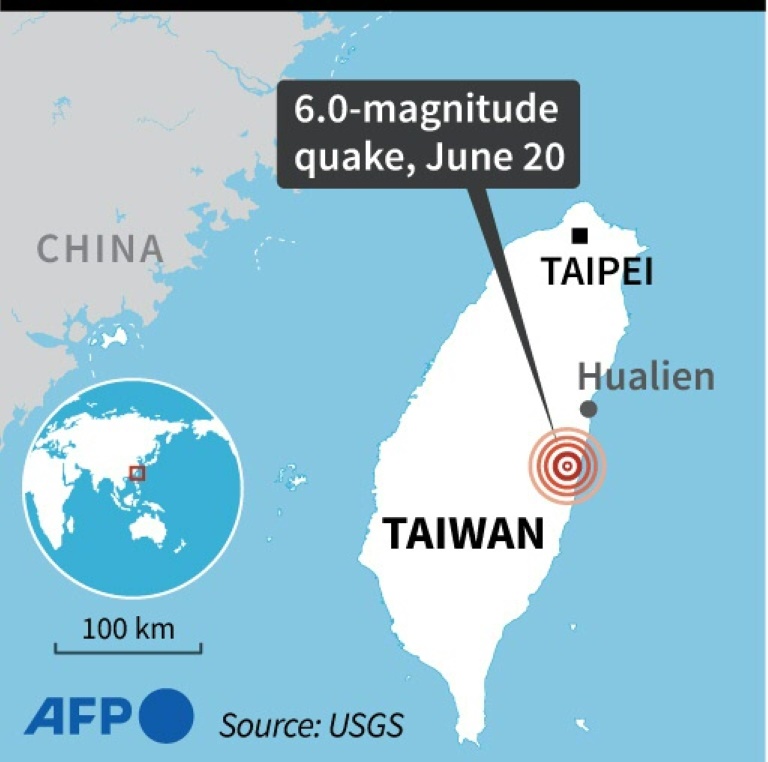
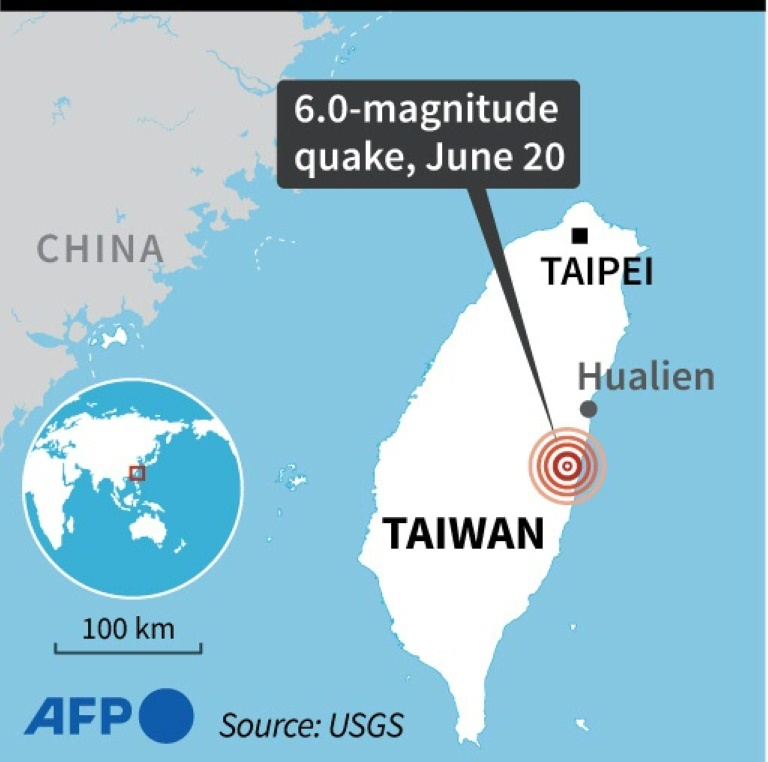
A 6.0-magnitude earthquake struck Monday in Taiwan’s east, 38 kilometres south of Hualien city, the US Geological Survey said.

There were no immediate reports of damage or injuries. 

The quake had an estimated depth of 10 kilometres, according to USGS, and struck at 09:05 local time (0105 GMT). 

A clip of a tranquil lakeside scene suddenly beginning to violently judder as the ground moved was posted on Facebook by a national park in Hualien. 

“This is a really big earthquake!… Hope everyone stays safe!”, the caption read, adding the clip had been taken from one of its camera feeds in the park.

An AFP reporter in Taipei felt shaking, and local media said the quake was felt across the island. 

The Taipei Metro stopped briefly when it hit, according to one passenger, before continuing at reduced speed for several stops.

A second smaller tremor hit about half an hour later, according to Taiwan’s Central Weather Bureau.

“In this area (where the quake hit today) there were only two earthquakes above 6.0 magnitude since 1990 and one close to 6.0 magnitude,” Chen Kuo-chang, head of Taiwan’s Central Weather Bureau’s Seismological Center, said at a press conference. 

“The most shallow one was today’s and we think it may be linked to fault activities,” he added. 

He said that the weather bureau was not ruling out more aftershocks above 5.0 magnitude in the next two days.

Taiwan is regularly hit by earthquakes as the island lies near the junction of two tectonic plates.

The island does not issue tsunami warnings unless a quake is more than magnitude 7.0.

Some earthquakes of 6.0 or more can prove deadly, although much depends on where the quake strikes and at what depth.

But the USGS gave a “green” ranking to the threat posed by the latest quake, predicting a low likelihood of either casualties or damage.

Chen said the most earthquakes over 6.0 magnitude were recorded in 1999, when there were 13. 

That year Taiwan was devastated by its deadliest ever quake — a 7.6-magnitude one in September that killed over 2,400 people. 

Strong quake hits eastern Taiwan: USGS

A 6.0-magnitude earthquake struck Monday in Taiwan’s east, 38 kilometres south of Hualien city, the US Geological Survey said.

There were no immediate reports of damage or injuries. 

The quake had an estimated depth of 10 kilometres, according to USGS, and struck at 09:05 local time (0105 GMT). 

A clip of a tranquil lakeside scene suddenly beginning to violently judder as the ground moved was posted on Facebook by a national park in Hualien. 

“This is a really big earthquake!… Hope everyone stays safe!”, the caption read, adding the clip had been taken from one of its camera feeds in the park.

An AFP reporter in Taipei felt shaking, and local media said the quake was felt across the island. 

The Taipei Metro stopped briefly when it hit, according to one passenger, before continuing at reduced speed for several stops.

A second smaller tremor hit about half an hour later, according to Taiwan’s Central Weather Bureau.

“In this area (where the quake hit today) there were only two earthquakes above 6.0 magnitude since 1990 and one close to 6.0 magnitude,” Chen Kuo-chang, head of Taiwan’s Central Weather Bureau’s Seismological Center, said at a press conference. 

“The most shallow one was today’s and we think it may be linked to fault activities,” he added. 

He said that the weather bureau was not ruling out more aftershocks above 5.0 magnitude in the next two days.

Taiwan is regularly hit by earthquakes as the island lies near the junction of two tectonic plates.

The island does not issue tsunami warnings unless a quake is more than magnitude 7.0.

Some earthquakes of 6.0 or more can prove deadly, although much depends on where the quake strikes and at what depth.

But the USGS gave a “green” ranking to the threat posed by the latest quake, predicting a low likelihood of either casualties or damage.

Chen said the most earthquakes over 6.0 magnitude were recorded in 1999, when there were 13. 

That year Taiwan was devastated by its deadliest ever quake — a 7.6-magnitude one in September that killed over 2,400 people. 

Asian markets, oil prices extend losses on recession worries

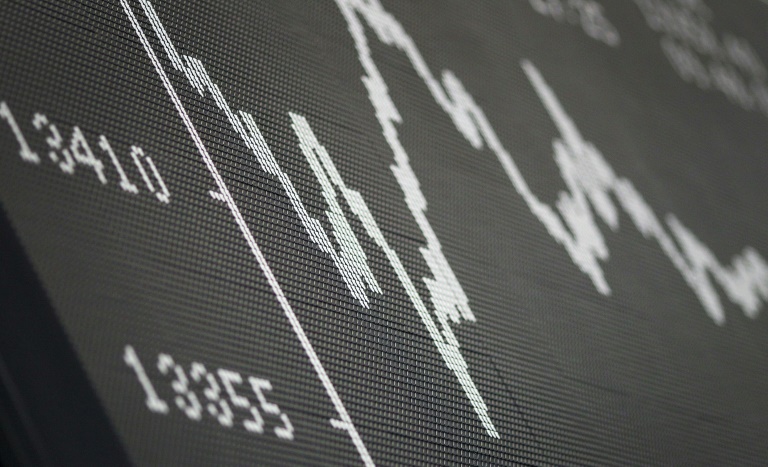
Asian markets fell again Monday and oil prices extended losses on growing fears that central bank moves to rein in soaring inflation will induce a recession.

The losses come after a sell-off last week fuelled by the Federal Reserve’s sharp interest rate hike last week — the biggest in nearly 30 years — and a warning of more to come, while increases in Britain and Switzerland added to the gloom.

And while the S&P 500 and Nasdaq saw gains on Friday, there is a sense that indexes still have some way down to go before they find a bottom, with economic data suggesting economies are beginning to feel the pinch.

Cleveland Fed chief Loretta Mester added to the worry, saying that the risk of a recession in the United States was increasing and it would take several years to bring inflation down from four decade highs to the bank’s two percent target.

She told CBS’s “Face The Nation” on Sunday that while she was not predicting a contraction, the Fed’s decision not to act sooner to fight rising prices was hurting the economy.

In early trade, Asian traders were struggling, with Tokyo, Hong Kong, Shanghai, Sydney, Singapore, Seoul, Taipei, Jakarta and Wellington all in the red.

Analysts warned there was likely to be more pain ahead for traders as the Ukraine war drags on and uncertainty continues to reign.

“Central banks’ hawkish rhetoric and concerns over a global economic slowdown/recession (are) not helping sentiment and at this stage it is hard to see a turn in fortunes until we see evidence of a material ease in inflationary pressures,” said National Australia Bank’s Rodrigo Catril.

And Stephen Innes of SPI Asset Management added: “Most of these major central banks are praying for some relief from inflation and hoping the data falls in line, but unless there is a detent in the Ukraine -Russia war, escalation will continue to drive energy price fears so it could be a tough road ahead.”

Still, oil prices fell further Monday after suffering a hefty drop Friday caused by demand worries caused by a possible recession.

However, US Energy Secretary Jennifer Granholm said prices could continue to surge if the European Union cuts off imports of the commodity from Russia in response to the Ukraine war.

She said Joe Biden had called on global suppliers to ramp up output to help temper the price rises, with the president to discuss the issue at an upcoming visit to Saudi Arabia next month.

– Key figures at around 0245 GMT –

Tokyo – Nikkei 225: DOWN 1.7 percent at 25,534.68 (close)

Hong Kong – Hang Seng Index: DOWN 0.4 percent at 21,001.43

Shanghai – Composite: DOWN 0.3 percent at 3,308.08

Dollar/yen: DOWN at 134.85 yen from 134.99 yen late Friday

Pound/dollar: DOWN at $1.2219 from $1.2221

Euro/dollar: UP at $1.0509 from $1.0493

Euro/pound: UP at 86.00 pence from 85.83 pence

West Texas Intermediate: DOWN 0.5 percent at $108.98

Brent North Sea crude: DOWN 0.5 percent at $112.56 a barrel

New York – Dow: DOWN 0.1 percent at 29,888.78 (close)

London – FTSE 100: DOWN 0.4 percent at 7,016.25 (close) 

— Bloomberg News contributed to this story —

China's mass testing mantra is building a waste mountain

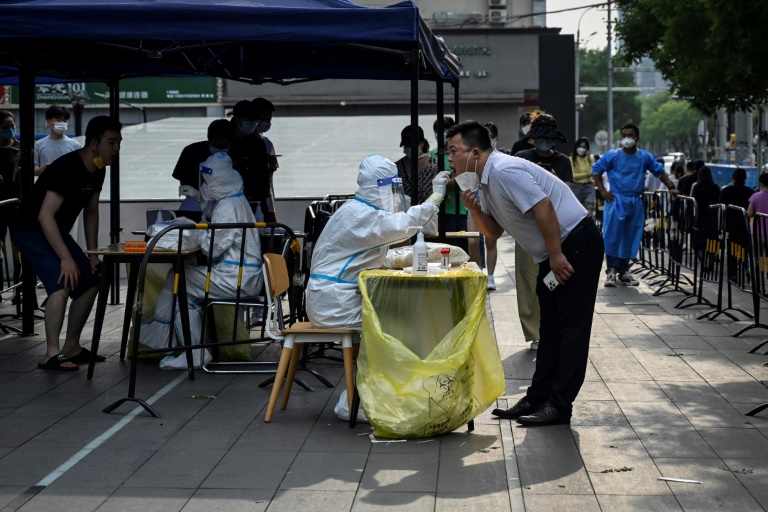
Hazmat-suited workers poke plastic swabs down millions of throats in China each day, leaving bins bursting with medical waste that has become the environmental and economic levy of a zero-Covid strategy.

China is the last major economy wedded to stamping out infections no matter the cost.

Near-daily testing is the most commonly used weapon in an anti-virus arsenal that includes snap lockdowns and forced quarantines when just a few cases are detected.

From Beijing to Shanghai, Shenzhen to Tianjin, cities are now home to an archipelago of temporary testing kiosks, while authorities order hundreds of millions of people to get swabbed every two or three days.

Mass testing appears set to stay as Chinese authorities insist zero-Covid has allowed the world’s most populous nation to avoid a public health catastrophe.

But experts say the approach — a source of political legitimacy for the ruling Communist Party — creates a sea of hazardous waste and a mounting economic burden for local governments who must plough tens of billions of dollars into funding the system.

“The sheer amount of medical waste that is being generated on a routine basis (is) at a scale that is practically unseen in human history,” said Yifei Li, an environmental studies expert at New York University Shanghai.

“The problems are already becoming astronomical, and they will continue to grow even bigger,” he told AFP.

Beijing has positioned itself as an environmental leader, cracking down on air and water pollution while setting the goal of making its economy carbon-neutral by 2060, a target experts say is untenable given the current trajectory of investments in coal.

Blanket-testing is now posing a new trash challenge.

Each positive case — typically a few dozen a day nationwide — unspools a trail of used test kits, face masks and personal protective gear.

If not disposed of properly, biomedical waste can contaminate soil and waterways, posing threats to the environment and human health.

– Burning questions –

Cities and provinces home to a total of around 600 million people have announced some form of routine testing in recent weeks, according to an AFP analysis of government notices and Chinese media reports.

Different regions have imposed different restrictions, and some areas have suspended the policy in step with falling cases. 

Nationwide data on the waste footprint has not been disclosed. But Shanghai officials said last month the city produced 68,500 tonnes of medical waste during its recent Covid lockdown, with daily output up to six times higher than normal.

Under Chinese regulations, local authorities are tasked with separating, disinfecting, transporting and storing Covid waste before finally disposing of it — usually by incineration.

But disposal systems in the poorer rural parts of the country have long been overburdened.

“I’m not sure that… the countryside really has the capacity to deal with a significant increase in the amount of medical waste,” said Yanzhong Huang, a senior fellow for global health at the Council on Foreign Relations.

The spike in waste may prompt some local governments to process it improperly or simply “dump it on the ground” in temporary landfills, said Benjamin Steuer, of the Hong Kong University of Science and Technology.

In a statement to AFP, China’s health ministry said it had made “specific demands for medical waste management” as part of national Covid protocols. 

– Waste of money? –

Beijing has urged provincial capitals and cities with at least 10 million people to set up a test site within 15 minutes’ walk of every resident.

Top leaders also expect local governments to foot the bill for testing at a time when many are struggling to balance the books.

Expanding the model to the whole of the country could cost between 0.9 and 2.3 percent of China’s gross domestic product, Nomura analysts said last month.

“The economics of that is tricky,” said Li of NYU Shanghai. “You don’t want to invest in permanent infrastructure to process what is perceived as a short-term surge of medical waste.”

Jin Dong-yan, a professor at Hong Kong University’s School of Biomedical Sciences, said “very ineffective and costly” routine testing would force governments to back away from other much-needed healthcare investments.

Authorities are also likely to miss positive cases as the Omicron variant spreads rapidly and is harder to detect than other strains, he told AFP.

“This will not work,” he said. “It will just wash down millions of dollars into the sea.”

Close Bitnami banner
Bitnami