World

Bitcoin plunges below $20,000

Bitcoin plunged below $20,000 on Saturday, shedding nine percent from the previous day to fall to $18,740, its lowest level since December 13, 2020.

With investors increasingly wary of risk, the world’s most popular crypto asset has lost more than 72 percent of its value since reaching a high of $68,991 on November 10, 2021.

After sinking to $18,740 on Saturday, Bitcoin rose to $18,941 at 1550 GMT, down eight percent from Friday.

Other major digital currencies were also down on Saturday, including ether, which lost nearly 10 percent of its value.

World stock markets plunged this week amid fears that inflation-fighting interest rate hikes by the US Federal Reserve and other central banks could trigger a recession.

Cryptocurrencies have paid the biggest price.

The value of the global crypto market fell below the symbolic $1 trillion mark on Monday after reaching $3 trillion in November of last year.

Bitcoin’s fall has been accelerated by the suspension of withdrawals by two cryptocurrency platforms.

The Celsius Network said it was pausing “all withdrawals, swap, and transfers between accounts” due to “extreme market conditions.”

Babel Finance said it was facing “unusual liquidity pressures.”

Major exchange Binance temporarily suspended bitcoin withdrawals and advised customers to use other networks.

Coinbase said Monday that it was trimming 18 percent of its workforce, about 1,100 jobs, citing tight economic conditions and overly rapid expansion.

“We appear to be entering a recession after a 10+ year economic boom,” Coinbase founder and CEO Brian Armstrong said.

In recent years, the crypto sector benefited from a vast infusion of cash due to easy money policies from the world’s biggest central banks.

However, rampant inflation has sparked tighter monetary policy across the globe, helping to send the industry crashing.

'We prepare for worst', says governor of Ukraine frontline region

The governor of the eastern Ukrainian region now seeing heavy fighting with Russia, Sergiy Gaiday, opened the pockets of his flack jacket Saturday to show gun cartridges and a tourniquet.

Appointed by President Volodymyr Zelensky, the 46-year-old heads the Lugansk region, including the city of Severodonetsk, where Russians are fighting street battles, and Lysychansk, where bangs of artillery are near-constant. 

“It’s a tough situation, in the city (of Lysychansk) and in the region as a whole,” he told AFP in an interview, as Russians “are just shelling our troop positions 24 hours a day.”

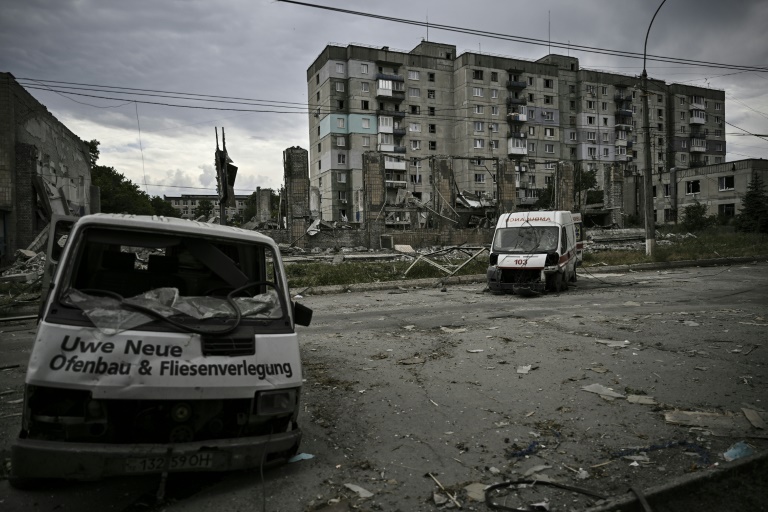
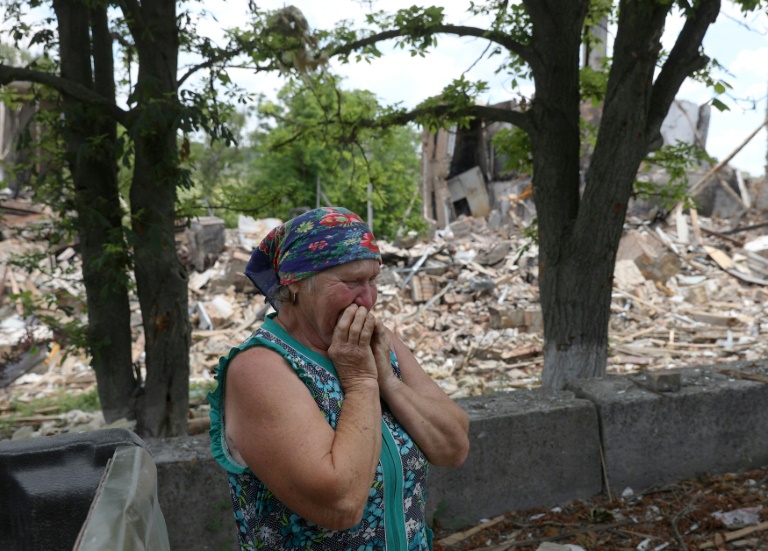
In Lysychansk, there are signs of preparations for street fighting: soldiers digging in, putting up barbed wire and police placing burnt-out vehicles sideways across roads to slow traffic.

“There’s an expression: prepare for the worst and the best will come by itself, Gaiday said. “of course we need to prepare.”

Gaiday has warned of the danger that Russian troops will encircle Lysychansk by cutting off supply roads. 

“Theoretically it’s possible. This is a war, anything can happen, he said.

“It could turn out that they cut off the region and we really do end up encircled. Maybe there will be fighting even in Lysychansk — this is war.”

From Lysychansk, Ukrainian artillery is firing at Severodonetsk, where smoke rises from the Azot factory and Russian troops fire back shells and rockets.

“Look how long Severodonetsk has held out: you can see they (the Russians) don’t control the town fully… they can’t go further in and they can’t put their big guns or tanks there,” the governor said.

He called for for supplies of “long-range weaponry to arrive as soon as possible”.

“The fact that the West is helping us is good, but it’s (too) late.”

– ‘No safe places’ –

The governor could still theoretically visit his home town of Severodonetsk accompanied by military, he said, “but it’s very highly risky”.

In fact “there are no safe places in Lugansk region,” he said, as explosions rang out in the background.

His flak jacket was stuffed with cartridge cases and he said he has a semi-automatic rifle in his car “and if I need to, I will fight”.

Gaiday was born in Severodonetsk and appointed by Zelensky after his election in 2019.

Of his current role as a wartime administrator, Gaiday said: “It’s hard, but I don’t let my emotions out.”

“It’s painful for me to see how my home city is being destroyed,” he said, as well seeing those he knew die.

“It’s all painful, I’m a human being but I bury this deep inside me,” he said, adding that his task is to “help people as much as possible”.

– Social media –

Conditions are grim for civilians left in Lysychansk, who have no mobile phone connection, running water or power. They cook on campfires and shelter in cellars.

“About 10 percent” have stayed in the city, Gaiday said. 

“We try to talk to people and persuade them to leave. Some point-blank refuse.”

There is a “small percentage” who are waiting for Moscow to build a “Russian world” in the region, he said.

Gaiday has a prominent presence on social media including Telegram and Facebook, giving regular updates on the war.

“You need to talk,” he said, saying this could counteract the powerful influence of Russia’s state propaganda machine.

He said he also wanted people in the conflict zone to “understand that I haven’t abandoned them, that I’m on the spot and with them.”

Referring to a potential war crimes tribunal, he also suggested his posts “could even be a small element when we try (Russian President Vladimir) Putin at the Hague”.

One killed as gunmen storm Sikh temple in Afghan capital

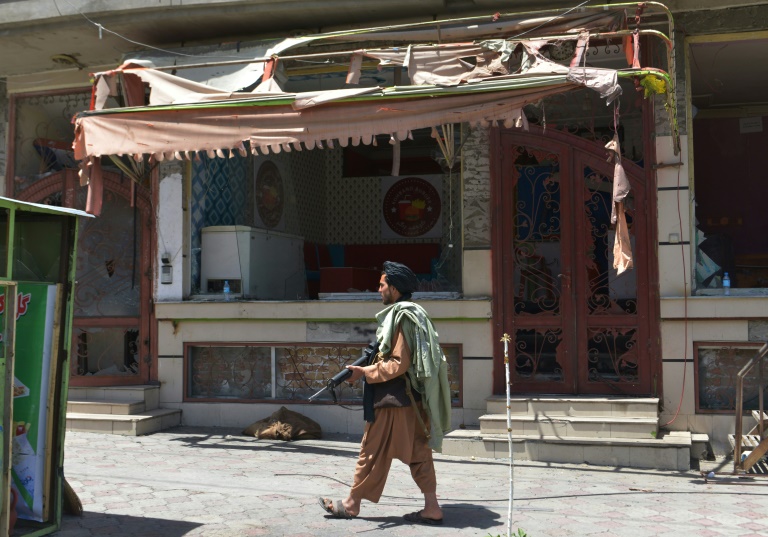
Armed men raided a Sikh temple in the Afghan capital on Saturday, killing at least one member of the community and wounding seven more, the interior ministry and witnesses said.

Ministry spokesman Abdul Nafi Takor said the attackers lobbed at least one grenade when they entered the temple, setting off a blaze.

Minutes later, a car bomb was detonated in the area but caused no casualties, he added.

“One of our Sikh brothers has been killed and seven others (were) wounded in the attack,” Takor said in a statement.

Two attackers were killed in an operation to secure the temple following the raid, he said, with one Taliban fighter also killed.

While the number of bombings across Afghanistan has dropped since the Taliban seized power in August, several fatal attacks have hit the country in recent months.

“I heard gunshots and blasts,” Gurnam Singh, a Sikh community leader, told AFP from close to the scene of Saturday’s attack soon after the raid began.

“Generally at that time in the morning we have several Sikh devotees who come to offer prayers at the gurdwara (temple complex).”

Arijit Singh, who lives in the area, said it was a relative of his who died in the attack.

“He was taking a shower which the attackers heard and they gunned him down there itself, shooting him twice,” Singh told AFP when the Taliban fighters allowed access to the complex late on Saturday. 

Footage posted on social media after the attack showed shattered pillars and walls in the temple’s main prayer hall, with debris scattered across the floor.

An AFP correspondent who visited the complex saw pockmarked walls and patches of blood.

A section of a building near the temple had also caught fire.

The windows of several residential buildings were broken from the impact of the car bomb. Nearby streets were littered with shattered glass.

– Repeated attacks –

A Taliban fighter deployed in the area told AFP that some Sikhs in the temple at the time of the attack managed to flee through a back door.

Some of Kabul’s other Sikh temples shut soon after reports of the attack spread.

No group has so far claimed responsibility for the raid.

The attack came days after an Indian delegation visited Kabul to discuss the distribution of humanitarian aid from India to Afghanistan.

Afghan and Indian media reports said the delegation also discussed with Taliban officials the possibility of reopening the Indian embassy.

New Delhi, which had close relations with the previous US-backed Afghan government, shut its mission in Kabul and evacuated all its diplomatic and other staff when the Taliban seized power in Afghanistan on August 15.

Indian Foreign Minister S. Jaishankar in a tweet condemned Saturday’s “cowardly attack” on the temple.

The number of Sikhs living in Afghanistan has dwindled to around 200, compared to about half a million in the 1970s.

Most of those who remain are traders involved in selling herbal medicines and electronic goods brought from India.

In recent months many impoverished Sikhs including women and children had taken refuge in the complex that was attacked on Saturday.

The community has faced repeated attacks over the years. At least 25 people were killed in March 2020 when gunmen stormed another Sikh temple in Kabul.

The jihadist group Islamic State claimed responsibility for that attack, which forced many Sikhs to leave the country even before the Taliban returned to power.

IS has a history of targeting Afghan Sikhs, Hindus and other members of minority communities — including Muslim Shiites and Sufis.

A string of bombings hit the country during the Muslim holy month of Ramadan, which ended in Afghanistan on April 30, some of them claimed by IS.

IS is a Sunni Islamist group, like the Taliban, but the two are bitter rivals.

Indigenous protesters in Ecuador defy state of emergency

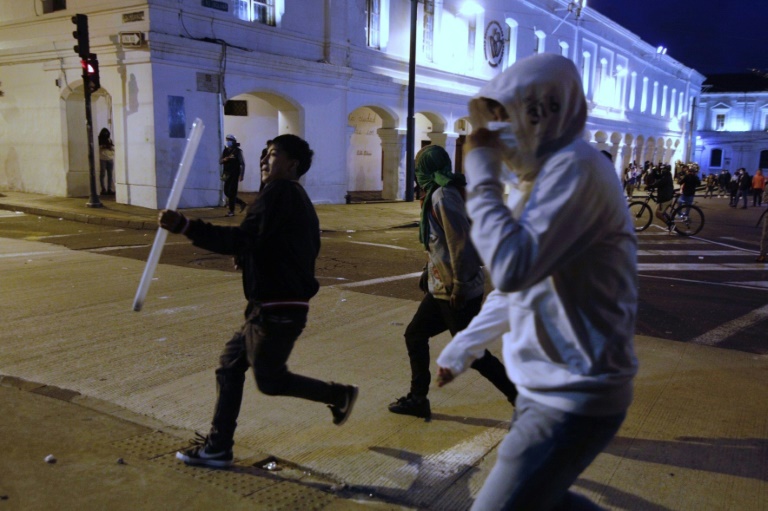
Indigenous protesters demanding cheaper fuel in Ecuador defied a state of emergency Saturday, pressing on with road blockages now in their sixth day.

A day after President Guillermo Lasso announced the restrictive measures in a bid to end the sometimes violent demonstrations, police said Indigenous people kept up protests in most of the country’s 24 provinces, including three where the president declared the state of emergency. One includes the capital, Quito.

Oil producer Ecuador has been hit by rising inflation, unemployment and poverty exacerbated by the coronavirus pandemic.

Fuel prices have risen sharply since 2020, almost doubling for diesel from $1 to $1.90 per gallon (3.8 liters) and rising from $1.75 to $2.55 for petrol.

Demonstrators from the country’s Indigenous community — which makes up over a million of Ecuador’s 17.7 million inhabitants — launched an open-ended anti-government protest this week that has since been joined by students, workers and others.

The demonstrations have blocked roads across the country, including highways leading into the capital Quito.

Talks with the president failed to end the demonstrations.

Clashes with security forces during the protests have left at least 83 people injured, and 40 have been arrested.

In response, Lasso’s decree empowers him to mobilize the armed forces to maintain order, suspend civil rights and declare curfews. 

“I am committed to defending our capital and our country,” Lasso said on television. 

“I called for dialogue and the response was more violence. There is no intention to seek solutions.”

The demonstrations have largely been concentrated in the northern region of Pichincha which includes Quito, and neighboring Cotopaxi and Imbabura.

In Quito, nearly 1,000 protesters tried to tear down metal fences that surround the presidential headquarters this week.

In a bid to ease grassroots anger, Lasso announced in his address late Friday a small increase in a monthly subsidy paid to Ecuador’s poorest, as well as a program to ease the debt of those who have loans from state-run banks.

Indigenous protesters in Ecuador defy state of emergency

Indigenous protesters demanding cheaper fuel in Ecuador defied a state of emergency Saturday, pressing on with road blockages now in their sixth day.

A day after President Guillermo Lasso announced the restrictive measures in a bid to end the sometimes violent demonstrations, police said Indigenous people kept up protests in most of the country’s 24 provinces, including three where the president declared the state of emergency. One includes the capital, Quito.

Oil producer Ecuador has been hit by rising inflation, unemployment and poverty exacerbated by the coronavirus pandemic.

Fuel prices have risen sharply since 2020, almost doubling for diesel from $1 to $1.90 per gallon (3.8 liters) and rising from $1.75 to $2.55 for petrol.

Demonstrators from the country’s Indigenous community — which makes up over a million of Ecuador’s 17.7 million inhabitants — launched an open-ended anti-government protest this week that has since been joined by students, workers and others.

The demonstrations have blocked roads across the country, including highways leading into the capital Quito.

Talks with the president failed to end the demonstrations.

Clashes with security forces during the protests have left at least 83 people injured, and 40 have been arrested.

In response, Lasso’s decree empowers him to mobilize the armed forces to maintain order, suspend civil rights and declare curfews. 

“I am committed to defending our capital and our country,” Lasso said on television. 

“I called for dialogue and the response was more violence. There is no intention to seek solutions.”

The demonstrations have largely been concentrated in the northern region of Pichincha which includes Quito, and neighboring Cotopaxi and Imbabura.

In Quito, nearly 1,000 protesters tried to tear down metal fences that surround the presidential headquarters this week.

In a bid to ease grassroots anger, Lasso announced in his address late Friday a small increase in a monthly subsidy paid to Ecuador’s poorest, as well as a program to ease the debt of those who have loans from state-run banks.

59 dead, millions stranded as floods hit Bangladesh, India

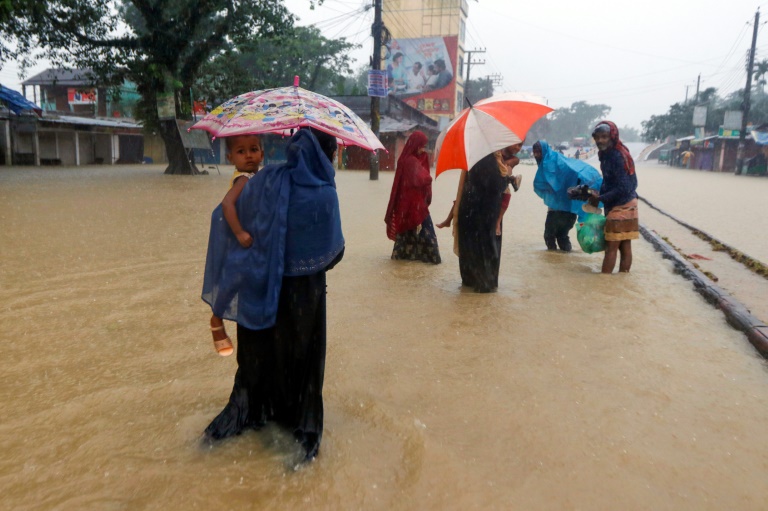
Monsoon storms in Bangladesh and India have killed at least 59 people and unleashed devastating floods that left millions of others stranded, officials said Saturday.

Floods are a regular menace to millions of people in low-lying Bangladesh, but experts say climate change is increasing their frequency, ferocity and unpredictability.

Relentless downpours over the past week have inundated vast stretches of Bangladesh’s northeast, with troops deployed to evacuate households cut off from neighbouring communities.

Schools have been turned into relief shelters to house entire villages inundated in a matter of hours by rivers that suddenly burst their banks.

“The whole village went under water by early Friday and we all got stranded,” said Lokman, whose family lives in Companiganj village.

“After waiting a whole day on the roof of our home, a neighbour rescued us with a makeshift boat. My mother said she has never seen such floods in her entire life,” the 23-year-old added.

Asma Akter, another woman rescued from the rising waters, said her family had not been able to eat for two days.

“The water rose so quickly we couldn’t bring any of our things,” she said. “And how can you cook anything when everything is underwater?”

Lightning triggered by the storms has killed at least 21 people around the South Asian nation since Friday afternoon, police officials told AFP.

Among them were three children aged between 12 and 14 who were struck by lightning on Friday in the rural town of Nandail, said local police chief Mizanur Rahman.

Another four people died when landslides hit their hillside homes in the port city of Chittagong, police inspector Nurul Islam told AFP.

At least 16 people have been killed since Thursday in India’s remote Meghalaya, the state’s chief minister Conrad Sangma wrote on Twitter, after landslides and surging rivers that submerged roads.

Next door in Assam, more than 2.6 million people have been affected by floods after five days of incessant downpours, according to the state’s disaster response agency.

Eighteen people had died in flood waters or landslides around the state since Thursday, the agency reported, with nearly 7,500 people rescued on Saturday by mid-afternoon.

Assam chief minister Himanta Biswa Sarma told reporters he had instructed district officials to provide “all necessary help and relief” to those caught in the flooding.

– ‘The situation is bad’ –

Flooding in Bangladesh worsened on Saturday morning after a temporary reprieve from the rains the previous afternoon, Sylhet region chief government administrator Mosharraf Hossain told AFP.

“The situation is bad. More than four million people have been stranded by flood water,” Hossain said, adding that nearly the entire region was without electricity. 

The flooding forced Bangladesh’s third-largest international airport in Sylhet to shut down on Friday.

Around the regional capital, residents waded through waist-deep water along roads next to partially submerged stuck vehicles.

Forecasters said the floods were set to worsen over the next two days with heavy rains in Bangladesh and upstream in India’s northeast.

Before this week’s rains, the Sylhet region was still recovering from its worst floods in nearly two decades late last month, when at least 10 people were killed and four million others were affected.

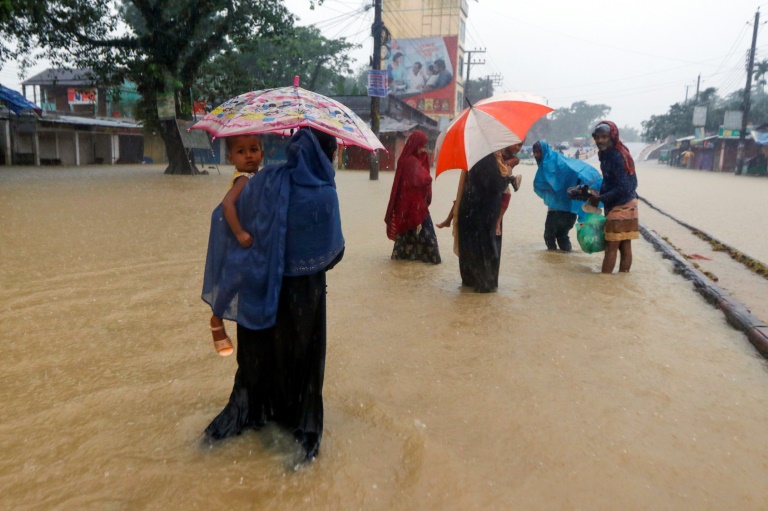
59 dead, millions stranded as floods hit Bangladesh, India

Monsoon storms in Bangladesh and India have killed at least 59 people and unleashed devastating floods that left millions of others stranded, officials said Saturday.

Floods are a regular menace to millions of people in low-lying Bangladesh, but experts say climate change is increasing their frequency, ferocity and unpredictability.

Relentless downpours over the past week have inundated vast stretches of Bangladesh’s northeast, with troops deployed to evacuate households cut off from neighbouring communities.

Schools have been turned into relief shelters to house entire villages inundated in a matter of hours by rivers that suddenly burst their banks.

“The whole village went under water by early Friday and we all got stranded,” said Lokman, whose family lives in Companiganj village.

“After waiting a whole day on the roof of our home, a neighbour rescued us with a makeshift boat. My mother said she has never seen such floods in her entire life,” the 23-year-old added.

Asma Akter, another woman rescued from the rising waters, said her family had not been able to eat for two days.

“The water rose so quickly we couldn’t bring any of our things,” she said. “And how can you cook anything when everything is underwater?”

Lightning triggered by the storms has killed at least 21 people around the South Asian nation since Friday afternoon, police officials told AFP.

Among them were three children aged between 12 and 14 who were struck by lightning on Friday in the rural town of Nandail, said local police chief Mizanur Rahman.

Another four people died when landslides hit their hillside homes in the port city of Chittagong, police inspector Nurul Islam told AFP.

At least 16 people have been killed since Thursday in India’s remote Meghalaya, the state’s chief minister Conrad Sangma wrote on Twitter, after landslides and surging rivers that submerged roads.

Next door in Assam, more than 2.6 million people have been affected by floods after five days of incessant downpours, according to the state’s disaster response agency.

Eighteen people had died in flood waters or landslides around the state since Thursday, the agency reported, with nearly 7,500 people rescued on Saturday by mid-afternoon.

Assam chief minister Himanta Biswa Sarma told reporters he had instructed district officials to provide “all necessary help and relief” to those caught in the flooding.

– ‘The situation is bad’ –

Flooding in Bangladesh worsened on Saturday morning after a temporary reprieve from the rains the previous afternoon, Sylhet region chief government administrator Mosharraf Hossain told AFP.

“The situation is bad. More than four million people have been stranded by flood water,” Hossain said, adding that nearly the entire region was without electricity. 

The flooding forced Bangladesh’s third-largest international airport in Sylhet to shut down on Friday.

Around the regional capital, residents waded through waist-deep water along roads next to partially submerged stuck vehicles.

Forecasters said the floods were set to worsen over the next two days with heavy rains in Bangladesh and upstream in India’s northeast.

Before this week’s rains, the Sylhet region was still recovering from its worst floods in nearly two decades late last month, when at least 10 people were killed and four million others were affected.

Ukraine's fallen honoured in Kyiv memorial

Roman Ratushny was a leading figure in Ukraine’s pro-European Maidan movement, an anti-corruption activist who fought Russian forces with the Ukrainian army. 

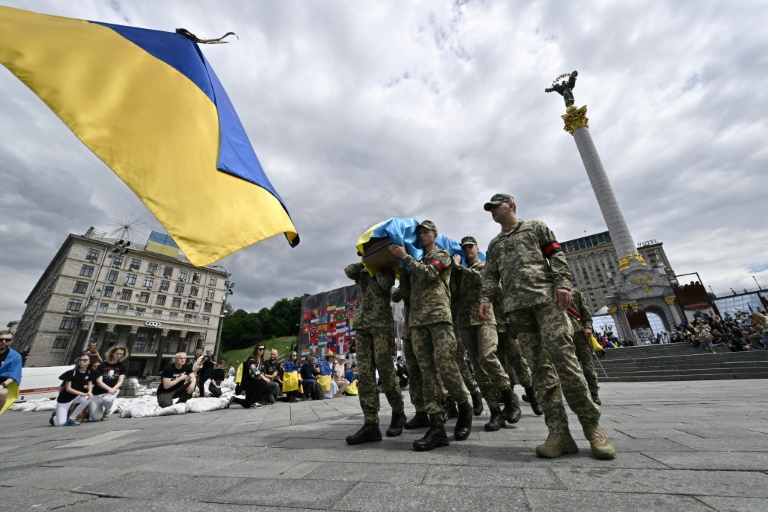
On Saturday, thousands of people in Kiev’s Independence Square paid tribute to the “hero” who was killed in the country’s east at the age of 24. 

In front of the coffin draped in a yellow and blue Ukrainian flag at the foot of the monument that overlooks the sprawling square in the capital, people of all ages saluted his memory.

He had joined the army like many other civilians since the start of the Russian offensive on February 24. 

“I think it is important to be here because he is a hero of Ukraine and we must remember him,” Dmytro Ostrovsky, a 17-year-old high school student, told AFP. 

Ratushny died on June 9 near Izium, in the Kharkiv region, where Ukrainian forces are confronting the Russian army. 

Mourners approached the body in turn, kneeling or bowing and placing a hand on the coffin where many flowers were laid. 

“For all, you were a brother, for some a son, and for others a father figure,” his father Taras Ratushny said into a microphone. 

“Roman has always fought for the right cause and this is an example for all of us, for the young,” said Hlib, a 29-year-old soldier. 

Ratushny was one of the first students to protest in the Maidan (Independence) square at the end of 2013, with the location going on to be the scene of massive pro-European protests that led to the fall of pro-Russian president Viktor Yanukovych in February 2014 . 

– Wave of reactions –

In addition to his political commitment and his fight against corruption in Ukraine, Ratushny headed the Protasiv Yar NGO, named after a historic site in Kyiv which activists sought to protect from illegal construction resulting in the destruction of a large forest in the neighbourhood. 

His activism had earned him death threats. 

He had appealed to President Volodymyr Zelensky and the prosecutor general in Kyiv, but no criminal investigation was opened. 

“If there were 10 people like Roman in Ukraine, we would live in a completely different country,” Ostrovsky said. 

Earlier in the day, hundreds of people, including Kyiv’s mayor Vitali Klitschko, attended the funeral at St Michael’s Golden-Domed monastery in central Kiev. 

“Although I didn’t know him personally, I felt like a loss because when my world view was formed, (Roman) became a person who influenced my vision and the person I am now,” Alina Horhol, a student who attended the funeral, told AFP. 

“Roman was the kind of person who could have changed a lot in our society,” she added. 

The news of his death earlier this week sparked a wave of reactions on social media, including that of English football legend Gary Lineker, who tweeted: “tragic”. 

“Roman Ratushnyi, one of the student protesters beaten by police on the first night of Maidan revolution, has been killed fighting in the east. I interviewed him a couple of times, and spoke to him a week ago. Very sharp, bright guy,” journalist Oliver Carroll tweeted. 

After the tribute on Maidan square, six soldiers carried the coffin down the steps of the square through crowds massed on both sides, before lowering it into a hearse. 

It was to be buried in the afternoon at the Baikove cemetery in southern Kyiv, where many prominent Ukrainian figures are buried. 

Ukraine's Zelensky visits southern front as battles rage

Ukrainian President Volodymyr Zelensky visited the war-torn southern frontline on Saturday for the first time since the Russian invasion as “fierce battles” raged again in the eastern Donbas region.

Making a rare trip outside Kyiv where he is based for security reasons, Zelensky travelled to the hold-out Black Sea city of Mykolaiv and visited troops nearby and in the neighbouring Odessa region.

Russian forces have directed their firepower on the east and south of Ukraine in recent weeks since failing in their bid to take the capital Kyiv after the lightning February 24 invasion.

“It is important that you are alive. As long as you live there is a strong Ukrainian wall that protects our country,” Zelensky told soldiers in the Odessa region. 

“I want to thank you from the people of Ukraine, from our state for the great work you are doing, for your impeccable service.” 

Mykolaiv is a key target for Russia as it lies on the way to the strategic Black Sea port of Odessa. It is around 100 kilometres (62 miles) northwest of Kherson, which fell to Russia in the first weeks of the war.

Zelensky surveyed the badly-damaged regional administration building in Mykolaiv and met officials in what appeared to be a basement where he handed out awards to soldiers, in a video released by his office.

– ‘Abandoning everything’ –

The shockwaves from the war in Ukraine continue to reverberate around the world, with the Russian blockade of the port of Odessa blamed for a grain shortage that is fuelling a global food crisis. 

Zelensky has appealed for western support and weapons to push out Russian forces, and got a boost on Friday when the European Commission backed it for EU candidate status.

He hailed it as a “historic achievement” in his nightly video address late Friday.

Full membership could take years but the bloc’s 27 leaders could add Ukraine to the list of countries vying for membership as early as a summit next week.

The leaders of the bloc’s biggest members — France, Germany and Italy — backed the idea during a visit to Kyiv this week, even as fighting rages elsewhere in the country.

The worst of the bloodshed continues to be in the eastern industrial Donbas region, with battles raging in villages outside the city of Severodonetsk, which Russia has been trying to seize for weeks.  

“Now the most fierce battles are near Severodonetsk. They (Russia) do not control the city entirely,” the governor of the eastern Lugansk region, Sergiy Gaiday, said on Telegram.

Gaiday said there was “more destruction” at the besieged Azot chemical plant in Severodonetsk, where he said 568 people were sheltering, including 38 children.

He also said Lysychansk — a Ukrainian-controlled city across a river from battered Severodonetsk — is being “heavily shelled”. 

Lysychansk residents were preparing to be evacuated. 

“We’re abandoning everything and going. No one can survive such a strike,” said history teacher Alla Bor, waiting with her son-in-law Volodymyr and 14-year-old grandson.

Pro-Russian officials in the eastern, separatist-held city of Donetsk said five civilians were killed and 12 injured by Ukrainian bombardment.

– ‘Defend their country’ –

Moscow has warned against outside involvement in its ex-Soviet neighbour, saying it invaded to “de-nazify and de-militarise” a country that was getting too close to the West.

Russian President Vladimir Putin said Friday he had “nothing against” Ukraine joining an economic union like the EU, unlike the security risk he sees in Kyiv joining NATO.

But he said EU membership would turn Ukraine into a “semi-colony” of the West.

Putin also insisted that the Russian invasion was not the cause of global inflation and grain shortages, blaming Western sanctions that he said threatened starvation “primarily in the poorest countries”.

Russian state television aired social media videos of two US military veterans who went missing last week while fighting alongside the Ukrainian army, stating they had been captured by Russian forces.

US President Joe Biden had said on Friday he did not know the whereabouts of Alexander Drueke and Andy Huynh, after their relatives lost contact with the pair. A third American is also missing.

Ukrainian civilian volunteers however continue to sign up, with a group performing military exercises on Friday in fortified positions left by Russian troops in Bucha, a town synonymous with war crimes blamed on Moscow’s forces.

“Most of those who are here aren’t soldiers. They’re just civilians who want to defend their country — 50 percent of them have never held a weapon until today,” a sergeant known as “Ticha” told AFP.

Soldiers in Mykolaiv meanwhile are trying to keep their pre-war routines alive, with one saying he will not give up his vegan diet on the frontlines.

Oleksandr Zhuhan said he had received a package from a network of volunteers to keep up his plant-based diet. 

“There was pate and vegan sausages, hummus, soya milk… and all this for free,” the 37-year-old drama teacher said happily.

Ukraine is also battling on another front — the right to host next year’s Eurovision song contest after its morale-boosting win this year.

Kyiv condemned a decision by organisers to move the 2023 version of the world’s biggest live music event on security grounds, possibly to Britain.

burs-dk/gw

Europe swelters in record-breaking June heatwave

Spain, France and other western European nations on Saturday sweltered under a blistering June heatwave that has sparked forest fires and concerns that such early summer blasts of hot weather will now become the norm.

The weather on Saturday was the peak of a June heatwave that is in line with scientists’ predictions that such phenomena will now strike earlier in the year thanks to global warming.

The French southwestern town of Biarritz, one of the country’s most sought-after seaside resorts, saw its highest all time temperature Saturday of 41 degrees, state forecaster Meteo France said. 

Queues of hundreds of people and traffic jams formed outside aquatic leisure parks in France, with people seeing water as the only refuge from the devastating heat.

With the River Seine off limits to bathing, scorched Parisians took refuge in the city’s fountains.   

Temperatures in France could reach as high as 42 degrees C in some areas on Saturday, Meteo France said, adding that June records had already been beaten in 11 areas on Friday.

“This is the earliest heatwave ever recorded in France” since 1947, said Matthieu Sorel, a climatologist at Meteo France.

With “many monthly or even all-time temperature records likely to be beaten in several regions,” he called the weather a “marker of climate change”.

– Forest fires rage –

In a major incident in France, a fire triggered by the firing of an artillery shell in military training in the Var region of southern France was burning some 200 hectares (495 acres) of vegetation, local authorities said.

“There is no threat to anyone except 2,500 sheep who are being evacuated and taken to safety,” said local fire brigade chief Olivier Pecot.

The fire came from the Canjeurs military camp, the biggest such training site in Western Europe. Fire services’ work was impeded by the presence of non-exploded munitions in the deserted area but four Canadair plans have been deployed to water bomb the fires.

Farmers in the country are having to adapt. Daniel Toffaloni, a 60-year-old farmer near the southern city of Perpignan, now only works from “daybreak until 11.30am” and in the evening, as temperatures in his tomato greenhouses reach a sizzling 55 degrees C. 

Forest fires in Spain on Saturday had burned nearly 20,000 hectares (50,000 acres) of land in the north-west Sierra de la Culebra region.

The flames forced several hundred people from their homes, and 14 villages were evacuated.

Some residents were able to return on Saturday morning, but regional authorities warned the fire “remains active”.

Firefighters were still battling blazes in several other regions, including woodlands in Catalonia. 

Temperatures above 40 degrees Celsius (104 degrees Fahrenheit) were forecast in parts of the country on Saturday — with highs of 43 degrees C expected in the north-eastern city of Zaragoza.

There have also been fires in Germany, where temperatures were forecast to go as high as 40 degrees C on Saturday, although only reached 36 degrees C. A blaze in the Brandenburg region around Berlin had spread over about 60 hectares by Friday evening.

– Foretaste of future –

Dutch authorities said they expect Saturday to be the hottest day of the year so far.

The UK recorded its hottest day of the year on Friday, with temperatures reaching over 30 degrees C in the early afternoon, meteorologists said. 

“I think at the moment people are just enjoying it being hot but if it gets any hotter than this, which I think it is meant to, then that’s a concern,” said Claire Moran, an editor in London.

Several towns in northern Italy have announced water rationing and the Lombardy region may declare a state of emergency as a record drought threatens harvests.

Italy’s dairy cows were putting out 10 percent less milk, the main agricultural association, Coldiretti, said Saturday. 

With temperatures far above the cows’ “ideal climate” of 22-24 degrees C, animals were drinking up to 140 litres of water per day, double their normal intake, and producing less due to stress, it said.

Experts warned the high temperatures were caused by worrying climate change trends.  

“As a result of climate change, heatwaves are starting earlier,” said Clare Nullis, a spokeswoman for the World Meteorological Organization in Geneva.

“What we’re witnessing today is unfortunately a foretaste of the future” if concentrations of greenhouse gases in the atmosphere continue to rise and push global warming towards 2 degrees C from pre-industrial levels, she added.

Close Bitnami banner
Bitnami