World

War in Ukraine: Latest developments

Here are the latest developments in the war in Ukraine:

– Macron, Scholz, Draghi in Kyiv –

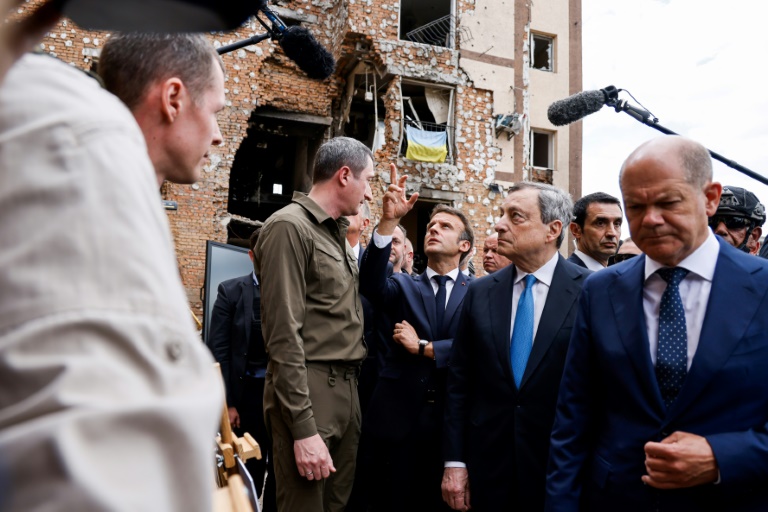
French President Emmanuel Macron, German Chancellor Olaf Scholz, and Italian Prime Minister Mario Draghi visit Kyiv for the first time since Russia invaded Ukraine. 

Macron says their visit to Kyiv and its battle-damaged suburb of Irpin aims to send “a message of European unity” with Ukraine, which is seeking EU membership.

Scholz says they want to ensure the country gets military, financial and humanitarian aid “for as long as necessary”.

Macron has been criticised for stressing the need not to “humiliate” Russia. 

He, Scholz and Draghi have worked to maintain contact with President Vladimir Putin.

– 10,000 civilians trapped in eastern city –

The governor of the eastern Lugansk region, Sergiy Gaiday, says around 10,000 civilians, out of a pre-war population of 100,000, remain trapped in the city of Severodonetsk, where intense fighting has raged for weeks.

The city is the biggest in the Lugansk region that has not fallen to Russian forces.

The three bridges into the city have been destroyed, cutting off key escape routes.

Moscow says Ukraine on Wednesday blocked the evacuation of civilians from a chemical plant where Ukrainian forces are holding out.

“Kyiv authorities cynically scuppered the humanitarian operation”, the Russian defence ministry said.

– $1 bn more in US weapons –

US President Joe Biden announces a new $1 billion worth of arms and ammunition for Ukraine.

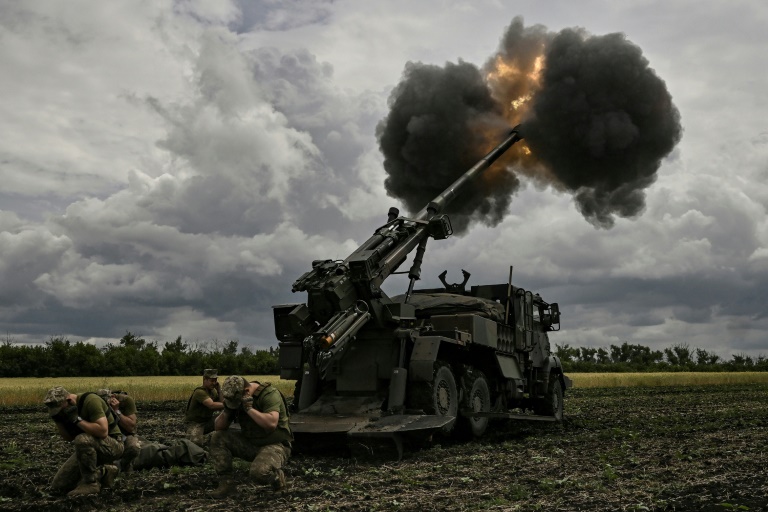
The package includes more artillery, coastal anti-ship defence systems and ammunition for artillery and advanced rocket systems that Ukraine is already using. 

Kyiv says it is outgunned in the fight for its industrial heartland of Donbas and appealed to Western allies for greater military aid.

– Xi assures Russia of Chinese support –

Chinese President Xi Jinping assures Putin of Beijing’s support on “sovereignty and security” during a call, according to state media.

China is “willing to continue to offer mutual support (to Russia) on issues concerning core interests and major concerns such as sovereignty and security,” Chinese state broadcaster CCTV reports Xi as saying.

China has refused to condemn Moscow’s invasion of Ukraine and has been accused of providing diplomatic cover for Russia by blasting Western sanctions and arms sales to Kyiv.

– Japanese airline ditches Z logo –

Japan’s Zipair budget airline ditches its Z logo for fear of it being read as a sign of support for Russia’s war in Ukraine.

The letter Z has become a symbol of support for Russia’s invasion after being spotted on Russian tanks and military uniforms in Ukraine.

It has since appeared on cars, clothing and on billboards across Russia, as well as on social media.

– UK rocket launcher delivery soon –

UK Defence Secretary Ben Wallace says Britain will soon deliver multiple-launch rocket systems to Ukraine in response to its request for more heavy weapons.

The US too has promised to send multiple-launch rocket systems and medium-range ammunition.

– Ikea reduces Russian activities –

Swedish furniture giant Ikea says it will “scale down” its activities in Russia and Belarus, after putting them on hold following the Russian invasion of Ukraine.

“Businesses and supply chains across the world have been heavily impacted and we do not see that it is possible to resume operations any time soon,” Ingka Group, which manages the majority of Ikea’s stores, says in a statement.

burs-cb/yad

Asian markets mixed as Fed rate hike rally fades

Asian markets were mixed Thursday as an early rally fuelled by a “dovish” Federal Reserve interest rate hike gave way to the prospect of an extended period of tight monetary policy.

Traders tracked a strong performance on Wall Street at the open as the US central bank move signalled it is intent on fighting runaway prices, while its boss Jerome Powell said such big moves would not be commonplace.

The 0.75 percentage point increase — the biggest in nearly 28 years — had been expected after data Friday showed inflation at its highest since 1981, as the Ukraine war supply chain snarls sent energy and food costs spiralling.

Powell said it was “essential” to lower inflation, and policymakers “have both the tools we need and the resolve it will take to restore price stability on behalf of American families”.

He stressed that the goal is to achieve that without derailing the US economy but acknowledged there was always a risk of going too far.

In his post-meeting news conference, he told reporters the move was “an unusually large one” but he did not expect “moves of this size to be common”.

But “from the perspective of today, either a 50-basis-point or a 75-basis-point increase seems most likely at our next meeting”.

While the lift was bigger than the 50 basis points flagged before Friday’s figures, it was welcomed as a sign the Fed was on the case and helped push down Treasury yields — a key guide to future rate expectations.

The 75 basis points hike “is a solid showing that will, all else being equal, serve to improve Fed credibility and leave monetary policy slightly less behind the inflationary curve”, said BMO Capital Markets strategists Benjamin Jeffery and Ian Lyngen.

“The response in risk assets will ultimately define the extent to which the Fed will be able to normalise monetary policy.”

However, after chasing higher in the first few hours of the day, Asia lost momentum in the afternoon.

Tokyo, Singapore, Seoul, Wellington, Manila and Jakarta held up, but Shanghai, Sydney, Taipei, Mumbai and Bangkok were all in negative territory.

Hong Kong led the losses after a big gain Wednesday and as investors there contemplated a sharp rate hike in the city owing to its monetary policy link to the United States. 

“Powell must be pretty pleased with his press conference and the market reaction as he delivered what I would interpret as a ‘dovish’ 75 basis point hike. Equities are up, rate expectations are slightly down and the dollar is a bit softer,” said SPI Asset Management’s Stephen Innes.

But he added: “The Fed now needs the data to play along for the ride and inflation to not surprise on the upside again. If it does, 75 basis points for July and September will be quickly repriced.”

“The much taller order for stocks to return to any semblance of bullish form would likely require an improbable upbeat mix of a seamless China growth recovery, a convincing deceleration of US inflation, and much softer oil prices.”

– Recession fears –

Other analysts were also wary about the outlook, with some concerned that the Fed measures could tip the world’s top economy into recession.

“The volatility in bond markets is definitely not over,” Jasmin Argyrou, of Credit Suisse Private Bank, told Bloomberg Television. “The likelihood is that policy rates in the US may need to go to a more restrictive stance than even the market is pricing in.”

European markets dropped at the open, with London traders awaiting a Bank of England policy meeting that is expected to see it hike rates for a fifth straight time.

On currency markets the dollar resumed its upward march across the board as the gap between the monetary policies of the Fed and other central banks widens.

The euro was particularly under pressure, having enjoyed a selling respite Wednesday after the European Central Bank said at an emergency meeting that it would act to ease stress on sovereign debt markets and design a new instrument to ward off a fresh crisis in the eurozone.

Borrowing costs in some eurozone countries are rising faster than in others as the ECB tightens its monetary policy, but officials said they would prevent such “fragmentation” that occurred during the region’s debt crisis a decade ago.

Oil prices ticked up a day after taking a hit from demand worries caused by new Covid containment measures in China and data showing a surge in US production.

The black gold was helped by a warning from the International Energy Agency that global supplies — hammered by the Ukraine conflict — will struggle to meet demand next year.

– Key figures at around 0720 GMT –

Tokyo – Nikkei 225: UP 0.4 percent at 26,431.20 (close)

Hong Kong – Hang Seng Index: DOWN 1.7 percent at 20,944.74 

Shanghai – Composite: DOWN 0.6 percent at 3,285.38 (close)

London – FTSE 100: DOWN 0.5 percent at 7,237.71

Dollar/yen: UP at 134.45 yen from 133.69 yen late Wednesday

Euro/dollar: DOWN at $1.0416 from $1.0457

Pound/dollar: DOWN at $1.2130 from $1.2181

Euro/pound: UP at 85.88 pence from 85.80 pence

West Texas Intermediate: UP 0.6 percent at $116.02 per barrel

Brent North Sea crude: UP 0.5 percent at $119.07 per barrel

New York – Dow: UP 1.0 percent at 30,668.53 (close)

Asian markets mixed as Fed rate hike rally fades

Asian markets were mixed Thursday as an early rally fuelled by a “dovish” Federal Reserve interest rate hike gave way to the prospect of an extended period of tight monetary policy.

Traders tracked a strong performance on Wall Street at the open as the US central bank move signalled it is intent on fighting runaway prices, while its boss Jerome Powell said such big moves would not be commonplace.

The 0.75 percentage point increase — the biggest in nearly 28 years — had been expected after data Friday showed inflation at its highest since 1981, as the Ukraine war supply chain snarls sent energy and food costs spiralling.

Powell said it was “essential” to lower inflation, and policymakers “have both the tools we need and the resolve it will take to restore price stability on behalf of American families”.

He stressed that the goal is to achieve that without derailing the US economy but acknowledged there was always a risk of going too far.

In his post-meeting news conference, he told reporters the move was “an unusually large one” but he did not expect “moves of this size to be common”.

But “from the perspective of today, either a 50-basis-point or a 75-basis-point increase seems most likely at our next meeting”.

While the lift was bigger than the 50 basis points flagged before Friday’s figures, it was welcomed as a sign the Fed was on the case and helped push down Treasury yields — a key guide to future rate expectations.

The 75 basis points hike “is a solid showing that will, all else being equal, serve to improve Fed credibility and leave monetary policy slightly less behind the inflationary curve”, said BMO Capital Markets strategists Benjamin Jeffery and Ian Lyngen.

“The response in risk assets will ultimately define the extent to which the Fed will be able to normalise monetary policy.”

However, after chasing higher in the first few hours of the day, Asia lost momentum in the afternoon.

Tokyo, Singapore, Seoul, Wellington, Manila and Jakarta held up, but Shanghai, Sydney, Taipei, Mumbai and Bangkok were all in negative territory.

Hong Kong led the losses after a big gain Wednesday and as investors there contemplated a sharp rate hike in the city owing to its monetary policy link to the United States. 

“Powell must be pretty pleased with his press conference and the market reaction as he delivered what I would interpret as a ‘dovish’ 75 basis point hike. Equities are up, rate expectations are slightly down and the dollar is a bit softer,” said SPI Asset Management’s Stephen Innes.

But he added: “The Fed now needs the data to play along for the ride and inflation to not surprise on the upside again. If it does, 75 basis points for July and September will be quickly repriced.”

“The much taller order for stocks to return to any semblance of bullish form would likely require an improbable upbeat mix of a seamless China growth recovery, a convincing deceleration of US inflation, and much softer oil prices.”

– Recession fears –

Other analysts were also wary about the outlook, with some concerned that the Fed measures could tip the world’s top economy into recession.

“The volatility in bond markets is definitely not over,” Jasmin Argyrou, of Credit Suisse Private Bank, told Bloomberg Television. “The likelihood is that policy rates in the US may need to go to a more restrictive stance than even the market is pricing in.”

European markets dropped at the open, with London traders awaiting a Bank of England policy meeting that is expected to see it hike rates for a fifth straight time.

On currency markets the dollar resumed its upward march across the board as the gap between the monetary policies of the Fed and other central banks widens.

The euro was particularly under pressure, having enjoyed a selling respite Wednesday after the European Central Bank said at an emergency meeting that it would act to ease stress on sovereign debt markets and design a new instrument to ward off a fresh crisis in the eurozone.

Borrowing costs in some eurozone countries are rising faster than in others as the ECB tightens its monetary policy, but officials said they would prevent such “fragmentation” that occurred during the region’s debt crisis a decade ago.

Oil prices ticked up a day after taking a hit from demand worries caused by new Covid containment measures in China and data showing a surge in US production.

The black gold was helped by a warning from the International Energy Agency that global supplies — hammered by the Ukraine conflict — will struggle to meet demand next year.

– Key figures at around 0720 GMT –

Tokyo – Nikkei 225: UP 0.4 percent at 26,431.20 (close)

Hong Kong – Hang Seng Index: DOWN 1.7 percent at 20,944.74 

Shanghai – Composite: DOWN 0.6 percent at 3,285.38 (close)

London – FTSE 100: DOWN 0.5 percent at 7,237.71

Dollar/yen: UP at 134.45 yen from 133.69 yen late Wednesday

Euro/dollar: DOWN at $1.0416 from $1.0457

Pound/dollar: DOWN at $1.2130 from $1.2181

Euro/pound: UP at 85.88 pence from 85.80 pence

West Texas Intermediate: UP 0.6 percent at $116.02 per barrel

Brent North Sea crude: UP 0.5 percent at $119.07 per barrel

New York – Dow: UP 1.0 percent at 30,668.53 (close)

European leaders visit Ukraine in show of support

The leaders of France, Germany and Italy visited Kyiv on Thursday in a show of European support for Ukraine, as Russia presses its brutal offensive in the east of the country.

French President Emmanuel Macron, German Chancellor Olaf Scholz, and Italian Prime Minister Mario Draghi arrived in the Ukrainian capital by train from Poland, according to an AFP reporter travelling with them.

Asked by a journalist why he had come to Ukraine, Macron said: “For a message of European unity.”

Scholz told German daily Bild that they “want to show not only solidarity, but also assure that the help that we’re organising — financial, humanitarian, but also, when it comes to weapons — will continue”.

“And that we will continue it as long as it is necessary for Ukraine’s fight” against Moscow, he said.

It is the first time that the leaders of the three European Union countries have visited Kyiv since Russia’s February 24 invasion. 

They are due to meet Ukrainian President Volodymyr Zelensky, at a time when Kyiv is pushing to be given official candidate status to join the EU.

France — which holds the rotating presidency of the EU until the end of this month — Germany and Italy view Ukraine’s aspirations to join the bloc favourably. 

But officials and leaders in the bloc caution that, even with candidacy status, membership could take years or even decades.

Despite reservations among some member states, EU leaders are expected to approve Ukraine’s candidate status, though with strict conditions attached.

Other leading figures to have visited Ukraine since the start of the war include British Prime Minister Boris Johnson, US Secretary of State Antony Blinken and UN chief Antonio Guterres. 

– ‘Stand by Ukraine’ –

Ukraine is also expected to reiterate its pleas for allies to send more weapons, with officials saying only a fraction of what they have asked for has so far been delivered. 

On Wednesday, US President Joe Biden announced $1 billion worth of new arms for Ukrainian forces.

The new package features howitzers, ammunition, anti-ship missile systems, and additional rockets for new artillery systems that Ukraine will soon put in the field.

Biden said that he told Zelensky in a phone call Wednesday that “the United States will stand by Ukraine as it defends its democracy and support its sovereignty and territorial integrity in the face of unprovoked Russian aggression.”

“The bravery, resilience, and determination of the Ukrainian people continues to inspire the world.”

Fighting in eastern Ukraine is focused on the industrial city of Severodonetsk, and the Russians appear close to consolidating control after weeks of intense battles.

Sergiy Gaiday — the governor of the Lugansk region, which includes the city — said Thursday around 10,000 civilians remain trapped in the city, out of a pre-war population of some 100,000. 

Kyiv’s army is “holding back the enemy as much as possible,” he said on Telegram. “For almost four months they have dreamt of controlling Severodonetsk… and they do not count the victims.”

Moscow’s forces have destroyed the three bridges spanning a river between the city and Lysychansk. 

Hundreds of civilians are trapped in a Severodonetsk chemical plant, which is under constant bombardment, according to Ukrainian authorities.

Russia said Ukrainian authorities had on Wednesday prevented an attempt at evacuating them.

From an elevated position in Lysychansk, an AFP team saw black smoke rising from the chemical factory in Severodonetsk and another area in the city.

The Ukrainian military was using the high ground to exchange fire with Russian forces across the river.

“It’s scary, very scary,” 83-year-old Lysychansk pensioner Valentina said. “Why can’t they agree at last, for God’s sake, just shake hands?”

Elsewhere, Russia launched a missile strike in Ukraine’s northeast Sumy region, killing four people and injuring six others, governor Dmytro Zhyvytsky said on Telegram.

– Seeking more arms –

In Brussels Wednesday, Ukrainian defence minister Oleksiy Reznikov and other officials met with some 50 countries of the Ukraine Defence Contact Group at NATO headquarters asking for a surge in weapons and ammunition.

“Ukraine is really in a very critical situation and therefore, it’s an urgent need to step up,” NATO chief Jens Stoltenberg told journalists. 

Russian President Vladimir Putin meanwhile underscored that he was not as isolated internationally as his foes would wish with a call with China’s leader Xi Jinping, their second reported call since Russia attacked Ukraine.

China has refused to condemn Moscow’s invasion of Ukraine and has been accused of providing diplomatic cover for Russia by criticising Western sanctions and arms sales to Kyiv.

The United Nations warned a hunger crisis that has been worsened by the war in Ukraine, traditionally a breadbasket to the world, could swell already record global displacement numbers.

Addressing the food insecurity crisis is “of paramount importance… to prevent a larger number of people moving,” the United Nations refugee chief Filippo Grandi told reporters.

Suspect confesses to burying bodies of two men missing in Amazon

One of two men arrested over the disappearance of a British journalist and an Indigenous expert in the Brazilian Amazon confessed to having buried the pair in the jungle, federal police said Wednesday after human remains were found.

Dom Phillips and his guide Bruno Pereira went missing June 5 in a remote part of the Amazon that is rife with environmental crimes including illegal mining, fishing and logging, as well as drug trafficking.

Police did not specify whether the suspect, Amarildo da Costa de Oliveira, also confessed to killing the pair, saying only that he admitted to having participated in the episode and “recounted in detail the crime that was committed and indicated the place where he buried the bodies.” 

Eduardo Alexandre Fontes, head of federal police in Brazil’s Amazonas state, told a press conference that Oliveira said the two men were fatally shot.

The location where the remains were found was “very difficult to reach,” the police officer said in Manaus, the largest city in the Amazon. 

“Excavations have been carried out on site. The excavations will continue, but human remains have already been found.

“As soon as we have been able to verify with the help of expertise that it is indeed the remains of Dom Phillips and Bruno Pereira, they will be returned to the families.”

Earlier in the day, Oliveira was taken by police to the search site along the Itaquai River, media reports said.

Phillips’ Brazilian wife, Alessandra Sampaio, in a statement Wednesday thanked “all the teams that carried out the search, especially the Indigenous volunteers,” whose absence from the press conference was criticized by some observers.

“Although we are still awaiting final confirmation, this tragic finale puts an end to the anguish of not knowing where Dom and Bruno were,” she said.

“Today we also begin our fight for justice… we will only have peace when the necessary measures are taken to ensure that such tragedies do not happen again.”

The other suspect, a man reported to be Oliveira’s brother, Oseney da Costa Oliveira, was arrested Tuesday in Atalaia do Norte — the city Phillips and Pereira were returning to when they disappeared in the Javari Valley after receiving threats during a trip.

Police are also investigating the possible role of a third person, Fontes said.

Amarildo, a fisherman, was arrested on June 7. Both he and Oseney are 41 years old.

Phillips, 57, a long-time contributor to Britain’s The Guardian and other leading international newspapers, was working on a book on sustainable development in the Amazon.

Pereira, 41, a highly regarded advocate for the region’s Indigenous peoples, was acting as his guide while on leave from his job with the Brazilian government’s Indigenous affairs agency, or FUNAI.

The father of three had repeatedly reported being threatened by loggers, miners and illegal fishermen who tried to encroach on protected lands.

The two men’s disappearance sparked global outrage, drawing reaction from high-profile political figures as well as celebrities such as members of Irish rock band U2.

– Briton ‘disliked’ –

President Jair Bolsonaro said Monday that entrails were found in the water during search operations, but police never confirmed this.

The day before, police said they had found personal effects belonging to the two missing men.

Bolsonaro — whose government has been accused of dragging its feet in the investigation — drew fresh criticism Wednesday for saying Phillips was “disliked” for his reporting on the region and should have been more careful.

“That Englishman was disliked in the region, because he wrote a lot of articles against illegal gold miners (and) environmental issues,” Bolsonaro said.

“A lot of people didn’t like him. He should have more than redoubled the precautions he was taking. And he decided to go on an excursion instead,” he told journalist Leda Nagle in an interview for her YouTube channel.

“All signs indicate that if they were killed — and I hope that’s not the case — they’re in the water, and in the water there won’t be much left. I don’t know if there are piranhas in the Javari,” Bolsonaro said.

He again appeared to blame the missing men, saying it was “very reckless to travel in that region without being sufficiently prepared, physically and with weapons.”

His comments triggered an outcry from critics.

“How disgusting,” journalist Ana Luiza Basilio wrote on Twitter.

Opposition lawmaker Orlando Silva agreed, tweeting: “The victims are not the ones to blame.”

“The government has an obligation to protect the country and not incentivize the criminals controlling the region.”

YouTube Shorts touts 1.5 bn users, taking on TikTok

YouTube on Wednesday said that more than 1.5 billion people monthly tune into its Shorts video service, which competes with global sensation TikTok.

Alphabet-owned YouTube and Facebook-parent Meta both added short-form video sharing formats to their services after TikTok — which late last year said it topped a billion users — became the rage.

YouTube Shorts went live less than two years ago, adding videos of no longer than 60 seconds to the mix of offerings on the platform.

“Shorts has really taken off and are now being watched by over 1.5 billion logged-in users every month,” said YouTube chief product officer Neal Mohan.

“We know the product will continue to be an integral part of the YouTube experience moving forward.”

YouTube last year launched a $100 million fund to “reward creators” whose video clips attract audiences to the online stage.

YouTube has also put the Silicon Valley tech titan’s advertising skills to work helping creators generate income from content on the platform, which brought in billions of dollars in revenue in 2021.

Creators are taking advantage of podcasting, shorts, and live streaming at YouTube in a “multi-platform approach,” said vice president of the Americas Tara Walpert Levy.

“This approach is yielding real results; channels uploading both short and long-form content are seeing better overall watch time and subscriber growth than those uploading only one format,” Levy said.

She billed YouTube as a one-stop shop for people to “flex their creative muscles.”

TikTok, owned by China-based ByteDance, early this year began letting users upload slightly longer videos, raising the maximum length to 10 minutes from 3 minutes.

YouTube, Meta, and TikTok compete to be the platform of preference from popular online personalities with revenue making features such as subscriptions or shares in ad revenue.

European leaders expected in Kyiv as US pledges more weapons

The leaders of France, Germany and Italy are expected to visit Kyiv on Thursday, a day after the United States announced $1 billion worth of new arms for embattled Ukrainian forces.

Kyiv’s troops are resisting a fierce onslaught in the Donbas region by Russian President Vladimir Putin’s forces, which are pushing to seize a swathe of eastern and southern Ukraine.

In a show of support, French President Emmanuel Macron, German Chancellor Olaf Scholz, and Italian Prime Minister Mario Draghi are expected in Kyiv. 

While there has been no official announcement about the trip, Macron is already in the region, having visited two of Ukraine’s neighbours — Romania and Moldova — in recent days. 

Speaking in Romania Wednesday after meeting French troops stationed there, Macron said that “we, the European Union, need to send clear political signals to Ukraine and the Ukrainian people, who have been resisting heroically for several months”.

Italian and German media have reported that Draghi and Scholz will visit Kyiv, and the three European leaders are reportedly set to meet Ukrainian President Volodymyr Zelensky. 

It will be the leaders’ first visit since Russia’s February invasion of Ukraine, and comes as Kyiv pushes to become a member of the European Union. 

Draghi has strongly supported EU sanctions against Moscow over the war, and has also backed Ukraine’s hopes of joining the bloc.

The European Commission has said it will give recommendations on Kyiv’s membership prospects soon. France holds the rotating presidency of the EU until the end of this month.

Other leading figures to have visited Ukraine since the start of the war include British Prime Minister Boris Johnson, US Secretary of State Antony Blinken and UN chief Antonio Guterres. 

– ‘Stand by Ukraine’ –

On Wednesday, President Joe Biden unveiled the new US arms package, featuring howitzers, ammunition, anti-ship missile systems, and additional rockets for new artillery systems that Ukraine will soon put in the field.

Biden said that he told Zelensky in a phone call Wednesday that “the United States will stand by Ukraine as it defends its democracy and support its sovereignty and territorial integrity in the face of unprovoked Russian aggression.”

“The bravery, resilience, and determination of the Ukrainian people continues to inspire the world.”

Fighting in eastern Ukraine is focused on the industrial city of Severodonetsk, and the Russians appear close to consolidating control after weeks of intense battles.

Moscow’s forces have destroyed the three bridges spanning a river between the city and Lysychansk just to the west, which is “likely to isolate the remaining Ukrainian defenders within the city from critical lines of communication,” according to the US Institute of War.

Hundreds of civilians are trapped in a Severodonetsk chemical plant, which is under constant bombardment, according to Ukrainian authorities.

Russia said it had sought to establish a humanitarian corridor Wednesday to evacuate them, but that Ukrainian forces “cynically scuppered” the operation and prevented it from going ahead.

From an elevated position in Lysychansk, an AFP team saw black smoke rising from the chemical factory in Sevorodonetsk and another area in the city.

The Ukrainian military was using the high ground to exchange fire with Russian forces across the river.

“It’s scary, very scary,” 83-year-old Lysychansk pensioner Valentina said. “Why can’t they agree at last, for God’s sake, just shake hands?”

– Seeking more arms –

In Brussels, Ukrainian defence minister Oleksiy Reznikov and other officials met with some 50 countries of the Ukraine Defence Contact Group at NATO headquarters asking for a surge in weapons and ammunition.

“Ukraine is really in a very critical situation and therefore, it’s an urgent need to step up,” NATO chief Jens Stoltenberg told journalists. 

Top US defence officials defended the pace of arms deliveries while stressing that some weapons Kyiv wants require weeks of training before they can enter battle.

“We really are focused on what the leadership believes that its current needs are in this fight,” said US Defense Secretary Lloyd Austin.

“And I think that the international community has done a pretty good job of providing that capability. But it’s never enough.”

Putin meanwhile underscored that he was not as isolated internationally as his foes would wish with a call with China’s Xi, their second reported call since Russian attacked Ukraine.

China has refused to condemn Moscow’s invasion of Ukraine and has been accused of providing diplomatic cover for Russia by criticising Western sanctions and arms sales to Kyiv.

The United Nations warned a hunger crisis that has been worsened by the war in Ukraine, traditionally a breadbasket to the world, could swell already record global displacement numbers.

Addressing the food insecurity crisis is “of paramount importance… to prevent a larger number of people moving,” the United Nations refugee chief Filippo Grandi told reporters.

Watergate: A scandal for the ages that could yet be eclipsed

Fifty years since it ignited Washington, the Watergate affair remains a cautionary tale on the threat of untrammeled presidential power and the yardstick against which all other political scandals are judged.

Yet some historians believe its architect, Richard Nixon, risks being displaced as the norm-breaking exemplar of presidential corruption by Donald Trump and the firestorm over his role in the 2021 US Capitol assault.

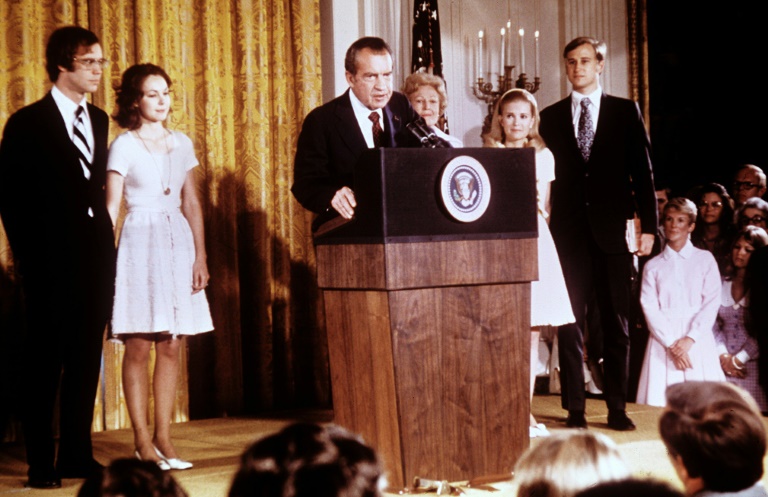
Nixon’s underlying crime was covering up a break-in at the Democratic National Committee headquarters in Washington’s Watergate complex to steal documents that might have helped him in an election he would ultimately win by a landslide anyway.

The accusations against Trump — that he incited a deadly riot to disrupt the peaceful transfer of power as part of a conspiracy to overturn an election — appear “far more serious,” says history professor Michael Green.

Nixon “already has been knocked off his perch, frankly,” Green, of the University of Nevada Las Vegas, told AFP. 

“One of the ironies is that Nixon did not need to order a break-in to win that election,” he said. “And there is no evidence, even with all of the tapes, that there was ever a discussion or thought of overturning the result if it went against him.” 

Five Watergate burglars were caught red-handed on June 17, 1972 and it quickly emerged that some were linked to the Nixon campaign and the White House.

The ensuing probe eventually opened a Pandora’s box of abuses and dirty tricks that included political spying, the forgery of correspondence and even the theft of a pair of shoes to intimidate a Nixon rival.

But the cover-up was initially so successful that Nixon won 49 of the 50 states in his landslide victory over Democrat George McGovern in that year’s presidential election.

– ‘The first seditious president’ –

The whitewash might have succeeded were it not for the chance discovery in the summer of 1973 that the president had secretly recorded all of his White House meetings.

They included a “smoking gun” tape in which Nixon could be heard ordering that the FBI, which was set to investigate the Watergate break-in, be told to “stay the hell out of this.”

Nixon resigned after a delegation of Republican elders, led by ultra-conservative Barry Goldwater, came to the White House in 1974 to tell him he was likely to be impeached and the jig was up.

He was ultimately pardoned but many of his top aides went to jail.

Carl Bernstein and Bob Woodward, the reporters who played a pivotal role in bringing down Nixon, have written a new foreword for their iconic book “All the President’s Men” drawing parallels to Trump. 

Their comparison offers an insight into a pair of outsiders who felt besieged by enemies in the media and institutions of state.

But they suggest that Trump’s incitement of a mob to march on the Capitol constituted “a deception that exceeded even Nixon’s imagination.”

“By legal definition this is clearly sedition… thus Trump became the first seditious president in our history,” they say.

Analysts interviewed by AFP pointed to the vastly different political and media landscape Nixon and Trump faced when it came to consequences for their actions.

The Goldwater intervention, for example, would be inconceivable among the vast majority of today’s serving Republicans, who have stuck by Trump through two impeachments and numerous other controversies. 

– ‘Just another story’ –

And while the Senate voted unanimously to set up a cross-party investigative committee on Watergate, the Republicans of the 2020s vetoed a bipartisan commission and punished two members who joined the Democratic-led House committee investigating January 6.

Some 80 million Americans — considerably more than a third of the population — tuned in to White House counsel John Dean’s televised testimony against Nixon at the Watergate hearings.

Around 20 million — just six percent of Americans — watched the blockbuster first hearing put on by the January 6 panel.

For David Greenberg, author of “Nixon’s Shadow: The History of an Image,” the Watergate hearings were “instrumental” in bringing down a president attempting to subvert democracy.

“The difference, however, is that in 1973 and 1974 a great many Republican congressmen and senators loyal to Nixon ended up admitting that he was engaged in criminal activity,” he told AFP.

“Today, only a few… have been willing to acknowledge Trump’s complicity. Our polarized, partisan environment may prevent the January 6 hearings from achieving all they should.”

Meanwhile Trump’s impeachment for inciting the insurrection — and the apparent cover up of almost eight hours of his phone calls on January 6 — have not significantly eroded his support base.

“At the time of Watergate, Americans were united and trusted their media sources as part of one national conversation. Today that is impossible,” former CNN anchor Rick Sanchez told AFP.

If the right-wing cable news outlets that dominate current conservative discourse had been around in the 1970s, argues Sanchez, Watergate would have been “just another story in the 24-hour news cycle of America.”

Asian markets track Wall St rally as traders cheer 'dovish' Fed hike

Asian markets rose Thursday as traders cheered a sharp Federal Reserve interest rate hike that signalled it is intent on driving inflation down from four-decade highs, while its boss Jerome Powell said such big moves would not be commonplace.

Regional traders tracked a surge on Wall Street after the central bank move, with hopes that the surge in prices can be brought under control, though analysts warned uncertainty continued to rule owing to the perfect storm of crises including the Ukraine war and China’s slowdown.

The 0.75 percentage point increase — the biggest in nearly 28 years — had been widely expected by investors after data Friday showed inflation at its highest since 1981, driven mostly by energy and food costs.

Powell said it was “essential” to lower inflation, and policymakers “have both the tools we need and the resolve it will take to restore price stability on behalf of American families”.

He stressed that the goal is to achieve that without derailing the US economy but acknowledged there was always a risk of going too far.

In his post-meeting news conference, he told reporters the move was “an unusually large one” but he did not expect “moves of this size to be common”.

However, “from the perspective of today, either a 50-basis-point or a 75-basis-point increase seems most likely at our next meeting”.

While the lift was bigger than the 50 basis points flagged before Friday’s figures, it was welcomed as a sign the Fed was on the case and helped push down Treasury yields — a key guide to future rate expectations.

The 75 basis points hike “is a solid showing that will, all else being equal, serve to improve Fed credibility and leave monetary policy slightly less behind the inflationary curve”, said BMO Capital Markets strategists Benjamin Jeffery and Ian Lyngen.

“The response in risk assets will ultimately define the extent to which the Fed will be able to normalise monetary policy.”

After the strong performance on New York’s three main indexes, Asia largely followed suit on hopes that a sharp burst of rate increases early will allow the bank to begin cutting sooner.

Tokyo, Sydney, Shanghai, Seoul, Singapore, Wellington, Taipei, Manila and Jakarta all rallied.

However, Hong Kong dipped after a big gain Wednesday, while investors there were also contemplating a sharp rate hike in the city owing to its monetary policy link to the United States. 

“Powell must be pretty pleased with his press conference and the market reaction as he delivered what I would interpret as a ‘dovish’ 75 basis point hike. Equities are up, rate expectations are slightly down and the dollar is a bit softer,” said SPI Asset Management’s Stephen Innes.

“Still, the Fed now needs the data to play along for the ride and inflation to not surprise on the upside again. If it does, 75 basis points for July and September will be quickly repriced.”

But he added that “the much taller order for stocks to return to any semblance of bullish form would likely require an improbable upbeat mix of a seamless China growth recovery, a convincing deceleration of US inflation, and much softer oil prices”.

Other analysts were also wary about the outlook, with some concerned that the Fed measures could tip the world’s top economy into recession.

“The volatility in bond markets is definitely not over,” Jasmin Argyrou, of Credit Suisse Private Bank, told Bloomberg Television. “The likelihood is that policy rates in the US may need to go to a more restrictive stance than even the market is pricing in.”

Oil prices edged up a day after taking a hit from demand worries caused by new Covid containment measures in China and data showing a surge in US production.

The black gold was helped by a warning from the International Energy Agency that global supplies — hammered by the Ukraine conflict — will struggle to meet demand next year.

The euro remained under pressure, having enjoyed a selling respite Wednesday after the European Central Bank said at an emergency meeting that it would act to ease stress on sovereign debt markets and design a new instrument to ward off a fresh crisis in the eurozone.

Borrowing costs in some eurozone countries are rising faster than in others as the ECB tightens its monetary policy, but officials said they would prevent such “fragmentation” that occurred during the region’s debt crisis a decade ago.

– Key figures at around 0250 GMT –

Tokyo – Nikkei 225: UP 1.4 percent at 26,694.05 (break)

Hong Kong – Hang Seng Index: DOWN 0.1 percent at 21,291.07 

Shanghai – Composite: UP 0.2 percent at 3,311.30 

Dollar/yen: UP at 134.41 yen from 133.69 yen late Wednesday

Euro/dollar: DOWN at $1.0438 from $1.0457

Pound/dollar: DOWN at $1.2153 from $1.2181

Euro/pound: UP at 85.88 pence from 85.80 pence

West Texas Intermediate: UP 1.0 percent at $116.47 per barrel

Brent North Sea crude: UP 0.8 percent at $119.47 per barrel

New York – Dow: UP 1.0 percent at 30,668.53 (close)

London – FTSE 100: UP 1.2 percent at 7,273.41 (close)

Australia submits more ambitious 2030 emissions target to UN

Australia’s new centre-left government submitted more ambitious emissions targets to the United Nations Thursday, seeking to end a decade of footdragging on climate change.

Prime Minister Anthony Albanese raised the country’s 2030 emissions reduction target to 43 percent, up from a more modest previous target of 26-28 percent.

The new goal “sets Australia up for a prosperous future, a future powered by cleaner, cheaper energy,” Albanese said.

Despite being ravaged by floods, fires and droughts, Australia has long been seen as a laggard on climate action.

The vast continent-country is replete with fossil fuel deposits and is one of the world’s top exporters of coal and gas.

Coal still plays a key role in domestic electricity production. 

In 2022, MIT ranked Australia 52nd of 76 nations on its Green Future Index, which rates how much countries are shifting towards an environmentally sustainable economy. 

– The ‘climate wars’ –

But Albanese made emissions cuts a centrepiece of his recent election campaign and pledged to “end the climate wars” that led to decades of policy stasis.

Albanese sought to frame the decision as an economic boon: “What business has been crying out for is investment certainty,” he said.

The Business Council of Australia welcomed the raised targets, saying they “should be a line in the sand.”

“Australia can’t afford to stall progress again because failure will see Australians miss out on new opportunities, new industries and better jobs,” the council’s chief executive Jennifer Westacott said.

– ‘Seize the opportunity’ –

Albanese said Thursday that world leaders had “all welcomed Australia’s changed position” on climate action during his conversations with them since taking power last month.

The issue of emissions reduction and fossil fuel exports was a key point of tension between Australia’s previous government and Pacific leaders, who have labelled climate change the greatest threat to their region.

Albanese tried to sidestep criticism that higher targets could harm Australian jobs saying he wanted to “seize the opportunity that is there from acting on climate change”.

The new targets would give business the certainty it needed to “invest over a longer time frame than the political cycle of three years,” he said.

But he has so far refused to set a deadline for phasing out coal, in line with other rich countries.

Even before the announcement, Australia’s fossil fuel industry was in flux with many major companies seeking to decarbonise their operations.

On Wednesday, global miner BHP announced it had been unable to find a buyer for its coal mines in the Australian state of New South Wales and would instead close the project by 2030.

The news came just a day after fossil fuel giant BP announced it would take out a 40.5 per cent stake in a renewables project in Australia, billed as the largest power station on earth.

Anja-Isabel Dotzenrath, BP’s executive vice president of gas and low carbon energy, said the company believed that “Australia has the potential to be a powerhouse in the global energy transition”.

Close Bitnami banner
Bitnami