World

Australia submits more ambitious 2030 emissions target to UN

Australia’s new centre-left government submitted more ambitious emissions targets to the United Nations Thursday, seeking to end a decade of footdragging on climate change.

Prime Minister Anthony Albanese raised the country’s 2030 emissions reduction target to 43 percent, up from a more modest previous target of 26-28 percent.

The new goal “sets Australia up for a prosperous future, a future powered by cleaner, cheaper energy,” Albanese said.

Despite being ravaged by floods, fires and droughts, Australia has long been seen as a laggard on climate action.

The vast continent-country is replete with fossil fuel deposits and is one of the world’s top exporters of coal and gas.

Coal still plays a key role in domestic electricity production. 

In 2022, MIT ranked Australia 52nd of 76 nations on its Green Future Index, which rates how much countries are shifting towards an environmentally sustainable economy. 

– The ‘climate wars’ –

But Albanese made emissions cuts a centrepiece of his recent election campaign and pledged to “end the climate wars” that led to decades of policy stasis.

Albanese sought to frame the decision as an economic boon: “What business has been crying out for is investment certainty,” he said.

The Business Council of Australia welcomed the raised targets, saying they “should be a line in the sand.”

“Australia can’t afford to stall progress again because failure will see Australians miss out on new opportunities, new industries and better jobs,” the council’s chief executive Jennifer Westacott said.

– ‘Seize the opportunity’ –

Albanese said Thursday that world leaders had “all welcomed Australia’s changed position” on climate action during his conversations with them since taking power last month.

The issue of emissions reduction and fossil fuel exports was a key point of tension between Australia’s previous government and Pacific leaders, who have labelled climate change the greatest threat to their region.

Albanese tried to sidestep criticism that higher targets could harm Australian jobs saying he wanted to “seize the opportunity that is there from acting on climate change”.

The new targets would give business the certainty it needed to “invest over a longer time frame than the political cycle of three years,” he said.

But he has so far refused to set a deadline for phasing out coal, in line with other rich countries.

Even before the announcement, Australia’s fossil fuel industry was in flux with many major companies seeking to decarbonise their operations.

On Wednesday, global miner BHP announced it had been unable to find a buyer for its coal mines in the Australian state of New South Wales and would instead close the project by 2030.

The news came just a day after fossil fuel giant BP announced it would take out a 40.5 per cent stake in a renewables project in Australia, billed as the largest power station on earth.

Anja-Isabel Dotzenrath, BP’s executive vice president of gas and low carbon energy, said the company believed that “Australia has the potential to be a powerhouse in the global energy transition”.

Phillips and Pereira: two men who loved the Amazon

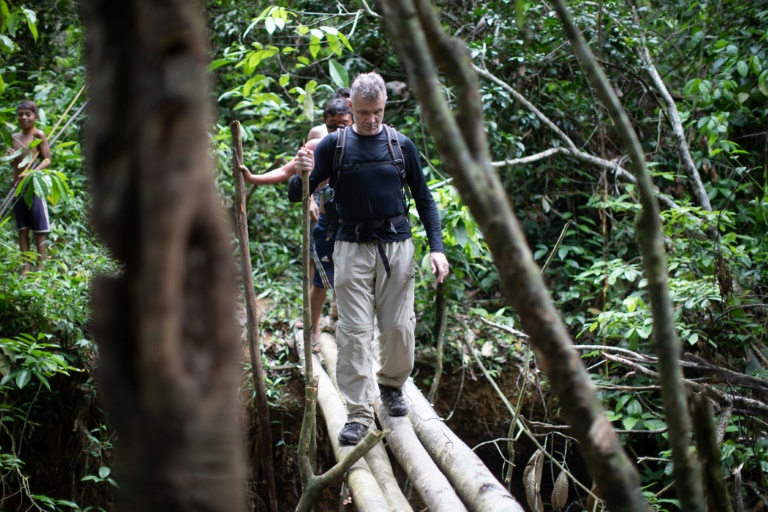
Veteran British freelance journalist Dom Phillips and respected Brazilian Indigenous expert Bruno Pereira shared a passion for the farthest reaches of the Amazon rainforest, where they went missing and were buried, according to a confession obtained by police.

The pair were last seen early on June 5 traveling by boat in Brazil’s Javari Valley, a far-flung jungle region near the border with Peru, where Phillips was researching a book.

The region has seen a surge of criminal activity in recent years, including illegal logging, gold mining, poaching and drug trafficking — incursions Phillips has reported on and Pereira has vigorously fought.

Police said Wednesday that one of two men arrested over their disappearance admitted to having buried their bodies in the jungle. While human remains have been found, they have not been definitively confirmed to be those of Pereira and Phillips.

The two had already traveled there together in 2018 for a feature story Phillips wrote in British newspaper The Guardian on an uncontacted tribe — one of an estimated 19 in the region.

“Wearing just shorts and flip-flops as he squats in the mud by a fire, Bruno Pereira, an official at Brazil’s government Indigenous agency, cracks open the boiled skull of a monkey with a spoon and eats its brains for breakfast as he discusses policy,” it began.

That memorable introduction neatly sums up both men, courageous adventurers who loved the rainforest and its peoples, each defending the Amazon in his own way.

– ‘Sharp, caring journalist’ –

Phillips, 57, started out as a music journalist in Britain, editing the magazine Mixmag and writing a book on the rise of DJ culture.

Lured by DJ friends, he set off for Brazil 15 years ago, falling in love with the country and the woman who became his wife, Alessandra Sampaio — a native of the northeastern city of Salvador.

Reinventing himself as a foreign correspondent, Phillips covered Brazil for media including The New York Times, The Washington Post, Financial Times and The Guardian, where he was a regular contributor.

A group of friends and colleagues described Phillips as “one of the sharpest and most caring foreign journalists in South America.”

“But there was a lot more to him than pages and paragraphs. His friends knew him as a smiling guy who would get up before dawn to do stand-up paddle. We knew him as a caring volunteer worker who gave English classes in a Rio favela,” they said in a statement.

Phillips traveled in and wrote about the Amazon for dozens of stories, winning a fellowship from the Alicia Patterson Foundation last year to fund his project to write a book on sustainable development in the rainforest.

The project took him back to the region he loved.

“Lovely Amazon,” he posted on Instagram earlier this month, along with a video of a small boat winding down a meandering river.

– ‘Courageous, dedicated’ Indigenous advocate –

Until recently working as a top expert at Brazil’s Indigenous affairs agency, FUNAI, Pereira was head of programs for isolated and recently contacted Indigenous groups.

As part of that job, the 41-year-old organized one of the largest ever expeditions to monitor isolated groups and try to avoid conflicts between them and others in the region.

Fiona Watson, research director at Indigenous rights group Survival International, called him a “courageous and dedicated” defender of Indigenous peoples.

Pereira was especially revered for his knowledge of the Javari Valley, where he was also FUNAI’s regional coordinator for years.

But he was on leave from the agency after butting heads with the new leadership brought in by far-right President Jair Bolsonaro, who faces accusations of dismantling Indigenous and environmental protection programs since taking office in 2019.

Pereira “was effectively forced out at FUNAI, basically because he was doing what FUNAI should be doing and have stopped doing since Bolsonaro took office: standing up for Indigenous rights,” Watson told AFP.

Pereira frequently received threats for his work fighting illegal invasions of the Javari reservation.

That includes helping set up Indigenous patrols. He and Phillips were on their way to a meeting on one such patrol project when they disappeared.

“Every time he enters the rainforest, he brings his passion and drive to help others,” Pereira’s family said in a statement.

Hariri killers to be sentenced as end looms for Lebanon court

A UN-backed court for Lebanon will sentence two Hezbollah members in their absence Thursday for the 2005 assassination of former premier Rafic Hariri in what could be the cash-strapped tribunal’s final act.

The Special Tribunal for Lebanon (STL), which is based in the Netherlands, found Habib Merhi and Hussein Oneissi guilty on appeal in March over a huge bombing which killed Hariri and 21 others and injured 226.

But they are unlikely to ever spend time behind bars as the Lebanese Shiite Muslim movement Hezbollah has refused to hand over the pair or a third man, Salim Ayyash, who was sentenced to life imprisonment in 2020.

Meanwhile the STL, which is estimated to have cost between $600 million and $1 billion since it opened in 2009, has warned it will close imminently due to a shortage of funds.

The court said in a statement that it will announce the sentences for Merhi and Oneissi at 2:00 pm (1200 GMT) on Thursday.

Sunni billionaire Hariri, who had stepped down as Lebanon’s prime minister in October 2004, was killed in a February 14 2005 suicide blast targeting his armoured convoy on the Beirut seafront.

The attack triggered protests that drove Syria out of Lebanon after a 29-year military deployment.

The court was born out of a United Nations Security Council resolution and eventually tried four suspects in absentia: Ayyash, Merhi, Oneissi and Assad Sabra. 

– Lack of funds –

The case relied almost exclusively on circumstantial evidence in the form of mobile phone records that prosecutors said showed a Hezbollah cell plotting the attack.

The STL originally convicted Ayyash and cleared the other three men. 

It said there was no direct evidence of Damascus or its ally Hezbollah’s involvement, but that the attack probably involved state actors and that the state with most to gain was Syria.

But in March it found Merhi and Oneissi guilty after an appeal by prosecutors, saying the original trial judges had “erred” by saying there was a lack of evidence. They upheld the acquittal of Sabra.

All three convicted men remain at large as Hezbollah leader Hassan Nasrallah has refused to hand over any of the suspects or to recognise the court.

Dogged by political issues in Lebanon and controversy over its huge cost and slowness, the court said last July that it would have to close after dealing with all outstanding appeals as it was running out of money.

The closure means a further trial against Ayyash in a separate case involving three attacks targeting Lebanese politicians in 2004 and 2005 is now unlikely to ever take place.

The STL draws 51 percent of its budget from donor countries and the rest from Lebanon, which is grappling with its deepest economic crisis since the 1975-1990 civil war

Weapons delays cast doubt on Germany's support for Ukraine

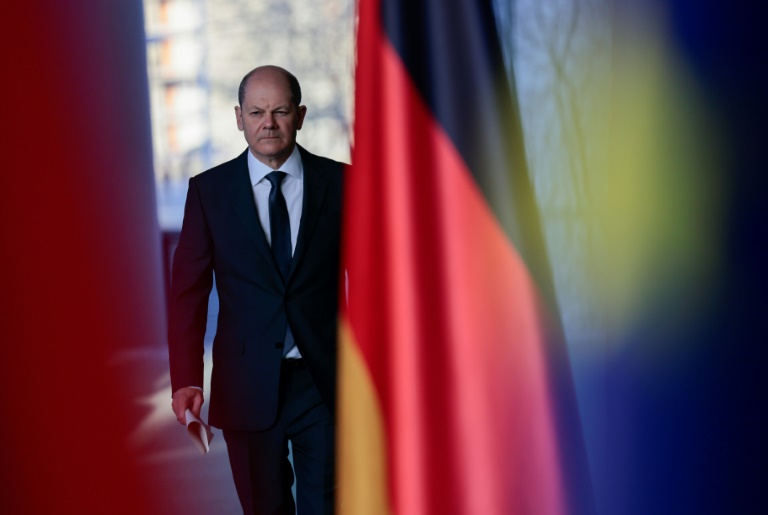
German Chancellor Olaf Scholz has promised Ukraine world-class weapons — from self-propelled howitzers to multiple launch rocket systems and an air defence shield capable of protecting a “large city” from Russian strikes. 

But the sluggishness in the actual delivery of heavy weapons to bolster Ukraine against Russia’s invasion has raised questions on whether the Social Democrat leader’s pledges are sincere. 

Trust was already beginning to show signs of eroding among Germany’s allies over the repeated rows over the urgently awaited armaments.

With Scholz’s long-awaited trip to Kyiv expected to take place on Thursday, Ukrainian President Volodymyr Zelensky this week ramped up the pressure on the German chancellor.

“Every leader of our partner countries and naturally the chancellor as well knows exactly what Ukraine needs. It’s just that the (weapons) deliveries from Germany are still less than they could be,” Zelensky told Wednesday’s Die Zeit weekly.

In a hint of what he seemed to think might be holding Scholz back, the Ukrainian president added in a separate interview with ZDF broadcaster that “there must be no attempt at a balancing act between Ukraine and the relationship with Russia”.

Scholz himself has batted off the accusations, as he underlined that Germany “will deliver all the weapons that we have set in motion”.

He argued, however, that there was no point sending complicated modern weapons without first training Ukrainian troops how to use them. 

Training is underway in Germany, he told a press conference this week, stressing that the weapons will follow once soldiers know how to deploy them effectively.

“I think that it would be a good thing for one or the other to think for a moment before he expresses his opinion,” he added, in a sign of irritation at the repeated queries.

With pointed criticisms levied almost on a daily basis — including by Ukraine’s outspoken ambassador — Berlin fears they could unwittingly play into the hands of Russia.

– ‘Middle of road’ –

But observers said the bad press was not surprising given the stuttering German response compared to other major Western allies such as the United States or Britain, or even when put next to much smaller eastern European nations like the Baltic states.

Marina Henke, director of the Hertie School’s Centre for International Security, said the problem is that “confusion” still reigns in the chancellery over how to handle Russia.

“There is no clear sense of direction,” she told AFP, noting the US, Britain and eastern Europe have all identified Vladimir Putin’s Russia as the clear enemy and therefore taken the lead in plying Ukraine with armaments.

“Here in Germany, there is the idea that Russia is a massive country on our doorstep and in all these actions, we need to think about how we can live with Russia in the long term,” she said.

“That’s why there is a confusion” that means major weapons pledges are being held up by Germany’s complex bureaucracy, she added.

Marcel Dirsus of the Institute for Security Policy at Kiel University also noted that “the German government appears quite content to take a middle of the road approach where they’re doing enough to avoid the most severe criticism, but they’re not really taking any initiative to go beyond that. 

“It’s almost a deliberate attempt to do as little as they can get away with.”

– ‘Huge fog’ –

Among the latest weapon promises made by Germany have been the Iris-T air defence system and the Mars II multiple launch rocket system.

But hours after Scholz mentioned the Iris-T, Foreign Minister Annalena Baerbock poured cold water on a swift deployment, warning it would take months before the air defence shield reached Ukraine.

The rocket launchers are due to arrive reportedly in August or September but on condition  Ukrainian soldiers are trained to use them by then.

Gepard anti-aircraft tanks pledged in April have been delayed to July at the earliest due to an ammunition shortfall. 

Seven self-propelled howitzers promised in May are pending amid ongoing training of Ukrainian troops.

Poland has accused Germany of failing to provide Leopard battle tanks to make up for the ones that Warsaw had sent ahead to Kyiv.

The Czech Republic is also waiting on a similar swap deal, but talks are still on.

“The German Ukraine policy has been shrouded in the last weeks by a huge fog of big announcements, logistical problems, tactical withdrawals and a verbal lack of clarity,” said Die Zeit weekly. 

The chancellery has defended its line as “strategic ambiguity”, but the weekly warned that this policy “has a price that Ukrainians are paying daily” in hundreds of deaths  in their eastern Donbas region alone.

“Clarity and sincerity are the minimum that Scholz must bring to Ukraine,” it said.

Small gun makers boom as US demand soars

Tony Hook flipped through cell phone pictures of finished work by his New Hampshire shop, explaining how one customer wanted mementos of major life events: a gun to mark each of his children’s births.

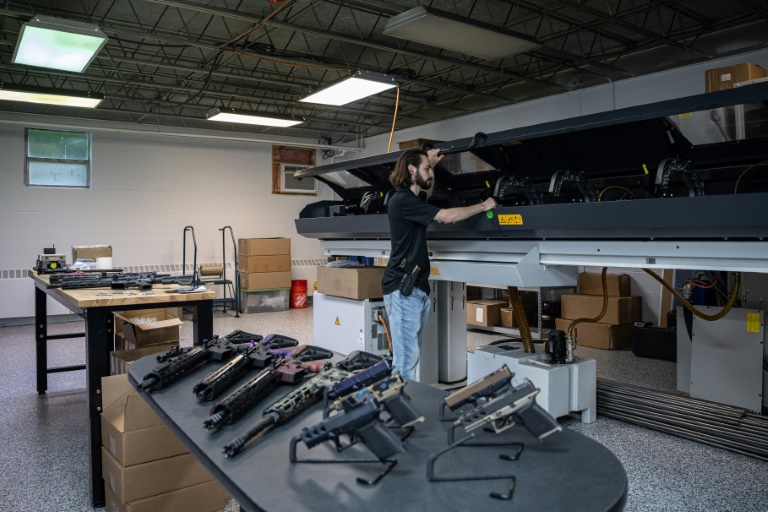
Smaller gun makers like him are booming in the United States, thanks to ravenous and sometimes specialized demand for pricey limited-production pistols and custom rifles, engraved with bible passages or the American flag.

“He had us build a gun for every newborn he had,” explained Hook, the owner of RTD Arms & Sport. “So this is his son’s name and his date of birth,” he said, showing the engraving on a rifle.

The millions of guns produced annually in the United States are primarily made by the nation’s biggest manufacturers, yet smaller operators have poured into a market that saw production nearly triple from 2000 to 2020.

The smaller makers can churn out parts destined for major firms like Sig Sauer or Smith & Wesson and for enthusiasts and gun shops, or they can be manufacturers themselves of specialized or customized weapons.

“It’s just like maybe stitching your name onto your baseball glove or having custom pinstriping put on your car,” said Hook. “People do the same with their guns. It’s a piece of them.” 

– $1,700 guns –

The United States has a deep culture of gun ownership centered around a constitutional guarantee for Americans to keep and bear arms, and as a result has a sprawling market of weapons, gear and accessories. 

America also sees roughly 40,000 gun deaths a year, about half of which are suicides, though homicides increased at historic rates during the pandemic. 

In this context, the gun and ammunition industry added an estimated $70 billion to the US economy in 2021 according to industry group NSSF — perhaps not surprising when a single rifle from a smaller workshop like Hook’s can sell between $1,295-$1,695.

“Seeing that the gun doesn’t have to look so generic, it’s attracting people in that never considered it before,” he added.

The boom in gun making is illuminated in US federal firearms license statistics, with the number of so-called “type 7” permits that allow production as well as sales increasing by over 694 percent from 2000 to 2020.

Getting one of those permits requires paperwork from applicants that includes their photo, fingerprints and other information, while the government also does a background check and in-person interview.

Big states like Texas and Florida each had hundreds of manufacturers of all sizes that reported, as required by law, their production to federal authorities for 2020, the most recent figures available. 

Matrix Arms in New Hampshire is one of those makers and its CEO and owner Allen Farris said so many manufacturers have joined the industry that the market has been saturated for at least the past six years now. 

– ‘People are the problem’ –

Yet his company appeared to be staying busy, with a row of machines the size of shipping containers churning out gun parts on a recent weekday. 

He noted that each week they produce 4,300-5,300 rifle receivers — key central components to making a gun.

“Our state motto in New Hampshire is ‘Live free or die’ and I think the firearm industry kind of goes hand in hand with that,” he added.

Hook and Farris emphasized they did not want their guns to be used in crime or mass murder and said they followed the law — with Hook also citing his own instinct, if a would-be buyer sets off alarm bells — to try to prevent that.

Inevitably, as the gun making industry has grown, more people face the risk the firearms they produce could be used in a crime, mass shooting or suicide.

“We don’t look at it as guns are the problem. People are the problem. Whether it’s a gun, a knife or a rock — Cain didn’t kill Abel with a gun. He killed him with a rock,” Hook said.

Farris added: “If somebody has the motivation to go out and try to kill people, first of all they could choose a million different ways.”

“Obviously I don’t want my guns being used in that way, but there’s nothing I can do to prevent it at that point.”

US panel recommends Covid vaccines for youngest children

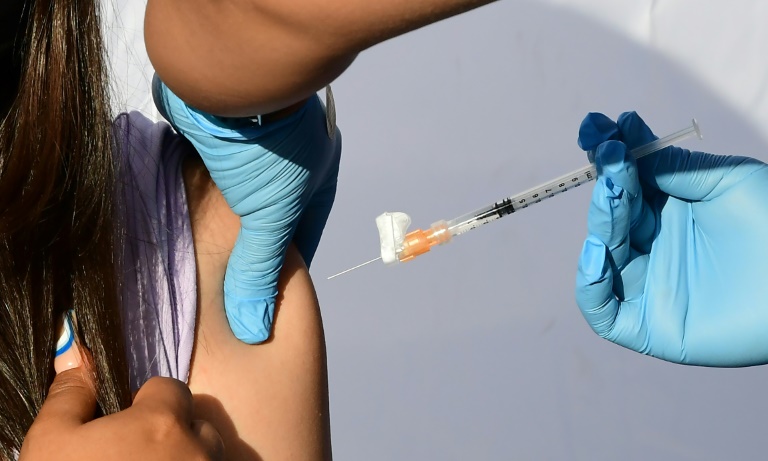
A panel of experts convened by the US Food and Drug Administration unanimously recommended Covid-19 vaccines Wednesday for children under five, the final age group awaiting immunization in most countries.

Formal authorizations for Moderna and Pfizer should follow soon, with the first shots in arms expected early next week, just over a year-and-a-half after the first Covid vaccines were greenlighted for the elderly in December 2020.

“This recommendation does fill a significant unmet need for a really ignored younger population,” said Michael Nelson, a professor of medicine at the University of Virginia, one of the 21 experts asked to vote for the milestone meeting.

Unlike regulators in other countries, FDA offers livestreams of its internal deliberations and its stamp of approval is considered the global gold standard.

Opening the discussion, senior FDA scientist Peter Marks said that despite studies showing the majority of children have now been infected with the coronavirus, the high rate of hospitalizations among infants, toddlers and young children during last winter’s Omicron wave underscored an urgent need for vaccination.

“We are dealing with an issue where we have to be careful we don’t become numb to the pediatric deaths because of the overwhelming number of older deaths,” he said.

“Every life is important and vaccine-preventable deaths are something we would like to try to do something about.”

The United States has recorded 480 Covid deaths in the 0-4 age group in the pandemic — far higher than even a bad flu season, Marks said.

As of May 2022, there have been 45,000 hospitalizations in that group, nearly a quarter of which required intensive care.

Ahead of the meeting, the FDA posted its independent analyses of the pharmaceutical companies’ vaccines, deeming both safe and effective.

Both vaccines are based on messenger RNA, which delivers genetic code for the coronavirus spike protein to human cells that then grow it on their surface, training the immune system to be ready. The technology is now considered the leading Covid vaccination platform.

Pfizer sought authorization for three doses at three micrograms given to children aged six months through four years, while Moderna asked for the FDA to authorize its vaccine as two doses of a higher 25 micrograms for ages six months through five years.

Both vaccines were tested in trials of thousands of children. They were found to cause similar levels of mild side effects as in older age groups and triggered similar levels of antibodies.

– Two doses, or three? –

Efficacy against infection was higher for Pfizer, with the company placing it at 80 percent, compared to Moderna’s estimates of 51 percent for children aged six-months to two years old and 37 percent for those aged two to five years.

But the Pfizer figure is based on very few cases and is thus considered preliminary. It also takes three doses to achieve its protection, with the third shot given eight weeks after the second, which is given three weeks after the first.

Moderna’s vaccine should provide strong protection against severe disease after two doses, given four weeks apart, and the company is studying adding a booster that would raise efficacy levels against mild disease.

However, Moderna’s decision to go with a higher dose is associated with higher levels of fevers in reaction to the vaccine compared to Pfizer.

There are some 20 million US children aged four years and under. 

Although obesity, neurological disorders and asthma are associated with increased risk of severe disease among young children, it’s not easy to predict severe outcomes.

In fact, 64 percent of hospitalizations in those under five occurred in patients without comorbidities.

Children can also go on to contract multisystem inflammatory syndrome in children (MIS-C), a rare but serious post-viral condition. Some three to six percent can experience long Covid symptoms for more than 12 weeks.

The FDA is expected to soon act on the panel’s recommendation, and the matter will go to the Centers for Disease Control and Prevention for a final say.

White House officials last week said the rollout of 10 million shots at pharmacies and doctors’ offices could begin as soon as June 21.

Hunger crisis could swell already record global displacement: UN

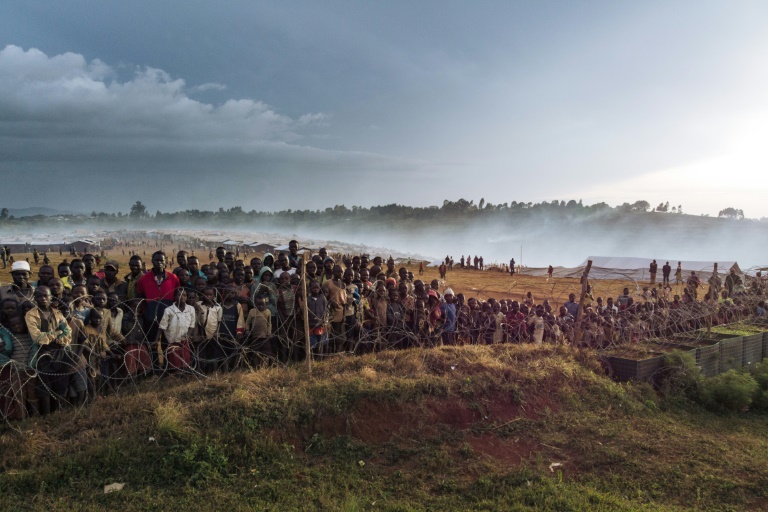
Russia’s war in Ukraine has pushed global displacement numbers above 100 million for the first time, and the UN warns the resulting hunger crisis could force many more to flee their homes.

Efforts to address the global food insecurity crisis, which has been dramatically aggravated by Russia’s invasion of Ukraine, is “of paramount importance… to prevent a larger number of people moving,” the United Nations refugee chief Filippo Grandi told reporters.

“If you ask me how many… I don’t know, but it will be pretty big numbers.”

Russia’s full-scale invasion of Ukraine, traditionally a breadbasket to the world, has sparked dramatic grain and fertiliser shortages, sent global prices soaring and put hundreds of millions of people at risk from hunger.

“The impact, if this is not resolved quickly, would be devastating,” Grandi said. “It is already devastating.”

His comments came as he presented the UNHCR refugee agency’s annual report on global displacement, showing that a record 89.3 million people were displaced at the end of 2021 — more than doubling in a decade.  

But since Russia launched its full-scale invasion on February 24, as many as 14 million Ukrainians may have fled within their own war-ravaged country or across borders as refugees, pushing global displacement past the grim 100-million mark for the first time.

– ‘Terrible trend’ –

“Every year of the last decade, the numbers have climbed,” Grandi said. 

“Either the international community comes together to take action to address this human tragedy, resolve conflicts and find lasting solutions, or this terrible trend will continue.”

The UN agency found that at the end of 2021, a record 27.1 million people were living as refugees, while the number of asylum seekers rose 11 percent to 4.6 million.

And for the 15th straight year, the number of people living displaced within their own country due to conflict swelled, hitting 53.2 million.

The UNHCR report said last year was notable for the number of protracted conflicts in places like Afghanistan that escalated, even as new ones flared.

At the same time, growing food scarcity, inflation and the climate crisis were adding to hardship and stretching the humanitarian response, threatening to weaken already dire funding levels for many crises, UNHCR warned.

That has not been the case for Ukraine, with an enormous outpouring of solidarity, and fleeing Ukrainians welcomed with open arms across Europe.

– ‘Not unmanageable’ –

Grandi hailed the generous response to this crisis, but highlighted the contrast to how refugees fleeing wars in places like Syria and Afghanistan have been met.

The UN refugee chief recalled how European leaders had insisted “it’s full” when asked to take in more refugees from those conflicts.

“I’m not naive. I fully understand the context,” he said, adding though that the generous response to fleeing Ukrainians “proves an important point… The arrival of desperate people on the shores or at the borders of rich countries is not unmanageable.”

Grandi also pointed to how massive sums of money had been made immediately available to respond to the Ukraine crisis, despite countries’ insistence their coffers were empty when met with appeals for more aid for other situations.

“There cannot be inequity in the response,” he said.

Countries have vowed the aid provided for Ukraine would come on top of amounts pledged for other crises, but Grandi cautioned that so far “the mathematics doesn’t show that.” 

– ‘Vicious circle’ –

It would be disastrous if already underfunded responses were cut further, he warned.

He voiced particular concern for the Horn of Africa and the Sahel, where massive displacement is being driven by a macabre combination of conflict, insecurity, poor governance and devastating effects of climate change.

“It’s a very vicious circle of many factors,” he said.

Grandi warned that beyond the immediate impact, the war in Ukraine was also complicating the response to displacement crises since it had “dealt a terrible blow to international cooperation.”

Even if the war were to end within months — which he thought unlikely — “the scars on international cooperation of those fractures between the West and Russia… will take a long time to heal.”

And, he warned, “if that is not healed, I don’t know how we will deal with this global crisis.”

Parts of storm-wrecked Yellowstone to remain shut all year

Parts of Yellowstone will remain closed for the rest of the year because of extensive flood damage, managers say, with the oldest national park in the United States completely shuttered Wednesday.

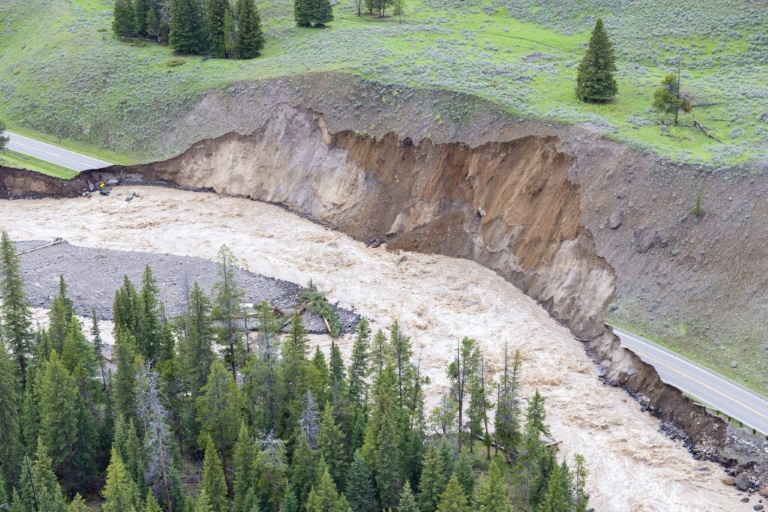
Roads have been washed out in the northern portion of the 9,000 square kilometer (3,400 square mile) park after torrential rainfall and snowmelt sent months’ worth of run-off into rivers in just a couple of days.

All the entrances to the park, which sits chiefly in Wyoming and is home to the Old Faithful geyser, remained closed Wednesday for a third consecutive day.

Images released by the National Park Service showed large sections of paved road had been swept away by raging rivers.

Aerial reconnaissance revealed “major damage to multiple sections of road” in the northern part of the park, the agency said in its latests assessment.

“Many sections of road in these areas are completely gone and will require substantial time and effort to reconstruct.

“The National Park Service will make every effort to repair these roads as soon as possible; however, it is probable that road sections in northern Yellowstone will not reopen this season.”

Several communities on the north side of the park in Montana also experienced significant flooding, with bridges and roads washed out in Park County. 

Montana Governor Greg Gianforte declared a statewide disaster on Tuesday “to help impacted communities get back on their feet as soon as possible,” he said on Twitter.

A huge dome of high pressure is sitting over the United States, sending temperatures soaring for 120 million people.

Meteorologists say the edge of that dome, where colder air meets warm air, is experiencing wild weather, including heavy rainfall.

Higher-than-usual temperatures have also caused snowpack on the high mountains to melt, adding to the influx of water into rivers.

Forecasters at CNN calculated that several months’ of run-off in Yellowstone has cascaded into rivers in just two days, resulting in their overflow.

Park service officials said they will look at conditions in the southern section of Yellowstone, to see when visitors can be allowed back in, but will likely limit admissions to avoid placing too much strain on the area.

Yellowstone Park, which welcomed more than 4.8 million visitors last year, is America’s oldest national park.

The park was the inspiration for Jellystone Park in the 1960s cartoon “Yogi Bear.”

Countries haggle through the night to salvage WTO deals

Ministers were frantically haggling through the night into Thursday at the World Trade Organization in a bid to salvage deals on food security, fishing and combating Covid-19.

The global trade body’s 164 members added on an extra fifth day of talks to try to break the deadlock gripping the WTO headquarters in Geneva.

But despite relaxing their original Wednesday deadline, countries were trading concessions through the early morning hours to cobble together a wide-ranging set of results.

Countries have hit a brick wall trying to secure each separate deal on its own merits, so are now making tit-for-tat offers in an attempt to keep them all afloat.

“They’re looking at a broad package: what can be achieved, trade-offs in different areas,” a Geneva trade official told reporters.

“It’s basically, ‘what can I get here, (in exchange) for this’,” the official said.

“We’re into the real bargaining part of the meeting. This is where all the action is happening and hopefully where some deals are going to be struck.”

– Juice and sandwiches –

US Trade Representative Katherine Tai was seen heading in and out of the late-night talks, while a giant tray of sandwiches was brought in to keep the deal-makers going.

“It’s going to go all night. Everything. People look tired,” the Geneva-based trade official told AFP, adding: “They’re negotiating, which is good news.”

He said the talks had run out of juice — but only fruit juice, rather than energy.

The WTO is hoping to prove it still has a role to play in tackling big global challenges.

WTO chief Ngozi Okonjo-Iweala, who took over in March 2021, has hinged her leadership on breathing new life into the sclerotic organisation.

“Progress is being made but it needs a little more work and more time,” the director-general said.

“It requires that we work and work nights; whatever it takes.”

The last WTO ministerial conference, in December 2017 in Buenos Aires, was widely considered a flop, closing without a major agreement and Okonjo-Iweala wants no repeat.

The global trade body only takes decisions by consensus among all 164 members, making deals all the harder to conclude.

Okonjo-Iweala was hoping to pull off a coup by securing a long-sought deal on curbing harmful fishing subsidies.

– India in the firing line –

Negotiations towards banning subsidies that encourage overfishing and threaten the sustainability of the planet’s fish stocks have been going on at the WTO for more than two decades.

Diplomats say a deal is closer now than ever before.

But India threw a spanner in the works late Tuesday, insisting it would not sign up without a 25-year exemption — far longer than many are comfortable with.

Some emerging from the negotiating rooms are blaming Indian intransigence on not just fisheries but across the board.

Citing their “destructive tactics”, one diplomatic source close to the negotiations said: “The question is are they really going to pull the whole edifice down, or whether they’re willing to go along with the views of the vast majority of members.”

On fishing, the source added: “Now is the time… civil society wants this, fishing communities want it, and our fish need it.”

WTO reform, agriculture and e-commerce deals are also on the table.

– ‘Saving WTO, not lives’ –

“There are things that are going in the right direction and others that unfortunately are not progressing very much,” France’s foreign trade minister Franck Riester told reporters before the all-night talks, with health issues looking among the most promising.

One pandemic-related text seeks to tackle supply constraints faced by certain countries in getting hold of Covid-fighting tools.

Ministers are also discussing the possibility of imposing a temporary waiver on Covid-19 vaccine patents.

But some countries that host major pharmaceutical companies, like Britain and Switzerland, are finding some of the draft wording problematic.

NGOs believe the text does not go nearly far enough.

Civil society activists staged a “die-in” protest in the WTO’s atrium, accusing the EU, Britain, Switzerland and the United States of scuppering a meaningful Covid intellectual property waiver.

“The proposal on the table is intended to save the reputation of the WTO but it will not save a human life from the pandemic,” demonstration organiser Deborah James told AFP.

Swiss economy minister Guy Parmelin insisted he remained against a wide-ranging waiver, adding: “Patents have not slowed access to vaccines — quite the opposite”.

Train carriages host the homeless in Ukraine's Irpin

A Russian missile transformed Vladimir Melnik’s house in the Kyiv suburb of Irpin into a smouldering wreck as Moscow’s forces advanced on the Ukrainian capital in March.

Three months later, the 73-year-old is back in Irpin and settling into a train carriage newly converted into accommodation for those whose homes were destroyed in the town devastated by Russia’s invasion.

“A missile pierced the roof, the ceiling and ended up in the cellar, but I managed to save myself,” said Melnik, who lived with his sister after his house burned down on March 10.

“Here, I was told I could stay as long as necessary,” he told AFP as he showed black and white photographs of his former dwelling.

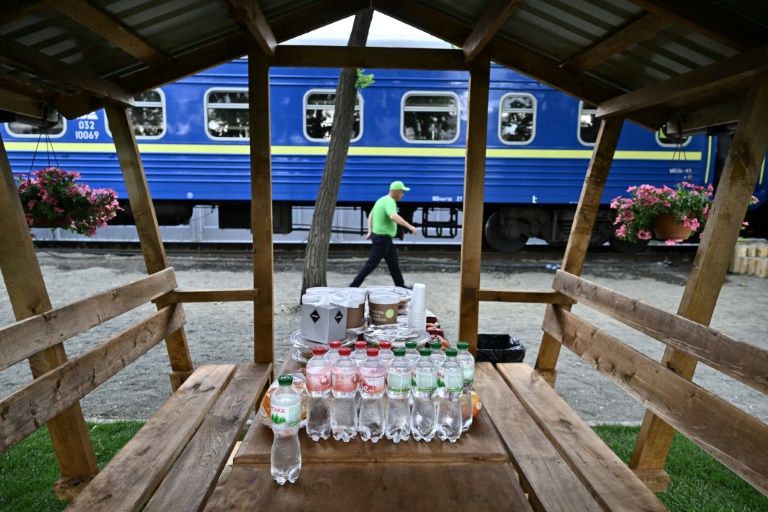
An enclosure dubbed “Iron City” contains five carriages that can host up to 25 families, Ukrainian railway company Ukrzaliznytsia (UZ) told reporters during a presentation of the homes on Wednesday.

The carriages come equipped with air conditioning, bathroom facilities and a coffee machine, and residents can connect to a Wi-Fi network provided by US billionaire Elon Musk’s Starlink service.

A dining car offers residents meals prepared every day by an NGO and a seventh carriage has been kitted out with shower rooms, a changing room and a washing machine.

An open space is dedicated to recreation, with small playgrounds for children, a barbecue area, benches, wooden tables and two hammocks.

The location is a haven of tranquility that contrasts sharply with the horrors of war the residents endured.

“Now we need to get the damage to the house assessed and rebuild everything, and that is going to take time,” Melnik said, wondering how he can finance the repairs on a monthly pension worth less than 200 euros ($209).

Olga Oleinik, 77, moved with her family of six into one of the carriages on Wednesday after her Irpin home was destroyed at the start of the war.

She and Melnik are among the first five families to be hosted. Others will arrive in the coming days.

Oleksandr Pertsovskyi, head of UZ’s passenger division, told AFP the maximum capacity of 25 families would be reached by the end of the month.

Close Bitnami banner
Bitnami