World

US Fed announces biggest interest rate hike since 1994

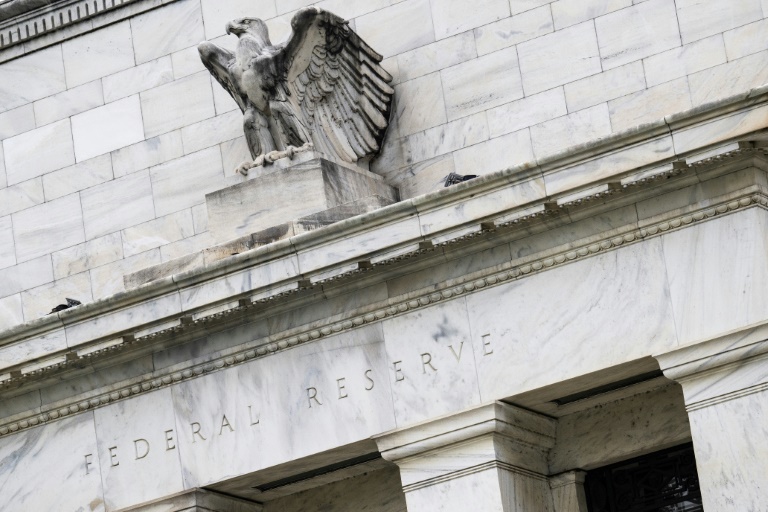
The Federal Reserve announced the most aggressive interest rate increase in nearly 30 years, raising the benchmark borrowing rate by 0.75 percentage points on Wednesday as it battles against surging inflation.

The Fed’s policy-setting Federal Open Market Committee reaffirmed that it remains “strongly committed to returning inflation to its 2 percent objective” and expects to continue to raise the key rate.

Until recently, the central bank seemed set to approve a 0.5-percentage-point increase, but economists say the rapid surge in inflation put the Fed behind the curve, meaning it needed to react strongly to prove its resolve to combat inflation

The super-sized move was the first 75-basis-point increase since November 1994.

Fed Chair Jerome Powell will hold a press conference after the meeting to provide more details on the central bank’s plans, which will be closely watched for signals on how aggressive policymakers will be in coming meetings.

Committee members now see the federal funds rate ending the year at 3.4 percent, up from the 1.9 percent projection in March, according to the median quarterly forecast.

They also expect the Fed’s preferred inflation index to rise to 5.2 percent by the end of the year, with GDP growth slowing to 1.7 percent in 2022 from the previous 2.8 percent forecast.

The FOMC noted that effects of Russia’s invasion of Ukraine are “creating additional upward pressure on inflation and are weighing on global economic activity.”

And ongoing Covid-19 lockdowns in China “are likely to exacerbate supply chain disruptions.”

Kansas City Federal Reserve Bank President Esther George, a noted inflation-hawk, dissented from the committee vote, preferring a smaller, half-point increase.

– Caught off guard –

US central bankers began raising interest rates off zero in March as buoyant demand from American consumers for homes, cars and other goods clashed with transportation and supply chain snarls in parts of the world where Covid-19 remained — and remains — a challenge.

That fueled inflation, which got dramatically worse after Russia invaded Ukraine in late February and Western nations imposed steep sanctions on Moscow, sending food and fuel prices up at a blistering rate.

US gasoline prices have topped $5.00 a gallon for the first time ever and are setting new records daily.

Economists thought March was the peak for consumer price hikes, but the rate spiked again in May, jumping 8.6 percent in the latest 12 months, and wholesale prices surged as well, almost entirely due to soaring costs for energy, especially gasoline.

The Fed was caught off guard with the speed of the price increases, and while policymakers usually prefer to clearly telegraph any policy shift to financial markets, the latest data changed the calculus.

Powell had indicated policymakers were poised to implement another half-point increase in the benchmark borrowing rate this week and a similar move next month, aiming to douse red-hot inflation without tipping the economy into recession and avoid a bout of 1970s-style stagflation.

However, the central bank cannot influence supply issues, and rate hikes only work by cooling demand and slowing the economy — meaning policymakers are walking a fine line between having an impact and doing too much.

And the impact won’t be immediate.

“Monetary policy operates with lags, today’s inflation reflects decisions taken a year ago,” said Adam Posen, head of the Peterson Institute for International Economics and a former central banker.

“Had Fed hiked in 2021Q2/Q3, then inflation now would be different — not least (because) the current global shocks wouldn’t be piling on already high inflation,” he said on Twitter.
US Fed announces biggest interest rate hike since 1994

The Federal Reserve announced the most aggressive interest rate increase in nearly 30 years, raising the benchmark borrowing rate by 0.75 percentage points on Wednesday as it battles against surging inflation.

The Fed’s policy-setting Federal Open Market Committee reaffirmed that it remains “strongly committed to returning inflation to its 2 percent objective” and expects to continue to raise the key rate.

Until recently, the central bank seemed set to approve a 0.5-percentage-point increase, but economists say the rapid surge in inflation put the Fed behind the curve, meaning it needed to react strongly to prove its resolve to combat inflation

The super-sized move was the first 75-basis-point increase since November 1994.

Fed Chair Jerome Powell will hold a press conference after the meeting to provide more details on the central bank’s plans, which will be closely watched for signals on how aggressive policymakers will be in coming meetings.

Committee members now see the federal funds rate ending the year at 3.4 percent, up from the 1.9 percent projection in March, according to the median quarterly forecast.

They also expect the Fed’s preferred inflation index to rise to 5.2 percent by the end of the year, with GDP growth slowing to 1.7 percent in 2022 from the previous 2.8 percent forecast.

The FOMC noted that effects of Russia’s invasion of Ukraine are “creating additional upward pressure on inflation and are weighing on global economic activity.”

And ongoing Covid-19 lockdowns in China “are likely to exacerbate supply chain disruptions.”

Kansas City Federal Reserve Bank President Esther George, a noted inflation-hawk, dissented from the committee vote, preferring a smaller, half-point increase.

– Caught off guard –

US central bankers began raising interest rates off zero in March as buoyant demand from American consumers for homes, cars and other goods clashed with transportation and supply chain snarls in parts of the world where Covid-19 remained — and remains — a challenge.

That fueled inflation, which got dramatically worse after Russia invaded Ukraine in late February and Western nations imposed steep sanctions on Moscow, sending food and fuel prices up at a blistering rate.

US gasoline prices have topped $5.00 a gallon for the first time ever and are setting new records daily.

Economists thought March was the peak for consumer price hikes, but the rate spiked again in May, jumping 8.6 percent in the latest 12 months, and wholesale prices surged as well, almost entirely due to soaring costs for energy, especially gasoline.

The Fed was caught off guard with the speed of the price increases, and while policymakers usually prefer to clearly telegraph any policy shift to financial markets, the latest data changed the calculus.

Powell had indicated policymakers were poised to implement another half-point increase in the benchmark borrowing rate this week and a similar move next month, aiming to douse red-hot inflation without tipping the economy into recession and avoid a bout of 1970s-style stagflation.

However, the central bank cannot influence supply issues, and rate hikes only work by cooling demand and slowing the economy — meaning policymakers are walking a fine line between having an impact and doing too much.

And the impact won’t be immediate.

“Monetary policy operates with lags, today’s inflation reflects decisions taken a year ago,” said Adam Posen, head of the Peterson Institute for International Economics and a former central banker.

“Had Fed hiked in 2021Q2/Q3, then inflation now would be different — not least (because) the current global shocks wouldn’t be piling on already high inflation,” he said on Twitter.
Working 24/7 to save baby manatee orphaned in Colombia

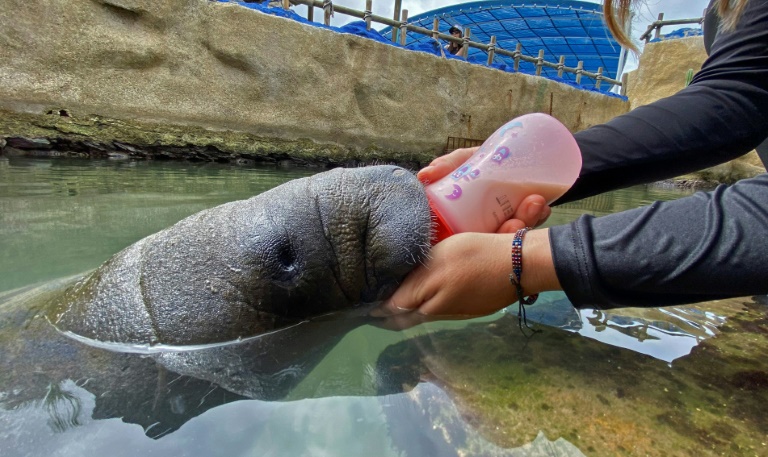
Last September, Tasajerito the manatee was found lost in a Colombian swamp, just three days old and separated from his mother.

Nine months later, the baby sea cow weighs as much as an adult woman and is bottle fed round the clock by doting aquarium staff.

Though much stronger now, Tasajerito’s prognosis is still touch-and-go, said Angela Davila, a veterinarian at the Rodadero Aquarium in Santa Marta in northern Colombia, near where he was found.

“Tasajerito is… still considered critical,” Davila told AFP. “He appears strong, he appears lively and to be feeding well, but things can change in a heartbeat.”

Rescued by fishermen, Tasajerito was brought to the aquarium with little hope of survival. 

A search for his mother proved fruitless.

Now safely ensconced in a dedicated pool at the aquarium, he has clung to life — increasing his consumption of a special vitamin-boosted milk formula six-fold in a few months.

Today, Tasajerito measures over 1.5 meters (4.9 feet) in length and weighs 53 kilograms (117 pounds).

Yet, he is still “a newborn,” said Rodadero marine biologist Julieth Prieto, who noted that manatees are raised by their mothers for five years and suckle for half that time.

“This makes the rehabilitation process… a challenge because we have to meet those needs that the mother usually provides,” she said.

– ‘Vulnerable’ species –

Tasajerito’s human foster parents are also teaching him to float, dive and swim.

To be released into the wild one day — hopefully in about two years’ time — he will have to grow to between three and four meters in length and weigh some 600 kg.

The American Manatee species (Trichechus manatus), to which Tasajerito belongs, is listed as “vulnerable” to extinction on the International Union for Conservation of Nature (IUCN) Red List, its population of some 10,000 individuals on the decline.

Threats include residential and commercial development, aquaculture and shipping lanes, with watercraft strikes responsible for a large number of deaths, according to the IUCN.

In Colombia, hunting by humans is a major threat, as are hippos — a foreign species introduced by drug trafficker Pablo Escobar, who imported some as pets in the 1980s. 

The hippos now number more than 100, competing for food and space with manatees.

The manatee is one of the world’s largest aquatic mammals, and according to Prieto, fulfils “irreplaceable ecological functions” in its population area that stretches from Brazil’s east coast all the way to the southeastern United States.

Seasonal migrants, they help keep rivers and water channels clear, devouring as much as 50 kg of aquatic plants each every day. 

“If this species were to become extinct, we would have to dredge to restore water flow between rivers, swamps and the sea,” Prieto said.

Deadly heatwaves threaten economies too

More frequent and intense heatwaves are the most deadly form of extreme weather made worse by global warming, with death tolls sometimes in the thousands, but they can also have devastating economic impacts too, experts say. 

The prolonged and unseasonable scorchers gripping the central United States and rolling northward across western Europe, sending the thermometer above 40 degrees Celsius (104 degrees Fahrenheit), are likely to cause both.   

Deadly and costly

Very high temperatures caused nearly 10 percent of the two million deaths attributed to extreme weather events from 1970 to 2019, according to the World Meteorological Organization. 

Virtually all that heat-related mortality, moreover, has been since 2000, especially the last decade: from 2010 to 2019 scorching heat was responsible for half of 185,000 extreme weather deaths registered.

In Europe, heatwaves accounted for about 90 percent of weather-related mortality between 1980 and 2022, the European Environment Agency (EEA) has reported. 

Heatwaves rack up economic costs as well, but they are harder to quantify than damage from a storm or flood, and more difficult to insure. 

But extended bouts of great heat can result in more hospital visits, a sharp loss of productivity in construction and agriculture, reduced agricultural yields, and even direct damage to infrastructure. Excess mortality has an economic cost too.

The EAA estimates that heatwaves in 32 European countries between 1980 and 2000 cost 27 to 70 billion euros. The damages over the last 20 years — which included the deadly heatwave of 2003, with 30,000 excess deaths — would almost certainly be higher.

Premature death

The national public health agency in France, which will be blanketed by extreme conditions over the coming days, has called heatwaves “a mostly invisible and underestimated social burden.”  

In France alone, heatwaves from 2015 to 2020 cost 22 to 37 billion euros due to health expenses, loss of well-being and especially “intangible costs stemming from premature deaths”.  

Reduced productivity

The heatwaves of 2003, 2010, 2015 and 2018 in Europe caused damages totalling 0.3 to 0.5 percent of GDP across the continent, and up to two percent of GDP in southern regions, according to a peer-reviewed study in Nature. 

This level of impact could be multiplied by five by 2060 compared to a 1981-2010 baseline without a sharp reduction in greenhouse gas emissions and measures to adapt to high temperatures, the study warned.

At sustained temperatures of around 33C or 34C, the average worker “loses 50 percent of his or her work capacity”, according to the International Labor Organization (ILO).

The ICO estimates by 2030 heatwaves could reduce the total number of hours worked globally by more than two percent — equivalent to 80 million fulltime jobs — at a cost of 2.4 trillion dollars, nearly 10 times the figure for 1995.

“Climate change-related heat stress will reduce outdoor physical work capacity on a global scale,” The UN’s Intergovernmental Panel on Climate Change (IPCC) said in its most recent synthesis report, noting that in some tropical regions outdoor work may become impossible by the end of the century for 200 to 250 days each year.

Drought and agriculture

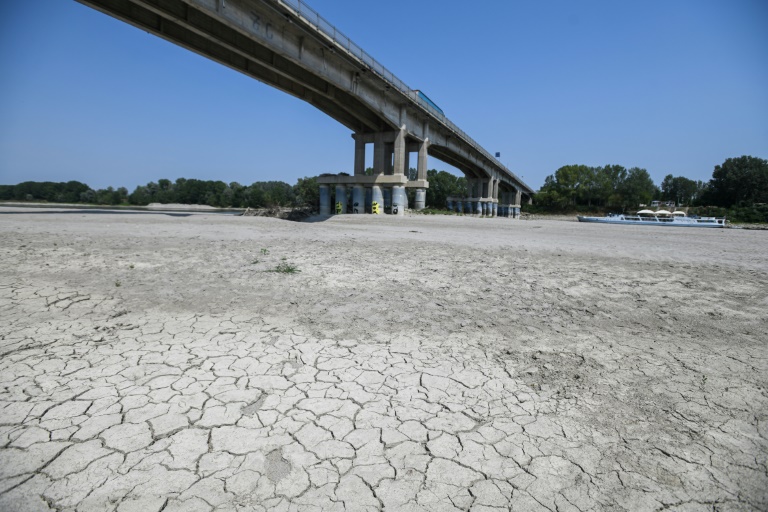
Both heatwaves and drought are a major threat to agriculture, and thus food security.

Long-term drought is agriculture’s worst enemy when it comes to extreme weather, but heatwaves can provoke major damage as well.

In 2019, a heatwave caused a nine percent drop in drop in maize yields across France, and a 10 percent decline in wheat, according to the French agricultural ministry.

A 2012 scorcher in the United States led to a 13 percent drop in maize production, and a sharp jump in global prices.

Heatwaves also have a negative impact on livestock production and on milk production, according to the IPCC.

Deadly heatwaves threaten economies too

More frequent and intense heatwaves are the most deadly form of extreme weather made worse by global warming, with death tolls sometimes in the thousands, but they can also have devastating economic impacts too, experts say. 

The prolonged and unseasonable scorchers gripping the central United States and rolling northward across western Europe, sending the thermometer above 40 degrees Celsius (104 degrees Fahrenheit), are likely to cause both.   

Deadly and costly

Very high temperatures caused nearly 10 percent of the two million deaths attributed to extreme weather events from 1970 to 2019, according to the World Meteorological Organization. 

Virtually all that heat-related mortality, moreover, has been since 2000, especially the last decade: from 2010 to 2019 scorching heat was responsible for half of 185,000 extreme weather deaths registered.

In Europe, heatwaves accounted for about 90 percent of weather-related mortality between 1980 and 2022, the European Environment Agency (EEA) has reported. 

Heatwaves rack up economic costs as well, but they are harder to quantify than damage from a storm or flood, and more difficult to insure. 

But extended bouts of great heat can result in more hospital visits, a sharp loss of productivity in construction and agriculture, reduced agricultural yields, and even direct damage to infrastructure. Excess mortality has an economic cost too.

The EAA estimates that heatwaves in 32 European countries between 1980 and 2000 cost 27 to 70 billion euros. The damages over the last 20 years — which included the deadly heatwave of 2003, with 30,000 excess deaths — would almost certainly be higher.

Premature death

The national public health agency in France, which will be blanketed by extreme conditions over the coming days, has called heatwaves “a mostly invisible and underestimated social burden.”  

In France alone, heatwaves from 2015 to 2020 cost 22 to 37 billion euros due to health expenses, loss of well-being and especially “intangible costs stemming from premature deaths”.  

Reduced productivity

The heatwaves of 2003, 2010, 2015 and 2018 in Europe caused damages totalling 0.3 to 0.5 percent of GDP across the continent, and up to two percent of GDP in southern regions, according to a peer-reviewed study in Nature. 

This level of impact could be multiplied by five by 2060 compared to a 1981-2010 baseline without a sharp reduction in greenhouse gas emissions and measures to adapt to high temperatures, the study warned.

At sustained temperatures of around 33C or 34C, the average worker “loses 50 percent of his or her work capacity”, according to the International Labor Organization (ILO).

The ICO estimates by 2030 heatwaves could reduce the total number of hours worked globally by more than two percent — equivalent to 80 million fulltime jobs — at a cost of 2.4 trillion dollars, nearly 10 times the figure for 1995.

“Climate change-related heat stress will reduce outdoor physical work capacity on a global scale,” The UN’s Intergovernmental Panel on Climate Change (IPCC) said in its most recent synthesis report, noting that in some tropical regions outdoor work may become impossible by the end of the century for 200 to 250 days each year.

Drought and agriculture

Both heatwaves and drought are a major threat to agriculture, and thus food security.

Long-term drought is agriculture’s worst enemy when it comes to extreme weather, but heatwaves can provoke major damage as well.

In 2019, a heatwave caused a nine percent drop in drop in maize yields across France, and a 10 percent decline in wheat, according to the French agricultural ministry.

A 2012 scorcher in the United States led to a 13 percent drop in maize production, and a sharp jump in global prices.

Heatwaves also have a negative impact on livestock production and on milk production, according to the IPCC.

RIP Explorer: Microsoft's web browser retired

Internet Explorer, Microsoft’s once dominant web browser that some users love to hate, was retired Wednesday after 27 years on the world’s computer screens.

The tech giant will no longer offer fixes or updates to the existing version of Explorer and users will be directed to its replacement, Microsoft Edge.

It was a moment marked with some genuine nostalgia — and plenty of jokes at the expense of what was many people’s first gateway to the internet.

“You took long to download stuff, you kept freezing, and you got replaced pretty easily by other browsers,” tweeted @Zytrux_1, under the hashtag #ripinternetexplorer.

“But there goes one of the first browsers I’ve ever used, and got plenty of good memories thanks to it.”

Twitter was flooded with Explorer memes, including tombstones or coffins bearing the browser’s signature blue “e,” and the occasional screenshot of error messages saying the app had stopped working.

Microsoft announced the change last year, and in a blog post Wednesday explained the need to start fresh with a different browser — Microsoft Edge.

“Internet Explorer (IE) is officially retired and out of support as of today,” the firm wrote.

“The web has evolved and so have browsers. Incremental improvements to Internet Explorer couldn’t match the general improvements to the web at large, so we started fresh,” it added.

– Antitrust battle –

Internet Explorer’s first version came out in 1995, in a challenge to the then rising early internet star Netscape Navigator.

The ubiquity of Microsoft’s operating system became a route also for Explorer to steadily become the default for many users.

In 1997 US authorities contended Microsoft, by incorporating its Internet Explorer in the Windows operating system for the first time, was trying to crush competition from Netscape.

The case was concluded with a settlement in November 2001 that imposed no financial penalty, but forced billionaire Bill Gates’s software giant to disclose more technical information and barred anti-competitive agreements on Microsoft products.

However, users gradually got more alternatives to the browser many loved to hate for its slowness and tech glitches.

Microsoft’s market share in the browser business plunged from more than 90 percent in the 2000s to the low single digits this year.

Google’s Chrome, with nearly 65 percent, is the market leader, according to Statcounter, a web traffic analysis site.

France's Macron calls for 'new discussions' with Ukraine

French President Emmanuel Macron on Wednesday called for “new in-depth discussions” with Ukraine, without confirming if he would travel this week to Kyiv as several media have reported.

“At the gates of our European Union, an unprecedented geopolitical situation is playing out,” Macron said after meeting French troops stationed in Romania.

“The political context and the decisions that the European Union and several nations will have to take justify new in-depth discussions and new progress.”

“We, the European Union, need to send clear political signals to Ukraine and the Ukrainian people, who have been resisting heroically for several months,” said Macron, speaking alongside Romanian President Klaus Iohannis.

He added the discussion should be “of a new nature”, including on military equipment, financing and unblocking shipments of Ukraine wheat affected by Russia’s invasion of its neighbour, which started in February.

“At some point, when we will have helped the resistance to the maximum, when — I hope — Ukraine will have won, and especially when guns can go quiet, we will have to negotiate,” Macron added. 

“The Ukrainian president and its leaders will have to negotiate with Russia. We will be — us Europeans — around that table,” the French president said.

Macron arrived on Tuesday in NATO member Romania. He had dinner with French soldiers on the Mihail Kogalniceanu base near the Black Sea and decided to spend the night in a tent instead of a hotel, according to his Elysee office.

On Wednesday, he had breakfast with soldiers before meeting Iohannis for more than an hour.

Later Wednesday, Macron travelled to Moldova for talks with President Maia Sandu in the capital Chisinau, where he called for the EU to send a positive signal to the former Soviet republic’s request to join the bloc.

“I would like us to send a positive and clear signal to Moldova. Nevertheless, I want to keep the conditions to build unanimity, consensus” amongst EU member states, Macron added.

Macron — the first French president to visit Moldova since Jacques Chirac in 1998 — has met Sandu three times since February 2021 in Paris and has developed “a relationship of trust” with the pro-European president, according to the Elysee.

“We know that the European integration of Moldova will be a long and complex process, which will require heavy efforts,” Sandu said in response to Macron. 

Hundreds of thousands Ukrainians have crossed into Moldova, one of Europe’s poorest countries with a population of 2.6 million. Most have since moved on to other countries.

Equities rebound as central banks in focus

Europe’s equities pushed higher Wednesday as the European Central Bank pledged to ease the stress in volatile eurozone bond markets, while US stocks advanced ahead of a major US rate hike.

Frankfurt, London and Paris stocks rallied, as investors were reassured by news of an emergency ECB meeting.

All three main indices had slid Tuesday, joining a global slide in equities on growing expectations that the US Federal Reserve will move aggressively to combat inflation at the conclusion of its latest scheduled monetary policy meeting on Wednesday.

Bitcoin extended this week’s precipitous slide to approach the key level of $20,000 as investors continued to shun risky crypto assets, while oil prices retreated further on lower energy demand expectations.

– ECB move ‘somewhat underwhelming’ –

The ECB said after its surprise meeting that it would use “flexibility” to ease stress on in sovereign debt markets and design a new instrument to ward off a fresh crisis in the eurozone.

The borrowing costs of some eurozone countries have risen faster than those of others as the ECB tightens its monetary policy. The bank has vowed to prevent such “fragmentation” which occured during the eurozone debt crisis a decade ago.

The yield on 10-year Italian bonds fell on Wednesday.

The euro rose against the dollar before giving up gains after the ECB announcement.

Markets.com analyst Neil Wilson called the announcement “somewhat underwhelming” and did not merit a special meeting.

Earlier, Wilson had said the emergency meeting “smacks of panic and a lack of control — but the market is happy to see it happen”.

The ECB is due to raise eurozone interest rates and end its massive bond-buying stimulus programme in July.

Asian stock markets closed mixed Wednesday with investors on edge over the looming Fed decision that has taken on greater significance since forecast-busting US inflation recently sent shockwaves through world markets.

Wall Street’s major stock indices advanced ahead of the Fed announcement.

Traders’ screens were awash with red at the start of the week after data on Friday revealed that US consumer prices had soared at the fastest pace in four decades.

That confounded hopes that US inflation was stabilising and intensified pressure on policymakers to act.

The news ramped up bets that the Fed would hike interest rates at a steeper and faster pace than expected as it struggles to retain credibility.

Before Friday’s data, the Fed had been tipped to lift borrowing costs by half a percentage point at Wednesday’s meeting, but investors are now widely anticipating a three-quarter point increase, with some even suggesting one percentage point.

The moves fuelled worries that the tighter monetary conditions will deal a blow to the US economy and potentially send it into recession next year.

Data released Wednesday showed US retail sales declined by 0.3 percent in May, confounding analysts who had expected a modest rise.

“These numbers were worse than expected and point to a US economy that appears to be weaker than thought,” said CMC Markets analyst Michael Hewson. 

“This should give the Fed pause if it is considering an outsized hike of” three-quarters of a percentage point, he added.

– Key figures at around 1530 GMT –

New York – Dow: UP 0.5 percent at 30,502.35 points

EURO STOXX 50: UP 1.2 percent at 3,444.49

London – FTSE 100: UP 1.3 percent at 7,280.53 (close)

Frankfurt – DAX: UP 1.4 percent at 13,485.29 (close)

Paris – CAC 40: UP 1.4 percent at 6,030.13 (close)

Tokyo – Nikkei 225: DOWN 1.1 percent at 26,326.16 (close)

Hong Kong – Hang Seng Index: UP 1.1 percent at 21,308.21 (close)

Shanghai – Composite: UP 0.5 percent at 3,305.41 (close)

Euro/dollar: DOWN at $1.0405 from $1.0416 late Tuesday

Pound/dollar: UP at $1.20659 from $1.1997

Euro/pound: DOWN at 86.27 pence from 86.83 pence

Dollar/yen: DOWN at 134.48 yen from 135.47 yen

Brent North Sea crude: DOWN 0.3 percent at $120.80 per barrel

West Texas Intermediate: DOWN 0.7 percent at $118.12 per barrel

Strike flattens street far from frontline in Ukraine's east

Yelena Gruzdeva and her children were asleep in a small Ukrainian town far from the frontline when an explosion blew off their roof, the family escaping uninjured “by a miracle”.

“Everything in the house has been chopped up by shrapnel,” said Gruzdeva on Wednesday as she cleared debris from their small blue-painted house on the outskirts of Dobropillia. 

Located in the Donetsk region, the town lies around 150 kilometres (90 miles) from the epicentre of the fighting between Ukrainian and Russian forces.

“It was because we were lying in bed — if we’d been walking around, (the shrapnel) would have ripped through us all,” said this 45-year-old housewife.

“There was a crack and everything started crumbling.”

In the early hours of Tuesday morning, a single strike slammed into the street just off the main road into the city, completely flattening a house and killing one man.

Dobropillia had previously suffered only a few strikes during the course of the war, unlike ravaged cities further north such as Lysychansk and Severodonetsk.

But on Tuesday, there were at least three strikes in one day, locals said, suggesting Russia may see the town as a hub for Ukrainian forces and a target for the future.

The strike left a huge crater with the explosive wave ripping off roofs and blowing out windows in houses further along the street, although many residents of the town had already left. 

In a thick cloud of dust, the family ran out and hid in the cellar, fearing further strikes, she said.

“We kept calm. We did have an idea that something like this could happen,” said Gruzdeva, whose family has been lent another house to live in by “kind people”.

– Three strikes in one day –

The man killed at the first house on the street was simply looking after it for the absent owners, locals said.

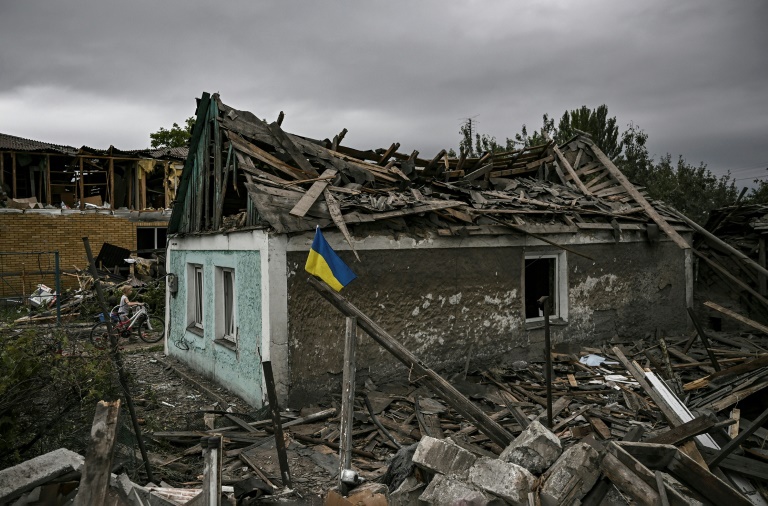
A Ukrainian flag still flew on a fence post next to the pile of debris.

A man smoking a cigarette as he worked on a shattered roof shouted down: “They hit us and we just laugh!”

Vitaliy Popelishko, another home owner looking at the huge hole in the facade of his house, said it was not reparable as “all the walls have cracked and it will need to be demolished”.

Escaping with a scratch on his forehead, the 33-year-old coal mine employee looked pale and shocked and said his father, who was also inside at the time, was distressed.

“Here during the whole time, there have been 10 strikes. Now there were three strikes just yesterday. That means they are in a position where they can shell us,” Popelishko said.

“Why do they shell peaceful houses — who was stationed here? There aren’t any military, no-one.”

The explosion smashed windows in an automotive depot at the end of the street that has a large hangar which may have been the intended target, although AFP journalists saw no military vehicles inside.

“I don’t know what you can call this? It’s mediaeval,” said Sergiy Semenets, a volunteer in the local territorial defence force who was later joined at the scene by a vehicle carrying humanitarian aid.

Things had been “going along quietly” in the town up to now, he said.

“They want to destroy Ukraine.”

Berlin blasts 'political decision' in Gazprom's gas squeeze

Russia on Wednesday stepped up the energy pressure on Europe, slashing gas supplies to the continent for the second day in a row in a move blasted as “political” by Germany.

A day after Gazprom said it was cutting deliveries via the Nord Stream pipeline by around 40 percent, the Russian state-owned energy giant said it was further snuffing out its daily deliveries by a third.

The energy company blamed the cut on “repair” work on compressor units by German company Siemens, but Berlin slapped down the excuse.

Gazprom’s move was “a political decision and not a technically justifiable decision”, Economy Minister Robert Habeck said at a press conference.

The minister said Wednesday’s move to further dwindle flows showed “it is obviously a strategy to unsettle and drive up prices”.

Separately, Italian energy giant Eni said it was informed by Gazprom that it was reducing its gas supplies by 15 percent for Wednesday without explanation.

Several European countries, including Germany, are highly reliant upon Russian gas for their energy needs.

But since Russia’s invasion of Ukraine, they have been battling to wean themselves off Russian power.

In a race for alternative sources of energy, the European Union signed gas deals with Egypt and Israel during a Cairo visit Wednesday by the bloc’s chief Ursula von der Leyen.

– Save energy –

The Nord Stream pipeline, commissioned in 2012, runs from Russia to Germany under the Baltic Sea and is the main conduit for gas from Russia to Europe’s biggest economy.

A second underwater pipeline, Nord Stream 2, that was set to double deliveries was halted by Germany in the run up to Russia’s invasion of Ukraine.

Habeck said Germany was aware of the need to service the Nord Stream pipeline but added that “the first set of maintenance works where this would have become relevant will not take place until autumn.”

At the same time, those works would not warrant a reduction “on the order of 40 percent”, Habeck said.

Gazprom said Tuesday that the delayed return of components meant only three gas-pumping units were currently operational at the Portovaya compression station near the Russian city Vyborg, where the pipeline begins.

Germany was monitoring the impact on the gas market, but there was “no supply problem in Germany”, Habeck said.

He stressed that saving energy was the “order of the day”, and that Germany was ready to “take government action, if necessary”. 

Since the start of the war, European countries have sought to reduce their reliance on imports from Russia, but are divided about how quickly to impose an embargo on gas.

Moscow has already cut off several European clients after they failed to comply with a Russian demand that all “unfriendly” countries pay for natural gas in rubles in response to a barrage of Western sanctions over Ukraine.

Poland, Bulgaria, Finland and the Netherlands have had their deliveries suspended after refusing the arrangement.

Eni said in May it has opened accounts in euros and in rubles to pay for Russian gas, thus complying with Moscow’s demands, but insisted the move was taken in compliance with the sanctions.

Close Bitnami banner
Bitnami