World

Flights resume after computer glitch shuts Swiss airspace

Swiss airspace reopened Wednesday morning after a computer glitch grounded flights across the Alpine nation for several hours, officials said.

“Swiss airspace is now open again,” Swiss air traffic control service Skyguide said in a tweet, adding “the technical malfunction at Skyguide has been resolved”.

It did not say what had caused the problem that shut Swiss airspace for hours Wednesday morning, but said that “air traffic over Switzerland and operations at the national airports of Geneva and Zurich are resuming”.

Those airports too announced that flights had begun taking off.

“Good news! Air traffic has gradually resumed since 8:30 am (0630 GMT),” Geneva airport said in a tweet, warning that a number of flights had been cancelled and urging passengers to check with their airlines.

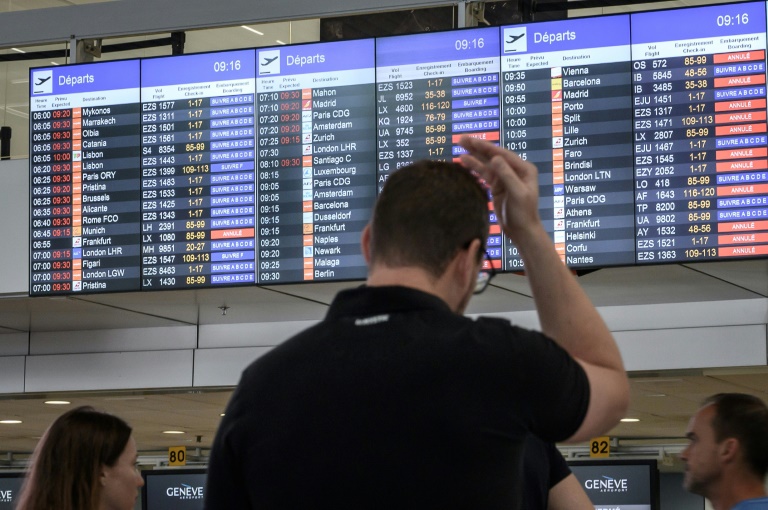
At the airport, where the first morning flights were delayed by more than three hours, dozens of travellers crowded around the information screens, with phones plastered to their ears.

Zurich airport also said flight operations were “running again”, although flight operations would be at 50-percent capacity until 9:30 am, and 75-percent after that.

“We recommend passengers to pay attention to the flight information of the airline.”

The chaos erupted when Skyguide announced it had “experienced a technical malfunction in the early hours of this morning, which is why Swiss airspace has been closed to traffic for safety reasons”.

It said it regretted “this incident and its consequences for its customers, partners and passengers.”

The Swiss news agency ATS-Keystone said international flights to Switzerland had been re-routed to Milan in northern Italy.

The Zurich airport website meanwhile showed that a United Airlsines flight from New York had been rerouted to Frankfurt in western Germany, while a Singapore Airlines flight from the city state had been sent to the southern German city of Munich. 

Zurich is Switzerland’s largest airport, with more than 10.2 million passengers going through its terminals in 2021.

But with Covid restrictions lifted, air traffic has picked up significantly since then, with 1.9 million passengers registered there in May alone.

Markets see post-rout calm as traders await Fed hike

Equities were mixed Wednesday with investors nervously awaiting a Federal Reserve interest rate decision that has taken on greater significance since a forecast-busting inflation report sent shockwaves through world markets.

Trading floors saw a sea of red at the start of the week after data showed US consumer prices soared at their fastest pace in four decades last month, confounding hopes they were stabilising and putting pressure on officials to act.

The news ramped up bets that the central bank would hike interest rates at a steeper and faster pace than expected as it struggles to retain credibility.

Before Friday’s data, the Fed had been tipped to lift borrowing costs by half a point when its policy meeting ends Wednesday but investors are now widely anticipating a three-quarter point increase, with some even suggesting one percentage point.

The moves fuelled worries that the tighter monetary conditions will deal a blow to the US economy and potentially send it into recession next year.

Still, many observers say acting now is the only option available to policymakers if they want to rein in prices and prevent stagflation.

“The sooner they are going to be clear about how quickly they are going to raise rates and what is an acceptable rate of inflation for them, the sooner markets will calm down,” Wincrest Capital’s Barbara Ann Bernard told Bloomberg Television.

And StoneX Financial’s Matt Simpson added: “A bullish outcome for risk-appetite is the well-telegraphed 75-basis-point hike, conviction from the Fed that they’ll manage a soft landing, alongside a downwardly revised CPI forecast for good measure”.

But he warned that a half-point increase “could inadvertently weigh on sentiment as markets are concerned the Fed aren’t taking inflation seriously enough”.

While most of Wall Street and Europe ended down, they saw less turbulent action than Friday and Monday.

In Asia markets were mixed with some seeing a pick-up on bargain-buying.

Hong Kong and Shanghai enjoyed some healthy buying after data showed an improvement in Chinese retail sales and factory output last month thanks to an easing of Covid restrictions in major cities.

The readings lifted hopes that government support can help lift the world’s number two economy out of its torpor.

Singapore and Mumbai were also in positive territory, while Tokyo, Sydney, Seoul, Taipei, Manila, Bangkok and Jakarta slipped.

London, Paris and RFrankfurt rose at the open, with traders following The European Central Bank after it said policymakers would hold an exceptional meeting Wednesday to “discuss current market conditions”.

The announcement saw the euro rally against the dollar on hopes for details on how officials will tackle the eurzone’s embattled bond market. Observers are predicting the single currency could rise back above $1.05. 

While there is a little calm ahead of the Fed announcement, commentators warn that uncertainty will continue to course through trading floors for some time.

Strategist Louis Navellier said markets could go one of two ways after the meeting.

“The big unknown is will the market have a relief rally thinking that inflation is finally being seriously addressed and will therefore be tamed sooner than feared?

“Or will the move create new sellers from fears that the Fed is panicking and may hasten a recession by overshooting as it chases inflation?

“Either way, rates will be rising in an attempt to slow demand in order to slow inflation and further volatility is almost guaranteed.”

In company news, the management agency of K-pop supergroup BTS plunged by a quarter in Seoul after the band announced they were taking an indefinite break.

The seven members, who have generated billions of dollars for South Korea’s economy, made the shock announcement on Tuesday.

On Wednesday morning the band’s label HYBE collapsed about 27 percent, wiping $1.6 billion off its market valuation.

– Key figures at around 0720 GMT –

Tokyo – Nikkei 225: DOWN 1.1 percent at 26,326.16 (close)

Hong Kong – Hang Seng Index: UP 1.0 percent at 21,271.14

Shanghai – Composite: UP 0.5 percent at 3,305.41 (close)

London – FTSE 100: UP 0.5 percent at 7,221.50

Euro/dollar: UP at $1.0469 from $1.0420 late Tuesday

Pound/dollar: UP at $1.2028 from $1.1993

Dollar/yen: DOWN at 134.66 yen from 135.33 yen 

Euro/pound: DOWN at 87.03 pence from 86.84 pence

Brent North Sea crude: UP 0.3 percent at $121.54 per barrel

West Texas Intermediate: UP 0.3 percent at $119.25 per barrel

New York – Dow: DOWN 0.5 percent at 30,364.83 (close)

Ecuador judge orders release of Indigenous leader amid protests

An Ecuador judge ordered the immediate release of prominent Indigenous leader Leonidas Iza, his lawyer said early Wednesday, less than a day after he was arrested and accused of paralyzing roads during nationwide anti-government protests. 

Demonstrations had kicked off since Monday, with protesters blocking roads with burning tires and barricades of sand, rocks and tree branches in at least 10 of Ecuador’s 24 provinces, authorities had said — partially cutting off access to the capital Quito.

Iza, leader of the powerful Confederation of Indigenous Nationalities of Ecuador (Conaie) — a group credited with helping topple three Ecuadorean presidents between 1997 and 2005, and was spearheading the movement — was arrested on suspicions of “sabotage,” according to the interior ministry.

But his detention sparked outrage, bringing supporters to the public prosecutor’s office in Latacunga, 90 kilometers (50 miles) from Quito, to call for his release, with protesters holding signs that read “Freedom for Iza!” 

Just after midnight, Iza’s lawyer Raul Ilaquiche told AFP a judge had ordered “his immediate release and that he appear periodically before the prosecutor’s office” when the trial begins.

Iza is accused of “allegedly paralyzing public transport services” for blocking roads during the anti-government protests, the prosecutor’s office said on Twitter, confirming the Indigenous leader’s release. 

The crime is punishable by up to three years in prison.

But Iza appeared defiant after his release, speaking to a crowd of supporters outside a military base in Latacunga, where he had been held. 

“We are not going to be demoralized,” he told supporters via a loudspeaker.

“Long live the struggle!” they shouted in response.

Hours earlier, Ecuador police in riot gear and soldiers had stood guard outside the public prosecutor’s office, and clashed with protesters calling for his freedom.

Members of the Indigenous movement said several people were injured when authorities deployed tear gas, while police said their officers were attacked and some were being held captive. 

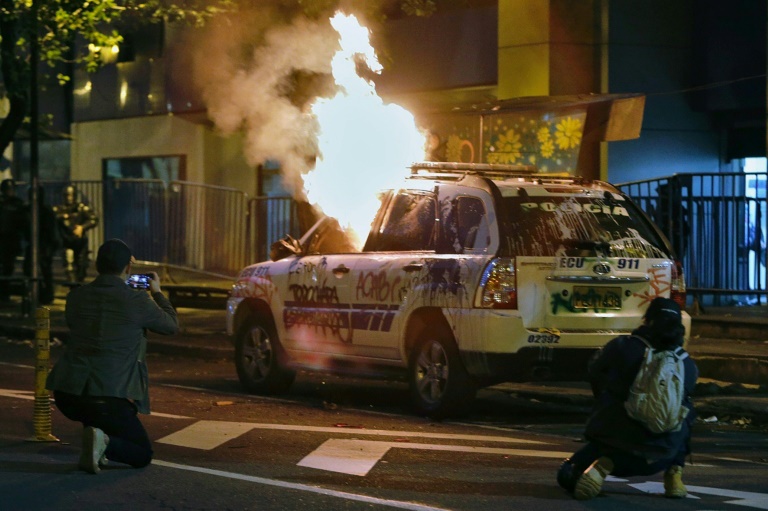
In Quito, police vehicles were set ablaze and protesters burned fires in the streets. 

– ‘Popular uprising’ –

Iza, a leader of the Kichwa-Panzaleo community, had been arrested in Pastocalle, just south of Quito — a flashpoint of protests called by Conaie against rising fuel prices and living costs. 

One of his lawyers told journalists the arrest had been “violent”, and his organization Conai condemned the detention as “arbitrary and illegal”, calling for a “radicalization” of protests.

“We call our organizational structure to a great Indigenous and popular uprising,” Conaie tweeted after Iza’s arrest. “Long live the social struggle!”

In 2019, Conaie-led protests resulted in 11 deaths and forced then-president Lenin Moreno to abandon plans to eliminate fuel subsidies. 

The group is also credited with helping topple three presidents between 1997 and 2005.

Oil producer Ecuador has been hit by rising inflation, unemployment and poverty — issues that were exacerbated by the pandemic.

President Guillermo Lasso had warned Sunday the government would not allow roads or Ecuador’s oil installations to be taken over by protesters.

But Iza insisted the demonstrations would continue for as long as necessary.

– ‘Disorder, chaos, vandalism’ –

Authorities say about 6,000 people took part in Monday’s protests, although Iza had accused them of “minimizing” the movement.

Lasso denounced “acts of vandalism,” including “the burning of patrol cars, invasions of farms, the breaking of windshields on private and school vehicles, an attack on an oil pumping facility, the cutting off of community water supplies, the closure and serious damage to state roads.”

Several security ministers denied there was an attack on the oil pumping facility in Ecuador’s Amazon region.

Chinese company PetroOriental said Tuesday protesters had occupied and paralyzed some of its wells in the Amazonian Orellana province, causing a loss of 1,400 barrels of crude per day.

Besides Iza, four others were detained Tuesday, said Interior Minister Patricio Carrillo.

Carrillo accused protesters of “paralyzing, looting, kidnapping, attacking” in such a way that “the disorder, the chaos, the vandalism causes social unrest.”

– Fruitless talks –

Conaie has taken part in several rounds of fruitless talks with Lasso’s conservative government.

Fuel prices have risen sharply since 2020, almost doubling for diesel from $1 to $1.90 per gallon (about 3.78 liters) and rising from $1.75 to $2.55 for gasoline.

Lasso froze fuel prices last October after a round of protests led by Conaie that saw dozens arrested and several people, including police, injured in clashes.

But the freeze failed to assuage simmering anger in a country that exports crude but imports much of the fuel it consumes.

The protesters are also demanding the government address price controls on agricultural products and mining concessions granted in Indigenous territories.

They have also called on the government to create more jobs and to renegotiate farmers’ debts with banks.

Indigenous peoples make up over a million of Ecuador’s 17.7 million inhabitants.

UK vows to pursue asylum policy after Rwanda flight cancelled

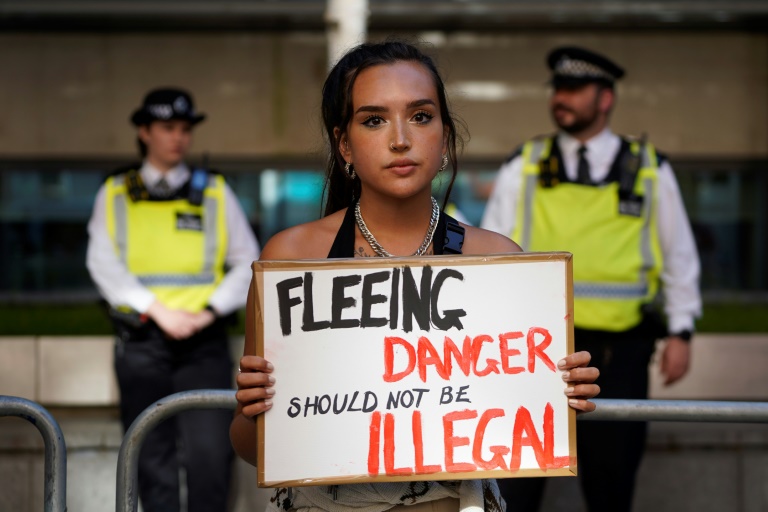
Britain vowed Wednesday it would pursue its controversial policy to deport asylum seekers to Rwanda after a first flight was cancelled following a legal ruling, in an embarrassing blow to Prime Minister Boris Johnson’s government.

The number of those due to be put on the flight on Tuesday had dwindled from an original 130 to seven and finally none after a last-minute order by the European Court of Human Rights (ECHR).

British Home Secretary Priti Patel said she was disappointed that “legal challenge and last-minute claims” meant the plane did not take off but insisted the heavily criticised programme would go ahead.

“We will not be deterred,” she said in a statement.

“Our legal team are reviewing every decision made on this flight and preparation for the next flight begins now.”

The grounding followed an ECHR ruling that at least one of the asylum seekers should stay in Britain as there were no guarantees for his legal future in Rwanda, an East African country thousands of miles (kilometres) away.

Patel called the ECHR intervention “very surprising” and vowed that “many of those removed from this flight will be placed on the next”.

Rwanda also said it remained committed to taking in the asylum seekers under the April deal, which has come under fire from the UN, rights groups and church leaders.

“We are not deterred by these developments,” government spokeswoman Yolande Makolo told AFP. “Rwanda stands ready to receive the migrants when they do arrive and offer them safety and opportunity in our country.”

The flight cancellation is an embarrassment for Johnson’s Conservative government after Foreign Secretary Liz Truss insisted the Kigali-bound plane would leave no matter how many people were on board.

But the ECHR issued an urgent interim measure to prevent the deportation of an Iraqi man booked on the flight as he may have been tortured and his asylum application was not completed.

The Strasbourg-based court said the expulsion should wait until British courts have taken a final decision on the legality of the policy, set for July.

British newspapers from across the political spectrum expressed outrage at the 11th-hour reversal and the government’s handling of the affair.

The conservative Daily Mail and Daily Express placed the blame in the hands of “meddling judges in Strasbourg”, expressing anger at what they called the “abuse of the legal system”. 

The left-leaning Daily Mirror, meanwhile, slammed the government’s “cruel farce” and the “chaos” the policy had provoked.

– ‘All wrong’ –

Rights group Care4Calais tweeted that the same ECHR order could be applied to the others set to be transported to Rwanda.

Truss has insisted the policy, which the UN refugee agency has criticised as “all wrong”, was vital to break up human-trafficking gangs exploiting vulnerable migrants.

Record numbers of migrants have made the perilous Channel crossing from northern France, heaping pressure on the government in London to act after it promised to tighten borders after Brexit.

British media said some 260 people attempting the crossing in small boats were brought ashore at the Channel port of Dover by 1200 GMT on Tuesday.

More than 10,000 have crossed since the start of the year.

– ‘Shames Britain’ –

Legal challenges in recent days had failed to stop the deportation policy, which Church of England leaders  described as “immoral” and “shames Britain”.

“We cannot offer asylum to everyone, but we must not outsource our ethical responsibilities, or discard international law — which protects the right to claim asylum,” Archbishop of Canterbury Justin Welby and Archbishop of York Stephen Cottrell wrote in a letter to The Times. 

It was reported last weekend that Queen Elizabeth II’s heir, Prince Charles, had privately described the government’s plan as “appalling”.

But Truss said: “The people who are immoral in this case are the people traffickers trading on human misery.”

Johnson has told his senior ministers the policy was “the right thing to do”.

Truss said she could not put a figure on the cost of the charter flight, which has been estimated at upwards of £250,000 ($303,000). 

But she insisted it was “value for money” to reduce the long-term cost of irregular migration, which the government says costs UK taxpayers £1.5 billion a year, including £5 million a day on accommodation.

– Not ‘a punishment’ –

In the French port of Calais, migrants said the risk of deportation to Rwanda would not stop them trying to reach Britain.

Moussa, 21, from Sudan’s Darfur region, said “getting papers” was the attraction. 

“That’s why we want to go to England,” he said.

Deported asylum seekers who eventually make the 4,000-mile (6,500-kilometre) trip to Kigali will be put up in the Hope Hostel, which was built in 2014 to give refuge to orphans from the 1994 genocide of around 800,000 mainly ethnic Tutsis.

Hostel manager Ismael Bakina said up to 100 migrants can be accommodated at a rate of $65 per person a day and that “this is not a prison.”

The government in Kigali, which is frequently accused of rights abuses, has rejected criticism that Rwanda is not a safe country.

“We don’t think it is immoral to offer a home to people,” spokeswoman Makolo said Tuesday. “We do not consider living in Rwanda a punishment.”

burs-txw

China factory output, retail sales weak as Covid shadow persists

China’s factory output and retail sales remained weak in May, official data showed Wednesday, with tepid demand and lingering Covid restrictions putting a damper on growth in the world’s second-largest economy.

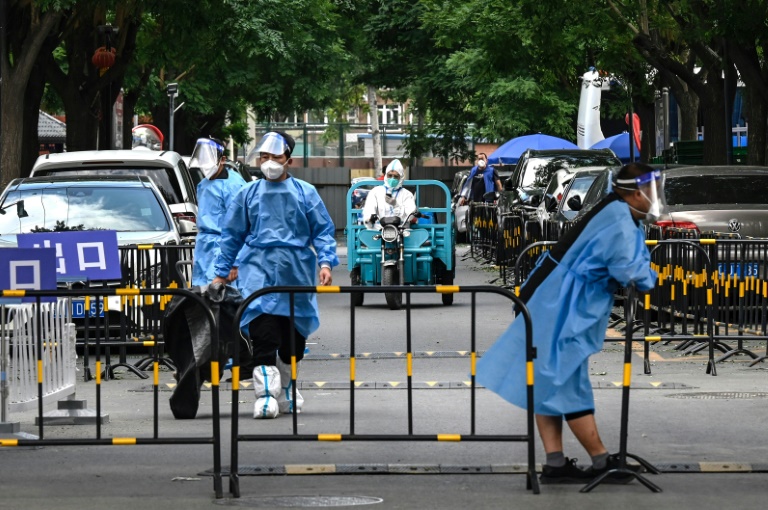
The government is persisting with a zero-Covid strategy to stamp out clusters as they emerge, but this has placed companies and consumers at the mercy of snap, economically damaging lockdowns.

Retail sales sank 6.7 percent on-year in May, the National Bureau of Statistics (NBS) said, though that was an improvement from April’s 11.1 percent drop.

The figure was also slightly better than forecasts from analysts polled by Bloomberg.

“In May, our economy gradually overcame the adverse impact of the pandemic,” NBS spokesman Fu Linghui told reporters.

“But we also have to see that the international environment has become more complex and severe, and the domestic economic recovery still faces many difficulties and challenges.”

It was the third straight month of contraction in retail sales, according to official data, suggesting nervous consumers are tightening their purse strings with the persistent threat of lockdowns.

But industrial production was up 0.7 percent after falling 2.9 percent in April, while the urban unemployment rate ticked down to 5.9 percent.

Shanghai, China’s most populous city, started emerging from a gruelling two-month lockdown in June, providing a boost to economic sentiment.

Tommy Wu, lead China economist at Oxford Economics, speculated that “the worst of lockdowns is probably behind us.”

However, he added that it will be “difficult for household consumption to recover strongly” while China’s zero-Covid strategy remains in place.

Meanwhile, concerns are mounting over the trend in unemployment as millions of students graduate in the summer, Zhiwei Zhang, of Pinpoint Asset Management, said.

Unemployment among rural migrant workers remained elevated, data showed, while home sales in the first five months dropped 34.5 percent.

Observers remain cautious in part because of a property sector slump and the government’s reluctance to transition away from zero-Covid despite recent fine-tuning.

“There is no guarantee that a new wave will not hit in coming months,” Nomura analysts said Wednesday.

Russia plans evacuations from chemical plant in battleground Ukraine city

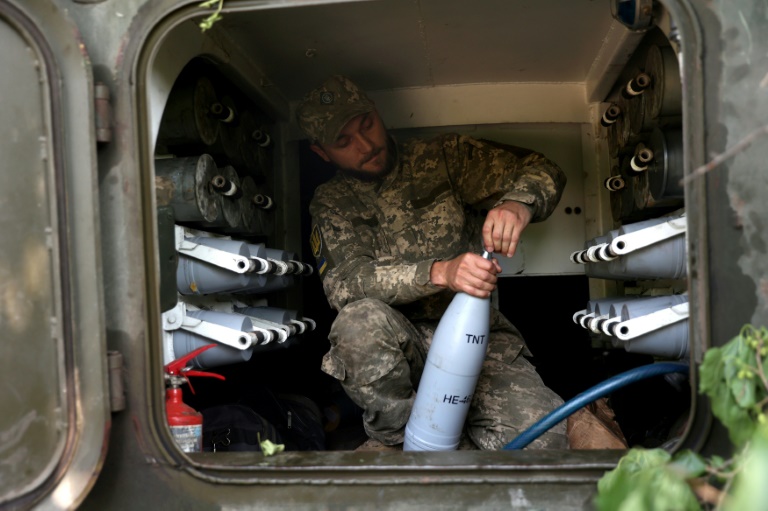
Russia said it would establish a humanitarian corridor to evacuate civilians from a chemical plant in Severodonetsk starting Wednesday as Ukrainian forces wage a desperate battle for control of the city.

The industrial hub is under intense bombardment as Russia focuses its offensive on the eastern Donbas region in an effort to seize a swathe of Ukraine.

Moscow’s forces have intensified efforts to cut off Ukrainian troops remaining in the city, destroying all three bridges which connect it across a river to the twin city of Lysychansk.

NATO chief Jens Stoltenberg meanwhile urged allies to send more heavy weapons to Ukraine, and said officials from the alliance would be discussing the subject at talks Wednesday. 

About 500 civilians are taking shelter in Severodonetsk’s Azot chemical plant, according to the head of the city’s administration.

The Russian defence ministry announced a humanitarian corridor would be established on Wednesday for evacuations from the plant, saying it was “guided by the principles of humanity”.

Evacuees would be transported to the city of Svatovo in the separatist-held region of Lugansk, Moscow said, urging those holding out at the plant to cease their “senseless resistance”.

There was no response from Kyiv to the announcement, and in a video address Tuesday evening, Ukrainian President Volodymyr Zelensky lamented “painful losses” in the ongoing fighting. 

“But we must stay strong. This is our nation… Hanging in there in Donbas is crucial. Donbas is the key to deciding who will dominate in the coming weeks.”

Following its February invasion, Russia was repelled from Kyiv and other parts of Ukraine, prompting it to focus its offensive on Donbas, a mainly Russian-speaking region partly held by pro-Kremlin separatists since 2014.

Capturing Severodonetsk has become a key goal, as it would open the road to Sloviansk and another major city, Kramatorsk.

– NATO urges heavy weapons –

Speaking in The Hague, NATO chief Stoltenberg urged Western countries to send the Ukrainians more heavy armaments, as they “absolutely depend on that to be able to stand up against the brutal Russian invasion”.

Addressing a press conference after meeting the leaders of seven European NATO allies, he added that NATO officials would discuss coordinating further support including heavy weaponry at a meeting in Brussels Wednesday.  

Zelensky meanwhile told reporters that he regretted what he called “the restrained behaviour of some leaders” which, he said, had “slowed down arms supplies very much”.

Ukraine has only received 10 percent of the arms it had requested from the West, Kyiv’s deputy defence minister said.

Kyiv’s forces face an increasingly desperate situation in Severodonetsk, with Ukrainian authorities estimating the Russians now control up to 80 percent of the city as they seek to encircle it. 

From an elevated position in Lysychansk, an AFP team saw black smoke rising from the Azot factory in Severodonetsk and another area in the city.

The Ukrainian military is using the high ground to exchange fire with Russian forces fighting for control of Severodonetsk, just across the water.

Lysychansk pensioner Valentina sat on the porch of her ground floor apartment, where she lives alone, her two walking sticks to hand.

“It’s scary, very scary,” said the 83-year-old former farm worker. 

“Why can’t they agree at last, for God’s sake, just shake hands?”

Along the road from Lysychansk to Kramatorsk, Ukrainian forces were transporting more weapons systems to the front, while specialist vehicles carried tanks for repair.

In the town of Novodruzhesk, close to Lysychansk, there was still a smell of burning and smoke from houses that had been destroyed by fire from shelling at the weekend.

“It’s not safe anywhere, it just depends on the time of day, that’s all,” said a soldier standing at a fire station with a skull logo on his sleeve.

– Britons blacklisted –

As tensions soar with the West, Russia announced it was blacklisting 49 British citizens, including defence officials and prominent reporters and editors from the BBC, The Financial Times and The Guardian.

The Russian foreign ministry said that the journalists targeted were “involved in the deliberate dissemination of false and one-sided information”.

In New York, a senior UN official warned Tuesday that Ukrainian children should not be adopted in Russia, where several thousand young people are believed to have been moved since Moscow’s February invasion.

“We’re reiterating, including to the Russian Federation, that adoption should never occur during or immediately after emergencies,” Asfhan Khan, the UN Children’s Fund (UNICEF) regional director for Europe and Central Asia, told reporters.

Such children cannot be assumed to be orphans and their movement must be voluntary, Khan added.

The Kremlin, meanwhile, said it had not received a request from London to intervene in the case of two Britons sentenced to death by pro-Moscow separatist authorities in eastern Ukraine.

Aiden Aslin and Shaun Pinner, along with Moroccan Brahim Saadun, were convicted of acting as mercenaries for Ukraine by the self-proclaimed Donetsk People’s Republic.

China's middle class looks to flee as Covid policies bite

Alan Li no longer sees any future for his family in China after harsh Covid rules decimated his business, upended his son’s education and left his country out of step with the rest of the world.

He has given up hope of a return to normal after months of lockdowns in Shanghai, and now plans to close his firm and move to Hungary, where he sees better opportunities and his 13-year-old son can attend an international school.

“Our losses this year mean that it’s over for us,” he told AFP wearily, asking to withhold his real name.

“We have been using our own cash savings to pay 400 workers (during the lockdown). What if it happens again this winter?”

Shanghai’s long shutdown, which brought food shortages and protests, has driven some to reconsider staying in a country where livelihoods and lifestyles can vanish at the whim of the state.

Schools have been closed and exams called off, including assessments for applying to American universities.

Li is frustrated that his son’s expensive bilingual schooling has been mostly online for two years, and he is anxious about the way Beijing has tightened oversight of the curriculum.

“This is a waste of our children’s youth,” Li said.

Being fairly well off, he has been able to take advantage of a European investment scheme that grants him and his family residency in Budapest.

“Many people know that if they sold all their assets they could ‘lie flat’ in a European country,” he said, using a slang phrase meaning to take it easy.

Beijing-based immigration consultant Guo Shize told AFP his company has seen an explosion of enquiries since March, including a threefold increase in Shanghai clients.

Even after the lockdown eased, requests continued flooding in at more than double the usual level.

“Once that spark has been lit in people’s minds, it doesn’t die down quickly,” he said. 

– Exit ban –

Censors have sought to suppress discussion of emigration, prompting nimble internet users to adopt the term “run” instead.

Searches for the term on messaging app WeChat peaked during Shanghai’s shutdown.

But as more people consider ways to leave, Beijing has doubled down on strict exit policies for Chinese citizens.

All “unnecessary” travel out of the country has been banned. Passport renewals have been all but halted, with authorities blaming the risk of Covid being carried into the country.

In the first half of 2021, immigration authorities issued only two percent of the passports given out in the same period in 2019.

One woman who emigrated to Germany told AFP she receives dozens of messages from Chinese people looking for tips on escaping.

Emily, who did not want to use her real name, tried to help a relative obtain a new passport to take up a job in Europe, but the application was denied.

“It’s like being a child who wants to go to their friend’s house to play but their parents won’t let them leave,” she said, adding that she has heard of passports being sold for up to 30,000 yuan ($4,500) on the black market.

– ‘Absolutely insane’ –

A Chinese freelancer told AFP he was turned back by immigration officers while attempting to fly to Turkey for work last October, despite having already checked in.

“My itinerary sounded too suspicious to them. They took my passport into an office and 15 minutes later told me I do not meet the requirements” for leaving, he said on condition of anonymity. “It was absolutely insane.”

He managed to leave weeks later by entering semi-autonomous Macau on a different travel document, before catching an onward flight.

Some are disillusioned with Beijing’s growing controls, which have been ramped up during the pandemic.

“I just want to live in a country where the government won’t crudely interfere in my personal life,” said Lucy, a 20-year-old student at an elite Beijing university involved in LGBTQ and Marxist activism.

The virus policies had “allowed the government to control and monitor everything”, she said.

“Perhaps rather than accepting and adapting to this system, we must go elsewhere and create a new life.”

Emotional BTS tell fans they're taking a break to 'figure things out'

K-pop megastars BTS told fans they were taking a break from the supergroup to focus on their solo careers, citing exhaustion and the pressures of stratospheric success in an emotional video appearance.

But the Grammy-nominated septet’s label HYBE pushed back on Wednesday as their share price went into freefall, telling AFP that the pop juggernaut would still be working together.

The seven members of BTS, credited with generating billions of dollars for the South Korean economy, dropped the bombshell on Tuesday, telling fans that they were “exhausted” and needed time apart.

“We’re going into an off phase now,” said Suga, 29, speaking Korean to his bandmates at a group dinner, a video of which was posted to the group’s official YouTube channel.

The clip included English subtitles, which used the word “hiatus”, but HYBE quickly disputed that, saying group activities would not be suspended.

“They will be doing team and individual projects simultaneously,” a representative for the label, whose share price was down 27 percent early Wednesday, told AFP.

In the video, RM, 27, said they were “exhausted” and that they “didn’t know what kind of group we were anymore.”

“The problem with K-pop and the whole idol system is that they don’t give you time to mature,” he said, referring to South Korea’s notoriously hard-driving music business model.

“Somehow, it’s become my job to be a rapping machine,” he said, adding that this made him feel “trapped”.

“I wanted to shed that for a little bit, but the world wouldn’t let me be.”

Jimin, 26, said the members are “slowly trying to figure things out now”.

“I think that’s why we’re going through a rough patch right now, we’re trying to find our identity and that’s an exhausting and long process.”

– ‘Overwhelming’ –

By the end of the dinner, several of the members of the group behind “Dynamite” and “Butter” had grown tearful as they voiced gratitude for their supporters, a fandom known online as the “ARMY”.

J-Hope, 28, said the group “should spend some time apart to learn how to be one again”.

“I hope you don’t see this is a negative thing,” the artist implored fans. “And see that it’s a healthy plan.”

“It’s not that we’re disbanding — we’re just living apart for a while,” said Suga. 

Jungkook, 24, said, “we promise we will return someday even more mature than we are now”, and asked for the “blessing” of fans.

ARMY’s online reaction was tearful but supportive, with tens of thousands of comments quickly posted under the YouTube video. 

“I can’t imagine how much pressure they felt these latest years. Being called the biggest band in the world, having all that responsibility… must be overwhelming,” one fan wrote. 

“I really love how honest they are here,” wrote another. 

“They are also people like us. They get exhausted and worn out. They deserve to rest and enjoy what they love to do,” the commenter added.

BTS has said they were going on short breaks before, first in 2019 and later in December 2021.

The news comes just days after the group released “Proof”, an anthology album that included a new single, “Yet To Come (The Most Beautiful Moment)”.

J-Hope, who is slated to headline Chicago’s Lollapalooza on his own later this summer, said in the clip that time apart could help BTS “become a stronger group”.

– ‘Confusing’ –

BTS’s label enjoyed a surge in profits despite holding fewer concerts during the pandemic.

But their messaging around the band’s next steps was “confusing” and “not clear”, Lee Moon-won, a K-pop culture commentator, told AFP.

“It appears what they meant is BTS will continue their ‘supplementary’ group activities (such as on YouTube) while pursuing solo careers,” he said, while not releasing music as a band.

“It would have been more appropriate had the label first issued a statement clearly detailing what it would mean,” Lee said, adding that it was a bad decision to have the band announce the development, which was sure to send fans into a tailspin.

BTS are the first all-South Korean act to reign over Billboard’s US top singles chart, a milestone they achieved with “Dynamite”, the first BTS song sung completely in English.

They’re also one of few acts since The Beatles to release four albums that hit number one stateside in less than two years.

The group has twice been nominated for a Grammy but has yet to win.

BTS recently made headlines for visiting the White House to deliver a message to President Joe Biden on the fight against anti-Asian racism.

What we know in case of missing British journalist and Amazon expert

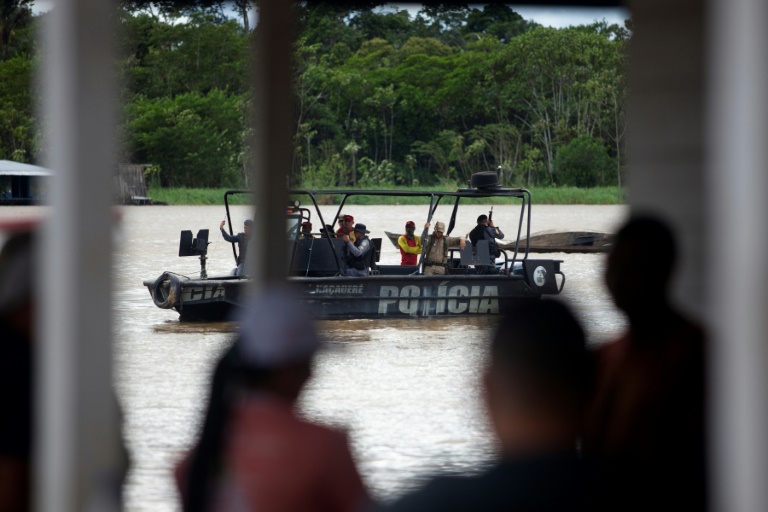
The search for a British journalist and a Brazilian Indigenous expert who vanished deep in the Amazon enters its 11th day Wednesday amid fading hopes of finding them alive and persistent international pressure to resolve the case.

This is what we know so far:

– Two missing men –

Veteran freelance journalist Dom Phillips, 57, has worked in Brazil for the past 15 years, reporting for media including The New York Times, Washington Post, Financial Times and The Guardian, where he is a regular contributor.

Phillips is an impassioned defender of the Amazon. He went missing in a remote region called the Javari Valley while doing research for a book on sustainable ways to protect the world’s largest rainforest.

Bruno Pereira, 41, is an expert who was on leave from his job with the Brazilian government’s Indigenous affairs agency, or FUNAI, and a well-known advocate for these communities. He was accompanying the Briton as a guide on Phillips’ second trip to the region since 2018.

Pereira was the regional coordinator of FUNAI in Atalaia do Norte, the town where Phillips was headed when the two of them vanished. 

The Javari Valley is rife with illegal fishing, logging, mining and drug trafficking. Pereira’s work defending Indigenous people drew frequent threats against him from criminal gangs operating in the area.

Both of the missing men are married and Pereira has three children.

– What happened? –

Phillips and Pereira were last seen on the morning of Sunday, June 5, in the village of Sao Gabriel, not far from Atalaia do Norte, where they were headed by way of the Itaquai River.

They were traveling in a new motorized boat with enough fuel to get where they were going. Their journey had started days earlier at Lake Jaburu, where they had interviewed local people.  

– A ‘complex’ region –

The Javari Valley, where the men disappeared, is a remote jungle region home to 26 different Indigenous peoples, many of which live in isolation.

Authorities warned that the region is “complex” because of the presence of rogue miners, loggers and fishermen who invade protected Indigenous lands to exploit their resources.

What is more, drug trafficking in the region has grown in recent years. The area is used as a conduit to transport drugs produced in Peru and Colombia, which border Brazil.

– Two detainees, some evidence – 

The search is being led by Indigenous people and Brazilian security forces. 

On Sunday the security forces said they found personal items belonging to the pair, including Pereira’s health card, pants and boots, as well as Phillips’s backpack and clothing.

Officials said these items were found in the water near the home of Amarildo da Costa Oliveira, the first person to be detained in the case.

Witnesses saw this 41-year-old fisherman in a motor boat following that of Phillips and Pereira at high speed before they disappeared.

Police found blood on a tarp in Oliveira’s boat. He denies any involvement.

Authorities are analyzing the blood and what are believed to be human remains found in the area, and results are expected this week.

On Tuesday, police arrested a second man identified as Oseney da Costa Oliveira, also 41, who according to Brazilian media site G1 is the brother of the first suspect.

Police also said they had seized cartridges for a firearm as well as an oar, without specifying if they were found in the same location where the second suspect was detained.

President Jair Bolsonaro said Monday, “the evidence leads us to believe something bad was done to them, because human innards were found floating in the river, which are now undergoing DNA testing.”

It is not clear if he was referring to the same remains that the police said they had found.

– Criticism and confusion –

The search for the men and their boat continues.

Confusion arose Monday when relatives of the journalist said a Brazilian diplomat in London told them two bodies had been found and the remains were being analyzed to see if they belonged to Phillips or Pereira.

But Federal Police, who are the official spokespeople in this drama, denied that bodies had been found. Indigenous people taking part in the search also issued a denial.

The federal government has been criticized by environmental activists, international agencies and Brazilian justice officials for alleged slowness and lack of coordination in the search.

Bolsonaro at first said Phillips and Pereira had embarked on an “unadvisable adventure” by traveling in a dangerous area without protection. This drew a rebuke from civil society organizations which defended their work to preserve the Amazon.

South Korean truckers end week-long strike

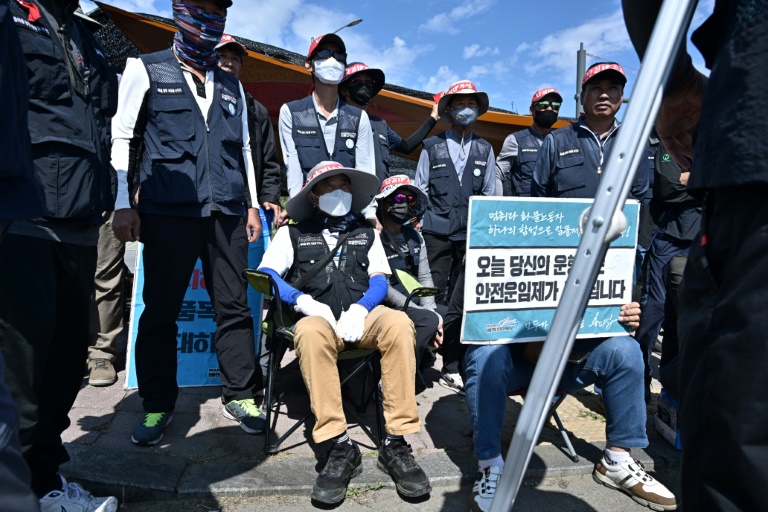
South Korean truck drivers will return to work Wednesday after reaching an agreement with Seoul to end an eight-day protest over wages and fuel costs that had snarled global supply chains.

The truckers’ industrial action had disrupted production and shipments for the crucial steel, petrochemical and automobile sectors, in an early test for new President Yoon Suk-yeol who has vowed to deal with labour disputes “strictly”.

The Cargo Truckers Solidarity Union reached an agreement with the transport ministry late Tuesday and truckers will return to work from Wednesday, the ministry said in a statement.

The ministry said is “relieved” that the union decided to end their strike, adding “we are very sorry for causing concern for the people due to discruptions in logistics and production”.

The truckers called the strike to protest over sharp rises in fuel prices — with inflation at its highest level in more than a decade — and the ending of a minimum wage guarantee.

The Safe Trucking Freight Rates System was due to expire later this year but the two sides reportedly agreed to keep it in place.

The policy was designed to help prevent dangerous driving by truckers and guarantee minimum freight rates.

“All we are asking for is to remove the uncertainty in our lives,” union member Cho Jeong-jae told AFP Tuesday at a protest in Incheon, a city bordering Seoul.

“Our livelihood is at stake.”

Cho said the rising cost of fuel had not been reflected in the fees businesses pay to transport their goods.

“When fuel prices drop, it’s reflected very quickly by lowering freight fees,” Cho said. “But that’s not the case when fuel prices rise.”

The strike in Asia’s fourth-largest economy was the latest blow to international supply chains that are already strained by Covid-19 lockdowns in China, and Russia’s invasion of Ukraine.

South Korea is the world’s largest memory chip exporter and home to global chip powerhouse Samsung Electronics, as well as large car companies including Kia and Hyundai Motors.

The country’s trade ministry said Tuesday that the action had resulted in losses for businesses of about 1.6 trillion won ($1.2 billion).

Prime Minister Han Duck-soo had called for an end to the strike at a cabinet meeting on Tuesday, saying “it’s causing a major setback to the logistics network.”

On the campaign trail, President Yoon — a political novice — had vowed to be strict on labour disputes and indicated he was more pro-business on issues such as minimum working hours.

At least 23 members of the Cargo Truckers Solidarity Union have been arrested for “illegal activities” at the protests, according to the transport ministry.

Close Bitnami banner
Bitnami