World

Mexico reports 37 US-bound migrants have died this year

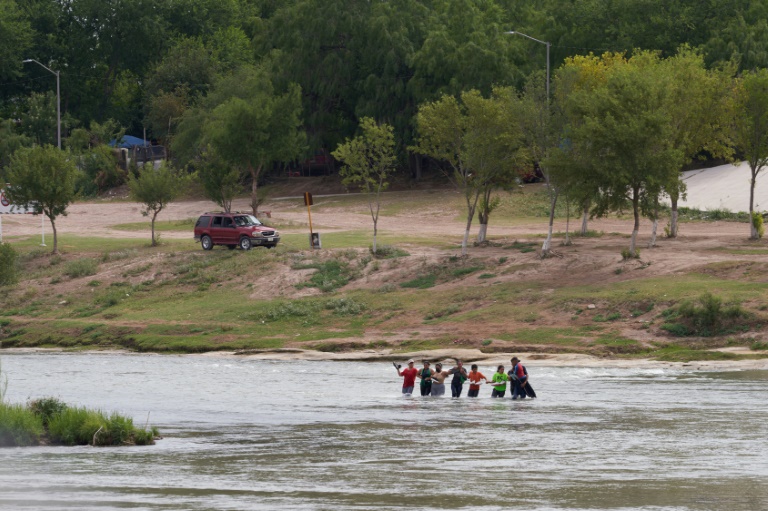
At least 37 undocumented migrants traveling through Mexico have died so far this year, most of whom drowned attempting to cross the Rio Grande into the United States, Mexico’s government reported Sunday.

In addition to four migrants who died due to various causes in the states of Veracruz and Baja, “33 drowned due to the force of the current, the depth and the low temperatures of the Rio Bravo (Grande)” delineating the Mexico-US border, said the National Institute of Migration (INM) in a press statement.

It added that 22 of the migrants “were not carrying identification,” while the others were from Mexico, Nicaragua, Honduras, Guatemala, Cuba, Peru and Venezuela.

When contacted by AFP, the INM said it had repatriated the bodies of the 11 identified immigrants, but would not say where the remains of the other 22 are located, or provide details about their ages and gender.

The report on migrant deaths from January to May comes a few days after the closing of the Ninth Summit of the Americas, hosted by the United States in Los Angeles, where immigration was a key topic.

On the gathering’s final day, US President Joe Biden led a pledge by 20 nations to support the “safety and dignity of all migrants” as well as greater cooperation by law enforcement.

It also comes as a new caravan of thousands of migrants fleeing poverty, violence and political oppression makes its way from southern Mexico towards the US border.

Each year, hundreds of thousands of migrants seeking to enter the United States travel from South and Central America up through Mexico, but in recent years the country has stepped up its border controls and in 2021 detained more than 300,000 undocumented migrants.

NASA loses two hurricane monitoring satellites on launch

Two small NASA satellites that were meant to study hurricane development failed to enter orbit Sunday when their Astra rocket shut off before reaching the necessary altitude, the US space agency said.

“After a nominal first stage flight, the upper stage of the rocket shut down early and failed to deliver the TROPICS CubeSats to orbit,” NASA’s Launch Services Program said on Twitter.

In a post to its website before the launch, NASA described the TROPICS CubeSats as a constellation of six “shoe-box sized” satellites that will “study the formation and development of tropical cyclones, making observations more often than what is possible with current weather satellites.”

Astra received a $7.95 million contract from NASA in February 2021 for three launches, each with a pair of TROPICS devices on board.

Hoping to become a key player in the market for launching small satellites, Astra promises more frequent launches with more flexibility than companies using bigger rockets, such as SpaceX and Arianespace.

But the start-up has faced recurring issues with its signature two-stage rocket failing to reach orbit.

In February, during another NASA CubeSat mission, Astra’s second stage failed to reach orbit due to an issue releasing the shells that cover the satellites during launch.

“We regret not being able to deliver the first two TROPICS satellites,” Astra’s chief executive Chris Kemp said Sunday in a tweet.

“Nothing is more important to our team than the trust of our customers and the successful delivery of the remaining TROPICS satellites.”

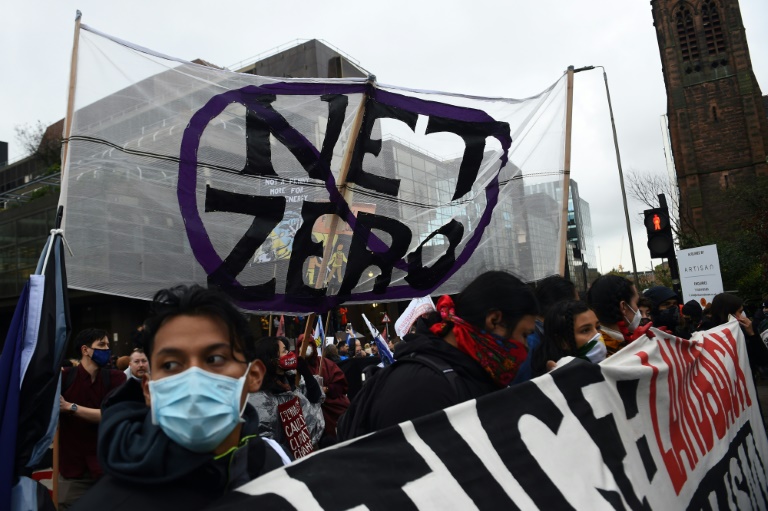
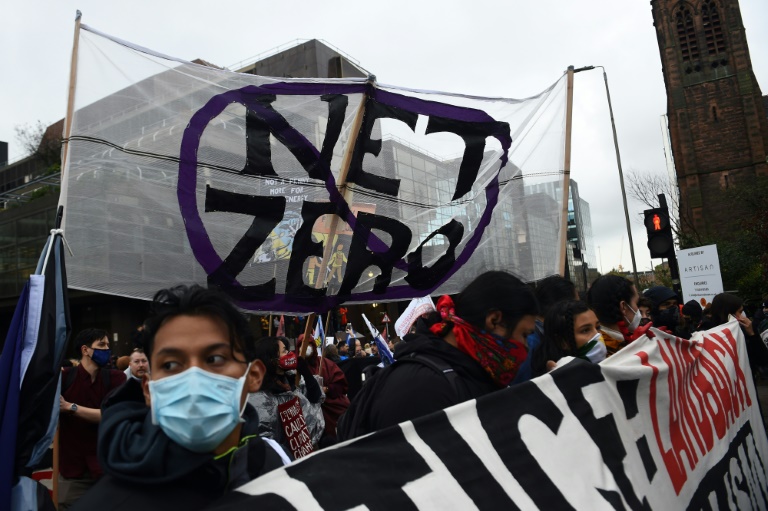
Flood of net zero vows suffer 'credibility gap': report

While countries, cities and companies have massively ramped up net-zero emissions promises in recent months there remain “major flaws” in many plans, according to an analysis published Monday that raises fears of potential large-scale greenwashing by businesses.

Faced with mounting urgency and public pressure as deadly and costly climate impacts increase, governments and corporations issued a proliferation of net zero pledges in the run up to the United Nation’s key climate summit in Glasgow last year. 

Most rich countries have announced they will be net zero by 2050, while China and India have vowed to reach that point by 2060 and 2070, respectively.

“The use of that concept has simply been booming,” said Frederic Hans, climate policy analyst at NewClimate Institute and the report’s co-lead author.

But the devil is in the details. 

“If you set a net zero target and you do not communicate in any way what emission reductions are implied by the targets, then nobody knows, you cannot be held accountable,” said Hans. 

The report draws on a database of over 4,000 governments, cities, states and major companies and comes as climate negotiators are meeting in Germany to prepare for major UN talks later this year. 

It does not drill into exactly how each net-zero plan will negate the amount of greenhouse gases it emits, instead focusing on monitoring how robust the targets are and whether they are followed up with a specific pathway to action.  

It found that more than 90 percent of the world’s economy is now covered by promises by governments to reach net zero — a near six-fold increase in three years. 

One third of the world’s largest publicly-traded companies also now have net zero goals — 702 firms, up from 417 in December 2020 — they said, while the number of major cities with these emissions reduction targets has doubled to 235.

“We are now at a watershed moment where peer pressure to hastily set net zero pledges, especially in the business sector, could result in either a mass flow of greenwashing — or a fundamental shift towards decarbonisation,” said co-author Takeshi Kuramochi, senior climate policy researcher at NewClimate Institute. 

– ‘Greenwashing’? –

The Net Zero Tracker analysis looked at a range of factors, like if detailed plans are published — or, for governments, enshrined in law — and included key interim targets that would ensure early carbon-cutting action.

The report found that 65 percent of national net zero targets had been set in domestic law or included in policy documents by May 2022, up from just 10 percent in December 2020. 

But even among the 702 firms that had net zero promises, the report found that only around half had some kind of interim target, which it deemed “unacceptably low”. 

Only 38 percent of these companies include all emissions associated with their products and activities — from supply chains to consumer use and disposal — in their net zero plans. 

The report found that big corporate emitters, particularly the fossil fuel industry, were among those most likely to have net zero goals.   

“This likely reflects the societal pressure on these industries to align with long-term emissions goals, and perhaps represents symbolic behaviour –or even flat-out greenwashing — rather than corporate climate leadership,” it said.  

UN experts have said carbon pollution must peak before 2025 and be cut in half by 2030 from 2010 levels to have a chance of reaching the Paris climate deal’s more ambitious goal of capping global warming at 1.5 degrees Celsius above pre-industrial levels.

Greenhouse gas emissions last year regained the record levels of 2019 after Covid lockdowns lowered them in 2020.

Hans said it was possible that the flood of net zero promises could generate a virtuous cycle.

“It requires companies to step up, regulators to step up, civil society to be ready and researchers so that this really improves over time,” he said.

Flood of net zero vows suffer 'credibility gap': report

While countries, cities and companies have massively ramped up net-zero emissions promises in recent months there remain “major flaws” in many plans, according to an analysis published Monday that raises fears of potential large-scale greenwashing by businesses.

Faced with mounting urgency and public pressure as deadly and costly climate impacts increase, governments and corporations issued a proliferation of net zero pledges in the run up to the United Nation’s key climate summit in Glasgow last year. 

Most rich countries have announced they will be net zero by 2050, while China and India have vowed to reach that point by 2060 and 2070, respectively.

“The use of that concept has simply been booming,” said Frederic Hans, climate policy analyst at NewClimate Institute and the report’s co-lead author.

But the devil is in the details. 

“If you set a net zero target and you do not communicate in any way what emission reductions are implied by the targets, then nobody knows, you cannot be held accountable,” said Hans. 

The report draws on a database of over 4,000 governments, cities, states and major companies and comes as climate negotiators are meeting in Germany to prepare for major UN talks later this year. 

It does not drill into exactly how each net-zero plan will negate the amount of greenhouse gases it emits, instead focusing on monitoring how robust the targets are and whether they are followed up with a specific pathway to action.  

It found that more than 90 percent of the world’s economy is now covered by promises by governments to reach net zero — a near six-fold increase in three years. 

One third of the world’s largest publicly-traded companies also now have net zero goals — 702 firms, up from 417 in December 2020 — they said, while the number of major cities with these emissions reduction targets has doubled to 235.

“We are now at a watershed moment where peer pressure to hastily set net zero pledges, especially in the business sector, could result in either a mass flow of greenwashing — or a fundamental shift towards decarbonisation,” said co-author Takeshi Kuramochi, senior climate policy researcher at NewClimate Institute. 

– ‘Greenwashing’? –

The Net Zero Tracker analysis looked at a range of factors, like if detailed plans are published — or, for governments, enshrined in law — and included key interim targets that would ensure early carbon-cutting action.

The report found that 65 percent of national net zero targets had been set in domestic law or included in policy documents by May 2022, up from just 10 percent in December 2020. 

But even among the 702 firms that had net zero promises, the report found that only around half had some kind of interim target, which it deemed “unacceptably low”. 

Only 38 percent of these companies include all emissions associated with their products and activities — from supply chains to consumer use and disposal — in their net zero plans. 

The report found that big corporate emitters, particularly the fossil fuel industry, were among those most likely to have net zero goals.   

“This likely reflects the societal pressure on these industries to align with long-term emissions goals, and perhaps represents symbolic behaviour –or even flat-out greenwashing — rather than corporate climate leadership,” it said.  

UN experts have said carbon pollution must peak before 2025 and be cut in half by 2030 from 2010 levels to have a chance of reaching the Paris climate deal’s more ambitious goal of capping global warming at 1.5 degrees Celsius above pre-industrial levels.

Greenhouse gas emissions last year regained the record levels of 2019 after Covid lockdowns lowered them in 2020.

Hans said it was possible that the flood of net zero promises could generate a virtuous cycle.

“It requires companies to step up, regulators to step up, civil society to be ready and researchers so that this really improves over time,” he said.

World headed for new era of nuclear rearmament: SIPRI

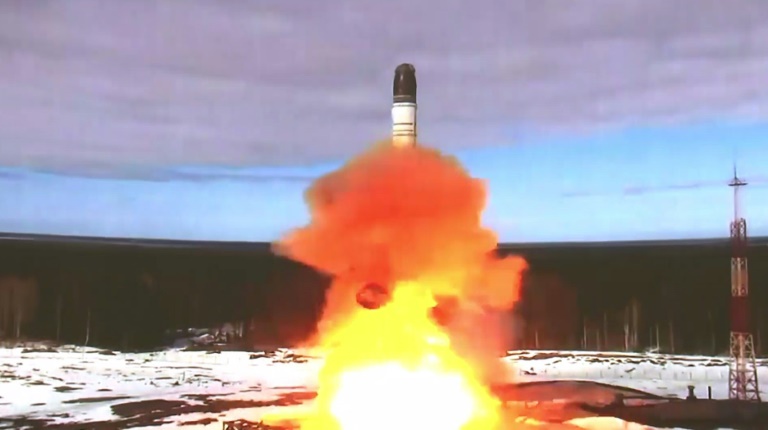
The number of nuclear weapons in the world is set to rise in the coming decade after 35 years of decline as global tensions flare amid Russia’s war in Ukraine, researchers said Monday. 

The nine nuclear powers — Britain, China, France, India, Israel, North Korea, Pakistan, the United States and Russia — had 12,705 nuclear warheads in early 2022, or 375 fewer than in early 2021, according to estimates by the Stockholm International Peace Research Institute (SIPRI).  

The number has come down from a high of more than 70,000 in 1986, as the US and Russia have gradually reduced their massive arsenals built up during the Cold War.

But this era of disarmament appears to be coming to an end and the risk of a nuclear escalation is now at its highest point in the post-Cold War period, SIPRI researchers said.

“Soon, we’re going to get to the point where, for the first time since the end of the Cold War, the global number of nuclear weapons in the world could start increasing for the first time”, Matt Korda, one of the co-authors of the report, told AFP.

“That is really kind of dangerous territory.”

After a “marginal” decrease seen last year, “nuclear arsenals are expected to grow over the coming decade”, SIPRI said.

During the war in Ukraine, Russian President Vladimir Putin has on several occasions made reference to the use of nuclear weapons.

Meanwhile several countries, including China and Britain, are either officially or unofficially modernising or ramping up their arsenals, the research institute said.

“It’s going to be very difficult to make progress on disarmament over the coming years because of this war, and because of how Putin is talking about his nuclear weapons”, Korda said.

These worrying statements are pushing “a lot of other nuclear armed states to think about their own nuclear strategies”, he added.

– ‘Nuclear war can’t be won’ –

Despite the entry into force in early 2021 of the UN nuclear weapon ban treaty and a five-year extension of the US-Russian “New START” treaty, the situation has been deteriorating for some time, according to SIPRI.

Iran’s nuclear programme and the development of increasingly advanced hypersonic missiles have, among other things, raised concern.

The drop in the overall number of weapons is due to the US and Russia “dismantling retired warheads”, SIPRI noted, while the number of operational weapons remains “relatively stable”.

Moscow and Washington alone account for 90 percent of the world’s nuclear arsenal.

Russia remains the biggest nuclear power, with 5,977 warheads in early 2022, down by 280 from a year ago, either deployed, in stock or waiting to be dismantled, according to the institute.

More than 1,600 of its warheads are believed to be immediately operational, SIPRI said.

The United States meanwhile has 5,428 warheads, 120 fewer than last year, but it has more deployed than Russia, at 1,750.

In terms of overall numbers, China comes third with 350, followed by France with 290, Britain with 225, Pakistan with 165, India with 160 and Israel with 90.

Israel is the only one of the nine that does not officially acknowledge having nuclear weapons.

As for North Korea, SIPRI said for the first time that Kim Jong-Un’s Communist regime now has 20 nuclear warheads.

Pyongyang is believed to have enough material to produce around 50.

In early 2022, the five nuclear-armed permanent members of the United Nations Security Council — Britain, China, France, Russia and the US — issued a statement that “nuclear war cannot be won and must never be fought”.

Nonetheless, SIPRI noted, all five “continue to expand or modernise their nuclear arsenals and appear to be increasing the salience of nuclear weapons in their military strategies.”

“China is in the middle of a substantial expansion of its nuclear weapon arsenal, which satellite images indicate includes the construction of over 300 new missile silos”, it said. 

According to the Pentagon, Beijing could have 700 warheads by 2027.

Britain last year said it would increase the ceiling on its total warhead stockpile, and would no longer publicly disclose figures for the country’s operational nuclear weapons.

Iraqi MPs from firebrand cleric Moqtada Sadr's bloc resign: official

Iraqi lawmakers from firebrand Shiite cleric Moqtada Sadr’s bloc resigned Sunday, the parliamentary speaker said, in a move designed to up pressure to end an eight-month political paralysis.

“We have reluctantly accepted the requests of our brothers and sisters, representatives of the Sadr bloc, to resign,” parliament’s speaker Mohammed al-Halbussi said on Twitter after receiving resignation letters from the 73 lawmakers.

Sadr on Thursday had urged the MPs from his bloc — the biggest in parliament — to ready resignation papers, in a bid, he said, to break the parliamentary logjam and create space for the establishment of a new government.

Parliament in Baghdad has been in turmoil since October’s general election, and intense negotiations among political factions have failed to forge a majority in support of a new prime minister to succeed Mustafa al-Kadhemi.

Iraqi lawmakers have already exceeded all deadlines for setting up a new government set down in the constitution, prolonging the war-scarred country’s political crisis.

Parliamentary services were not available on Sunday evening for comment on the constitutional implications of the Sadr bloc’s move.

But Iraqi political scientist Hamzeh Haddad said that “parliament still needs to ratify” the resignations “with an absolute majority” for them to take effect.

Parliamentary holidays began on Thursday and MPs are not scheduled to return until August.

The two Shiite groupings — the coalition led by Sadr, and its powerful rival, the Coordination Framework — have each claimed to hold a parliamentary majority, and with it the right to appoint the prime minister.

While Sadr counts on the direct loyalty of 73 lawmakers, his wider bloc also includes Sunni lawmakers from the party of parliamentary speaker Halbussi and the Kurdistan Democratic Party (KDP).

But the grand total of Sadr’s bloc of 155 still falls short of the absolute majority needed in the 329-member parliament.

Sadr’s move puts the onus for forming a government on the 83 lawmakers of the rival Coordination Framework, which draws lawmakers from former premier Nuri al-Maliki’s party and the pro-Iran Fatah Alliance, the political arm of the Shiite-led former paramilitary group Hashed al-Shaabi.

If the parliamentary impasse cannot be broken, new elections could follow — but that would itself require lawmakers to agree on dissolving parliament.

Lawmakers have already failed three times to elect a new national president, the first key stage before naming a prime minister and the subsequent establishment of a government.

“If the survival of the Sadrist bloc is an obstacle to the formation of the government, then all representatives of the bloc are ready to resign from parliament,” Sadr had said Thursday in a televised statement.

Cautious optimism at high-stakes WTO meet

The World Trade Organization chief voiced cautious optimism Sunday as global trade ministers gathered to tackle food security threatened by Russia’s invasion of Ukraine, overfishing and equitable access to Covid vaccines.

Opening the WTO’s first ministerial meeting in nearly five years, Ngozi Okonjo-Iweala said to “expect a rocky, bumpy road with a few landmines along the way”.

But she told journalists she was “cautiously optimistic” that the more than 100 attending ministers would manage to agree on at least one or two of a long line of pressing issues, and that would be “a success”.

The WTO faces pressure to eke out long-sought trade deals on a range of issues and show unity amid the still raging pandemic and an impending global hunger crisis.

But since the global trade body only makes decisions by consensus, it can be more than tricky to reach agreements.

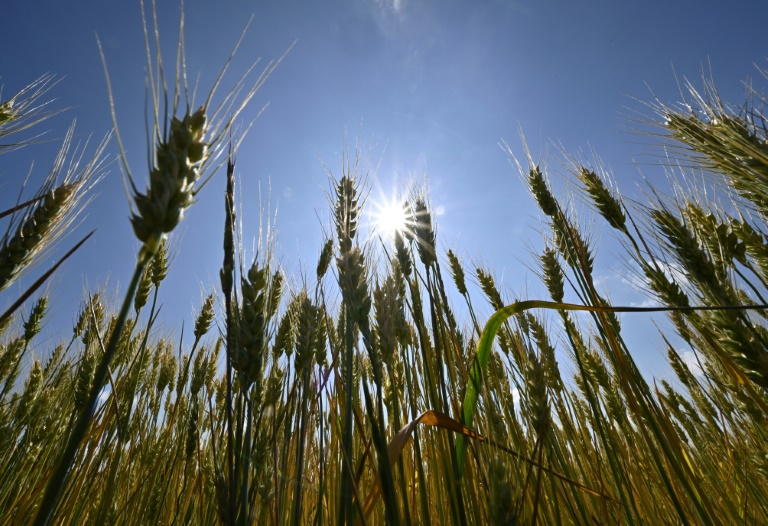
Top of the agenda at the four-day meeting is the toll Russia’s war in Ukraine, traditionally a breadbasket that feeds hundreds of millions of people, is having on food security. 

– ‘Do the right thing’ –

The ministers are expected to agree on a joint declaration in which they “commit to take concrete steps to facilitate trade and improve the functioning and longterm resilience of global markets for food and agriculture”.

According to the draft text, countries would vow that “particular consideration will be given to the specific needs and circumstances of developing country Members”.

“I hope you will collectively do the right thing,” Ngozi told the delegates. 

EU agriculture commissioner Janusz Wojciechowski told reporters that the bloc would have wanted the declaration to include the question of “Russia’s responsibility for the crisis”, but had sought a text that would actually be adopted by all WTO members, including Russia. 

The bloc did however gather representatives from 57 countries, including Kyiv’s trade envoy Taras Kachka, for a show solidarity with Ukraine right before the main conference kicked off, with EU trade commissioner Valdis Dombrovskis slamming Russia’s “illegal and barbaric aggression”

Russia’s deputy economic development minister Vladimir Ilichev meanwhile urged an “objective and balanced assessment” of the food security situation and the “underlying causes”, stressing in a video address Moscow’s readiness to “participate actively and responsibly” in efforts to address the crisis.”

– Fisheries deal in sight? –

The WTO hopes to keep criticism of Russia’s war in Ukraine to the the first day of talks, allowing ministers to focus in the following days on nailing down trade deals, after nearly a decade with no major agreements. 

There is some optimism that countries could finally agree on banning subsidies that contribute to illegal and unregulated fishing, after more than two decades of negotiations.

“Twenty-one years is enough,” Okonjo-Iweala said. “Will our children forgive us… if we allow our oceans to be depleted?” 

The WTO says talks have never been this close to the finish line, but diplomats remain cautious.

One of the main sticking points has been so-called special and differential treatment (SDT) for developing countries, including major fishing nation India, which can request exemptions.

– India blocking  –

The duration of exemptions remains undefined, with environmental groups warning anything beyond 10 years would be catastrophic.

India has demanded a 25-year exemption, and is so far refusing to budge.

Indian Commerce and Industry Minister Piyush Goyal insisted in a video address that most fishing in India is vital for survival, and that fishermen use “sustainable methods”.

“Their right to life and livelihood cannot be curtailed in any manner.”

Angered by lacking follow-through on promises made at a WTO ministerial meeting nearly a decade ago for food policy measures, India is proving intransigent on other issues as well, jeopardising the chances of locking down deals.

“There is not a single issue that India is not blocking,” a Geneva-based ambassador said, singling out WTO reform and agriculture.

– Patent waiver? –

India has also struck a harsh tone on another key issue on the table: WTO response to the Covid crisis.

“The rich countries need to introspect. We need to bow our heads in shame for our inability to respond to the pandemic in time,” he said.

India and South Africa began in October 2020 pushing for the WTO to temporarily lift intellectual property rights on Covid-19 medical tools like vaccines to help ensure more equitable access in poorer nations.

After multiple rounds of talks, the EU, the United States, India and South Africa hammered out a compromise.

The text, which would allow most developing countries, although not China, to produce Covid vaccines without authorisation from patent holders, still faces opposition from both sides.

The pharmaceutical industry insists the waiver would undermine investment in innovation, while public interest groups charge the text falls far short of what is needed, by limiting and complicating the vaccine waiver and not covering Covid treatments and diagnostics.

“The negotiations are still aeons away from ensuring access to lifesaving Covid medical tools for everyone, everywhere,” medical charity Doctors Without Borders warned.

Cautious optimism at high-stakes WTO meet

The World Trade Organization chief voiced cautious optimism Sunday as global trade ministers gathered to tackle food security threatened by Russia’s invasion of Ukraine, overfishing and equitable access to Covid vaccines.

Opening the WTO’s first ministerial meeting in nearly five years, Ngozi Okonjo-Iweala said to “expect a rocky, bumpy road with a few landmines along the way”.

But she told journalists she was “cautiously optimistic” that the more than 100 attending ministers would manage to agree on at least one or two of a long line of pressing issues, and that would be “a success”.

The WTO faces pressure to eke out long-sought trade deals on a range of issues and show unity amid the still raging pandemic and an impending global hunger crisis.

But since the global trade body only makes decisions by consensus, it can be more than tricky to reach agreements.

Top of the agenda at the four-day meeting is the toll Russia’s war in Ukraine, traditionally a breadbasket that feeds hundreds of millions of people, is having on food security. 

– ‘Do the right thing’ –

The ministers are expected to agree on a joint declaration in which they “commit to take concrete steps to facilitate trade and improve the functioning and longterm resilience of global markets for food and agriculture”.

According to the draft text, countries would vow that “particular consideration will be given to the specific needs and circumstances of developing country Members”.

“I hope you will collectively do the right thing,” Ngozi told the delegates. 

EU agriculture commissioner Janusz Wojciechowski told reporters that the bloc would have wanted the declaration to include the question of “Russia’s responsibility for the crisis”, but had sought a text that would actually be adopted by all WTO members, including Russia. 

The bloc did however gather representatives from 57 countries, including Kyiv’s trade envoy Taras Kachka, for a show solidarity with Ukraine right before the main conference kicked off, with EU trade commissioner Valdis Dombrovskis slamming Russia’s “illegal and barbaric aggression”

Russia’s deputy economic development minister Vladimir Ilichev meanwhile urged an “objective and balanced assessment” of the food security situation and the “underlying causes”, stressing in a video address Moscow’s readiness to “participate actively and responsibly” in efforts to address the crisis.”

– Fisheries deal in sight? –

The WTO hopes to keep criticism of Russia’s war in Ukraine to the the first day of talks, allowing ministers to focus in the following days on nailing down trade deals, after nearly a decade with no major agreements. 

There is some optimism that countries could finally agree on banning subsidies that contribute to illegal and unregulated fishing, after more than two decades of negotiations.

“Twenty-one years is enough,” Okonjo-Iweala said. “Will our children forgive us… if we allow our oceans to be depleted?” 

The WTO says talks have never been this close to the finish line, but diplomats remain cautious.

One of the main sticking points has been so-called special and differential treatment (SDT) for developing countries, including major fishing nation India, which can request exemptions.

– India blocking  –

The duration of exemptions remains undefined, with environmental groups warning anything beyond 10 years would be catastrophic.

India has demanded a 25-year exemption, and is so far refusing to budge.

Indian Commerce and Industry Minister Piyush Goyal insisted in a video address that most fishing in India is vital for survival, and that fishermen use “sustainable methods”.

“Their right to life and livelihood cannot be curtailed in any manner.”

Angered by lacking follow-through on promises made at a WTO ministerial meeting nearly a decade ago for food policy measures, India is proving intransigent on other issues as well, jeopardising the chances of locking down deals.

“There is not a single issue that India is not blocking,” a Geneva-based ambassador said, singling out WTO reform and agriculture.

– Patent waiver? –

India has also struck a harsh tone on another key issue on the table: WTO response to the Covid crisis.

“The rich countries need to introspect. We need to bow our heads in shame for our inability to respond to the pandemic in time,” he said.

India and South Africa began in October 2020 pushing for the WTO to temporarily lift intellectual property rights on Covid-19 medical tools like vaccines to help ensure more equitable access in poorer nations.

After multiple rounds of talks, the EU, the United States, India and South Africa hammered out a compromise.

The text, which would allow most developing countries, although not China, to produce Covid vaccines without authorisation from patent holders, still faces opposition from both sides.

The pharmaceutical industry insists the waiver would undermine investment in innovation, while public interest groups charge the text falls far short of what is needed, by limiting and complicating the vaccine waiver and not covering Covid treatments and diagnostics.

“The negotiations are still aeons away from ensuring access to lifesaving Covid medical tools for everyone, everywhere,” medical charity Doctors Without Borders warned.

Life goes on as Ukraine army holds war weddings

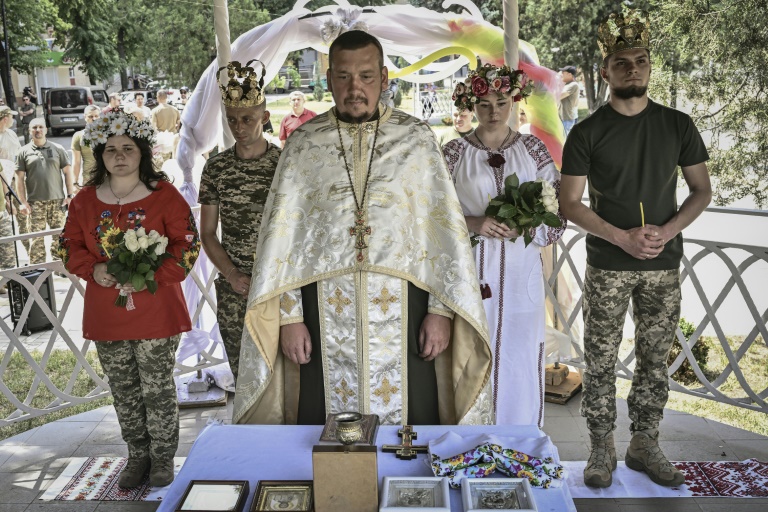
Air raid sirens wailed and one of the brides wore camouflage trousers as the Ukrainian army took a break from frontline fighting in the east to hold a double wedding Sunday.

Two young couples who met just months earlier while serving in the army tied the knot together Sunday in the small town of Druzhkivka, 40 kilometres (25 miles) from frontline zones where Ukrainian forces are battling Russian invaders.

The sun shone and soldiers carried bouquets in a brief interlude from heavy fighting as Russians intensify efforts to push out Kiev’s forces in the east.

One of the brides, Khrystyna Lyuta, a 23-year-old contract soldier with the rank of private first class, wore camouflage trousers and army boots with a traditional red Ukrainian blouse embroidered with flowers.

“I’ve got used to this uniform,” she explained of her choice of outfit.

She met her husband Volodymyr Mykhalchuk, 28, just two months ago, when he was mobilised. They live around five kilometres from each other in the same southwestern Vinnytska region but might never have met if it had not been for the war.

“War is war, but life goes on,” Lyuta explained their decision to marry.

“This was not a hasty decision,” said Volodymyr.

“The main thing is that we love each other and we want to be together.”

The other bride, Kristina, 23, who works in the signals corps, opted for a traditional long white dress with red folk embroidery to marry Vitaliy Orlich, also 23, a sniper.

“I believe that this is about creating a new family — it doesn’t matter where it happens or how,” she said.

The grooms both wore soldiers’ uniforms.

The couples were set to return to serve in the war zone on the same day.

“I can’t give them free days as such. The only thing is that they won’t be on the frontline, they will stay in the rear,” the brigade’s commander Oleksandr Okhrimenko told AFP. 

Neither couple had family present but they said relatives had been understanding.

Kristina said that her husband had spoken to her mother online and “she already calls him a son”.

The soldiers were from the 14th Separate Mechanised Brigade, which has been fighting Russian-backed forces in Donbas since May.

The young couples married in front of a registry office, which had closed due to the war. 

The quiet street had few cars and occasional trams. Sandbags were piled up in front of cafe and shop windows.

– ‘There’s no time’ –

The couples went through traditional rituals such as stepping together onto an embroidered towel, symbolising togetherness.

The brigade’s chaplain gave them an Orthodox Christian blessing, flicking holy water and placing crowns on their heads, on the day of a major Church holiday, the Festival of the Holy Trinity.

The Priest in a khaki cassock, Yuriy Zdebskiy, told AFP that “it’s the first marriage in the brigade in wartime”, since Russia launched its invasion on February 24.

“Now it’s wartime and there’s no time for big celebrations,” he said.

The infantry brigade’s commander, Okhrimenko, has the right to certify marriages under martial law.

He said the location for the weddings “was chosen primarily for security reasons”.

Druzhkivka is about 40 kilometres as the crow flies from three fronts, as Russian troop threaten  the towns of Sloviansk to the northeast, Bakhmut to the east and Gorlivka to the southeast.

Hours later, AFP reporters heard shelling and saw smoke rising as the two sides exchanged fire close to Bakhmut.

Even in relatively untouched Druzhkivka, shelling earlier this month tore apart private houses and crashed through the roof of a Baptist church in one street.

During the wedding, air raid sirens went off three times, an AFP reporter heard.

None of those attending reacted. Many war-hardened locals now ignore warnings to go to shelters unless there is an obvious threat.

US senators announce limited deal on gun violence measures

A bipartisan group of US senators on Sunday proposed steps to curb gun violence following devastating mass shootings in Texas and New York, but the limited measures fall far short of the president’s calls for change.

The shootings in May — one at a Texas elementary school that killed 19 young children and two teachers, and another at a New York supermarket that left 10 Black people dead — have piled pressure on politicians to take action.

But Republicans lawmakers, who have repeatedly blocked tougher measures, are still resisting major changes to gun regulations, instead pointing to mental health issues as the root of the problem.

The new proposals include tougher background checks for gun buyers under 21, increasing resources for states to keep weapons out of the hands of people deemed a risk, and adding domestic violence convictions and restraining orders to the national background check database.

“Today, we are announcing a commonsense, bipartisan proposal to protect America’s children, keep our schools safe, and reduce the threat of violence across our country,” the group of 20 lawmakers said in a statement.

“Our plan increases needed mental health resources, improves school safety and support for students, and helps ensure dangerous criminals and those who are adjudicated as mentally ill can’t purchase weapons.”

President Joe Biden praised the proposals and urged lawmakers to quickly turn them into legislation, while saying the measures do not go far enough.

“Obviously, it does not do everything that I think is needed, but it reflects important steps in the right direction, and would be the most significant gun safety legislation to pass Congress in decades,” he said in a statement.

“With bipartisan support, there are no excuses for delay, and no reason why it should not quickly move through the Senate and the House.”

Both Chuck Schumer and Mitch McConnell — the top Democrat and Republican in the US Senate — expressed support for the bipartisan effort, signaling that legislation based on the proposals could make it through the upper house.

– Frequent mass shootings –

Biden had pushed for more substantive reforms, including a ban on assault rifles — which were used in both the Texas and New York shootings — or at least an increase in the age at which they can be purchased.

He had also urged lawmakers to ban high-capacity magazines, mandate safe storage of firearms, and allow gun manufacturers to be held liable for crimes committed with their products.

The Democrat-controlled House of Representatives passed a broad package of proposals this month that included raising the purchasing age for most semi-automatic rifles from 18 to 21.

But the party does not have the requisite 60 votes to advance it in the Senate, leaving the bipartisan deal as the only hope for federal legislation to address firearms violence.

Frequent mass shootings have led to widespread outrage in the United States, where a majority of people support tighter gun laws, but opposition from many Republican lawmakers and voters has long been a hurdle to major changes.

A strong opponent of tougher measures is the National Rifle Association, which has been weakened by scandals and was hit by a lawsuit from New York State’s attorney general, but still wields considerable influence.

“The media, leftist politicians, and gun-hating activists are bullying NRA members and gun owners because they want us to give up. We won’t bend a knee,” the lobby tweeted on Saturday.

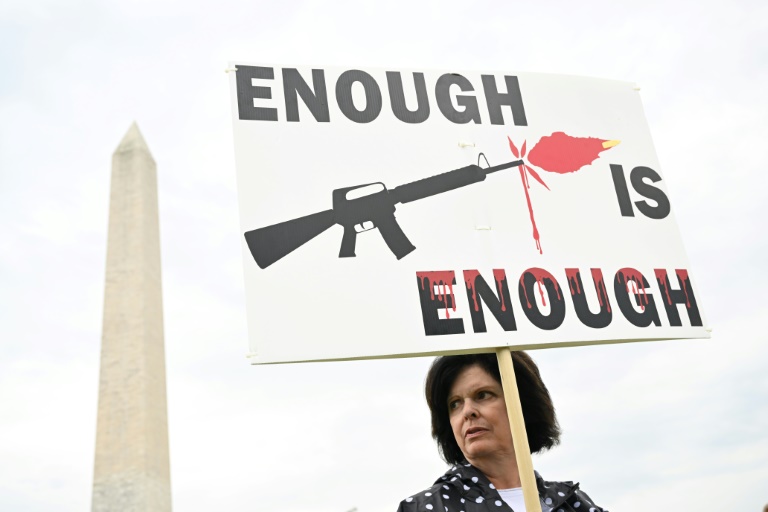
That day, thousands of people took to the streets across the United States to push for action on gun violence, which has killed more than 19,400 people in the country so far this year, more than half of them suicides, according to the Gun Violence Archive.

“The will of the American people is being subverted by a minority,” 63-year-old protester Cynthia Martins said during a demonstration in the US capital on Saturday. “Hand wringing is not going to do anything — you have to make your voice heard.”

Close Bitnami banner
Bitnami