World

US Capitol riot hearings to link Trump election plots to insurrection

The year-long congressional panel probing the 2021 assault on the US Capitol begins outlining its findings Thursday, promising explosive new revelations that will tie the deadly siege to Donald Trump’s attempts to overturn his election defeat.

The first hearing — an evening primetime presentation — will serve as an “opening statement” on the January 6 insurrection, according to aides of the investigating House select committee, which began its work last July.

It will also aim to demonstrate that the violence was part of a broader conspiracy by Trump and his inner circle to illegitimately hold on to power, tearing up the Constitution and more than two centuries of peaceful transitions from one administration to the next.

“We will be revealing new details showing that the violence of January 6 was the result of a coordinated multi-step effort to overturn the results of the 2020 election and stop the transfer of power from Donald Trump to Joe Biden,” a select committee aide said.

“And indeed that former president Donald Trump was at the center of that effort.”

A slickly-produced 90-plus minutes of television — and five subsequent hearings over the coming weeks — will focus on Trump’s role in the multi-pronged effort to return him to the Oval Office as an unelected president by disenfranchising millions of voters. 

The case the committee plans to make is that Trump laid the groundwork for the insurrection through months of lies about fraud in an election described by his own administration as the most secure in history.

His White House is accused of involvement in several potentially illegal schemes to aid the effort, including a plot to seize voting machines and another to appoint fake “alternative electors” from swing states who would ignore the will of their voters and hand victory to Trump. 

– ‘Chilling’ conspiracy –

The select committee’s Republican vice-chairwoman Liz Cheney said on Sunday that the assault on the Capitol was part of a “chilling” conspiracy.

“It is extremely broad. It’s extremely well organized,” she told CBS.

The committee is planning to present live testimony Thursday from two people who interacted with members of the neofascist organization the Proud Boys on January 6 and in the days leading to the violence.

Cheney and chairman Bennie Thompson will make opening arguments before explaining how each of the six hearings, organized by theme, is expected to play out.

They will feature previously unseen video clips of the violence itself and excerpts from a trove of 1,000 interviews, including a “meaningful portion” of discussions with Trump’s senior White House and campaign officials — as well as members of his family.

Trump’s daughter Ivanka and her husband Jared Kushner, as well as the former president’s eldest son Don Jr., have all cooperated voluntarily with the committee.

British documentary filmmaker Nick Quested will testify Thursday about his experience shadowing members of the Proud Boys in the days leading up to January 6 and his interactions with them on the day itself.

The Emmy Award-winning director’s evidence is seen as crucial, said a committee aide, because he was on the scene during the first moments of violence against the Capitol Police and “all the chaos that ensued.”

– ‘Ongoing threats’ –

Capitol Police Officer Caroline Edwards, who was present at the breach of the first barricade, will describe sustaining head injuries in clashes with the far-right group, which saw its leader and four lieutenants charged on Monday with seditious conspiracy.

The hearings will differ from Trump’s two impeachments, however, in that he will not be represented in the room as he is not on trial — except perhaps in the court of public opinion.

Nevertheless, a number of his most loyal counter-punchers are expected to circle the wagons on Capitol Hill, questioning any damning testimony and challenging the validity of the investigation in TV appearances. 

AFP asked Trump spokesman Taylor Budowich for details of the plan for Trump’s defense, but there was no response.

The committee has not confirmed its plans for after the initial slate of hearings, but at least one more presentation and a final report are expected in the fall.

The panel, which sees Trump as a potential threat to the next election, will make legislative recommendations to ensure there is no repeat of the events of January 6.

“The investigation has flagged ongoing threats to our democracy, and our job is to tell the story of what happened,” said an aide.

“And, frankly, to let others judge about continuing threats and what needs to be done.”
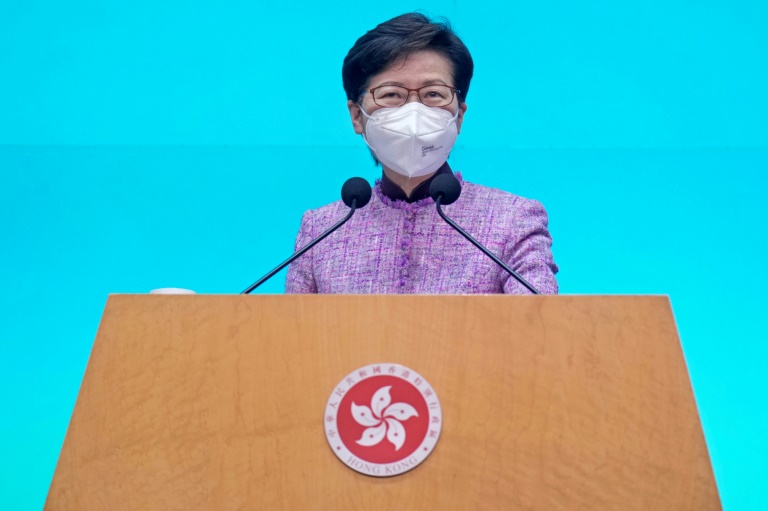
Hong Kong leader delivers defiant swansong speech

Hong Kong’s leader delivered a defiant final speech to the legislature Thursday, saying she was “not ashamed” of her record despite being set to end her tumultuous term with her approval ratings at an all-time low.  

Carrie Lam’s five-year tenure as chief executive coincided with massive and often violent pro-democracy protests, Beijing’s imposition of a draconian national security law and a coronavirus outbreak that left more than 9,000 dead.

She is on track to depart at the end of June with the lowest approval ratings of any Hong Kong leader since the city’s handover from British to Chinese rule in 1997.

At her last appearance in Hong Kong’s legislature, an emotional Lam told lawmakers: “I can boldly say I have delivered a report card I am not ashamed of, and have put a full stop to my 42 years in public service.”

Lam said her term had marked the “most difficult” period in Hong Kong’s post-handover history.

At the height of the pro-democracy protests in 2019, according to a leaked recording, Lam said in a closed-door meeting that she had caused “unforgivable” havoc and would quit if given a choice.

But on Thursday she said she had never considered resigning, citing the support of Beijing and her family, as well as a sense of “historic mission”.

Since the demonstrations, Beijing has remoulded Hong Kong in its authoritarian image, imposing a national security law used to effectively quash dissent, along with electoral reforms that have ousted pro-democracy figures from the legislature.

Lam said Hong Kong’s governance had improved after Beijing intervened to put “patriots” in power.

Prior to the rule change, she said, her government had been frustrated by the confrontational attitude and frequent filibusters in the city’s politics. 

Her speech was warmly applauded by the “patriots-only” legislature, formed in December after the electoral system was overhauled. 

– China border stays shut –

Lam’s time in office also saw her grappling with the challenge of the coronavirus pandemic. 

Despite keeping the virus largely under control initially, an Omicron-fuelled fifth wave that broke out at the beginning of this year left thousands dead. 

Hospital wards were flooded with patients and morgues overcrowded with bodies, prompting critics to fault the government for being unprepared despite two years of breathing room.

Lam’s administration has hewed to China’s strict zero-Covid strategy, which uses rapid lockdowns, mass testing and travel curbs to eliminate even the smallest outbreaks. 

It has prioritised opening the border with mainland China over reopening to international travel, leaving a city that was once a global logistics and transportation hub largely cut off from the rest of the world for most of the pandemic. 

On Thursday, Lam dismissed the possibility of reopening the border with the mainland in the near future, saying it was a complicated challenge.

“If we use what was discussed from last September to December as a basis, in the short term we do not see the possibility,” Lam said, referring to policy negotiations between Hong Kong and Beijing before Omicron hit.

“As it is clear now, most overseas countries use one set of anti-epidemic theories and measures, and our country has another set of theories and measures,” she added. 

“With us in the middle, we have to carefully assess what measures to take… which can look after both sides.”

Asian, European markets hit as inflation fears ramp up

Most Asian and European markets fell Thursday as a rally in oil ramped up inflation fears, with top officials warning of more pain to come as the Ukraine war continues to push prices up and put further pressure on the global economy.

Buyers on Wall Street were in retreat again after data showed US crude and gasoline stockpiles sank, just as the summer driving season begins and a leading OPEC member warned demand would surge further as China reopens.

Adding to the gloom was the OECD’s sharp downward revision of its global growth outlook and doubling of its inflation forecast.

The glum mood was only slightly offset by ongoing optimism that Beijing’s tech crackdown was close to an end.

Both main crude contracts edged down but held most gains after jumping more than two percent Wednesday to three-month highs after figures showed the biggest US storage depot had seen a big fall in reserves last week, suggesting elevated prices were not deterring people from driving.

Meanwhile, White House Press Secretary Karine Jean-Pierre said officials expect Friday’s keenly awaited consumer price index will be “elevated”.

The comment lifted expectations that the Federal Reserve will stick to its hawkish path and hike interest rates by half a point for at least three more meetings this year as it tries to bring down inflation from four-decade highs.

Analysts said investors were unlikely to get any reprieve until crude — a key driver of inflation since Russia’s invasion of Ukraine — was brought under control.

“A pullback in crude would be crucial for any prolonged risk rally, given implications for inflation expectations,” said SPI Asset Management’s Stephen Innes. 

“And for the central bank fraternity intent on frontloading rates, chapter two of the current playbook reads that aggressive tightening risks a material decline in housing, consumer confidence, and consumption that will eventually drive their respective economies into recession and send stocks tumbling.

“So until we reach peak inflation, which will trigger a less hawkish Fed and lower recession odds, it could be a gloomy summer for global stock pickers.”

He added that prices were expected to rise further for now as China emerges from months of lockdown, a sentiment that United Arab Emirates Energy Minister Suhail Al-Mazrouei agreed with.

“With the pace of consumption we have, we are nowhere near the peak because China is not back yet,” he told a conference Wednesday. “China will come with more consumption.”

And OANDA’s Jeffrey Halley said difficulties monitoring Iran’s nuclear compliance meant a nuclear deal with Iran — and the release of its crude onto world markets — was “as far away as ever”.

The unease about rising prices and rates saw all three main indexes fall on Wall Street, with focus on the European Central Bank’s policy meeting later Thursday and the release of US inflation data Friday.

The ECB is expected to begin winding down its massive bond-buying programme and signal a rate hike is in the pipeline.

Asian traders followed suit Thursday.

Hong Kong dropped, even as tech firms continued to benefit from hopes that China’s crackdown was almost over, while Shanghai, Sydney, Seoul, Singapore, Taipei, Manila and Wellington were also in the red.

Traders were nervous about news that officials in Shanghai will lock down a district of 2.7 million people Saturday to conduct mass coronavirus testing, highlighting the problems they have in running an economy while chasing their zero-Covid strategy.

There was little reaction to news that China’s exports surged last month.

Tokyo, however, was marginally in positive territory as the yen sat at two-decade lows owing to widening monetary policies of the United States and Japan, which shows no signs of lifting rates. Mumbai, Jakarta and Bangkok also edged up.

London, Paris and Frankfurt opened lower.

Investors were jarred by a report from the Organisation for Economic Co-operation and Development, which said it had cut its 2022 growth outlook to three percent — from 4.5 percent predicted in December — owing to the Ukraine war.

It also doubled its inflation estimate to 8.5 percent, a 34-year high. 

“The world is set to pay a hefty price for Russia’s war against Ukraine,” wrote the OECD’s chief economist and deputy secretary-general Laurence Boone.

And Anna Han, at Wells Fargo Securities, told Bloomberg Television: “Our view is that the chance of recession by the end of 2023 is 40 percent or so.” 

– Key figures at around 0720 GMT –

Tokyo – Nikkei 225: FLAT at 28,246.53 (close)

Hong Kong – Hang Seng Index: DOWN 1.0 percent at 21,795.62

Shanghai – Composite: DOWN 0.8 percent at 3,238.95 (close)

London – FTSE 100: DOWN 0.2 percent at 7,581.81

Brent North Sea crude: DOWN 0.2 percent at $123.29 per barrel

West Texas Intermediate: DOWN 0.3 percent at $121.75 per barrel

Dollar/yen: DOWN at 133.83 yen from 134.29 yen late Wednesday

Euro/dollar: DOWN at $1.0716 from $1.0720 

Pound/dollar: DOWN at $1.2520 from $1.2535

Euro/pound: UP at 85.59 pence from 85.54 pence

New York – Dow: DOWN 0.8 percent to 32,910.90 (close)

Shanghai to lock down and test 2.7 million as Covid fears linger

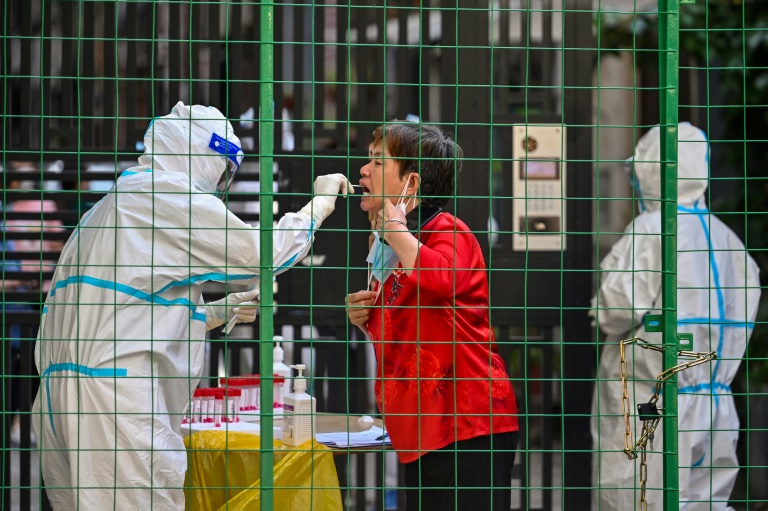
Shanghai will lock down a district of 2.7 million people on Saturday to conduct mass coronavirus testing, city authorities said, as the Chinese metropolis struggles to fully emerge from punishing curbs.

The city eased many restrictions last week, after confining most of its 25 million residents to their homes since March as China battled its worst Covid outbreak in two years.

But the lockdown was never fully lifted, with hundreds of thousands in China’s biggest city still restricted to their homes and multiple residential compounds put under fresh stay-home orders.

The southwestern district of Minhang, home to 2.7 million people, will be placed under “closed management” on Saturday morning and all residents will be tested, district authorities said in a social media post on Thursday.

“The closure will be lifted after samples have been collected,” they added, without giving a specific time or date.

The statement also did not say what measures would be imposed if any district residents test positive.

Under China’s stringent zero-Covid approach, all positive cases are isolated and close contacts — often including the entire building or community where they live — are made to quarantine.

Shanghai reported nine new local infections on Thursday — none in Minhang.

– Fears of another lockdown –

The district’s announcement sparked fear among some social media users that the lockdown could be prolonged beyond Saturday if any cases are found.

“You need to clarify if (the lockdown) will really be lifted after samples are collected,” one user wrote on Weibo.

“If there are abnormal results after the tests, what will you do? Continue the lockdown?” asked another.

The city government on Thursday denied rumours that the rest of the city would lock down again in phases, saying that while individual areas had issued confinement orders, the city as a whole was “gradually resuming normal production and life”.

The lockdown in Shanghai — a major global shipping hub — had threatened to pile further pressure on already-strained international supply chains.

But the city has slowly come back to life in recent days.

Commuters are back on subways and buses as people return to working in their offices, while residents have gathered in parks and along the city’s historic waterfront.

But others are chafing under continued restrictions, with residents in one compound in the downtown Xuhui district protesting against the rules this week.

Beijing, meanwhile, was transitioning more smoothly towards normality after shutting restaurants, gyms and subway stations last month to stamp out a smaller outbreak.

The Chinese capital’s largest district, however, on Thursday ordered clubs and bars to close after some venues were linked to Covid cases, according to state media.

Dying children reflect brutal toll of Somalia drought

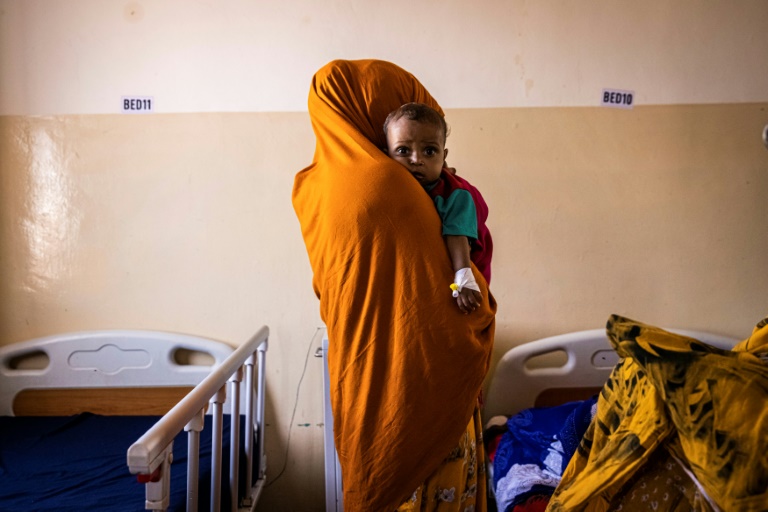
Arbay Mahad Qasim has already lost two children to a vicious drought, and now the Somali villager fears she could lose a third as her malnourished toddler Ifrah awaits treatment in a Mogadishu hospital.

Barely out of her teens, Qasim is among dozens of weary parents crowding Banadir Maternity & Children Hospital, which has become ground zero for the starvation crisis sweeping across Somalia as a record drought grips the Horn of Africa.

Entire villages have been forced to uproot their lives and flee their homes after poor rainfall destroyed crops and killed livestock.

When the rains failed for a fourth consecutive season last month, UN aid agencies and meteorologists warned that a famine was looming in Somalia, Kenya and Ethiopia.

But for many Somalis like Qasim, who has been surviving on government handouts for the past few months, catastrophe has already struck.

Two of her children died of hunger in the last 18 months.

When two-year-old Ifrah’s tiny body began to swell, showing symptoms of severe malnutrition, Qasim wasted no time, spending a day travelling to Mogadishu from her village in the southwest in a desperate bid to save her youngest child’s life.

– ‘Worst conditions’ –

The Banadir facility is packed with parents fearing the worst for their children.

Some have walked for days to find help, carrying their sick, skeletal toddlers on their backs.

Many told AFP they had never endured a crisis of such terrifying magnitude, echoing the warnings of climate scientists who say the unprecedented drought is the worst seen in four decades.

“The crops failed. We lost the livestock. The river dried up,” said Khadija Mohamed Hassan, whose 14-month-old son Bilal is among those admitted to the Banadir facility.

“I am 45 years old and I have never seen such a devastating drought ever in my life. We are living in the worst conditions of our time,” she told AFP.

Health workers are already overwhelmed, with doctor Hafsa Mohamed Hassan telling AFP that the number of patients arriving at Banadir’s stabilisation centre for malnutrition had trebled since the drought began, leading to a shortage of beds on some days.

“The cases we are receiving include children with other health complications like acute measles and others who are in a coma due to severe malnutrition,” she said.

The situation is at a tipping point, said Bishar Osman Hussein of the non-profit organisation Concern Worldwide, which has been supporting the Banadir centre since 2017.

“Between January and June this year, the number of children admitted at the Banadir Hospital stabilisation centre with severe malnutrition and other complications has increased from 120 to 230 per month,” he told AFP.

Meteorologists have warned that the October-November monsoon could also fail, plunging the region into further turmoil.

– ‘Cannot wait’ –

Conflict-wracked Somalia is particularly ill-equipped to cope with the crisis, with a grinding Islamist insurgency limiting humanitarian access to parts of the country.

Thousands of miles away, the war in Ukraine has also had a devastating impact on the lives of Somalis, with food prices soaring and aid in short supply.

Some 7.1 million Somalis — nearly half the population — are battling hunger, with more than 200,000 on the brink of starvation, the UN said this week.

Meanwhile appeals for aid have largely gone unnoticed, with agencies raising less than 20 percent of the funds needed to prevent a repeat of the 2011 famine that killed 260,000 people — half of them children under the age of six.

“We cannot wait for a declaration of famine to act,” El-Khidir Daloum, the World Food Programme’s country director in Somalia, said in a statement Monday, warning of a race against time.

As humanitarian aid falls short, Somalia’s newly elected President Hassan Sheikh Mohamud has urged Somalis to help their fellow citizens.

“Anyone with a plate of food in their table today must think about the child who is crying somewhere because of hunger and help them in any way possible,” he said during a recent visit to a camp housing drought-displaced communities.

Back at Banadir hospital, Khadija Mohamed Hassan anxiously keeps vigil over little Bilal, his bony body a mess of tubes and bandages.

“We have been here for 13 days, and he looks better now,” she said. 

Dying children reflect brutal toll of Somalia drought

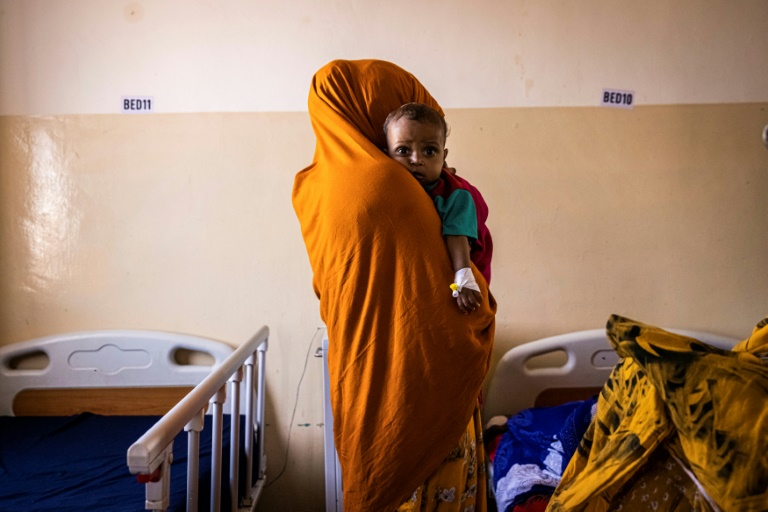
Arbay Mahad Qasim has already lost two children to a vicious drought, and now the Somali villager fears she could lose a third as her malnourished toddler Ifrah awaits treatment in a Mogadishu hospital.

Barely out of her teens, Qasim is among dozens of weary parents crowding Banadir Maternity & Children Hospital, which has become ground zero for the starvation crisis sweeping across Somalia as a record drought grips the Horn of Africa.

Entire villages have been forced to uproot their lives and flee their homes after poor rainfall destroyed crops and killed livestock.

When the rains failed for a fourth consecutive season last month, UN aid agencies and meteorologists warned that a famine was looming in Somalia, Kenya and Ethiopia.

But for many Somalis like Qasim, who has been surviving on government handouts for the past few months, catastrophe has already struck.

Two of her children died of hunger in the last 18 months.

When two-year-old Ifrah’s tiny body began to swell, showing symptoms of severe malnutrition, Qasim wasted no time, spending a day travelling to Mogadishu from her village in the southwest in a desperate bid to save her youngest child’s life.

– ‘Worst conditions’ –

The Banadir facility is packed with parents fearing the worst for their children.

Some have walked for days to find help, carrying their sick, skeletal toddlers on their backs.

Many told AFP they had never endured a crisis of such terrifying magnitude, echoing the warnings of climate scientists who say the unprecedented drought is the worst seen in four decades.

“The crops failed. We lost the livestock. The river dried up,” said Khadija Mohamed Hassan, whose 14-month-old son Bilal is among those admitted to the Banadir facility.

“I am 45 years old and I have never seen such a devastating drought ever in my life. We are living in the worst conditions of our time,” she told AFP.

Health workers are already overwhelmed, with doctor Hafsa Mohamed Hassan telling AFP that the number of patients arriving at Banadir’s stabilisation centre for malnutrition had trebled since the drought began, leading to a shortage of beds on some days.

“The cases we are receiving include children with other health complications like acute measles and others who are in a coma due to severe malnutrition,” she said.

The situation is at a tipping point, said Bishar Osman Hussein of the non-profit organisation Concern Worldwide, which has been supporting the Banadir centre since 2017.

“Between January and June this year, the number of children admitted at the Banadir Hospital stabilisation centre with severe malnutrition and other complications has increased from 120 to 230 per month,” he told AFP.

Meteorologists have warned that the October-November monsoon could also fail, plunging the region into further turmoil.

– ‘Cannot wait’ –

Conflict-wracked Somalia is particularly ill-equipped to cope with the crisis, with a grinding Islamist insurgency limiting humanitarian access to parts of the country.

Thousands of miles away, the war in Ukraine has also had a devastating impact on the lives of Somalis, with food prices soaring and aid in short supply.

Some 7.1 million Somalis — nearly half the population — are battling hunger, with more than 200,000 on the brink of starvation, the UN said this week.

Meanwhile appeals for aid have largely gone unnoticed, with agencies raising less than 20 percent of the funds needed to prevent a repeat of the 2011 famine that killed 260,000 people — half of them children under the age of six.

“We cannot wait for a declaration of famine to act,” El-Khidir Daloum, the World Food Programme’s country director in Somalia, said in a statement Monday, warning of a race against time.

As humanitarian aid falls short, Somalia’s newly elected President Hassan Sheikh Mohamud has urged Somalis to help their fellow citizens.

“Anyone with a plate of food in their table today must think about the child who is crying somewhere because of hunger and help them in any way possible,” he said during a recent visit to a camp housing drought-displaced communities.

Back at Banadir hospital, Khadija Mohamed Hassan anxiously keeps vigil over little Bilal, his bony body a mess of tubes and bandages.

“We have been here for 13 days, and he looks better now,” she said. 

France begins choosing new parliament in test for Macron

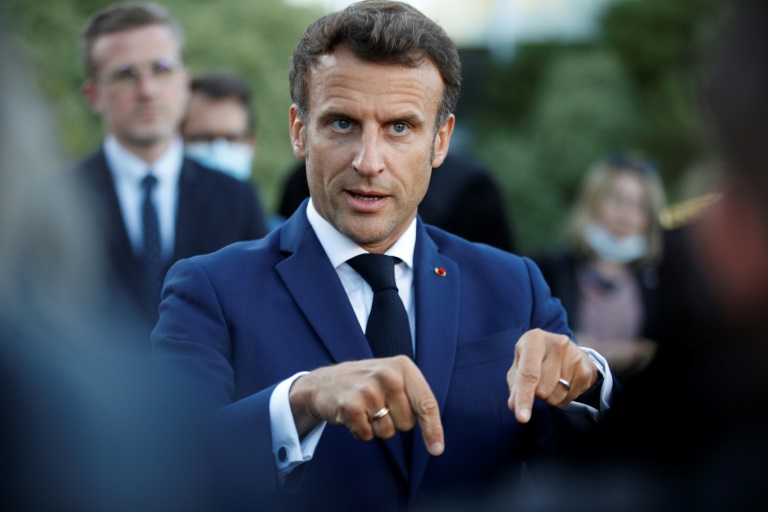
France votes Sunday in parliamentary elections with allies of President Emmanuel Macron seeking to retain a majority in the face of an increasingly competitive challenge from a new left-wing coalition.

Elections for the 577 seats in the lower-house National Assembly are a two-round process, with the shape of the new parliament clear only after the second round, a week later, on June 19.

But they provide a crucial coda to April’s presidential election, when Macron won re-election and pledged a transformative new era after his first term was dominated by protests, the Covid pandemic and Russia’s war against Ukraine.

If the president’s alliance Ensemble (Together) retains an overall majority, he will be able to carry on governing as before. Falling short could prompt a coalition with other right-wing parties and an unwanted cabinet shuffle weeks after the government was revamped.

A win by the left-wing coalition –- seen as unlikely by analysts but not impossible –- would be a disaster for Macron and raise the spectre of a clunky “cohabitation” — where the premier and president are from different factions — that has paralysed French politics in the past.

Left-wing leader Jean-Luc Melenchon, a former Marxist, has already made clear his ambition to become prime minister and stymie Macron’s plan to raise the French retirement age, though the president would retain control over foreign policy.

– ‘Lowered ambitions’ –

While Macron and his EU allies breathed a heavy sigh of relief after his solid if unspectacular presidential victory against far-right leader Marine Le Pen, the last weeks have brought no sense of a honeymoon.

Energy and food prices are soaring in France as elsewhere in Europe, the treatment of English fans at the Champions League final in Paris damaged France’s image abroad, and Macron has been accused by Ukraine of being too accommodating to Russia.

And two rape accusations against his new disabilities minister Damien Abad –- which he vehemently denied –- was the worst possible start for the new government after last month’s long-awaited reshuffle.

New Prime Minister Elisabeth Borne has yet to make an impact, and a major radio interview Tuesday was dominated by an exchange with a disabled caller who was left in tears after the premier suggested she should try to find work. 

Meanwhile, the French left has moved on from the disunity that saw it fail to make the presidential election run-off by forming the Nupes alliance, which groups Melenchon’s hard-left France Unbowed party, the Socialists, Greens and Communists.

Polls show that it is mounting an increasingly serious challenge to Macron’s alliance, though the two-round system and a high abstention rate, predicted to reach record levels of well over 50 percent, could play into the hands of the president.

Polls project that the Together alliance and Nupes will be neck-and-neck in terms of the popular vote on around 28 percent in the first round, though this figure is quite distinct from the final seat breakdown.

“The day after Emmanuel Macron’s re-election, his lieutenants saw the legislative elections as a formality,” said leading French daily Le Monde.

“But now they have seriously lowered their ambitions… Even a defeat, unthinkable several weeks ago, is now considered not impossible at the Elysee,” it said.

Macron has made clear that ministers who are standing in the election — including Borne, who is making her first attempt at winning a seat — will have to step down if they lose.

– ‘Majority not assured’ –

Of the 577 deputies in the National Assembly, eight represent France’s overseas territories and 11 account for French nationals living abroad. Macron’s party and his allies currently hold an absolute majority of 345 seats.

The latest poll by Ipsos projects that Macron’s alliance would win 275 to 315 seats, meaning it is by no means assured of an absolute majority, for which 289 seats are needed.

“Projecting seats is a perilous exercise at this stage,” said the managing director of Ipsos France, Brice Teinturier. 

“An absolute majority (for Together) is not assured but the presidential majority does have a certain margin” that will play to its advantage in the second round.

Under France’s system, a candidate needs over half of the vote on the day as well as the backing of at least 25 percent of registered voters in a constituency to be elected outright in the first round.

Otherwise the top two candidates in a constituency, as well as any other candidate who won the backing of at least 12.5 percent of registered voters, will go forward to the second round, where the candidate with the most votes wins.

The first round of voting for French living abroad took place early, with results published Monday showing Macron’s candidates finishing top in eight out of the 11 constituencies as expected, but Nupes’ candidates making major gains compared with the last parliament election in 2017.

Laying out pledges, Biden urges Americas to prove democracy works

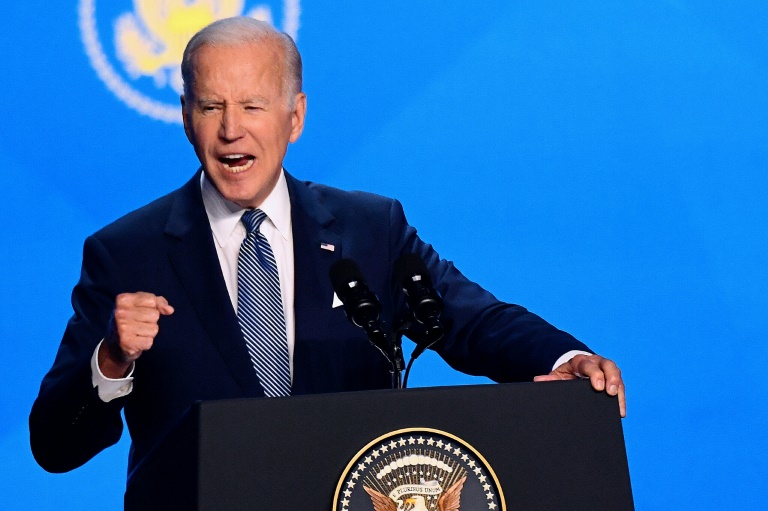
US President Joe Biden on Wednesday urged leaders of the Americas to prove that democracy works as he laid out plans to boost economic cooperation and improve health and food access in a region where China has been making growing inroads.

Welcoming leaders to Los Angeles for the Summit of the Americas, Biden acknowledged differences — with Mexico’s leader refusing to come — but made an impassioned plea for democracy as the best way forward.

“When democracy is under assault around the world, let us unite again and renew our conviction that democracy is not only the defining feature of American histories, but the essential ingredient to Americas’ future,” Biden said. 

“At this summit, we have an opportunity for us to come together around some bold ideas, ambitious actions, and to demonstrate to our people the incredible power of democracy.”

In a theater that plays host to the Emmys, delegations snacking on popcorn watched a Caribbean-influenced dance show choreographed by Emilio Estefan and listened to pop star Sheila E who, in a fitting choice, covered The Beatles’ “Come Together.”

Biden laid out a new regionwide economic plan that was large on ideas but short on commitments, with no promises of further market access or funding.

In an echo of US political debates, Biden said that the United States was looking for economic growth “from the bottom up and the middle out and not the top down.”

“What was true in the United States is true in every country — ‘trickle-down economics’ does not work,” he said to applause.

– More than ‘state dollars’ –

In an implicit contrast to Beijing, Biden’s national security advisor, Jake Sullivan, said the United States was worried less about flashy announcements than about supporting more inclusive growth.

“The United States has never seen its comparative advantages in the world as just leveraging huge numbers of state dollars, but rather leveraging all of the tools available to us,” he told reporters on Air Force One.

Biden announced an initiative worth $300 million to tackle food insecurity — on the rise as Russia’s invasion of Ukraine disrupts grain exports — by coordinating with the hemisphere’s major agriculture nations including Argentina, Brazil and Canada.

The White House also announced a new Americas Health Corps that aims to improve the skills of 500,000 health workers across the region, building on the lessons from Covid-19, which hit the Western Hemisphere especially hard.

China has stepped up its role in Latin America during the pandemic, moving early to supply vaccines, and US nemesis Cuba has long exported its state-employed doctors. 

The announcement comes a day after Vice President Kamala Harris detailed $1.9 billion in private sector investment in impoverished and violence-ravaged El Salvador, Guatemala and Honduras.

The troubles in the so-called Northern Triangle, as well as Haiti, have generated a soaring number of migrants to the United States, setting off a domestic furor as Donald Trump’s Republican Party demands efforts to stop them.

– Meeting with ‘Tropical Trump’ –

Draining US diplomatic energy ahead of the summit, Mexican President Andres Manuel Lopez Obrador refused to attend as he insisted that Biden invite the leftist leaders of Cuba, Nicaragua and Venezuela, shunned on the grounds that they are autocrats.

Mexican Foreign Secretary Marcelo Ebrard attended in Obrador’s stead. Speaking to his counterparts, Ebrard called the exclusion of the three countries “a strategic error” and said Mexico would look at ways to reform regional institutions.

Biden will have a potentially awkward first meeting Thursday with President Jair Bolsonaro of Brazil, Latin America’s most populous nation. 

A Trump supporter, Bolsonaro has raised doubts about the legitimacy both of upcoming voting in Brazil and, on the eve of his trip, of Biden’s own election.

Sullivan said that Biden would not shy away from the topic and would discuss the importance of “open, free, fair, transparent democratic elections.”

The Summit of the Americas is the first in the United States since the inaugural edition in 1994 was held in Miami under Bill Clinton, who proposed a free-trade zone that would span the hemisphere — but exclude communist-ruled Cuba.

The White House billed Biden’s summit as an update to Clinton’s vision. But the US political mood has since dramatically soured on free trade, with Trump rising to power denouncing liberalization as harmful to US workers. 

The Americas Partnership for Economic Prosperity announced by Biden will look at coordinating on standards and supply chains but will not offer new market access — a key incentive offered to the region by China, with its billion-plus consumer market.

Biden last month similarly unveiled an Asian partnership on setting economic standards as he visited Tokyo.

But unlike in Asia, the United States already has free trade deals with a number of major Latin American nations including Mexico, Chile, Colombia and Peru.

Laying out pledges, Biden urges Americas to prove democracy works

US President Joe Biden on Wednesday urged leaders of the Americas to prove that democracy works as he laid out plans to boost economic cooperation and improve health and food access in a region where China has been making growing inroads.

Welcoming leaders to Los Angeles for the Summit of the Americas, Biden acknowledged differences — with Mexico’s leader refusing to come — but made an impassioned plea for democracy as the best way forward.

“When democracy is under assault around the world, let us unite again and renew our conviction that democracy is not only the defining feature of American histories, but the essential ingredient to Americas’ future,” Biden said. 

“At this summit, we have an opportunity for us to come together around some bold ideas, ambitious actions, and to demonstrate to our people the incredible power of democracy.”

In a theater that plays host to the Emmys, delegations snacking on popcorn watched a Caribbean-influenced dance show choreographed by Emilio Estefan and listened to pop star Sheila E who, in a fitting choice, covered The Beatles’ “Come Together.”

Biden laid out a new regionwide economic plan that was large on ideas but short on commitments, with no promises of further market access or funding.

In an echo of US political debates, Biden said that the United States was looking for economic growth “from the bottom up and the middle out and not the top down.”

“What was true in the United States is true in every country — ‘trickle-down economics’ does not work,” he said to applause.

– More than ‘state dollars’ –

In an implicit contrast to Beijing, Biden’s national security advisor, Jake Sullivan, said the United States was worried less about flashy announcements than about supporting more inclusive growth.

“The United States has never seen its comparative advantages in the world as just leveraging huge numbers of state dollars, but rather leveraging all of the tools available to us,” he told reporters on Air Force One.

Biden announced an initiative worth $300 million to tackle food insecurity — on the rise as Russia’s invasion of Ukraine disrupts grain exports — by coordinating with the hemisphere’s major agriculture nations including Argentina, Brazil and Canada.

The White House also announced a new Americas Health Corps that aims to improve the skills of 500,000 health workers across the region, building on the lessons from Covid-19, which hit the Western Hemisphere especially hard.

China has stepped up its role in Latin America during the pandemic, moving early to supply vaccines, and US nemesis Cuba has long exported its state-employed doctors. 

The announcement comes a day after Vice President Kamala Harris detailed $1.9 billion in private sector investment in impoverished and violence-ravaged El Salvador, Guatemala and Honduras.

The troubles in the so-called Northern Triangle, as well as Haiti, have generated a soaring number of migrants to the United States, setting off a domestic furor as Donald Trump’s Republican Party demands efforts to stop them.

– Meeting with ‘Tropical Trump’ –

Draining US diplomatic energy ahead of the summit, Mexican President Andres Manuel Lopez Obrador refused to attend as he insisted that Biden invite the leftist leaders of Cuba, Nicaragua and Venezuela, shunned on the grounds that they are autocrats.

Mexican Foreign Secretary Marcelo Ebrard attended in Obrador’s stead. Speaking to his counterparts, Ebrard called the exclusion of the three countries “a strategic error” and said Mexico would look at ways to reform regional institutions.

Biden will have a potentially awkward first meeting Thursday with President Jair Bolsonaro of Brazil, Latin America’s most populous nation. 

A Trump supporter, Bolsonaro has raised doubts about the legitimacy both of upcoming voting in Brazil and, on the eve of his trip, of Biden’s own election.

Sullivan said that Biden would not shy away from the topic and would discuss the importance of “open, free, fair, transparent democratic elections.”

The Summit of the Americas is the first in the United States since the inaugural edition in 1994 was held in Miami under Bill Clinton, who proposed a free-trade zone that would span the hemisphere — but exclude communist-ruled Cuba.

The White House billed Biden’s summit as an update to Clinton’s vision. But the US political mood has since dramatically soured on free trade, with Trump rising to power denouncing liberalization as harmful to US workers. 

The Americas Partnership for Economic Prosperity announced by Biden will look at coordinating on standards and supply chains but will not offer new market access — a key incentive offered to the region by China, with its billion-plus consumer market.

Biden last month similarly unveiled an Asian partnership on setting economic standards as he visited Tokyo.

But unlike in Asia, the United States already has free trade deals with a number of major Latin American nations including Mexico, Chile, Colombia and Peru.

Fate of Donbas rests in battleground Ukraine city: Zelensky

Ukrainian soldiers in Severodonetsk are fighting “one of the most difficult” battles against Russian troops since the start of the war, President Volodymyr Zelensky said, adding the fate of the whole Donbas region rests in the eastern city.

Moscow’s forces are concentrating their firepower on the strategically important industrial hub as part of efforts to capture a swathe of eastern Ukraine.

After days of raging street battles, Ukrainian officials conceded that Russian troops control a large part of Severodonetsk, and that their forces might have to pull back due to constant shelling.

In his evening address to the nation, Zelensky said the battle for the city was “very fierce… very difficult. Probably one of the most difficult throughout this war.

“In many ways, the fate of our Donbas is being decided there.”

After being repelled from Kyiv and other parts of Ukraine following their February invasion, Russian President Vladimir Putin’s troops have refocused their offensive on the Donbas region, comprising Lugansk and Donetsk.

The cities of Severodonetsk and Lysychansk, which are separated by a river, were the last areas still under Ukrainian control in Lugansk.

Lysychansk is still in Ukrainian hands but under fierce Russian bombardment.

At the United Nations, Secretary-General Antonio Guterres added his voice to increasingly dire warnings about the conflict’s impact. 

“For people around the world, the war is threatening to unleash an unprecedented wave of hunger and destitution, leaving social and economic chaos in its wake,” he said. 

– Little progress on grain –

At talks in Ankara, Russia and Turkey made little headway in striking a deal to secure safe passage for grain exports stuck in Ukraine due to a Russian sea blockade.

At the request of the United Nations, Turkey has offered its services to escort maritime convoys from Ukrainian ports, despite the presence of mines — some of which have been detected near the Turkish coast.

“We are ready to do this in cooperation with our Turkish colleagues,” Russian Foreign Minister Sergei Lavrov told reporters in Ankara.

Kyiv said it would not demine waters around the Black Sea port of Odessa to allow grain exports, citing the threat of Russian attacks on the city.

Lavrov’s Turkish counterpart Mevlut Cavusoglu called Russian demands for an end to sanctions to help grain onto the world market “legitimate”.

“If we need to open up the international market to Ukrainian grain, we see the removal of obstacles standing in the way of Russia’s exports as a legitimate demand,” he said.

But Kyiv, which was not represented at the Ankara talks, pushed back against claims that Western sanctions on Moscow had sent prices soaring.

“We have been actively communicating, the president and myself, about the true cause of this crisis: it is Russian aggression, not sanctions,” Ukraine’s Foreign Minister Dmytro Kuleba said. 

Before the war, Ukraine was a major exporter of wheat, corn and sunflower oil. Russia’s blockade has been blamed for contributing to soaring prices, stoking fears of a looming food crisis in poor countries.

As he hosted Mediterranean ministers for talks on the global food crisis, Italian Foreign Minister Luigi Di Maio warned “millions” could die unless Russia unblocked Ukraine’s ports.

But Kremlin spokesman Dmitry Peskov rejected suggestions that grain stuck in Ukrainian ports was fuelling the problem.

“As far as we know, there is much less grain than the Ukrainians say. There is no need to exaggerate the importance of these grain reserves,” he told reporters.

– ‘Bombings every day’ –

Severodonetsk appeared close to being captured just days ago but Ukrainian forces launched counterattacks and managed to hold out, despite warnings they were outnumbered by superior forces.

About 800 civilians trapped by the fighting have taken refuge in the city’s Azot chemical factory in the city, according to the lawyer of a Ukrainian tycoon whose company owns the facility. 

Ukrainian authorities have yet to confirm the report.

The situation was also increasingly desperate in other parts of the Donbas. 

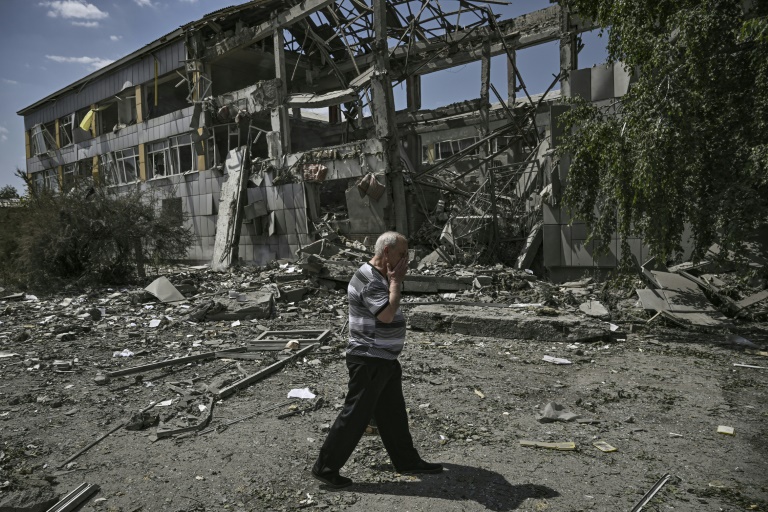
In the city of Bakhmut, an unoccupied school building was reduced to a smouldering wreck after being shelled Wednesday, with burnt books visible among the rubble, according to AFP journalists. No injuries or deaths were reported. 

In Severodonetsk’s twin city Lysychansk, residents who had chosen to stay were facing fierce Russian bombardments. 

“Every day there are bombings and every day something burns. A house, a flat… And there is nobody to help me,” 70-year-old Yuriy Krasnikov told AFP.

“I tried to go to the city authorities, but nobody’s there, everyone has run away.”

There was some rare good news for Ukraine, as their football side clinched a 1-0 Nations League victory over the Republic of Ireland on Wednesday.

The victory — thanks to a free kick from Viktor Tsygankov — lifted the country’s spirits after their painful failure to qualify for the World Cup.

burs-sr/dva

Close Bitnami banner
Bitnami