World

Kazakhstan holds referendum to move past Nazarbayev era

Polls opened in Kazakhstan Sunday for a referendum to overhaul the constitution after deadly unrest in January ended founding leader Nursultan Nazarbayev’s three-decade grip on Central Asia’s richest country.

The bloodshed, which grew out of peaceful protests over a spike in car fuel prices — left more than 230 people dead and prompted authorities to call in troops from a Russia-led security bloc.

The drive for a “New Kazakhstan” in the wake of the violence has come from the man that Nazarbayev hand-picked to replace him as president in 2019, Kassym-Jomart Tokayev.

Tokayev, 69, describes the snap referendum as a shift from “super-presidential” rule that will strengthen parliament.

But it is the absence of special privileges for 81-year-old Nazarbayev that is the most eye-catching change to the constitution.

Prior to January’s crisis, Tokayev was widely seen as ruling in the shadow of Nazarbayev and his super-rich relatives. 

Even after stepping down as president, Nazarbayev retained the constitutional title of “Elbasy”, or “Leader of the Nation” — a role that afforded him influence over policymaking regardless of his formal position.

The new constitution does away with that status. 

Another amendment prevents relatives of the president from holding government positions — a clear nod to the influence of Nazarbayev’s family and in-laws, who lost powerful positions in the aftermath of the violence.

– ‘Never any justice’  –

Alnur Ilyashev, a long-time government critic, told AFP that the plebiscite is an attempt to “legitimise” Tokayev in the aftermath of the bloodshed and “formalise the retirement” of his predecessor.

The amendments were drafted “without the participation of protest-oriented civil society or authoritative human rights activists,” said Ilyashev, based in the largest city Almaty.

Despite a government push to sell the changes, voters appear ambivalent about the referendum that seeks to amend around a third of the constitution’s articles. 

Gulsara, 31, an Almaty cleaner, said she would vote for the constitution despite believing that the oil-rich government was failing in its pledge to raise living standards.

“They say the vote is about justice but there is never any justice here,” she told AFP. 

In the capital, whose renaming to “Nur-Sultan” marked the peak of Nazarbayev’s personality cult, 40-year-old construction manager Meirambek said he had not studied the amendments but would vote for them. 

“It will take time for (government) to overcome pessimism. But I think things will get better,” he said.

The constitution is almost certain to pass, and there has been no visible “no” campaign.

Voting in Almaty and Nur-Sultan began at 7:00 am (0100 GMT) and concludes at 8:00 pm (1400 GMT). Polling stations in the west will close an hour later, at 9:00 pm.

Kazakhstan’s New Year crisis remains poorly understood, with a days-long Internet shutdown at the peak of the unrest helping to further obscure the events. 

Protests stirred in the oil-producing west over a New Year fuel price hike, but it was Almaty — 2,000 kilometres (1,200 miles) away — that became the epicentre of armed clashes, looting and arson.

Nur-Sultan, which was called Astana prior to 2019, remained largely untouched. 

– Leadership struggle – 

Tokayev blamed the violence on “terrorists” seeking to seize power and issued a “shoot to kill” order to Kazakh troops.

But the arrest on treason charges of a Nazarbayev ally who served as national security chief at the time fuelled speculation that a leadership struggle was at the heart of the violence.

After stability was restored, Tokayev criticised Nazarbayev for allowing inequality to fester, while crediting his mentor’s state-building achievements.

Both former and current presidents are allies of neighbouring Russia, and the arrival of a 2,000-plus detachment of peacekeepers from a Moscow-led security bloc bolstered Tokayev’s control over the situation in January.

The Kremlin claimed the intervention requested by Tokayev did not extend to any political settlement, which was “the internal affair of Kazakhstan”.  

Nazarbayev has made few public appearances since the crisis but gave a rare interview published on Monday in which he pledged support for Tokayev and the constitutional changes.

He added that his relatives should be “held accountable” if they committed crimes, but were entitled to a fair trial — an apparent reference to nephew Kairat Satybaldy, a businessman presently detained on embezzlement charges.
Managing inventories a pandemic headache for US businesses

More than two years into the Covid-19 pandemic, American businesses are still struggling to manage their inventories in a feast-or-famine cycle caused by fickle consumer demand.

“We have way too much inventory right now,” said Ginny Pasqualone, chief executive of Sparkledots, a children’s clothing manufacturer.

“It’s important that we have a large selection of merchandise that our clients can choose from,” she said, but store traffic has been hit by inflation concerns, with some customers “very scared that they’re not going to survive another recession.” 

For now, Sparkledots is holding more goods in inventory, but that ties up company capital and limits its ability to add to its 18-worker staff.

“It sucks our growth for the future,” Pasqualone said.

Such is the dilemma affecting businesses of all sizes. 

Large store chains like Walmart, Target and Macy’s have acknowledged in recent weeks that they misread consumer patterns, leaving them with excess supplies of appliances, casual clothing and bicycles.

Bicycles were a hot commodity early in the pandemic, prompting surprisingly large orders, said Wayne Sosin, owner of Worksman Cycles, a New York manufacturer best known for its tricycles. 

“Retailers bought whatever they could as if bike sales would continue to have unprecedented demand,” Sosin said. “It was so obvious to me that (this) would not last.”

Still, Sosin said demand remains strong in some parts of the business, placing stress on supplies of some key bicycle parts.

– Unexpected shift –

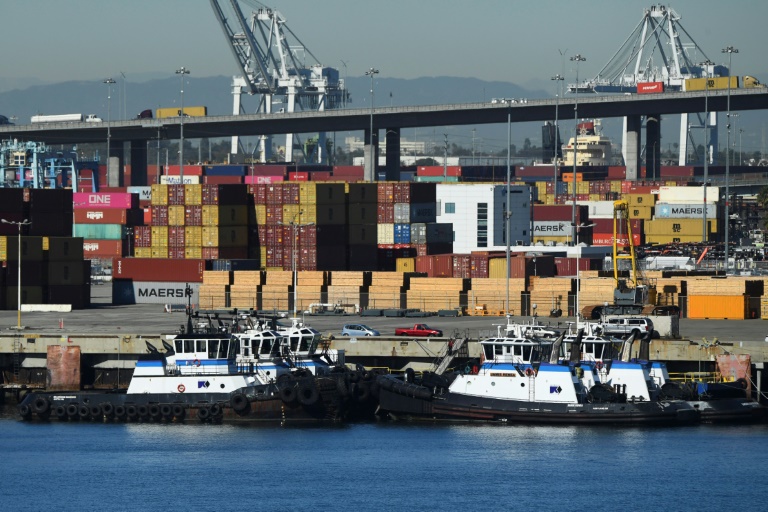
Torrid consumer demand since 2020 fueled by government pandemic relief programs has led to product shortages and backlogs in seaports.

“The business can no longer count on the idea that you’re going to have this easy, just-in-time inventory and that you can only keep stock on hand that you need,” said Phil Levy, an economist for logistics company Flexport. 

Companies are unsure how much the outsized buying during the pandemic will persist and for which goods.

“The way we tend to predict things is by looking at past patterns,” Levy said. “But we don’t have data on how the consumers behaved during the five recent major modern pandemics.”

In the most recent quarter, the big-box chain Target saw sales of appliances, clothing and other goods slow as consumers shifted spending to travel and other service-oriented consumption.

“We didn’t anticipate the magnitude of that shift,” Target Chief Executive Brian Cornell said on an analyst conference call.

As a result, Target had bought too many televisions and too much outdoor furniture.

Similarly, department-store chain Macy’s was caught off guard by a 20 percent drop in sales of casual clothing and housewares in the most recent period, compared with the prior quarter.

At the same time, “supply chain constraints relaxed,” unexpectedly boosting deliveries of merchandise, said Macy’s Chief Executive Jeffrey Gennette.

– ‘Wildcards’ –

Retailers have adopted different strategies for dealing with a glut of goods.

Target has moved some of its goods outside of stores into temporary storage facilities, while liquidating seasonal merchandise no longer in demand.

Others plan to offer more discounted items. Apparel chain Urban Outfitters expects promotions to increase “not just in the second quarter, but throughout the year and into the holiday season,” said Chief Executive Richard Hayne.

The consumer remains the “wildcard,” said Brian Yarbrough, an analyst who follows consumer companies at Edward Jones.

Demand for goods has remained fairly robust even as consumers spend more on services and contend with inflation, Yarbrough said.

Among other unknowns is the state of ocean shipping between Asia and the United States. Will ports on the US West Coast again struggle with delays, or even a possible strike due to high-stakes labor negotiations this summer?

“How long will it take to ship freight from Asia to the US to have stuff on the shelves this fall?” wonders Levy. “You just don’t know.”

Canada handgun sales soar after Trudeau proposes freeze

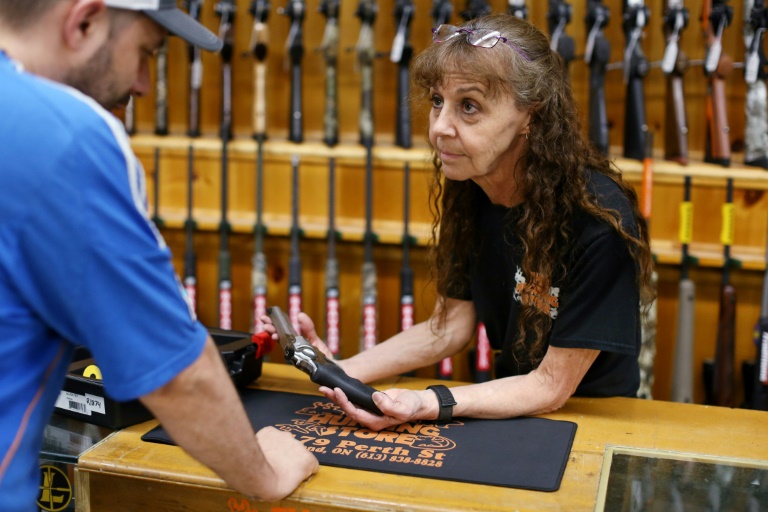
Aman Sandhu checked store after store for a handgun in Canada’s British Columbia, hoping to make a purchase before a freeze on sales takes effect, but struggled to find one in stock.

“I’m concerned that if I don’t buy one now, I may never have the choice again,” Sandhu, a member of the Dawson Creek Sportsman’s Club, told AFP.

Prime Minister Justin Trudeau’s proposed freeze on pistol sales — which he announced in the wake of a series of high-profile mass shootings in the United States — has pushed some Canadians to rush out to gun stores while they still can.

While Sandhu is keen to buy a pistol, he is also wary of becoming mired in new rules that include hefty penalties for even minor lapses.

“Jeez, if I slip up, I could screw up the rest of my firearms ownership,” he said, describing a handful of long guns in his collection.

Several gun stores in British Columbia province saw lines out the door within hours of the liberal leader’s declaration on Monday. Other shops across Canada said they sold out within days.

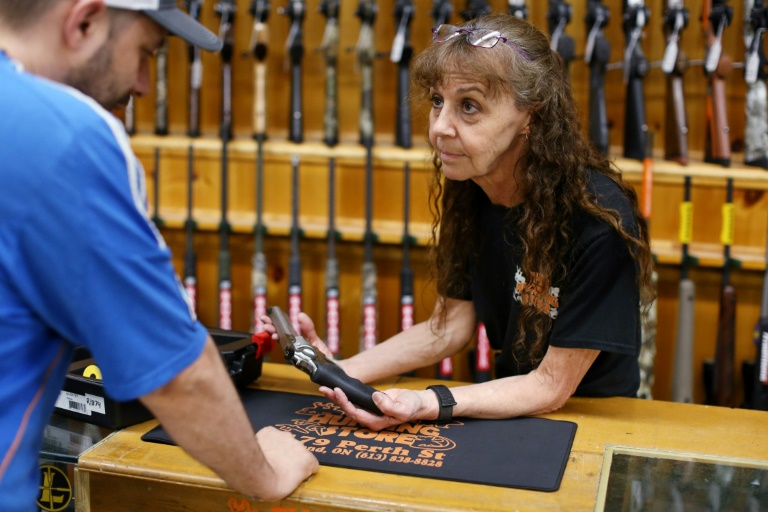
“Sales have been brisk,” said Jen Lavigne, co-owner of That Hunting Store in a strip mall on the outskirts of the capital Ottawa, nestled between a barbershop, a Chinese buffet restaurant, and a conservative lawmaker’s constituency office.

“We sold 100 handguns, or almost our entire stock, in the last three days, since the prime minister announced the freeze,” she said, showing off her nearly empty handgun cabinet.

– ‘Panic’ –

At DoubleTap Sports in Toronto, a similar scene unfolded. Owner Josko Kovic said the government announcement “created a panic, and people are now rushing out to buy handguns.”

“Almost all stores are sold out, including me,” he said.

According to government estimates, there are more than one million handguns in Canada, which has a population of 38 million people. Some 2,500 stores sell pistols in the country.

At present, a person must have a restricted firearms license in order to purchase a handgun. Most also require a special permit to transport them from any location to another, and they must be in secured cases.

Shooting ranges are about the only places where they can be legally fired.

The new regulations, unveiled after mass shootings killed 21 people at an elementary school in Texas and 10 at a supermarket in New York state, would prohibit the purchase, sale, transfer and importation of handguns.

They are expected to come into force in the fall, along with a border crackdown on weapons smuggling from the United States.

“We are capping the number of handguns in this country,” Trudeau said Monday, citing “a level of gun violence in our communities that is unacceptable.”

– ‘Catch-22’ –

Almost two-thirds of gun crimes in Canadian cities over the past decade involved handguns, according to government data.

At That Hunting Store, a man picking up a new handgun for competition, who identified himself as David, lamented the new restrictions on top of already cumbersome rules that drag out purchases.

“It’s ridiculous,” he said. “It takes two months just to get a license with all the background checks.”

Gun shop owners interviewed by AFP unanimously decried the freeze, which must still be passed by parliament.

“This measure is only going to hurt legal gun owners,”  Lavigne said, adding: “It’s not going to reduce any of the crime because the bad guys don’t follow the rules.”

Darryl Tomlinson, owner of Canadian Gun Guys in Winnipeg, said he worries for the future of his store and shooting range, as well as the social network of members.

“This handgun measure is going to take away livelihoods and break up communities,” he said.

“It’s a Catch-22. We’re busy now, but I fear we’re going to be put out of business in the fall,” Tomlinson said of the week’s sales boom.

Canada handgun sales soar after Trudeau proposes freeze

Aman Sandhu checked store after store for a handgun in Canada’s British Columbia, hoping to make a purchase before a freeze on sales takes effect, but struggled to find one in stock.

“I’m concerned that if I don’t buy one now, I may never have the choice again,” Sandhu, a member of the Dawson Creek Sportsman’s Club, told AFP.

Prime Minister Justin Trudeau’s proposed freeze on pistol sales — which he announced in the wake of a series of high-profile mass shootings in the United States — has pushed some Canadians to rush out to gun stores while they still can.

While Sandhu is keen to buy a pistol, he is also wary of becoming mired in new rules that include hefty penalties for even minor lapses.

“Jeez, if I slip up, I could screw up the rest of my firearms ownership,” he said, describing a handful of long guns in his collection.

Several gun stores in British Columbia province saw lines out the door within hours of the liberal leader’s declaration on Monday. Other shops across Canada said they sold out within days.

“Sales have been brisk,” said Jen Lavigne, co-owner of That Hunting Store in a strip mall on the outskirts of the capital Ottawa, nestled between a barbershop, a Chinese buffet restaurant, and a conservative lawmaker’s constituency office.

“We sold 100 handguns, or almost our entire stock, in the last three days, since the prime minister announced the freeze,” she said, showing off her nearly empty handgun cabinet.

– ‘Panic’ –

At DoubleTap Sports in Toronto, a similar scene unfolded. Owner Josko Kovic said the government announcement “created a panic, and people are now rushing out to buy handguns.”

“Almost all stores are sold out, including me,” he said.

According to government estimates, there are more than one million handguns in Canada, which has a population of 38 million people. Some 2,500 stores sell pistols in the country.

At present, a person must have a restricted firearms license in order to purchase a handgun. Most also require a special permit to transport them from any location to another, and they must be in secured cases.

Shooting ranges are about the only places where they can be legally fired.

The new regulations, unveiled after mass shootings killed 21 people at an elementary school in Texas and 10 at a supermarket in New York state, would prohibit the purchase, sale, transfer and importation of handguns.

They are expected to come into force in the fall, along with a border crackdown on weapons smuggling from the United States.

“We are capping the number of handguns in this country,” Trudeau said Monday, citing “a level of gun violence in our communities that is unacceptable.”

– ‘Catch-22’ –

Almost two-thirds of gun crimes in Canadian cities over the past decade involved handguns, according to government data.

At That Hunting Store, a man picking up a new handgun for competition, who identified himself as David, lamented the new restrictions on top of already cumbersome rules that drag out purchases.

“It’s ridiculous,” he said. “It takes two months just to get a license with all the background checks.”

Gun shop owners interviewed by AFP unanimously decried the freeze, which must still be passed by parliament.

“This measure is only going to hurt legal gun owners,”  Lavigne said, adding: “It’s not going to reduce any of the crime because the bad guys don’t follow the rules.”

Darryl Tomlinson, owner of Canadian Gun Guys in Winnipeg, said he worries for the future of his store and shooting range, as well as the social network of members.

“This handgun measure is going to take away livelihoods and break up communities,” he said.

“It’s a Catch-22. We’re busy now, but I fear we’re going to be put out of business in the fall,” Tomlinson said of the week’s sales boom.

War film 'Shershaah' steals show as Bollywood's Oscars return

War movie “Shershaah” marched off with Best Picture and Best Director as Bollywood’s Oscars returned for the first time since the pandemic began with an all-singing, all-dancing awards ceremony in Abu Dhabi on Saturday.

“Shershaah”, depicting Indian war hero Vikram Batra, who was killed in the 1999 Kargil conflict with Pakistan, had been tipped to dominate after receiving 12 nods for the first International Indian Film Academy Awards since 2019.

“I would like to thank the family of Vikram Batra for helping me make this movie,” director Vishnuvardhan told the crowd at the end of the energetic, five-hour gala in the United Arab Emirates capital.

Indian A-listers packed the ceremony, which featured a belly-dancing number during the lavishly choreographed stage show. Bollywood, the Hindi-language film industry known for its strong musical tradition, is the world’s most prolific producer of movies.

Best leading male went to Vicky Kaushal for “Sardar Udham”, a drama depicting an Indian revolutionary’s revenge on the British officer behind the 1919 Amritsar massacre.

And Kriti Sanon won best female lead for “Mimi”, a comedy-drama that tackles the thriving surrogacy industry and attitudes towards single mothers. Sai Tamhankar won best supporting female for the same film.

But cricket movie “83”, which depicts India’s seminal 1983 World Cup triumph and received nine nominations, missed out on the major prizes.

The IIFA awards follow a torrid period when India and its film industry were sent reeling by Covid-19, which shuttered cinemas and triggered a rush to streaming services.

– ‘You saved the film industry’ –

Host Salman Khan, one of Bollywood’s heavyweights, opened proceedings by riding into the auditorium on a motorbike, a gold IIFA trophy perched on the handlebars.

“We saw that in the last two years the world closed down. Many of us lost our loved ones. Many lost their jobs as well. We faced many difficulties. All of us together overcame the difficulty,” he told the packed venue.

“When the world slowly opened, cinema halls were the last to open. But it got filled up first. You saved the film industry and everyone who worked in the industry,” said Khan.

Tiger Shroff, son of 1980s superstar Jacky Shroff and one of the new breed of actors, ripped off his jacket to perform the opening number bare-chested, in shades and sparkly trousers.

Outside, the green carpet — switched from red in 2007 to support climate awareness — bore glamorous stars such as Aishwarya Rai Bachchan and Urvashi Rautela, along with Emirati royalty such as Sheikh Nahyan bin Mubarak Al Nahyan, the minister of state for tolerance.

A group of nominees including A.R. Rahman, B. Praak, Jaani and Pritam shared the award for musical direction; Sharvari Wagh won best debut female and Ahan Shetty was named best debut male.

Pankaj Tripathi won best supporting male actor for “Ludo”. Jubin Nautiyal won best male playback singer — whose voice is dubbed over the actor’s — for his work on “Shershaah”.

The Hindi-language film industry was worth $2.5 billion in 2019 and produces more movies than any other. India also releases hundreds of films in its 21 other official languages every year.

But pandemic lockdowns sent the industry into a tailspin, with multiplex chains suffering major losses and dozens of small cinemas going bust. India’s media and entertainment earnings slumped by a quarter to $18.7 billion in 2020, according to accounting firm EY.

The theatre closures prompted a surge in subscriptions to streaming platforms, with American services Netflix, Amazon Prime and Disney’s Hotstar tapping into a sharp growth in online audiences.

Dutch port's rooftop walk shows post-climate future

As one of the world’s most densely populated countries grapples with climate change, the Dutch are taking to their rooftops.

An organisation in the port city of Rotterdam has built a skywalk linking the roofs of the downtown shopping area to show what the future might look like.

From a village to food cultivation and rainwater storage areas, the “Rooftop Days” association is showing how to unlock the unused space of Europe’s biggest port.

“We want people to experience how great it is to be on a rooftop and what space we have there above the city,” Rooftop Days director Leon van Geest told AFP.

“We are only using three percent of the full potential of the flat rooftops that we have here in our city.”

The bright orange skywalk runs for some 600 metres (1,969 feet), with a heart-stopping “airbridge” section linking the city’s World Trade Centre to a department store, at 29.5 metres above street level.

The walk, which is open until June 24, also features wind turbines, solar panels, art galleries and a drone landing pad. 

If the city authorities give approval for a full-scale rooftop village in future, it is expected to include crops and tiny houses built of sustainable materials. 

– ‘Unique opportunity’ –

With around a third of its land lying below a sea level that creeps higher each year, the Netherlands has become a world leader in adapting to climate change.

The urgency is even greater for the Dutch given that the nation’s 17 million inhabitants are squeezed into Europe’s most densely populated country after tiny Monaco, the Vatican City, Malta and San Marino.

Known for its architectural daring in the decades after it was flattened during World War II, Rotterdam itself is something of a pioneer for the Netherlands, which only uses some 1.8 percent of its roof space. 

Transforming the city could take decades but van Geest says he is “convinced that this will become a reality”.

As the Dutch population becomes increasingly urban, “space is becoming a rare commodity in the city, so we will have to exploit the roof”, he added.

Rotterdammers are enjoying the change of perspective.

“It is a unique opportunity to see Rotterdam from a higher distance,” approved 69-year-old resident Harry Schouten. 

– ‘Intensive rooftops’ –

The “Rooftop Days” have been going on for six years and the latest highlights some of the most successful ideas for a climate-adapted future. 

These include the “Rooftop Field”, a 1,000-square-metre area on the sixth floor of a building which grows vegetables, fruit and edible flowers.

Founder Emile van Rinsum, director of the Rotterdam Environment Centre, said his organisation created the field nearly 10 years ago on the roof of the building where their offices are located.

“It’s really nice” to work a few staircases away from such a green space in the heart of the Netherlands’ second city, he said.

One of its main purposes is for storing water, as climate change makes seasonal rainfall levels increasingly unpredictable.

“On this roof, we can already store 60,000 litres of water,” Van Rinsum said.

Part of the produce grown there is delivered to eateries in Rotterdam, while a restaurant set up near the field is proving “very popular”.

“We call them ‘intensive rooftops’ on which you can walk or, for example, grow food as we do, and that is very important for a city,” he said.

Baby formula plant linked to US shortage resumes production

Production resumed Saturday at an Abbott Nutrition baby formula plant in the US whose closure helped fuel a crippling nationwide shortage.

The facility in Sturges, Michigan has met initial government sanitary requirements for reopening, the company said in a statement. 

The plant, a major producer of formula, shut down and issued a product recall in February after the death of two babies raised concerns over contamination.

Subsequent shortages were particularly worrying to parents of infants with allergies or with certain metabolic conditions. They desperately scoured stores and online sources for the specialized formulas.

Their concerns became so acute that President Joe Biden met virtually this week with infant-food executives and insisted his administration was doing everything it could to help.

The crisis, coming at a time when soaring inflation and supply-chain delays have fanned a growing sense of unease among many ordinary Americans, has been seized on by Biden critics to question the competence of his administration.

– ‘Working hard’ –

Abbott, which controls about 40 percent of the US baby food market, said Saturday that it was restarting production of its hypoallergenic EleCare formula and that the product should be back on store shelves around June 20.

“We’re also working hard to fulfill the steps necessary to restart production of Similac and other formulas,” Abbott said. “We will ramp production as quickly as we can while meeting all requirements.”

The formula shortages, initially caused by supply chain blockages and a lack of workers due to the pandemic, were exacerbated when Abbott closed its Sturges plant.

The plant was shut down amid complaints the plant lacked adequate protections against contamination from bacteria — complaints echoed after a six-week inspection by US Food and Drug Administration agents.

“Frankly, the inspection results were shocking,” FDA chief Robert Califf told members of a House subcommittee last month.

There was standing water in key equipment that presented “the potential for bacterial contamination,” plus leaks in the roof and a lack of basic hygiene facilities, he said.

But Abbott officials, while apologizing for the formula shortage, have said there is no conclusive evidence linking the formula to infant illnesses or deaths.

For Biden, the issue had blown up into a political maelstrom.

He told reporters Wednesday that he was only informed about the looming problem in early April and that he had pulled all the levers of government to resolve shortages ever since.

“I don’t think anyone anticipated the impact of the shutdown of one facility,” Biden said at a virtual meeting with the executives from five companies helping to take up the slack caused by Abbott’s problems.

“Once we learned the extent of it and how broad it was, it kicked everything into gear,” Biden said.

However, some executives said they had been able to tell immediately in February that a crisis was imminent.

“We knew from the very beginning,” said Robert Cleveland, a senior vice president at Reckitt.

Other executives taking part in the video session represented Gerber, ByHeart, Bubs Australia and Perrigo. Notably absent was anyone from Abbott.

Shakira and footballer Gerard Pique separate

Together, they were one of the world’s most famous couples, but more than a decade later, Colombian superstar Shakira and FC Barcelona defender Gerard Pique have called time on their relationship, they announced Saturday.

The 45-year-old “Hips don’t Lie” songstress is one of the biggest names in the global music industry and has sold more than 60 million albums.

Spanish football hero Pique, 35, won the 2010 World Cup and the 2012 European Championship, and is a three-time Champions League winner with Barcelona.

Shakira sang her infectious hit “Waka Waka”, the official song of the 2010 World Cup, at the event’s closing ceremony in South Africa.

They met during the filming of the anthem’s video and had exchanged messages a few weeks before the closing ceremony.

Once official, they soon became a darling of the paparazzi.

The couple share two sons and had been living together for years on the outskirts of Barcelona.

“We regret to confirm that we are separating. For the well-being of our children, who are our upmost priority, we request respect for (our) privacy,” the couple said in a statement.

With her mix of Latin and Arabic rhythms and rock influence, three-time Grammy winner Shakira is one of the biggest stars from Latin America, scoring major global hits with songs such as “Hips don’t Lie” and “Whenever, Wherever”.

In 2020, she performed with Jennifer Lopez at the half-time show of the NFL’s Super Bowl championship final in Miami, one of the most-watched half-hours in US television.

– Legal proceedings –

With Shakira by his side, Pique’s celebrity reached new levels, and the couple expanded their influence beyond music and sport.

Pique also became a successful entrepreneur.

In 2015, they organised a dinner with Japanese online retailer Rakuten, leading to one of Barcelona’s biggest sponsorship agreements.

Pique’s sports interests were not limited to football. His investment fund Kosmos in 2018 acquired the Davis Cup in a 25-year deal worth $3 billion.

Pique also took advantage of an off-season to study for a masters at Harvard University.

The couple announced their separation just over a week after Spanish court documents inched Shakira closer to standing trial in Spain for tax fraud after a Barcelona court dismissed an appeal from the singer.

Spanish prosecutors accuse her of defrauding the Spanish tax office out of 14.5 million euros ($15.5 million) on income earned between 2012 and 2014.

They say she moved to Spain in 2011 when her relationship with Pique became public but maintained official tax residency in the Bahamas until 2015.

Her defence lawyers say she moved to Spain full time only in 2015 and insist that her “conduct on tax matters has always been impeccable in all the countries she had to pay taxes”.

– ‘Darkest moment’ –

Pique, facing his own legal issues, saw Spain’s Supreme court in December annul a lower court ruling ordering him to pay the tax office 2.1 million euros in back taxes and fines.

Shakira had also been named in one of the largest ever leaks of financial documents in October 2021, known as the “Pandora Papers”, among public figures linked to offshore assets.

In an interview with AFP in 2019, Shakira said temporarily losing her voice two years earlier had been “the darkest moment of her life” and affected her “deeply”. 

She later recovered her voice naturally, without needing to undergo surgery as recommended by doctors and subsequently carried out a world tour in 2018.

Greece evacuates Athens suburb under wildfire threat

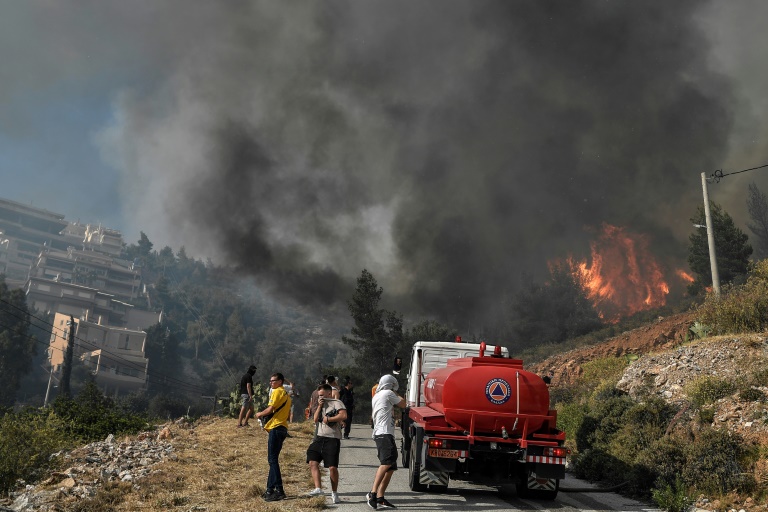
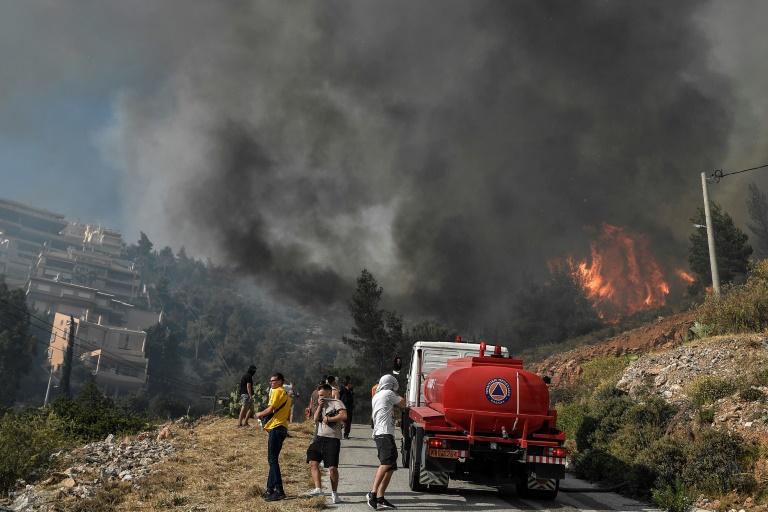
A wildfire whipped by gale-force winds blazed through vegetation in a southern suburb of Athens on Saturday, the fire brigade said, forcing residents to evacuate and damaging about 20 properties.

The Greek Civil Protection agency issued an emergency appeal via SMS for people to leave Ano Voula as the flames reached homes.

Officials reported no casualties but  four more neighbourhoods were evacuated as the wind changed direction and drove the fire front towards the town of Vari, Grigoris Konstantelos, the mayor of Voula, told Skai TV.

Kostantelos said around 20 houses were damaged.

Six water-bombing aircrafts, three helicopters and municipal water tankers supported dozens of firefighters with 20 fire engines.

“The situation is very difficult and the wind does not help,” said Giannis Konstantatos, mayor of  Ellinikon-Argiroupoli, a neighbouring municipality.

“The atmosphere is suffocating, we have difficulty breathing,” he told Athens News Agency.

Police told people to leave their homes in images broadcast by Ant1 TV.

The Fire Brigade told AFP that the wind has dropped a bit so they are hopeful that the fire will slow its pace. 

Skai TV showed footage of a burning house with flames licking inside. 

Giorgos Papanikolaou, the mayor of Glyfada, where the fire first broke out, said it began at a high voltage electricity power station, according to the agency.

Later in the afternoon, a second fire broke out near Athens, in the village of Kouvaras but residential areas were not under threat.

Late in the day, the Fire Brigade told AFP that the wind has dropped raising hopes the spread of the fire will slow.

Last summer, Greece’s most severe heatwave in decades, which authorities blamed on climate change, saw fires destroy more than 100,000 hectares of forest and farmland, the country’s worst wildfire damage since 2007. 

More than 200 firefighters and technical equipment provided by European Union countries will be soon deployed to Greece to help boost the battle against large wildfires.

Bulgaria, Finland, France, Germany, Romania and Norway will take part in the deployment, coordinated by the EU’s Civil Protection Mechanism.

Greece evacuates Athens suburb under wildfire threat

A wildfire whipped by gale-force winds blazed through vegetation in a southern suburb of Athens on Saturday, the fire brigade said, forcing residents to evacuate and damaging about 20 properties.

The Greek Civil Protection agency issued an emergency appeal via SMS for people to leave Ano Voula as the flames reached homes.

Officials reported no casualties but  four more neighbourhoods were evacuated as the wind changed direction and drove the fire front towards the town of Vari, Grigoris Konstantelos, the mayor of Voula, told Skai TV.

Kostantelos said around 20 houses were damaged.

Six water-bombing aircrafts, three helicopters and municipal water tankers supported dozens of firefighters with 20 fire engines.

“The situation is very difficult and the wind does not help,” said Giannis Konstantatos, mayor of  Ellinikon-Argiroupoli, a neighbouring municipality.

“The atmosphere is suffocating, we have difficulty breathing,” he told Athens News Agency.

Police told people to leave their homes in images broadcast by Ant1 TV.

The Fire Brigade told AFP that the wind has dropped a bit so they are hopeful that the fire will slow its pace. 

Skai TV showed footage of a burning house with flames licking inside. 

Giorgos Papanikolaou, the mayor of Glyfada, where the fire first broke out, said it began at a high voltage electricity power station, according to the agency.

Later in the afternoon, a second fire broke out near Athens, in the village of Kouvaras but residential areas were not under threat.

Late in the day, the Fire Brigade told AFP that the wind has dropped raising hopes the spread of the fire will slow.

Last summer, Greece’s most severe heatwave in decades, which authorities blamed on climate change, saw fires destroy more than 100,000 hectares of forest and farmland, the country’s worst wildfire damage since 2007. 

More than 200 firefighters and technical equipment provided by European Union countries will be soon deployed to Greece to help boost the battle against large wildfires.

Bulgaria, Finland, France, Germany, Romania and Norway will take part in the deployment, coordinated by the EU’s Civil Protection Mechanism.

Close Bitnami banner
Bitnami