World

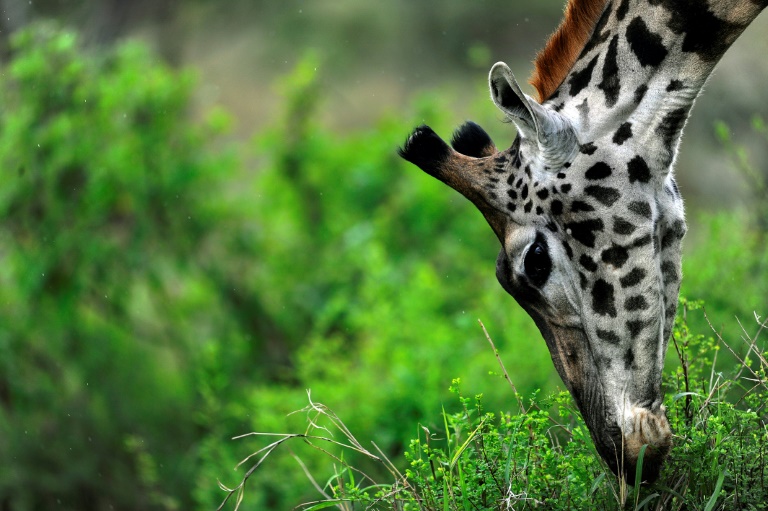
Tanzania lifts ban on wildlife exports

Tanzania is temporarily rolling back a ban on wildlife exports that was in force for six years to safeguard protected animals and birds in the east African nation, the wildlife service said.

The decision to lift the ban for an initial six months saw conservationists appeal for monitoring processes to guard against poaching, which has been in decline.

“The government has been assessing the business of exporting live wild animals since the ban was imposed and now it has lifted the ban,” Tanzania Wildlife Management Authority said in a statement late Friday.

Traders will have six months from June 6 to December 5 to “clear stocks of animals” that they were unable to sell under the ban, it added. 

Tanzania imposed the ban in 2016 under the authoritarian rule of then president John Magufuli, whose uncompromising leadership style saw him nicknamed “the Bulldozer”. 

The government at the time justified the ban because of “irregularities” in trade, including the shipment of protected animals abroad.

President Samia Suluhu Hassan has sought to break with some of Magufuli’s policies since she came to power last year following his sudden death.

Conservation group WWF cautioned that easing the ban should not undo gains made in protecting wildlife, such as triggering poaching which has been on a decline.

“Proper monitoring mechanisms and data are needed to back such kinds of decisions,” WWF country director Amani Ngusaru told AFP.

Tanzania is famed for its sandy beach archipelago of Zanzibar, wildlife safaris and Mount Kilimanjaro which are a lucrative draw for tourists. 

In 2010, at least 116 animals and 16 birds, some of them protected species, were illegally exported from Kilimanjaro airport in the north of the country aboard a Qatari plane.

They included at least four giraffes, several different types of antelope, hornbills and vultures, according to local media.

Britain to hold star-studded party for queen's jubilee

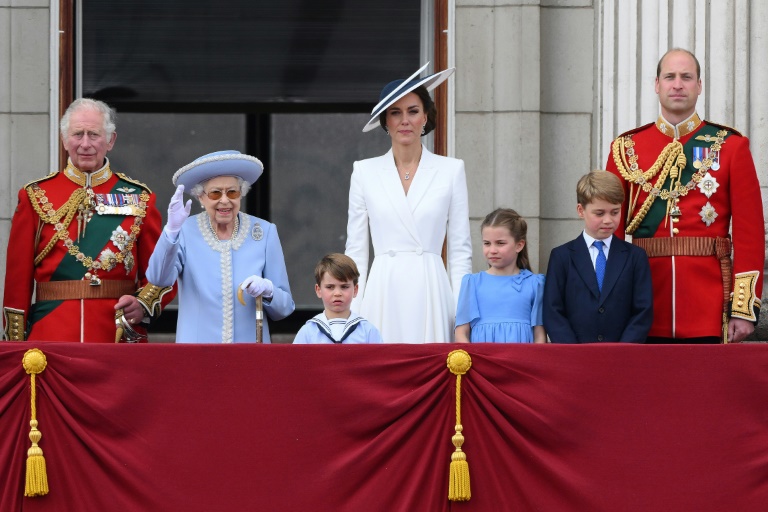
Britain geared up Saturday for a “party at the palace” concert starring Diana Ross and Andrea Bocelli, set to be watched by millions to celebrate Queen Elizabeth II’s 70 years on the throne.

The concert is the highlight of the third day of public events to mark the 96-year-old monarch’s record-breaking Platinum Jubilee with 22,000 people set to attend in person outside Buckingham Palace.

Motown legend Ross, performing for the first time in Britain in 15 years, is a star attraction at the event, to be held on a purpose-built 360-degree stage outside the queen’s central London residence.

Rockers Queen + Adam Lambert will open the concert, with Italian opera star Bocelli and James Bond composer Hans Zimmer also featuring in the line-up.

Other performers include Alicia Keys, Craig David and Rod Stewart, George Ezra and Eurovision 2022 runner-up Sam Ryder. Elton John has recorded a tribute.

The queen — the longest-reigning monarch in British history — is not expected to attend the two-and-a-half-hour event in person but will instead watch on television at Windsor Castle.

Her heir Prince Charles, 73, and his eldest son, Prince William, 39, will be in attendance.

On Thursday, the first day of celebrations, the queen made two public appearances to huge crowds from the Buckingham Palace balcony, and then travelled to Windsor to attend a beacon-lighting ceremony.

– Derby no-show –

The effort, after months battling difficulties walking and standing, left her in “some discomfort”, Buckingham Palace said.

On Friday, she withdrew from a church service of thanksgiving and also pulled out of attending the Epsom racecourse for the flat-racing showcase The Derby.

Her no-show at The Derby on Saturday is only the fourth time the keen horseracing fan, rider and breeder has missed the race since 1952.

She did not attend in 2020 as spectators were banned due to Covid.

Saturday’s concert will be broadcast live by the BBC on radio, television and online from 1900 GMT.

As an open-air event, all eyes will be on the skies and the fickle British weather to see if it can be spared downpours forecast later in the evening.

Jubilee celebrations began Thursday with the pomp and pageantry of the Trooping the Colour military parade to mark the sovereign’s official birthday.

Friday’s focus was the traditional Church of England service led by senior royals — and returning Prince Harry and his wife Meghan — in the hallowed surroundings of St Paul’s Cathedral.

– Lilibet birthday –

On Saturday, the queen wished her namesake great-granddaughter Lilibet a “very happy first birthday” on Twitter, after reportedly meeting Harry and Meghan’s second child for the first time in recent days.

The couple, who sensationally quit royal life in January 2020, now live in California. 

They are staying in Frogmore Cottage on the queen’s Windsor Castle estate while visiting Britain for the jubilee.

Britain made Thursday and Friday public holidays to mark the unprecedented landmark of the queen’s reign, which has focused attention on the monarchy’s future without her.

Longer pub opening hours, street parties and other events celebrating the queen’s central place in the life of most Britons have temporarily lifted the gloom of a soaring cost of living crisis.

Sunday will see more than 10 million people share food at “Big Jubilee Lunch” picnics and a musical and creative public pageant involving 10,000 people.

Ed Sheeran will round off the celebrations Sunday, singing his 2017 hit “Perfect” at the end of the pageant.

– ‘Part of my life’ –

Ross, who heads to the Glastonbury Festival this month after Saturday’s concert, said she was “absolutely delighted to receive an invitation to perform on such a momentous occasion”.

Charles has previously revealed that the 78-year-old diva’s disco hit “Upside Down” from 1980 was one of his favourite tracks.

Queen guitarist Brian May provided one of the most enduring images from the 2002 jubilee, playing “God Save the Queen” from the roof of Buckingham Palace.

British rocker Stewart, who received a knighthood in the queen’s 2016 birthday honours for services to music and charity, said Saturday’s gig was “nerve-wracking”.

“I’ve grown up with this woman. I was seven when she came to the throne,” the 77-year-old singer told the BBC on Friday.

“She’s always been part of my life.”

Hong Kong drives Tiananmen memories underground on anniversary

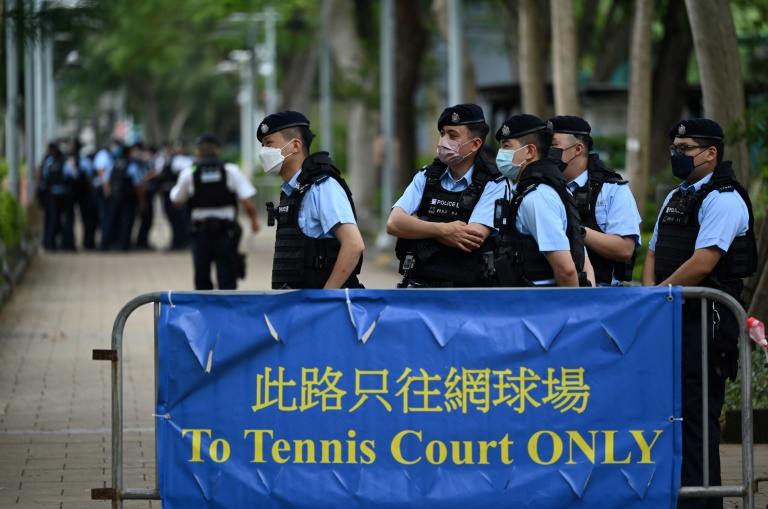
Hong Kong authorities strove on Saturday to stop any public commemoration of the 33rd anniversary of the Tiananmen crackdown, with police warning gatherings could break the law as China vies to remove all reminders of the deadly event. 

On June 4, 1989, Beijing sent troops and tanks to break up peaceful protests, crushing demonstrations calling for political change and curbs on official corruption.

Hundreds, by some estimates more than 1,000, were killed in the crackdown.

Discussion of what happened is all but forbidden on the mainland.

Semi-autonomous Hong Kong had been the one place in China where large-scale remembrance was still tolerated — until two years ago when Beijing imposed a national security law to snuff out dissent after huge pro-democracy protests in 2019. 

Authorities have warned the public that “participating in an unauthorised assembly” on Saturday risks a maximum penalty of five years’ imprisonment. 

They have also closed large parts of Victoria Park, once the site of packed annual candlelight vigils attended by tens of thousands.

– ‘Infringing individual freedom’ –

The park and nearby Causeway Bay shopping district were heavily policed Saturday, and multiple people were stopped and searched. 

One man, wearing a black T-shirt and carrying a white chrysanthemum, a sign of mourning, spoke to reporters after being searched. 

“The police warned me not to do anything to attract people to gather,” said the man, surnamed Lau. “But people are going to work and I am just passing by with a white chrysanthemum.” 

“This is infringing on Hong Kong people’s individual freedom.” 

Lau said he used to join the vigil every year. 

One former leader of the now-disbanded vigil organiser, Hong Kong Alliance, was surrounded by police as he walked around with a bunch of red and white roses, and his bag searched. 

Pedestrian areas where in the past pro-democracy groups would set up booths were cordoned off, and local media said some reporters had their information taken down and were restricted into a press area. 

“Keep going. Nothing to see here,” an officer told passersby through a loudspeaker. 

AFP journalists saw one man in a black T-shirt being taken away in a police van. 

The night before in the same area, a performance artist who whittled a potato into the shape of a candle and held a lighter to it was also taken away.

– ‘Scared of assembly’ –

Security was heightened in Beijing on Saturday as well, with officer numbers bulked up, and ID checks and facial recognition devices set up on roads leading to Tiananmen Square. 

China has gone to exhaustive lengths to erase the crackdown from collective memory, omitting it from history textbooks and scrubbing references to it from the Chinese internet and social media platforms.

A similar approach is now beginning to be applied to Hong Kong as authorities remould the city in the mainland’s image. 

Since last September, the Victoria Park vigil’s organisers have been arrested and charged with subversion, their June 4 museum has been closed, statues have been removed and memorial church services cancelled. 

Commemoration events in Macau were also cancelled this year.

“The government is so scared of any possible assembly,” said Dorothy, a 32-year-old coach who spoke to AFP near Victoria Park on Saturday morning. 

She said she had not been a regular attendee at the vigils, but that it was “a great loss for the society”. 

– ‘Memories systematically erased’ –

Multiple Western Consulate Generals in Hong Kong on Saturday posted Tiananmen tributes on social media, despite local media reports that they had been warned by the city’s Chinese foreign ministry office to refrain from doing so. 

The European Union’s office confirmed to AFP that they had received a call. 

US Secretary of State Antony Blinken on Saturday released a statement pledging to continue to “honour and remember those who stood up for human rights and fundamental freedoms”.

“While many are no longer able to speak up themselves, we and many around the world continue to stand up on their behalf,” he said, specifically mentioning the situation in Hong Kong. 

Vigils will be held globally, with rights group Amnesty International coordinating candlelit ones in 20 cities “to demand justice and show solidarity for Hong Kong”. 

One Hong Konger told AFP that in place of the Victoria Park vigil, she had lit a candle at home instead, and would walk around the city wearing a T-shirt with June 4 numerals as a more “subtle” form of remembrance.

“The collective memories of June 4 in Hong Kong are being systematically erased,” said Taiwanese President Tsai Ing-wen in a statement on Saturday. “But we believe that such coarse and unreasonable measures cannot wipe away people’s memories.” 

War in Ukraine: Latest developments

Here are the latest developments in the war in Ukraine.

– Fierce fighting in eastern city –

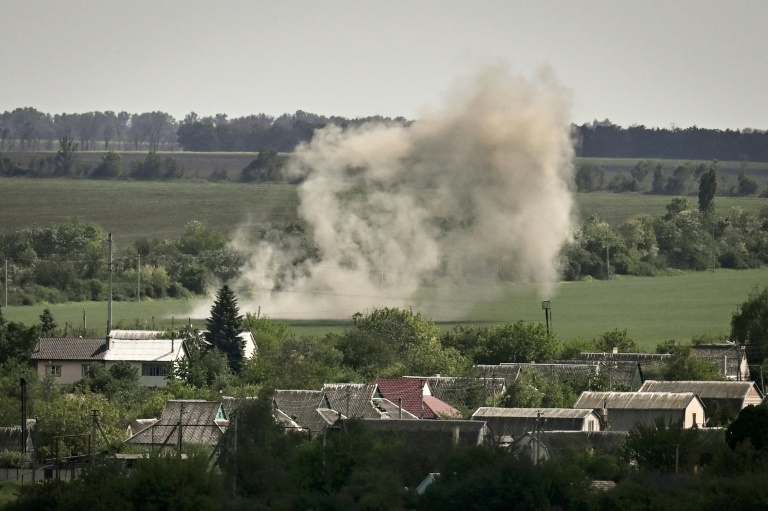
Russian artillery slams Ukraine’s eastern Donbas region with fierce fighting over the city of Severodonetsk, but the local governor says there was some progress in pushing back invading forces.

Gaining control of Severodonetsk would give Russia de-facto control of Lugansk, one of two regions along with Donetsk that make up the Donbas.

Russia claims it sent its forces into Ukraine to defend residents of two self-proclaimed Russian-backed statelets, the Donetsk and Lugansk People’s Republics.

“They (Russians) didn’t seize it fully,” says Lugansk regional governor Sergiy Gaiday.

“As soon as we get a big amount of Western long-range weapons, we will push their artillery back… and then Russian infantry will run.”

– ‘Many settlements liberated’: Kremlin –

Kremlin spokesman Dmitry Peskov says “many settlements have been liberated from the pro-Nazi armed forces of Ukraine and directly from nationalist elements” in the 100 days since the invasion.

“In terms of ensuring their protection, measures are being taken and certain results have been achieved,” Peskov says.

“The opportunity has been provided for people to start establishing a peaceful life,” Peskov tells reporters.

– Putin made ‘historic’ error –

French President Emmanuel Macron says his Russian counterpart Vladimir Putin committed a “historic and fundamental error” by invading Ukraine.

“I think he has isolated himself,” Macron tells French media. 

The French president insists that Russia should not be “humiliated… so that the day the fighting stops we can pave a way out through diplomatic means.”

Macron says he does not “rule out” a visit to Kyiv.

– AU head ‘reassured’ on food shortages –

African Union head Macky Sall says he was “reassured” after talks with Putin on food shortages caused by Moscow’s military campaign in Ukraine.

Putin hosted the Senegalese president, who chairs the African Union, at his Black Sea residence in Sochi. 

Putin says there was “no problem” to export grain from Ukraine, saying it could be done via Ukrainian ports, via others under Russian control, or even through central Europe.

Russian Foreign Minister Sergei Lavrov is expected in Turkey next Wednesday for talks on creating a “security corridor” to unblock exports from Ukraine.

– Ukraine says Russia sent ‘stolen’ grain abroad –

Ukraine’s ambassador to Ankara accuses Russia of “stealing” Ukrainian grain and sending it abroad.

“Russia shamelessly steals Ukrainian grain and sends it overseas from Crimea, including to Turkey,” said envoy Vasyl Bodnar.

“We have asked for Turkey’s help to resolve the issue,” he says.

– EU sanctions alleged Putin girlfriend –

The EU adds President Vladimir Putin’s alleged girlfriend, former gymnast Alina Kabaeva, to an assets freeze and visa ban blacklist as part of a sixth wave of sanctions that include a ban on most Russian oil imports.

Britain was the first country to put Kabaeva on its sanctions list last month.

burs-arp/lcm/ach 

Bosphorus sea trade unaffected by Ukraine war, sanctions

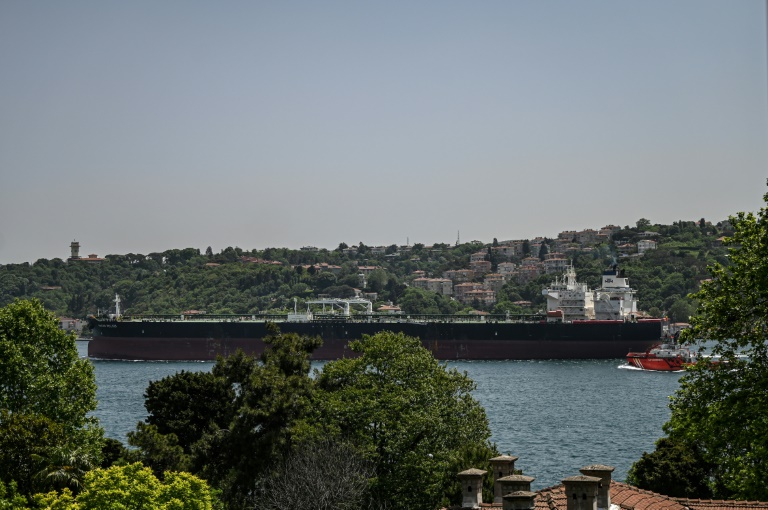
At the gates of the Black Sea, trade is in full swing as freighters and oil tankers sail from the heart of Istanbul to Russian and Ukrainian ports. 

Just after the Russian offensive in Ukraine on February 24 and the first Western sanctions, the largest vessels of international companies plying on these waters were replaced by smaller ships.

The total number of ships on the route remains around the pre-war level of 40,000, according to experts.

“Russia shamelessly steals Ukrainian grain and sends it overseas from Crimea, including to Turkey,” said Vasyl Bodnar, Ukraine’s ambassador to Ankara.

“In May alone, we counted at least 10 passages including two round trips from three vessels flying the Russian flag… Not to mention those that we would have collectively missed.”

From his terrace overlooking the Bosphorus, Yoruk Isik has been a passionate observer of ship movements on this key waterway between the Black Sea and the Mediterranean for a decade now.

While swiftly condemning the Russian offensive in Ukraine, Turkey positioned itself as a neutral mediator and refused to join Western sanctions against Moscow. 

Although Ankara has banned the passage of military vessels through its straits of the Dardanelles and Bosphorus since late February under the Montreux Treaty of 1936, it is not legally entitled to intercept commercial ships or to search them, a diplomatic source said in Ankara.

“We don’t follow the ships on their way out of the Straits. We monitor them 10 kilometres before they enter and 10 kilometres after they leave,” the source said on condition of anonymity.

Elizabete Aunina, a researcher at Amsterdam University, said: “If we look at the vague words of the Montreux treaty it leaves a lot up for interpretation. 

“It did not foresee that merchant vessels could be carrying stolen goods… Turkey has before showed a certain commitment to stick to the very basic interpretation of the Convention as a way to also protect itself from entering deeper into the conflict”.

The European Union imposed an embargo on Russian imports but tankers flying the Greek or Maltese flags are seen sailing through the Bosphorus up to the Black Sea to the Russian ports. 

– Maritime corridors – 

Thanks to real-time tracking applications, a strong network of observers, Russian and Ukrainian activists and satellite images, no vessel escapes Isik’s radar. 

“We can see from end to end, where the ship is getting loaded by the ship,” he said. 

Some freighters loaded the wheat in Ukrainian ports under Russian blockade such as Odessa, Chornomorsk or Mariupol, he said. 

The destination?  Syria — where Russia retains an operational base — and then Lebanon or Egypt.

Isik also identified a flotilla of old Turkish boats, “never seen before in the area” suddenly appearing under a flag of convenience in the Russian port of Novorossiysk — “likely under contract with the Russian government”.

He lists a few names: Kocatepe (now Tanzanian), Barbaros (Equatorial Guinea), Hizir (Malta) and Sampiyon Trabzonsport (Cameroon).

Russian Foreign Minister Sergei Lavrov will visit Turkey on Wednesday to discuss a possible establishment of “sea corridors” — although Ukrainian wheat is being covertly exported to Russia’s benefit, according to experts. 

“This is the information we get but we cannot stop, or check, or question the intention of any cargo ship except if we feel a threat to  Turkish peace or security,” the diplomatic source said. 

But for Isik who keeps the list of cargo ships belonging to the Russian defence ministry and those of private companies operating on its behalf, “what is happening is unacceptable”.

– EU mulling tighter sanctions –

Before the war, Ukraine was on track to becoming the world’s third biggest exporter of wheat and many countries in Africa and the Middle East depend on it.

“If Russia exports Ukrainian products, nobody authorises Turkey to stop the vessels,” said Yucel Acer, professor of international law at the University of Ankara, adding “unless there is a United Nations resolution” — a futile move as long as Russia holds a veto power in the Security Council.

Without openly admitting it, the European Commission has found holes in the current sanctions regime and is preparing to tighten the screws again, said a source in Brussels.

These foresee a new set of sanctions targeting Moscow plans to deprive the European operators of their insurance if their vessels are caught red-handed.

“Most of these vessels are covered by European and British insurance: with this new package, they will no longer be able to use them,” said the source.

“This should have a significant impact.”

But Turkey could do more, said Aunina, from Amsterdam university.

“Following the annexation of Crimea, Turkey technically banned ships from Crimea in its ports: This could be done as well!”

Saudi receives first foreign hajj pilgrims since before pandemic

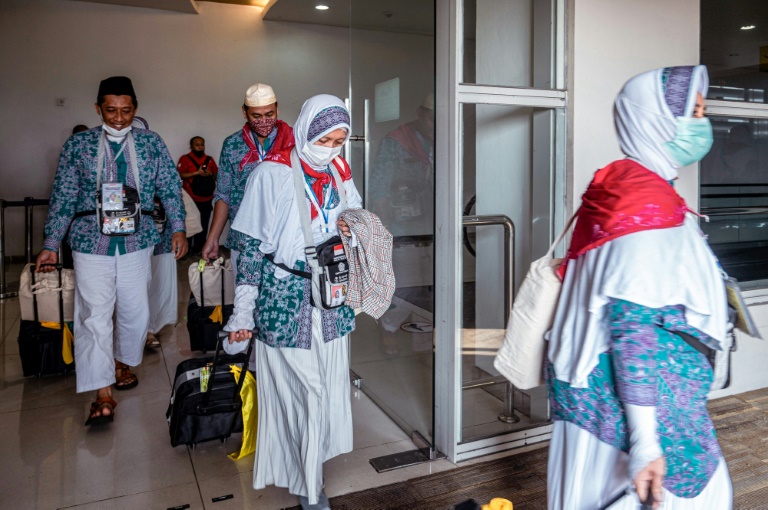
Saudi Arabia on Saturday welcomed its first batch of hajj pilgrims since before the coronavirus pandemic, which prompted authorities to sharply restrict the annual ritual. 

The group from Indonesia landed in the city of Medina and was set to travel south to the holy city of Mecca in the coming weeks to prepare for the hajj next month, state media reported. 

“Today we received the first group of this year’s pilgrims from Indonesia, and the flights will continue from Malaysia and India,” Mohammed al-Bijawi of the country’s Hajj Ministry told the state-run Al-Ekhbariya channel. 

“Today we are happy to receive the guests of God from outside the kingdom, after a two-year interruption due to the pandemic,” he added, describing Saudi Arabia as “fully prepared” to accommodate them.

One of the five pillars of Islam, the hajj must be undertaken by all Muslims who have the means at least once in their lives. 

Usually one of the world’s largest religious gatherings, about 2.5 million people participated in 2019. 

But after the onset of the pandemic in 2020, Saudi authorities announced they would only let 1,000 pilgrims take part. 

The following year, they increased the total to 60,000 fully vaccinated Saudi citizens and residents chosen through a lottery. 

Barring overseas pilgrims caused deep disappointment among Muslims worldwide, who typically save for years to take part.

In April, the kingdom announced it would permit one million Muslims from inside and outside the country to participate in this year’s hajj, which will take place in July. 

The hajj consists of a series of religious rites that are completed over five days in Islam’s holiest city, Mecca, and surrounding areas of western Saudi Arabia. 

Hosting the hajj is a matter of prestige for Saudi rulers, as the custodianship of Islam’s holiest sites is the most powerful source of their political legitimacy. 

Before the pandemic, Muslim pilgrimages were major revenue earners for the kingdom, bringing in about $12 billion annually. 

This year’s pilgrimage will be limited to vaccinated Muslims under age 65, the hajj ministry has said. 

Those coming from outside Saudi Arabia, who must apply for hajj visas, are required to submit a negative Covid-19 PCR result from a test taken within 72 hours of travel.

Hong Kong drives Tiananmen memories underground on anniversary

Hong Kong authorities on Saturday strove to stop any public commemoration of the 33rd anniversary of the Tiananmen crackdown, with police warning gatherings could break the law as Beijing vies to remove all reminders of the events of June 4. 

On that day in 1989, the government sent troops and tanks to break up peaceful protests, crushing a weeks-long wave of demonstrations calling for political change and curbs on official corruption.

Hundreds, by some estimates more than 1,000, were killed in the crackdown.

Discussion of what happened is highly sensitive to China’s communist leadership, and is all but forbidden on the mainland.

Semi-autonomous Hong Kong had been the one place in China where large-scale remembrance was still tolerated — until two years ago when Beijing imposed a national security law to snuff out dissent after huge pro-democracy protests in 2019. 

Authorities warned the public on Friday that “participating in an unauthorised assembly” risked a maximum penalty of five years’ imprisonment. 

They also closed large parts of Victoria Park, once the site of packed annual candlelight vigils attended by tens of thousands.

One woman told AFP she had lit a candle at home instead and placed a replica of the Goddess of Democracy statue, the original of which stood in Tiananmen Square in 1989, on her windowsill. 

“For me and many Hong Kongers of my generation, June 4 was our political enlightenment,” said the 49-year-old public relations professional, who used to volunteer for the vigil’s organisers. 

On Saturday, she said she would walk around the city wearing a t-shirt with June 4 numerals as a more “subtle” form of commemoration, given the legal risks.

– Heightened security –

China has gone to exhaustive lengths to erase the crackdown from collective memory, omitting it from history textbooks and scrubbing references to it from the Chinese internet and social media platforms.

On Saturday, authorities in Beijing had set up facial recognition devices at roads leading to Tiananmen Square and stopped passersby to check their identification. 

The security presence in the area was noticeably bulked up, with two to three times the regular number of officers visible.

In Hong Kong too, the area around Victoria Park was heavily policed, with long lines of security vehicles parked next to it. 

On Friday night, in the nearby bustling Causeway Bay shopping district, a performance artist who whittled a potato into the shape of a candle and held a lighter to it was surrounded by more than a dozen officers and taken away in a police van, an AFP reporter saw.

Police later said they had arrested a 31-year-old woman for “disorderly conduct in a public place”.

“The government is so scared of any possible assembly,” said Dorothy, a 32-year-old coach who spoke to AFP near the park on Saturday morning. 

She said she had not been a regular attendee at the vigils, but that it was “a great loss for the society”. 

“The most profound impact is on the younger generations as the vigil used to be a window to let them know that such an appalling incident took place in China,” she added.

– ‘Memories systematically erased’ –

In a period of months, decades of commemorations have been wiped from Hong Kong. 

Since last September, the vigil’s leaders have been arrested and charged with subversion, their June 4 museum has been closed, statues have been removed, and memorial church services cancelled. 

Commemoration events in Macau were also cancelled this year.

US Secretary of State Antony Blinken on Saturday released a statement pledging to continue to “honour and remember those who stood up for human rights and fundamental freedoms”.

“While many are no longer able to speak up themselves, we and many around the world continue to stand up on their behalf and support their peaceful efforts to promote democracy and the rights of individuals,” he said, specifically mentioning the situation in Hong Kong. 

Multiple Western Consulate Generals in Hong Kong on Saturday posted Tiananmen tributes on social media as well.  

“The collective memories of June 4 in Hong Kong are being systematically erased,” said Taiwanese President Tsai Ing-wen in a statement. “But we believe that such coarse and unreasonable measures cannot wipe away people’s memories.”
Vigils will be held globally, with rights group Amnesty International coordinating candlelit ones in 20 cities “to demand justice and show solidarity for Hong Kong”. 

At Victoria Park on Saturday morning, photographer Kityee was confident that people would not forget the events of 1989. 

“I think most people will not insist on coming here in defiance,” she said. 

“But they will find their own ways of commemoration.”

More than 700 monkeypox cases globally, 21 in US: CDC

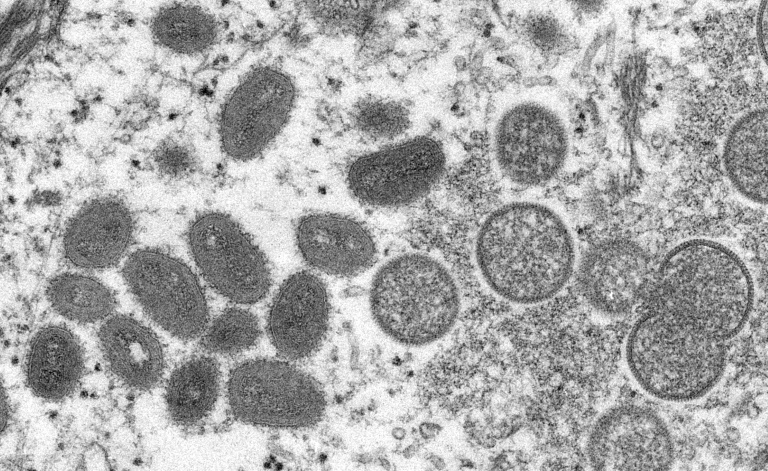
The US Centers for Disease Control and Prevention (CDC) said Friday it was aware of more than 700 global cases of monkeypox, including 21 in the United States, with investigations now suggesting it is spreading inside the country.

Sixteen of the first 17 cases were among people who identify as men who have sex with men, according to a new CDC report, and 14 were thought to be travel associated.

All patients are in recovery or have recovered, and no cases have been fatal.

“There have also been some cases in the United States that we know are linked to known cases,” Jennifer McQuiston, deputy director of the CDC’s Division of High Consequence Pathogens and Pathology, told reporters on a call. 

“We also have at least one case in the United States that does not have a travel link or know how they acquired their infection.”

Monkeypox is a rare disease that is related to but less severe than smallpox, causing a rash that spreads, fever, chills, and aches, among other symptoms.

Generally confined to western and central Africa, cases have been reported in Europe since May and the number of countries affected has grown since.

Canada also released new figures Friday, counting 77 confirmed cases — almost all of them detected in Quebec province, where vaccines have been delivered.

Though its new spread may be linked to particular gay festivals in Europe, monkeypox is not thought to be a sexually transmitted disease, with the main risk factor being close skin-to-skin contact with someone who has monkey pox sores. 

A person is contagious until all the sores have scabbed and new skin is formed. 

– ‘More than enough vaccine’ –

Raj Panjabi, senior director for the White House’s global health security and biodefense division, added that 1,200 vaccines and 100 treatment courses had been delivered to US states, where they were offered to close contacts of those infected.

There are currently two authorized vaccines: ACAM2000 and JYNNEOS, which were originally developed against smallpox. 

Though smallpox has been eliminated, the United States retains the vaccines in a strategic national reserve in case it is deployed as a biological weapon. 

JYNNEOS is the more modern of the two vaccines, with fewer side effects.

“We continue to have more than enough vaccine available,” Dawn O’Connell, assistant secretary for preparedness and response in the Department of Health and Human Services, told reporters. 

In late May, the CDC said it had 100 million doses of ACAM200 and 1,000 doses of JYNNEOS available, but O’Connell said Friday the figures had shifted, though she could not divulge precise numbers for strategic reasons.

The CDC has also authorized two antivirals used to treat smallpox, TPOXX and Cidofovir, to be repurposed to treat monkeypox.

“Anyone can get monkeypox and we are carefully monitoring for monkeypox that may be spreading in any population, including those who are not identifying as men who have sex with men,” said McQuiston. 

That being said, the CDC is undertaking special outreach in the LGBT community, she added.

A suspected case “should be anyone with a new characteristic rash,” or anyone who meets the criteria for high suspicion such as relevant travel, close contact, or being a man who has sex with men. 

Dutch port's rooftop walk shows post-climate future

As one of the world’s most densely populated countries grapples with climate change, the Dutch are taking to their rooftops.

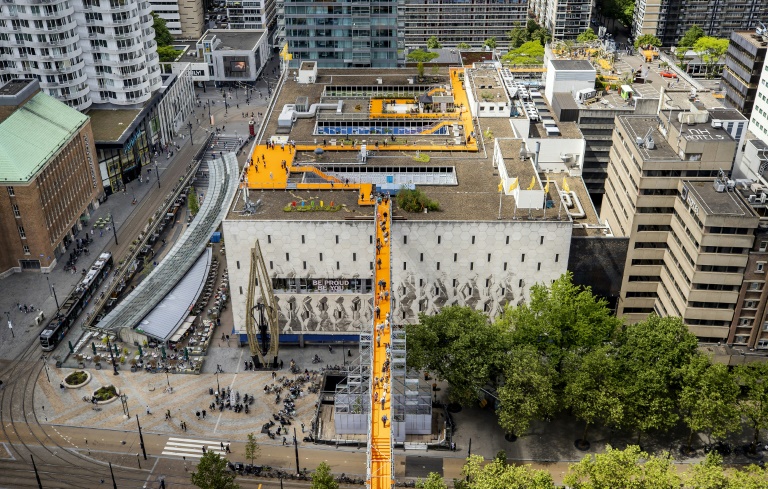
An organisation in the port city of Rotterdam has built a skywalk linking the roofs of the downtown shopping area to show what the future might look like.

From a village to food cultivation and rainwater storage areas, the “Rooftop Days” association is showing how to unlock the unused space of Europe’s biggest port.

“We want people to experience how great it is to be on a rooftop and what space we have there above the city,” Rooftop Days director Leon van Geest told AFP.

“We are only using three percent of the full potential of the flat rooftops that we have here in our city.”

The bright orange skywalk runs for some 600 metres (1,969 feet), with a heart-stopping “airbridge” section linking the city’s World Trade Centre to a department store, at 29.5 metres above street level.

The walk, which is open until June 24, also features wind turbines, solar panels, art galleries and a drone landing pad. 

If the city authorities give approval for a full-scale rooftop village in future, it is expected to include crops and tiny houses built of sustainable materials. 

– ‘Unique opportunity’ –

With around a third of its land lying below a sea level that creeps higher each year, the Netherlands has become a world leader in adapting to climate change.

The urgency is even greater for the Dutch given that the nation’s 17 million inhabitants are squeezed into Europe’s most densely populated country after tiny Monaco, the Vatican City, Malta and San Marino.

Known for its architectural daring in the decades after it was flattened during World War II, Rotterdam itself is something of a pioneer for the Netherlands, which only uses some 1.8 percent of its roof space. 

Transforming the city could take decades but van Geest says he is “convinced that this will become a reality”.

As the Dutch population becomes increasingly urban, “space is becoming a rare commodity in the city, so we will have to exploit the roof”, he added.

Rotterdammers are enjoying the change of perspective.

“It is a unique opportunity to see Rotterdam from a higher distance,” approved 69-year-old resident Harry Schouten. 

– ‘Intensive rooftops’ –

The “Rooftop Days” have been going on for six years and the latest highlights some of the most successful ideas for a climate-adapted future. 

These include the “Rooftop Field”, a 1,000-square-metre area on the sixth floor of a building which grows vegetables, fruit and edible flowers.

Founder Emile van Rinsum, director of the Rotterdam Environment Centre, said his organisation created the field nearly 10 years ago on the roof of the building where their offices are located.

“It’s really nice” to work a few staircases away from such a green space in the heart of the Netherlands’ second city, he said.

One of its main purposes is for storing water, as climate change makes seasonal rainfall levels increasingly unpredictable.

“On this roof, we can already store 60,000 litres of water,” Van Rinsum said.

Part of the produce grown there is delivered to eateries in Rotterdam, while a restaurant set up near the field is proving “very popular”.

“We call them ‘intensive rooftops’ on which you can walk or, for example, grow food as we do, and that is very important for a city,” he said.

Floods kill at least three in Cuba

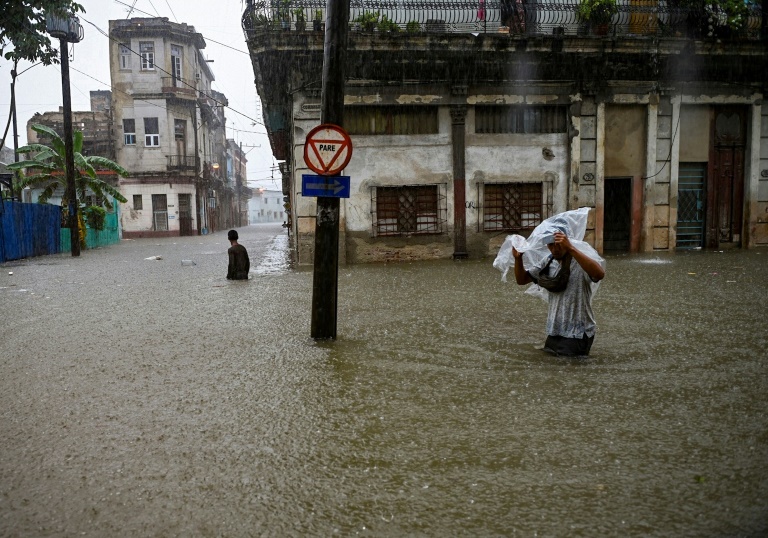
Heavy rains from the remnants of Hurricane Agatha flooded much of western Cuba on Friday, killing at least three people in Havana.

Thousands of residents in the region lost power and a man in Pinar del Rio province also was missing, Cuban officials said.

“Strong, heavy rain and electrical storms have been affecting the western and central regions of Cuba with accumulations greater than 200 millimeters (eight inches), which will continue for the rest of today and tomorrow, Saturday,” the Cuban Weather Office (INSMET) said.

A 44-year-old man, initially thought missing, was found dead Friday evening in the western province of Pinar del Rio after falling into a stream, according to local news site CubaDebate.

They also reported the disappearance of another person in the region.

Agatha had crashed into southern Mexico with the potential to redevelop as a tropical storm in the Atlantic, the Miami-based US National Hurricane Center had said.

So far, heavy rains “have produced floods in localities from Pinar del Rio (western extreme) to Sancti Spiritus (Center) and in the Isla de la Juventud Special Municipality (south of Havana),” INSMET said.

With parts of the capital flooding, state media images showed rescuers in areas of central Havana evacuating people in canoes. 

Nearly 2,000 people have decided to evacuate their homes, authorities say, while about 50,000 customers in the province of Havana are without electricity.

“People are almost waist-deep in water,” said Luis Antonio Torres, first secretary of the Communist Party of Cuba (PPC) in the capital.

He had visited the municipality of Cerro, one of the most damaged areas, where at least one bridge fell and floodwaters seeped into some homes.

The Atlantic hurricane season begins each year on June 1 and ends on November 30, for the North Atlantic, the Gulf of Mexico and the Caribbean. 

Close Bitnami banner
Bitnami