World

Floods kill at least three in Cuba

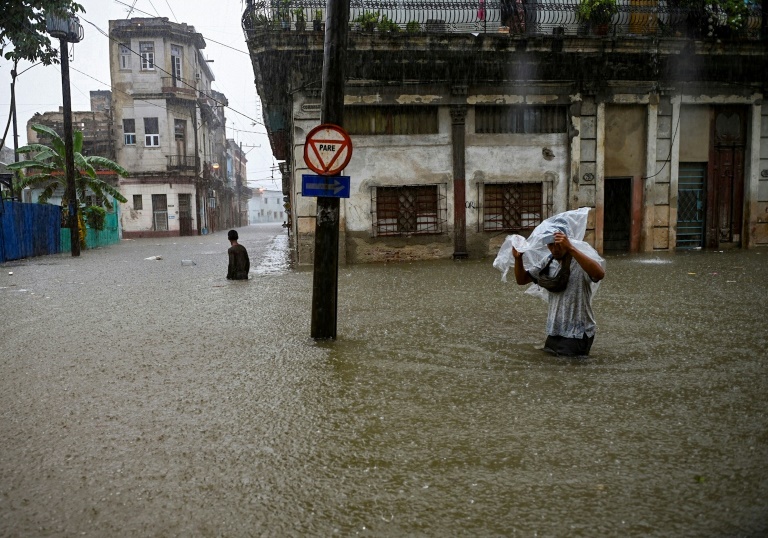
Heavy rains from the remnants of Hurricane Agatha flooded much of western Cuba on Friday, killing at least three people in Havana.

Thousands of residents in the region lost power and a man in Pinar del Rio province also was missing, Cuban officials said.

“Strong, heavy rain and electrical storms have been affecting the western and central regions of Cuba with accumulations greater than 200 millimeters (eight inches), which will continue for the rest of today and tomorrow, Saturday,” the Cuban Weather Office (INSMET) said.

A 44-year-old man, initially thought missing, was found dead Friday evening in the western province of Pinar del Rio after falling into a stream, according to local news site CubaDebate.

They also reported the disappearance of another person in the region.

Agatha had crashed into southern Mexico with the potential to redevelop as a tropical storm in the Atlantic, the Miami-based US National Hurricane Center had said.

So far, heavy rains “have produced floods in localities from Pinar del Rio (western extreme) to Sancti Spiritus (Center) and in the Isla de la Juventud Special Municipality (south of Havana),” INSMET said.

With parts of the capital flooding, state media images showed rescuers in areas of central Havana evacuating people in canoes. 

Nearly 2,000 people have decided to evacuate their homes, authorities say, while about 50,000 customers in the province of Havana are without electricity.

“People are almost waist-deep in water,” said Luis Antonio Torres, first secretary of the Communist Party of Cuba (PPC) in the capital.

He had visited the municipality of Cerro, one of the most damaged areas, where at least one bridge fell and floodwaters seeped into some homes.

The Atlantic hurricane season begins each year on June 1 and ends on November 30, for the North Atlantic, the Gulf of Mexico and the Caribbean. 

Ukraine claims Russian forces pushed back in east in fierce fighting

Russian artillery slammed Ukraine’s eastern Donbas region with fierce fighting over the city of Severodonetsk, but the local governor said there was some progress in pushing back invading forces.

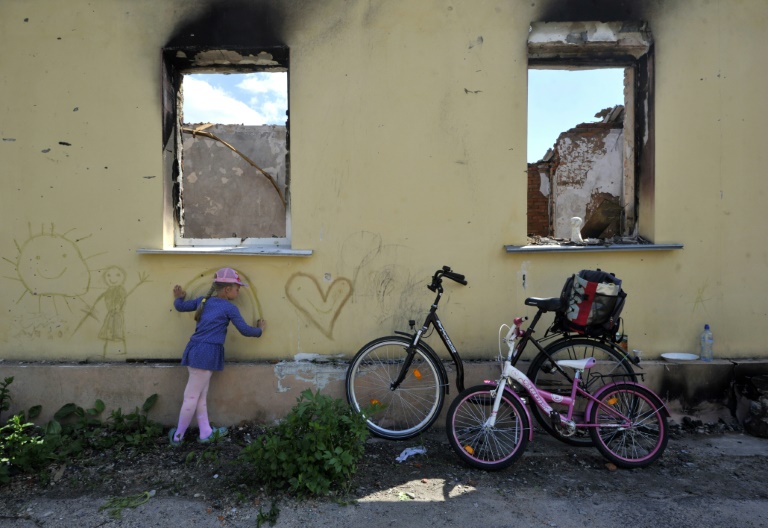
More than 100 days since President Vladimir Putin ordered Russian troops into Ukraine, thousands of people have been killed, millions sent fleeing and towns turned into rubble.

The advance of Russian forces has been slowed by stiff Ukrainian resistance, repelling them from around the capital Kyiv and forcing Moscow to focus on capturing the east, including the Donbas.

Some of the fiercest fighting has been centred on Severodonetsk, where Ukrainian troops are resisting a complete takeover.

“They (Russians) didn’t seize it fully,” Lugansk regional governor Sergiy Gaiday said Friday, saying the invading forces had been pushed back “20 percent”.

“As soon as we get a big amount of Western long-range weapons, we will push their artillery back… and then Russian infantry will run.”

Ukrainian troops were still holding an industrial zone in Severodonetsk, Gaiday had said, a scenario reminiscent of Mariupol, where a steelworks was the port city’s last holdout.

The situation in Lysychansk — Severodonetsk’s twin city, which sits just across a river — looked increasingly dire.

About 60 percent of infrastructure and housing had been destroyed, while internet, mobile networks and gas services had been knocked out, said its mayor Oleksandr Zaika.

In the city of Sloviansk, about 80 kilometres (50 miles) from Severodonetsk, the mayor has urged residents to evacuate in the face of intense bombardment, with water and electricity cut off.

“The situation is getting worse,” student Gulnara Evgaripova told AFP as she boarded a minibus to leave the city.

Ekaterina Perednenko, a paramedic, said: “I am scared that there will be nothing to come back to.”

– ‘Shame and hatred’ –

Russian troops now occupy a fifth of Ukraine’s territory and Moscow has imposed a blockade on its Black Sea ports.

But Ukrainian President Volodymyr Zelensky was defiant on Friday.

“Victory will be ours,” he said in a video speech.

Later, in his nightly address, he dismissed the Russian army. 

“At first it looked threatening. Then dangerous… And now probably just a bitter smile,” he said.

“Because what’s left of it? … War crimes, shame and hatred.”

But Kremlin spokesman Dmitry Peskov said “certain results have been achieved”, pointing to the “liberation” of some areas from what he called the “pro-Nazi armed forces of Ukraine”.

The West has sent ever-more potent weapons to Ukraine and piled on ever more stringent sanctions against Moscow, with the European Union on Friday formally adopting a ban on most Russian oil imports.

Putin’s alleged girlfriend, former gymnast Alina Kabaeva, was also added to an assets freeze and visa-ban blacklist.

– Food crisis –

The war has sparked fears of a global food crisis — Ukraine and Russia are among the top wheat exporters in the world.

The United Nations said it was leading intense negotiations with Russia to allow Ukraine’s grain harvest to leave the country.

Putin in a televised interview Friday said there was “no problem” to export grain from Ukraine, via Kyiv- or Moscow-controlled ports or even through central Europe.

The UN has warned that African countries, which imported more than half of their wheat consumption from Ukraine and Russia, face an “unprecedented” crisis.

Food prices in Africa have already exceeded those in the aftermath of the 2011 Arab Spring uprisings and the 2008 food riots.

On Friday, Putin met the head of the African Union, Senegalese President Macky Sall, at his Black Sea residence in Sochi.

After the meeting, Sall said he was “very reassured”, adding that Putin was “committed and aware that the crisis and sanctions create serious problems for weak economies”.

French President Emmanuel Macron, meanwhile, said Putin had made a “historic” error in starting the war.

But he said the Russian leader should not be “humiliated”, and to leave room for diplomacy.

– Media driver killed –

A driver transporting two Reuters journalists in eastern Ukraine was killed and the two reporters were lightly wounded, a spokesman for the international news agency said.

A French volunteer fighter in Ukraine was also killed in combat, the French foreign ministry said Friday.

In areas around the capital Kyiv, which Russian troops retreated from at the end of March, some residents remain in desperate need of assistance.

At an aid distribution point in Horenka, northwest of Kyiv, a tearful Hanna Viniychuk, 67, said she had come for some basic necessities after losing her home to Russian bombardment.

“I’m grateful for this help,” she said.

burs-qan/mtp

Myanmar villagers accuse junta troops of burning spree

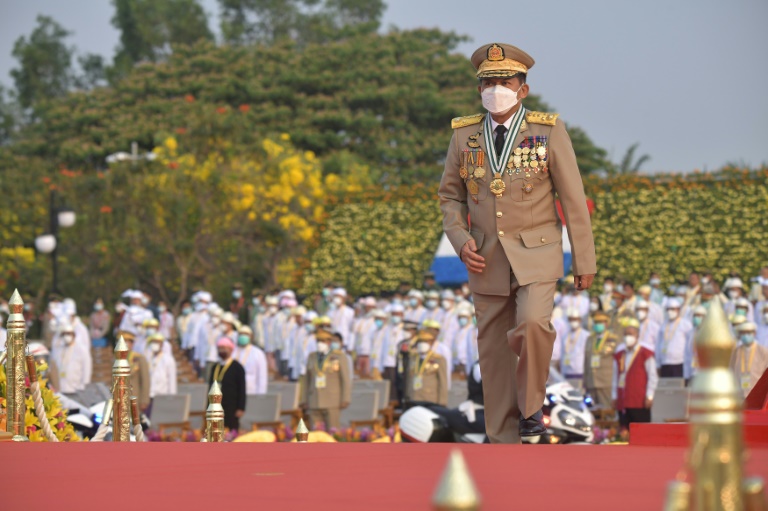
Myanmar junta troops have torched hundreds of buildings during a three-day raid in the country’s north, local media and residents said, as the military struggles to crush resistance to its rule.

The Sagaing region has seen fierce fighting and bloody reprisals since the coup last year, with local “People’s Defence Force” (PDF) members clashing regularly with junta troops.

Analysts say the informal militia has surprised junta forces with its effectiveness, and the military has on numerous occasions called in air strikes to support its troops on the ground.

Troops torched hundreds of buildings in the villages of Kinn, Upper Kinn and Ke Taung over three days last week, locals and media reports said. 

On May 26, villagers in Kinn fled as soldiers approached and began shooting into the air, said one resident who requested anonymity.  

“The next morning we saw smoke rising from our village before they left. 

“Over 200 houses were burned down… my house was totally burned down, only the concrete foundation is left.”

Drone footage purporting to show the aftermath obtained by AFP showed columns of smoke rising into the sky from the villages, set along a roughly eight-kilometre stretch of the Chindwin river.

A health clinic seen in the video matched the geolocation of one in Ke Taung village.

AFP digital verification reporters confirmed the footage had not appeared online before last week but could not independently verify reports from the region. 

Soldiers “raided and destroyed our houses”, said Ke Taung villager Aye Tin, who requested to use a pseudonym.  

“And they also burned motor boats that we use for transport and for carrying food for our village, including my boat.

“My life is ruined, as I have lost my home… and I nothing left to do for a living.”

Satellite images from US space agency NASA showed fires in locations that matched Ke Taung and Kinn villages last week. 

The junta has previously rebuffed claims its troops have torched houses, accusing “terrorist” PDF fighters of starting the fires.

In a speech on Tuesday, junta chief Min Aung Hlaing said “efforts were made to minimise the casualties as much as possible in performing the counterattacks to terror acts.” 

“Now, the country is in tranquillity,” he said, according to state newspaper the Global New Light of Myanmar.  

China, Hong Kong scrub Tiananmen memories on anniversary

There was heightened security around Beijing’s Tiananmen Square Saturday, anniversary of the bloody 1989 crackdown, while police in Hong Kong warned people not to gather as China strives to remove all reminders of the events of June 4.

Discussion of the crackdown is highly sensitive to China’s communist leadership.

It has gone to exhaustive lengths to erase Tiananmen from collective memory, omitting it from history textbooks and censoring online discussion.

On June 4, 1989, the government sent troops and tanks to break up peaceful protests, crushing a weeks-long wave of demonstrations calling for political change and curbs on official corruption.

Hundreds, by some estimates more than 1,000, were killed in the crackdown.

On Saturday, authorities in Beijing had set up facial recognition devices at roads leading to the square and stopped passersby to check their identification, including a large group of cyclists who were made to individually scan their ID cards. 

The police presence in the area was noticeably heavier than normal, with two to three times the regular number of officers visible on Saturday morning.

References to June 4 were scrubbed from Chinese social media platforms.

On Twitter, which is blocked in China, US Secretary of State Antony Blinken said it had been 33 years “since the world watched brave demonstrators and bystanders peacefully demand democracy in Tiananmen Square”. 

“Despite the removal of memorials and attempts to erase history, we honor their memory by promoting respect for human rights wherever threatened,” he wrote. 

– Hong Kong commemorations stifled –

Semi-autonomous Hong Kong had been the one place in China where large-scale remembrance was still tolerated — until two years ago when Beijing imposed a national security law to snuff out dissent after huge pro-democracy protests in 2019. 

The drive to remove all trace of Tiananmen from the city has intensified over the past year in particular. 

Authorities warned the public on Friday that “participating in an unauthorised assembly” risked breaking the law and carried a maximum penalty of five years’ imprisonment.

Large parts of Victoria Park, the site of a once annual candlelit vigil attended by tens of thousands, were closed off on the eve of the anniversary. 

In the nearby bustling Causeway Bay shopping district, a performance artist who whittled a potato into the shape of a candle and held a lighter to it was surrounded by more than a dozen officers and taken away in a police van, an AFP reporter saw.

Police later said they had arrested a 31-year-old woman for “disorderly conduct in a public place”. 

The Hong Kong Alliance, the vigil’s organiser, has been prosecuted as a “foreign agent” over incitement to subversion.

Last September, its leaders were arrested, their museum shuttered after a police raid and their digital records of the crackdown erased. 

– ‘A privilege to mourn’ –

The lack of clarity over where exactly Hong Kong’s red lines lie has made many fall in line.

Six universities have removed June 4 monuments that had stood on their campuses for years. Just before Christmas last year, three were whisked away within 48 hours.

Annual Catholic memorial masses, one of the last ways for Hongkongers to come together publicly to remember, were cancelled this year, with organisers saying they did not want to breach the law. 

Commemoration events in Macau were also cancelled, with organisers blaming the “worsening environment in Macau politics”.

The space for remembering the crackdown publicly now lies outside China, with exiled dissidents setting up their own museums in the United States and activists planning to resurrect the Pillar of Shame, one of the removed university statues, in Taiwan.

The US and Australian Consulate Generals in Hong Kong on Saturday posted Tiananmen tributes on social media, with the former changing its Facebook cover photo to the Pillar. 

On June 4, vigils will be held globally, with rights group Amnesty International coordinating candlelit ones in 20 cities “to demand justice and show solidarity for Hong Kong”. 

“The ability to commemorate the June 4 massacre has been drastically deteriorating in Hong Kong,” Kacey Wong, an artist who fled to Taiwan, told AFP at an exhibition in Taipei. 

“Coming to Taiwan and having the ability once again to be human -– to voice our concern, to mourn the dead, it’s a privilege. Totally a privilege to be able to openly, in a public space together, to mourn.”

Queen's jubilee goes pop with a party

Some 22,000 people and millions more at home were on Saturday expected at a musical celebration for Queen Elizabeth II’s historic Platinum Jubilee.

The “Platinum Party at the Palace” is the highlight of the third day of public events to mark the 96-year-old monarch’s record-breaking 70 years on the throne.

Motown legend Diana Ross is a star attraction at the event, to be held on a purpose-built 360-degree stage outside the head of state’s central London residence, Buckingham Palace.

The concert also features artists including Italian opera star Andrea Bocelli and James Bond composer Hans Zimmer, in a marked shift in tone from the jubilee’s first two days.

Celebrations began on Thursday with the pomp and pageantry of the Trooping the Colour military parade to mark the sovereign’s official birthday.

Friday’s focus was a traditional Church of England service of thanksgiving led by senior royals — and returning Prince Harry and his wife Meghan — in the hallowed surroundings of St Paul’s Cathedral.

Saturday’s concert, which will be broadcast live by the BBC on radio, television and online from 1900 GMT, is no less grand in scale.

But as an open-air event, all eyes will be on the skies and the fickle British weather to see if the forecast downpours hold off.

– At home –

The queen — the longest-reigning monarch in British history — is not expected to attend the 2.5-hour concert but will watch on television at Windsor Castle.

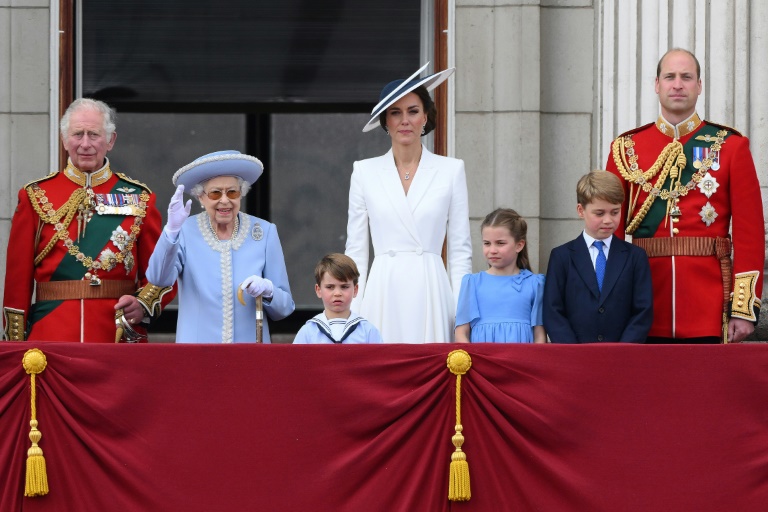
She made two public appearances to huge crowds from the Buckingham Palace balcony on Thursday, and was then at Windsor for a beacon-lighting ceremony.

The effort, after months battling difficulties walking and standing, left her in “some discomfort”, Buckingham Palace said.

It led to her withdrawing from Friday’s church service and also an expected appearance at Epsom racecourse for the flat-racing showcase The Derby.

Her no-show at The Derby on Saturday is only the fourth time the keen horseracing fan, rider and breeder has missed the race since 1952.

She did not attend in 2020 as spectators were banned due to Covid.

Her heir Prince Charles, 73, and his eldest son, Prince William, 39, will be in attendance at the concert instead.

– Inspired –

Thursday and Friday were made public holidays to mark the unprecedented landmark, which has focused attention on the monarchy’s future without her.

Longer pub opening hours, street parties and other events celebrating the queen’s central place in the life of most Britons alive have temporarily lifted the gloom of a soaring cost of living crisis.

Sunday will see more than 10 million people share food at “Big Jubilee Lunch” picnics and a musical and creative public pageant involving 10,000 people.

Ed Sheeran will round off the celebrations on Sunday, singing his 2017 hit “Perfect” at the end of the pageant.

The “Shape of You” singer-songwriter, 31, has said the “Party at the Palace” to mark the queen’s Golden Jubilee in 2002 inspired his musical career.

Watching on television, he saw Eric Clapton play “Layla” and decided “that’s what I wanna do”, he wrote on Instagram.

Sheeran then performed at the queen’s Diamond Jubilee concert 10 years ago. “Life is weird how it keeps coming full circle in lovely ways,” he added.

– ‘Nerve-wracking’ –

Ross’ performance is her first in the UK in 15 years and comes before she heads to the Glastonbury Festival later this month.

The 78-year-old diva said she was “absolutely delighted to receive an invitation to perform on such a momentous occasion”.

Charles has previously revealed that her 1980 disco hit “Upside Down” was one of his favourite tracks.

Other performers on Saturday include Alicia Keys, Craig David and Rod Stewart, Queen + Adam Lambert, George Ezra and Eurovision 2022 runner-up Sam Ryder.

Elton John has recorded a tribute.

Queen guitarist Brian May provided one of the most enduring images from the 2002 jubilee, playing “God Save the Queen” from the roof of Buckingham Palace.

Stewart, who received a knighthood in the queen’s 2016 birthday honours for services to music and charity, said the gig was “nerve-wracking”.

“I’ve grown up with this woman. I was seven when she came to the throne,” the 77-year-old singer told the BBC on Friday.

“She’s always been part of my life.”

Japanese man becomes world's oldest to sail solo across Pacific

An 83-year-old yachtsman arrived in Japan early Saturday morning after a solo, non-stop trip across the Pacific, becoming the oldest person ever to achieve the feat. 

Famed ocean adventurer Kenichi Horie’s arrival in the Kii Strait off western Japan capped a two-month trip that started from a yacht harbour in San Francisco in March. 

It was only the latest seagoing achievement by the Japanese octogenarian, who in 1962 voyaged from Japan to San Francisco at age 23, becoming the first person in the world to sail alone across the Pacific. 

The public relations team for his most recent voyage said Horie’s Saturday return to Japan made him the world’s oldest person to pull off a solo, non-stop crossing of the largest and deepest ocean on Earth. 

“I’m about to cross the finish line,” Horie wrote on his blog Friday after what he described as a three-day battle with the pushback from a current.

“I’m exhausted.” 

His 1962 Pacific crossing made headlines as he embarked on the trip without a passport, essentially smuggling his way into the United States. 

Sixty years ago, “I was constantly anxious and stressed that I might get caught… My condition was the worst,” he blogged in April. 

“But this time it’s different, I was sent off by many people and have their support through tracking systems and wireless radio. I couldn’t be more grateful.”

Aside from his 1962 Pacific crossing, Horie is known for sailing around the world solo in 1974 and his longitudinal voyage around the world between 1978 and 1982. 

The latest expedition was the first he had undertaken since 2008, when he sailed from Honolulu to the Kii Strait on a wave-powered 31-foot boat.

Bomb kills two peacekeepers in Mali: UN

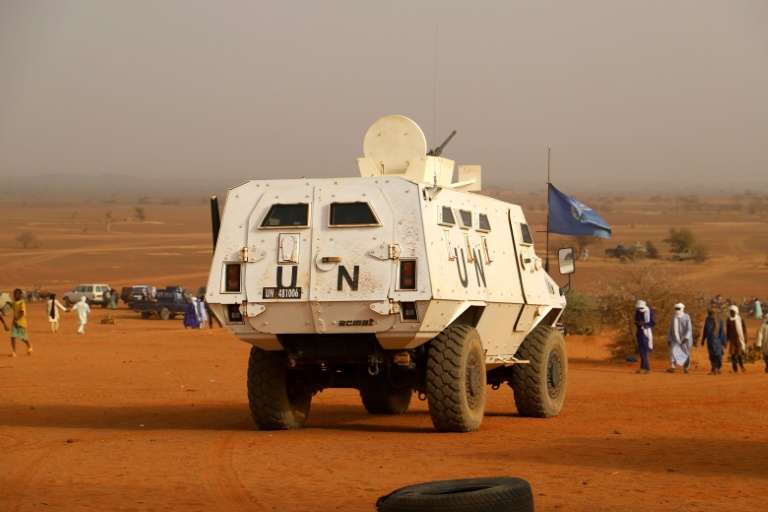
Two UN peacekeepers were killed and one wounded on Friday after an improvised bomb exploded in central Mali, a spokesman for the MINUSMA mission tweeted.

They were just the latest deaths in the centre of the country, which has since 2012 been wracked by a deadly jihadist insurgency.

In a separate incident, six civilians were killed when a cart hit another explosive device a day earlier, a military official and two councillors said.

The soldiers were part of the Egyptian contingent of the UN peacekeeping mission, a security official said.

“The head of MINUSMA condemned the attack,” mission spokesman Olivier Salgado said on social media. He said two blue helmets were killed and one wounded, correcting an earlier toll.

Salgado said the incident took place near the town of Douentza, on the road to Timbuktu.

The UN Security Council said it “condemned in the strongest terms the attack perpetrated against MINUSMA”.

In a statement, the Security Council also urged the Malian authorities “to swiftly investigate the attack against peacekeepers and bring the perpetrators to justice”.

They were the second and third UN peacekeepers to be killed in three days.

On Wednesday, a Jordanian blue helmet was killed in an attack on his convoy in Kidal, in northern Mali.

“A hard, hard week for us. We cannot say enough about the difficulty of our task and the extreme dedication of our peacekeepers,” tweeted MINUSMA chief El-Ghassim Wane.

With 13,000 members, MINUSMA — the United Nations Multidimensional Integrated Stabilization Mission in Mali — is one of the UN’s biggest peacekeeping operations, and one of its most dangerous.

It says 174 troops have died from hostile acts since its creation in 2013.

“This is the sixth incident in which a UN peacekeeping convoy was hit since May 22,” UN spokesman Stephane Dujarric said in New York, condemning the latest attack.

But, despite the difficulties, the UN peacekeepers continue their work in accordance with their Security Council mandate, he added, citing MINUSMA’s involvement in the recent restoration of two bridges destroyed in the same region.

Improvised explosive devices are a weapon of choice for jihadists attacking MINUSMA and Malian forces. They also kill many civilians.

In Thursday’s incident, a cart returning from market hit a small bomb near Waya, killing five civilians and gravely wounding a sixth who died on Friday, the military official and councillors said, speaking on condition of anonymity for fear of jihadist retaliation.

– Hotbed of violence –

On Friday, the Egyptian peacekeepers were in an escort of a dozen UN vehicles accompanying a convoy of civilian trucks carrying fuel, Salgado said. 

Such convoys can stretch for miles. 

A mine exploded as the convoy passed, Salgado said. Mines can be detonated on contact or remotely.

Central Mali is a hotbed of violence and jihadist activity that has spread from the north to the centre of the country, and on to neighbouring Burkina Faso and Niger. 

Thousands of civilians and combatants have died and hundreds of thousands have been displaced. 

Two reports published this week — one from UN Secretary-General Antonio Guterres and another from the human rights division of MINUSMA — expressed alarm at the intensification of the violence in central Mali.

Meanwhile, a Mali-based coalition of Al-Qaeda-aligned militants claimed responsibility for an attack in Togo last month, the SITE Intelligence monitoring group said Friday.

The Jama’at Nasr al-Islam wal Muslimin (JNIM) has been threatening northern parts of coastal Benin, Ivory Coast, Ghana and Togo.

Togo’s government had confirmed a “terrorist attack” on May 11 in the northern town of Kpekankandi, near the border with Burkina Faso, where the insurgents are also present. 

Officials said eight Togolese soldiers were killed and 13 wounded.

Real Madrid's Benzema drops appeal over 'sex tape' sentence

Real Madrid forward Karim Benzema has dropped an appeal against a one-year suspended sentence for complicity in a bid to blackmail former France teammate Mathieu Valbuena with a sex tape, his lawyer said Saturday.

Benzema was sentenced in November 2021 and fined 75,000 euros ($82,000) over the 2015 extortion attempt that shocked French football and saw him exiled from the French national team for five-and-a-half years.

The Real Madrid star has finally dropped his appeal, his lawyer Hugues Vigier told AFP, confirming a report on the Actu78 website.

The Versailles court of appeal will notify the parties of the withdrawal order on Tuesday.

Vigier previously told French sports daily L’Equipe Benzema did so because he was “exhausted” by the process.

“This withdrawal endorses a ruling of condemnation and apparently of guilt. It is a judicial truth. But it is not reality,” he said.

Scrapping the appeal makes definitive the November ruling against him.

Benzema was one of five people tried over the ultimately unsuccessful attempt to blackmail Valbuena with a sexually explicit video stolen from his phone. 

He was not accused of being behind the extortion attempt but rather of conspiring with the suspected blackmailers by putting pressure on Valbuena to pay them off.

The 34-year-old footballer had been set to appeal on June 30-July 1 at the court in Versailles, outside Paris. His former lawyer, Antoine Vey, had said Benzema would explain himself in person at the appeal trial.

In its November judgment, the Versailles criminal court ruled that Benzema had “implicated himself personally, through subterfuge and lies, to convince his teammate to submit to the blackmail”.

It added he had shown “no kindness towards Valbuena”, as he had claimed, but “just the opposite” and had even appeared to take pleasure in his fellow player’s plight.

The affair rocked the French national team and led to the Madrid star being cast out of the side for five-and-a-half years before making a surprise return to “Les Bleus” in 2021 in time for the European championship.

Benzema, who has always maintained his innocence, has on several occasions expressed his desire to turn the page on the affair as soon as possible.

News of the star striker’s announcement that he was dropping his appeal came just hours after he scored a brilliant opening goal in France’s UEFA Nations League clash against Denmark in Paris.

The Danes, however, recovered to win 2-1 after substitute Andreas Cornelius scored twice.

Benzema is a favourite for the Ballon d’Or after helping Madrid beat Liverpool 1-0 in the Champions League final in Paris last weekend.

Why US gun violence spikes in warm weather

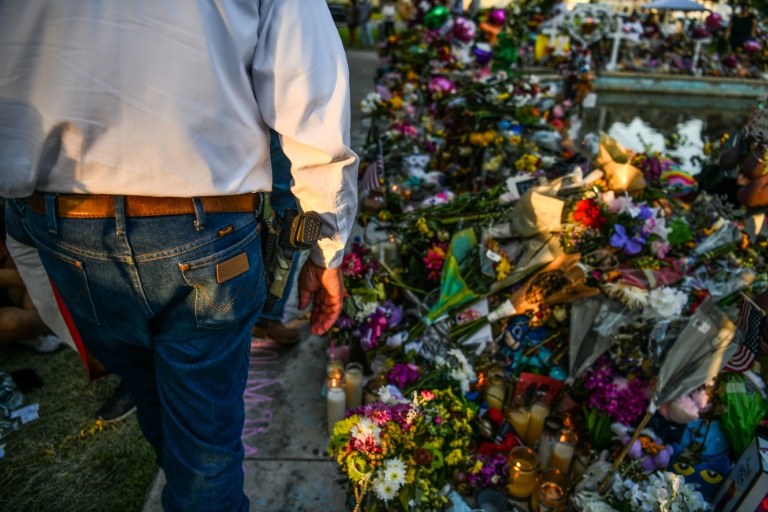
From the Texas school massacre to a Tulsa hospital shooting and many less-reported incidents, a recent spate of gun violence across America bears out a trend police departments have long sworn by: murders go up in warmer weather.

The link has been written about for decades by criminologists, with more recent research drilling down on the precise relationship between temperature and crime rates.

For those who have studied the question, there are common sense as well as potentially less obvious mechanisms at play.

First, the more obvious: “It’s hard to shoot somebody if there’s nobody around,” David Hemenway, a professor of health policy at the Harvard TH Chan School of Public Health, told AFP, explaining why gun crime is lower in bad weather.

A second, more controversial idea is that heat itself — as opposed to weather that encourages people to be out — might rev up conflict.

While there are many causes behind the rising tide of gun violence in the United States, weather could play an increasingly important role in world that is fast warming due to climate change.

– Warm days in cold months – 

Hemenway said he had long been interested in the relationship between heat and higher crime given stereotypes about the north-south divide within the United States and Italy, as well as between the northern European states of Scandinavia and southern Mediterranean countries.

In 2020, he co-wrote a paper in Injury Epidemiology led by his then-graduate student Paul Reeping examining the city of Chicago between 2012 and 2016.

The paper used reports from the Chicago Tribune to get the number of shootings per day, and then matched those against daily high temperature, humidity, wind speed, difference in temperature from historical average, and precipitation type and amount.

They found a 10 degree Celsius higher temperature was significantly associated with 34 percent more shootings on weekdays, and 42 percent more shootings on weekends or holidays. 

They also found a 10C higher than average temperature was associated with 33.8 percent higher rate of shootings.

In other words, said Hemenway, it’s not just heat that’s important, but relative heat: “In the winter, there were more shootings on those days which wouldn’t have been hot in the summer but were warm for winter.”

Another recent paper, led by Leah Schinasi of Drexel University and published in the Journal of Urban Health in 2017, looked at violent crime in Philadelphia.

“I live in Philadelphia, and I remember biking home from work on a very hot day and observing how cranky everyone seemed. I was interested to see if this observation translated to higher rates of crime on hot days,” she told AFP.

She and co-author Ghassan Hamra did indeed find violent crimes happened more often in the warmer months — May through September — and were highest on the hottest days.

The contrast was most striking on comfortable days in the colder months — October through April — compared to colder days in those months. 

When temperatures reached 21C (70F) during that time period, daily rates of violent crime were 16 percent higher compared to 6C (43F) days, the median for those months.

–  ‘Harm reduction’ –

Hemenway believes that both of the main hypotheses on the subject — that more people being outside opens more possibilities of hostile interactions, and that heat itself makes people more aggressive — could be true.

A striking study published by the National Bureau of Economic Research in 2019 involved placing university students in Kenya and California in either hot or cold rooms and measuring the impact on a number of behavioral categories.

It found “heat significantly affects individuals’ willingness to voluntarily destroy other participants’ assets” in the form of gift cards and vouchers.

When it comes to the overall issue of gun violence, there are far bigger drivers than temperature, Hemenway acknowledged.

These include the fact there were an estimated 393 million guns in circulation in the United States in 2020, more than the number of people, while many states have moved in recent years to ease rather than toughen restrictions.

But better understanding the relationship with weather could have policy implications — for example finding more activities for young males to keep them off street corners on the hottest summer days, and boosting police presence in key areas based on forecasts.

“It’s sort of a harm reduction,” said Hemenway. “But even if this wasn’t a gun problem, I suspect we would find the same thing if we had evidence about fights and assaults. What the guns do is make hostile interactions more deadly.”

Floods kill at least two in Cuba

Remnants of Hurricane Agatha flooded much of western Cuba on Friday, killing at least two people in Havana.

Many residents in the region lost power and a man in Pinar del Rio province also was missing, Cuban officials said. 

“Strong, heavy rain and electrical storms have been affecting the western and central regions of Cuba with accumulations greater than 200 millimeters (eight inches), which will continue for the rest of today and tomorrow, Saturday,” the Cuban Weather Office forecast.

Agatha crashed into southern Mexico and the Atlantic with potential to redevelop as a tropical storm, the Miami-based US National Hurricane Center said.

“The death of two people in the province of Havana and a missing person in Pinar del Río are regretted,” said the Cuban News Agency. 

With parts of the capital flooding, state media images showed rescuers in areas of central Havana evacuating people in canoes. 

Heavy rains “have produced floods in localities from Pinar del Río (western extreme) to Sancti Spíritus (Center) and in the Isla de la Juventud Special Municipality (south of Havana),” the weather office said. 

The Atlantic hurricane season begins each year on June 1 and ends on November 30, for the North Atlantic, the Gulf of Mexico and the Caribbean area. 

Close Bitnami banner
Bitnami