World

Sri Lanka honours Tamil war-dead after 13 years

Thousands of Tamils killed in Sri Lanka’s decades-long separatist war were commemorated on Wednesday for the first time outside the minority’s heartland in the north and east of the country.

Clergy from Buddhist, Hindu and Christian communities offered prayers in Colombo and lit a clay lamp for those who perished between 1972 and May 2009 when the fighting ended.

The ceremony coincided with the 13th anniversary of the ending of hostilities.

“This is highly symbolic and very important for Tamils,” legislator Dharmalingam Sithadthan, an MP from the northern Tamil heartland of Jaffna, told AFP.

“In previous years, there were private memorials held in secret, but this public event is highly welcome.”

Any remembrance of Tamil war victims had been banned under Sri Lanka’s powerful Rajapaksa family which is currently under siege over the country’s dire economic crisis.

The head of the separatist Tamil Tiger movement, Velupillai Prabhakaran, was shot dead by security forces on May 18, 2009, bringing a formal end to the bloody ethnic war.

Current President Gotabaya Rajapaksa led the government’s military campaign against the Tigers as the head of the defence ministry under his president brother Mahinda.

Mahinda stepped down as prime minister last week after weeks of protests over severe shortages of food, fuel and medicines.

The government defaulted on its $51 billion foreign debt last month as it ran out of dollars to finance even the most essential imports.

The country’s main Tamil party, the Tamil National Alliance, said the commemoration showed that the country’s majority Sinhalese were willing to support reconciliation after decades of ethnic war.

“This gives us a lot of hope and I hope that Tamil people will also reciprocate,” TNA spokesman M. A. Sumanthiran told AFP. “There may be pitfalls along the way, but this is a very good start.”

– Porridge feast –

On Wednesday, volunteers offered porridge to passers-by as a symbol of the humble food that tens of thousands of Tamils were left with during the final stages of the war.

“The kanji (porridge) was the life-saving food for Tamil people in the last stages of the war,” a Hindu priest said at the ceremony. “They struggled in the midst of shelling and bombing and underwent untold suffering.”

Government forces imposed an economic embargo, ordered civilians into what they called “no-fire zones” and allegedly bombarded them killing an estimated 40,000 Tamils.

Successive Sri Lankan governments have denied allegations that troops committed war crimes but have refused to allow any independent investigation.

Rights activist Mari de Silva said she hoped Wednesday’s commemoration would lead to ethnic reconciliation in the Sinhalese-majority nation.

“I sincerely hope this is also a first step towards real reconciliation in Lanka and that we can join the call for justice and accountability,” she said on Twitter.

The UN Human Rights Council last year set up a mechanism to preserve evidence of war crimes in Sri Lanka so that prosecutions could take place in the future.

China calls for urgent boost to virus-hit economy

China’s premier called for greater “urgency” in rolling out measures to support the virus-battered economy, state media reported Wednesday, days after data highlighted the stark impact of Covid-19 restrictions.

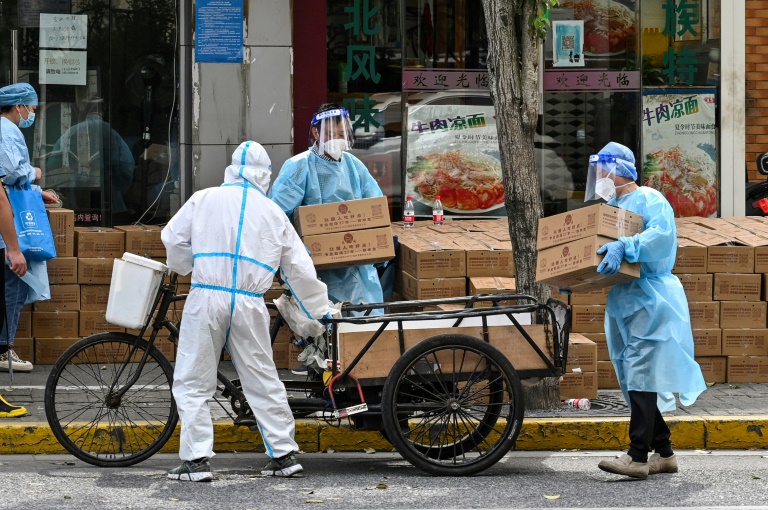
China — the last major global economy sticking to a rigid zero-Covid policy — is battling an economic slump due to prolonged virus lockdowns that have constricted supply chains, quelled demand and stalled manufacturing.

“All localities and departments should step up their sense of urgency, and new measures that can be used should be used,” Li Keqiang said at a symposium on Wednesday, according to state broadcaster CCTV.

He added that efforts to support the economy should bring it “back to normal quickly” after admitting that indicators have “weakened significantly” since March, with a particular dip in April.

On Monday, data showed retail sales and factory output last month had slumped the most since the start of the pandemic, while unemployment edged back toward its February 2020 peak.

Beijing’s unrelenting approach to Covid-19 outbreaks has snarled supply chains and locked down tens of millions of people, hitting major financial, industrial and tourist hubs.

The country’s borders also remain closed to most foreign travellers and a slew of international sports events have been scrapped over pandemic concerns.

China has targeted full-year growth of around 5.5 percent, but data published in April showed that first-quarter growth slowed to 4.8 percent after the world’s second-biggest economy lost steam in the latter half of last year.

And the economic targets have a political dimension for Chinese leader Xi Jinping, who is eyeing another term in power.

Xi has pinned his legacy to China’s strong economic growth and winning the “battle” against Covid.

But the current outbreak is the country’s worst since the virus emerged in Wuhan in late 2019, and the economy is beginning to weaken. 

– Tech support –

Li also called Wednesday for backing Chinese tech companies’ bids to list domestically and abroad, a day after Communist Party leaders doubled down on support for the tech sector in a rare meeting with executives.

China’s economic slowdown appears to have motivated a softer approach toward the vast, money-spinning tech sector, after an 18-month clampdown driven by fears massive internet companies control too much data and expanded too quickly.

Vice Premier Liu He and other Communist leaders addressed executives, including Robin Li of Baidu — universally used for its search engine and mapping service — and Zhou Hongyi of internet security firm Qihoo 360, state media reported late Tuesday.

Liu offered support for “the sustainable and healthy development of the platform economy and the private economy,” CCTV said.

During the tech crackdown, overseas IPOs from Alibaba’s Ant Group and Didi Chuxing — China’s Uber — were spiked, while millions of dollars of fines over anti-trust and data breaches were ladled out to tech giants. 

Chinese tech shares surged late April after officials pledged support for internet firms at a Politburo meeting.

Tech giants including Alibaba, Tencent and Baidu were marginally lower Wednesday morning, with e-commerce behemoth JD slumping over 4 percent after it recorded a 3 billion yuan ($444 million) loss in first-quarter earnings. 

On Wednesday, Tencent reported record-low quarterly revenue growth at nearly zero, reaching the slowest pace since the company went public in 2004.

China calls for urgent boost to virus-hit economy

China’s premier called for greater “urgency” in rolling out measures to support the virus-battered economy, state media reported Wednesday, days after data highlighted the stark impact of Covid-19 restrictions.

China — the last major global economy sticking to a rigid zero-Covid policy — is battling an economic slump due to prolonged virus lockdowns that have constricted supply chains, quelled demand and stalled manufacturing.

“All localities and departments should step up their sense of urgency, and new measures that can be used should be used,” Li Keqiang said at a symposium on Wednesday, according to state broadcaster CCTV.

He added that efforts to support the economy should bring it “back to normal quickly” after admitting that indicators have “weakened significantly” since March, with a particular dip in April.

On Monday, data showed retail sales and factory output last month had slumped the most since the start of the pandemic, while unemployment edged back toward its February 2020 peak.

Beijing’s unrelenting approach to Covid-19 outbreaks has snarled supply chains and locked down tens of millions of people, hitting major financial, industrial and tourist hubs.

The country’s borders also remain closed to most foreign travellers and a slew of international sports events have been scrapped over pandemic concerns.

China has targeted full-year growth of around 5.5 percent, but data published in April showed that first-quarter growth slowed to 4.8 percent after the world’s second-biggest economy lost steam in the latter half of last year.

And the economic targets have a political dimension for Chinese leader Xi Jinping, who is eyeing another term in power.

Xi has pinned his legacy to China’s strong economic growth and winning the “battle” against Covid.

But the current outbreak is the country’s worst since the virus emerged in Wuhan in late 2019, and the economy is beginning to weaken. 

– Tech support –

Li also called Wednesday for backing Chinese tech companies’ bids to list domestically and abroad, a day after Communist Party leaders doubled down on support for the tech sector in a rare meeting with executives.

China’s economic slowdown appears to have motivated a softer approach toward the vast, money-spinning tech sector, after an 18-month clampdown driven by fears massive internet companies control too much data and expanded too quickly.

Vice Premier Liu He and other Communist leaders addressed executives, including Robin Li of Baidu — universally used for its search engine and mapping service — and Zhou Hongyi of internet security firm Qihoo 360, state media reported late Tuesday.

Liu offered support for “the sustainable and healthy development of the platform economy and the private economy,” CCTV said.

During the tech crackdown, overseas IPOs from Alibaba’s Ant Group and Didi Chuxing — China’s Uber — were spiked, while millions of dollars of fines over anti-trust and data breaches were ladled out to tech giants. 

Chinese tech shares surged late April after officials pledged support for internet firms at a Politburo meeting.

Tech giants including Alibaba, Tencent and Baidu were marginally lower Wednesday morning, with e-commerce behemoth JD slumping over 4 percent after it recorded a 3 billion yuan ($444 million) loss in first-quarter earnings. 

On Wednesday, Tencent reported record-low quarterly revenue growth at nearly zero, reaching the slowest pace since the company went public in 2004.

'Historic’ equal pay deal for US men and women soccer teams

The US men’s and women’s national soccer teams will receive equal pay under a “historic” agreement announced by the US Soccer Federation on Wednesday, following years of pressure from female players.

The move makes the federation the first in the world to equalize World Cup prize money awarded to its men’s and women’s teams.

“This is a truly historic moment. These agreements have changed the game forever here in the United States and have the potential to change the game around the world,” said US Soccer president Cindy Parlow Cone.

The terms of Wednesday’s landmark agreement include “identical compensation for all competitions, including the FIFA World Cup, and the introduction of the same commercial revenue sharing mechanism for both teams,” USSF said.

The deal stipulates that players from both teams “pool and share” the otherwise unequal prize money paid by FIFA for participation in their respective World Cups.

For non-World Cup tournaments, players from “both teams will earn an equal amount of the total prize money paid when both teams participate in the same competition.”

In February, the US national women’s team won a $24 million payout and a promise of equal pay in a najor settlement with US Soccer, that was contingent on the new collective bargaining agreement.

The question of World Cup prize money had formed a prominent part of the lawsuit, which was filed in 2019 and accused the federation of “stubbornly refusing” to pay its men and women’s players equally.

“The accomplishments in this CBA (collective bargaining agreement) are a testament to the incredible efforts of WNT players on and off the field,” said US women’s captain Becky Sauerbrunn, who is also her team’s players association president.

She added that she hoped the agreement “will similarly serve as the foundation for continued growth of women’s soccer both in the United States and abroad.”

– ‘Achieved it’ –

The agreement, which runs through 2028, also aims to improve “player health and safety, data privacy and the need to balance responsibilities to both club and country,” USSF said.

Women’s star Megan Rapinoe, who has forged a reputation as an unflinching advocate for social justice causes including equal pay and conditions for her and team-mates, said in February that the settlement marked a moment in which “US Soccer changed for the better.”

Center-back Walker Zimmerman, a member of the men’s team players association, welcomed Wednesday’s deal saying that “we hope this will awaken others to the need for this type of change.”

“They said equal pay for men and women was not possible, but that did not stop us and we went ahead and achieved it,” he added.

The United States women have won four Women’s World Cup titles and four Olympic gold medals. They are chasing an unprecedented third consecutive Women’s World Cup crown after hoisting trophies in 2015 at Canada and 2019 in France. They last won Olympic gold in London in 2012.

War in Ukraine: Latest developments

Here are the latest developments in the war in Ukraine:

– Nearly 1,000 Mariupol fighters have surrendered: Russia –

Russia says that a total of 959 Ukrainian soldiers have surrendered at the besieged Azovstal steel plant in the port city of Mariupol, including 80 wounded.

The defence ministry in Moscow said that a further 694 fighters had surrendered in the past 24 hours after a first group of 265 laid down arms and left the plant on Monday.

It said that the injured are being treated in a hospital in a part of the eastern Donetsk region controlled by pro-Russian rebels.

It is unclear if any of the troops, who have been acclaimed as heroes for holding out for weeks after Mariupol fell, remain at the plant.

Ukraine says it hopes to exchange Azovstal fighters for Russian soldiers it is holding.

– First war crimes trial starts – 

A 21-year-old Russian soldier has pleaded guilty to killing an unarmed Ukrainian civilian at a war crimes trial in Kyiv, in the first such case to go to court since the start of the offensive.

Vadim Shishimarin from Irkutsk in Siberia admitted gunning down the 62-year-old man near the central village of Chupakhivka to prevent him reporting a carjacking by fleeing Russian troops.

He faces possible life imprisonment for war crimes and premeditated murder after the case heard by a district court in Kyiv.

“By this first trial, we are sending a clear signal that every perpetrator, every person who ordered or assisted in the commission of crimes in Ukraine shall not avoid responsibility,” Ukraine’s chief prosecutor Iryna Venediktova tweeted.

– Finland, Sweden submit NATO bids –

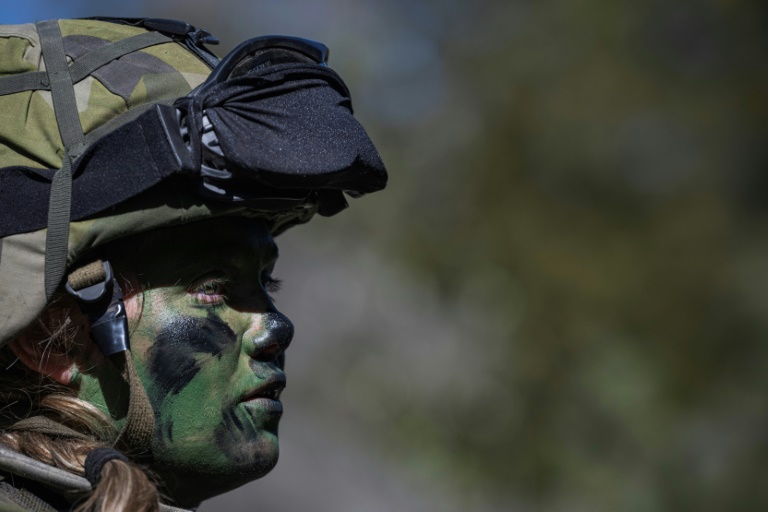
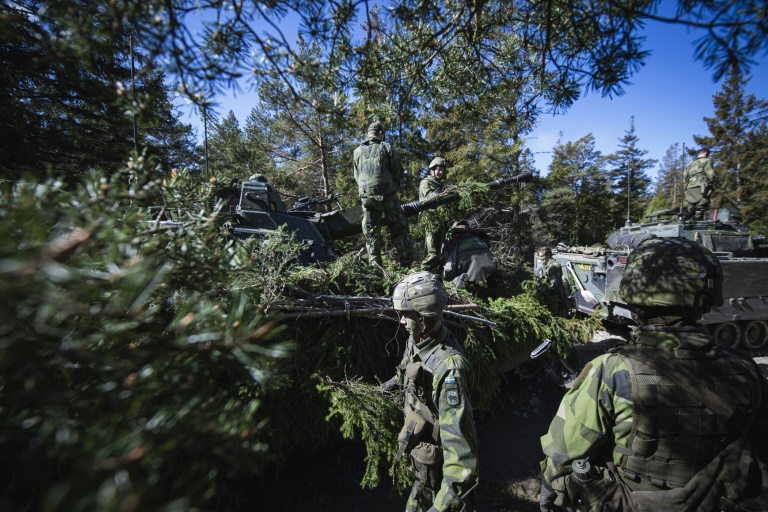
Finland and Sweden submit their bids to join NATO, sealing their decision to jettison decades of military non-alignment, despite threats of reprisals from Moscow.

NATO chief Jens Stoltenberg calls it a “historic step”. He has promised to welcome them “with open arms” despite Turkey’s threat to veto their membership over its claim that the Nordic neighbours harbour members of armed groups opposed to Ankara.

NATO ambassadors are expected to discuss the applications on Wednesday.

Finland, which shares a 1,300-kilometre (800-mile) border with Russia, and Sweden fear they could be future targets of Russian aggression following Moscow’s invasion of Ukraine. Public support in the two countries for NATO membership skyrocketed after the war began.

– Moscow expels dozens of diplomats –

Russia expels dozens of French, Italian and Spanish diplomats in tit-for-tat responses to the expulsion of Russian diplomats over the Ukraine conflict.

The foreign ministry says 27 Spanish, 24 Italian and 34 French diplomats have been declared “persona non grata”.

France and Italy condemn the move, with Italian Prime Minister Mario Draghi calling it a “hostile act” which will make resolving the war through peaceful means more difficult.

– Peace talks on hold –

Russia and Ukraine both admit that peace talks have stalled, with both accusing the other of blocking progress.

Kyiv accuses Moscow of failing to find areas for compromise. 

Kremlin spokesman Dmitry Peskov blames the “complete lack of will of Ukrainian negotiators to continue this process.” 

The two sides reported progress at talks in Istanbul in late March but the process stalled shortly after, following revelations of atrocities in towns that were controlled by Russian forces.

– Zelensky calls Cannes –

Ukrainian President Volodymyr Zelensky makes a surprise video address to the opening ceremony of the Cannes Film Festival in France.

“In the end, hatred will disappear and dictators will die,” he tells the audience, who give him a standing ovation.

The Ukrainian leader also addressed the Grammys in April.

burs-cb/spm/cdw

Finland, Sweden apply to join NATO as first Ukraine war crimes trial begins

Finland and Sweden on Wednesday submitted a joint application to join NATO as Russia’s invasion of Ukraine forces a dramatic reappraisal of security in Europe.

The reversal of the Nordic countries’ longstanding policy of non-alignment came as Ukraine opened the first war crimes trial of a Russian soldier since the invasion began.

Vadim Shishimarin, 21, from Irkutsk in Siberia, pleaded guilty to killing an unarmed 62-year-old man in Ukraine’s Sumy region on February 28 — four days into the invasion.

“By this first trial, we are sending a clear signal that every perpetrator, every person who ordered or assisted in the commission of crimes in Ukraine shall not avoid responsibility,” prosecutor general Iryna Venediktova said. 

Russia’s government has no information on Shishimarin, Kremlin spokesman Dmitry Peskov said, adding that many such cases reported by Ukraine are “simply fake or staged”.

Peskov further accused Kyiv of a “complete lack of will” towards peace talks, after Ukrainian negotiator Mykhaylo Podolyak said stop-start dialogue was “on hold”, having failed to yield any breakthroughs.

The Kremlin also intensified a tit-for-tat round of diplomatic expulsions against European countries, ordering out dozens of personnel from France, Italy and Spain.

At NATO headquarters in Brussels, alliance chief Jens Stoltenberg formally received the applications from the Finnish and Swedish ambassadors, calling them “an historic step”.

“All allies agree on the importance of NATO enlargement. We all agree that we must stand together and we all agree that this is an historic moment which we must seize,” he said.

The membership push could represent the most significant expansion of NATO in decades, doubling its border with Russia, and President Vladimir Putin has warned it may trigger a response from Moscow. 

But the applications face resistance from NATO member Turkey, which accuses the Nordic neighbours of harbouring anti-Turkish extremists.

Turkish President Recep Tayyip Erdogan demanded “respect” from NATO over his government’s concerns.

Western allies remain optimistic they can overcome Turkey’s objections and for now, several including Britain have offered security guarantees to Finland and Sweden to guard against any Russian aggression.

British Prime Minister Boris Johnson said the Nordic applications would not have been expected a short time ago, “but Putin’s appalling ambitions have transformed the geopolitical contours of our continent”.

– Mediators for Azovstal –

On the ground, in Ukraine’s ruined port city of Mariupol, a unit of soldiers had been holding out in the Azovstal steelworks, but Moscow said Wednesday that 959 of the troops had surrendered this week.

Kyiv’s defence ministry said it would do “everything necessary” to rescue the undisclosed number of personnel still in the plant’s tunnels, but admitted there was no military option available.

“The evacuation mission continues, it is overseen by our military and intelligence,” Ukrainian President Volodymyr Zelensky said in his nightly address. 

“The most influential international mediators are involved.”

Those who have left Azovstal were taken into Russian captivity, including 80 who were heavily wounded, the Russian defence ministry said.

The ministry, which published images showing soldiers on stretchers, said the injured were transported to a hospital in the eastern Donetsk region controlled by pro-Kremlin rebels.

The defence ministry in Kyiv said it was hoping for an “exchange procedure… to repatriate these Ukrainian heroes as quickly as possible”.

But their fate was unclear, with Kremlin spokesman Dmitry Peskov refusing to say whether they would be treated as criminals or prisoners of war.

Putin had “guaranteed that they would be treated according to the relevant international laws”, Peskov said.

– ‘My war is not over’ –

Despite their last-ditch resistance in places such as Mariupol, and their successful defence of Kyiv, Ukrainian forces are retreating across swathes of the eastern front.

White smoke from burning fields marks the pace of Russia’s advance around the village of Sydorove, on the approaches to the militarily important city of Slovyansk and Ukraine’s eastern administrative centre in Kramatorsk.

Army volunteer Yaroslava, 51, sat on a slab of concrete jutting out from the remains of a school in Sydorove where her husband’s unit had set up camp before it was hit by a Russian strike.

She stared at a spot where rescuers and de-miners had spotted a motionless hand reaching out from the rubble.

“We had settled in London before the war but felt like we had no choice but to come back,” Yaroslava said.

“My two sons have just signed three-year contracts with the army. We will fight. We will still fight,” she said without moving her eyes. 

“My war is not over.”

The war crimes trial in Kyiv, expected to be followed by several others, posed a test of the Ukrainian justice system at a time when international bodies are also conducting their own investigations.

Shishimarin faces a possible life sentence. Prosecutors said the sergeant was commanding a unit in a tank division when his convoy came under attack.

He and four other soldiers stole a car and encountered the man on a bicycle, shooting him in cold blood, according to the prosecutors.

The International Criminal Court said Tuesday it was deploying its largest-ever field team to Ukraine, with 42 investigators, forensic experts and support staff being sent into the field to gather evidence of alleged atrocities.

The US State Department also announced it was creating a special unit to research, document and publicise Russian war crimes.

Climate change indicators hit record highs in 2021: UN

Four key climate change indicators all set new record highs in 2021, the United Nations said Wednesday, warning that the global energy system was driving humanity towards catastrophe.

Greenhouse gas concentrations, sea level rise, ocean heat and ocean acidification all set new records last year, the UN’s World Meteorological Organization (WMO) said in its “State of the Global Climate in 2021” report.

The annual overview is “a dismal litany of humanity’s failure to tackle climate disruption”, UN chief Antonio Guterres said.

“The global energy system is broken and bringing us ever closer to climate catastrophe.”

The WMO said human activity was causing planetary-scale changes on land, in the ocean and in the atmosphere, with harmful and long-lasting ramifications for ecosystems.

WMO chief Petteri Taalas said the war in Ukraine had been overshadowing climate change, which “is still the biggest challenge we are having as mankind”.

– Record heat –

The report confirmed the past seven years were the top seven hottest years on record.

Back-to-back La Nina events at the start and end of 2021 had a cooling effect on global temperatures last year.

Even so, it was still one of the warmest years ever recorded, with the average global temperature in 2021 about 1.11 degrees Celsius above the pre-industrial level.

The 2015 Paris Agreement on climate change saw countries agree to cap global warming at “well below” 2C above average levels measured between 1850 and 1900 — and 1.5C if possible.

“All major climate indicators are quite frankly heading in the wrong direction and without much greater ambition and urgency, we are about to lose the narrow window of opportunity to keep the 1.5-degree goal alive,” Guterres’ climate action advisor Selwin Hart told a press conference.

Taalas said the climate was changing “before our eyes”.

“The heat trapped by human-induced greenhouse gases will warm the planet for many generations to come. Sea level rise, ocean heat and acidification will continue for hundreds of years unless means to remove carbon from the atmosphere are invented,” he said.

– ‘Consistent picture of warming world’ –

Four key indicators of climate change “build a consistent picture of a warming world that touches all parts of the Earth system”, the report said.

Greenhouse gas concentrations reached a new global high in 2020, when the concentration of carbon dioxide (CO2) reached 413.2 parts per million globally, or 149 percent of the pre-industrial level.

Data indicate they continued to increase in 2021 and early 2022, the report said.

Taalas reiterated Covid-19 lockdowns had had no impact on atmospheric greenhouse gases concentrations.

Global mean sea level reached a new record high in 2021, rising an average of 4.5 millimetres per year throughout 2013 to 2021, the report said.

That is more than double the average annual rise of 2.1 mm per year between 1993 and 2002, with the increase between the two time periods “mostly due to the accelerated loss of ice mass from the ice sheets”, it said.

Taalas said the melting of glaciers would raise sea levels for hundreds or thousands of years to come, due to CO2 concentrations in the atmosphere.

“This is a lost game already,” he said.

– Price of failure –

Ocean heat hit a record high last year, exceeding the 2020 value, the report said. 

And it is expected the upper 2,000 metres of the ocean will continue to warm in the future — “a change which is irreversible on centennial to millennial timescales”, said the WMO.

The ocean absorbs around 23 percent of the annual emissions of human-caused CO2 into the atmosphere. While this slows the rise of atmospheric CO2 concentrations, CO2 reacts with seawater and leads to ocean acidification.

The UN’s Intergovernmental Panel on Climate Change concluded with “very high confidence” that open ocean surface acidity is at the highest “for at least 26,000 years”.

“We should take action now,” Taalas told AFP.

“We are now heading 2.5 to three degrees warming instead of 1.5, which would be best for our future.

“It is better to invest in climate-friendly technologies than to live with the consequences of climate change that are going to be even 20 times more expensive if we fail.”

Kabul brokers peace talks between Pakistani Taliban and Islamabad

The Afghan Taliban said on Wednesday that it was hosting peace talks between Pakistan officials and a Taliban-inspired militant group that has battled Islamabad for over a decade.

Since the Afghan Taliban returned to power last year, Islamabad has increasingly complained of attacks by the Tehreek-e-Taliban Pakistan (TTP), especially along the mountainous border with Afghanistan.

The TTP is a home-grown movement but shares common roots with the new rulers of Kabul, who Pakistan has claimed permit its fighters to stage assaults from Afghan soil.

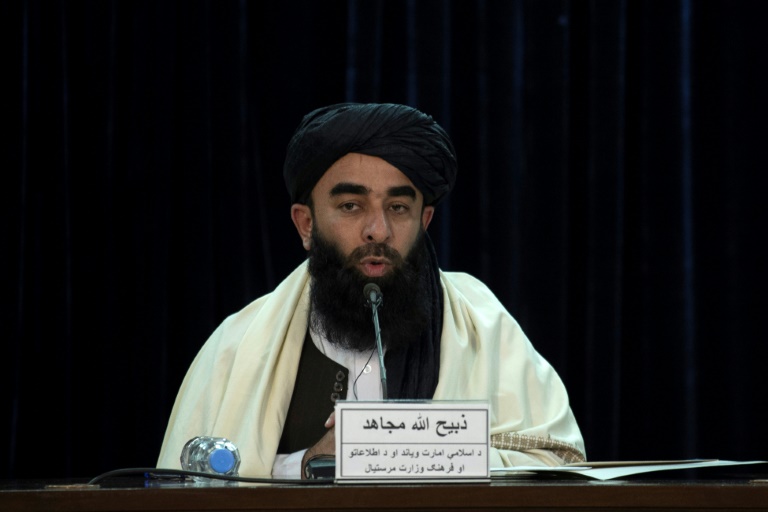
“Talks were held in Kabul between the government of Pakistan and the Tehreek-e-Taliban Pakistan in the mediation of the Islamic Emirate,” government spokesman Zabihullah Mujahid said, using the self-styled name of Taliban-ruled Afghanistan.

“The Islamic Emirate of Afghanistan, in good faith, strives for a successful negotiation process and expects both sides to be tolerant and flexible,” he said on Twitter.

In a statement, the group also confirmed that “negotiations are underway” under the guidance of the Afghan Taliban.

A truce previously agreed for the Islamic festival of Eid will also be extended until May 30, the statement said.

A militant source told AFP that “negotiations are held in Kabul in a positive atmosphere” but that it would be “premature to draw any conclusion”.

Pakistan government officials have not yet commented on the talks.

The official discussions may be an indication the Taliban are trying to smooth over rocky relations with neighbouring Pakistan.

The mountainous region between Afghanistan and Pakistan has long been a hive of militant activity, with the border becoming a source of friction since the Taliban reclaimed power in August.

Islamabad has made repeated claims its forces have been targeted by fighters across the international boundary.

Last month, Afghan officials said a Pakistani airstrike in eastern Afghanistan killed 47 people.

Pakistan did not comment on the strike but urged Kabul to secure its border to prevent militant operations.

The Afghan Taliban called the assault a “cruelty” that “is paving the way for enmity between Afghanistan and Pakistan”.

Last year Pakistan conducted peace negotiations with the TTP during a month-long ceasefire, but that truce eventually collapsed.

World's tallest building engulfed as Mideast sandstorms hit UAE

The world’s tallest building disappeared behind a grey layer of dust on Wednesday as sandstorms that have swept the Middle East hit the United Arab Emirates, prompting weather and traffic warnings.

The 828-metre (2,716 ft, 6ins) Burj Khalifa, which towers over Dubai and is usually visible across the busy financial hub, retreated behind a curtain of airborne dirt that shrouded much of the country.

The UAE is just the latest country in the path of sandstorms that have smothered Iraq, Kuwait, Saudi Arabia, Iran and others in recent days, closing airports and schools and sending thousands to hospital with breathing problems.

Capital city Abu Dhabi’s air quality index (AQI) soared into the “hazardous” zone overnight, according to waqi.info and the Plume pollution app.

The Middle East’s sandstorms are becoming more frequent and intense, a trend associated with overgrazing and deforestation, overuse of river water and more dams. 

Experts say the phenomenon could worsen as climate change warps regional weather patterns and drives desertification.

Emirati authorities issued a nationwide warning urging residents to remain vigilant.

“Abu Dhabi Police urges drivers to be cautious due to low visibility during high winds and dust,” the police force tweeted, as residents took to social media to publish photos and videos.   

“Please do not be distracted by taking any videos or using your phone,” it added.

– ‘Hazardous weather’ –

A National Center for Meteorology graphic showed nearly all the country covered by the storm, with the warning: “Be on the alert: hazardous weather events are expected.”

Winds with speeds up to 40 kilometres (25 miles) per hour are blowing the dust, it said, reducing visibility in some areas to less than 2,000 metres (2,200 yards).

However, a Dubai airports spokesman said there was no impact on air traffic. Weather conditions were expected to remain the same for the next few days.

In neighbouring Saudi Arabia, badly hit on Tuesday, conditions eased in the capital Riyadh on Wednesday but continued to restrict visibility in the city centre.

Emergency rooms in Riyadh hospitals received some 1,285 people suffering from respiratory problems over 24 hours from the sandstorm, the state-run Al-Ekhbariya channel reported late on Tuesday.

The Saudi national weather centre reported that dust was also affecting visibility in the west and south, specifically in Assir, Najran, Hael and Medina provinces. Medina is home to Medina city, the second-holiest city in Islam.

The centre predicted another sandstorm would arrive in the kingdom by Sunday.

Japanese man to repay $360,000 'bit by bit' after subsidy mix-up

A Japanese man who blew a $360,000 Covid-19 handout at online casinos after receiving the cash in error will pay authorities back “bit by bit”, reports said Wednesday.

“I feel very sorry that I used it up,” the man said according to his lawyer, who told the Yomiuri Shimbun daily that his client had gambled away the money.

The hefty lump sum was transferred last month in a mix-up by officials in the remote town of Abu in western Japan, which had organised a cash handout for low-income residents affected by the pandemic.

Weeks of failure to repay the 46.3 million yen by the man, who is reportedly 24 years old, led authorities to sue him in a desperate attempt to get their money back.

Now, he has made up his mind to “return the money — even if it’s going to be bit by bit,” his lawyer said.

The town says officials at one point even asked the man’s mother to join them in visiting him at work to convince him, but to no avail.

And questions have emerged over whether he is able to pay the money back at all, after the lawyer said his client is now running very low on funds.

Abu’s mayor, Norihiko Hanada, told reporters on Wednesday that he was “honestly happy” about the man’s decision, but said the town is not planning to withdraw its lawsuit.

“That’s one thing, and the lawsuit we’re filing against him is another thing, so I hope that he will tell the truth in court,” Hanada said.

Close Bitnami banner
Bitnami