World

Dirty tricks allegations mar last days of Philippine election campaign

Philippine election rivals traded allegations of dirty tricks and vote-rigging Friday, in the final stretch of an acerbic campaign that is tipped to bring the son of former dictator Ferdinand Marcos to power.

After months of fierce campaigning marked by relentless misinformation and an online whitewashing of the country’s violent history, rivals Ferdinand Marcos Jr and Leni Robredo implicated each other in underhand tactics.

Marcos Jr — the son the late dictator and notoriously kleptocratic first lady Imelda Marcos — is predicted to win Monday’s poll by a landslide.

The Marcos campaign on Friday urged supporters to “protect their votes” against unspecified attempts at vote-rigging.

“We’ve already won!” Marcos Jr said. “Just make sure you guard the votes on Monday — don’t sleep… we know that when we sleep, a lot of undesirable things happen.”

The Marcos campaign also accused Robredo of being “toxic, divisive and acrimonious” and having “associated themselves” with shadowy political groups.

Robredo has campaigned on a promise to clean up the Philippines’ chronically corrupt politics.

The 57-year-old lawyer, and current vice president, has attracted fevered support from progressive young Filipinos.

Despite her deficit in opinion polls, few are ready to completely rule her out, as febrile rumours swirl about the accuracy of polls that currently put her on 23 percent of the vote versus Marcos’ 56 percent.

With all still to play for, her campaign took legal action on Friday to bat back potentially damaging rumours that she is in league with the Communist Party.

Unproven allegations that party founder Jose Maria Sison, who lives in exile in the Netherlands, was advising her campaign resurfaced this week in Marcos-allied media.

In a complaint affidavit filed with the prosecutor’s office Robredo’s spokesman called the allegations “fabricated” and “fictitious”.  

– Echoes of the dictator –

Despite a lack of evidence, the allegations have circulated widely on Facebook, which is extremely popular in the Philippines, gaining hundreds of thousands of interactions.

Communist rebels have waged a decades-long insurgency in the country. 

Red-tagging — accusing someone of being a communist sympathiser — has intensified under President Rodrigo Duterte and has resulted in the deaths of many activists, journalists and lawyers.

The allegations against Robredo carry echoes of the elder Ferdinand Marcos’s tactics of discrediting enemies, justifying his dictatorial rule and retaining US Cold War support by playing up the spectre of a looming Red Peril that was hell-bent on taking over the country.

For much of the campaign, Marcos Jr has eschewed detailed policy pronouncements, instead framing himself as uniquely qualified to “unify” the nation.

He also portrayed his father’s rule — which saw widespread human rights abuses, rampant corruption, international opprobrium and the cratering of the Philippine economy — as a gilded age.

Behind the scenes, he has built a potent coalition of the country’s ruling families who can deliver blocks of votes on mass.

Marcos’ running mate is Sarah Duterte, the daughter of the outgoing president, who has strong domestic support for his unvarnished political style and a bloody drug war that rights groups estimate has killed tens of thousands in extrajudicial executions.

The duo’s campaign on Friday promised to reopen the economy after Covid-19 lockdowns, invest in infrastructure and continue Rodrigo Duterte’s “campaign against illegal drugs and criminality” which is subject to an investigation by the International Criminal Court.

Saturday will see both sides hold enormous rallies in Manila — with hundreds of thousands projected to gather just a few kilometres (miles) apart to cheer their political idols and enjoy a barrage of Pinoy pop.
War in Ukraine: Latest developments

Here are the latest developments in the war in Ukraine:

-Mariupol factory ceasefire in doubt –

The Russian military had announced a three-day ceasefire starting Thursday at the besieged Azovstal steelworks in the southern port city of Mariupol, where Ukrainian forces are making a last stand.

But a commander of the Azov regiment which is defending it says in a video on Telegram that “heavy bloody fighting continues”, accusing Russia of violating its promise of a ceasefire.

President Vladimir Putin says the Russian army is “still ready” to give safe passage to civilians trapped at Azovstal.

“As for the militants remaining at Azovstal, the Kyiv authorities must give them an order to lay down their arms,” the Kremlin quotes Putin as saying.

– UN rescue convoy heads to Azovstal –

Despite the ceasefire uncertainty, a new UN convoy is expected in Mariupol on Friday to try to evacuate civilians from the factory.

“Today as we speak, a convoy is proceeding to get to Azovstal by tomorrow morning hopefully to receive those civilians remaining in that bleak hell … and take them back to safety,” UN humanitarian chief Martin Griffiths tells a Ukraine donors’ conference in Warsaw on Thursday.

– Pentagon denies helping target Russian generals –

The US Defense Department denies providing intelligence on the locations of Russian generals on the battlefield so that Ukrainian forces could kill them.

“We do not provide intelligence on the location of senior military leaders on the battlefield or participate in the targeting decisions of the Ukrainian military,” Pentagon spokesman John Kirby says, responding to an explosive New York Times report on US support for Ukraine’s military.

Separately, US media report Washington had shared intelligence that helped Ukraine sink the Russian warship Moskva last month.

However, a US official, speaking on condition of anonymity, tells AFP that the United States does not “provide specific targeting information on ships”.

– West slowing, not hindering operation: Kremlin –

The Kremlin accuses the West of preventing a quick end to Russia’s military campaign.

“The United States, Britain, NATO as a whole hand over intelligence… to Ukraine’s armed forces on a permanent basis,” spokesman Dmitry Peskov tells reporters. 

“Coupled with the flow of weapons that these countries are sending to Ukraine, these are all actions that do not contribute to the quick completion of the operation.”

But Peskov says the West is “incapable of hindering the achievement” of the Russian operation’s goals.

– Donor conference, crowdfunding –

More than six billion euros ($6.3 billion) were collected at a Ukraine donors’ conference in Warsaw, Polish Prime Minister Mateusz Morawiecki says.

Separately, Ukrainian President Volodymyr Zelensky launches a global crowdfunding platform — United24 — to help Kyiv win the war with Russia and rebuild the country’s infrastructure.

Ukraine’s government in April estimated the cost of rebuilding after the war to be at least $600 billion (570 billion euros).

– Fiji seizes oligarch’s yacht –

Authorities in Fiji seize the $300 million yacht of Russian oligarch Suleiman Kerimov after a US request to hold the vessel for violating sanctions and for alleged ties to corruption, the US Justice Department says.

The 348-foot (106-metre) “Amadea” was berthed in Lautoka, Fiji in the South Pacific when local authorities took control of it.

– Sell seized assets: EU chief –

The European Union should confiscate and sell Russian assets it has seized and use the proceeds to rebuild Ukraine, EU chief Charles Michel says, echoing an idea already floated in the United States. 

The EU said early last month it had frozen 30 billion euros ($31.5 billion) in assets linked to blacklisted Russian and Belarusian individuals.

– Eastern assault continues –

The governor of Ukraine’s eastern Donbas region Pavlo Kyrylenko says at least 25 civilians were wounded in an overnight Russian strike on the city of Kramatorsk.

Moscow seeks to establish “full control” of the regions of Lugansk and Donetsk, and to maintain a land corridor to occupied Crimea.

The Ukrainian army meanwhile says it has retaken control of “several settlements on the border of Mykolaiv and Kherson regions”. 

– Russia, Israel and the Holocaust –

Israeli Prime Minister Naftali Bennett says Putin has apologised for remarks made by Russian Foreign Minister Sergei Lavrov, who claimed Adolf Hitler may have had “Jewish blood”. 

The comments had sparked outrage in Israel.

A Kremlin summary of the Bennett-Putin call, which came as Israel marked 74 years since the creation of the Jewish state, made no mention of a Putin apology.

It did, however, note that the leaders discussed the “historic memory” of the Holocaust.

– Zelensky invites German leaders –

German Chancellor Olaf Scholz is yet to commit to visiting Kyiv, even after Ukraine’s leader invited him and President Frank-Walter Steinmeier — three weeks after the German president was snubbed by Kyiv.

– NATO, Sweden and the Baltic Sea –

NATO Secretary General Jens Stoltenberg says the alliance could heighten its presence around Sweden and the Baltic Sea to protect the country from Russian interference during a potential membership application.

burs-qan/mtp

Police violence remains chronic struggle in Dominican Republic

An argument between a shopper and a store clerk at a mall in the Dominican Republic capital of Santo Domingo ended last month with police arresting customer David de los Santos.

Three days later, the 24-year-old was dead in hospital, after suffering catastrophic injuries during his detention.

The case has highlighted chronic police violence in the Dominican Republic — an issue that appears linked to racial and class discrimination in the country.

The official police version of the events of April 27 is that de los Santos was the victim of a nervous breakdown in his cell and that he himself caused the injuries that lead to his death.

But an autopsy revealed that he was killed, having died from a head trauma.

“If they had the courage to assassinate him, let them show the courage to respond to the Dominican people about what happened to my son,” de los Santos’ father Cesar Ozuna told AFP at a protest against police abuse in Santo Domingo Tuesday.

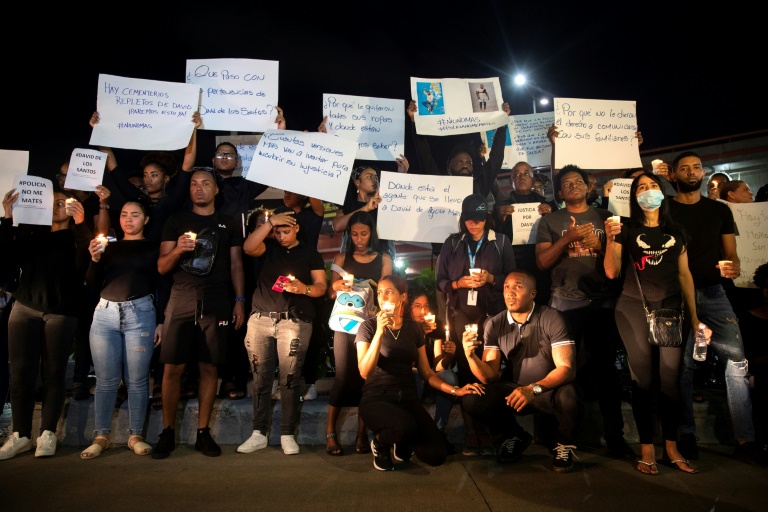
Around 100 people demonstrated in the square at the shopping center where de los Santos was arrested late last month.

Protesters wore black, lit candles and held up signs demanding justice for the deceased physical education teacher, whose family claims he was tortured by police, including even burning his testicles.

His death was the third at the hands of authorities since April 5.

Dominican President Luis Abinader promised on Twitter that “none of these cases will remain unpunished.” 

National police authorities suspended the officers involved at the station located in the fashionable Naco neighborhood, and opened an investigation alongside the public ministry.

“It is about events that cause indignation, pain and shame,” said Attorney General Miriam German Brito, whose office has recorded 41 deaths at the hands of police since October 2021.

“There is a certain pattern of behavior that we cannot allow,” she added.

– ‘Color, economic situation matter’ –

The Dominican Republic’s National Commission on Human Rights (CNDH) has recorded more than 4,000 deaths during clashes with police or security forces between 2010 and April 2021 — though they say many such deaths are not reported due to a lack of faith in the judicial system. 

CNDH president Manuel Maria Mercedes insists that “color and economic position have a huge influence” on whether someone is likely to suffer police violence in a country where almost a quarter of the population is poor.

“The fact that you come from a poor family, with scarce economic resources, is sufficient to determine the treatment you are given in this type of situation,” Mercedes told AFP.

“If David had been the son of a wealthy person… his family would not be crying now.”

In October, Abinader made moves to address policing culture in the country when he sacked the director of the national police force and ordered a reform of the institution.

The firing came after the killings of a pair of Evangelical pastors who were shot more than 20 times due to police “confusion” in March 2021, and the death of Leslie Rosado on October 2, who was chased by a police officer she allegedly struck with her car.

Just two weeks before de los Santos’s death, another man, Jose Gregorio Custodio, died at the hands of security personnel in the southern town of San Jose de Ocoa.

A video shared by national media showed the moment police officers removed the 38-year-old prisoner from a health center, where police say he had been taken for medical attention.

The footage shows police throwing him onto the pavement and then kicking him repeatedly.

The police said he died on returning to his cell after a stint in hospital due to health problems.

Custodio’s family accused them of torturing their son.

The colonel in charge of the police station was sacked during the investigation.

However, national police chief Claudio Peguero insisted on Wednesday that “there was no excess” force used in either case.

“No member (of the police) physically assaulted or physically hit either of these two people,” he said.

In another case, 30-year-old Richard Baez died of blunt head trauma in a hospital on April 5 after he had been detained in the northern city of Santiago.

Inbreeding won't doom the last of the vaquitas, but fishing might: study

Vaquita porpoises are on the edge of extinction, with just 10 left in their sole habitat within Mexico’s Gulf of California.

However, a new study published Thursday in the journal Science offers some hope: the world’s rarest marine mammals aren’t doomed by a lack of genetic diversity, and can recover if illegal “gillnet” fishing ceases immediately. 

“We’re trying to push back on this idea that there’s no hope, that nothing we do could save them at this point. It’s just not an accurate assumption,” lead author Jacqueline Robinson of the University of California San Francisco told AFP.

Porpoises are closely related to dolphins, and share many things in common including great intelligence. 

The vaquita, whose name means “little cow” in Spanish, measures four to five feet (about 1.5 meters) in length, making it the smallest of all cetaceans.

Shy and elusive, they are known for distinctive dark circles around their eyes, and relatively large dorsal fins, which are thought to help them dissipate heat in their warm habitat.

Vaquita numbers were decimated in the 20th century as a result of being accidentally trapped and drowning in gillnets: long walls of nets hanging in open water that are used to catch fish and shrimp. 

Fishermen sought in particular the totoaba, a large fish about the size of the vaquita, whose swim-bladder is prized in traditional Chinese medicine.

The totoaba itself is endangered and its fishing is illegal, but the ban isn’t always respected.

The vaquita’s historical abundance was unknown, but by the time of the first survey, in 1997, only around 570 remained.

There were fears that harmful mutations among the surviving vaquitas could seal the species’ fate due to inevitable inbreeding.

To find out whether that was the case, the researchers analyzed the genomes of 20 vaquitas that lived between 1985 and 2017, and discovered that over the past 250,000 years their population had never exceeded a few thousand.

They also learned that their genetic diversity had always been low, relative to other cetacean species such as dolphins, orcas, and other whales. 

– Benefits to low genetic diversity –

“Generally, we would think of low genetic diversity as being a bad thing. But in this case, it is somewhat advantageous for the vaquitas for their possibility of future recovery,” said Robinson. 

Inbreeding increases the chances offspring will inherit two copies of harmful mutations, leading to genetic disorders.

But it turned out that the frequency of these mutations are very low in vaquitas to begin with, because the population has always been small.

“So those mutations were historically weeded out much more effectively, than in a larger population, where those mutations could persist and remain hidden from natural selection,” explained Robinson.

There are other species that appear more resistant to so-called “inbreeding depression,” including mountain gorillas and narwhals, for similar reasons.

The team then carried out simulations to forecast the species’ future. 

Encouragingly, there is only a six percent chance of vaquitas’ extinction if gillnet fishing is eliminated.

But if such fishing is only reduced, then the extinction risk rises drastically. 

Even with an 80 percent reduction in fishing, the porpoises have a 62 percent chance of disappearing.

“While we now know that the species’ ability to recover is not limited by their genetics, vaquitas have very little time left,” said co-author Christopher Kyriazis of the University of California, Los Angeles, in a statement.

“If we lose them, it would be the result of our human choices, not inherent genetic factors.”

Karine Jean-Pierre named as first Black W.House press secretary

US President Joe Biden on Thursday named Karine Jean-Pierre as the next White House press secretary, the first Black person to hold the high-profile post.

Jean-Pierre, who will also be the first openly LGBTQ+ person in the role, will replace Jen Psaki, under whom she served as deputy, from May 13.

Biden in a statement praised Jean-Pierre’s “experience, talent and integrity,” saying he was “proud” to announce her appointment.

The outgoing spokeswoman, bringing Jean-Pierre behind the podium for the traditional briefing of accredited journalists at the White House on Thursday, praised, in a voice sometimes choked with emotion, the qualities of her deputy, whom she hugged several times.

Jean-Pierre “will be the first Black woman, the first out LGBTQ+ person to serve in this role,” said Psaki, who said from the outset that she would step down during Biden’s term.

Jean-Pierre’s promotion is “amazing because representation matters and she is going to give a voice to so many and show so many what is truly possible when you work hard and dream big,” Psaki added, opting not to comment on media reports that she will be joining TV channel MSNBC after leaving the White House.

Also visibly moved, the future press secretary said: “This is a historic moment and it’s not lost on me. I understand how important it is for so many people.”

The 44-year-old Jean-Pierre, who has a daughter with her partner, a CNN journalist, has already taken to the famed podium in the White House’s James S. Brady Press Briefing Room as Psaki’s number two.

From May she’ll take center stage at the daily White House press conference, which is broadcast live and highly scrutinized.

Before her, only one other Black woman, Judy Smith, had been deputy White House press secretary, during George H.W. Bush’s presidency in 1991.

– ‘American dream’ –

A long-time advisor to Biden, Jean-Pierre worked on both of former president Barack Obama’s campaigns in 2008 and 2012 and then on Biden’s campaign in 2020 before joining his team at the White House.

She also served under Biden during his tenure as Obama’s vice president.

Jean-Pierre was previously chief public affairs officer for liberal advocacy group MoveOn.org and worked as a political analyst with NBC and MSNBC, the White House statement said.

Raised in New York, French-speaking Jean-Pierre was born in Martinique to Haitian parents who emigrated to the United States, where her father drove a taxi and her mother was a home health worker.

It was in New York that she took her first steps into politics before also becoming a leading figure in the non-profit sphere, having graduated from the prestigious Columbia University. 

Jean-Pierre has often said her family’s background, emblematic of the “American dream,” was a determining factor in her career.

But she has also written of “the pressure of growing up in an immigrant household to succeed” in a book published in 2019.

An advocate for combatting mental health stigma, the new White House spokeswoman has also shared her own stories of being sexually abused as a child as well as suffering from depression and at one point attempting suicide.

On Thursday, when asked about the message she wanted to deliver to American youth, she said: “If you are passionate about what you want to be, where you want to go, and you work very hard to that goal it will happen. 

“You’ll be knocked down and you’ll have some tough times and it won’t be easy all the time but the rewards are pretty amazing, especially if you stay true to yourself.”

China building collapse death toll rises to 53

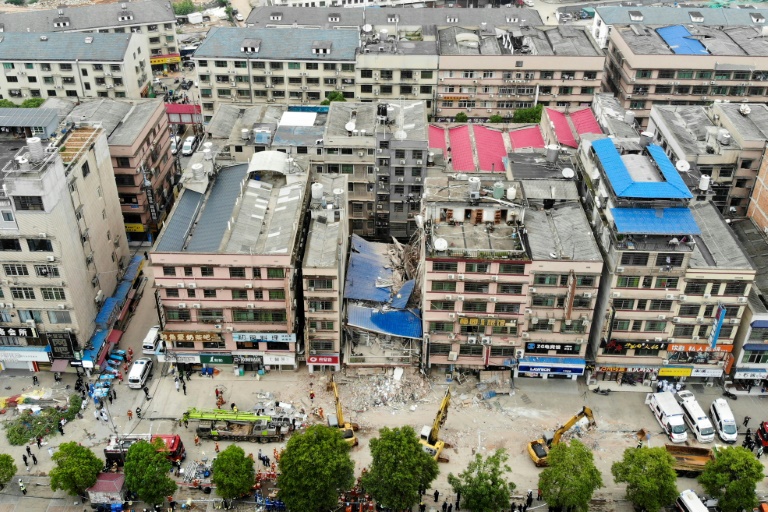
Fifty-three people died in a building collapse in central China, authorities said Friday, announcing the end of the rescue mission in a disaster which has been blamed on illegal construction.

The commercial building in Changsha city caved in last Friday, prompting over six days of painstaking attempts to pull survivors free from the mass of rubble and twisted metal.

“The search and rescue work at the Changsha building collapse site has been completed,” state broadcaster CCTV quoted city officials as saying.

“The trapped and incommunicado people from the accident scene have all been found… 10 people were rescued and 53 people died.”

The 10th person pulled alive from the rubble just after midnight on Thursday had been buried in debris for nearly six days, state media reported earlier.

Changsha’s top Communist Party official Wu Guiying led other city officials in apologising for the accident and bowed in commemoration of the victims during a Friday briefing.

They “offered a sincere apology to society” and “expressed deep condolences to all the families of the victims and injured”, according to state media, as Wu mentioned her “extreme distress” and “unparalleled self-blame”.

Officials will “fully cooperate with higher departments to thoroughly investigate the cause of the accident … and give a responsible explanation to the whole of society,” Wu vowed.

The toll from the collapse rose from 26 on Thursday evening. 

The block had contained apartments, a hotel and a cinema. The flattened structure, which has left a gaping hole in a dense Changsha streetscape, created a mess of debris and crumbled concrete beams.

Another woman who survived around 88 hours in the debris told state media that she was studying on her bed at the time of the collapse and managed to stay alive by holding on to a small amount of water and using her quilt to keep warm.

Rescuers have been able to find live victims with the help of sniffer dogs, life detectors and drones, as well as from the shouting and knocking of survivors, according to Xinhua news agency.

– Eleven detained –

Eleven people — including the building’s owner and a team of safety inspectors — have been detained in connection with the collapse, including two people suspected of engaging in “illegal alteration” of the building, according to Changsha authorities.

Officials have alleged that surveyors falsified a safety audit of the building. 

State media have identified the building as a “self-built residential structure”, meaning built by individuals or companies with no state funding. 

The Ministry of Housing and Urban-Rural Development on Sunday announced a safety inspection drive for “self-built housing” nationwide.

President Xi Jinping last week ordered a thorough investigation into the cause of the collapse, an indication of the severity of the disaster.

Building collapses are not uncommon in China due to weak safety and construction standards, as well as corruption among officials tasked with enforcement.

In January, an explosion triggered by a suspected gas leak brought down a building in the southwest city of Chongqing, killing at least 16 people.

Twenty-five people also lost their lives in June 2021 when a gas blast hit a residential compound in the central city of Shiyan.

From lockdown to wedlock: Shanghai couple defy Covid woes to marry

A couple in Shanghai have beaten Covid lockdowns and bureaucracy to tie the knot, celebrating their marriage in the car park of their housing compound after a ceremony officiated via Zoom from the United States.

With the “Bridal Chorus” on speaker, a smattering of socially distanced friends and an immaculate white dress complete with blue surgical mask, bride Janelle Nuyts walked down the aisle followed by an official in a hazmat suit who disinfected the ground around her.

Shanghai’s weeks-long lockdown has brought the business hub of 25 million people to a halt as China sticks with its zero-Covid policy.

But an easing of the rules in recent weeks has allowed some residents out of their homes, although mostly within the confines of their housing developments.

Groom Matthew Mitchener, 35, said he initially had doubts about a lockdown wedding but they melted away Saturday when he caught sight of his bride in a figure-hugging wedding dress highlighting her five-month baby bump.

“It was all a little surreal,” the Australian said, beaming, as neighbours threw rice around for good luck and cheered.

After a month stuck at home, the couple had their wedding officiated online by a US celebrant, with friends and family as witnesses, before they headed to the car park of their compound for a small celebration.

A ban on marriage between foreigners in China in place since 2019 prevented the pair from using a Chinese official, and the option to tie the knot at one of their embassies was not available.

The car park celebration had only been decided on a day before, when the couple’s neighbours suggested they hold a reception party there after an easing of restrictions made it possible.

“It kind of snowballed,” said Mitchener. “The next thing we knew, we had a wedding dress arrive from our friend, and a wedding cake, a bouquet of flowers.”

“Once I put the dress on, everything changed,” the 33-year-old Nuyts added.

The pair decided in March to have their wedding officiated online after discovering they were expecting a baby.

“It was beyond our expectations,” said Nuyts of the big day.

“We didn’t really expect it was going to be so romantic.”

UN sends new Mariupol convoy to rescue civilians from 'bleak hell'

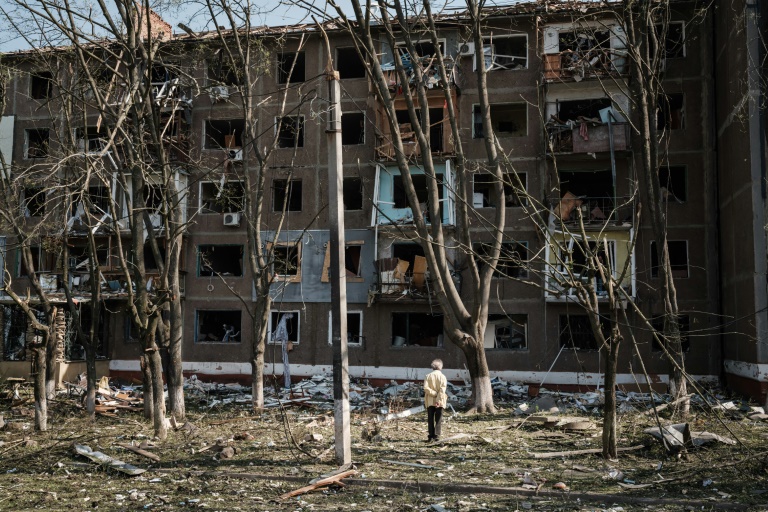
A new UN convoy was expected in Mariupol Friday to evacuate civilians from the “bleak hell” of a besieged steel plant that has become the last pocket of resistance against invading Russian forces in the southern port city.

The Russian military had announced a three-day ceasefire at the site starting Thursday but a Ukrainian commander said there was still heavy fighting at the sprawling Azovstal complex, where hundreds of soldiers and civilians have been holed up for weeks under heavy bombardment.

Ten weeks into a war that has killed thousands, destroyed cities and uprooted more than 13 million people, Russia has focused its efforts on Ukraine’s east and south, and taking full control of the now-flattened Mariupol would be a major victory for Moscow.

“A convoy is proceeding to get to Azovstal by tomorrow morning hopefully to receive those civilians remaining in that bleak hell,” UN humanitarian chief Martin Griffiths told a Ukraine donor conference in Warsaw on Thursday.

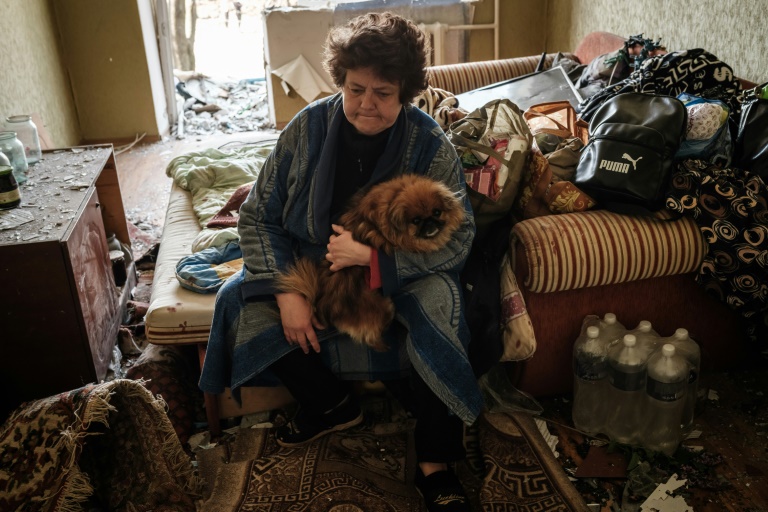
The mayor of Mariupol estimates around 200 civilians remain sheltering in dismal conditions in the plant’s Soviet-era underground tunnels. 

“We still have to evacuate civilians from there, women and children. Just imagine… more than two months of constant bombing and constant death,” Ukrainian President Volodymyr Zelensky said in his evening address on Thursday.

The International Committee of the Red Cross (ICRC) told AFP “that a safe passage operation is ongoing” in coordination with the UN. The two organisations have already worked together to evacuate some 100 civilians from the complex.

Speaking to the Israeli prime minister Thursday, Russian President Vladimir Putin said his military was ready to allow civilians to leave, according to the Kremlin.

“As for the militants remaining at Azovstal, the Kyiv authorities must give them an order to lay down their arms,” Putin said.

A commander of the Azov regiment defending the factory said in a video on Telegram that there was still heavy bloody fighting.

“The Russians violated the promise of a truce and did not allow the evacuation of civilians who continue to hide from shelling in the basement of the plant,” Svyatoslav Palamar said.

– Pentagon denial –

Since failing to take Kyiv early on in its invasion, which began February 24, Russia has focused its efforts on Ukraine’s east and south.

Seizing the strategically located Mariupol would allow Moscow to create a land bridge between the separatist pro-Russian regions in eastern Ukraine and Crimea, which it annexed in 2014.

The Kremlin conceded Thursday that Kyiv’s Western partners had prevented a quick end to Moscow’s campaign by sharing intelligence and weapons with Ukraine, but that it was “incapable of hindering the achievement” of Russia’s military operation.

The United States is among Ukraine’s biggest backers, supplying military equipment and munitions worth billions of dollars as well as intelligence and training.

But the White House has sought to limit knowledge of the full extent of its assistance to avoid provoking Russia into a broader conflict beyond Ukraine.

Washington on Thursday denied an explosive report in The New York Times that it helped Ukraine target Russian generals.

“The United States provides battlefield intelligence to help the Ukrainians defend their country,” National Security Council spokesperson Adrienne Watson said.

“We do not provide intelligence with the intent to kill Russian generals.”

Separately, US media reported Thursday that Washington had shared intelligence that helped Ukraine sink the Russian warship Moskva last month.

However a US official, who spoke on condition of anonymity, told AFP that the United States does not “provide specific targeting information on ships.” 

– Fiji seizes oligarch’s yacht –

Ukraine’s government has estimated at least $600 billion will be needed to rebuild the country after the war.

President Zelensky, who has tirelessly campaigned for help from allies, on Thursday launched a global crowdfunding platform called United24 to help Ukraine win the war and rebuild its infrastructure.

More than six billion euros ($6.3 billion) were collected at a donors’ conference in Warsaw, Polish Prime Minister Mateusz Morawiecki said Thursday.

In addition to financial and military assistance, Ukraine’s allies have also punished Russia for the invasion with unprecedented sanctions.

In one of the latest such moves, the British government said Thursday it had frozen the assets of UK-based steel and mining firm Evraz as it is of strategic significance for Russia’s war effort.

Evraz’s main shareholder is Russian oligarch Roman Abramovich, who is already under sanctions, and its main operations are in Russia.

And in another action against oligarchs close to Putin, authorities in Fiji seized the $300 million yacht of Suleiman Kerimov after the United States requested be held for sanctions violations and ties to corruption.

– Farmers on the front line –

Fighting continued across eastern Ukraine.

Donbas regional governor Pavlo Kyrylenko said at least 25 civilians were wounded in an overnight Russian strike on the city of Kramatorsk.

Elsewhere, the Ukrainian army said it had retaken control of “several settlements on the border of Mykolaiv and Kherson regions”.

In the southwest, farmers racing to keep up with the spring planting season have found themselves ploughing around unexploded ordnance — one more piece of worrying news for next year’s harvest in Europe’s breadbasket.

“Every day since the start of the war we have been finding and destroying unexploded ammunition,” Dmytro Polishchuk, one of the deminers, told AFP before heading into a field in the southwestern village of Grygorivka to destroy an unexploded rocket.

burs-qan/ser

Asian markets tumble on Wall street rout, pound slumps

Asian equities tumbled Friday following a rout on Wall Street fuelled by worries over rising interest rates and surging inflation, while the pound extended losses the day after taking a beating on fears of a UK recession. 

Global markets have been battered this year by a series of crises including surging inflation, rising interest rates, China’s economic slowdown and the war in Ukraine.

There was some relief after the Federal Reserve on Wednesday lifted borrowing costs 50 basis points — the most since 2000 — but suggested a feared 75-point lift was not on the agenda for now.

However, US traders ran for the hills Thursday as they contemplated a period of fierce monetary tightening by the US central bank as it struggles to contain inflation running at a more than 40-year high.

The Nasdaq — dominated by tech firms particularly sensitive to higher rates — lost five percent, while the Dow and S&P 500 fell more than three percent. 

“Valuations become even more sensitive, very sensitive, when rates are going up and that is what we are experiencing,” Kristina Hooper, at Invesco, told Bloomberg Television. 

“It’s just getting exacerbated as we get into the thick of monetary-policy tightening in the US.”

That sell-off filtered through to Asia, where Hong Kong tanked more than three percent as tech firms took a hit. Meanwhile, the European Chamber of Commerce in the city called the finance hub’s stringent pandemic travel restrictions and frequent flight bans a “nightmare” for businesses. 

The remarks come a week after the Australian Chamber of Commerce recommended that Hong Kong follow the lead of Singapore or Japan by lowering quarantine requirements for business travellers.

Shanghai, Sydney, Seoul, Singapore, Wellington, Taipei and Manila also tanked. However, Tokyo ended the morning slightly higher.

Adding to the selling pressure was ongoing weakness in China’s economy caused by strict lockdowns and other containment measures as officials struggle to bring a Covid flare-up under control by sticking to a zero-Covid policy.

Various districts in Beijing told residents on Thursday to work from home, while Shanghai, the biggest city in the country, remains essentially shut down.

On currency markets the pound continued to struggle a day after plunging more than two percent in reaction to the Bank of England’s updated forecast that warned annual inflation would top 10 percent and the economy would contract later this year.

Crude rose after key oil producers led by Saudi Arabia and Russia refused to lift output more than their planned marginal increase as they weighed tight supply concerns caused by the Ukraine war. 

“OPEC’s inability to ramp up production when desperately needed by the market is compounding an already dangerous supply deficit,” said Stephen Innes, of SPI Asset Management

“This means geopolitical tensions will remain high, and while there are some demand-side risks at the moment, it seems likely that the threat of supply disruption will be the dominant driver at this time,” he said. 

– Key figures at around 0230 GMT –

Tokyo – Nikkei 225: UP 0.1 percent at 26,850.53 (break)

Hong Kong – Hang Seng Index: DOWN 3.3 percent at 20,102.87 

Shanghai – Composite: DOWN 1.5 percent at 3,020.33

Brent North Sea crude: UP 0.5 percent at $111.46 per barrel

West Texas Intermediate: UP 0.4 percent at $108.74 per barrel

Euro/dollar: DOWN at $1.0525 from $1.0540 on Thursday

Pound/dollar: DOWN at $1.2348 from $1.2353

Euro/pound: UP at 85.23 pence from 84.13 pence

Dollar/yen: UP at 130.68 yen from 129.23 yen

New York – Dow: UP 2.8 percent at 34,061.06 (close)

London – FTSE 100: UP 0.1 percent at 7,503.27 (close)

Pro-Marcos misinformation targets main rival in Philippine polls

The son and namesake of the Philippines’ late dictator Ferdinand Marcos is on track to win Monday’s presidential poll, after a massive misinformation campaign whitewashed the family’s past and smeared his main rival.

Leni Robredo, the incumbent vice president, is the last obstacle to the controversial clan achieving their goal of returning to the presidential palace they fled in disgrace in 1986 following a popular uprising.

Social media groups supporting Ferdinand Marcos Jr’s bid for the top job have bombarded Filipinos with false and misleading posts about Robredo on platforms where they rank among the world’s heaviest users.

A string of doctored photos and videos viewed tens of thousands of times have sought to portray Robredo, 57, as stupid, unfriendly towards voters, and a communist.

Dozens of other bogus claims targeting her have flooded social media.

Here are the five most shared posts debunked by AFP:  

– Bungled interview –

Pro-Marcos accounts that have sought to discredit Robredo as unintelligent and cold-hearted have had a huge impact online.

A clip from an interview with a Filipino journalist back in December 2016 shows Robredo looking baffled by a question over allegations she cheated Marcos Jr.

Robredo came from behind to narrowly beat Marcos Jr for the Philippines vice presidency that year — which he then spent five years trying in vain to overturn. 

The clip was posted on Facebook on February 19, less than two weeks after the presidential election campaign season kicked off, and has been viewed more than 78,000 times.

Similar posts were uncovered by AFP Facebook, YouTube, Twitter and TikTok.

AFP fact checkers debunked the posts, reporting that portions of the original interview with news programme TV Patrol had been omitted. 

– Legal career –

Before entering politics in 2013, Robredo worked as a lawyer for more than a decade representing battered women and poor farmers.

But a post on a pro-Marcos Facebook page in March quoted the Public Attorney’s Office as saying she had “handled zero cases”.

It was shared hundreds of times by the account named “Bbm-Sara Around the World 2022” that has 24,500 followers. 

“So that’s why she has a clean record… literally no cases,” one user wrote.

The Facebook page features a manipulated header image of Marcos Jr and his running mate Sara Duterte wearing military hats, with a Philippine flag and cartoon-like images of a tiger and an eagle in the background.

The government’s law office told AFP fact checkers it did not issue the statement. 

– ‘Secret husband’ –

Even Robredo’s personal life has been the target of misinformation following the death of her husband.

Jesse Robredo, a respected cabinet member in former president Benigno Aquino’s administration, died in a plane crash in 2012.

Since Robredo won the vice presidency in 2016, a photo has circulated in false posts claiming it shows her with a “secret first husband” who “also died in a mysterious plane crash”.

A Filipino couple living in the northern province of Pampanga told AFP fact checkers it was their wedding photo that was being shared.

“I wish people would respect other people’s privacy,” husband Daniel Canlas said.

– ‘Leaked ballot’ –

Marcos supporters have repeatedly accused Robredo of voter fraud since the 2016 vice presidential contest — and even alleged that the national election agency was involved. 

Pro-Marcos accounts claimed that a video posted on Facebook and TikTok showed a leaked ballot paper, which they said proved the Commission on Elections had cheated for Robredo. 

The video was viewed more than a million times.

But a commission spokesman told AFP that the document, which was missing various features included on official election ballots, was only a sample.

– Wrongly counted vote –

After Filipinos living overseas began voting in April, a video showing a woman in Hong Kong complaining that her vote for Marcos Jr had been wrongly counted for Robredo went viral.

The clip was viewed tens of thousands of times on Facebook, but an AFP investigation found it had been doctored.

There was no mention of Robredo in the unedited version of the video, which had been circulating online since at least 2016.

The Commission on Elections told AFP it had not received complaints of wrongly counted votes during early overseas voting this year.

Close Bitnami banner
Bitnami