World

Thirsty birds struggle to survive in scorching Indian heat

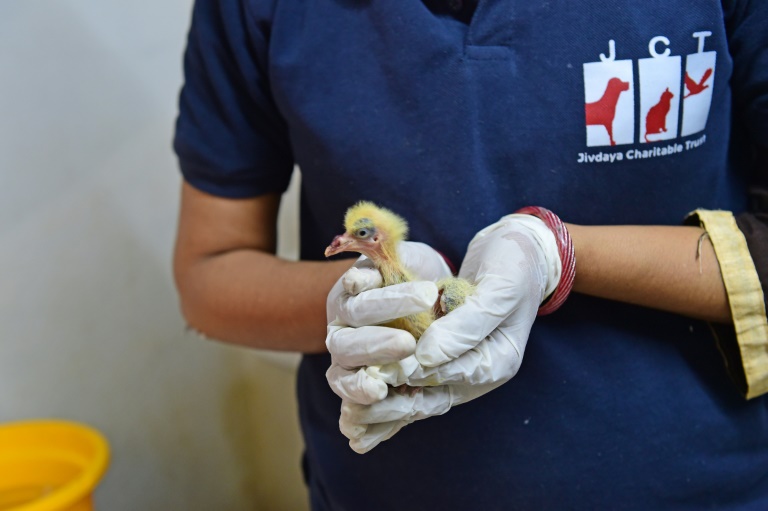
A volunteer scoops up a fledgling kite lying nearly immobile on a scorching Indian sidewalk as the relentless sun beats down on its feathers — one of countless birds struggling to endure an unbearable heatwave.

An early start to summer has brought record temperatures and made life a misery for human and animal alike, with experts warning that climate change is making such conditions more intense and more frequent.

One animal hospital in the western city of Ahmedabad has treated around 2,000 birds over the past month, many weak and severely dehydrated, with some suffering from broken wings after falling from trees.

“We receive daily at least 50 to 60 dehydrated birds,” Gira Shah, co-founder of the Jivdaya Charitable Trust that manages the hospital, told AFP, adding that temperatures have soared up to 46 degrees Celsius (115 degrees Fahrenheit).

The bird hospital is one of the biggest of its kind in India and was established by members of the Jain faith — an ancient Indian religion that preaches non-violence and love for all creatures, great and small.

The hellish heat has coincided with the end of the breeding season for some bird species, resulting in large numbers of chicks and fledglings being treated in the facility.

A regular stream of volunteer rescuers and members of the public bring the birds in cardboard boxes or baskets every day, where they are logged, weighed, tagged and examined by a veterinarian.

The birds are treated, but around one in four do not survive due to the severity of their dehydration or from the resulting complications.

Those that recover are kept in an aviary until they are ready to be released back into the wild.

Others that have been too severely disabled by their injuries are sent to zoos or educational institutions.

– ‘Pretty dire’ –

Veterinarian Nidhi Sharma had already treated a parakeet and a babbler chick before the fledgling kite rescued from the road was brought to her for examination.

“It’s severely dehydrated,” the 29-year-old said as she injected it with replenishing fluids.

The rescuers believe the kite, weakened by the heat, fell to the ground from its nest in a tree nearly 15 metres (50 feet) above.

Hospital curator Sherwin Everett has worked at Jivdaya — “compassionate life” in the local Gujarati language — since 2010.

He says this year’s heatwave has been among the worst for local birds he has ever seen.

Heatwaves have killed more than 6,500 people in India since 2010, but Shah and Everett are also calling on the public to also be considerate of the welfare of any wildlife they come across.

“We are expecting until July to have multiple heatwaves and the temperature will get worse,” Everett said.

“Right now we have received quite a lot of birds that have been dehydrated,” he added. “But the upcoming months seem to be pretty dire for us as well.”

Thirsty birds struggle to survive in scorching Indian heat

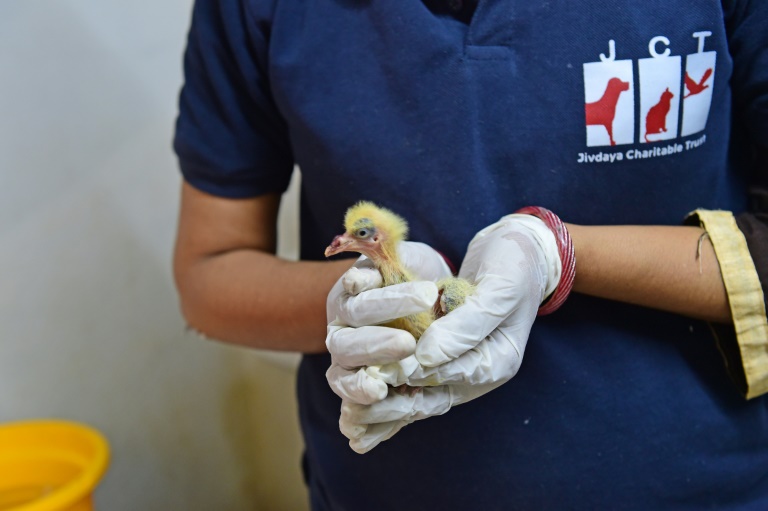
A volunteer scoops up a fledgling kite lying nearly immobile on a scorching Indian sidewalk as the relentless sun beats down on its feathers — one of countless birds struggling to endure an unbearable heatwave.

An early start to summer has brought record temperatures and made life a misery for human and animal alike, with experts warning that climate change is making such conditions more intense and more frequent.

One animal hospital in the western city of Ahmedabad has treated around 2,000 birds over the past month, many weak and severely dehydrated, with some suffering from broken wings after falling from trees.

“We receive daily at least 50 to 60 dehydrated birds,” Gira Shah, co-founder of the Jivdaya Charitable Trust that manages the hospital, told AFP, adding that temperatures have soared up to 46 degrees Celsius (115 degrees Fahrenheit).

The bird hospital is one of the biggest of its kind in India and was established by members of the Jain faith — an ancient Indian religion that preaches non-violence and love for all creatures, great and small.

The hellish heat has coincided with the end of the breeding season for some bird species, resulting in large numbers of chicks and fledglings being treated in the facility.

A regular stream of volunteer rescuers and members of the public bring the birds in cardboard boxes or baskets every day, where they are logged, weighed, tagged and examined by a veterinarian.

The birds are treated, but around one in four do not survive due to the severity of their dehydration or from the resulting complications.

Those that recover are kept in an aviary until they are ready to be released back into the wild.

Others that have been too severely disabled by their injuries are sent to zoos or educational institutions.

– ‘Pretty dire’ –

Veterinarian Nidhi Sharma had already treated a parakeet and a babbler chick before the fledgling kite rescued from the road was brought to her for examination.

“It’s severely dehydrated,” the 29-year-old said as she injected it with replenishing fluids.

The rescuers believe the kite, weakened by the heat, fell to the ground from its nest in a tree nearly 15 metres (50 feet) above.

Hospital curator Sherwin Everett has worked at Jivdaya — “compassionate life” in the local Gujarati language — since 2010.

He says this year’s heatwave has been among the worst for local birds he has ever seen.

Heatwaves have killed more than 6,500 people in India since 2010, but Shah and Everett are also calling on the public to also be considerate of the welfare of any wildlife they come across.

“We are expecting until July to have multiple heatwaves and the temperature will get worse,” Everett said.

“Right now we have received quite a lot of birds that have been dehydrated,” he added. “But the upcoming months seem to be pretty dire for us as well.”
Conservatives lose key councils in UK vote, historic N.Ireland result predicted

Prime Minister Boris Johnson’s Conservative party lost control of key councils in London, according to partial results from local and regional UK elections on Friday, with a potentially historic change looming in Northern Ireland.

The main opposition Labour party of Keir Starmer won control of long-term Conservative strongholds in the capital, including Wandsworth and Barnet as well as Westminster, for the first time since 1964, with around a third of English votes counted.

Results so far are not a landslide for Labour, with the centrist Lib Dems and Greens making inroads elsewhere in England, and counting from Thursday’s vote in Scotland, Wales and Northern Ireland to get underway later in the day.

Conservative Party chairman Oliver Dowden sought to play down Conservative losses and insisted Johnson was not under threat.

“I think looking at the picture of the results so far, they demonstrate that whilst there have been difficult results, they are consistent with what you’d expect with us from mid-term,” Dowden told Sky News.

The new Labour leader of Westminster City Council Adam Hug said his party’s victory was a “huge privilege”, while the leader of the Labour group in Barnet said the result was a reflection of disillusionment with the Tories.

“I think a lot of Conservatives haven’t voted this time, I think they feel alienated from No 10 and that they are, I don’t know, they’ve been disappointed with Boris Johnson and so not voting and I think that’s made a difference as well,” Barry Rawlings told the BBC.

The contest for the devolved assembly in Belfast could see a pro-Irish nationalist party win for the first time in the troubled history of the British province.

The results could have huge constitutional implications for the four-nation UK’s future, with predicted victors Sinn Fein committed to a vote on reunification with Ireland.

Poor results could reignite simmering discontent within Johnson’s ruling Conservatives about his leadership, after a string of recent scandals.

Johnson has tried to sideline the so-called “Partygate” scandal that last month saw him become the first British prime minister to be fined for breaking the law while in office.

– Jeopardy –

Johnson, 57, won a landslide 2019 general election victory by vowing to take the UK out of the European Union, and reverse rampant regional inequality.

Despite making good on his Brexit pledge, the coronavirus pandemic largely stalled his domestic plans. 

But his position has been put in jeopardy because of anger at lockdown-breaking parties at his Downing Street office and the steeply rising cost of living.

Labour is trying to make inroads across England despite defending the many gains it made at the last local elections in 2018.

The party is bidding to leapfrog the Conservatives into second place in Scotland, behind the pro-independence Scottish National Party (SNP), and remain the largest party in Wales, where 16 and 17-year-olds are eligible to vote for the first time. 

– ‘Sea change’ –

The contest for Northern Ireland’s power-sharing assembly is set to capture attention, after numerous polls put Sinn Fein ahead.

A University of Liverpool poll reported Tuesday it remained on target to win comfortably with over a quarter of the vote. 

The pro-UK Democratic Unionist Party (DUP) and cross-community Alliance Party were tied for second.

Deirdre Heenan, professor of social policy at Ulster University, said there was a feeling the election “really is momentous”. 

“It will be a sea change if a nationalist becomes first minister,” she told AFP.

Sinn Fein — the IRA’s former political wing — has dialled down its calls for Irish unity during campaigning, saying it is “not fixated” on a date for a sovereignty poll, instead focusing on the rising cost of living and other local issues.

Party vice president Michelle O’Neill has insisted voters are “looking towards the future” with pragmatism rather than the dogmatism that has long been the hallmark of Northern Irish politics.

O’Neill’s DUP rivals have sought to keep the spotlight on possible Irish reunification in the hope of bolstering their flagging fortunes.

In February, its first minister withdrew from the power-sharing government in protest at post-Brexit trade arrangements, prompting its collapse. 

DUP leader Jeffrey Donaldson has said that his party would not form a new executive unless London rips up the trading terms, known as the Northern Ireland Protocol.

Ukraine says UN-led Mariupol mission rescues 'almost 500 civilians'

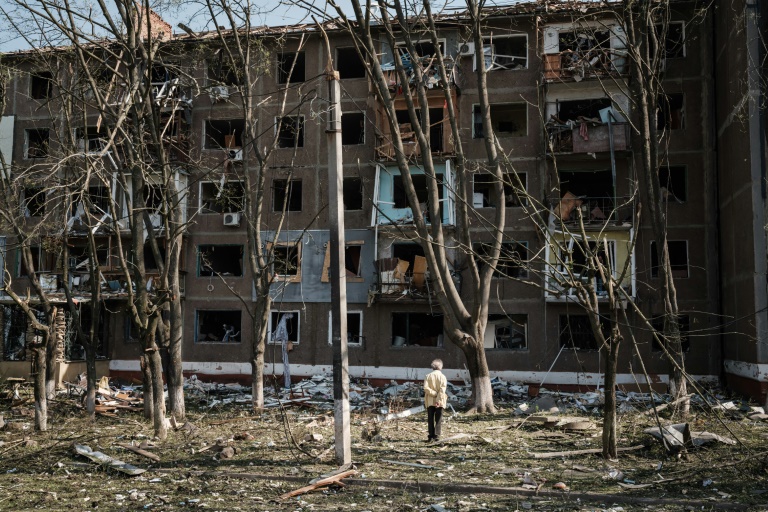
Almost 500 civilians have been evacuated from the devastated city of Mariupol and its besieged Azovstal steel plant in a UN-led rescue operation, the Ukrainian president’s office said Friday.

The United Nations had said Thursday that a new convoy would evacuate civilians from the “bleak hell” of the factory, which has become the last pocket of resistance in the southern port city.

“We have managed to evacuate almost 500 civilians,” Andriy Yermak, who heads Volodymyr Zelensky’s office, said on Telegram.

He said Kyiv will “do everything to save all its civilians and military” stuck in the devastated city, adding that the operation was ongoing.

The Russian military had announced a three-day ceasefire at the site starting Thursday but a Ukrainian commander said there was still heavy fighting at the sprawling complex.

Hundreds of soldiers and civilians have been holed up for weeks under heavy bombardment, many taking shelter in the plant’s Soviet-era underground tunnels.

Ten weeks into a war that has killed thousands, destroyed cities and uprooted more than 13 million people, Russia has focused its efforts on Ukraine’s east and south, and taking full control of the now-flattened Mariupol would be a major victory for Moscow.

“We still have to evacuate civilians from there, women and children. Just imagine… more than two months of constant bombing and constant death,” Zelensky had said Thursday.

Speaking to the Israeli prime minister Thursday, Russian President Vladimir Putin had said his military was ready to allow civilians to leave, according to the Kremlin.

“As for the militants remaining at Azovstal, the Kyiv authorities must give them an order to lay down their arms,” Putin said.

A commander of the Azov regiment defending the factory said in a video on Telegram that there was still heavy fighting.

“The Russians violated the promise of a truce and did not allow the evacuation of civilians who continue to hide from shelling in the basement of the plant,” Svyatoslav Palamar said.

– Pentagon denial –

Since failing to take Kyiv early on in its invasion, which began February 24, Russia has focused its efforts on Ukraine’s east and south.

Seizing the strategically located Mariupol would allow Moscow to create a land bridge between the separatist pro-Russian regions in eastern Ukraine and Crimea, which it annexed in 2014.

The Kremlin conceded Thursday that Kyiv’s Western partners had prevented a quick end to Moscow’s campaign by sharing intelligence and weapons with Ukraine, but that it was “incapable of hindering the achievement” of Russia’s military operation.

The United States is among Ukraine’s biggest backers, supplying military equipment and munitions worth billions of dollars as well as intelligence and training.

But the White House has sought to limit knowledge of the full extent of its assistance to avoid provoking Russia into a broader conflict beyond Ukraine.

Washington on Thursday denied an explosive report in The New York Times that it helped Ukraine target Russian generals.

“The United States provides battlefield intelligence to help the Ukrainians defend their country,” National Security Council spokesperson Adrienne Watson said.

“We do not provide intelligence with the intent to kill Russian generals.”

Separately, US media reported Thursday that Washington had shared intelligence that helped Ukraine sink the Russian warship Moskva last month.

However a US official, who spoke on condition of anonymity, told AFP that the United States does not “provide specific targeting information on ships.” 

– Fiji seizes oligarch’s yacht –

Ukraine’s government has estimated at least $600 billion will be needed to rebuild the country after the war.

Zelensky, who has tirelessly campaigned for help from allies, on Thursday launched a global crowdfunding platform called United24 to help Ukraine win the war and rebuild its infrastructure.

More than six billion euros ($6.3 billion) were collected at a donors’ conference in Warsaw, Polish Prime Minister Mateusz Morawiecki said Thursday.

In addition to financial and military assistance, Ukraine’s allies have also punished Russia for the invasion with unprecedented sanctions.

In one of the latest such moves, the British government said Thursday it had frozen the assets of UK-based steel and mining firm Evraz as it is of strategic significance for Russia’s war effort.

Evraz’s main shareholder is Russian oligarch Roman Abramovich, who is already under sanctions, and its main operations are in Russia.

And in another action against oligarchs close to Putin, authorities in Fiji seized the $300 million yacht of Suleiman Kerimov after the United States requested be held for sanctions violations and ties to corruption.

– Farmers on the front line –

Fighting continued across eastern Ukraine.

Donbas regional governor Pavlo Kyrylenko said at least 25 civilians were wounded in an overnight Russian strike on the city of Kramatorsk.

Elsewhere, the Ukrainian army said it had retaken control of “several settlements on the border of Mykolaiv and Kherson regions”.

In the southwest, farmers racing to keep up with the spring planting season have found themselves ploughing around unexploded ordnance — one more piece of worrying news for next year’s harvest in Europe’s breadbasket.

“Every day since the start of the war we have been finding and destroying unexploded ammunition,” Dmytro Polishchuk, one of the deminers, told AFP before heading into a field in the southwestern village of Grygorivka to destroy an unexploded rocket.

burs-qan/ser

Dirty tricks allegations mar last days of Philippine election campaign

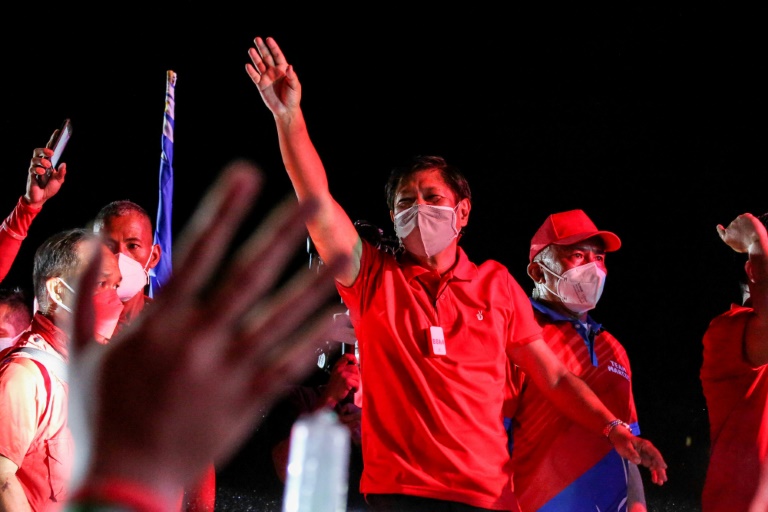
Philippine election rivals traded allegations of dirty tricks and vote-rigging Friday, in the final stretch of an acerbic campaign that is tipped to bring the son of former dictator Ferdinand Marcos to power.

After months of fierce campaigning marked by relentless misinformation and an online whitewashing of the country’s violent history, rivals Ferdinand Marcos Jr and Leni Robredo implicated each other in underhand tactics.

Marcos Jr — the son of the late dictator and notoriously kleptocratic first lady Imelda Marcos — is predicted to win Monday’s poll by a landslide.

The Marcos campaign on Friday urged supporters to “protect their votes” against unspecified attempts at vote-rigging.

“We’ve already won!” Marcos Jr said. “Just make sure you guard the votes on Monday — don’t sleep… we know that when we sleep, a lot of undesirable things happen.”

The Marcos campaign also accused Robredo of being “toxic, divisive and acrimonious” and having “associated themselves” with shadowy political groups.

Robredo has campaigned on a promise to clean up the Philippines’ chronically corrupt politics.

The 57-year-old lawyer, and current vice president, has attracted fevered support from progressive young Filipinos.

Despite her deficit in opinion polls, few are ready to completely rule her out, as febrile rumours swirl about the accuracy of polls that currently put her on 23 percent of the vote versus Marcos’ 56 percent.

With all still to play for, her campaign took legal action on Friday to bat back potentially damaging rumours that she is in league with the Communist Party.

Unproven allegations that party founder Jose Maria Sison, who lives in exile in the Netherlands, was advising her campaign recently resurfaced in Marcos-allied media.

In a complaint affidavit filed with the prosecutor’s office Robredo’s spokesman called the allegations “fabricated” and “fictitious”.

“This crossed a line,” Barry Gutierrez told reporters. 

“This is not a vlogger, it’s not some random influencer on social media putting out criticisms. This is supposedly a respectable member of the journalism profession.”

– Echoes of the dictator –

Despite a lack of evidence, the allegations have circulated widely on Facebook, which is extremely popular in the Philippines, gaining hundreds of thousands of interactions.

Misinformation seeking to discredit Robredo as stupid, unfriendly or even a communist has surged during the election season. 

Communist rebels have waged a decades-long insurgency in the country. 

Red-tagging — accusing someone of being a communist sympathiser — has intensified under President Rodrigo Duterte and has resulted in the deaths of many activists, journalists and lawyers.

Robredo hit back on Friday, accusing Marcos Jr of being a “liar”.

“I pity the Filipinos who were deceived by him,” she told reporters in the central city of Sorsogon.

The allegations against Robredo carry echoes of the elder Ferdinand Marcos’s tactics of discrediting enemies, justifying his dictatorial rule and retaining US Cold War support by playing up the spectre of a looming Red Peril that was hell-bent on taking over the country.

For much of the campaign, Marcos Jr has eschewed detailed policy pronouncements, instead framing himself as uniquely qualified to “unify” the nation.

He also portrayed his father’s rule — which saw widespread human rights abuses, rampant corruption, international opprobrium and the cratering of the Philippine economy — as a gilded age.

Behind the scenes, he has built a potent coalition of the country’s ruling families who can deliver blocks of votes on mass.

Marcos’ running mate is Sarah Duterte, the daughter of the outgoing president, who has strong domestic support for his unvarnished political style and a bloody drug war that rights groups estimate has killed tens of thousands in extrajudicial executions.

The duo’s campaign on Friday promised to reopen the economy after Covid-19 lockdowns, invest in infrastructure and continue Rodrigo Duterte’s “campaign against illegal drugs and criminality” which is subject to an investigation by the International Criminal Court.

But the prospect of a Marcos presidency has alarmed rights groups and Catholic church leaders, who doubt his commitment to democracy and fear his administration will weaken checks and balances on governance and worsen corruption.

Saturday will see both sides hold enormous rallies in Manila for the last day of campaigning — with hundreds of thousands projected to gather just a few kilometres (miles) apart to cheer their political idols and enjoy a barrage of Pinoy pop.

Bulgaria industry on tenterhooks after Russia gas cut

The halt of Russian gas supplies to Bulgaria last week has left companies big and small scrambling as they fear halts in deliveries and rising prices.

“We are already on the brink. We’ll have to raise our prices further,” said Valery Krastev, who owns a bread factory in the northern town of Montana.

“How will people pay for this bread?” he worried.

The government has insisted Bulgaria has “alternative choices” to Russian gas and won’t reduce supplies to consumers, calling Moscow’s move to halt deliveries “blackmail”.

While natural gas supplies had escaped punishing European sanctions on Russia over its invasion of Ukraine, Moscow sought to sow division among European nations by exploiting their dependence on its gas.

Russia demanded that Gazprom customers have to pay in rubles rather than US dollars or euros, which would be a violation of Western sanctions.

The Russian energy giant cut deliveries to Bulgaria and Poland on April 27.

Since then, Bulgaria’s neighbours have stepped in, shoring up deliveries to the country, which has received more than 90 percent of its gas from Russia for decades.

– Diversification –

But the lack of a long-term solution to secure the Balkan EU member’s annual needs of about 3.0 billion cubic metres of gas is keeping large industrial consumers as well as smaller businesses on tenterhooks.

Many people living in Sofia still remember January 2009 when a Russia-Ukraine gas spat cut deliveries to Europe for days on end, leaving their homes without heating in the dead of winter and prompting rationing for industry.

Bulgaria already pays 10 percent more for its gas, Energy Minister Alexander Nikolov confirmed after securing deliveries for May through an intermediary gas trading company.

“I can’t believe that someone is trying to convince us that… this is good for us. No it is not,” said Konstantin Stamenov, head of the BFIEC federation of industrial energy consumers and a senior executive at a steel manufacturer, on public radio BNR.

To keep prices contained and secure energy supplies, the government has vowed to diversify suppliers.

It plans to wrap up construction of another major pipeline linking its gas network with that of Greece by the end of June.

This will allow the state gas operator Bulgargaz to negotiate an increase of supplies on an existing contract with Azerbaijan to an annual 1.0 bcm and receive more gas from liquefied natural gas (LNG) terminals in Greece. 

Prime Minister Kiril Petkov also said that the government is in talks to buy LNG from the United States and Egypt.

Analysts say prices may even fall if the country manages to secure long-term contracts for LNG deliveries.

“We have here a huge opportunity to achieve stable diversification of gas deliveries,” energy expert Martin Vladimirov from the Sofia-based think tank Centre for the Study of Democracy told AFP.

However, Open Society economist Georgy Angelov warned: “But that won’t happen in a day.”

– Business as usual – 

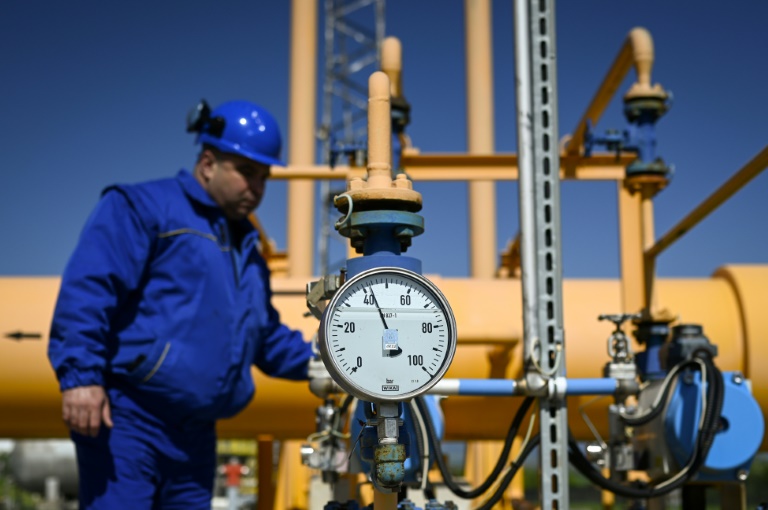
For now, it’s business as usual at a Bulgartransgaz compressor station near Ihtiman, where Russian natural gas is still flowing through the bright yellow pipes.

But Bulgargaz is no longer allowed to use any of this gas — most of it being destined for Greece and North Macedonia.

For its own supply, Bulgaria is currently relying on swap operations with its neighbours, who supply it with Russian gas or LNG through reverse flow pipelines from Greece and Romania. 

Expert Vladimirov cautioned, however, against a suspected scheme by Russia to abandon its direct contract with Bulgargaz and instead make the country buy gas at higher prices through intermediaries such as Hungarian gas trader MET, known to be close to Gazprom, which already helped secure the deliveries for May.

“This, in the end, might lead to higher dependency on Russia under worse contractual conditions,” he warned.

Some industry players are putting on a brave face as they have already started to convert their equipment to be able to use alternative sources of fuel, fearing a crisis in deliveries.

“Yes, it will become more expensive. But it will not be impossible to work,” Krasen Kyurkchiev, owner of home care product maker Ficosota, told AFP.

Russian oligarch's yacht seized in Fiji on US request

Fiji authorities have seized sanctioned Russian oligarch Suleiman Kerimov’s $300 million yacht in line with a US warrant, the US Justice Department says.

The 348-foot (106-metre) Amadea was berthed in Lautoka, Fiji in the South Pacific when the island state’s law enforcement took control of it.

The US Justice Department had requested the vessel, which sailed to Fiji in mid-April, be held for violating sanctions and for alleged ties to corruption.

The Amadea is worth $325 million and has a helipad, pool, jacuzzi and “winter garden” on the sun deck, according to tracking website superyachtfan.com.

“The Amadea is subject to forfeiture based on probable cause of violations of US law, including the International Emergency Economic Powers Act, money laundering and conspiracy,” the department said in a statement Thursday.

Kerimov is among a group of Russian oligarchs “who profit from the Russian government through corruption and its malign activity around the globe, including the occupation of Crimea,” it said.

The United States has imposed sanctions on Russian oligarchs close to President Vladimir Putin to punish Moscow for its invasion of Ukraine.

Kerimov, who has made a fortune as part-owner of major Russian energy and financial companies including Gazprom and Sberbank, is also an official of the Russian government and a member of the Russian Federation Counsel, it said.

– ‘No hiding place’ –

“There is no hiding place for the assets of criminals who enable the Russian regime,” US Attorney General Merrick Garland said in a statement. 

“The Justice Department will be relentless in our efforts to hold accountable those who facilitate the death and destruction we are witnessing in Ukraine,” Garland added.

Deputy Attorney General Lisa Monaco said the department had its eyes “on every yacht purchased with dirty money”.

“This yacht seizure should tell every corrupt Russian oligarch that they cannot hide — not even in the remotest part of the world,” she said.

“We will use every means of enforcing the sanctions imposed in response to Russia’s unprovoked and unjustified war in Ukraine.”

An application by a company registered as the owner of the Amadea, Millemarin Investment, for an interim stay of execution of the court order approving the seizure, pending an appeal, was denied Friday by the Fiji High Court.

Fiji news media reported the superyacht is expected to be moved to the United States within days.

In a publicly released copy of the US warrant, the section listing various reasons to believe Kerimov is the true beneficial owner of the yacht was partly blacked out. 

It said the Amadea’s ownership was transferred to Millemarin Investment in August 2021.

The US warrant said Fiji’s authorities searched the vessel last month and found “numerous” financial documents related to the Amadea. Details of the transactions were blacked out.

The Amadea’s official paperwork said its next destination after Fiji was the Philippines. 

“However, there is reason to believe that its intended destination is, in fact, Vladivostok or other waters in Russian territory,” the warrant said.

Fears mount for China's economy as leaders dig in on zero-Covid

Mass testing of China’s vast population could bring fresh misery to the economy, experts warned Friday, after Beijing vowed to regain control of the narrative around a zero-Covid policy that has strangled growth and fanned anger across the country.

Leaders have taken a hardline approach to stamping out virus outbreaks, locking down Shanghai — the country’s economic dynamo and biggest city — and slowly restricting movement in Beijing over dozens of new cases. 

Authorities have refused to bend to mounting public outcry at food shortages and spartan quarantine conditions in Shanghai, with top officials on Thursday pledging to “unwaveringly adhere” to zero-Covid and “fight against” criticism of the policy.

China’s government has brandished the strategy as proof that it values human life above material concerns and can avert the public health crises seen in other countries.

But the approach is hammering the economy and posing a sharp political challenge to President Xi Jinping.

He now has to convince an increasingly unsettled public, which has cascaded its anger at lockdowns onto social media, that the trade-off between the economy and lives is sustainable.

At Thursday’s meeting — attended by Xi — the nation’s top brass pledged to “resolutely fight against all words and deeds that distort, question or reject our nation’s disease control policies”.

Experts fear Beijing’s game plan will weigh heavily on the world’s second-largest economy.

Analysts at Nomura on Friday predicted that mass testing mandates alone could cost up to 2.3 percent of annual gross domestic product.

Shanghai’s 25 million residents have been tested several times, while some of Beijing’s 21 million people have also undergone repeated rounds of checks — a policy the government has hinted may be extended across the country to combat the highly transmissible Omicron variant.

Nomura said a requirement that half of the world’s most populous nation took one test every three days would cost around 0.9 percent of GDP, while any demand that 90 percent of the population takes a test every two days would cost 2.3 percent.

The restrictions could carry “quite high” costs if expanded nationwide, while offering only “limited” benefits as the hard-to-contain Omicron strain may trigger lockdowns in more cities, said Ting Lu, Nomura’s chief China economist.

The grim prediction follows a Fitch Ratings cut to its forecast for China’s full-year economic growth to 4.3 percent, from 4.8 percent.

That is well off the government’s official target of 5.5 percent. 

A key index of service sector activity slumped to 36.2 in April, the second-lowest on record, in what some experts said is a stark pointer of a country in recession.

Astronaut crew returns to Earth after six months on ISS

NASA’s Crew-3 mission returned home to Earth on Friday after six months aboard the International Space Station.

The SpaceX Dragon Endurance spacecraft with NASA astronauts Kayla Barron, Raja Chari and Tom Marshburn, as well as European Space Agency astronaut Matthias Maurer, undocked from the orbital laboratory a day earlier.

Their 23.5 hour journey back saw them splash down off the coast of Florida at 12:43 am (0443 GMT).

“On behalf of the entire SpaceX team, welcome home,” a SpaceX official said to the crew moments after the capsule splashed down.

They left behind the one Italian and three American astronauts of Crew-4, and three Russian cosmonauts. Ahead of departure, Marshburn handed command of the station over to Russian Oleg Artemyev.

During their mission, Crew-3 carried out hundreds of scientific experiments, including growing chiles in space to add to knowledge of cultivating crops on long-term missions, exploring how concrete hardens in space, and Earth monitoring.

“Every day on @Space_Station is #EarthDay for @NASA_Astronauts since we see how thin the precious layer is that protects everything we know & love as a human race,” Crew-3 commander Chari tweeted on Thursday.

“Hopefully, @NASA research will help w/ H20 purification & carbon dioxide reductions but the rest is up to us.”

Chancellor Olaf Scholz wished Maurer, the 12th German in space, “a good and safe journey back with a soft landing,” thanking him on Twitter Thursday for “all the new discoveries in space that are so important for us here on Earth.”

Crew-3’s expedition came at an increasingly busy time for commercial space. 

They welcomed aboard a private crew that included three wealthy businessmen that came and went on another SpaceX Crew Dragon, as well as a Japanese mission that flew on a Soyuz aircraft to the Russian segment.

The ISS now awaits docking with an uncrewed Boeing Starliner capsule, which is set to launch from Florida on May 19. 

NASA is looking to certify a second company to ferry astronauts to the region of space called Low Earth Orbit, leaving it to develop its super heavy space launch system (SLS) rocket for missions to the Moon, and eventually Mars.

Fears mount for China's economy as leaders dig in on zero-Covid

Mass testing of China’s vast population could bring fresh misery to the economy, experts warned Friday, after Beijing vowed to regain control of the narrative around a zero-Covid policy that has strangled growth and fanned anger across the country.

Leaders have taken a hardline approach to stamping out virus outbreaks, locking down Shanghai — the country’s economic dynamo and biggest city — and slowly restricting movement in Beijing over dozens of new cases. 

Authorities have refused to bend to mounting public outcry at food shortages and spartan quarantine conditions in Shanghai, with top officials on Thursday pledging to “unwaveringly adhere” to zero-Covid and “fight against” criticism of the policy.

China’s government has brandished the strategy as proof that it values human life above material concerns and can avert the public health crises seen in other countries.

But the approach is hammering the economy and posing a sharp political challenge to President Xi Jinping.

He now has to convince an increasingly unsettled public, which has cascaded its anger at lockdowns onto social media, that the trade-off between the economy and lives is sustainable.

At Thursday’s meeting — attended by Xi — the nation’s top brass pledged to “resolutely fight against all words and deeds that distort, question or reject our nation’s disease control policies”.

Experts fear Beijing’s game plan will weigh heavily on the world’s second-largest economy.

Analysts at Nomura on Friday predicted that mass testing mandates alone could cost up to 2.3 percent of annual gross domestic product.

Shanghai’s 25 million residents have been tested several times, while some of Beijing’s 21 million people have also undergone repeated rounds of checks — a policy the government has hinted may be extended across the country to combat the highly transmissible Omicron variant.

Nomura said a requirement that half of the world’s most populous nation took one test every three days would cost around 0.9 percent of GDP, while any demand that 90 percent of the population takes a test every two days would cost 2.3 percent.

The restrictions could carry “quite high” costs if expanded nationwide, while offering only “limited” benefits as the hard-to-contain Omicron strain may trigger lockdowns in more cities, said Ting Lu, Nomura’s chief China economist.

The grim prediction follows a Fitch Ratings cut to its forecast for China’s full-year economic growth to 4.3 percent, from 4.8 percent.

That is well off the government’s official target of 5.5 percent. 

A key index of service sector activity slumped to 36.2 in April, the second-lowest on record, in what some experts said is a stark pointer of a country in recession.

Close Bitnami banner
Bitnami