World

Orthodox Palm Sunday brings brief respite to Ukraine's Kramatorsk

For once, the distant thunder of shelling cannot be heard in the eastern Ukrainian city of Kramatorsk. Orthodox Palm Sunday has granted its residents some respite before an expected Russian onslaught.

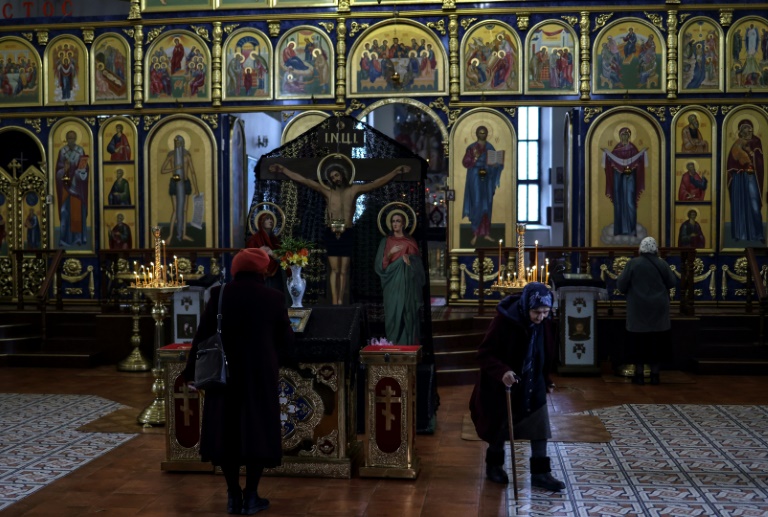
In the Orthodox Svyato-Pokrovsky church, around 40 people — mostly women wearing colourful headscarves — occupy the largely empty pews as the sermon begins.

“It’s very hard and scary right now,” said a congregant as she arrived at the red-brick church topped with four gleaming domes.

“We must pray for our soldiers to have strength and faith. We need it and they need it,” she told AFP on condition of anonymity.

Two young children entered with their mother. Holding branches to commemorate the Christian holiday of Easter, they solemnly lit a candle before leaving. 

“Today is a big celebration, Palm Sunday. It would be wrong not to come, especially when it’s calm,” said Nadia, 30, as her children aged three and four played in the adjoining park.

Nadia refused to be evacuated for fear of travelling alone with her two young offspring and leaving her relatives in Kramatorsk.

“We don’t go to the basement each time there’s a (bomb) siren. It’s too stressful for them (the children),” she said. 

“We have our spot in the basement just in case, but we prefer to stay in the house if possible. We dim the lights.”

– ‘Miracle Market’ –

Near the railway station — closed since shelling on April 8 killed 57 people — a heavy military vehicle slowly transports an imposing artillery cannon through a junction.

The range of its shells is about 40 kilometres (25 miles) — roughly the distance separating Kramatorsk from the surrounding frontline.

In a rare continuation of normal life, a handful of ageing trolleybuses ferry passengers around the city centre.

The “Miracle Market” store also remains open — one of the few supermarkets to do so.

Some aisles are bare, but many customers remain in the alleys in their search for essentials such as bread, meat, vegetables, cheese and tea.

Shop manager Igor Kudriavtsiev is proud to serve those who have stayed in the capital of the Donbas region, after the vast majority of its 150,000 inhabitants fled.

“Our profits aren’t as high (as before the war), but we’re responsible for those who have stayed — mostly elderly people who, for one reason or another, weren’t able to leave,” he said.

Only one of the chain’s eight stores in Kramatorsk had to close owing to a lack of staff. 

“We have all the products we need. There’s no supply problem,” Kudriavtsiev insisted.

A shop employee fills empty display boxes with sought-after bags of sweets. “It’s what goes the quickest, along with tea,” she explained.

– ‘Believe in Ukraine’ –

Most of the stalls in Kramatorsk’s large central market are closed, but dozens of residents can still be seen roaming the streets.

“It’s difficult, but we keep working. We have fewer than half of our regular customers,” said Yelena, 51.

Running her small clothes stall, she said she would not leave Kramatorsk.

“I have my own house. I worked so hard, I won’t move anywhere. My father is 80, I’m not going to leave him,” she explained.

“I believe in our men (on the frontline), I believe in Ukraine.”

Business has also been tough for Sergiy, a cigarette-puffing fruit and vegetable seller who also refuses to flee his city.

“I’ve got nowhere to go, even if I wanted to. Of course, it was better without (the war). When it was calm, we worked and lived well,” he said.

Sergiy vowed to keep working “as long as I can” even if Russian troops take Kramatorsk.
Divers find 'no leaks' from fuel-laden ship sunk off Tunisia

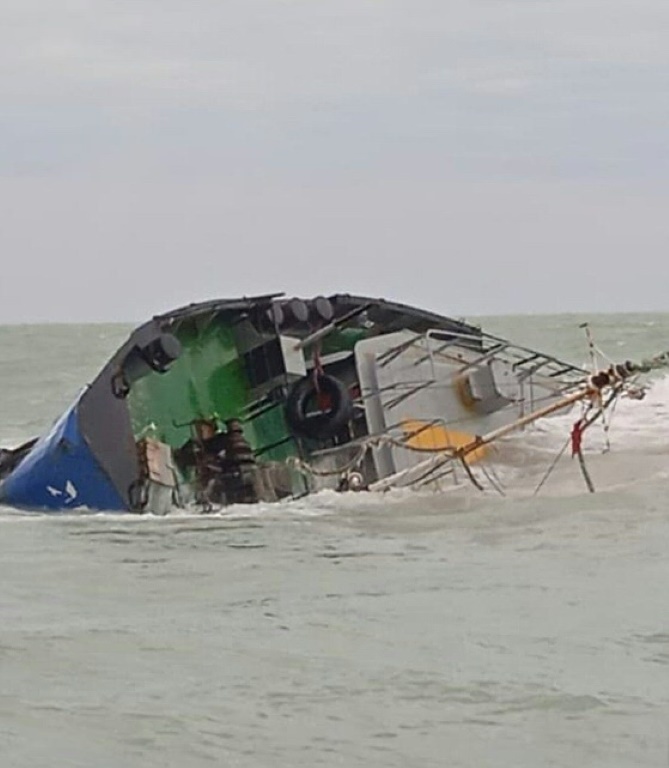
Divers who inspected the hull of a tanker loaded with 750 tonnes of fuel that sank off southeast Tunisia detected no leaks on Sunday, officials said.

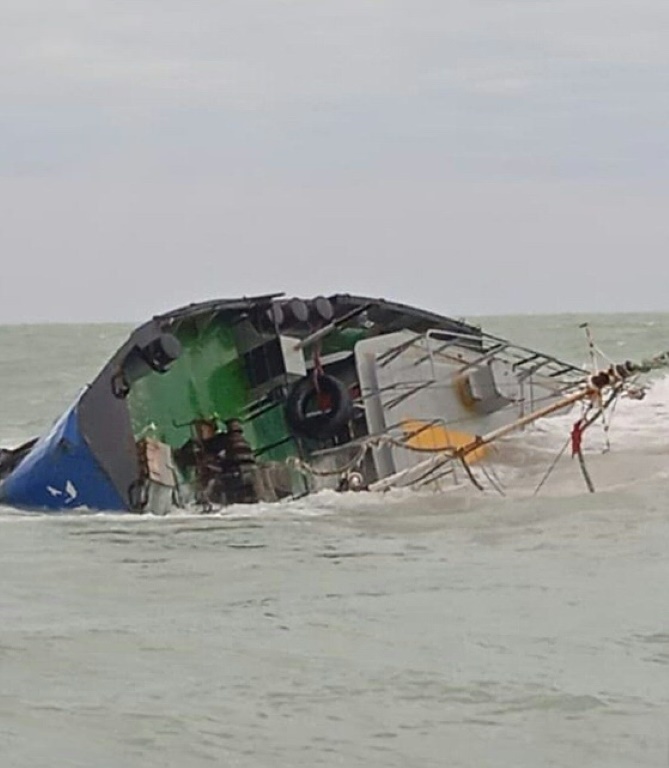
The Equatorial Guinea-flagged Xelo, which sank Saturday in the Gulf of Gabes, has settled on its side at a depth of almost 20 metres (65 feet), the environment ministry said.

“No leak has been detected,” it said in a statement.

The inspection was carried out by divers accompanied by the ship’s captain and engineer, said Mohamed Karray, spokesman for a court in Gabes city that is investigating the sinking.

The Xelo was travelling from Egypt to Malta when it went down.

With the scene sealed off by Tunisia’s military, the defence ministry released pictures showing the vessel submerged on its side.

The crew of the Xelo had issued a distress call on Friday evening and sought shelter in Tunisian waters from bad weather before going down.

Tunisian authorities rescued the seven-member crew, who received first aid and were moved to a hotel.

Transport Minister Rabie Majidi said Sunday that rescue workers had checked during the operation that the valves were closed, and the team of divers ensured they were sealed and intact.

“The situation is not dangerous, the outlook is positive, the ship is stable because luckily it ran aground on sand,” he told reporters.

The minister said the priority was to pump the diesel fuel and prevent any spillage or pollution.

An Italian ship specialised in cleaning up marine pollution will be sent alongside a team of divers to aid with efforts, an Italian official said.

As a precaution, protective booms have already been placed around the wreck.

Environment Minister Leila Chikhaoui has also been at the scene in the port of Gabes to follow up on the incident.

Tunisian officials are investigating the itinerary of the tanker, which reportedly has Turkish and Libyan owners.

The Tunisia branch of the World Wildlife Fund has expressed concern about another “environmental catastrophe” in the region, an important fishing zone.

The tanker is 58 metres (63 yards) long and nine metres wide, according to ship monitoring website vesseltracker.com.

It began taking on water around seven kilometres (four miles) offshore in the Gulf of Gabes and the engine room was engulfed, according to the environment ministry.

Israel government faces new split amid Jerusalem violence

Israel’s fractious governing coalition faced a new split on Sunday when Arab-Israeli party Raam “suspended” its membership, after violence around a flashpoint Jerusalem holy site that wounded 170 people over the weekend.

The government — an ideologically disparate mix of left-wing, hardline Jewish nationalist and religious parties, as well as Raam — had already lost its razor-thin majority this month when a religious Jewish member quit in a dispute over leavened bread distribution at hospitals.

Since then, days of violence around Jerusalem’s Al-Aqsa Mosque compound, sacred to both Muslims and Jews, put Raam under pressure to quit too. 

“If the government continues its steps against the people of Jerusalem… we will resign as a bloc,” Raam said in a statement.

The declaration came hours after more than 20 Palestinians and Israelis were wounded in incidents in and around the Al-Aqsa Mosque compound, known to Jews as the Temple Mount.

The latest clashes take the number of wounded since Friday to more than 170, at a tense time when the Jewish Passover festival coincides with the Muslim fasting month of Ramadan.

They also follow deadly violence in Israel and the occupied West Bank starting in late March, in which 36 people have been killed.

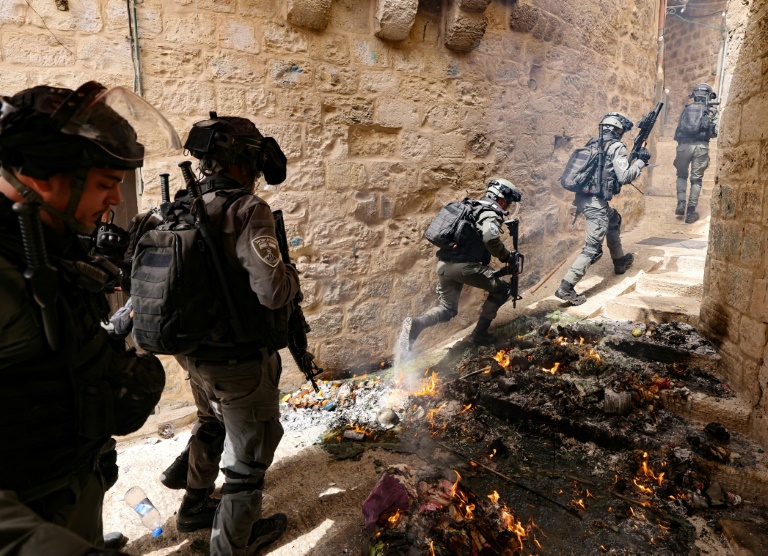
Early on Sunday morning, police said “hundreds” of Palestinian demonstrators inside the mosque compound started gathering piles of stones, shortly before the arrival of Jewish visitors.

Jews are allowed to visit but not to pray at the site, the holiest place in Judaism and third-holiest in Islam.

Israeli police said its forces had entered the compound in order to “remove” the demonstrators and “re-establish order”.

The Palestinian Red Crescent said 19 Palestinians were injured, including at least five who were hospitalised. It said some had been wounded with rubber-coated steel bullets.

– ‘Free hand’ –

An AFP team near the entrance to the compound early Sunday morning saw Jewish worshippers leaving the site, barefoot for religious reasons, and protected by heavily armed police.

Outside the Old City, which lies in Israeli-annexed east Jerusalem, Palestinian youths threw rocks at passing buses, smashing their windows, resulting in seven people being treated for light wounds, Shaare Zedek hospital said.

The police said they had arrested 18 Palestinians, and Public Security Minister Omer Bar-Lev said Israel would “act strongly against anyone who dares to use terrorism against Israeli citizens”.

Bennett had said that the security forces “continue to receive a free hand… for any action that will provide security to the citizens of Israel”, while stressing every effort should be made to allow members of all religions to worship in Jerusalem.

Political sources told AFP that, after Raam’s withdrawal from his coalition, Bennett would likely seek to calm the situation.

King Abdullah II of Jordan on Sunday called on Israel to “stop all illegal and provocative measures” that drive “further aggravation”.

The kingdom serves as custodian of holy places in east Jerusalem, which Israel captured in 1967 and later annexed in a move not recognised by most of the international community.

Senior Palestinian official Hussein Al Sheikh said Sunday that “Israel’s dangerous escalation in the Al-Aqsa compound … is a blatant attack on our holy places”, and called on the international community to intervene.

The chief of the Hamas Islamist movement, which controls the Palestinian enclave of Gaza, had earlier warned Israel that “Al-Aqsa is ours and ours alone”.

“Our people have the right to access it and pray in it, and we will not bow down to (Israeli) repression and terror,” Ismail Haniyeh said.

– Pope’s Easter peace prayer –

Weeks of mounting tensions saw two recent deadly attacks by Palestinians in or near the Israeli coastal city of Tel Aviv, alongside mass arrests by Israeli forces in the occupied West Bank.

A total of 14 people have been killed in attacks against Israel since March 22.

Twenty-two Palestinians have been killed over the same period, including assailants who targeted Israelis, according to an AFP tally.

On Friday morning, police clashed with Palestinians in the Al-Aqsa compound, including inside the Al-Aqsa Mosque, drawing strong condemnation from Muslim countries. Some 150 people were wounded during those clashes.

Turkish President Recep Tayyip Erdogan, in a call Sunday with Palestinian president Mahmud Abbas, said he would make contact with all sides to “end the Israeli escalation”, Abbas’s office said in a statement.

Pope Francis on Sunday — with Christians marking Easter at the Church of the Holy Sepulchre in Jerusalem, where they believe Jesus died and was resurrected — prayed for peace.

“May Israelis, Palestinians and all who dwell in the Holy City, together with the pilgrims… dwell in fraternity and enjoy free access to the Holy Places in mutual respect for the rights of each,” he said in his Easter address.

South Africa flood toll rises to 443 as deluge eases

The death toll from floods that have battered South Africa climbed above 440 on Sunday as abating rains allowed rescue operations to accelerate after one of the deadliest storms in living memory.

Torrential rains that started lashing the southeastern coastal region last weekend quickly triggered heavy floods and landslides that smashed into Durban city and surrounding areas, pulling with them buildings and people.

By Sunday 443 people, including two police emergency workers, had died from the raging floods.

Scientists warn that floods and other extreme weather events are becoming more powerful and frequent as the world gets warmer because of climate change.

At least 63 other people are still missing and feared dead after the floodwaters — the strongest to have struck KwaZulu-Natal in recent memory — engulfed the region, trashing the idyllic beaches with debris.

– Emotional prayers –

Amid the destruction, climbing temperatures and an overcast sky, survivors sought divine solace and temporary distraction from their misery while observing Easter Sunday.

Thulisile Mkhabela went to church, at a large white concrete building with a tiled roof ceiling — one of a few solid structures left standing by the raging floods that engulfed her Inanda township.

She recalled watching her house gradually collapse under the weight of the waters six days ago.

It started with the living room. “We took out whatever we could,” she said, and took the children to what was thought to be a secure outbuilding. 

As “soon as we took them out then the bedroom started collapsing”, she said.

The family then moved to an outbuilding, which had also been damaged but held together for the rest of the night.

That building has since collapsed and they are now “squatting” in her brother’s two-bedroom house where 12 people are crammed.

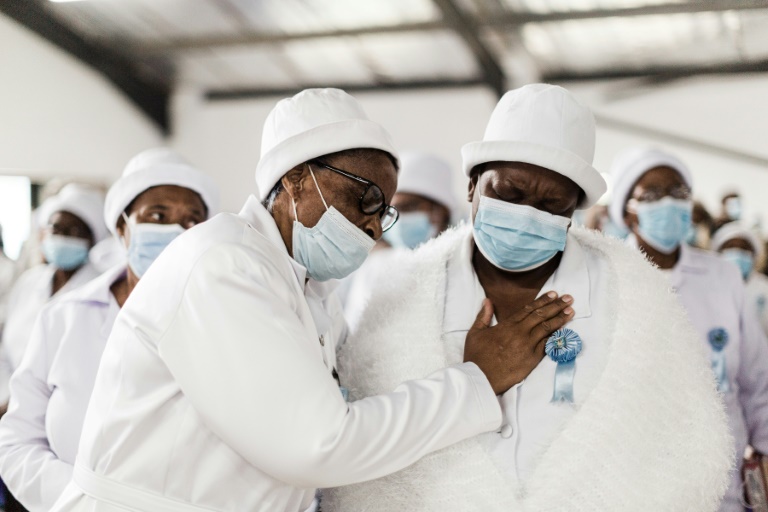
Worshippers at the United Congregational Church of Southern Africa raised hands as tears rolled down, while others fell to the ground during emotional prayers.

“The loss of life, destruction of homes, the damage to the physical infrastructure… make this natural disaster one of the worst ever in recorded history of our province,” said Sihle Zikalala, the premier of the KwaZulu-Natal province.

Rains were starting to let up on Sunday, allowing for search and relief aid operations to continue in and around Durban. 

The city of 3.5 million was overcast but the South African Weather Service said rainfall would have cleared by midweek.

But recovery operations and humanitarian relief continued in the economic hub and tourist magnet city, whose beaches and warm Indian Ocean waters would normally have been teeming with Easter holidaymakers.

The government, churches and charities were marshalling relief aid for the more than 40,000 people left homeless by the raging floodwaters.

The government has announced an immediate one billion rand ($68 million) in emergency relief funding. 

– Hospitals and schools destroyed –

Deputy Social Development Minister Hendrietta Bogopane-Zulu said some 340 social workers had been deployed to offer support to traumatised survivors, with many still missing children and other relatives.

Most casualties were in Durban, a port city and a major economic hub.

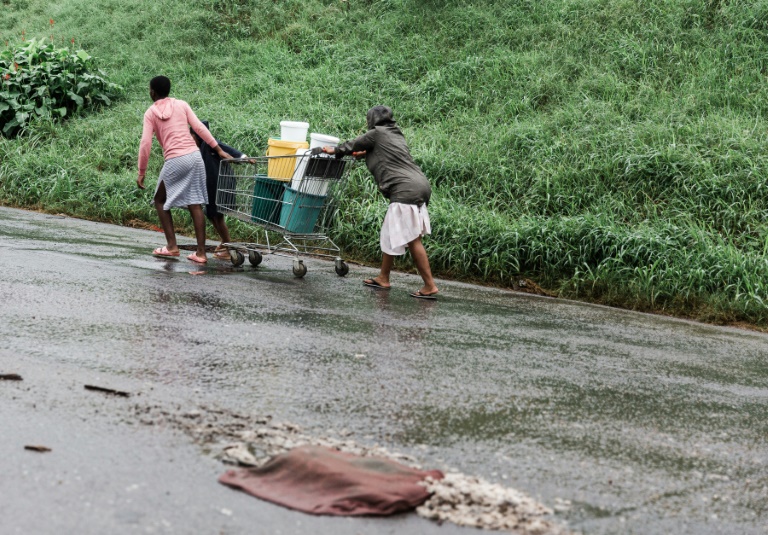
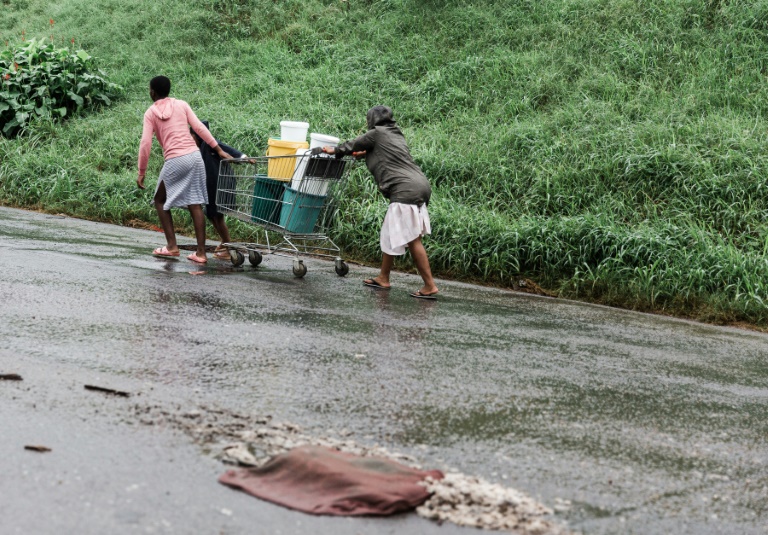
Parts of the city have been without water since Monday after floods ripped away infrastructure.

Scores of hospitals and more than 500 schools have been destroyed.

The intensity of the floods took South Africa, the most economically advanced African country, by surprise.

While the southeastern region has suffered some flooding before, the devastation has never been so severe. South Africans have previously watched similar tragedies hit neighbouring countries such as cyclone-prone Mozambique.

The country is still struggling to recover from the Covid pandemic and deadly riots last year that killed more than 350 people, mostly in the now flood-struck southeastern region.

South Africa flood toll rises to 443 as deluge eases

The death toll from floods that have battered South Africa climbed above 440 on Sunday as abating rains allowed rescue operations to accelerate after one of the deadliest storms in living memory.

Torrential rains that started lashing the southeastern coastal region last weekend quickly triggered heavy floods and landslides that smashed into Durban city and surrounding areas, pulling with them buildings and people.

By Sunday 443 people, including two police emergency workers, had died from the raging floods.

Scientists warn that floods and other extreme weather events are becoming more powerful and frequent as the world gets warmer because of climate change.

At least 63 other people are still missing and feared dead after the floodwaters — the strongest to have struck KwaZulu-Natal in recent memory — engulfed the region, trashing the idyllic beaches with debris.

– Emotional prayers –

Amid the destruction, climbing temperatures and an overcast sky, survivors sought divine solace and temporary distraction from their misery while observing Easter Sunday.

Thulisile Mkhabela went to church, at a large white concrete building with a tiled roof ceiling — one of a few solid structures left standing by the raging floods that engulfed her Inanda township.

She recalled watching her house gradually collapse under the weight of the waters six days ago.

It started with the living room. “We took out whatever we could,” she said, and took the children to what was thought to be a secure outbuilding. 

As “soon as we took them out then the bedroom started collapsing”, she said.

The family then moved to an outbuilding, which had also been damaged but held together for the rest of the night.

That building has since collapsed and they are now “squatting” in her brother’s two-bedroom house where 12 people are crammed.

Worshippers at the United Congregational Church of Southern Africa raised hands as tears rolled down, while others fell to the ground during emotional prayers.

“The loss of life, destruction of homes, the damage to the physical infrastructure… make this natural disaster one of the worst ever in recorded history of our province,” said Sihle Zikalala, the premier of the KwaZulu-Natal province.

Rains were starting to let up on Sunday, allowing for search and relief aid operations to continue in and around Durban. 

The city of 3.5 million was overcast but the South African Weather Service said rainfall would have cleared by midweek.

But recovery operations and humanitarian relief continued in the economic hub and tourist magnet city, whose beaches and warm Indian Ocean waters would normally have been teeming with Easter holidaymakers.

The government, churches and charities were marshalling relief aid for the more than 40,000 people left homeless by the raging floodwaters.

The government has announced an immediate one billion rand ($68 million) in emergency relief funding. 

– Hospitals and schools destroyed –

Deputy Social Development Minister Hendrietta Bogopane-Zulu said some 340 social workers had been deployed to offer support to traumatised survivors, with many still missing children and other relatives.

Most casualties were in Durban, a port city and a major economic hub.

Parts of the city have been without water since Monday after floods ripped away infrastructure.

Scores of hospitals and more than 500 schools have been destroyed.

The intensity of the floods took South Africa, the most economically advanced African country, by surprise.

While the southeastern region has suffered some flooding before, the devastation has never been so severe. South Africans have previously watched similar tragedies hit neighbouring countries such as cyclone-prone Mozambique.

The country is still struggling to recover from the Covid pandemic and deadly riots last year that killed more than 350 people, mostly in the now flood-struck southeastern region.

Ukraine vows to fight to the end in Mariupol as ultimatum expires

Ukraine on Sunday vowed to fight to the end in Mariupol after a Russian ultimatum expired for remaining forces to surrender in the Black Sea port city where Moscow is pushing for a major strategic victory.

“The city still has not fallen,” Prime Minister Denys Shmyhal said hours after Moscow’s deadline for fighters holed up and surrounded in a sprawling fortress-like steelworks to surrender passed.

“There’s still our military forces, our soldiers. So they will fight to the end,” he told ABC’s “This Week”.

Moscow has shifted its military focus to gaining control of the eastern Donbas region and forging a land corridor to already-annexed Crimea. 

Russia’s defence ministry said there were up to 400 mercenaries inside the encircled Azovstal steel plant, calling on Ukrainian forces inside to “lay down their arms and surrender in order to save their lives”. 

Moscow claims Kyiv has ordered fighters of the nationalist Azov battalion to “shoot on the spot” anyone wanting to surrender. 

– ‘Dead end’ –

Ukraine President Volodymyr Zelensky said if Russian forces killed the remaining troops defending the city, that would put a end to the peace talks.

Russian President Vladimir Putin has already said the talks are at a “dead end”.

Shmyhal said Ukraine wanted a diplomatic solution “if possible”, but they would fight to the end if necessary. “We will not surrender.”

While several cities are under siege, he said, not one — with the exception of Kherson in the south — had fallen, and more than 900 towns and cities had been liberated.

As Russia scales up attacks on Ukraine’s eastern flank, at least five people were killed and 20 wounded in a series of strikes in second city Kharkiv, just 21 kilometres (13 miles) from the Russian border.

Russian forces continued to shell the eastern Lugansk region and two people died in the town of Zolote, governor Sergiy Gaiday told Ukrainian media.

An air strike also hit an armaments factory in the capital Kyiv.

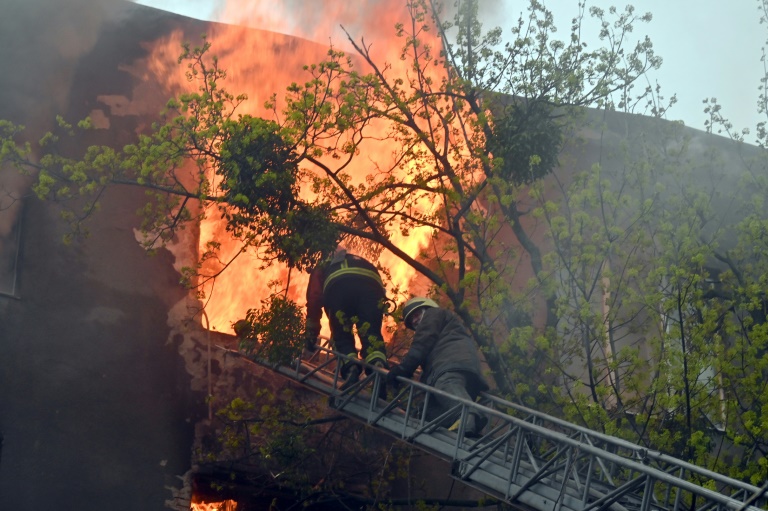
Maksym Khaustov, the head of the Kharkiv region’s health department, confirmed the deaths following a series of strikes that AFP journalists on the scene said had ignited fires throughout the city and torn roofs from buildings.

“The whole home rumbled and trembled,” 71-year-old Svitlana Pelelygina told AFP as she surveyed her wrecked apartment. “Everything here began to burn.”

“I called the firefighters. They said, ‘We are on our way but we were also being shelled.'”

– ‘Inhuman’ –

Ukrainian Deputy Prime Minister Iryna Vereshchuk urged Russian forces to let people flee besieged Mariupol.

“Once again, we demand the opening of a humanitarian corridor for the evacuation of civilians, especially women and children, from Mariupol,” Vereshchuk wrote.

Zelensky, describing the situation there as “inhuman”, called on the West to immediately provide heavy weapons.

Mariupol has become a symbol of Ukraine’s unexpectedly fierce resistance since Russian troops invaded the former Soviet state on February 24.

The UN World Food Programme says that more than 100,000 civilians there are on the verge of famine, and lacking water and heating.

Ukraine’s Minister of Digital Transformation Mykhailo Fedorov said the city was on “the verge of a humanitarian catastrophe”.

They were compiling evidence of alleged Russian atrocities there, he said. “We will hand everything over to The Hague. There will be no impunity.”

The mayor of Bucha — a town near Kyiv where the discovery of dead civilians sparked international condemnation and war crimes accusations — said Russian troops had raped men as well as women and children there.

Ukrainian authorities have urged people in the eastern Donbas area to move west to escape a large-scale Russian offensive to capture its composite regions, Donetsk and Lugansk.

Deputy Prime Minister Vereshchuk said humanitarian corridors allowing civilians to flee would not open on Sunday after failing to agree terms with Russian forces.

But Lugansk governor Gaiday said he had nevertheless proceeded with evacuations. “At our own peril and risk, we took out several dozen people anyway, but it’s already dangerous,” he told Ukrainian media.

– ‘Easter of war’ –

“May there be peace for war-torn Ukraine, so sorely tried by the violence and destruction of the cruel and senseless war into which it was dragged,” said Pope Francis as he celebrated Easter Sunday at the Vatican.

Francis said he held “in my heart all the many Ukrainian victims, the millions of refugees and internally displaced persons, the divided families, the elderly left to themselves, the lives broken and the cities razed to the ground.

“I see the faces of the orphaned children fleeing from the war.”

Zelensky said he had invited his French counterpart to visit Ukraine to see for himself evidence that Russian forces have committed “genocide”, a term President Emmanuel Macron has avoided.

“I talked to him yesterday,” Zelensky told CNN in an interview recorded on Friday but broadcast Sunday.

“I just told him I want him to understand that this is not war, but nothing other than genocide. I invited him to come when he will have the opportunity. He’ll come and see, and I’m sure he will understand.”

– ‘Unpredictable consequences’ –

Russia warned the United States this week of “unpredictable consequences” if it sent its “most sensitive” weapons systems to Ukraine, as Zelensky has requested.

Its defence ministry claimed Saturday to have shot down a Ukrainian transport plane in the Odessa region, carrying weapons supplied by Western nations.

On Sunday, spokesman Igor Konashenkov said Russian missiles had destroyed ammunition, fuel and lubricant depots in eastern Ukraine and 44 Ukrainian military facilities, including command posts.

Russian air defence systems shot down two Ukrainian MiG-29 aircraft in the Kharkiv region and a drone near the city of Pavlograd, he added.

burs-cjo/imm/jj

Divers find 'no leaks' from fuel-laden ship sunk off Tunisia

Divers who inspected the hull of a tanker loaded with 750 tonnes of fuel that sank off southeast Tunisia detected no leaks on Sunday, officials said.

The Equatorial Guinea-flagged Xelo, which sank Saturday in the Gulf of Gabes, has settled on its side at a depth of almost 20 metres (65 feet), the environment ministry said.

“No leak has been detected,” it said in a statement.

The inspection was carried out by divers accompanied by the ship’s captain and engineer, said Mohamed Karray, spokesman for a court in Gabes city that is investigating the sinking.

The Xelo was travelling from Egypt to Malta when it went down.

With the scene sealed off by Tunisia’s military, the defence ministry released pictures showing the vessel submerged on its side.

The crew of the Xelo had issued a distress call on Friday evening and sought shelter in Tunisian waters from bad weather before going down.

Tunisian authorities rescued the seven-member crew, who received first aid and were moved to a hotel.

Transport Minister Rabie Majidi said Sunday that rescue workers had checked during the operation that the valves were closed, and the team of divers ensured they were sealed and intact.

“The situation is not dangerous, the outlook is positive, the ship is stable because luckily it ran aground on sand,” he told reporters.

The minister said the priority was to pump the diesel fuel and prevent any spillage or pollution.

An Italian ship specialised in cleaning up marine pollution will be sent alongside a team of divers to aid with efforts, an Italian official said.

As a precaution, protective booms have already been placed around the wreck.

Environment Minister Leila Chikhaoui has also been at the scene in the port of Gabes to follow up on the incident.

Tunisian officials are investigating the itinerary of the tanker, which reportedly has Turkish and Libyan owners.

The Tunisia branch of the World Wildlife Fund has expressed concern about another “environmental catastrophe” in the region, an important fishing zone.

The tanker is 58 metres (63 yards) long and nine metres wide, according to ship monitoring website vesseltracker.com.

It began taking on water around seven kilometres (four miles) offshore in the Gulf of Gabes and the engine room was engulfed, according to the environment ministry.

Divers find 'no leaks' from fuel-laden ship sunk off Tunisia

Divers who inspected the hull of a tanker loaded with 750 tonnes of fuel that sank off southeast Tunisia detected no leaks on Sunday, officials said.

The Equatorial Guinea-flagged Xelo, which sank Saturday in the Gulf of Gabes, has settled on its side at a depth of almost 20 metres (65 feet), the environment ministry said.

“No leak has been detected,” it said in a statement.

The inspection was carried out by divers accompanied by the ship’s captain and engineer, said Mohamed Karray, spokesman for a court in Gabes city that is investigating the sinking.

The Xelo was travelling from Egypt to Malta when it went down.

With the scene sealed off by Tunisia’s military, the defence ministry released pictures showing the vessel submerged on its side.

The crew of the Xelo had issued a distress call on Friday evening and sought shelter in Tunisian waters from bad weather before going down.

Tunisian authorities rescued the seven-member crew, who received first aid and were moved to a hotel.

Transport Minister Rabie Majidi said Sunday that rescue workers had checked during the operation that the valves were closed, and the team of divers ensured they were sealed and intact.

“The situation is not dangerous, the outlook is positive, the ship is stable because luckily it ran aground on sand,” he told reporters.

The minister said the priority was to pump the diesel fuel and prevent any spillage or pollution.

An Italian ship specialised in cleaning up marine pollution will be sent alongside a team of divers to aid with efforts, an Italian official said.

As a precaution, protective booms have already been placed around the wreck.

Environment Minister Leila Chikhaoui has also been at the scene in the port of Gabes to follow up on the incident.

Tunisian officials are investigating the itinerary of the tanker, which reportedly has Turkish and Libyan owners.

The Tunisia branch of the World Wildlife Fund has expressed concern about another “environmental catastrophe” in the region, an important fishing zone.

The tanker is 58 metres (63 yards) long and nine metres wide, according to ship monitoring website vesseltracker.com.

It began taking on water around seven kilometres (four miles) offshore in the Gulf of Gabes and the engine room was engulfed, according to the environment ministry.

Flood-struck S.Africans seek Easter Sunday divine 'refuge'

As temperatures climbed and an overcast sky hung over a storm-ravaged township in eastern South Africa, survivors of the deadly floods sought divine solace observing Easter Sunday.

Inanda, a rural township 30 kilometres (19 miles) from the city of Durban’s central business district, was one of the areas devastated by heavy flooding that has killed 443 people and left more than 40,000 homeless.

On Sunday, around 200 Christian worshippers gathered at the United Congregational Church of Southern Africa for an Easter service.

The large white concrete church with a tiled roof ceiling is one of a few solid structures left standing by the raging floods that engulfed the city last week.

The warmer temperatures throughout the day, ranging between 15 and 20 degrees Celsius (59 and 68 degrees Fahrenheit), were much more reflective of Durban’s marketing slogan as “the warmest city to be”.

But that warmth was not enough to soothe the grieving and suffering survivors.

Thulisile Mkhabela said she was at church because she still had “hope” that her situation would change.

“I felt I should come here to take refuge in the lord… for comfort and to get that hope that we will go through this,” said Mkhabela, who returned home from her call centre job on Monday to find floodwater decimating the house she was renovating.

The house started collapsing from the living room.

“We were still awake so we took out whatever we could and took the children to the other house. (As) soon as we took them out then the bedroom started collapsing,” she said.

They moved to their outbuilding, which had also been damaged but held together for the rest of the night.

The outbuilding has since collapsed and they are now “squatting” in her brother’s two-bedroom house. 

– Hope and new beginnings –

“Now there is 12 of us in a two-bedroom house. My brother, his wife and their children in the one room and the rest of us in the other room,” said Mkhabela, wearing an orange jacket and a black dress.

Another congregant, Nokuthula Chili, had to evacuate her family from her home when floodwaters reached shoulder height on Monday night.

Floors and walls were cracked and all the furniture and electrical appliances were damaged. 

“What hurts the most is that I went through a lot of difficulties to build that house and seeing it collapse so easily, right in front of my eyes broke me. 

“I don’t know if I will have the means to rebuild,” she said, tears running down her cheeks.

Thankfully, Chili, her husband, four children and two grandchildren who were in the house escaped unhurt.

Easter Sunday marks the day Christians symbolically celebrate triumph over death.

For this small Christian community in Inanda, it marked a start of new beginning and a temporary distraction from the ruins around them.

Reverend Bhekubuhle Dlamini encouraged the congregants — most of them neatly dressed in white or cream tops and black skirts — to keep their faith in the face of the disaster.

The floods struck “so close to the Easter weekend — the weekend that begins with hopelessness and darkness before He (Jesus) rises on Sunday, which is today”, he said in his sermon.

“That gives us hope that after all the challenges we went through we will be able to rise up again even though our houses fell down, our infrastructure in ruins.”

As worshippers prayed some got emotional, raising their hands as tears rolled down, while others fell to the ground.

Chili’s faith remained unshaken.

“I don’t think there would be a better time for (the disaster) to happen than so close to the resurrection Sunday, a time meant for new beginnings,” she said.

Over 20 wounded in new Jerusalem violence

More than 20 Palestinians and Israelis were wounded on Sunday in several incidents in and around Jerusalem’s flashpoint Al-Aqsa Mosque compound, two days after major violence at the site.

The latest clashes take the number of wounded since Friday to more than 170, at a tense time when the Jewish Passover festival coincides with the Muslim fasting month of Ramadan.

They also follow deadly violence in Israel and the occupied West Bank starting in late March, in which 36 people have been killed.

Early on Sunday morning, police said “hundreds” of Palestinian demonstrators inside the mosque compound started gathering piles of stones, shortly before the arrival of Jewish visitors.

Jews are allowed to visit but not to pray at the site, also known as Temple Mount, the holiest place in Judaism and third-holiest in Islam.

Israeli police said its forces had entered the compound in order to “remove” the demonstrators and “re-establish order”.

The Palestinian Red Crescent said 19 Palestinians were wounded, including at least five who were hospitalised. It said some had been wounded with rubber-coated steel bullets.

– ‘Free hand’ –

An AFP team near the entrance to the compound early Sunday morning saw Jewish worshippers leaving the site, barefoot for religious reasons, and protected by heavily armed police.

Outside the Old City, which lies in Israeli-annexed east Jerusalem, Palestinian youths threw rocks at passing buses, smashing their windows, resulting in seven people being treated for light wounds, Shaare Zedek hospital said.

The police said they had arrested 18 Palestinians, and Public Security Minister Omer Bar-Lev said Israel would “act strongly against anyone who dares to use terrorism against Israeli citizens.”

Israeli Prime Minister Naftali Bennett said that the security forces “continue to receive a free hand… for any action that will provide security to the citizens of Israel”, while stressing every effort should be made to allow members of all religions to worship in Jerusalem.

King Abdullah II of Jordan — the kingdom serves as custodian of holy places in east Jerusalem, which Israel captured in 1967 and later annexed in a move not recognised by most of the international community — on Sunday called on Israel to “stop all illegal and provocative measures” that drives “further aggravation”.

Senior Palestinian official Hussein Al Sheikh said Sunday that “Israel’s dangerous escalation in the Al-Aqsa compound … is a blatant attack on our holy places”, and called on the international community to intervene.

The chief of the Hamas Islamist movement, which controls the Palestinian enclave of Gaza, had earlier warned Israel that “Al-Aqsa is ours and ours alone”.

“Our people have the right to access it and pray in it, and we will not bow down to (Israeli) repression and terror,” Ismail Haniyeh said in a statement.

The United Nations has called for calm, a year after clashes in and around the mosque compound escalated into an 11-day war between Israel and Palestinian militants in Gaza.

– Pope’s Easter peace prayer –

Weeks of mounting tensions saw two recent deadly attacks by Palestinians in or near the Israeli coastal city of Tel Aviv, alongside mass arrests by Israeli forces in the occupied West Bank.

A total of 14 people have been killed in attacks against Israel since March 22.

Twenty-two Palestinians have been killed over the same period, including assailants who targeted Israelis, according to an AFP tally.

On Friday morning, police clashed with Palestinians in the Al-Aqsa compound, including inside the Al-Aqsa mosque, drawing strong condemnation from Muslim countries. Some 150 people were wounded during those clashes.

Turkish President Recep Tayyip Erdogan, in a call Sunday with Palestinian president Mahmud Abbas, said he would make contact with all sides to “end the Israeli escalation”, Abbas’ office said in a statement.

Pope Francis on Sunday — with Christians marking Easter at the Church of the Holy Sepulchre in Jerusalem, where they believe Jesus died and was resurrected — prayed for peace.

“May Israelis, Palestinians and all who dwell in the Holy City, together with the pilgrims, experience the beauty of peace, dwell in fraternity and enjoy free access to the Holy Places in mutual respect for the rights of each,” he said in his Easter address.

Despite the tensions, hundreds of Christians staged a lively parade in Jerusalem, with processions led by marching bands with deafening drums and wailing bagpipes.

Close Bitnami banner
Bitnami