World

More than 150 hurt in Jerusalem clashes as religious festivals overlap

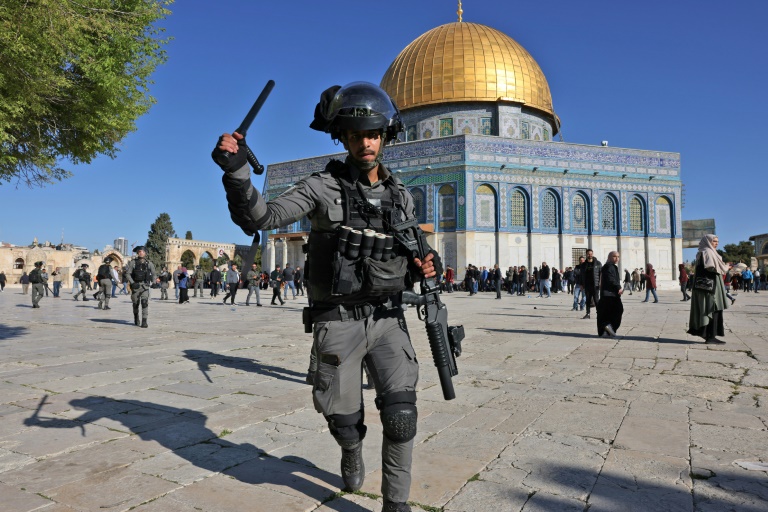
More than 150 people were wounded Friday in clashes between Palestinian demonstrators and Israeli police in Jerusalem’s Al-Aqsa mosque compound, the first face-off at the flashpoint holy site since the start of Ramadan.

Israeli police said dozens of masked men marched into Al-Aqsa setting off fireworks before crowds hurled stones towards the Western Wall — considered the holiest site where Jews can pray.

Witnesses said Palestinians threw stones at Israeli forces, who fired rubber-coated bullets and stun grenades.

The Palestinian Red Crescent said 153 people were hospitalised and “dozens” of others were treated at the scene. Israeli police said at least three officers were hurt.

Around 400 people were arrested, the Palestinian Prisoner’s Club said.

The clashes come after three weeks of deadly violence in Israel and the occupied West Bank, and as the Jewish festival of Passover and Christian Easter overlap with the Muslim holy month of Ramadan.

Al-Aqsa is Islam’s third-holiest site. Jews refer to it as the Temple Mount, referencing two temples said to have stood there in antiquity.

Last year during the Muslim fasting month, clashes that flared in Jerusalem, including between Israeli forces and Palestinians visiting Al-Aqsa, led to 11 days of devastating conflict between Israel and Hamas, the Islamist group that rules the Palestinian enclave of Gaza.

Israeli Foreign Minister Yair Lapid said Friday’s “riots” were “unacceptable”.

“The convergence of Passover, Ramadan and Easter is symbolic of what we have in common. We must not let anyone turn these holy days into a platform for hate, incitement and violence,” he said.    

UN Middle East peace envoy Tor Wennesland urged “the authorities on both sides to immediately de-escalate the situation and prevent any further provocations by radical actors”.

The US, European Union and the Arab League have also voiced their concern.

Washington on Friday said it was “deeply concerned” by the events in Jerusalem.

“We call on all sides to exercise restraint (and) avoid provocative actions and rhetoric,” State Department spokesman Ned Price said in a statement.

– ‘Red line’ –

Police said crowds had hurled rocks “in the direction of the Western Wall… and as the violence surged, police were forced to enter the grounds surrounding the mosque,” adding officers did not enter the mosque.

But Al-Aqsa mosque director Omar al-Kiswani told AFP that an “assault was made inside the Al-Aqsa mosque”.

“More than 80 young people inside the holy mosque were displaced,” he said, adding: “Al-Aqsa mosque is a red line”.

Before Ramadan, Israel and Jordan stepped up talks in an effort to avoid a repeat of last year’s violence.

Jordan serves as custodian of the mosque compound, while Israel controls access.

Hamas leader Ismail Haniyeh said there was “no place for the invaders and occupiers in our holy Jerusalem”.

Analysts say Hamas wants to keep the conflict alive in the West Bank and in Jerusalem but avoid escalation in the Gaza Strip after last year’s war, and with thousands of Gazans’ Israeli work permits at risk.

“Hamas does not want a new confrontation,” said Mukhaimer Abu Saada, professor of political science at Gaza’s Al-Azhar University.

An Israeli security source said the Islamic Jihad militant group — which controls neither the West Bank nor Gaza — would be more inclined towards an escalation with Israel.

The group warned “the confrontation will be closer and harder” for Israeli forces if “they do not stop the aggression against our people”.

Along with Hamas, Islamic Jihad mobilised thousands of people in Gaza on Friday in solidarity with Palestinians at Al-Aqsa, AFP correspondents reported.

– Spiralling violence –

Israel has poured additional forces into the West Bank and is reinforcing its wall and fence barrier after four deadly attacks in the Jewish state in the past three weeks.

A total of 14 people have been killed in the attacks since March 22, including a shooting spree in Bnei Brak, an Orthodox Jewish city in greater Tel Aviv.

Twenty-two Palestinians have been killed over the same period, including assailants who targeted Israelis, according to an AFP tally.

On Thursday, Israel announced it would block crossings from the West Bank and Gaza into Israel from Friday afternoon through Saturday, the first two nights of Passover week, and potentially keep the crossings closed for the rest of the holiday.

Prime Minister Naftali Bennett, who lost his parliamentary majority last week, has given Israeli forces a free hand to “defeat terror” in the West Bank, which Israel has occupied since the Six-Day War of 1967.

Some of the attacks in Israel were carried out by Arab citizens of Israel linked to or inspired by the Islamic State group, others by Palestinians, cheered by Hamas and Islamic Jihad.

Three Palestinians died Thursday as Israeli forces launched fresh raids into the West Bank district of Jenin, a week after a deadly gun attack against a Tel Aviv nightlife district. A fourth died of his wounds on Friday.
Twitter adopts 'poison pill' defense against Musk buyout bid

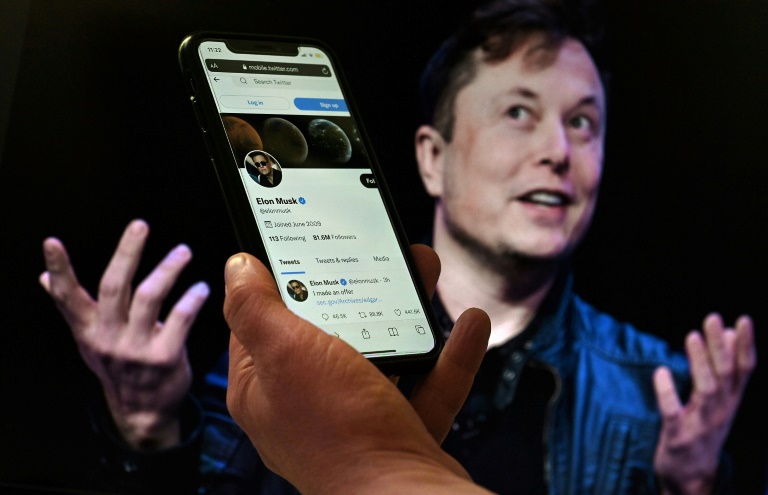
Twitter moved Friday to defend itself against Elon Musk’s $43 billion hostile takeover bid, announcing a “poison pill” plan that would make it harder for the billionaire to get a controlling stake.

Musk’s proposed buyout faces several hazards, including possible rejection and the challenge of assembling the money, but could have significant impacts on the key social media service if consummated.

Twitter said its board unanimously adopted a so-called shareholder rights plan, also known as a “poison pill,” which kicks in if an investor buys more than 15 percent in shares without the directors’ agreement. Musk holds nine percent.

The maneuver makes it harder for a buyer to build too big of a stake without board approval, by triggering an option that allows other investors to buy more of a company’s shares at a discount.

Twitter said the plan, which experts consider a potent tool against corporate raiders, does not prevent discussing or even agreeing to an acquisition.

Musk sent shockwaves through the tech world on Thursday with an unsolicited bid to buy the company, stating the promotion of freedom of speech on Twitter as a key motive for what he called his “best and final offer.”

The world’s richest person offered $54.20 a share, which values the social media firm at some $43 billion, in a filing with the Securities and Exchange Commission.

He has not directly addressed the poison pill, but tweeted after his bid was announced that the board would face “titanic” legal liability if it goes against the interests of shareholders in rejecting his offer.

Analyst Dan Ives predicted that the board’s move would “not be viewed positively by shareholders” given both the potential dilution of stock and the signal it sends of hostility towards being bought. He foresaw a “likely” court challenge.

Musk has already acknowledged he was “not sure” he would succeed and refused to elaborate on a “plan B,” though in the filing he noted a rejection would make him consider selling his existing shares.

He also said he “could technically afford” the buyout while offering no information on financing, though he would likely need to borrow money or part with some of his mountain of Tesla or SpaceX shares. 

– ‘Frightened’ by Musk ownership –

Some investors had already spoken against the proposal, including businessman and Saudi Prince Alwaleed bin Talal.

Morningstar Research analysts echoed that perspective, saying, “While the board will take the Tesla CEO’s offer into consideration, we believe the probability of Twitter accepting it is likely below 50 percent.”

Twitter stock closed down nearly two percent Thursday.

Musk’s move throws another curve into the roller-coaster ride of his volatile relationship with the global social media service, and raises many questions about what comes next.

He was offered a seat on the board but turned it down over the weekend.

Musk’s shock offer to buy Twitter drew worries — and some cheers — over putting the platform in the hands of a mercurial billionaire who advocates generally for few limits on what users can post.

He provided some detail Thursday on his vision, saying he’d like to lift the veil on the algorithm that runs on the platform, even allowing people to look through it and suggest changes.

He also reiterated his support for a more hands-off approach to policing the platform, a thorny matter particularly in high-profile cases such as Donald Trump who was banned after the assault on the US Capitol last year.

Critics argued that free speech absolutism on social media can be very messy in the real world.

“I am frightened by the impact on society and politics if Elon Musk acquires Twitter,” tweeted Max Boot, a Washington Post columnist, on Thursday.

“He seems to believe that on social media anything goes. For democracy to survive, we need more content moderation, not less,” Boot added.

Still Musk was rallying support on Twitter, where he has over 81 million followers, for the fight ahead.

“Thanks for the support!” he tweeted in reply to a poll that overwhelming backed his bid.

Twitter adopts 'poison pill' defense against Musk buyout bid

Twitter moved Friday to defend itself against Elon Musk’s $43 billion hostile takeover bid, announcing a “poison pill” plan that would make it harder for the billionaire to get a controlling stake.

Musk’s proposed buyout faces several hazards, including possible rejection and the challenge of assembling the money, but could have significant impacts on the key social media service if consummated.

Twitter said its board unanimously adopted a so-called shareholder rights plan, also known as a “poison pill,” which kicks in if an investor buys more than 15 percent in shares without the directors’ agreement. Musk holds nine percent.

The maneuver makes it harder for a buyer to build too big of a stake without board approval, by triggering an option that allows other investors to buy more of a company’s shares at a discount.

Twitter said the plan, which experts consider a potent tool against corporate raiders, does not prevent discussing or even agreeing to an acquisition.

Musk sent shockwaves through the tech world on Thursday with an unsolicited bid to buy the company, stating the promotion of freedom of speech on Twitter as a key motive for what he called his “best and final offer.”

The world’s richest person offered $54.20 a share, which values the social media firm at some $43 billion, in a filing with the Securities and Exchange Commission.

He has not directly addressed the poison pill, but tweeted after his bid was announced that the board would face “titanic” legal liability if it goes against the interests of shareholders in rejecting his offer.

Analyst Dan Ives predicted that the board’s move would “not be viewed positively by shareholders” given both the potential dilution of stock and the signal it sends of hostility towards being bought. He foresaw a “likely” court challenge.

Musk has already acknowledged he was “not sure” he would succeed and refused to elaborate on a “plan B,” though in the filing he noted a rejection would make him consider selling his existing shares.

He also said he “could technically afford” the buyout while offering no information on financing, though he would likely need to borrow money or part with some of his mountain of Tesla or SpaceX shares. 

– ‘Frightened’ by Musk ownership –

Some investors had already spoken against the proposal, including businessman and Saudi Prince Alwaleed bin Talal.

Morningstar Research analysts echoed that perspective, saying, “While the board will take the Tesla CEO’s offer into consideration, we believe the probability of Twitter accepting it is likely below 50 percent.”

Twitter stock closed down nearly two percent Thursday.

Musk’s move throws another curve into the roller-coaster ride of his volatile relationship with the global social media service, and raises many questions about what comes next.

He was offered a seat on the board but turned it down over the weekend.

Musk’s shock offer to buy Twitter drew worries — and some cheers — over putting the platform in the hands of a mercurial billionaire who advocates generally for few limits on what users can post.

He provided some detail Thursday on his vision, saying he’d like to lift the veil on the algorithm that runs on the platform, even allowing people to look through it and suggest changes.

He also reiterated his support for a more hands-off approach to policing the platform, a thorny matter particularly in high-profile cases such as Donald Trump who was banned after the assault on the US Capitol last year.

Critics argued that free speech absolutism on social media can be very messy in the real world.

“I am frightened by the impact on society and politics if Elon Musk acquires Twitter,” tweeted Max Boot, a Washington Post columnist, on Thursday.

“He seems to believe that on social media anything goes. For democracy to survive, we need more content moderation, not less,” Boot added.

Still Musk was rallying support on Twitter, where he has over 81 million followers, for the fight ahead.

“Thanks for the support!” he tweeted in reply to a poll that overwhelming backed his bid.

Twitter adopts 'poison pill' defense against Musk buyout bid

Twitter moved Friday to defend itself against Elon Musk’s $43 billion hostile takeover bid, announcing a “poison pill” plan that would make it harder for the billionaire to get a controlling stake.

Musk’s proposed buyout faces several hazards, including possible rejection and the challenge of assembling the money, but could have significant impacts on the key social media service if consummated.

Twitter said its board unanimously adopted a so-called shareholder rights plan, also known as a “poison pill,” as the struggle for control of the social media platform intensified.

The maneuver makes it harder for a buyer to build too big of a stake without board approval, by triggering an option that allows other investors to buy more of a company’s shares at a discount.

Musk sent shockwaves through the tech world on Thursday with an unsolicited bid to buy the company, stating the promotion of freedom of speech on Twitter as a key motive for what he called his “best and final offer.”

The world’s richest person offered $54.20 a share, which values the social media firm at some $43 billion, in a filing with the Securities and Exchange Commission.

He has not yet reacted to the poison pill, but tweeted after his bid was announced that the board would face “titanic” legal liability if it goes against the interests of shareholders in rejecting his offer.

The board’s “rights plan” kicks in if a buyer takes 15 percent or more of Twitter’s outstanding common stock in a transaction not approved by the board — Musk holds nine percent.

Analyst Dan Ives predicted that the board’s move would “not be viewed positively by shareholders” given both the potential dilution of stock and the signal it sends of hostility towards being bought. He foresaw a “likely” court challenge.

Musk has already acknowledged he was “not sure” he would succeed and refused to elaborate on a “plan B,” though in the filing he noted a rejection would make him consider selling his existing shares.

He also said he “could technically afford” the buyout while offering no information on financing, though he would likely need to borrow money or part with some of his mountain of Tesla or SpaceX shares. 

– ‘Frightened’ by Musk ownership –

Despite saying he wanted to take the company private, he said the firm would keep up to 2,000 investors — the maximum allowed.

Some investors had already spoken against the proposal, including businessman and Saudi Prince Alwaleed bin Talal.

Morningstar Research analysts echoed that perspective, saying, “While the board will take the Tesla CEO’s offer into consideration, we believe the probability of Twitter accepting it is likely below 50 percent.”

Twitter stock closed down nearly two percent Thursday.

Musk’s move throws another curve into the roller-coaster ride of his volatile relationship with the global social media service, and raises many questions about what comes next.

He was offered a seat on the board but turned it down over the weekend.

Musk’s shock offer to buy Twitter drew worries — and some cheers — over putting the platform in the hands of a mercurial billionaire who advocates generally for few limits on what users can post.

He provided some detail Thursday on his vision, saying he’d like to lift the veil on the algorithm that runs on the platform, even allowing people to look through it and suggest changes.

He also reiterated his support for a more hands-off approach to policing the platform, a thorny matter particularly in high-profile cases such as Donald Trump who was banned after the assault on the US Capitol last year.

Critics argued that free speech absolutism on social media can be very messy in the real world.

“I am frightened by the impact on society and politics if Elon Musk acquires Twitter,” tweeted Max Boot, a Washington Post columnist, on Thursday.

“He seems to believe that on social media anything goes. For democracy to survive, we need more content moderation, not less,” Boot added.

Twitter adopts 'poison pill' defense against Musk buyout bid

Twitter moved Friday to defend itself against Elon Musk’s $43 billion hostile takeover bid, announcing a “poison pill” plan that would make it harder for the billionaire to get a controlling stake.

Musk’s proposed buyout faces several hazards, including possible rejection and the challenge of assembling the money, but could have significant impacts on the key social media service if consummated.

Twitter said its board unanimously adopted a so-called shareholder rights plan, also known as a “poison pill,” as the struggle for control of the social media platform intensified.

The maneuver makes it harder for a buyer to build too big of a stake without board approval, by triggering an option that allows other investors to buy more of a company’s shares at a discount.

Musk sent shockwaves through the tech world on Thursday with an unsolicited bid to buy the company, stating the promotion of freedom of speech on Twitter as a key motive for what he called his “best and final offer.”

The world’s richest person offered $54.20 a share, which values the social media firm at some $43 billion, in a filing with the Securities and Exchange Commission.

He has not yet reacted to the poison pill, but tweeted after his bid was announced that the board would face “titanic” legal liability if it goes against the interests of shareholders in rejecting his offer.

The board’s “rights plan” kicks in if a buyer takes 15 percent or more of Twitter’s outstanding common stock in a transaction not approved by the board — Musk holds nine percent.

Analyst Dan Ives predicted that the board’s move would “not be viewed positively by shareholders” given both the potential dilution of stock and the signal it sends of hostility towards being bought. He foresaw a “likely” court challenge.

Musk has already acknowledged he was “not sure” he would succeed and refused to elaborate on a “plan B,” though in the filing he noted a rejection would make him consider selling his existing shares.

He also said he “could technically afford” the buyout while offering no information on financing, though he would likely need to borrow money or part with some of his mountain of Tesla or SpaceX shares. 

– ‘Frightened’ by Musk ownership –

Despite saying he wanted to take the company private, he said the firm would keep up to 2,000 investors — the maximum allowed.

Some investors had already spoken against the proposal, including businessman and Saudi Prince Alwaleed bin Talal.

Morningstar Research analysts echoed that perspective, saying, “While the board will take the Tesla CEO’s offer into consideration, we believe the probability of Twitter accepting it is likely below 50 percent.”

Twitter stock closed down nearly two percent Thursday.

Musk’s move throws another curve into the roller-coaster ride of his volatile relationship with the global social media service, and raises many questions about what comes next.

He was offered a seat on the board but turned it down over the weekend.

Musk’s shock offer to buy Twitter drew worries — and some cheers — over putting the platform in the hands of a mercurial billionaire who advocates generally for few limits on what users can post.

He provided some detail Thursday on his vision, saying he’d like to lift the veil on the algorithm that runs on the platform, even allowing people to look through it and suggest changes.

He also reiterated his support for a more hands-off approach to policing the platform, a thorny matter particularly in high-profile cases such as Donald Trump who was banned after the assault on the US Capitol last year.

Critics argued that free speech absolutism on social media can be very messy in the real world.

“I am frightened by the impact on society and politics if Elon Musk acquires Twitter,” tweeted Max Boot, a Washington Post columnist, on Thursday.

“He seems to believe that on social media anything goes. For democracy to survive, we need more content moderation, not less,” Boot added.

Three months after oil spill, Peru fishermen remain without work

Three months after an oil spill that polluted beaches and killed wildlife in Peru, hundreds of fishermen remain out of work as Easter approaches.

“We never imagined spending such a sad Holy Week because normally people eat fish at this time,” Anthony Chumpitaz, president of a local traditional fishermen association, told AFP.

Almost 12,000 barrels of crude spilled into the sea off Peru on January 15 as a tanker unloaded oil at a refinery owned by Spanish energy giant Repsol in Ventanilla, some 30 kilometers (20 miles) north of Lima.

Carried by ocean currents, the oil spread some 140 kilometers northwards, killing hundreds of sea birds and forcing fishermen to abandon their work due to pollution described as an ecological disaster by the government.

At least 5,000 traditional fishermen and traders in Lima and the neighboring province of Huaral have been affected by the spill, according to the government.

Many fish and seafood restaurants have been forced to close.

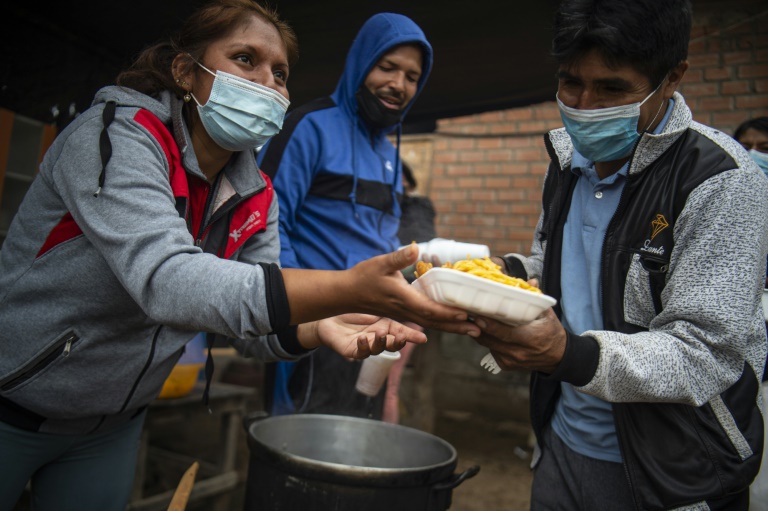
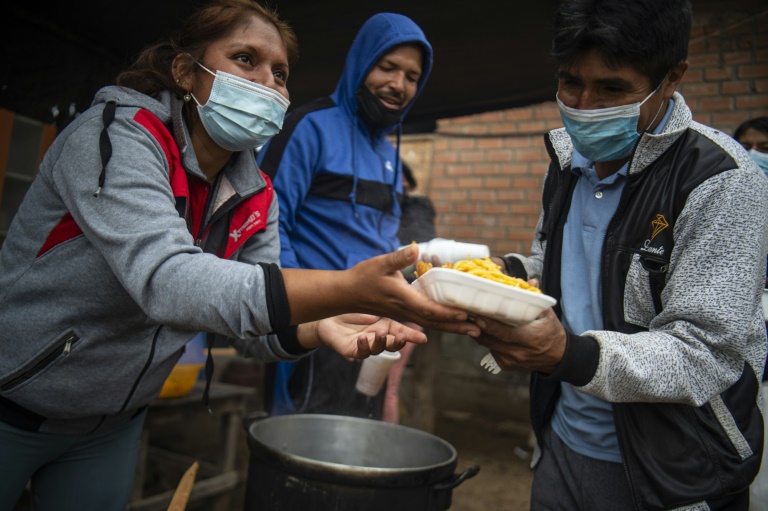
“I feel outraged. I have no work. We weren’t ready for this spill,” Rocio Alonzo Espinar, 30, a fish merchant in Ventanilla, told AFP as he cooked noodles with canned tuna at a soup kitchen.

Several soup kitchens have sprung up in the area since the spill.

Repsol, which blamed the spill on a volcanic eruption 10,000 kilometers away near Tonga in the Pacific, has agreed to pay fishermen and shopkeepers compensation.

Chumpitaz says those affected have so far only received a payment of 500 soles ($125) in January plus another advance payment of 3,000 soles.

There has still been no agreement on the total compensation to be paid to individuals.

“The cost of living is increasing and that’s affecting us a lot,” said Chumpitaz from the Cavero beach in Ventanilla, where several Repsol employees continue to clean up and decontaminate the area.

At the end of March, the Spanish company said it had cleaned up 95 percent of the coastal and maritime areas suffering from pollution.

Repsol denies responsibility for the spill and has made a claim against the Italian owner of the tanker involved in the accident.

Peruvian authorities have ordered the Mare Doricum tanker to remain anchored off its coast for the duration of the investigation into the disaster.

Eight directors of Repsol Peru, including its Spanish president Jaime Fernandez-Cuesta Luca de Tena, are under investigation and have been barred from leaving the country for 18 months.

Peru’s environmental evaluation and control body has hit Repsol with five fines for a total of $620,000.

The environment ministry says at least 500 hectares of protected marine reserve have been affected by the spill.

Three months after oil spill, Peru fishermen remain without work

Three months after an oil spill that polluted beaches and killed wildlife in Peru, hundreds of fishermen remain out of work as Easter approaches.

“We never imagined spending such a sad Holy Week because normally people eat fish at this time,” Anthony Chumpitaz, president of a local traditional fishermen association, told AFP.

Almost 12,000 barrels of crude spilled into the sea off Peru on January 15 as a tanker unloaded oil at a refinery owned by Spanish energy giant Repsol in Ventanilla, some 30 kilometers (20 miles) north of Lima.

Carried by ocean currents, the oil spread some 140 kilometers northwards, killing hundreds of sea birds and forcing fishermen to abandon their work due to pollution described as an ecological disaster by the government.

At least 5,000 traditional fishermen and traders in Lima and the neighboring province of Huaral have been affected by the spill, according to the government.

Many fish and seafood restaurants have been forced to close.

“I feel outraged. I have no work. We weren’t ready for this spill,” Rocio Alonzo Espinar, 30, a fish merchant in Ventanilla, told AFP as he cooked noodles with canned tuna at a soup kitchen.

Several soup kitchens have sprung up in the area since the spill.

Repsol, which blamed the spill on a volcanic eruption 10,000 kilometers away near Tonga in the Pacific, has agreed to pay fishermen and shopkeepers compensation.

Chumpitaz says those affected have so far only received a payment of 500 soles ($125) in January plus another advance payment of 3,000 soles.

There has still been no agreement on the total compensation to be paid to individuals.

“The cost of living is increasing and that’s affecting us a lot,” said Chumpitaz from the Cavero beach in Ventanilla, where several Repsol employees continue to clean up and decontaminate the area.

At the end of March, the Spanish company said it had cleaned up 95 percent of the coastal and maritime areas suffering from pollution.

Repsol denies responsibility for the spill and has made a claim against the Italian owner of the tanker involved in the accident.

Peruvian authorities have ordered the Mare Doricum tanker to remain anchored off its coast for the duration of the investigation into the disaster.

Eight directors of Repsol Peru, including its Spanish president Jaime Fernandez-Cuesta Luca de Tena, are under investigation and have been barred from leaving the country for 18 months.

Peru’s environmental evaluation and control body has hit Repsol with five fines for a total of $620,000.

The environment ministry says at least 500 hectares of protected marine reserve have been affected by the spill.

Russian warship stamp becomes collector's item in Ukraine

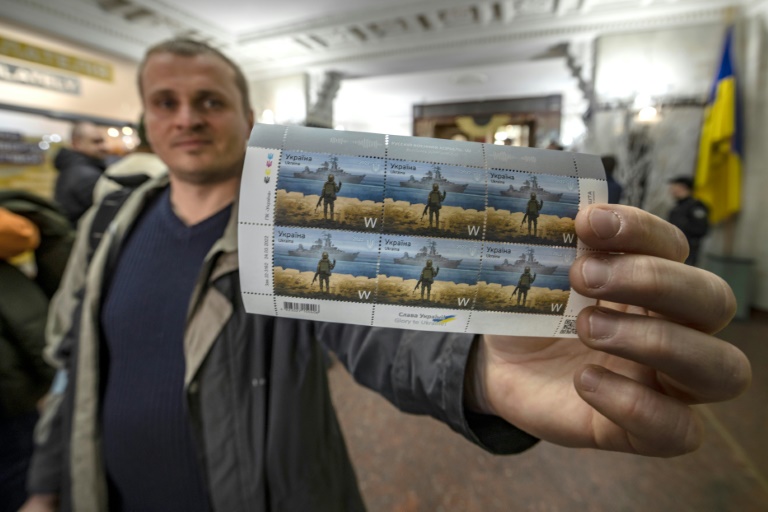
A stamp depicting a Ukrainian soldier making an obscene hand gesture at the Russian Black Sea flagship Moskva has become a collector’s item for Ukrainians who see it as a sign of “victory”.

At the central post office in the capital Kyiv, hundreds of Ukrainians of every age could be seen queueing for hours on Friday to get their hands on one of the one million copies printed so far.

“That ship was the biggest one they had…. They gambled a lot on it and we destroyed it!” said Yury Kolesan, 22, who waited for two-and-a-half hours to get a set of 30 stamps.

“It’s a new phase of the war, one of victory!”

The warship sank on Thursday after an explosion and fire that Ukraine claimed was caused by a missile strike — while Russia said the damage was caused by an explosion of munitions on board.

The missile cruiser gained notoriety in the early stages of Russia’s invasion of Ukraine when its crew called on a unit of Ukrainian border guards to surrender, only for them to defiantly refuse.

The incident quickly became a symbol of Ukraine’s resistance against Russia’s assault.

Ukraine’s postal service last month launched a competition to illustrate the episode.

Out of more than 500 submissions, Lviv designer Boris Groh’s winning entry shows a Ukrainian soldier from behind swearing at the warship.

It has proved a hit, selling out in many post offices and quickly appearing for resale online.

“We wanted to print more but the bombing last night in Kyiv affected the work of the factory and we did not manage to print the necessary quantity,” Ukrainian postal service Igor Smelyansky told AFP.

'My daughter, my sisters': S.Africa flood survivor mourns lost family

Staring at the mound of mud where a house once stood, flood survivor Mluleki Hlophe is in a state of disbelief.

“I’m still shocked and I still don’t believe… my daughter and my sister, my young sisters, my nephews. I still don’t believe,” he says.

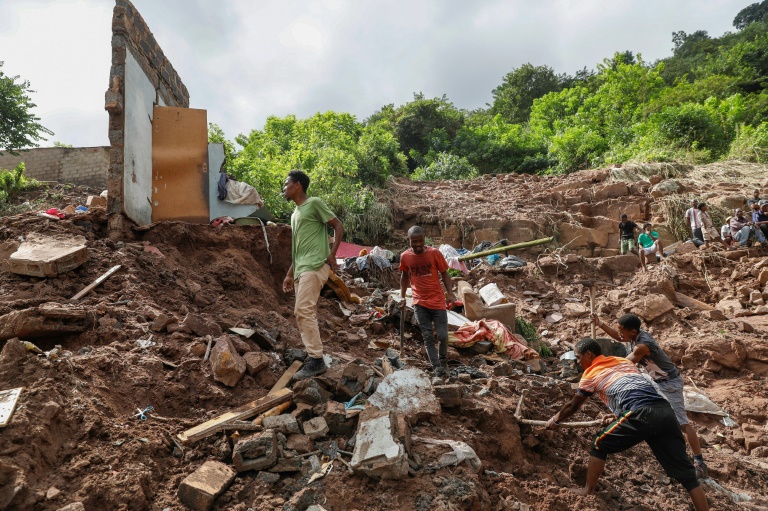
More than a dozen South African rescue workers on Friday painstakingly combed through a lush green valley where 10 people from Hlophe’s family have been missing for five days since violent floods tore through Durban city, killing 395 people.

The 32-year-old survivor and other men from the KwaNdengezi township outside Durban have been helping search crews dig through the mud. 

Only the body of Hlophe’s mother has been found in the river after the storm cleared.

An officer warns him that the sandy soil will make it harder for the dogs to trace the scent of any other bodies.

Others believe the bodies have most likely been swept away by the swollen river.

Divers search the dirty waters of the river while the dogs unit scours the floodplain.

But after four hours’ searching they find nothing.

– ‘Many people are lost’ –

All along the river, families approach the search teams, begging them to let the dogs try to find their missing loved ones.

Police “didn’t answer our calls and if they did answer, they said there is no help for now because there are many people that are lost”, says Sinenhlanhla Menela, 30, whose sister, 26, and two-year-old nephew are missing.

The head of the search team explains to desperate residents that their resources have been stretched to the limit by the disaster.

With more rain forecast this weekend, any further flooding or mudslides could further hinder efforts to recover more bodies.

Officials have described the heavy rains that hit the southeastern coastal province of KwaZulu-Natal as one of the worst weather disasters in the country’s history. 

Dozens of people are still missing.

Police, military and volunteer rescuers have joined forces to respond to the endless stream of calls for help.

“Even with everybody pulling together, the devastation is so vast, we’re very sparsely spread out,” said Travis Trower, director for the volunteer-run organisation Rescue South Africa.

A woman in her late twenties, Hlophe’s sister, was the only survivor from the landslide that swept way the family home. 

She had gone to check on an uncle next door, whose house was closer to the river, when the larger homestead was swept away in front of her, Hlophe says. Her one-year-old son was among those lost.

“I don’t even believe anymore that God is here. Because why would he allow us to feel this much pain?” says Mesuli Shandu, 20, a close relative of the family, looking down at the devastated hillside spot where generations of the same family had lived.

“It’s better that we know that this is someone’s grave. Maybe we’ll be able to move on, accept it, because it’s very hard to deal with this,” she says, fighting back tears.

Macron clashes with Le Pen over Islamic headscarf ban

President Emmanuel Macron has clashed with his rival Marine Le Pen over her plan to ban women from wearing the Islamic headscarf in public, with an eye on the votes of Muslims in the second round of elections.

Le Pen on April 24 will seek to cause the greatest upset in modern French political history by defeating Macron in a run-off in presidential elections.

While polls indicate Macron is ahead, they also point to a far tighter race between the centrist and the far-right leader than in their 2017 run-off.

Analysts say one reason for her advance is Le Pen’s success in cultivating a more moderate image and portraying herself as the candidate best equipped to deal with problems like rising prices.

But one signature hard-line policy the anti-immigration Le Pen has not dropped is her opposition to the Islamic headscarf, saying women who wear the hijab in public in France will be fined if she wins power.

Macron meanwhile has sought to seize on her insistence to argue that Le Pen’s policies are no different from those of the hard-line National Front (FN) founded by her father Jean-Marie.

He has also presented himself as a defender of religious freedom, insisting that any ban on the veil would constitutionally mean that all religious signs must be banned including the kippa and the cross.

– ‘You want to be the first?’ –

Visiting the eastern city of Strasbourg on Tuesday, Macron during a walkabout to meet voters asked a veiled women if she was wearing the headscarf by choice or obligation.

“It’s by choice. Totally by choice!” said the woman, who proudly declared she was a feminist.

Macron replied, in clear reference to Le Pen’s plan: “This is the best response to the rubbish that I have been hearing.”

He went even further on Thursday during a visit to the northern port city of Le Havre: “There is not a single country in the world that bans the headscarf in public. Do you want to be the first?”

Macron is clearly aware of the importance of the votes of France’s roughly five million Muslims, who are estimated to make up almost nine percent of the population. 

According to a survey by the Ifop pollster, 69 percent of Muslim voters in the first round of the election opted for third-placed candidate Jean-Luc Melenchon.

Wooing the Melenchon vote is seen as crucial for Macron to be assured of victory in round two.

Macron has in the past himself run into controversy from Muslims and leaders of Islamic countries over his tough stance over what the government calls radical Islamism.

After a spate of attacks in late 2020 blamed on radical Islamists, the president railed against what he called “Islamist separatism” in France and forced through a series of measures to limit its spread.

But two Muslim groups on Friday, the Grand Mosque of Paris and Rally of French Muslims, called on voters to choose Macron in the second round.

“Malicious forces today come out and call for the banishment of Muslims,” the rector of the Grand Mosque, Chems-Eddine Hafiz, said in a statement. 

“Let’s vote for Emmanuel Macron,” he added.

– ‘It’s not true’ –

Le Pen has said that wearing the Islamic headscarf in public in France should be an offence punishable by a fine issued by the police, like a traffic infraction. 

The debate also goes to the heart of candidates portraying themselves as champions of the French principle of secularism, where religion and state are separate.

“The headscarf has been imposed by Islamists,” Le Pen told BFM TV in an interview on Friday describing it as a “uniform”.

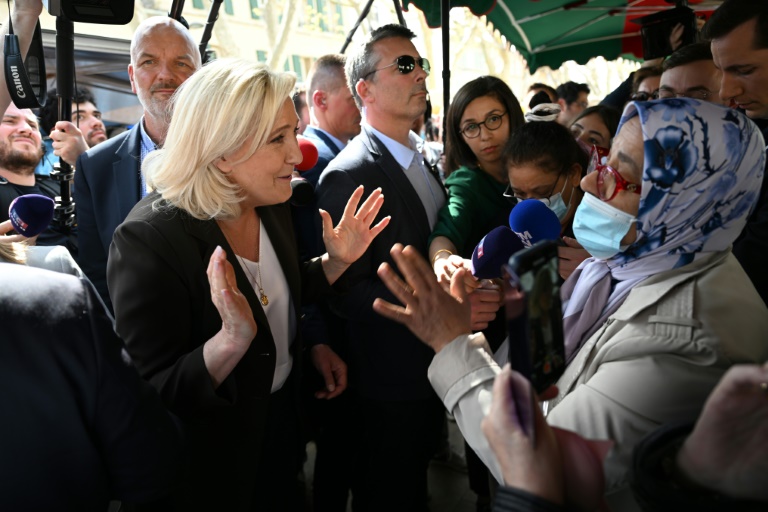
In an uncomfortable exchange, Le Pen on Friday found herself cornered by a Muslim woman wearing a headscarf during a visit to the town of Pertuis in the south of France.

Le Pen claimed that in “some areas” in France, women who do not wear the headscarf are “isolated and judged”.

“It’s not true. It’s not true,” said the woman, laughing incredulously and saying her father had fought for France in the army for 15 years.

After further argument, Le Pen then waved cheerily and breezily ended the exchange.

Even within her own camp, the hard-line stance has caused controversy.

“It’s an error,” said Robert Menard, mayor of the town of Beziers and a supporter of Le Pen in the second round. “It’s not possible to put in place.”

Close Bitnami banner
Bitnami